My review of Marf: City Blues, an exhibition at the Guildhall Art Gallery, appears in the Independent.
The Guildhall in the City is an appropriate venue for a series of cartoons about the financial crisis of 2008 and its aftermath. Marf is Canadian, but her cartoons are all set in London, and the Gherkin, St Paul’s and the tube all make appearances. The exhibition is on until June 20.
The Guildhall has recently become a free venue, which is slightly contrary to current trends, but the City of London has always done things a bit differently. It has a wonderful collection of London-related paintings, and is definitely worth a visit, and there are also plans to host regular paid-for temporary exhibitions. Marf, however, is free. The intention is that local workers, who are overwhelmingly from the financial services, will come to the gallery in their lunchtime to nose around.
I wonder what they will make of cartoons like the following when they do? Water off a duck’s back, probably.
A quick post on maps. I have a small piece in the Independent about the Museum of London and Londonist’s forthcoming collaboration, Hand-Drawn London. This exhibition, opening on April 21, features maps drawn by Londoners.
I submitted a map drawn by four-year-old daughter of her daily walk to nursery, but it was harshly rejected. I have reproduced it here.
When Mohamed ‘Al’ Fayed unveiled an extraordinary tribute to Michael Jackson at Craven Cottage, seasoned statue-watchers found themselves embroiled in a furious debate. Was this London’s worst statue?
And then there are these: London’s statues of shame.
7. Peter The Great in Deptford Because it is silly.
6 Queen Victoria at Buckingham Palace Pompous and bloated.
5 Charles II at Soho Square
For its condition as much as its, er, execution. But even if this wasn’t horribly weathered, I reckon it would look a bit shit.
4 Oscar Wilde at Charing Cross Disturbing. Like somebody tried to find the face of Jesus in a puddle of vomit.
3 Nelson Mandela at Parliament Square
I know, let’s imagine one of the great icons of the modern era, as if he was a THUNDERBIRDS PUPPET!
2. Horse’s head at Marble Arch Stupid. Not to be confused with the almost as ridiculous Animals at War statue down the road on Park Lane.
1 The Meeting Place at St Pancras Widely acclaimed as the worst statue in London, this monstrosity was brought to you by the same person responsible for the hideously smug Queen Mother statue on the Mall.
For a forensic analysis of this statue and its faults, I point you towards Christopher Fowler‘s excellent critique of its numerous deficencies.
But the question remains: is Jacko worse than this?
The V&A’s Cult of Beauty exhibition opened over the weeked. You can read my feature on the Aesthetic movement in the Independent on Sunday.
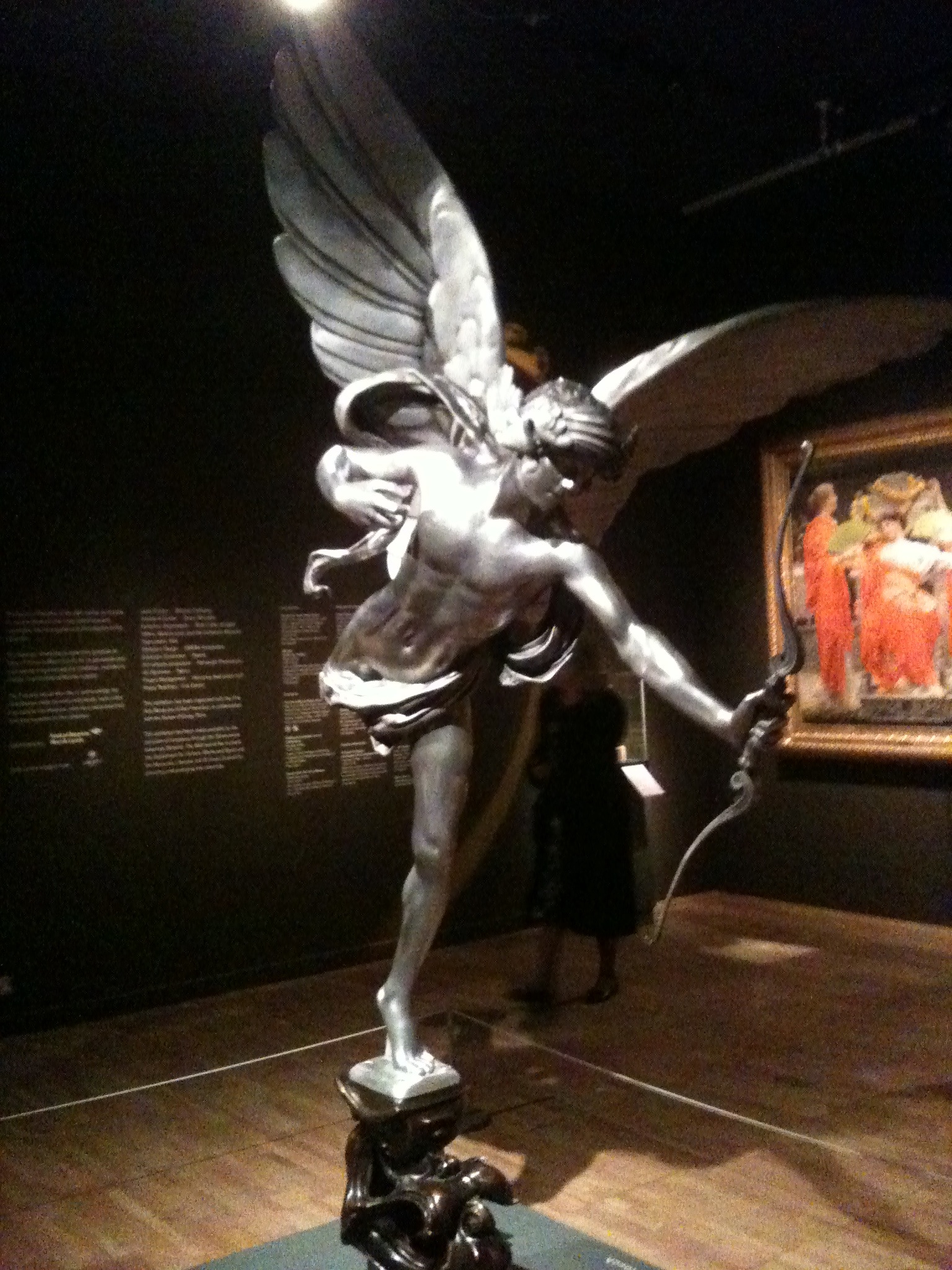
The highlight of the exhibition comes right at the end. Alfred Gilbert’s statue of Eros, or to be more precise Anteros, or to be even more precise, The Angel of Christian Charity, is easily overlooked in its usual home of Piccadilly Circus, located as it is in the second worst place in all of London. But lowered to eye level and removed of surrounding neon, tourists and traffic, it turns out to be a figure of real beauty, simultaneously delicate and robust, and gleaming in its shiny aluminium (this is a recent cast).
The rest of the exhibition is similarly eye-catching, as you wander round the gallery following what seems to be an endless procession of portraits of dark-haired, brown-eyed women painted between 1860 and 1900 by the Aesthetes. William Brown, the fictitious schoolboy and one of my chief inspirations, always admitted a soft spot for a certain kind of women: dark-haired, brown-eyed and dimpled. He was clearly inspired by the Aesthetes.
The Muppets have a long relationship with London. That’s partly because Jim Henson lived in Camden from 1977 and opened his workshop, the Jim Henson Creature Shop, in the area, filming many of the Henson films in London. A rather fantastic Muppets walk with all locations – including a Muppets bench on Hampstead Heath – can be found on the Camden website here.
Henson’s first workshop was at 1b Downshire Hill, NW3. It was initially used for the production of The Dark Crystal but remained in use from the late 1970s to 1990. It is said it had to be closed after neighbours complained about the strange smells coming from the factory, which reminds me of Charlie and the Chocolate Factory.
You can watch a (rather scratchy) tour of (I think) the second Creature Shop here.
I visited this second Creature Shop in 2000 on the invitation of a model-maker who I met in a Camden pub. There was a definite magical/spooky Roald Dahl quality to the experience. This Creature Shop was located on Oval Road overlooking the canal, and was a huge mysterious building filled with puppets of all sizes. This is where the puppets for Animal Farm, 101 Dalmatians and The Muppet Christmas Carol were made.
The Creature Shop closed in 2005 and the building has since been demolished, but you can see London’s influence on the Muppets in a number of films. Here are five of my favourites.
1 ‘Maybe It’s Because I’m A Londoner’
This is from the time when Chris Langham was writing the Muppets. It’s an early, possibly rather clumsy, stab at celebrating London’s multiculturalism, and thus the sort of thing that would make Rod Liddle cry.
2 Burlington Bertie From Bow A great version of one of the great London Music Hall songs, a repeated inspiration for Muppets songs.
3 The London Fog Kermit reports from ‘London, England’ and interviews a cockney frog and a Beefeater.
4 The Muppets Christmas Carol The superior Dickens adaptation is all London, obviously, but this first meeting with Michael Caine’s Scrooge sets the scene nicely. Plus: singing pigeons.
5 Wotcher (Knocked ‘Em In The Old Kent Road) Another Music Hall classic, with Fozzie Bear dressed as a Pearly King (or possibly as an Old Compton Street stroller).
It seems to happen every time a march or protest takes place in London. A much-loved statue or monument is defaced, horrifying the sort of people who are horrified by this sort of thing while the rest of us wonder why nobody’s got round to throwing a bucket of paint at that godawful Animals At War monstrosity on Park Lane.
On Saturday, after the TUC and some kids dressed in black marched through the London to complain about stuff, it was the turn for the Landseer lions at Trafalgar Square to take a pasting.
While the statue of Charles I received a more artful reimagining.
Interestingly, this Charles I statue had already been manhandled by the mob – albeit inadvertently – way back in 1867 when a reporter climbed the statue to get a better view of a passing protest and used the sword to steady himself. The sword promptly fell off and disappeared into the crowd, never to be seen again.
Most people think that this habit of deliberately defacing certain statues is a recent thing, dating back to the inarguably splendid Winston Churchill turf mohican on May Day 2000.
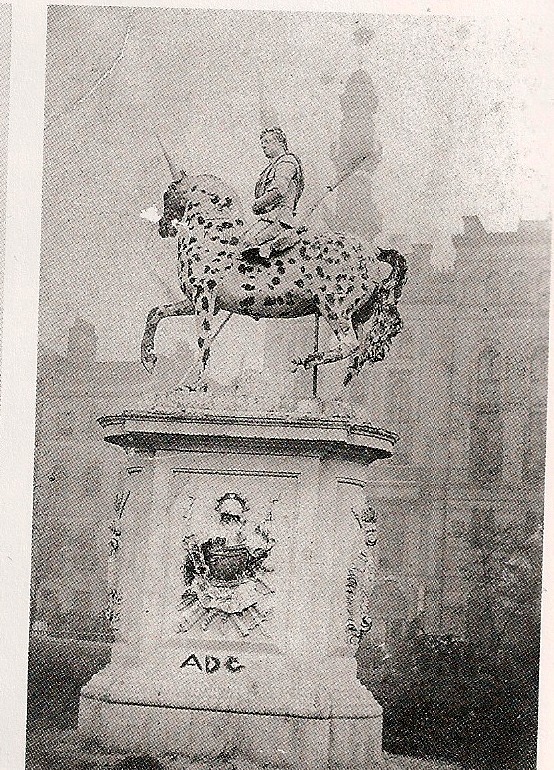
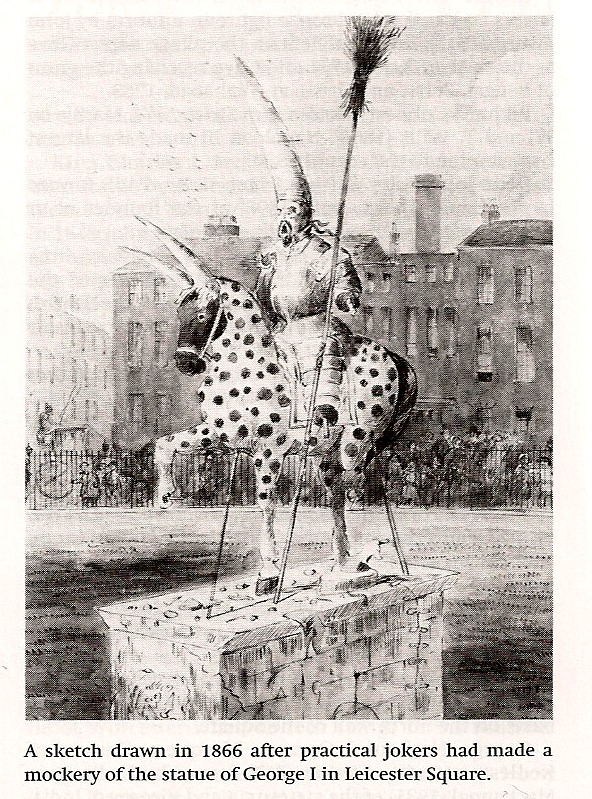
But the London mob has a rich tradition of dressing up (or down, depending on your viewpoint) London statues. My favourite example is the treatment dished out to the statue of a mounted George I, which was cast in 1716 and placed in Leicester Fields in 1784. This received serious punishment over the years as children clambered all over it, so both horse and rider lost bits, and at one point the poor king was without head, legs and arms. But worse was to come.
In October 1866, after the state of the statue had been discussed in the Times, guerilla jokers attacked the statue at night, painting black spots all over the horse, replacing the lance with a broomstick and putting a dunce’s hat from the nearby Alhambra Theatre on George’s bonce. Crowds flocked to see the spectacle. It was cleaned up, but eventually sold for £16 and pulled down in 1872.
As British History online website comments: ‘It would be almost impossible to tell all the pranks that were played upon this ill-starred monument, and how Punch and his comic contemporaries made fun of it, whilst the more serious organs waxed indignant as they dilated on the unmerited insults to which it was subjected.’
Street photography – the snatched and unposed glimpse of everyday life – is a fascinating genre even if it is never quite as authentic as it appears. Many of the strongest images in the exhibition reminded me of those Victorian journalists who investigated the slums of working-class London life in the 1880s and 1890s, reporting back in horror on what they found to their middle-class readers.
Thanks to these pioneeers, we now have evocative visual records of London life. My favourite were probably the images Roger Mayne took in the late 1950s to record the streets in West London that were scheduled to be demolished and replaced by Trellick Tower. A book of Mayne’s photographs has just been republished and can be purchased at the Museum of London bookshop, along with the excellent accompanying book for the exhibition.
For my recent piece in Uncut on the London underground press, I contacted Pete Townshend to ask if he had any memories of the era. His reply was long and illuminating, and is worth reproducing in full.
ME: Pete was a regular at UFO. Was it unusual for somebody so well-known and from a Mod background to go to a hippie club?
PT: I was taken hostage in a sense. My partner Karen Astley (whose pretty face was used for a few UFO posters) was working with her old friends from the Ealing Fashion School – Angela Brown and Annie Dupée. They had a company called Hem & Fringe. They made clothes for various boutiques, but in particular were designing for an adventurous new King’s Road store in the manner of Granny Takes a Trip. It was to be called Gandalf’s Garden. It was a joint effort by Barbara Allen and Michael Rainey I think.
Michael McInnerney was doing the window design, with – I believe – another artist called Dudley Edwards (who had decorated Lennon’s big Rolls Royce in psychedelic style). I had met Mike and Dudley after the Who had played Monterey Pop Festival with Jimi Hendrix in 1967, and I was interested in Meher Baba who they both followed.
The Who then went off on a very long tour supporting Herman’s Hermits, and while we were away there was a widely reported hippy wedding in Hyde Park, Michael McInnerney married Katie, and Karen was there, and in many of the photos. There is also newsreel film of Karen dancing with Barbara Allen and Hoppy. Mike McInnerney worked with Hoppy and Miles on IT. Karen was right in the centre of the hippy scene, and knew a lot of the leading faces of the time. Through her I met Joe Boyd, the producer of The Incredible String Band and Fairport Convention, and Barry Miles and his wife Sue (who was a terrific restaurateur), and Hoppy. I also got to know John Dunbar [Marianne Faithfull’s first husband] and met the other founders of the Indica Bookshop in Southampton Row at a party with the Beatles, but I never went to the shop. The way I remember it is that Paul McCartney was the chief patron of Indica from the Beatles and the pop scene at large. He was passionate about legalising marijuana, and came close to being arrested for some of the things he said. As far as I could see, marijuana and LSD were what the politics of the times revolved around. There may have been more, deeper things, but I never saw much sign of it at the time. Vietnam was big news of course, but sadly not to me. More of my myopic tendencies later.
Michael English was an old friend from Ealing Art College, and his partner was Angela Brown. When I wasn’t performing we hung out together. Michael was developing his air-brushing techniques, but also making silk-screened posters for hippy events with his colleague Nigel Weymouth. Michael and I were extremely close for about a year in 1967, and I became very fond of him. My friendship with Mike McInnerney lasted much longer, and although we don’t see much of each other today, his work on the Tommy artwork went much further than just coming up with cover art. I flew every single Tommy song past him before I played it to Kit Lambert my mentor and Who producer and manager.
I loved the UFO club. Hoppy was always on the door, smiling, welcoming, never spoke about politics although we knew he was involved in trying to get marijuana legalised. On the stairs I often found Mike McInnerney, who would never stop drawing and painting, and sometimes took his work out with him. One night Gustav Metzger who had lectured at Ealing Art College did the acid-based-light-projections for The Soft Machine. In those days Soft Machine were really very jazzy, and I seem to remember they played a few pieces by John Coltrane. I’ve always been a huge fan of Robert Wyatt, and he married one of my friends Alfreda Benge who edited The Lone Ranger, the first film for which I ever made a soundtrack. Pink Floyd were regulars, and I thought they were wonderful, and not just Syd. I’d met Syd at a few parties, and he was already pretty mad, too many trips we all thought. One Pink Floyd night at the UFO a bunch of Mod boys circled me and ridiculed my hippy coat that Karen had made me, and from then on I think I started wearing boiler suits and Doc Martens, attempting to disown both fashions. We had a lot of fun, I had about five LSD trips, one good one, the rest pretty scary. The UFO was a very friendly place, unless you happened to run into Roger Waters. I’m joking, he was friendly enough, but though handsome he was extremely scary looking, and was rather too keen on Karen for my liking, but then a lot of men were.
I am simply name-dropping here, over and over again, because I was not really a part of this scene at all. I just met all these extraordinarily glamorous and friendly people through Karen, then jumped back in the shitty old Who tour bus and went off to play in fucking Morecambe.
Was Pete’s comfort with the counterculture a result of his art school background?
I was not comfortable with it. This is where I confess my myopic nature. I never ever managed to find a sense of place in it. I think when we played Woodstock a year later, and my famous argument happened on stage with Abbie Hoffman, I suddenly realised I simply hadn’t understood how divided society had become by then. This divide was not just between young and old, but between those younger people who saw themselves as political agitators and those who simply wanted to conform, get a job and have a quiet life.
As an artist I operated within the Who as a kind of mirror or commentator, always looking at the local neighbourhood rather than the international scene, trying to give a voice to that part of our audience that seemed most disaffected, but I lost touch completely during the hippy years. Tommy was possibly only accepted from the Who because in hindsight some aspects of the hippy movement had been seen to be counterfeit and bogus. But the spiritual yearning that grew out of the LSD revolution was carried in Tommy, and made a connection somehow.
My art school work had been hugely inspiring, especially with respect to the possibilities of future technology and the way it would affect art. I have always felt I juggled art, technology and spiritual matters fairly well. But those three issues really needed from me an awareness of politics to produce balanced artistic work. That never happened for me. My mostly apolitical protests were rather sullen and sometimes resentful.
Did interviews with International Times allow musicians to reach different audiences or talk about different subjects than was possible with the mainstream press?
Oh yes. But I don’t remember my talk with Miles, I just remember Miles himself, and I adored him. Around that time (1967) I began to specialise in thought-stream interviews, just rapping really. I spoke creatively, sometimes absurdly, often moving into territory I knew little about. Occasionally this system did produce the most wonderful ideas. At other times, looking back, I just sounded out of my depth.
Why did rock stars like Pete and Paul McCartney get involved with IT, UFO and the counterculture scene? What did Pete personally do to help?
It wouldn’t surprise me to hear that Macca got taken hostage as I did, but in his case by his partner Jane Asher. I know that her brother Peter was involved in some way with John Dunbar. We were all part of what we thought would be a new London intelligentsia. In the end it was just a group of young pop stars with extremely pretty girl friends. I can remember one gathering – I think it was at an art opening for Simon and Maryka – where George Harrison was talking about Krishna, Macca about legalising marijuana and Eric Clapton and I were with the artist and lyricist Martin Sharp talking about the Oz Trial. I don’t think I helped at all, but Macca did. He gave money when Hoppy was arrested, and later for the Oz trial I believe.
Did Pete attend or have anything to do with International Times happenings at the Roundhouse or Alexandra Palace?
Yes I went to both events. Michael English and I took LSD and walked all the way to the Roundhouse from his house in Portland Road. A long, wonderful trip, one of the good ones. At the Ally Pally Rave I ‘discovered’ Arthur Brown and started recording him. Kit Lambert got thrown out of the Alexander Palace event. God knows what he did. He was rather posh, maybe he was thought to be too straight, but I got Hoppy to get him back in. The Who actually performed at one of the last IT Roundhouse events, with Elton John’s new band. By that time IT and Hoppy had lost control of the London hippy scene and it was being taken over by the old guard of promoters.
Last week I attended my first auction. It was at Christie’s, the grand London auction house who hold their blockbuster Impressionist and Modern Sale every February.
It was a strange experience. This will almost certainly be the only time I’m ever in the same room as somebody spending upwards of £7 million on, well, anything. The big seller was Lot 10, a Pierre Bonnard oil painting from 1923 that went for £7.2m in a lengthy contest. The entire Bonnard bidding process can be witnessed here and is an interesting example of what can take place in this unusual atmosphere of extreme wealth and refined competition.
At times, when the auctioneer is registering bids – ‘3.5… 3.8’ you have to remind yourself these are millions of pounds he is talking about. A painting can double in value in seconds. Note also how polite the auctioneer is. He personally addresses the bidders by name and asks them if they will continue to bid, delicately stoking their interest without seeming too pushy and occasionally breaking the tension with a joke. There is no aggression here, no way you could ‘accidentally’ bid for something, and the bidder is also given plenty of time to say whether they will maintain an interest. It is not the clock you are competing against.
Bidding also goes up quite gradually. You are not attempting to blow your opponent out of the water poker-style with an eye-watering bid, but merely hoping to part with as little more than your direct competitor is prepared to pay then you can get away with. For this reason, battles can be protracted.
The Bonnard contest perhaps went on a little too long for the purists, but even I could detect the air of disappointment when the auction’s landmark painting, a Gaughin estimated at up to £10m, failed to meet its reserve and was withdrawn from sale. Could nobody really be bothered to fork out for this work? The room sighed.
Some of the things I witnessed intrigued me. The auctioneer is Jussi Pylkannen, who also happens to be the President of Christie’s Europe, so each increment of £100,000 will translate directly into profits for the company’s coffers. No wonder he gives people time. At one point in the Bonnard sale, he started accepting bids of £50,000, much to the annoyance of the man sitting next to me who felt that ‘splitting the bid’ so late in the day simply wasn’t on. But it’s all profit for Christie’s.
I was also interested to see that many of the Christie’s senior management – including Olivier Camu and Giovanna Bertazzoni, who organised the sale – were now manning the phones, bidding on behalf of individual clients and offering advice on what to go for. This put them in a curious position, although given that Christie’s itself is essentially just a gigantic middleman, not a particularly troubling one.
The auction room itself is a busy, noisy place, packed with an international clientele of around 500 people dressed in their finery and younger than I expected. For some it was clearly seen as an exciting way to begin a night out in London.
Most of the bidding was done on the phone, but some came from people in the room. I wondered whether people deliberately remove themselves from the room so they can avoid the tension and the sort of ‘testosterone bidding’ I had been told about.
A man near me purchased a Picasso for £500,000 while slouching against a pillar, desperately trying to look casual. As his bid was accepted he barely looked up, but the arm holding the paddle was trembling. An elegant woman right at the back suddenly became involved in a fascinating competition over a Max Ernst sculpture, that was expected to reach £350,000 but eventually went for over a million. Between bids I watched her take instruction from a mobile phone. Was she bidding on behalf of somebody else, consulting an lawyer or accountant, or was she seeking approval from her husband before busting his budget over the million pound mark? The billionaires who deal in this market are, after all, overwhelmingly – but not exclusively – male.
The battle over the Ernst sculpture reminded me of something Bertazonni had said – that sculpture had become hugely popular in the post financial crash art market, ‘as though people wanted something tangible, three-dimensional’ to hold on to. This piece of tangibility cost somebody £1.3 million. Security comes at a price.