Category Archives: Art

London in maps

This was a piece I wrote for the January 2011 issue of Metropolitan magazine.

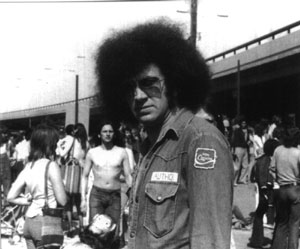
In July, the Mayor of London introduced a scheme that allowed the public to rent bicycles from 300 docking stations in different London. Within days, maps could be found all over the internet showing exactly where each docking stations could be found and which were the most popular. These maps were largely unofficial and all free, created by tech geeks for fun and copied to internet forums for the use of cyclists, tourists and map lovers. It proved once again that Londoners will map anything. There are maps for free wi-fi hotspots, maps that chart where the most Twitter activity comes from and maps that find the nearest toilet. One of my favourite maps is this 1970s version of the knitted football tribes of London.


This love of maps is engrained in London’s psyche, the result of living in a chaotic and unplanned metropolis. Two of the city’s favourite icons are maps: the A-Z, that portable atlas which even seasoned Londoners carry in case they get lost; and the Tube map, a design classic that has been copied by transport networks all over the world and is regularly ‘mashed-up’ by artists, replacing stations with footballers, philosophers, films, authors and anagrams.

In 2006, the British Library organised a ‘London: Life In Maps’ exhibition, curated by Peter Barber, the library’s Head of Maps, who thinks London’s love of maps is far stronger than anything you might find in Paris. ‘The French have a very cool attitude towards maps,’ he says. ‘They don’t, on the whole, use them and there is no comparable market in old maps to the one we have in London. You have to give away old maps of France. Maps in France are associated with authority – they were tools of administration and control. Whereas in England maps were commissioned privately and so are not perceived as being so menacing.’

Barber names the key maps of London’s past –the Copperplate map of the 1550s, the Morgan map of 1682, the John Rocque map of 1746 and the Horwood map of 1829. Barber makes a distinction between two kinds of maps. There are functional maps for getting you from A to B (or A to Z) and there are maps that work thematically or artistically to present information or ideas over a cartographical plan. The thematic map has been popular in London for centuries – the most famous is Charles Booth’s Poverty Map of 1889, which colour-coded streets according to income. Another is ‘The Modern Plague’ of 1886, produced by the National Temperance League, which showed pubs in central London. These maps are designed to transmit an idea, not aid mobility, and are fascinating to study. One of the first was John Snow’s map, tracking cholera outbreaks in Soho.

Such maps are now getting easier to compile. ‘It’s said that 80 per cent of all knowledge is spatial, and you can geo-reference any phenomenon and plot it on a map,’ says Barber. ‘With digital mapping, the techniques to do this are within the range of everyone. Digital mapping isn’t new, what is new is the ease with which it can be done and the extent of the information that can be plotted.’

Simon Foxall summarised this in his book ‘Mapping London’, writing: ‘Maps have been made to do things they were never expected to tackle and, in doing so, have exposed patterns, connections and ideas that were as interesting as they were unexpected. ‘

Straddling these two types of map is Bill Visick, a former manager at IBM, who has developed the London Time Travel Explorer (TTX) app for the iPhone. This features four maps of London dating from 1746 to 1862 and a contemporary map of the city. Using GPS technology, the user can fade between old and new maps to see how the street on which they stand has changed. It’s virtual time travel.

Visick had been collecting maps of his Kensington home for years, but smart phones allowed him to take this to another level. ‘What sparked it for me was realising that the street I lived on contained the first buildings ever built in Kensington,’ says Visick. ’I was standing outside my door and thinking, “blimey, that was a hedge and that was a field”. So the first thing I did was put this old map on my phone and walk around looking at it – that became the prototype and that’s where the idea of TTX came from. It happened almost as soon as I realised the technology would allow it.’

The novelist and poet Blake Morrison has spoken about ‘our craving for interactivity’, and that is something the artist Stephen Walter is also exploring through maps. In 2008, he created The Island, a vast, exquisitely detailed map of London, crammed with cultural and political references and in-jokes. ‘People have been suggesting I do an app,’ says Walter. ‘The British Library did a brilliant browsing tool for the map and people have suggested I do something for a phone or tablet computer. I’m interested to see if there’s a way people can leave their own tabs on the map, personally configure it with their own information.’

The Island is modern in its outlook, but Walter was following a long tradition. ‘There’s a huge, strong history of map-making in London and we do like to beat our chests about it,’ says Walter. ‘It’s a bragging thing, a celebration of history and size. The Island was a spoof of a medieval map. The twist was that a lot of it was very personal and also a contemporary reaction to the city, whereas at first glance it looks like a pretty conservative world map.’

It has long been understood that the map is subjective, reflecting the views of the maker, although rarely as blatantly as in The Island. In ‘Mapping London’, Foxall writes, ‘The map, as a scaled replica of the entire city, presents a choice to its maker: not what to include, but rather, what to exclude. The mapmaker, like a sculptor, must chip away at the raw block of material that is the city to reveal the shape and representation hidden inside.’

Barber expands this point. ‘Different maps show different things and your judgment of a map depends entirely on what you want from it. In some cases you could draw a direct contrast between the map the man in the street wants and the map the expert says is best. The A-Z is a complete travesty of mapping because the streets are grotesquely enlarged and the open spaces much reduced.’

The irony of the growth of digital mapping is that it comes at the expense of the old-fashioned kind. People no longer need A-Zs, because they can use GPS or SatNav. ‘I spoke to somebody the other day, a businessman in his 60s, who no longer takes directions,’ says Visick, with one example that stands for thousands. ‘He knows he can get anywhere on his phone.’

And into this breach step the digital mappers, who offer information in a manner that all of us can understand. London can be a daunting city to comprehend, so a thematic map that breaks the city down into easily absorbed chunks of information located spatially is very helpful. As Walter muses, ‘It seems the more complicated life gets and the easier it gets to traverse the landscape, the more maps become all about ourselves.’

Mucky pics in Victorian London

It can be hard to persuade people to visit historic houses, which makes you wonder why the owners of 18 Stafford Terrace don’t make more of the secrets that are hidden in the attic.

Stafford Terrace in Kensington is also known as Linley Sambourne’s House. Sambourne was a cartoonist for Punch who bought the five-storey terrace in 1875 and decided to decorate it as fashionably as he could, along aesthetic principles. This meant much William Morris wallpaper and exotic furniture. The problem was, Sambourne was not a wealthy man, so he purchased the latter from house clearances and junk shops and to make the former go further, he would cut out bits of wallpaper that were hidden from sight behind paintings and furniture and use them to paper other parts of the house. And he had a lot of paintings and furniture.

When Sambourne died, his son kept it exactly as it had been left, as did the following generations, until Stafford Terrace, now essentially a time capsule of Victorian middle-class life, was purchased by the GLC.

And that is how it has remained. The house is now owned by Kensington & Chelsea and run by nearby Leighton House.  Visitors get to see inside a fascinating interior and learn about the fashions of the Victorian middle-class first-hand.

But there’s more.

Sambourne was a cartoonist, but he also developed an interest in photography. He realised that instead of drawing his caricatures from scratch, he could get people to assume certain positions, photograph them, and then sketch the results. In his backyard he would get the coach-driver to dress as the statue of Eros, or pretend himself to be a tennis player or Roman soldier, using props from around the house. Here’s an example.

But there’s more.

Sambourne also started a Camera Club. Here his subjects tended to be more specialist.

For some reason, Camera Club always took place when Sambourne’s wife was visiting friends in the country.

In the attic of 18 Stafford Terrace, on a very high shelf, are several unmarked volumes packed with this sort of photographic work. Some are displayed in the bathroom for public study.

Mocked up in the same attic room is a demonstration of how Sambourne worked. An easel contains a cartoon of three women on a bicycle, copied from an adjacent photograph of three women pretending to be on a bike. In the photograph, all the women are nude; not so in the cartoon.

But it doesn’t end there.

Sambourne would also take his camera out with him when he was in Hyde Park or mooching around Kensington, and take surreptitious images of passing nursemaids, which he would carefully file as ‘Zoological Studies’. He even purchased a special camera with a secret lens that took pictures at right-angles so his subjects would be completely unaware as to what was going on. He still received a number of warnings for his behaviour.

And he also liked to take pictures of his maid. In bed. Asleep.

There’s nothing quite as creepy as a middle-aged Victorian male, is there?

See also The Man From London and Virtual Victorian.  

Pussyfoot Johnson and the London mob

My review of Ink And The Bottle, an exhibition about cartoons and alcohol, appears in the Independent.

One of the cartoons at the gallery is based on the story of William ‘Pussyfoot’ Johnson, an American who was active in the temperance movement and came to London on Nov 13, 1919 to give a talk.

Johnson was leader of the Anti-Saloon League and after success in America, he headed to the Old World to spread the anti-drinking word. He argued, ‘There is more bootlegging and more moonshining in Europe than in the whole United States.’

He may have been right. This temperance movement map from 1886 attempted to show the scale of the problem by depicting all of London’s pubs in its ‘Modern Plague of London’ map.

Pussyfoot earned his nickname for his habit of amending laws by stealth, and this did not go down well with the London mob. As one anti-temperance advocate told the New York Times, ‘You know how the majority of Englishmen look upon prohibition and Mr Johnson’s activities? The thought of not being able to have the well-known pint of bitter fills them with horror. The war was terrible enough but it was something that happened before. There have always been wars. Taking away the drinks is attacking the divine rights of the Britisher. I can tell you they don’t like it!’

They certainly didn’t, and decided to do something about it. While Johnson was speaking at Essex Hall, he was captured by medical students from nearby King’s College who dragged him out the buildin, poured a bottle of beer over his head and marched him around the West End chanting ribald songs. It was noted that the police ‘seemed lacking in sympathy with the missionary’.

Johnson was hauled hatless on a stretcher around Regent’s Street, Leicester Square and Oxford Street while the students chanted ‘What won the war? Rum!’ and ‘We’ve got Pussyfoot meow, send him back to America’.

Such larks, what fun and games!

And so what if Johnson lost his right eye in the incident? The lesson was learnt. Not many people have tried to take the Britisher’s beer away from him since.

Magic mushrooms in Georgian London

I have always considered Green Park to be the dullest of all central London parks. Look. There’s really nothing there. It’s just a very big lawn.

But twas not always this way. High Society, the Wellcome Collection’s superb new exhibition on drugs in culture – which I recently reviewed in New Statesman – includes a great story from 1799 concerning a doctor, Everard Brande, who was called to the London house of a family suffering from some form of poisoning.

Concerned for his sick family, the father had gone out to seek help but was soon found in a confused state, unable to remember where he was going or why. He was rescued by neighbours and eventually the doctor pieced the story together.

The family had been out gathering mushrooms in Green Park, which they had cooked into a broth, and this had upon the parents and four children an extraordinary effect. All were giddy – with high pulse rates and intense breathing – and all were seeing things. While the adults seemed struck by a morbid fear of death, eight-year-old Edward ‘was attacked by fits of immoderate laughter’ and his staring pupils were massively dilated.

After treatment from Dr Brande, the family recovered (aka came down). I’ll never see Green Park in quite the same way again. I’m sure they didn’t.

For more, see Michael Jay‘s excellent accompanying book.

The London Anti-University

This newsclip of the London Anti-University from 1968 is wonderfully evocative, not just for the interviewees’ earnest insistence that they could change the world of education, but also through the grim tattiness of late 1960s Shoreditch, reproduced in glorious colour.

The London Anti-University was formed after participants at 1967’s Congress on the Dialectics Of Liberation at the Roundhouse decided they wanted to continue to explore some of the themes and conversations that had started there (sample debates: The Future of Capitalism; Black Power; Imperialism and Revolution in America).

Based at 49 Rivington Street – previously home of the Vietnam Solidarity Campaign – the Anti-University was opened in February 1968 by David Cooper and Alan Krebs, and featured lecturers such as Cornelius Cardew, CLR James, Robin Blackburn, Bob Cobbing, RD Laing, Yoko Ono, Jeff Nuttall, John Latham and Alex Trocchi – all key figures on the intellectual left-wing of the 1960s counterculture.  The Anti-University syllabus covered three main areas: radical politics, existential psychiatry and the artistic avant-garde.

An idea of the direction of the Anti-University can be gleaned by a reported exchange at Joseph Berke’s course on ‘anti-universities, anti-hospitals, anti-theatres and anti-families’.

He asked the class: ‘How can we discuss how we can discuss what we want to discuss?’ After a long silence, somebody answered ‘Maybe we don’t need to discuss it.’ Berke pondered this for a while and then left; the class continued for an hour despite his absence.

The Anti-University lasted almost a year, which isn’t bad by the standards of the time, but it’s premises soon became squatted, and the landlords, the Bertrand Russell Peace Foundation, reclaimed the campus.

But the Anti-University’s most important legacy may have come from a conversation in the classroom of psychoanalyst Juliet Mitchell, who lectured on literature and psychology.

One of Mitchell’s students, Diana Gravill, had inherited some money and was intending here to spend it on a women’s refuge. Mitchell instead persuaded her to put it towards a bookshop. This she did, and the shop, named Compendium, was opened by Gravill and her partner Nicholas Rochford on Camden High Street in August 1968.

Over the next thirty years it became one of the world’s great bookshops, stocking everything from academic studies of the women’s movement to punk fanzines. It was still going strong when I used to go there in the late 1990s, fascinated and intimidated by the content of the bookshelves. It eventually closed in 2000, a sad end to one of London’s greatest counterculture institutions, but a longstanding tribute to the ideas and passions raised by the London Anti-University.

Mapping Sixties London

This exquisite map of the 1960s West End is one of the most interesting ways I’ve seen of making tangible that fascinating era that remains tantalisingly out of reach and hard to comprehend. Produced by Herb Lester Associates, Wish You Were There is a fascinating physical attempt to bridge the gap in time, to fill in some of the blanks.

It is also a beautiful artefact, a fold-up map that offers a ‘retrospective guide to London’s shops, clubs, boutiques and sundry diversions, 1960-66’. Included are such diverse pleasures as Better Books, home of the Beats, the offices of promoter Don Arden and restaurants like Cranks and The Nosh Bar alongside better known clothes shops, bars and venues.

On one side is a map of central London, and on the other a written guide to the 130 locations, padded out with period advertisements.

Wish You Were There can be purchased here for a bargain £4.

Secret London: the Russian tank of Bermondsey

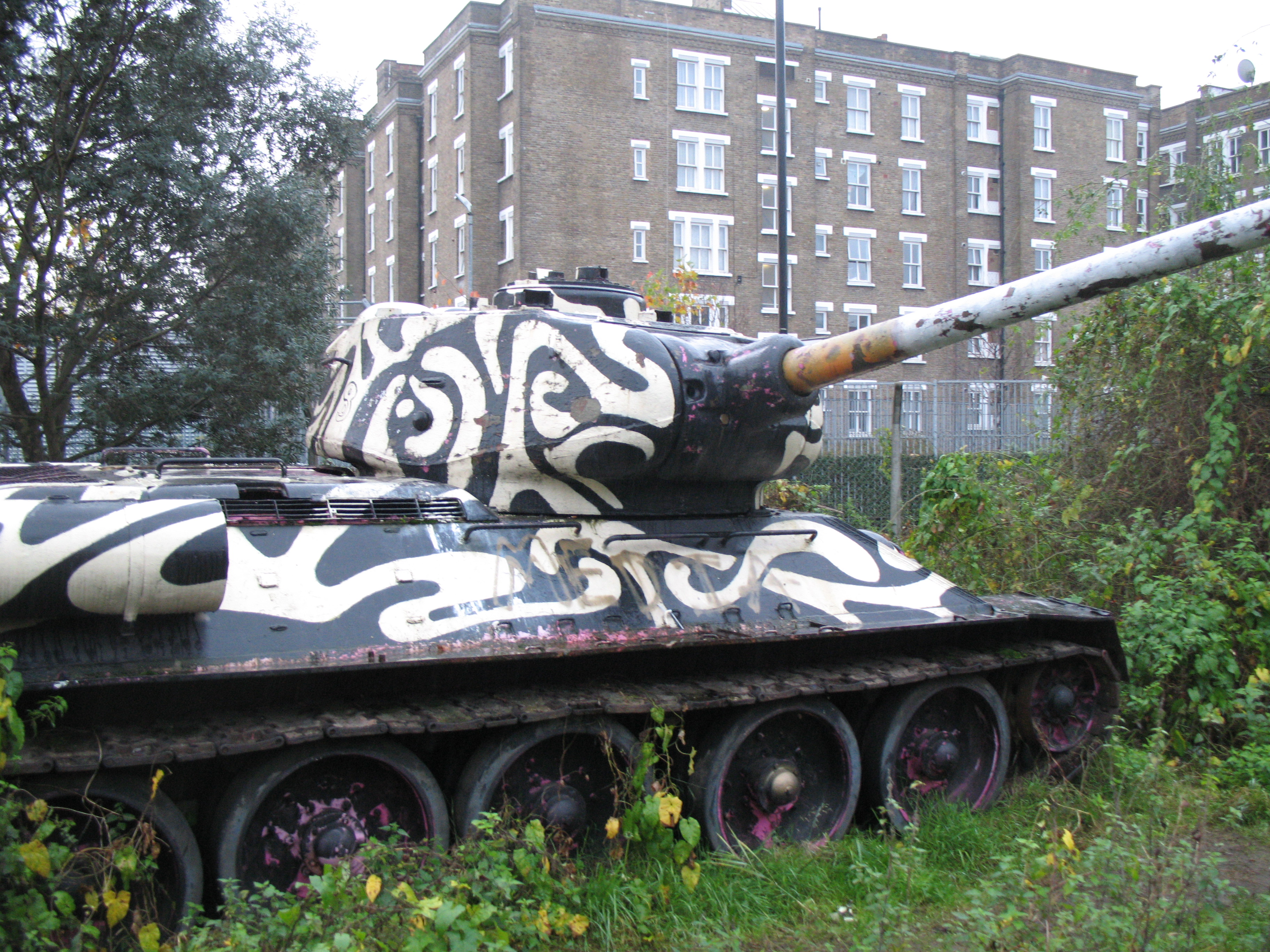
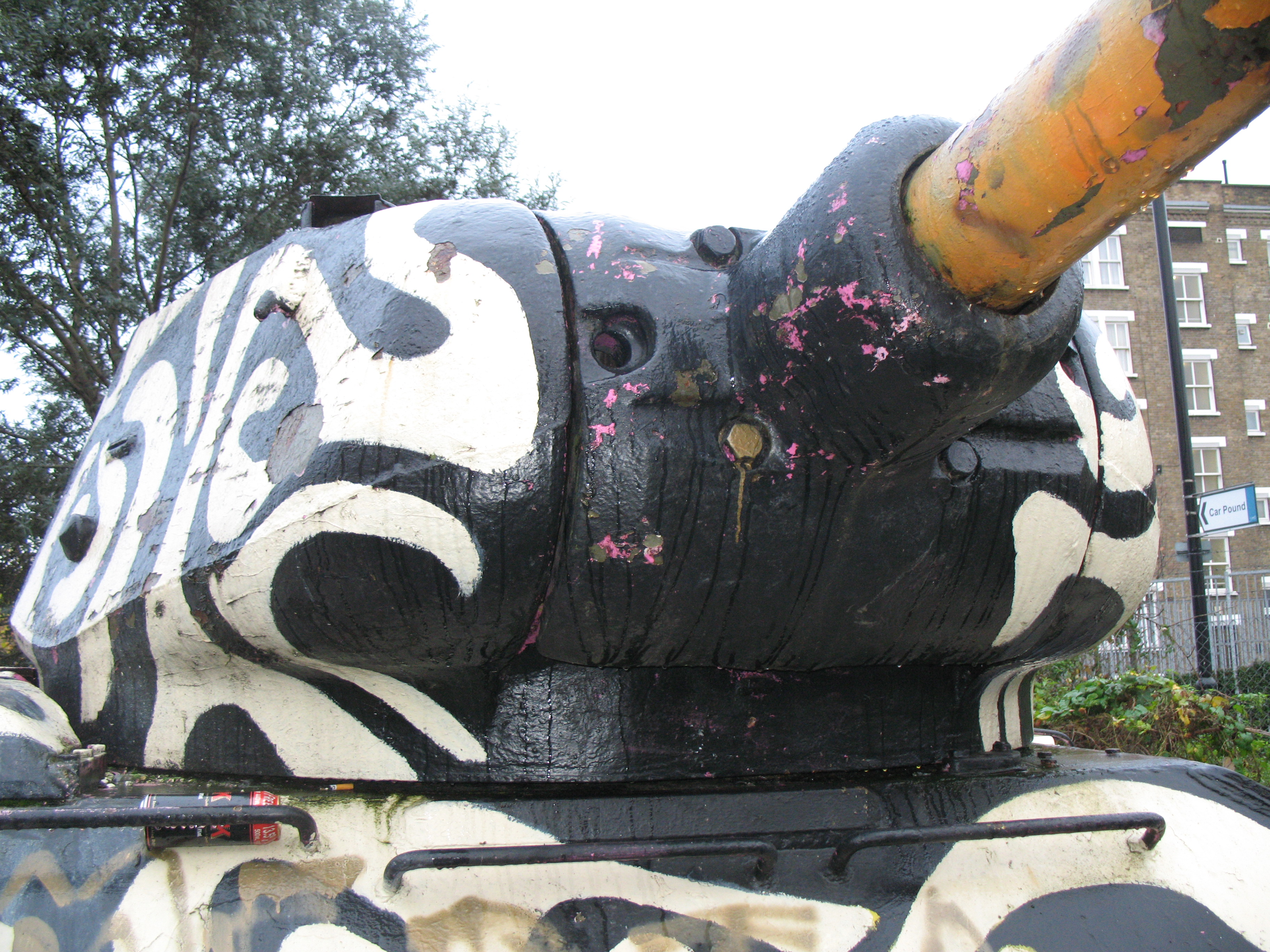
That there is an authentic Russian tank parked in a patch of wasteland on a side street off the Old Kent Road is one of those things that is so brilliant it should be mentioned on the news at least once every day. (I felt much the same way about Gordon Brown’s glass eye.  A Prime Minister with a glass eye! How cool was that! What a wasted opportunity.)

The tank is a T34 Russian tank that was possibly used against the Czechs in the Prague Spring uprising of 1968. It arrived in London in 1995 when it was used for the filming of Richard III. The tank was then purchased by Londoner Russell Gray as a sort of giant and very expensive pun after Southwark refused him planning permission to build houses on the site. Gray instead applied for permission to put a tank on the site. They thought he meant water tank, but he didn’t. The tank’s gun is trained on the council office.

How much truth there is to that story is surely irrelevant. It feels right. And when it comes down to it, all that matters is that there is a bloody great Russian tank on the streets of South London and people don’t seem to realise quite how incredible this actually is.

Jeremy Deller’s Baghdad car at the Imperial War Museum

If the V&A’s latest exhibition demonstrates that big can be beautiful, the new acquisition at the Imperial War Museum shows that small can be profound.

It’s a car, badly damaged and barely recognisable, that was caught in a suicide bomb blast in Baghdad in 2007. The artist Jeremy Deller got hold of it and toured it across America on the back of a truck in the company of a US soldier and an Iraqi citizen for a piece entitled It Is What It Is. Now, shorn of any artistic element, it is on display at the Imperial War Museum. My review in the New Statesman can be read here.

After interviewing Deller, I avoided reading too much about the car before I wrote the piece other than this by Jonathan Jones in the Guardian. Jones, I think, slightly overdoes his praise – is it really true that ‘a dismembered body is what you immediately think of when you come into the museum and see a car’? – while the commentators beneath the line seem obessessed with the pointless and hoary argument about ‘what is art’.

They’ll never be able to answer that question from behind their computer screens because this compelling and thought-provoking piece needs to be seen on location and in context to be fully appreciated. It’s a fine and valuable addition to the IWM’s collection and makes a fascinating footnote in the history of war art.

Oh, and Jeremy Deller is one of the nicest famous people I have ever interviewed, right up there with Graham Taylor, the former England manager, belittled turnip and little appreciated ballet enthusiast.

Diaghilev at the V&A

Two months ago I knew diddly about Diaghilev. Since then I’ve written two features about him – including this in the Independent On Sunday – and can confidently assert that this Russian-born impressario changed the face of ballet in the early twentieth century when his company, the Ballets Russes, enlisted artists and composers like Picasso, Matisse and Stravinsky to showcase the work of groundbreaking dancers and choreographers like Nijinsky and Massine. Such is the magic of journalism.

The occasion is the V&A’s big autumn exhibition, Diaghilev and the Golden Age of the Ballets Russe, which opens on September 25. It’s an incredibly rich exhibition, crammed with memorabilia and costumes and images and music. Highlights include the astonishing, undanceable costumes from Parade, Picasso and Cocteau’s ‘Cubist ballet’, the monumental back cloth from ‘The Firebird’, and a wonderful bust of Nijinsky that captures his odd features.

I’m not a great fan of the ‘blockbuster’ exhibition as they are rarely as satisfying and intelligent as intimate displays at the more thoughtful museums, but this one is a real cracker, demonstrating decades of learning and showcasing a marvellous collection of costumes bought in auction and secured in the V&A’s vaults for just such an occasion.

(There’s a nice piece here from Diaghilev’s biographer about the Russian’s relationship with London.)

To the library! For comix!


When I was a kid I used to pretend to be ill so I could bunk off school and go to the library. That’s how square I was. I’d feign illness, then nip down to Cheam Library to choose books, before coming home to eat cheese on toast, lounge on the beanbag and read. Boy, was I a devil.

That’s pretty much my ideal day still, and so it’s no coincidence that since turning freelance – which is basically licenced truancy – I have rediscovered my love for the library. Let’s just take a minute to appreciate what a wonderful concept this is: a huge building where you can borrow thousands of books for free, or just hang around avoiding the tramps and reading periodicals.

It’s particularly useful because I have also rediscovered my love for comics. As a teenager, I subscribed at various times to Transformers, Roy of the Rovers and 2000AD but put these childish things away when I was 16 and thought I should be reading NME and Camus, even though I really preferred Rogue Trooper to The Plague and The Lemonheads.

I’ve often wanted to get back into comics and picked up the odd book from the rejects pile at Time Out, but balked at paying £15 for something that I could get through in a couple of hours – if I want shitty value for my entertainment I’d go to the cinema.

Which is where the library comes in handy. I can nip down there once a week and pick up five new books without paying a penny. Brixton Library has a pretty decent selection of comics, and I have a lot of catching up to do, so it’ll keep me happy for a few months yet. Although I wish they’d get in a complete set of The Invisibles.

So here’s the best of what I’ve been reading: V for Vendetta, Swamp Thing, Y: The Last Man On Earth, Superman: Red Son, Batman: The Killing Joke, Batman: The Dark Knight, Batman: Face To Face, Slade, JLA: The New Frontier, Tamara Drewe, Gemma Bovery, Greyshirt, Crisis On Infinite Earths and Preacher.

Most of these are great. Gemma Bovery and Tamara Drewe are wonderfully subtle English middlebrow lit classics – and far preferable as such to, say, Ian McEwan.  Greyshirt is a wildly smart genre spoof that reminded me of the best of the Coen brothers. JLA: The New Frontier was wonderful nostalgia. And anything involving Batman is always going to be great. Well, apart from all of the films.

Then there’s Preacher, which is one of the lewdest, sickest, smartest, weirdest, funniest, scariest and most brilliantly written, drawn and dramatised pieces of art I have seen in any form for years.

When one of my friends found out I was reading comics again, she accused me of reading ‘tosh’. I suppose it is, but only to the extent that most fiction – be it radio, cinema, TV and novels – is ‘tosh’. And some of it is very far from tosh indeed. Equally, I’ve been surprised how many people I know have also turned out to be fans of comics, quietly chipping in with recommendations and suggestions when I’ve mentioned my regained love. And it is love. How could it not be with something as beautiful as this?