Category Archives: Art

Comics at the British Library

Action 1976-77, by Jack Adrian and Mike White. Action, used with permission from Egmont UK Ltd.

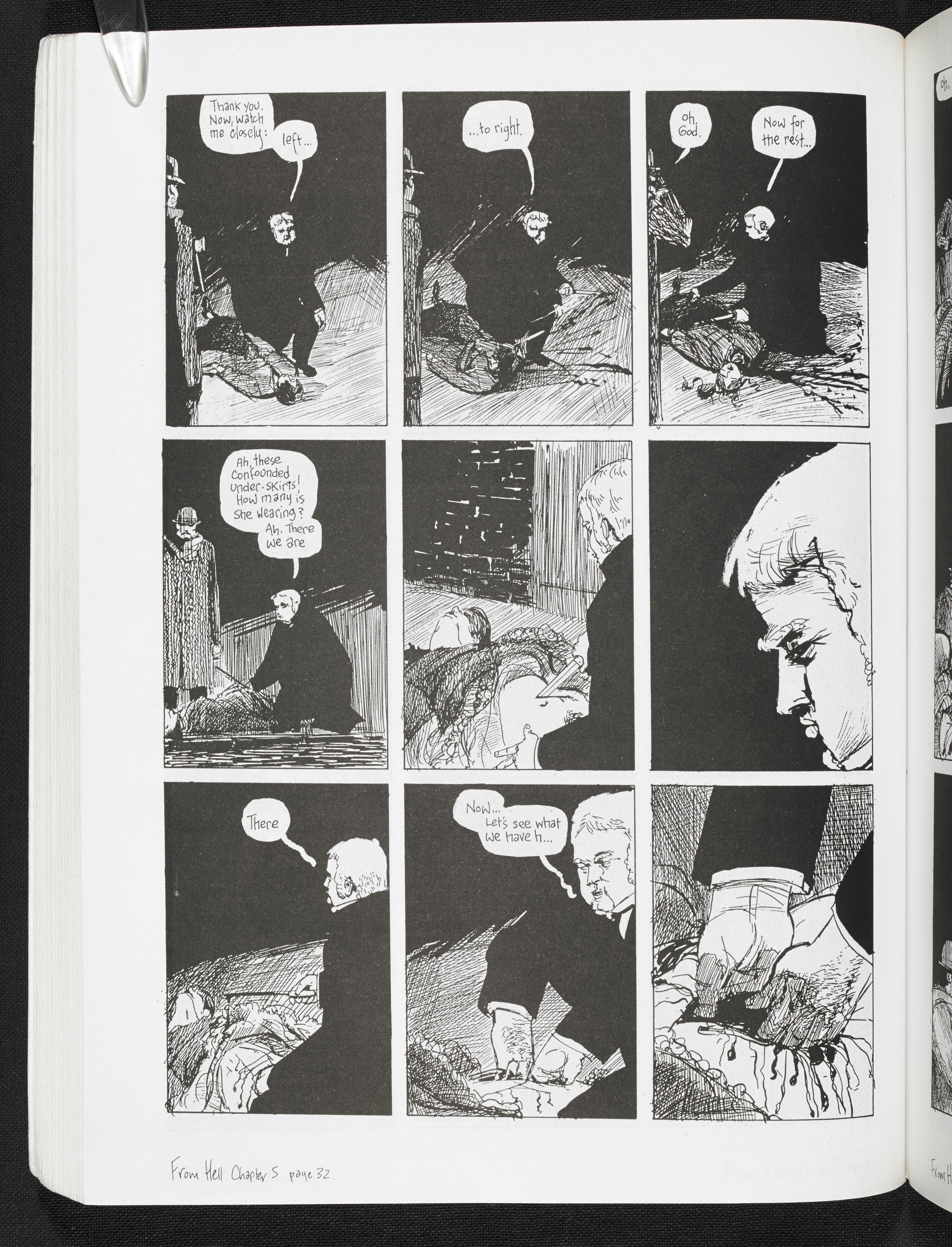
The British Library’s current exhibition, Comics Unmasked: Art And Anarchy In The UK is one of their best for a while. A thematic study of seditious comics in the UK, it covers a lot of ground without over-cramming – a consistent fault of BL exhibitions to date. And while exhibitions devoted to books can get a little frustrating – essentially, you are staring at hundreds of book covers you cannot read – comics work perfectly as you can read a single page and at a glance grasp an awful lot about the concept from the artwork and a couple of panels, such as this from Alan Moore and Eddie Campbell’s London classic From Hell.

From Hell, by Alan Moore & Eddie Campbell published by Knockabout Ltd. 1999 (c) Knockabout

Another plus is that the exhibition never makes excuses for its content matter so we are spared yet another analysis of why comics are for grown-ups. Instead it shows that comics have always been for grown-ups, right back to George Cruikshank (whose work is presented in a tremendous juxtaposition with an OZ strip about Edward Heath). The exhibition also takes a bold step by looking at the historical inspirations for comics writers’ love of magic and fantasy, with exhibits including John Dee’s spell book, the first draft of Crowley’s Diary Of A Drug Fiend and one of his tarot cards. These items are somewhat tenuous, but they are also marvellous and suggest an area a future BL exhibition could explore.

Original painting of Aleister Crowleys tarot card 'The Universe', on loan from The Warburg Institute. Photography (c) Tony Antoniou

There are several items with particular London resonance or import. I was fascinated by Riot, a book written in the immediate aftermath of the 1981 Brixton riot about which I’d love to know more. I also enjoyed the juxtaposition of Batman with Spring-Heeled Jack. There were also several contemporary strips, including Janette Parris’s Arch, about life in Archway, and Katriona Chapman’s contribution to Ink + Paper about renting in modern London. Oh, and there was a comic written by William Burroughs during his London sojourn.

Riot

Riot

Spring-Heeled Jack

Spring-Heeled Jack

IMG_2515

Other countercultural exhibits included a beautifully bound copy of IT, with the cover a reprint of a Situationist comic the publishers had found stuck on their office door (or a lamppost, I forget which) and a comic about the Nasty Tales trial, the IT spin off that was charged with obscenity.

The Trials of Nasty Tales, 1973, cover art (c) Dave Gibbons and Richard AdamsThere’s also loads of stuff on Batman and Superman, with particular reference to the work of Alan Moore and Grant Morrison, while Moore’s Lond0n-set V For Vendetta is a recurring motif. And there’s a decent amount of 2001, including Judge Dredd’s helmet and a never-reprinted Judge Dredd strip about a war between fans of Burger King and fans of McDonald’s – featuring a psychotic Ronald McDonald – that has never been reprinted for fear of a law suit. I also learned that tedious busybody Dan Dare of the Eagle had originally been created as an intergalactic space vicar, which probably explains why I never much liked the man.

Judge Dredd's helmet loaned by DNA Films - producers of 'Dredd'. Photography (c) Tony Antoniou

Now do you want to hear the flaws? There were only three I really noticed. One was the design, which was never quite as weird and psychedelic as I’d have liked (though that may be why I am not an exhibition designer). Another was that there wasn’t enough about the artists, who while by no means neglected were never quite given the attention and praise they deserve. And finally I’d like to have seen more about the development of the grammar and rules of comic book art – how artists have torn up the traditional episodic, thought-and-speech-bubble panel-based framework – which was addressed only superficially towards the end. These though, are little more than quibbles. Go see.

V for Vendetta mask on a manequin in Comics Unmasked. Photography (c) Tony Antoniou


Syd, psychedelia, If…. and the Olympics: an interview with Kevin Whitney

I have a piece in the current issue of Uncut about Psychedelia,  a film made in 1969 and featuring Syd Barrett. The film has been sitting underneath Kevin Whitney’s bed for 40 years, but will be shown in June 2014 at the ICA ahead of its sale. Whitney was on the fringes of the psychedelic movement in the late-1960s and later became the first official artist of the Olympic movement. ‘In my work there are still hints of psychedelic imagery,’ he tells me. ‘But using beautiful athletes instead of mad freaks.’ 

Psychedelia can be seen at Room&Book: ICA Art Book Fair, ICA, 6-8 June. 

——-

‘I was at art school until 1970 and during I was making the film. I was inspired by psychedelic light shows, which I’d screen on the front of Chelsea Art School  at underground pop shows at the Roundhouse. Chelsea Art School was a modern building off the Kings Road. It was the only building built in the 20th century to be used as an art school. It’s now a hotel. It was very anarchic. Art is now geared towards corporate success and Saatchi but then that sort of thing was frowned upon, you weren’t supposed to make any money out of it. You did conceptual things, it was against the system. Now it’s the opposite and has no balls. We were very privileged to be around then. We took art into the streets.

Chelsea Art School on Manresa Road, built in 1963

Previously, I’d been at art school in Ipswich with Brian Eno. We smoked our first joint together at Christchurch Park in Ipswich. We did a thing where about 12 of us would get on a bus and we’d have these sheets of Perspex the size of a newspaper. We cut out the title of the paper and glued it to the Perspex and then sit next to people on the bus pretending to read the stories from this empty sheet of Perspex. Everybody thought we were bonkers.

UFO Club flyer

I never did light shows at the UFO Club. I went there but they had some Americans, Joe’s Lights, who got the contract and nobody else could do it. I knew them and admit I was influenced by their ideas but I also showed them some of my tricks. One was fabulous. You’d get two pieces of Perspex and put in some olive or vegetable oil, then drop some vegetable dye – bright blue, red or yellow – and then close the Perspex together. You’d put that in the projector, which had a very powerful light and would heat up the dye and send it shooting to the edges of the Perspex. It was like going through a timewarp. Joe’s Lights liked this and used it at the Roundhouse for the big Jefferson Airplane/Door show in 1968. [Editor note: I think that while Joe’s Lights did the Roundhouse gig, the Boyle Family did projections at UFO.]

In 1968, I began making my film, Psychedelia. Syd was part of the scenario. Well, he was the scenario. Anybody that would agree I got to appear in the film, which was done at this basement on Old Church Street in Chelsea in a house owned by Antonia Chetwynd [regular visitors included Donald Cammell, David Bowie, Marc Bolan and Anita Pallenberg]. One day I went to Wetherby Mansions to pick up Syd. I was going to take him to the art school to this red and green painted studio I had in the annexe where I was making the film.

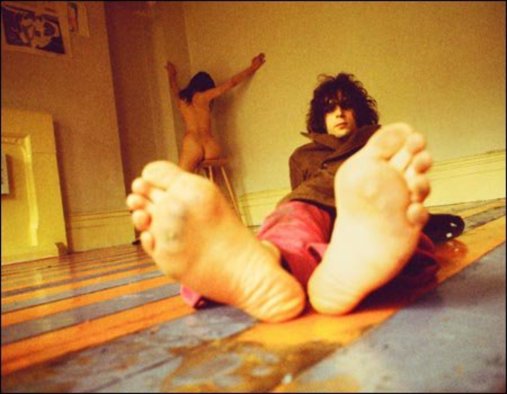
Syd Barrett in Wetherby Mansions

On the way, Syd offered me half a Mandrax. It’s like a sleeping pill that makes you very randy. We took half each. Then we got to the art school and I realised my camera didn’t have a cassette in it and all the shops were closed. So I said we’d do it tomorrow in Old Church Street. In the evening I called Duggie Fields [Syd’s flatmate, still resident at Wetherby Mansions] to check Syd had got back okay and Duggie told me he’d gone to Ibiza. He had a passport with him and he’d just gone to the airport and taken a flight to Ibiza.

When he got back we went to the basement and did the filming. I just had the camera with this psychedelic lighting. It was very amateur and everyone was very stoned. I’d sit people down and tell them to do whatever they wanted. Some took their tops off, some stared at the camera, talked, had a cup of tea… and I just filmed it because they were fabulous people. I filmed so many. In the scene I shot with Syd was Geoffrey Cleghorn, who was a friend of the Who and the Stones. I’d met him at art school in Ipswich and he’d followed when I moved to London and got involved in the whole scene. He’s an amazing guy. There was another chap called David Crowland. There’s a chap called Rupert [Webster], who was the very pretty boy in “If….”.


I screened it while playing Velvet Underground’s Sister Ray. I also use them on the other film I made Red And Green, when they are actually on the soundtrack, the Syd film was silent though I would have been playing Velvet Underground in the basement when making it. I was obsessed with them. It was all very Warholesque.


I gave my camera to Derek Jarman, I was living with the artist Luciana Martinez and she said, ‘You’ve finished with films and Derek’s a lousy painter, so why not give him your camera.’ He’d just finished making The Devils with Ken Russell, doing the sets. I did that and the rest is history. I then got totally into paining, film was an art student fling. In 1982 I got involved with the Olympis and been there ever since.

“Female gymnast”, 1984

I knew Syd as well as anybody could know Syd. He definitely wasn’t on this planet but he was lovely, very charming, and he seemed to like my paintings. He liked to paint himself and because I was pretty good he warmed to me. Also, I don’t hold him in awe, I was the same with Bowie, they were friends and I’d talk to them like that. I’d ask to draw them but treat them as I would anybody. People can treat pop stars in a different way and they can get very isolated. Most people were too much in awe of Syd to ask to film him and I think that comes across in the film. He was a very troubled mind and this wasn’t a great time. He’d been eased out of the Floyd and Dave Gilmour had taken over. But people who knew him said he looks so happy.’


Richard Fortey’s secret tour of the Natural History Museum

Some years ago, the writer and scientist Richard Fortey took me on a tour of his favourite items in the Natural History Museum. His book, Dry Store Room No 1, is one of the best books I’ve read about London museums.

1 ‘This is the collection of all known species of humming birds which I used as the cover for my book. It goes back nearly 200 years to the earliest days of natural history as spectacle. One of the amazing things is that the colours, the iridescent feathers, have survived so long. You can even see the tiny eggs, with the appropriate egg in it. This whole bird gallery is a survivor to the old days of the museum, preserved almost apologetically as an example of the classic gallery, but a lot of people still stop and look at it even though it’s just stuffed birds.’

Pregnant ichthyosaur fossil showing three skeletons of young inside her bodys 2. ‘This one of the great sea dragons, an ichthyosaur, a marine reptile. This one is particularly beautiful and informative because within the body cavity you can see here outlined in red, the remains of other smaller individuals. The question originally was ‘were they cannibals or did they give birth to live young’ and the answer is almost certainly the latter. These animals are very like porpoises and almost certainly lived the same way, gregariously and pursuing a very fast life that gave them no time to sit on eggs. But this is very easy to miss.’

45 NHMX 4597.jpg

3 ‘The building itself. You can choose anything from the various animals and birds that adorn the interior. Even the pillars are based on the bark of trees. On the whole, the building moves from living to fossil as you go from one end to another and that is true also of the animals portrayed. In the mineral gallery, right at the end above a door on the left is a dodo. I also think that one of the monkeys has been made to look a little like Darwin.’

4. ‘The mineral gallery has probably changed the least since my early days and it’s also the least visited. It’s a classic systematic approach where all the minerals are laid out in cases arranged by chemical composition, so you could come here and learn some serious mineralogy if you started at one end and worked your way through. At the end, in the Vault, where particularly precious minerals are displayed, is something  called bournonite with black wheels shaped like cogwheels. This came from a Cornish mine that has since closed so this is really the only good specimen that will ever be found with this particular chemical composition. It’s now extremely valuable because the rarer something gets, the more valuable it becomes.’

5. ‘The blue whale, it might be obvious but it is remarkable. For a while, during the war, some people working here kept an illicit still in the belly of the whale. So even with the best-known exhibit, there are secrets to be had.’

The Natural History Museum's table tops

6. ‘Finally, head for the geology section in the mezzanine level. This used to be an old-fashioned museum in its own right but now it has been changed and in making space they only put back about ten per cent of the specimens. Each one is individually highlighted so it doesn’t give you the systematic overview or leave room for the quirkier items. But this table is still here. It’s a collection of North European ornamental stones all made into one table. You can even make out fossilised nautiloids of around 450 millions year in some of them, and also fossilised coral. There’s no label for it, nothing to say what it is and where it came from. You and I are probably the first people to have stopped and look at this for several weeks.’

Wappingness

This is an edited version of a piece about Wapping  written in 2011.

‘Explore Wapping,’ exhorted Samuel Johnson to Boswell, ‘to see the wonderful extent and variety of London.’ It is fine advice still. Johnson was speaking in the 1790s, when Wapping was London’s principle settlement for sailors, a hive of cobbled streets and damp, narrow alleys that led to the numerous wharves and jetties of riverside London, but his instruction rings true today. Explore Wapping and see how London can demonstrate a seemingly infinite capacity to reinvent itself, how it will welcome newcomers and how it celebrates its past while never neglecting to engage with the future. Few cities have such a knack at looking simultaneously backwards as well as forwards, and few places in London do this better then Wapping. Here, Morrissey explores Wapping landmarks in his 1992 video, “We Hate It When Our Friends Become Successful”, just as the area was undergoing heavy gentrification.

To understand Wapping try approaching it from St Katherine’s Dock, the pretty riverside development that lies adjacent to the Tower of London. Leave St Katharine Dock at the point where it almost touches the Thames and you will arrive in Wapping at the very western end of Wapping High Street, the charismatic street that runs parallel to the river for the length of the district. Here, on the corner with Kennet Street, is a large stone wall, decorated with icicle-like drips of cement. Inside the wall is a large red brick building, which still proudly wears the emblem of the Port Of London Authority, although this has over time turned the sort of misty green colour you associate with cannons dredged from the ocean floor.

This is the old dock house, a remnant of when Wapping was home to London Docks, and it stands next to Hermitage Basin, one of the few parts of the dock complex not to have been filled with concrete and covered with roads and houses in the 1970s. Hermitage Basin once offered a way for ships from around the world to get from the mammoth London Dock to the Thames, but now it is a sweet little ornamental lake surrounded by houses, and a home itself to a sedate family of regal swans and the odd mallard.

Hermitage Basin is a fine example of what you could call Wappingness: the way Wapping has come to terms with its past, making sensible accommodation with what has been before. This has not been an easy task. Wapping has been battered by change over the centuries, first when the docks were built in 1805, carving great watery holes throughout the neighbourhood and reducing the population of 6,000 by two thirds, and then when they were filled in again in the 1970s, eradicating what had been Wapping’s identity for more than 150 years. The warehouses and docks of Wapping were also heavily targeted by German bombers during the Second World War. But still it prospers.

Signs of Wapping’s maritime heritage are everywhere. Before the docks arrived, it was a place of wharves, jetties, warehouses, boatbuilders, sailmakers, brothels and pubs, having been originally settled by the Saxons and used by London’s sailors for centuries. The building of the docks over reclaimed marshland helped cement these long links with the sea, even if they replaced the bustling village atmosphere with vast warehouses and a more transient population. The London Docks were the closest docks to the City of London, which gave them a significant advantage over those docks that had recently been built on the Isle of Dogs.

In these Wapping warehouses, dockers would unload treasures from right across the British Empire, including tobacco, rum, whalebone, spices, cocoa, coffee, rubber, coconuts, marble and wool. Settlers from overseas lived in Wapping – nearby Limehouse was home to London’s first Chinatown and is now home to a thriving Bangladeshi community – and artists, writers and poets would come to Wapping to glimpse exotica in the form of both the goods brought from overseas and in the working-class men and women who lived and worked in the area. They would then disperse around London and the East End, taking some of the essence of Wapping with them across the Highway into Whitechapel, Spitalfields and beyond. Later still, artists set up studios in the derelict warehouses of Wapping in the 1970s, heralding a trend that soon spread throughout east London.

The chief attraction, of course, was the river, although the Thames itself can only intermittently be glimpsed between the tall warehouses that act almost like a river wall. But stroll round Wapping and you’ll see signs of its maritime history everywhere in the shape of weathered dock walls, converted warehouses and industrial walkways that allow passageway high above the cobbled streets. Here are restaurants and pubs that pay homage to the past, plus a pretty canal that stretches in a narrow strip from Hermitage Basin in the west to Shadwell Basin in the east, offering a slender shadow of the bustling docks that once stood here. Between buildings on Wapping High Street you can see numerous ancient stone stairs, green with age, that lead directly down to the river.

Such is the all-pervasive water-soaked atmosphere that Wapping itself can even feel like something of an island, bordered on three side by the liquid barriers of the Thames, St Katherine’s Dock and Shadwell Basin and with a busy main road, the Highway, to the north, cutting it off from the rest of London. And within this island, there is just as much to explore as there was in Johnson’s time. You can find London’s oldest riverside inn, the grisly site of pirate executions, an abandoned shopping centre, a gorgeous listed church, a power station turned art gallery, a historic foot tunnel, London’s only memorial to the Blitz, a beach that the Beatles posed on, mudlarks searching for Tudor bric-a-brac, Wapping Wood and an escaped tiger. So follow Johnson, explore Wapping, embrace Wappingness.

London by the bollards

I have a piece in the Autumn 2013 issue of Completely London about London experts, those Londoners who specialise in esoteric subjects like lion statues, ghost signs and stinkpipes. You can read part of it here. My interview with John Kennedy, London’s bollard supremo, didn’t make the cut so I have reproduced it below.

John Kennedy, 47, taxi driver & writer of Bollards Of London
Most people in London get excited about the Tower of London and Buckingham Palace but when you drive a taxi you get bored of the norm and start to look around and notice other things. With me, it’s bollards. It actually began as a bet with ‘Big’ George Webley, a radio presenter. He challenged me to write a blog about something weird and it got picked up by the Guardian. Now I’m really interested in bollards, the way they look, where they are located, what they are used for and how we interact with them.


Bollards have so many uses but most people don’t notice them no matter how colourful, ornate or dandy they are. I really like the Anthony Gormley bollards in Peckham. I love that one of our great contemporary artists is making street furniture. I picked up Charles Saatchi recently and we ended up talking bollards, he found it quite amusing that I had a blog with pictures of 330 bollards. You do get some odd looks when you photograph a bollard – the other day I was spotted taking a picture by somebody. He said, ‘You must be the bollard man.’

The Clash in Soho

The Clash have opened a, wait for it, pop-up shop in Soho to promote the release of their new box set. It’s only open for a couple of weeks, and I happened to be in the West End yesterday so paid a quick visit, joining a crowd made up entirely, and unsurprisingly, of middle-aged men.

I wasn’t actually expecting a great deal, but was pleasantly surprised by what I found. While the upstairs is essentially a Clash mini-mart, flogging copies of the band’s albums as well as the Sound System box, the downstairs is more like a mini-museum of Clash memorabilia, featuring the iconic alongside pleasing ephemera.

So while the biggest draw was the buggered bass guitar that Paul Simonon is seen smashing on the cover of London Calling

IMG_1934

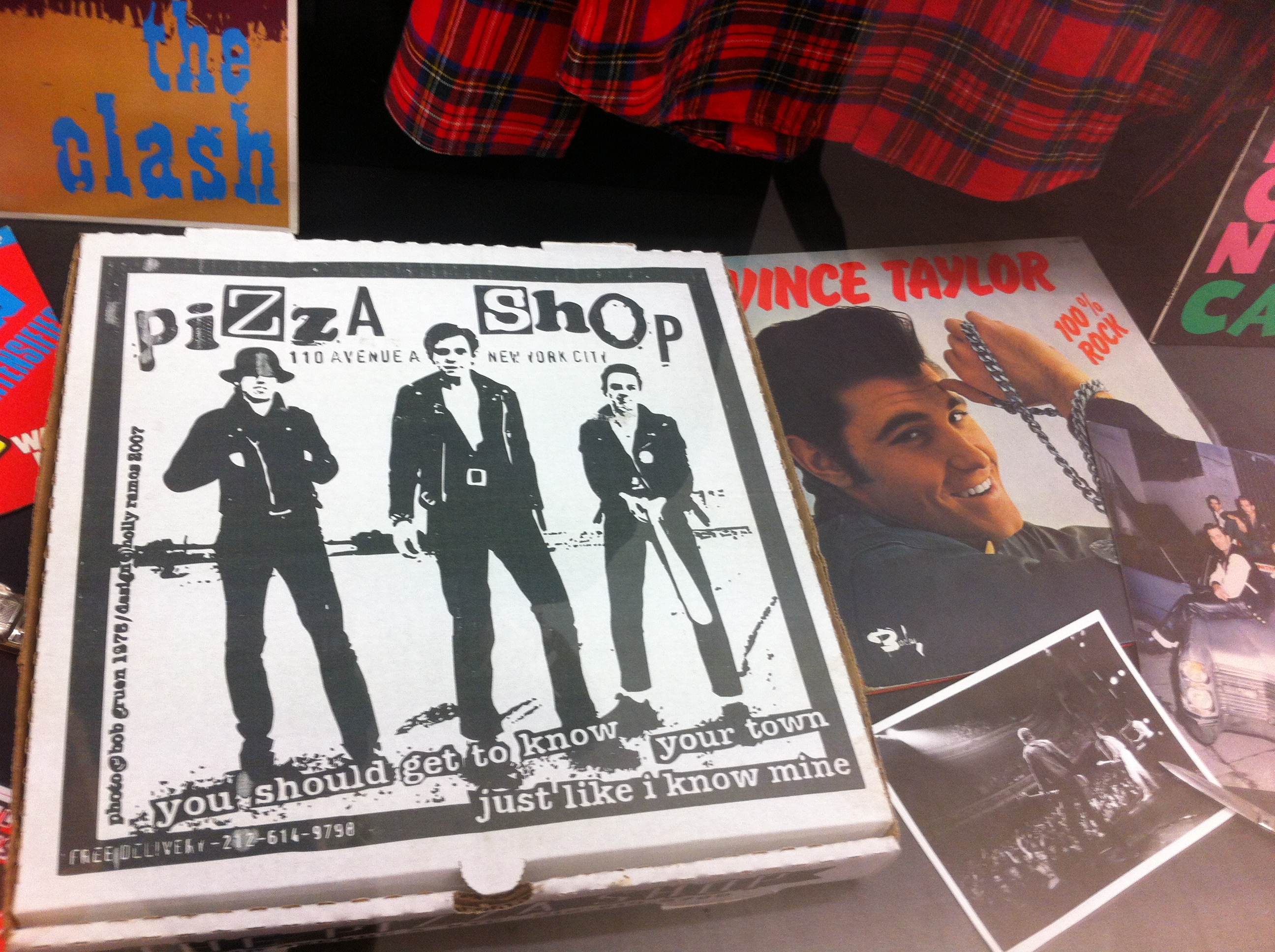
… I rather preferred witty juxtapositions like this, which places a punk-referencing pizza box alongside a Vince Taylor LP.

IMG_1930

A long cabinet acts like a timeline of the band’s history, crammed with ephemera relating to the band personally and politically, but also to the musical and literary influences they were absorbing along the way. So the section around the time of, say, Sandinista!, is full of South American political paraphernalia, lyric sheets and cassettes of the music they were discovering, while further along, at the time of Combat Rock, it’s all about cowboys and indians, and the US military. It was a bit like the Bowie V&A show in miniature with a better developed sense of humour, and ably demonstrated that the three-dimensional, technicolor world of rock and roll offers huge potential for entertaining and informative exhibitions when handled with the right blend of respect and irreverence. One day, one hopes, somebody will do a Beatles exhibition that works along similar lines.

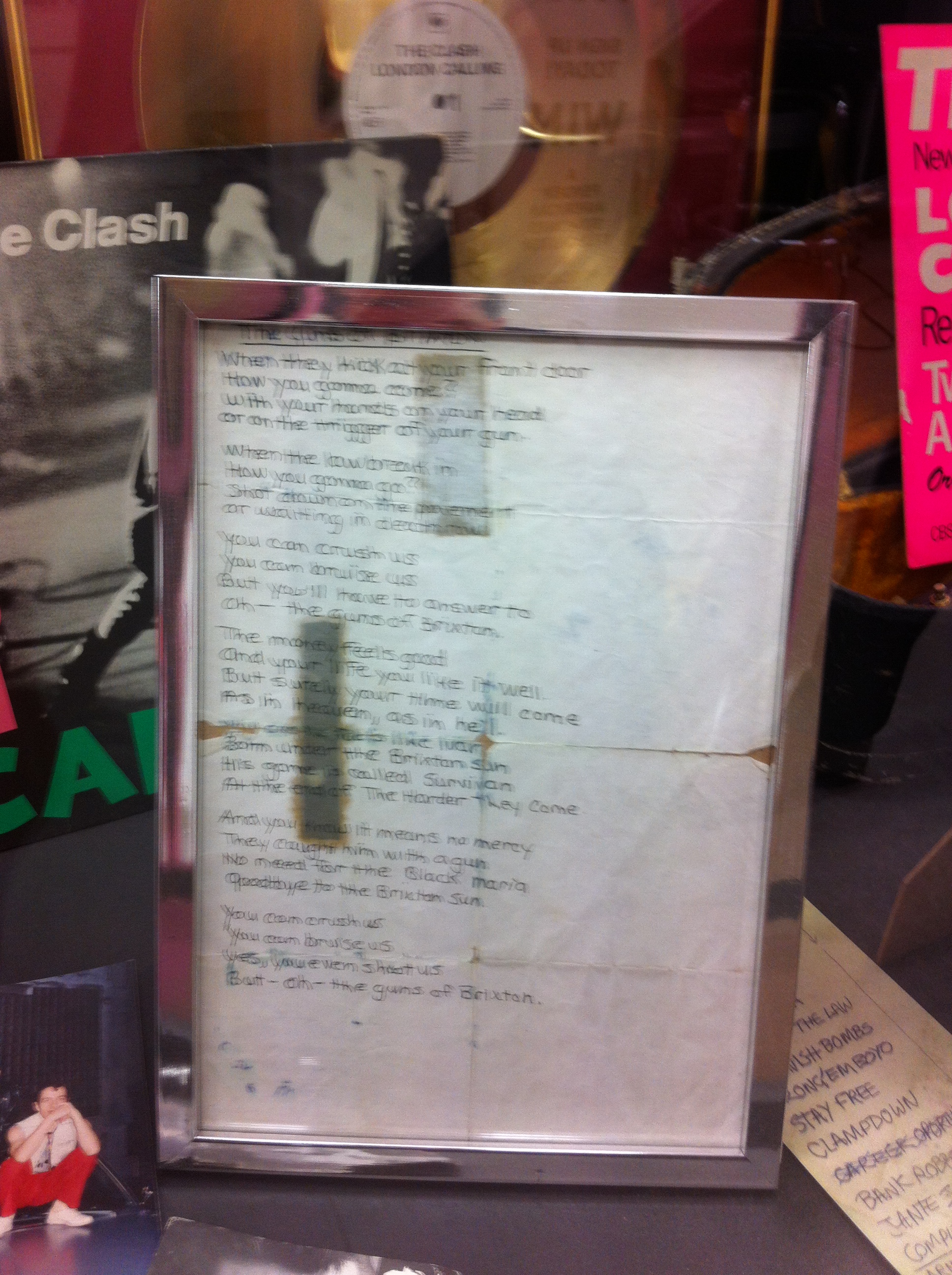
Other items of interest included the Clash’s map of the world, Paul Simonon’s certificate of appreciation from the Guardian Angels, the hand-written lyrics to “Guns Of Brixton” and an old beat box, with rather touching home-made cassettes. Everything is offered entirely without explanation, which is part of the fun. Check it out.

IMG_1933

IMG_1932

IMG_1931

IMG_1935

Black Market Clash, 75 Berwick Street, W1. Open until September 22.

Jonathan Gili, on collecting and connecting

Paul McCartney-designed wrapping paper for Indica bookshop and gallery.

Paul McCartney-designed wrapping paper for Indica bookshop and gallery.

The wonderful new catalogue by Maggs counterculture is dedicated to (a fragment) of the vast collection amassed over four decades by the film-maker Jonathan Gili. An insight into Gili’s collecting instinct comes from this article by Anthony Gardner:

Lift the lids of the boxes, and you can scarcely believe your eyes. There are bottles of Star Wars bubble bath and packets of Beatles bubblegum; fridge magnets shaped like kettles and Danish pastries; hair clips
commemorating the Queen’s coronation; Camembert boxes and plastic lizards and packets of tortilla chips. It is as if all the flotsam and jetsam of post-war consumer society had been washed up on a concrete shore and painstakingly catalogued by an tireless, obsessive beachcomber.

Although the catalogue focuses on the recognised brilliance of London’s 1960s psychedelic poster artists like Martin Sharp and Haphash And The Coloured Coat, Gili would collect anything – indeed, Gardner notes he was particularly drawn to sardine tins and even self-published a book about them. The items Maggs has for sale includes such magpie oddities as shopping bags, wrapping paper (albeit designed by Paul McCartney) and old newspaper posters, such as this one regarding Joe Orton’s murder, taken from a newstand in London in 1967.

1465_28

In 1986, Gili wrote an article about his collection asking rhetorically: ‘Who could resist records shaped like Elton John’s hat or Barry Manilow’s nose? They have poor sound and often can’t be made to play at all… but as art objects they are sublime.’

Sadly, there are no records shaped like Barry Manilow’s nose in this catalogue as much of Gili’s collection went to a private collector sympathetic to the intentions and ambitions of Gili. But what makes somebody collect stuff like this? In his short, thoughtful, introduction to the catalogue, Carl Williams – who knows much about collectors – ponders that question. Collectors are often said to be creating a bulwark against their own death, but perhaps, speculates Williams, they also wish to act as a guardian for those things that would otherwise be ‘forgotten, scorned or destroyed’ as tastes and times change?  Today’s trash is tomorrow’s museum piece; yesterday’s lunatic is the future’s visionary. Gardner touches on this, with an anecdote in which Gili ‘rescues’ a particularly revolting object from a garage forecourt. It’s a revealing story. By the very nature of his collecting this worthless item, Gili has given it value. But he’s also, clearly and very simply, enjoyed the moment, relishing both the acquisition and the reaction it will get from his co-conspirator. Why collect? Why not!

Lucinda Lambton tells a story which epitomises Gili’s passion for acquisition. ‘We were driving through the outskirts of Guildford,’ she says, ‘and he suddenly shouted “Stop!” Then he jumped out of the car while it was still moving and ran across this huge, horrible garage forecourt. When he came back, he was triumphantly waving a gold-lamé-clad Michael
Jackson doll.

Collections also gain their own momentum, and I sometimes wonder how many collections have been made almost by accident – one minute you are idly picking up old books about London from secondhand shops and markets, the next thing you know you have 250 of the things and, inadvertently, the beginnings of a minor collection. And if you’ve started, you might as well finish. What else is there to do with your time?

More obviously, collectors hoard items that carry the echo of a cherished memory, certain pieces that remind them of a special moment in their past, or of a past they wished they had. Many of the items being sold by Maggs are focused around the London underground scene of the 1960s. I’m not sure quite what relationship Gili had with the counterculture, but he was clearly an interested observer at the very least – and he edited cult London film Bronco Bullfrog, with soundtrack by 1960s Gilbert & George support act, Audience.

Gili’s 1960s collection includes a number of items from that era that have always been regarded as important and beautiful, such as these stunning posters by Martin Sharp, one of my favourite psychedelic artists and, in my view, a rival to anything that came out of the more lauded Bay Area poster scene.

Cream by Martin Sharp

Cream by Martin Sharp

Purple Dylan by Martin Sharp

Purple Dylan by Martin Sharp

Oz magazine

Oz magazine

UFO Club poster

UFO Club poster

Many of the objects are related specifically to the London scene – the shops, clubs, galleries and ‘fun palaces’ of 1960s London. Gili, then, had a close relationship with this city. One of his best-known films is the charming To The World’s End, about the No 31 bus journey from Islington to Chelsea. Interestingly, 1960s historian Jonathon Green recalls a map of this very bus route once published as a cover of IT newspaper, showing how it connected some of the key points of swinging London – ‘The hippie highway: all the way from Granny Takes a Trip to the Roundhouse’, as Green puts it.

A semi-thorough scouring of the ever-so-distracting IT archive has not turned up this delightful sounding map, so perhaps it was produced by one of the many other underground papers of the era. But it is not a massive leap to speculate that Gili, the great collector of underground London, noted this off-kilter way of observing and uniting the London villages, and later chose to make a film taking precisely that approach. Collections, like buses, are a way to make connections.

fotoflexer_photo

Secret London: torture at the Temple

In some parts of London you can travel in space as well as time. Take the Temple. This characterful cluster of medieval buildings, gardens, courts and alleys wedged between Fleet Street and the Thames seems to have been uprooted from an Oxbridge college and dropped brick-for-brick in central London, just a heartbeat from the Embankment.

The Temple is a maze of cobbled paths and narrow arched doorways leading to small courtyards that have names like Pump Court and King’s Bench Walk. Most of the buildings are offices occupied by lawyers – this is London’s legal quarter, where barristers receive their training – but the area is also popular with tourists, who have found their way into this most secluded spot. They are here to see the Temple Church, one of London’s oldest churches and, with its distinctive circular nave, also one of the most atmospheric. It’s a building that exudes medieval mystery, and rightly so. Temple Church was founded by one of the world’s most intriguing secret societies, and continues to exude a curious, almost sinister vibe, a feeling that there is more to the Temple than meets the eye.

Even those who know the place well can sense the mood. ‘Buildings have memories,’ says Oliver the verger. ‘And this building has seen some turbulent times.’ Oliver is an intense young man who holds the keys to the secret parts of Temple Church. But that must wait. First, he offers a potted history, one that explains why the Temple is off the beaten track but very much on the tourist trail.

The great London writer HV Morton wrote in 1951 that ‘The Temple brings into the heart of a great city the peace of some ancient university town and the dignity of a past age’, and although the Temple area is redolent of Oxbridge its holy centrepiece is actually a stand-in for a more distant city. The Temple Church was built by the Knights Templars in the twelfth century. The Templars were a holy order formed in 1118 to protect European pilgrims visiting the Holy Land. Their base in Jerusalem was supposed to be the site of the Temple of Solomon, so the warrior-monks became known as the Knights Of The Temple of Solomon of Jerusalem, soon shortened to Knights Templars. The Knights Templars had churches and land all over Europe. In London they settled in Holborn but moved nearer the river in 1162, where they built the church. This great round edifice, the New Temple, was consecrated in 1185. Its circular nave paid direct homage to the Church of the Holy Sepulchre in Jerusalem, the idea being that Londoners could visit Jerusalem without leaving the city. Such symbolism was easily grasped by medieval worshippers, who understood how one place could represent another and how the present could fold into the past.

The Knights Templars’ management of the routes in and out of the Middle East soon brought them great wealth, with which came great power, with which came great enemies. Rumours – started by rivals in other religious orders and the nobility – began to spread of their nefarious conduct, and of their sacrilegious and obscene initiation ceremonies, which took place on sacred ground, in London’s case in the crypt beneath the church. It was said that members spat on the cross, worshipped cats and practised ‘unnatural vice’ with each together. As hostility heightened, the end was inevitable and bloody. Phillip IV of France, who, coincidentally no doubt, was heavily in debt to the order, arrested leading French Templars in 1307 and through torture and imprisonment, gained lurid confessions about their immoral conduct. The order was dissolved in 1312.

Although the end for English Templars was not quite so brutal, the abrupt dissolution of the order – and the rumours that surrounded it – has provided fertile ground for conspiracy theorists. Some argue that the Templars were abolished because they knew more about the origins of the organised church than they should, others claimed that the Templars did not disappear, but were merely pushed underground and continue to operate to this day as a clandestine force that shape the world order. Novelist Dan Brown seized on versions of these myths for his blockbuster ‘The Da Vinci Code’, and, having done his research, settled on Temple Church as a suitably spooky location for some key aspects of the action.

52 TEMP 14.jpg

Brown was doubtless drawn by the dominant feature of the church, the ten statues of knights that lie on their backs on the floor in the centre of the circular nave. These stone effigies of dead Templars are frozen in time like Neolithic humans dredged from a peat bog. Despite having lain here since the twelfth century (one, commemorating Geoffrey De Mandeville, is dated 1144 making it older than the church itself; it is said to be here, because no other church would bury him), some have sharp, fine feature, while others have faces melted by German incendiary bombs. All look like they are covering something, perhaps an opening to a secret chamber. They certainly appear to serve some function greater than mere decoration. When you stand in the airless centre of this strange church, looking at this ancient stonework, you can feel the clammy arm of history encircling you. For centuries, Londoners and travellers will have stood at this spot, and bar some cosmetic changes – the church has been refurbished three times, by Christopher Wren, by the ever-busy Victorians and after the Second World War – will have gazed upon the same sight. Nothing has changed.

Oliver the verger interrupts my reverie with some subtle key jangling. We head over to a small door, which he unlocks to reveal a spiral stone staircase. We are seeking the penitential cell. This is where the Master of the Temple – the gloriously authoritarian title given to the church’s head priest – used to punish the unholy. The unfortunate Walter Bachelor was left to starve to death in the penitential cell after disobeying the Master, which is a particularly serious form of penance  as you can’t really repent after you are dead. The cell is halfway up the stairs and now has the appearance of a broom cupboard. It’s tall, but narrow, so a man can stand but not lie flat. Most disturbingly, it has windows overlooking the interior of the church, so those sentenced to starve could look down upon the statues of the crusaders, who would bear silent witness to the suffering taking place above. When we talk of a punishment being medieval, this is what we mean.

Oliver does not enjoy talking about the penitential cell, understandably uncomfortable with such ugly things occurring in the place he has to work every day. He also maintains a theological distance. He says this cruel punishment must have been a Templar thing, nothing to do with the organised church of the time. The Templars, it seems, are destined to play the role of scapegoats for centuries to come.

Oliver and the current Master, though, are happy to play the Templar connection to their advantage when it suits. Dan Brown’s novel brought unprecedented interest in their church, and the Temple suddenly became a hit on the tourist circuit. The Master wrote a book debunking the myths and generally tapped into the new-found interest. Now ‘The Da Vinci Code’ fever has worn off, but the Church has stayed in travel guides on its own merits, remaining a must-see for tourists from all over the world. Here they learn about the Temple Church’s history after the order was dissolved. After passing into the hands of the crown, the surrounding Templar land was given to barristers in 1608. They had begun to locate here from around the fifteenth century. After receiving the land rent-free, the barristers agreed to maintain the church and the Master in perpetuity. The most colourful example of them protecting the church occurred in 1678 during an outbreak of fire. The junior barristers quelled the flames with beer; it took six years for them to settle the brewer’s bill.

In preparation for the arrival of the day’s first tourists – and some are already milling outside waiting for their chance to snoop the ancient masonry – Oliver throws open the vast West Door. This huge arched door opens on to an easily overlooked alleyway, on the opposite side of the church to the large square that fronts the main entrance. It is a magnificent piece, thick regal wood surrounded by an arch of elaborate carved stonework. Nobody knows its age, although Oliver points out that some of the faded figures are wearing buttons, which were supposedly unheard of in Britain before the fourteenth century as they were associated with Muslims, the very foe the Templars were formed to fight.

Standing in this quiet spot round the back of the aged church staring at a door that by implication if not construction dates back to the twelfth century, it is easy to feel that you have slipped through time. One London writer, James Bone, said in 1919 that ‘At Temple, you are as close as an echo to the past’. Here, the echo resounds loudest and longest.

Gilbert & George and David Bowie at the Marquee, 1968/9

Should you be fortunate enough to attend the superb David Bowie exhibition at the V&A this spring, one of the first thing you will see is a video of the artists Gilbert & George performing their ‘Singing Sculpture‘. The intention, I think, is to draw a connection between Bowie and conceptual art, but there is another facet of the relationship between David Bowie and Gilbert & George that goes unmentioned: they both played gigs at the Marquee.

I have an article in the current issue of Uncut about the Marquee club. It mainly focuses on The Who, and while asking around about people who may have seen Townshend and Co perform at the Marquee I received an intriguing email from the writer Jonathon Green, who recalled a show at the Marquee in 1968. ‘They were holding auditions and some pals of mine who had a band tried their luck. Unsuccessfully. Naturally we friends tipped up to cheer. But the weird moment of the evening was when this pair of blokes appeared and, saying nothing, sat for some minutes on either side of a table that they placed centre stage. The two blokes, it transpired, though I must admit I can longer recall when I made this discovery, were Gilbert and George.’

Astonishingly, it seems London artists Gilbert & George did play the Marquee at least once – as they mention here – and possibly even twice. Because as well as the evening Green recalls they also played a show there in early 1969, when they were supported by Audience (who later played on the soundtrack to cult suedehead film Bronco Bullfrog).

I asked two members of Audience about their show with Gilbert & George. Sadly, G&G themselves did not respond to repeated queries about their Marquee days.

Trevor Williams: ‘It was an audition night for us, but I’m not sure what they were doing there unless it was to audition an act they were planning to perform later at the Marquee. It was our first live gig but their act basically consisted of them sitting at a table on two chairs facing each other. They were in suits and their faces were painted gold or silver and one told the other stories while the other said nothing. These were very macabre little stories one of which involved a dwarf committing suicide in the bath and the water getting pinker and pinker but never got red because there’s not enough blood in a dwarf.

They were really nice, pleasant, social guys. I don’t remember how they were received but it was an era when anything went and people enjoyed anything off the wall. I’ve no idea how many people were there although somebody once told me that Germaine Greer was in the audience that night.’

Howard Werth: We first encountered Gilbert & George at the back of the Marquee when these two tweed besuited gentlemen with metallic gold heads and hands, in the style of shop window dummies of a gentlemen outfitters, poked their heads into our van politely asking where the entrance to the Marquee was. We were getting ready to audition as were they. Their act consisted of them both seated with one of them (Gilbert I believe) relating a rather strange tale involving dwarves whilst the other one (George) listened intently, chin on fist. I remember Germaine Greer backstage who was trying to get members of another audition band to retrieve some of their equipment they’d left at her flat in the Pheasantry in the Kings road. We shortly after did a gig at the Lyceum with Gilbert & George, I believe they were about to leave Central St Martins art school around that time.’

So there we have it. In an alternative universe perhaps Gilbert & George gave up art and continued their life in music, while David Bowie, fed up of playing bottom of the bill at the Marquee, jacked in the pop trade and threw himself wholeheartedly into the curious world of conceptual art.

Secret London: the Science Museum’s palace of pills

© Science Museum/SSPL

Time Out recently asked me to contribute to a piece on London’s 10 weirdest museum exhibits (something I’ve blogged about previously). My favourite previously overlooked discovery was the above ‘Palace Of Pills’ at the Science Museum.

This extraordinary sculpture, constructed from old pills, medicine bottles and syringes, was made for a campaign run by the East London Health Project between 1978 and 1980. The ELHP was a coalition of health worker unions and local Trades Councils who were campaigning against cuts to the NHS as well as highlighting other healthcare issues facing Londoners in the late-70s. This was the first time the NHS had really come under sustained attack from any political party since it was formed in the aftermath of the Second World War.

The Palace of Pills was created by artists Peter Dunn and Loraine Leeson, who built the sculpture in their studio using old pill bottles that they acquired from the ELHP’s partners working in the health service. They then photographed it for a poster that was displayed in waiting rooms and doctor surgeries.

‘We did eight posters,’ Leeson told me. ‘The Palace of Pills was made for a poster that talked about how the drug companies were dominating what was happening in health, and for reasons of profit not health.’ The model was too big for the studio and already starting to deteriorate when the Science Museum asked if they could have it. ‘They saw it as a curiosity but I’m delighted it still exists,’ she says. Leeson and Dunn took the experience into creating posters for further pioneering campaigns against the redevelopment of Docklands.