Category Archives: Architecture

London’s lost rivers

There is almost endless fascination with London’s lost rivers, as can be seen with the publication of Paul Talling‘s fine – if brief – new book on the subject. I have written about them a number of times and this article first appeared in Time Out in 2008.

Londoners love what they cannot see. Take the excitement that is generated by ‘ghost tube stations’ such as Museum and Aldwych that sit unused beneath our feet and can occasionally be glimpsed from trains. Yet people rarely blink when they descend escalators into the remarkable interiors of busy, living stations. Concealment and abandonment excited the mind more than the here and now.

So it is with London’s lost rivers. Anybody can check out the quirky Lea or watch the Wandle weave serenely past Merton Savacentre, but mention Brixton’s Effra or the City’s Walbrook rivers and the eyes of a certain sort of Londoner will light up, and a torrent of trivia about lost rivers will gush forth. This is an interest that can take us to unusual places. When Design for London recently mounted London Open City, an exhibition about creating new spaces in the capital, the idea of restoring buried rivers got people talking. The Sunday Times claimed Boris Johnson was going to greenlight the scheme and Peter Bishop, then director of Design for London, said: ‘When these rivers are opened up, Londoners will be absolutely amazed.’

Which was great news for James Bowdidge, a property developer with a yen for the Tyburn. ‘As soon as I learnt about it, I became fascinated with the old river and the way you could see it in street patterns,’ says Bowdidge, who channelled his enthusiasm into a curious project – ‘an angling society for a river that didn’t exist’. The Tyburn Angling Society, an irregular supper club, was born – Ken Livingstone attended their 600th anniversary dinner, 600 being a number they plucked out of thin air.

So far, so whimsical.

However, Bowdidge – a London buff with half an eye on property prices – has also looked into raising the Tyburn, which was covered in 1750 but still meanders underground from Hampstead to Westminster. ‘I asked an architect to draw up plans of the building that would have to go. We write to Westminster City Council about it every now and then. But they are sceptical because this particular plan requires the demolition of their headquarters.’

Now Bowdidge’s hope is renewed. ‘If you look at the planning statement the Mayor brought out, you can see a degree of support for this sort of project. And now the subject is live it’s worth thinking about seriously – what could you do? There’s no reason why you couldn’t reinstate the river through Regent’s Park. You don’t have to demolish billions of pounds of property, there are places where you could really bring it back if you looked at it pragmatically.’

Well, perhaps. The notion that Boris has gleefully embraced the scheme is not supported by the raised-eyebrows reaction of a GLA spokesperson, who told me: ‘Opening up parts of London’s subterranean river networks is one of many ideas proposed at the exhibition… As with all the ideas designed to stimulate thinking, a full study would need to be undertaken before any could be taken forward.’

In other words: Never. Gonna. Happen.

At least, not with the Mayor’s money. But there are always other pockets to pick. In 2003, the Environment Agency rescued the Quaggy, a tributary of the Ravensbourne, from an underground culvert in Kidbooke’s Sutcliffe Park, and there are plans to restore the Ravensbourne itself in Lewisham town centre, paid for by a regeneration group called Urban Renaissance in Lewisham (which includes the Quaggy Waterways Action Group). Architect Will Alsop has floated a similar scheme for Croydon, where a branch of the Wandle is interred. He says, ‘The buried river thing Boris is banging on about is a really good idea. In Croydon, the Wandle was only buried in 1967 so you can easily bring it back in patches: ponds or lakes or some elements of river. And you don’t even have to bring them back; you can leave some underground and go and see them there.’

Which brings us neatly to the most interesting scheme, that of Nick Robertson, a designer and London obsessive who once walked the Thames from source to sea with Peter Ackroyd (‘every Saturday for a year’) and harbours a fascination for the Fleet. Bowdidge refers to the infamously filthy Fleet as ‘the ditch’, and Robertson does not disagree. ‘There’s nothing artistic about the Fleet,’ he says. ‘It was bricked up for good reason. He’s right to call it a ditch. But some ditches are worth celebrating.’

Robertson’s plan was ‘the confluence of several ideas’. One was a walk he completed along the course of the Fleet – ‘it was a river route, you could see it in street names, and in the topography and geology; a river that wasn’t there, but was.’ A second influence was an exhibition at the Royal Academy in 1996 called ‘Living Bridges’, which author Stephen Bayley has said marked the ‘moment when bridges have become showpieces of architects rather than engineers’. And the third was a visit to the Monument, the column raised by Wren and Hooke in 1677 to commemorate the Great Fire.

Robertson explains: ‘What interested me about the Monument was that it wasn’t representational. You climbed this big Doric column and saw what you saw, which was the extent of the destroyed city. The Monument is not the monument – what you see, the rebuilt city, is the monument. Stylistically, it’s of its time but conceptually, it’s way ahead.’

Robertson and an architect friend Iain Johnston explored options. ‘We discussed whether it was a good idea to open up the river and very quickly dismissed it because most plans to open up the hidden river are missing the point. The point is this river is covered. That’s what is interesting. To open it up is to ignore the historical process. And it’s ignoring the mystery, the charm. If you opened up the Fleet, it would regress to what it was, an urban river: charmless, shit-filled.’

Instead, Robertson ‘thought it would be interesting to have a bridge that went underground and the obvious site was Ludgate Circus because that was the site of the Fleet Bridge and Wren’s bridge when he tried to turn the Fleet into a canal.’ They designed a subterranean chamber that went under the road and had a glass floor through which visitors could observe the still-living Fleet. ‘A warped bridge over a warped bridge’.

He sent his proposal to the head of Thames Water where, as far as he knows, it still resides. The Fleet and the Tyburn were incorporated into Joseph Bazalgette’s sewer system in the 1860s and both Bowdidge and Robertson have blagged trips underground with Thames Water sewer workers. Says Robertson: ‘One of the things I found most interesting was the amount of decoration. The designers stopped and thought what they were doing even though nobody was going to see it – it’s effectively dressing up shit.’

It’s true. London river-sewers are artfully constructed, beautiful things that deserve celebration, both for what they are now and what they used to be. The Guardian’s Ian Jack disagrees. When confronted with Bowdidge’s cheerful scheme of tree-lined tributaries, he wrote that the Tyburn was a ‘sewer owned by Thames Water and more remotely by pension funds in Canada and Australia. It has been a sewer for hundreds of years as part of a combined system, far too expensive to separate, that carries rainwater and human waste.’

And that’s that. Robertson at least sees a way past this brutal approach, and while his Fleet Bridge is the sort of imaginative scheme destined to go nowhere, he also believes the Fleet should be remembered in simpler ways, such as surface markers along its course of which there are none. It seems London is ashamed of its lost rivers, or at least of its treatment of them.

‘The Fleet is something London has buried,’ says Robertson. ‘So it appeals to people who feel strongly about the occluded side of London history.’ The best way to deal with it, he thinks, is to go down and confront this ‘trapped nerve’.

‘It was once a bubbling brook of bucolic bliss, then it turned into an open sewer, then it was bricked up,’ he says. ‘Now it needs to recreate itself in a different way. To open it up is to miss the point, pandering to a nostalgic view of London. London should never be nostalgic.’

Spoken like a true Ballardian (and Ian Jack would surely approve), but everybody, even a ruthless modernist, is allowed to look back every now and then and wonder. So Robertson tells me to head up Farringdon Road and down Ray Street towards Back Hill. There, in the road outside The Coach & Horses, is a grill, and ‘when you stand over it,’ says Robertson, ‘you can hear the Fleet belting beneath your feet.’

So it does, the magnificent sound of a torrent of water battering its way downhill directly beneath London streets. Sewer or river, call it what you will, but the Fleet lives on. Deep waters run still.

Secret London: more bits of lost London Bridge + Lorne Greene

Last week, I looked at where parts of Old London Bridge had ended up after the medieval bridge was demolished in the 1830s. But the story does not end there.

The new London Bridge, built by John Rennie, only lasted 140 years before it too was replaced, rendered obselete by the invention of the motor car. Rennie’s bridge was, famously and rather brilliantly, sold to Americans and moved to Lake Havasu City, Arizona, where it has become a tourist attraction.

The story that the Americans thought they were really buying Tower Bridge is almost certainly apocryphal. The bridge in Arizona was opened by the Lord Mayor of London at a banquet at which the master of ceremonies was Bonanza’s Lorne Greene.

Then they made a film about the bridge starring Greene, Tom Jones, Kirk Douglas, The Carpenters, Charlton Heston, Rudolf Nureyev, Terry-Thomas and Engelbert Humperdink. It was called The Special London Bridge Special and here it is in full.

But although the Americans paid £1 million for the bridge, they didn’t get the lot and a small selection of bits and bobs were left behind.

Some of the oddest remnants of the bridge can be found in Kew Gardens, where four granite blocks from the bridge are used as a feeding platform for waterfowl. Further granite blocks can be seen outside the Mudlark pub on Montigue Close, SE1, where they were placed to mark the Silver Jubilee in 1977, and there are two more on the pavement nearby, at the southern end of the Rennie bridge.

And there’s more. On the previous post, London Remembers reports ‘there’s a piece of granite behind the Duke of Wellington statue at Bank, commemorating his involvement with the London Bridge Approaches Act 1827.’

Other remaining bits of bridge are an abutment and arch at Tooley Street and the outer wall of the river steps up to the old bridge on the north bank. Finally, under the first arch of the new bridge on the north side hang four City of London lamps, which are also believed to have originally come from the Rennie bridge.

Just nobody tell Lorne Greene, okay?

Secret London: the Mail Rail

A group of Urban Explorers have managed to get inside what some people consider the holy grail of subterranean London – the Mail Rail. This is the mini-underground railway that used to take letters along tracks to different station/sorting offices located deep beneath London streets.

The Mail Rail stretches from Paddington to Whitechapel and is still more or less intact, despite having been mothballed nearly a decade ago in 2002. Silent UK managed to gain access and then explored the full length from the track, investigating and photographing nine stations along six miles of track.

Read the lot here – it’s an extraordinary story.

You can watch a film about Mail Rail here.

Secret London: finding bits of lost London Bridge

When Old London Bridge was demolished in 1831, it was decided with typical Victorian frugality to sell off some of the old bits and bobs of stonework. Although they were ostensibly part of the medieval bridge, they had largely been added during an 18th-century reconstruction. The best surviving examples are the old stone alcoves.

There were originally 14 of these covered domes at the end of the piers. They looked rather like curved stone bus shelters and were so sturdy and useful that four still survive.

Two now stand in Victoria Park, having arrived here some time in the 1860s and offering a pleasant seat from which to view passing parklife or shelter from London rain.

One other stands in isolation in a courtyard in the grounds of Guy’s Hospital (now with a statue of John Keats as the London Historians blog explains), while the fourth, somewhat bizarrely, has ended up in the garden of a block of flats in East Sheen. This is the Courtlands Estate, and there were originally two alcoves, or ‘porter’s rests’, but one ‘disappeared’ during renovation in the 1930s, as did some balustrading from the Bridge that was used as a wall. Further balustrading was taken to Herne Bay, but this was lost in the storm of 1951.

An arch from the bridge was discovered in 1921 during the rebuilding of Adelaide House, but this was deemed too expensive to preserve and was destroyed. One stone, though, survived, and is now preserved in the churchyard of St Magnus the Martyr

One final bit of the bridge that survives can be seen above the door of the King’s Arms on Newcomen Street in Borough. This was the coat of arms that had been added to Stonegate – the bridge tollgate – during rebuilding in 1728 but was demolished in 1760.

Update Since writing this I have learnt of more rescued balustrades from Old London Bridge. These sit in Myddleton House Gardens in Enfield alongside a piece of the original St Paul’s Cathedral, which burnt down in 1085.

London’s seven statues of shame

When Mohamed ‘Al’ Fayed unveiled this extraordinary tribute to Michael Jackson at Craven Cottage, seasoned statue-watchers found themselves embroiled in a furious debate. Was this London’s worst statue?

Note: the statue is the one in the background

And then there are these: London’s statues of shame.

7. Peter The Great in Deptford
Because it is silly.


6 Queen Victoria at Buckingham Palace
Pompous and bloated.

5 Charles II at Soho Square
For its condition as much as its, er, execution. But even if this wasn’t horribly weathered, I reckon it would look a bit shit.

File:Statue of King Charles II in Soho Square.jpg

4 Oscar Wilde at Charing Cross
Disturbing. Like somebody tried to find the face of Jesus in a puddle of vomit.

3 Nelson Mandela at Parliament Square
I know, let’s imagine one of the great icons of the modern era, as if he was a THUNDERBIRDS PUPPET! The nearby statue of David Lloyd George’s cape is also appalling.


2. Horse’s head at Marble Arch
Stupid. Not to be confused with the almost as ridiculous Animals at War statue down the road on Park Lane.

1 The Meeting Place at St Pancras
Widely acclaimed as the worst statue in London, this monstrosity was brought to you by the same person responsible for the hideously smug Queen Mother statue on the Mall.

For a forensic analysis of this statue and its fauls, I point you towards Christopher Fowler‘s excellent critique of its numerous deficencies.

But the question remains: is Jacko worse than this?

Stamford Bridge in 1979

For people like me, there are few things more emotive than an empty football ground, filmed in 1979 in flickery Super-8 and overlayed by a haunting soundtrack. It’s like Simon Inglis’s first volume of ‘Football Grounds Of Great Britain’ come to life.

Check out loads more here.

The man who saved the Midland Grand Hotel

With the Midland Grand Hotel at St Pancras about to reopen as the St Pancras Renaissance, I thought it worth posting a piece I wrote about the renovation last year for Metropolitan.

Of the six major London stations, strung out like new gates to the old city along the Euston Road, there is none quite like St Pancras, where all Eurostar journeys begin and end. Much is made of the station’s emblematic steel-and-glass roof, but that delight will soon be upstaged by the refurbished wonder that lies outside the station walls. The Midland Grand Hotel – even when sheathed in scaffolding and protective hoardings – is a breathtaking sight. ‘It’s a fantastic building,’ says a besotted Harry Handelsman, the property developer. ‘It’s amazing, such a legacy, such an important structure.’

A vast red-brick neo-Gothic vision of spires, arched windows, clock towers and weathervanes, the Midland Grand looms over the Euston Road more like a Transylvanian castle than a hotel. But guests have not been welcomed since 1935, when the hotel was converted to offices, desecrated internally and left to rot. Renaissance has been a long time coming, but will be confirmed when the hotel reopens after 76 years of neglect and near destruction.

Handelsman is a German-born London-based property developer whose Manhattan Loft Corporation pioneered loft-living in London. ‘In 1997 I was asked if I would be interested in converting 20-odd rooms in St Pancras into flats. That was it, the extent of our involvement. For me the chance to have a small share in such a fantastic building was very exciting.’ Thirteen years later he finds himself financing and organising a project that now includes 68 apartments and a bar, restaurant and health club in the original building, as well as a newly built 250-bed five-star hotel next door. ‘Have I kept an apartment for myself?’ he muses. ‘No, I kept the hotel.’

The Midland Grand Hotel opened on May 5, 1873. It was designed by George Gilbert Scott, the architect who also built the Albert Memorial. In ‘St Pancras Station’, Simon Bradley describes the hotel as ‘the grandest single monument of the Gothic Revival in Britain’ and upon completion, Scott believed the Midland Grand was perhaps ‘too good’ for its intended purpose.

The hotel cost £437,335, making it one of the most expensive buildings in London and one of the most modern hotels in Europe. It had a revolving entrance door, only the second in London and also some of the capital’s first ‘ascending rooms’, or lifts. The central feature was the breathtaking main staircase, which rose grandly from ground floor to fifth. Although the hotel was at the cutting-edge of Victorian technology, it was not an exclusive venue. Victorian hotels were built for everybody, with rooms getting smaller and cheaper the higher you got, so the aristocracy had suites on the first floor and the travelling salesman attic rooms at the top. This floor-by-floor ranking was reflected in the furniture: oak and walnut on the first floor; teak on the second floor; mahogany on the third floor; ash on the fourth floor; softwood on the fifth floor.

Striking, modern and open to all, at first the hotel prospered, but slowly decline set in. The reasons for the hotel’s demise were built into the fabric of its creation: there were around 400 rooms, 250 of them bedrooms, but no central heating and only nine bathrooms.

‘The toilet was invented six years after it was finished, so this place was redundant almost overnight,’ says Geoff Mann, principal director of RHWL, the project architect. As newer hotels with en-suite bathrooms were built, the Midland Grand began to look outdated. And it was a problem that could not be solved. While a hotel like the Savoy could turn balconies into bathrooms, there was no way the Midland could modernise as the fire-proof floors proved resistant to inserting pipes. Further difficulties came with maintaining the exterior of such an elaborate building and the sheer cost of running it – the census of 1881 recorded 115 resident staff to 91 guests. Even the bloke who chalked up the score in the billiard room was on ten shillings a week.

‘It never lost money, but it wasn’t making as much as they’d have wanted it to,’ explains the building’s unofficial historian Royden Stock. ‘So in 1930, they did the group accounts and found this one had made a profit of £2,700 whereas the Midland in Manchester had made £51,000. This was the flagship and today people would have kept it open as a loss-leader, but back then it was about straight profit. It closed five years later.’

Now began the dark days of the hotel’s life. Railway staff moved in and set about trying to turn an ornate Victorian hotel into utilitarian offices. ‘They had no respect for the building whatsoever,’ says Handelsman. ‘It was awful, awful, awful, awful. The destruction. It was almost like they said, “oh, there’s an amazing feature let’s stick a hammer through it”, and they did this with pedestrian efficiency.’ Cheap false ceilings were installed, walls were knocked through and beautiful features painted over in an orgy of philistinism.

It got worse. In 1966, a plot was hatched to demolish St Pancras hotel and station, a fate that had already befallen nearby Euston. Led by Sir John Betjeman, the Poet Laureate, conservationists managed to secure Grade I listed status for St Pancras in November 1967, ensuring it could never be demolished. The hotel was renamed St Pancras Chambers and limped on as offices until it was abandoned completely in 1988. But the chance of a second life came with the proposal of a Paris-London railway in the mid-1990s. Mann explains, ‘With the high speed rail scheme [HS1] came an act of Parliament saying the hotel would be returned to its original purpose. This was an important point – it became a legal requirement of the consortium bidding for HS1 to find somebody who could take on this project. That wasn’t easy. RHWL, the Manhattan Loft Corporation and Whitbread, who owned the Marriott franchise, won the contract.’

Now began more fun and games. RHWL quickly ascertained that there was not enough space in the original building to open a modern, viable five-star hotel. Originally, 20 apartments were intended to underwrite the cost of refurbishing the hotel, but this was upped to 68 apartments, and a new 250-room hotel was built behind St Pancras Chambers, alongside the station, the design of which was vigorously contested by English Heritage and the architects. Then Whitbread pulled out. ‘We had two choices,’ says Handelsman. ‘We could pull out or we could ask Marriott to do a direct deal with us, which they did. So from doing 20 rooms, I suddenly inherited the whole project. The cost went through the roof, but by the same token I became much more personally involved because I saw this was an opportunity to create something. With Eurostar coming here I saw that the only way I could recoup my expenditure was by turning this into a five-star luxury hotel. My ambition is that somebody who is coming to London will want to stay at the Dorchester, Savoy or St Pancras – that’s where I want to be with facilities and aura.’

Renovation has been difficult – ‘It was a monster, there’s not one room the same in the whole building and we’ve discovered rooms we didn’t even know existed,’ says Mann’ – but is now complete. All work has been done under the close supervision of English Heritage, who insisted that six rooms were put back as they were original designed. As Mann points out, ‘this was quite a difficult thing to do as the hotel was in use for sixty years and kept being renovated. We’d scrape off a layer of paint and find six more underneath – so which one counted as original?’

But now it is over. Eurostar passengers arriving at St Pancras will soon be able to step straight off the platform and into the hotel to check in. They’ll be able to eat in a Michelin-starred restaurant, work out in a top-of-the-range health club, drink in a gorgeous Victorian station-bar or network in a state-of-the-art conference room. Or they’ll simply be able to wander around one of the most beautiful buildings in London and rejoice that it has not only survived, but it has prospered.

Bollardian

I first came across John Kennedy’s brilliant Bollards of London blog shortly after he started it two years ago, when I idly googled ‘London bollards’ one evening (that is the sort of thing I do).

I’ve been fascinated by bollards for years, ever since I pretended to be  an art cinema-loving ponce and went to see Ben Hopkins’ weird London demi-classic The Nine Lives Of Tomas Katz at the ICA and was transfixed by a montage scene involving talking bollards.

Many years later I sent M@ from Londonist on a quest to locate London’s top ten bollards, but John has taken this to the extreme and now has over 100 London bollards on his site.

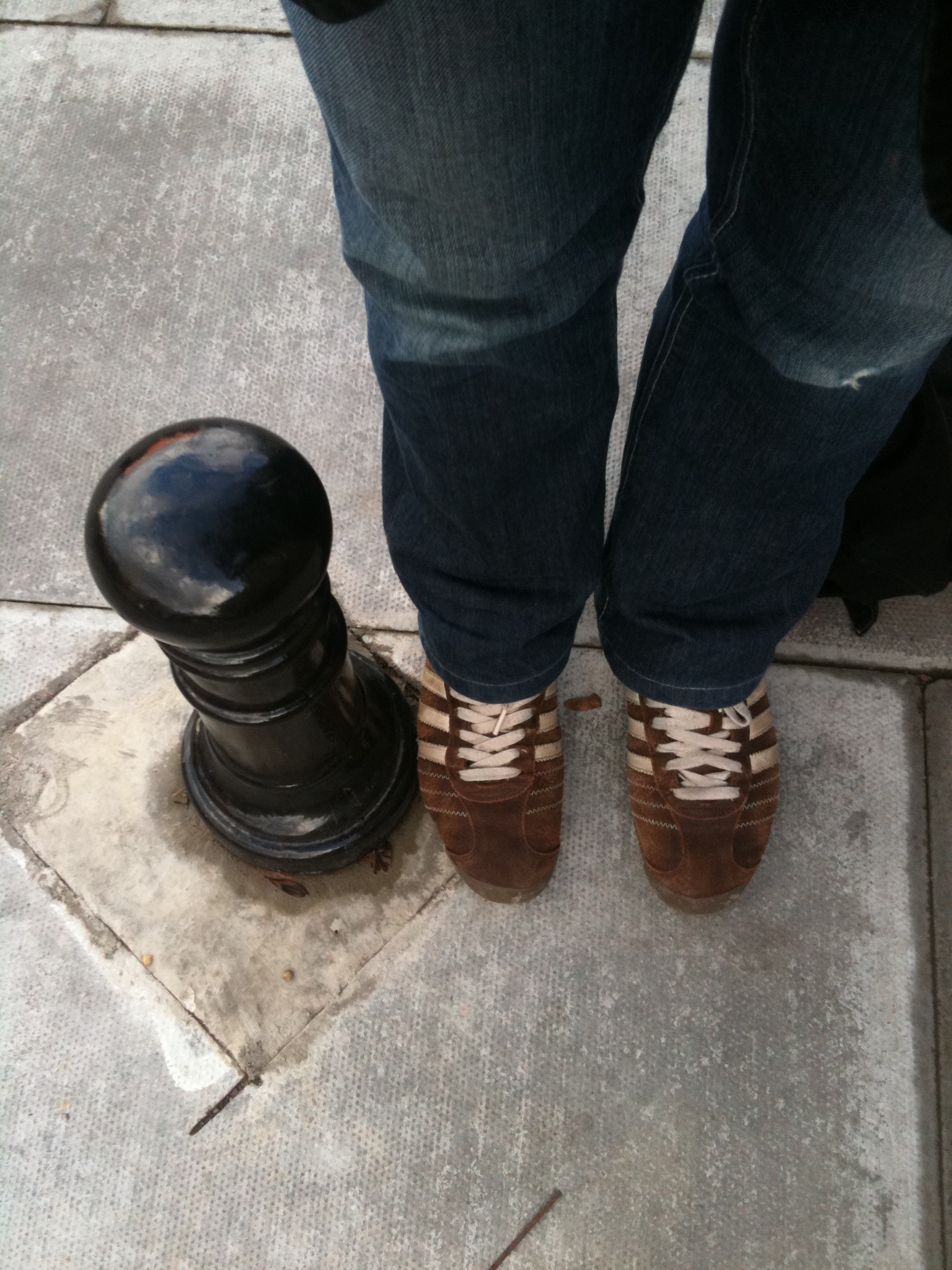
Bollards are great. They are everywhere and they are all different. Here are two I snapped last week, located within metres of each other in Wapping but very different. 

This one is fat, old and very rusty.

This one is new, shiny and very, very short. It barely comes up to my knees and nobody would ever describe me as a giant.

Amazing eh? If you agree, check out John’s site, where he will shortly be presenting my top three London bollards from his collection.

Can you contain yourselves?

Inside the Fleet: exploring London’s lost rivers

I wrote this piece for Time Out in 2005 and for some reason it’s never been available online. Until now.

It’s only as the filthy brown water rises above my thigh-high waders and my feet struggle to grip the tunnel’s slimy floor that I realise that drowning in a river of shit after breaking into a London sewer would be a really, really crap way to die.

It all began so well. I found Jondoe and Stoop, two urban explorers who get their kicks investigating drains, lost rivers and derelict buildings, on the internet and asked them if I could come on their next journey beneath the city streets.

We met near Farringdon. The plan is to explore one of London’s lost rivers, the Fleet, which once flowed from Hampstead to Blackfriars. Although long bricked over, the Fleet, like many of London’s old rivers, still flows underground through a series of pipes and culverts. Joseph Bazalgette integrated these rivers into his sewer system, using them as storm-relief drains to carry overspill into the Thames when the main east-west sewers were swelled beyond capacity. These days, heavy rain can still cause sewage to flow into the river via the Fleet.

Jondoe and Stoop have been in the Fleet before, but turned back when the stench became overwhelming for even these experienced drainers. This time, they are determined to reach the end. They believe no other UK urban explorer has made the trip, largely because it takes considerable planning to find a way into London drains. Urban explorers are driven by a combination of adrenalin and curiosity, and take their hobby seriously. This trip has been months in the planning. They’ve popped many manholes looking for the right entry point, and the weather has to be right – no rain for at least three days before we enter.

In a nearby car park, we change into waders, boiler suits, flourescent vests and hard hats – the latter more for disguise than protection. Carrying a couple of traffic cones, we’re suddenly transformed into construction workers, practically invisible to passers-by. Nobody bats an eyelid as we walk through busy streets to the selected manhole, stick some cones round it, lift the cover and climb down the ladder into the gloom.

We enter a feeder tunnel with a five-foot ceiling, which means we have to abandon our hats and walk with cricked necks. It’s cramped, damp, dank and dirty but doesn’t smell too bad. Stoop and Jondoe glide like skaters along the slippery floor while I splash clumsily behind, using slimy walls to keep my balance. We head downwards along a series of mini-waterfalls. The light and noise that intermittently emerges from the grates overhead suggest we aren’t getting deeper, but simply following the gradient of the road. It’s a curious feeling, being isolated in the dark but with occasional glimpses of London reminding us that normal life continues up above.

Eventually we reach the end of the feeder tunnel and swing into the Fleet itself using broadband cables that make useful subterranean handrails. It stinks in here and the air is heavy with a strange mist. Jondoe points north, to where the Fleet is blocked by the main east-west sewer. Ominous clumps of matter fester in pools all around. ‘Don’t disturb them,’ he says. ‘It’ll be full of gas that just sits there and collects.’

As he speaks, one of the hard hats we’d left by the entry point shoots out of the feeder tunnel on a wave and floats towards the Thames, bobbing along the shallow water that moves sluggishly down the centre of the tunnel.

We follow, heading south. The tunnel is around ten feet tall and wide, so we can walk two abreast. It’s about the same size as a tube tunnel. The smell slowly subsides, although lumps of faeces and toilet paper gather in places where they’ve washed against the brickwork. Otherwise, there’s just a trickle of brown water ferrying the odd cotton-bud downriver.

It’s no hellhole, but still a far cry from the Fleet’s sixteenth-century heyday as one of London’s key tributaries, when, flanked by wharves and warehouses, it was a centre of London commerce. It separated Westminster from the City and carried cargo to the Thames, was compared unfavourably with the four rivers of Hades by Ben Jonson, was briefly turned into a canal and then covered in portions from 1732, by which time it was little more than an open sewer.

But this was not the end of it. In 1846, the Fleet exploded, its sewage gasses bursting the street above, rendering King’s Cross Road impassable, destroying Clerkenwell poorhouses and smashing a Thames steamboat against Blackfriars Bridge. This river, it seems, has a habit of coming back to ambush those who thought it dead and buried.

Almost two centuries later, traffic and police sirens are audible overhead, competing with the constant crash of water that flows from numerous side tunnels, feeding the central trickle. Rats stop and stare as we walk past. I nervously keep my torch shining on them until we have moved on.

Before Ludgate Circus, the Fleet splits into two parallel tunnels, directly replicating the pattern of Farringdon Street overhead. Otherwise, it’s impossible to work out exactly where we are. The tunnel heads south, but is full of turns. At one point we notice large iron rings cemented into the wall. They are support for scaffolding, but look like mooring rings. Throughout, the Victorian brickwork is surprisingly beautiful for something that is so rarely seen.


After about two miles of trudging, we emerge into an enormous end chamber, more than 20-feet high and elaborate in design and construction. Two short tunnels lead from here, ending in huge metal flaps, which we assume open directly into the Thames.

After taking pictures, we head back. Immediately, we realise there’s a problem. It’s much harder to walk uphill against the flow of water. On the way down, the water was a stream, heading back, it’s more like a river. We labour onwards and upwards in the dark, but it’s tough work.

Stoop eventually says what we’ve all been thinking. ‘Is it just me,’ he asks, ‘Or is the water getting deeper?’

Water which before barely covered our feet is now above our knees, flooding downhill towards us at pace and rising slowly all the time. Wading into the tide, our clothes are heavy with water and our feet struggle to grip the slimy stone floor. Panicking rats scurry up the walls to get out the way of the bubbling water.

 It’s frightening. Nobody knows we are down here and as our pace slows I begin to ponder our options. Should we press on, or brave a side tunnel, where a ladder may at least take us above water level, so we can sit it out. But how long would that take? And what if the water keeps rising and the side tunnel we’re in doesn’t have access to the street? 

We reach a turn where the water has become a torrent and Stoop tries to brace himself against the tide but instead starts sliding backwards towards me, threatening to skittle us all into the dirty water. For a split second I consider what an undignified death this would make, and with one final effort we press on, forcing ourselves to a point where we can stand without getting knocked off our feet. But we’re exhausted.

Then Jondoe shouts, ‘That’s where we came in!’ It is indeed. We pull ourselves up into the feeder drain via the broadband cable and watch the river below us boil to a frenzy. The Fleet is back with a vengeance. Later Jondoe explains, ‘Somewhere further up the sewer they must have been doing some maintenance and so diverted the flow down the Fleet.’ It is, he says, something he’s never experienced before.

Twenty minutes later, after an exhausting walk through the smaller drain in the course of which I bang my head several times on overhanging pipes and bricks, I haul my battered, sodden body up the ladder and into the sunshine. It’s bright outside. The air smells clean. Half-a-dozen people across the road pay us no heed as we emerge from the manhole and sit slumped in the road, moving only to remove our waders and empty them back down the drain.

We trek back to the car in soaking socks, leaving a trail of footprints behind us.

Room for improvement

Writer, Londonphile and intimidatingly prolific blogger Christopher Fowler recently noted my post on the London terraced house on his own excellent blog, adding intriguingly that:

‘Looking into the subject a bit more, I found that the terraced rooms and gardens are all percentages of those [9th century] measurements, making everything look neat and tidy even when it’s not.’

His recommended related reading on the subject is Harry Mount‘s ‘A Lust for Window Sills: A Lover’s Guide to British Buildings from Portcullis to Pebble Dash’.