Under London: Crossrail is coming

Like every other journalist in London, I wrote an article about the Crossrail project. It appeared in Eurostar’s Metropolitan magazine in May and is reprinted here.

In a cavern 35 metres underneath Stepney City Farm, London is getting smaller. Not literally of course, that would be terrifying. No, this gigantic space under east London has been excavated for Crossrail, the 42-km high-speed tunnel being built beneath London. When it opens in 2018, Crossrail will carry 200 million passengers every year from east to west (or west to east), cutting the city down to a more manageable size as journey times are greatly reduced. When Mayor Boris Johnson entered a similar Crossrail site in Canary Wharf he gushed it was “like a Neanderthal stumbling into the gloom of Lascaux… akin to a gigantic subterranean cathedral several times the size of Chartres.” In truth, the Stepney cavern is more like a big, bare quarry, shaft open to the sky, lined with concrete and exuding a faint smell of wet earth.

Chartres cathedral

Crossrail hole in the ground

“If Crossrail is a Y, we are standing where it splits,” explains Will Jobling, Crossrail construction manager, pointing at a map that shows Crossrail travelling across London to Stepney, where it divides with one leg heading north-east and the other crossing the Thames to Abbey Wood in the south-east. “Two of the tunnel boring machines (TBM), Victoria and Elizabeth, have passed through here and you can just see the back of one on its way to Farringdon. They should get there by February 2015.”

There are eight TBMs working on Crossrail, giant moles that slowly grind through London clay at the rate of around 150 metres a week. Weighing 1000 tonnes and with rotating, earth-scraping heads, these monsters run 24-hours a day and are like mobile factories, removing dirt and sealing the tunnel with concrete as they move. They even have canteens and toilets as well as a rescue chamber in which workers can take refuge in case of an accident. Around 4.5 million tonnes of earth (which Jobling says has the consistency of “elephant dung”) will be transported by barge to the Thames estuary to create a man-made nature reserve. One machine, Jessica (named after Olympic athlete Jessica Ennis), is being removed at Stepney. It’s taken apart underground, lifted out the shaft then transported to Canning Town, where it will be welded back together and lowered into the ground to continue tunnelling. Parts of Jessica lie strewn across the Stepney site, battleworn, clay-scarred and weary but with more work still to do. They look like ancient artefacts salvaged from the seabed.

The TBMs cost £10million apiece and are fitted with lasers that help engineers plot a course around and under London’s subterranean obstacles – sewers, foundations, plague pits, buried rivers and other tube lines. “At Tottenham Court Road, we come within 80cm of the Northern Line,” says Jobling. “We look at every obstruction we could possibly find. Sometimes we have to back-engineer, look at how high a building is and then work out how deep the piles will go.”

Despite this, the basic principles haven’t changed since Marc Isambard Brunel invented the tunnel shield to dig the Thames Tunnel from Rotherhithe to Wapping between 1825 and 1843. Some methods go back even further. “At Canary Wharf we hit a bunch of old piles that we had to cut through by hand using old mining techniques,” says Jobling. “The older guys loved it.” He’s interrupted as a loco, a miniature train used by workers to travel through completed tunnels, scoots noisily past. It’s like an old mining cart, only it runs on diesel and is deafening. As the TBMs approach Farringdon, workers will have an 8km underground commute on the loco to work every morning. When the screeches have stopped echoing off the cavern walls, Jobling explains how a ceremony was held at the start of operations as priests blessed 38 statues of St Barbara, the patron saint of miners, and placed them at tunnel mouths. “Tunnellers can be a superstitious lot,” he notes.

Saint Barbara

Crossrail will be followed by similar huge projects – the Northern Line extension to Battersea, a gigantic sewer called the Thames Tideway, and possibly a north-south Crossrail Two – and to ensure London retains its tunnelling knowhow, Crossrail opened the Tunnelling And Underground Construction Academy (TUCA) in Ilford in 2011. In a building designed to look like a TBM entering the ground, workers are trained in a specially developed environment that includes a replica of Crossrail tunnel. “We get them used to working in an enclosed space,” says Georgina Bigam, Skills And Training Manager. “Everything can be installed and dismantled. We also do a safety course where they fill the tunnel with smoke, turn off the lights and simulate explosions by chucking firecrackers around for half-an-hour. They have to find their way out.” She pauses. “I usually make the journalists do it,” she says, and giggles.

TUCA trains hundreds of people to work beneath London’s soil. The canteen – complete with mural of UK tunnelling landmarks – is filled with eating, gossiping men (and one woman) of all ethnicities, from Cockney grease monkeys to a middle-aged Sikh with hard hat screwed on top of his turban. Many gain knowledge that is valued all over the world. As Valerie Todd, TUCA’s Talent and Resources Director, explains. “There’s tunnelling happening right across the world as cities everywhere are facing similar pressures, looking to find ways to move a lot of people around very quickly when the surface area is used up.” But Crossrail is the current focus, a £15-billion project that is Europe’s largest infrastructure project and which Boris Johnson has likened to conquering Everest. Onward push the TBMs, while the city sleeps and workmen come and go. Saint Barbara would be proud

London timewarp: James Smith & Sons umbrella shop, Holborn

smith


This article appears in the current issue of Completely London magazine

When you first stumble upon James Smith & Sons, it’s tempting to believe you have slipped through a timewarp in the Holborn pavement and landed in Victorian London or, more prosaically, chanced upon a perfectly realised film set. The plate windows of the New Oxford Street shop are crowded with umbrellas and walking sticks, while the polished frontage of carved mahogany, brass, enamel and engraved glass boasts, in richly painted font, that James Smith & Sons was “Established 1830”. It’s easy to believe it hasn’t changed a jot since then.
The interior is every bit as spectacular as the outside, and English Heritage have listed the whole thing at Grade II*, noting that it is a ‘typical high-class late Victorian or Edwardian shop and as such is a rare survival in London’. The shop has been occupied by James Smith & Sons since 1867 and while there have been some updates – a new till, electric lighting – much of the façade and interior date to then. “There have been some changes but not many,” says Robert Harvey, the owner. “A few years ago we spent a considerable amount refurbishing the shop and on the day we opened a customer came in, looked around and said, “I thought you were having it redecorated?’.”

London_-_James_Smith_and_Sons_-_1819-2.jpg

Fittingly for such a classic-looking shop, James Smith & Sons, which is still owned by descendants of the original James Smith, specialise in the very British trade of umbrellas and walking sticks – as one writer has noted, “the art of applying the shade to the ribs with just the right amount of tension is no small matter”. The umbrella is still seen as a key piece of kit for a well-equipped Londoner looking for protection from the elements in this most rainy of cities, and an umbrella from James Smith & Sons is as desirable as a pair of shoes from John Lobb or suit from Savile Row. The shop is also popular with foreign visitors, who purchase English umbrellas as well as walking sticks and seat sticks (collapsible seats, originally for shooting but now more likely to be found at Glyndebourne). They also once sold items like swordsticks and swagger sticks as well as ceremonial sun shades for African chiefs; according to legend, one American customer asked the company for walking sticks made from every English wood possible and received more than 70. The range of umbrellas stretches into the thousands and about 30% of the stock is unique, existing as just a single item, with its own combination of material, colour, wood and style of handle.

The shop’s appearance is, admits Harvey, an anomaly as well as something of an accident. “Looking through the records, the business survived by a miracle,” he says. “The Smiths never had enough money to refurbish and I’m not sure they were the sort of people who looked long-term – they were never sure how long the business would last.” The appearance eventually became a trademark, and the shop has made regular appearances in London guidebook, even appearing in novels, in one instance when the villain of a thriller purchases a murderous swordstick from a strange old shop “marooned on an island surrounded by traffic”.

But while the appearance is identical to the Victorian shop, the attitude is different. “Unlike the Smiths in the 19th century we see the business as having a future providing a great product,” says Harvey. “But we also try very hard to retain that original character, not as a museum piece but as an example of 19th-century commercialism in the 21st-century.”

London’s new invasive species, and how the Daily Mail has welcomed them to the city

This piece first featured in the April issue of Metropolitan. Interestingly, the Daily Mail had not discovered the aesculapian snakes when I wrote this piece but did so very shortly afterwards. I sincerely hope my article was not what alerted them to this harmless colony.

When workers began clearing the Hackney site that was to become the 2012 Olympic Park, one of the biggest problems they faced amid polluted soil and world war explosives came from a plant. Japanese knotweed is a scarily resilient and fast-growing weed that infested the waterway and removing it was a laborious process that began with chemical treatment before the dense root structure was dug out. Next came cutting, hand-sorting, incineration and burial of the remains inside a welded physical membrane on landfill sites in five-metre pits. Only after this was the plant, introduced by Victorians because it looked pretty, deemed safe. It cost £70m.

London is home to around 76 such ‘invasive species’, leading to the creation of the London Invasive Species Initiative, which monitors those alien invaders that have found a predator-free London life to their liking, causing serious damage to the city’s ecosystem even if they add an exotic splash to the urban landscape. Many, like the knotweed, arrived in the 19th century. “There was a flowering of ‘acclimatisation societies’, which were specifically set up to introduce new species,” says Tim Blackburn of the Zoological Society of London. “The Zoological Society envisioned a golden age where we would have herds of elands [African antelopes] roaming the south of England. But the impacts are pervasive and affect so many aspects of life.’

But not every alien species is dangerous and London is home to hundreds of non-native species that merrily co-habit with London’s longer-term residents. “There are many species we think of as part of our national heritage that were originally non-native,” points out Alex Robb, a London Wildlife Trust warden, in defence of the ring-necked parakeet, which has adapted to London life so successfully it has been adopted as the country’s first naturalised parrot. It is unlikely, however, that Japanese knotweed will ever be regarded so warmly.

Muntjac deers
Originally from: China.
Now found: Mill Hill, Barnet, Enfield, Edgware and Bethnal Green.
Daily Mail headline: Two-Foot Muntjac Deer Cause Thousands Of Crashes Every Year, Sept 2011.

bambi

For centuries, London parks have contained red and fallow deer, generally doing little other than giving dogs something to bark at. Now there’s also the muntjac deer, introduced to Britain in the 19th century. As muntjac began escaping from zoos or were deliberately released, the population expanded to today’s 2 million. The muntjac is small and shy, with stubby antlers and an unappealing call that sounds like a smoker’s cough. It can usually be seen in north London suburbs munching roses, but some have been spotted as centrally as Bethnal Green and they have an annoying habit of running into the road, causing accidents.

Japanese knotweed
Originally from: Japanese volcanoes.
Now found: Everywhere, especially alongside railways.
Daily Mail headline: The Dreaded Alien Eating Your Garden And Home, July 2013

knotwwed

Japanese knotweed was introduced by Victorians as an ornamental plant. Big mistake. The bamboo-like plant is one of the country’s most invasive species with a frightening rate of growth – up to 10cm a day to a height of three metres and with a root system (rhizome) that can expand seven metres in all directions. It’s persistent too. It can push through cracks in cement and tarmac, and has been known to grow through floorboards, wrecking houses. Knotweed is devilish to remove, requiring intensive herbicide treatment and even then, freakishly, a new plant can spring from a fragment of rhizome the size of a fingernail that’s lain dormant for 20 years. The problem is so great some banks refuse to give mortgages to properties that have knotweed within sight of the walls. The good news? A predatory insect has been shipped in from Japan that’s meant to control the triffid. Another alien species introduced from overseas – what could possibly go wrong?

Red-eared terrapins
Originally from: The Americas
Now found: Regent’s Canal and other waterways.
Daily Mail headline (after related scare in Lake District): Terrapins That Can Bite A Child’s Finger Off Are Being Dumped By Owners, August 2013

terrapins

Terrapins arrived during the brief but annoying Teenage Mutant Hero Turtle craze of the 1990s when parents bought baby terrapins for demanding children but then dumped the creatures in the nearest pond when playground tastes turned to Pokemon. These red-eared terrapins love London lakes, with meals of fish and ducklings helping them grow to around 30cm. Terrapins can live for 40 years and while it was believed London would prove too cold for them to breed, a baby terrapin was spotted in Regent’s Canal in 2013. Will warm summers may see a generation of even tougher, London-born terrapins take over our waterways? Worse still is the American signal crayfish, an armour-plated monstrosity that was introduced in the 1970s, escaped and set about annihilating the native white claw crayfish. Fortunately, the signal crayfish has one predator, “Crayfish Bob”, who has turned the epidemic into an opportunity, serving Thames-caught crustaceans at pop-up restaurants around London.

What the terrapins may look like if they discovered martial arts and were fans of the Beatles

Ring-necked parakeets
Originally from: Afro-Asian.
Now found: Originally south-west London, now widespread.
Daily Mail headline: Native British Birds Are So Scared Of Invading Parakeets That It’s Putting Them Off Their Food, April 2014.

parakeets

There are several legends about how shrieking flocks of green parakeets came to colonise south-west London. The most popular is that they are descendants of a pair released by Jimi Hendrix while he lived in Notting Hill. Another is they escaped from Shepperton while The African Queen was being filmed in 1951. Or maybe they fled from exiled King Manuel II of Portugal’s Fulwell aviary in the 1920s. The population has rocketed since the 1990s, when flocks were concentrated around Esher, Richmond and Twickenham. Mobs of noisy parakeets are everywhere, and the splendid ease with which this hardy, convivial, colourful bird has adapted to London life has made it increasingly popular among Londoners.

Oak processionary moth
Originally from: central and southern Europe.
Now found: Kew and across south-west London.
Daily Mail headline: Rise Of Poisonous Caterpillar That Can Cause Lethal Asthma Attack Is Unstoppable, May 2012

moth

It’s the caterpillars you have to watch. These hairy toxic insects arrived in London in 2006 on imported oak trees and established colonies around Kew. While the caterpillars can damage oak bark, they are also a pain for humans thanks to 60,000 poisonous hairs that irritates skin, eyes and throats, or provoke allergic reactions. Fears were raised by newspaper that the caterpillar would cause carnage during the 2012 Olympics but fortunately this came to nothing. The pest has spread from Ealing, Richmond, Brent and Hounslow to Bromley and Croydon.

Aesculapian snake
Originally from: Former Yugoslavia, now found across mainland Europe
Now found: Regent’s Park.
Daily Mail headline: London Hit By Outbreak Of Eight-Foot SNAKES That Could Kill Cats Or Small Dogs, May 2014.

snakes

While the aesculapian snake is common in mainland Europe, London only discovered its colony in around 2007, when several were found in Regent’s Park alongside the canal near the zoo. Nobody knows how the snakes got there, but they are the first examples of non-native snakes breeding successfully in the wild in London. The snake can grow to 3-4 metres and is harmless to humans – although they can bite – developing instead a fondness for rats, of which London has plenty.

Panther
Originally from: Asia, Africa, Americas
Now found: Sydenham
Daily Mail headline: The Night I Was Mauled By London’s Black Panther, March 2005

panther

Police with taser guns were called to south-east London in March 2005 when a man was attacked by a huge black beast. ‘I could see these huge teeth and the whites of its eyes just inches from my face,’ he said. ‘I believed it was trying to do some serious damage.’ The “Beast of Sydenham” was seen again in 2009, chasing a jogger through Dulwich Woods, but has since gone quiet. While such stories often turn out to be nonsense – the Essex Lion of 2012 was a large ginger cat – strange mammals, escaped from zoos, farms and private menageries, do turn up in London, most recently two wallabies in Highgate Cemetery and an American mink in Thamesmead.

Ten weird London films from Pathe: featuring leopards, scooter jousting, Willesden oil wells and Peter Cushing’s toy soldiers

1. Japes! It’s a fight between students in Brixton over a stolen stuffed owl, featuring many flour bombs. These days, this wouldn’t lead to a jaunty newsreel as much as apocalyptic headlines in the Evening Standard. 1957

2. A secretary in Kensington takes her pet leopard for a walk, 1968.

3. Jousting on scooters in Wembley, 1957.

4. Marcus the chimp cycles around London, 1940s. 

5. Dog blessing ceremony in Swiss Cottage, 1939.

6. Ever wanted to see Peter Cushing play with his collection of toy soldiers? From 1956.

7.  Some great Pathe footage comes in the form of out-takes, like this silent colour footage of a man pogo-ing into a Soho strip club in 1962.

8. An oil well in Willesden, 1947.

9. Kentish Town children hold a protest march to demand a zebra crossing, 1962.

10. A look at fashion featuring I Was Lord Kitchener’s Valet and a couple dressed as Bonnie & Clyde pretending to murder a man wearing an Afghan, 1969.

Pathe newsreel: London time machine

These are all taken from the recent cache of thousands of Pathe newsreels loaded on to You Tube.

1. A trip to Swinging London in 67. Is that Yoko reading International Times at Trafalgar Square? Surprisingly sympathetic beneath the patronising tone. I love those Bob Dylan paper dresses. And at 4:50 you get to meet Keith Albarn, father of Damon, as he organises a happening. Also features Mary Quant, the Speakeasy, the Scotch of St James and much more.

2. This Is London, with commentary by Rex Harrison. A tour of the capital for the British Travel Association, starting at the Tower of London, into Fleet Street and Temple then into the West End and Westminster. It’s all very quaint and polite, but great for location spotting. The shots from Chelsea at 10:42 are extraordinary.

3. Platform shoes, 1977. A wide range of Londoners discuss platform shoes – “they’re not natural,” says one cockney. I think this was filmed around the King’s Road.

4. Tracking shots of Soho at night, 1968. No sound or context here, just a series of tracking shots around Soho at night. It’s incredibly atmospheric and full of strange glimpses into past lives, especially the laughing man at 3:22, whose companions have slipped off to an upstairs flat.

5. West End, 1977. Similar to the above, this is a series of disconnected, fairly random shot of London and the West End starting in Chinatown. Silent but fascinating as a sort of moving street photography. Note the number of Scotland fans around Piccadilly Circus, the porn shops, and the huge amount of scaffolding that appears to be everywhere.

7. Making a psychedelic light machine, 1968. A sitar plays while Mike Leonard constructs his machine for a light show. For 60s scene nerds, this is pretty fascinating.

8. White Defence League, 1959. Footage from Notting Hill, featuring an interview outside the HQ of the White Defence League (soundtrack starts around 1.20min). Staggering racism, unapologetically voiced.

Mount London – a book about London’s hills

Mount London: Ascents in the Vertical City

I am surrounded by hills. North-east is Denmark Hill, south is Tulse Hill, west is Brixton Hill and beneath my feet is Herne Hill. From the highest point of Brockwell Park, I can see the wooded tip of Sydenham Hill and the Autobot mast of Crystal Palace, which sits on top of a stomach-looping hill at Cystal Palace. And there’s more – Knights Hill, Beulah Hill, Forest Hill, Streatham Hill –  all within a few miles, usually to the south on land that slowly undulates into deep suburbia.

One of the things I like about Herne Hill is that the hill it is named after takes the form of an easily ignored road that snakes up towards Camberwell while the town itself sits in a hollow at the bottom, where it often floods. You don’t usually get a flooded hill, but that’s Herne Hill for you. Maybe that’s in keeping with the contradictory nature of London hills. Elsewhere, a hill lifts you above the fray but London hills tend to accentuate the clutter, confirming the claustrophobia of London life.

Tom Chivers is from Herne Hill, and perhaps that prompted him to commission and edit, along with Martin Kratz, Mount London, a book of essays about London hills and other raised areas. A team of 23 urban topographers study 25 spots: famous viewpoints like Parliament Hill, suburban sprawls like Stamford Hill, lost City of London hillocks like Ludgate Hill, plus the odd, witty, wild card – Battersea Power Station’s chimneys or the emergency stairs at Hampstead Underground Station.

Early on, Sarah Butler captures the curious charm of London’s hills  – ‘I’d stand and look,’ she writes in her chapter on Dartmouth Park Hill, ‘and I would always be struck by the fact that London stretched right out to the horizon and as far left and right as I could see. Do the equivalent in Manchester, and you can see where the city ends, the edges fading out into fields.’ London has no edges.

Contributions are a mix of autobiography, psychogeography and history. One of my favourites was Tim Cresswell’s elegant take on Northala Fields, an artificial hill constructed from the rubble of Wembley Stadium and including the remains of London’s failed attempt at building an Eiffel Tower. Londonist’s Matt Brown demonstrates his usual nose for an oddity with his piece on Windmill Hill, a municipal dump on Moorfields constructed from dung and bones. Submarine author Joe Dunthorne takes on the Shard, astutely noting that ‘since the arrival of the Walkie-Talkie, it may not even be the most evil skyscraper in London.’

Chivers tackles Snow Hill – a place I always associate with terrible London-set computer game Driver – and in doing so manages to capture that strange, uplifting sight: the Fleet Valley from Holborn Viaduct. ‘To stand on the Viaduct and look over Farringdon Road is to experience London’s vertical axis; the city not as streetplan write large but a three dimensional environment with depth as well as spread. And even to the untrained eye, the view from the Viaduct is unmistakably that of a river from a bridge.’ This is a perspective almost impossible to capture in a photograph. I have always thought it had to be experienced in person, but Chivers has it nailed.

Chivers and Kratz are poets, and there is a bias towards a certain tricksy type of inward-looking London writing – the school of Sinclair – with particularly abstract or experimental musings coming from Kratz on Richmond Hill and Tamar Yoseloff on Farringdon shitheap Mount Pleasant. That’s fine, but I would have welcomed a little more variety in styles. Mary Paterson brings the only touch of fiction to her piece on Denmark Hill and while I enjoyed Katy Evans-Bush’s supernatural glimpse of Stamford Hill, even this was intensely personal. Amber Massie-Blomfield’s piece on Gypsy Hill is typical, interweaving 18th-century south London gypsies with musings about her grandfather, who once lived in a caravan in Lossiemouth,

But maybe such naval-gazing is in keeping with the very nature of London hills, and also the introspective activity of solo walking. London is not a city that looks particularly good from the air – notable exceptions being Parliament Hill and Greenwich Hill, neither of which feature here. Instead, elevated views merely reinforce the sense that we are stuck in the middle of an endless mega city. The only respite lies within.

‘Some friends once lived in a double-fronted Georgian on Brixton Water Lane,’ writes Karen McCarthy Woolf of Brixton Hill. ‘Their garden was large and L-shaped and a good proportion of it used to be the car park of the pub now called The Hootenanny. Their garden also had a well in it that sank into the subterranean Effra.’

I know that Georgian, I know that garden, I know that well. In London, no matter how high we climb, we will never escape from each other, and from other hills.

Mount London: Ascents In The Vertical City edited by Tom Chivers and Martin Kratz (Penned In The Margins, £12.99).

Comics at the British Library

Action 1976-77, by Jack Adrian and Mike White. Action, used with permission from Egmont UK Ltd.

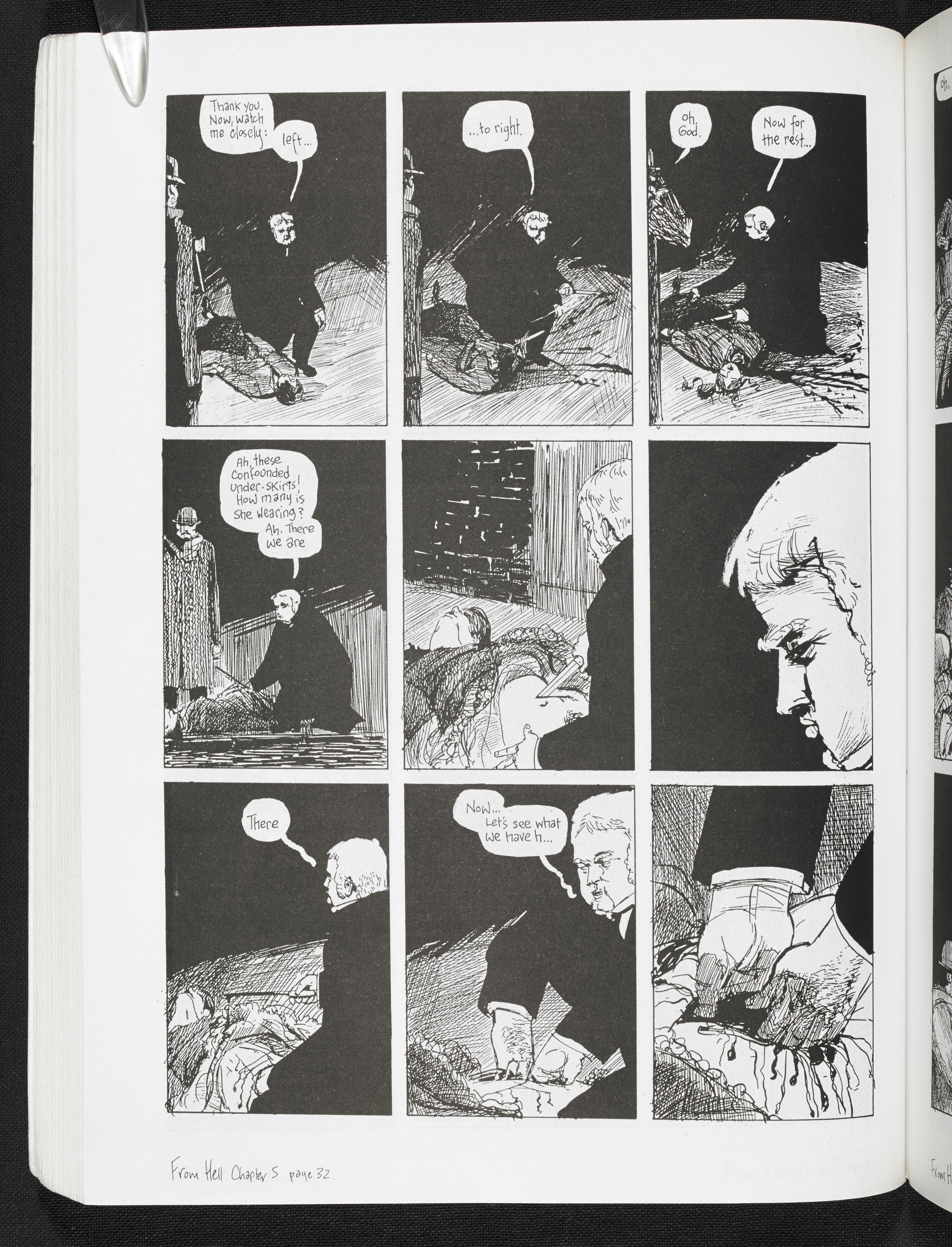
The British Library’s current exhibition, Comics Unmasked: Art And Anarchy In The UK is one of their best for a while. A thematic study of seditious comics in the UK, it covers a lot of ground without over-cramming – a consistent fault of BL exhibitions to date. And while exhibitions devoted to books can get a little frustrating – essentially, you are staring at hundreds of book covers you cannot read – comics work perfectly as you can read a single page and at a glance grasp an awful lot about the concept from the artwork and a couple of panels, such as this from Alan Moore and Eddie Campbell’s London classic From Hell.

From Hell, by Alan Moore & Eddie Campbell published by Knockabout Ltd. 1999 (c) Knockabout

Another plus is that the exhibition never makes excuses for its content matter so we are spared yet another analysis of why comics are for grown-ups. Instead it shows that comics have always been for grown-ups, right back to George Cruikshank (whose work is presented in a tremendous juxtaposition with an OZ strip about Edward Heath). The exhibition also takes a bold step by looking at the historical inspirations for comics writers’ love of magic and fantasy, with exhibits including John Dee’s spell book, the first draft of Crowley’s Diary Of A Drug Fiend and one of his tarot cards. These items are somewhat tenuous, but they are also marvellous and suggest an area a future BL exhibition could explore.

Original painting of Aleister Crowleys tarot card 'The Universe', on loan from The Warburg Institute. Photography (c) Tony Antoniou

There are several items with particular London resonance or import. I was fascinated by Riot, a book written in the immediate aftermath of the 1981 Brixton riot about which I’d love to know more. I also enjoyed the juxtaposition of Batman with Spring-Heeled Jack. There were also several contemporary strips, including Janette Parris’s Arch, about life in Archway, and Katriona Chapman’s contribution to Ink + Paper about renting in modern London. Oh, and there was a comic written by William Burroughs during his London sojourn.

Riot

Riot

Spring-Heeled Jack

Spring-Heeled Jack

IMG_2515

Other countercultural exhibits included a beautifully bound copy of IT, with the cover a reprint of a Situationist comic the publishers had found stuck on their office door (or a lamppost, I forget which) and a comic about the Nasty Tales trial, the IT spin off that was charged with obscenity.

The Trials of Nasty Tales, 1973, cover art (c) Dave Gibbons and Richard AdamsThere’s also loads of stuff on Batman and Superman, with particular reference to the work of Alan Moore and Grant Morrison, while Moore’s Lond0n-set V For Vendetta is a recurring motif. And there’s a decent amount of 2001, including Judge Dredd’s helmet and a never-reprinted Judge Dredd strip about a war between fans of Burger King and fans of McDonald’s – featuring a psychotic Ronald McDonald – that has never been reprinted for fear of a law suit. I also learned that tedious busybody Dan Dare of the Eagle had originally been created as an intergalactic space vicar, which probably explains why I never much liked the man.

Judge Dredd's helmet loaned by DNA Films - producers of 'Dredd'. Photography (c) Tony Antoniou

Now do you want to hear the flaws? There were only three I really noticed. One was the design, which was never quite as weird and psychedelic as I’d have liked (though that may be why I am not an exhibition designer). Another was that there wasn’t enough about the artists, who while by no means neglected were never quite given the attention and praise they deserve. And finally I’d like to have seen more about the development of the grammar and rules of comic book art – how artists have torn up the traditional episodic, thought-and-speech-bubble panel-based framework – which was addressed only superficially towards the end. These though, are little more than quibbles. Go see.

V for Vendetta mask on a manequin in Comics Unmasked. Photography (c) Tony Antoniou


Syd, psychedelia, If…. and the Olympics: an interview with Kevin Whitney

I have a piece in the current issue of Uncut about Psychedelia,  a film made in 1969 and featuring Syd Barrett. The film has been sitting underneath Kevin Whitney’s bed for 40 years, but will be shown in June 2014 at the ICA ahead of its sale. Whitney was on the fringes of the psychedelic movement in the late-1960s and later became the first official artist of the Olympic movement. ‘In my work there are still hints of psychedelic imagery,’ he tells me. ‘But using beautiful athletes instead of mad freaks.’ 

Psychedelia can be seen at Room&Book: ICA Art Book Fair, ICA, 6-8 June. 

——-

‘I was at art school until 1970 and during I was making the film. I was inspired by psychedelic light shows, which I’d screen on the front of Chelsea Art School  at underground pop shows at the Roundhouse. Chelsea Art School was a modern building off the Kings Road. It was the only building built in the 20th century to be used as an art school. It’s now a hotel. It was very anarchic. Art is now geared towards corporate success and Saatchi but then that sort of thing was frowned upon, you weren’t supposed to make any money out of it. You did conceptual things, it was against the system. Now it’s the opposite and has no balls. We were very privileged to be around then. We took art into the streets.

Chelsea Art School on Manresa Road, built in 1963

Previously, I’d been at art school in Ipswich with Brian Eno. We smoked our first joint together at Christchurch Park in Ipswich. We did a thing where about 12 of us would get on a bus and we’d have these sheets of Perspex the size of a newspaper. We cut out the title of the paper and glued it to the Perspex and then sit next to people on the bus pretending to read the stories from this empty sheet of Perspex. Everybody thought we were bonkers.

UFO Club flyer

I never did light shows at the UFO Club. I went there but they had some Americans, Joe’s Lights, who got the contract and nobody else could do it. I knew them and admit I was influenced by their ideas but I also showed them some of my tricks. One was fabulous. You’d get two pieces of Perspex and put in some olive or vegetable oil, then drop some vegetable dye – bright blue, red or yellow – and then close the Perspex together. You’d put that in the projector, which had a very powerful light and would heat up the dye and send it shooting to the edges of the Perspex. It was like going through a timewarp. Joe’s Lights liked this and used it at the Roundhouse for the big Jefferson Airplane/Door show in 1968. [Editor note: I think that while Joe’s Lights did the Roundhouse gig, the Boyle Family did projections at UFO.]

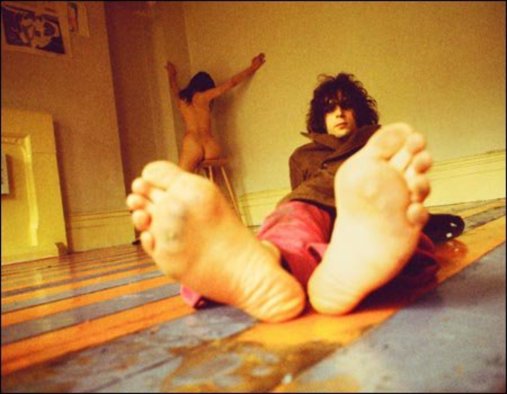
In 1968, I began making my film, Psychedelia. Syd was part of the scenario. Well, he was the scenario. Anybody that would agree I got to appear in the film, which was done at this basement on Old Church Street in Chelsea in a house owned by Antonia Chetwynd [regular visitors included Donald Cammell, David Bowie, Marc Bolan and Anita Pallenberg]. One day I went to Wetherby Mansions to pick up Syd. I was going to take him to the art school to this red and green painted studio I had in the annexe where I was making the film.

Syd Barrett in Wetherby Mansions

On the way, Syd offered me half a Mandrax. It’s like a sleeping pill that makes you very randy. We took half each. Then we got to the art school and I realised my camera didn’t have a cassette in it and all the shops were closed. So I said we’d do it tomorrow in Old Church Street. In the evening I called Duggie Fields [Syd’s flatmate, still resident at Wetherby Mansions] to check Syd had got back okay and Duggie told me he’d gone to Ibiza. He had a passport with him and he’d just gone to the airport and taken a flight to Ibiza.

When he got back we went to the basement and did the filming. I just had the camera with this psychedelic lighting. It was very amateur and everyone was very stoned. I’d sit people down and tell them to do whatever they wanted. Some took their tops off, some stared at the camera, talked, had a cup of tea… and I just filmed it because they were fabulous people. I filmed so many. In the scene I shot with Syd was Geoffrey Cleghorn, who was a friend of the Who and the Stones. I’d met him at art school in Ipswich and he’d followed when I moved to London and got involved in the whole scene. He’s an amazing guy. There was another chap called David Crowland. There’s a chap called Rupert [Webster], who was the very pretty boy in “If….”.


I screened it while playing Velvet Underground’s Sister Ray. I also use them on the other film I made Red And Green, when they are actually on the soundtrack, the Syd film was silent though I would have been playing Velvet Underground in the basement when making it. I was obsessed with them. It was all very Warholesque.


I gave my camera to Derek Jarman, I was living with the artist Luciana Martinez and she said, ‘You’ve finished with films and Derek’s a lousy painter, so why not give him your camera.’ He’d just finished making The Devils with Ken Russell, doing the sets. I did that and the rest is history. I then got totally into paining, film was an art student fling. In 1982 I got involved with the Olympis and been there ever since.

“Female gymnast”, 1984

I knew Syd as well as anybody could know Syd. He definitely wasn’t on this planet but he was lovely, very charming, and he seemed to like my paintings. He liked to paint himself and because I was pretty good he warmed to me. Also, I don’t hold him in awe, I was the same with Bowie, they were friends and I’d talk to them like that. I’d ask to draw them but treat them as I would anybody. People can treat pop stars in a different way and they can get very isolated. Most people were too much in awe of Syd to ask to film him and I think that comes across in the film. He was a very troubled mind and this wasn’t a great time. He’d been eased out of the Floyd and Dave Gilmour had taken over. But people who knew him said he looks so happy.’


Mama Cass in London: drugs, towels, Michael Caine and Charles Manson

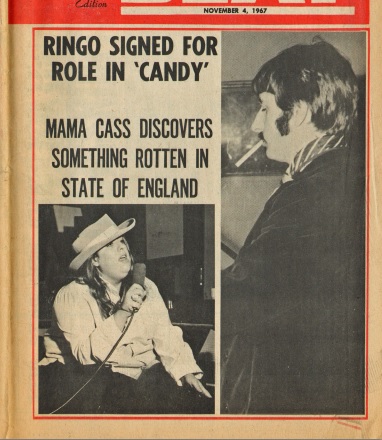
I have a piece about Mama Cass Elliot in the current issue of Uncut. One area I didn’t have space to cover was Cass’s arrest in London in 1967 when The Mamas & The Papas were travelling by boat to England to play a show at the Albert Hall. They had arrived at Southampton when they were told police were waiting with a warrant for Elliot’s arrest. The band frantically tried to destroy their stash of weed and then went on to the dock where they were supposed to meet label boss Lou Adler and his friend Andrew Loog Oldham. They were instead greeted by six of the Met’s finest, who bundled Elliot into a police car and drove her to Scotland Yard.

Cass

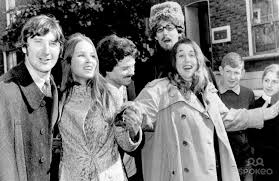
Elliot was stripsearched and questioned, then denied bail and held overnight. The police said the charges related to a stay in London six months previously at Queen’s Gate Terrace, when she had absconded with an unpaid bill and several towels. Outside the police station, The Mamas & The Papas – Denny Doherty, John Phillips and Michelle Phillips – were joined by Scott McKenzie, brandishing FREE MAMA CASS placards while they waited for Elliot’s release. The Albert Hall concert was cancelled.

Elliot escorted to the police station in Waterloo.

Elliot escorted to the police station.

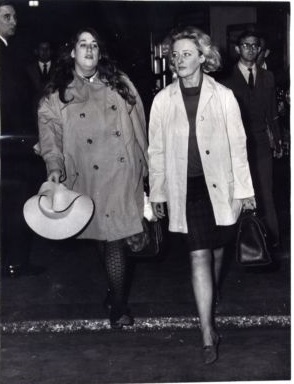
Elliot told the press she had been treated well, but not been given enough blankets. ‘Believe me,’ she said, ‘One blanket doesn’t go far round this chick.’ After a trial at West London Magistrates Court, at which no evidence was offered for the prosecution, she was released without charge and left the courtroom munching on a hash cookie that she found in her handbag. That may account for the big smiles in the photo below, taken shortly after her release.

Elliot on release.

Elliot on release.

The Mamas & The Papas with Scott McKenzie after Elliot's release.

The Mamas & The Papas with Scott McKenzie after Elliot’s release.

The Mamas and the Papas with Scott McKenzie in London.

The Mamas and the Papas with Scott McKenzie in London.

While such heavyhanded treatment by the authorities of rock stars was fairly common at this time, it later emerged that Elliot’s arrest actually had more to do with her occasional boyfriend, Pic Dawson, who the British police believed was involved in a major drug-smuggling operation. According to Michelle Phillips, this was the only subject the police in London were really interested in.

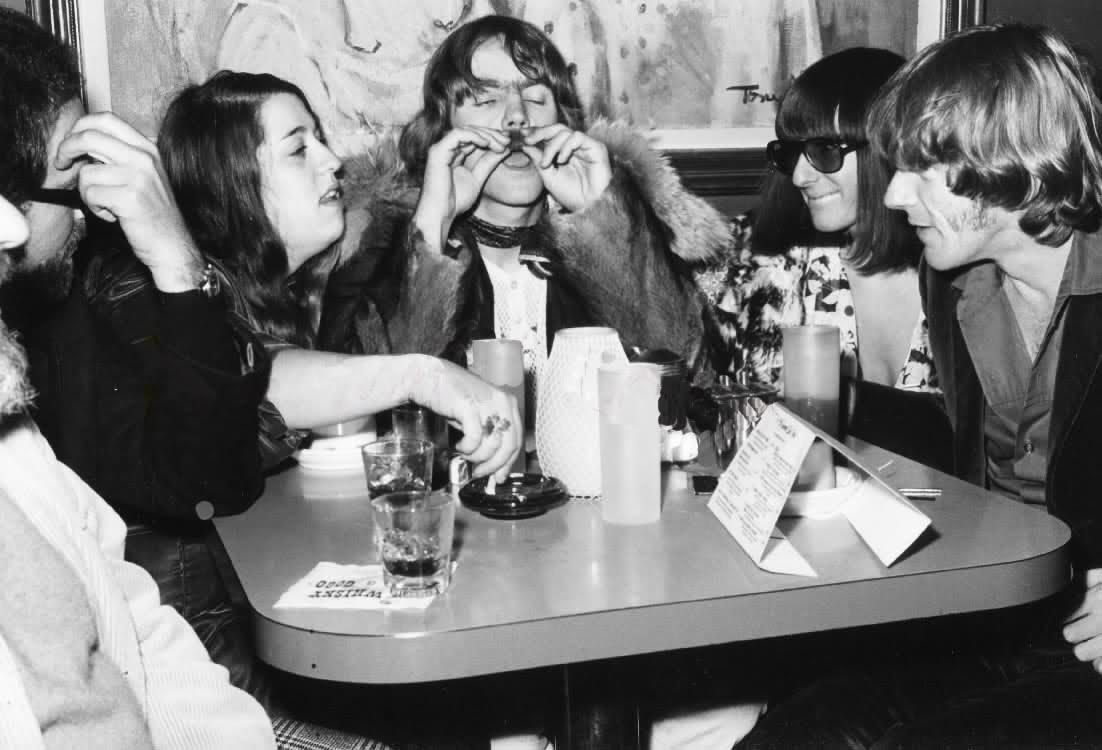
Pic Dawson and Cass Elliot at Whisky A Go Go.

Pic Dawson and Cass Elliot at Whisky A Go Go.

Dawson, who died of a drug overdose in the 1980s, was certainly an interesting figure with connections to the underworld. Numerous rumours circulate about him partly thanks to his peripheral involvement in the Manson Family murders.

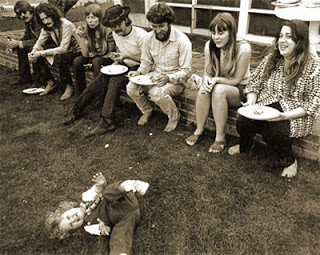
Dawson, left, and Elliot, right, at Mama Cass’s house with guests including David Crosby and Eric Clapton

Dawson knew several of the victims – basically, he supplied them drugs – and after the murders John Phillips is said to have told the police that the bloody PIG daubed on Sharon Tate’s wall actually said PIC. The LA police were also informed that Dawson, along with another of Elliot’s drug-dealing boyfriends, Bill Doyle, had been ejected from a party at the Polanski house shortly before the murders. Dawson was subsequently arrested, questioned and cleared, as was Doyle.

These were not Elliot’s only connections with the Manson murders. Dave Mason recalls, “One of the freakiest parts was that at Cass’s I saw a lot of Abbie Folger and Wojciech Frykowski until the Manson crew slaughtered them” and she knew all the victims well. But she also knew the murderers – in his autobiography, Michael Caine of all people recalls attending a party in Hollywood with Jay Sebring and Sharon Tate, where Mama Cass introduced him to a ‘scruffy little man’. His name was Charles Manson.

‘Last time I went into central London I needed a lie down’: life on London’s floating bookshop

An interview with Paddy Screech, a floating bookseller, for a piece I wrote for Time Out in June 2013.

Paddy Screech, 47, Word On The Water

‘By terms of the continuous cruising licence I have to move to a new mooring every two weeks. In the winter I try and stay around the urban bits and in the summer I stay near the parks. We try and stay north-east because my business partner has a little girl at school in Stoke Newington. We go to Paddington, Camden, Angel, Broadway Market, Mile End Park, Victoria Park and Springfield Park. We can’t go much further because our supply lines start to get stretched as we have relationships with five or six charity shops in this area. These are our friends and were we get our stock and also this is where our boating friends are. If we move to far afield we don’t have a world there.

What’s the appeal? Well, on a day when I have a carpet wrapped around a broken propeller and I have to have my boat towed in a strong wind, I can’t quite recall. Generally, I love the freedom and the less regulated life. London can be a chilly place. On the canal, people behave like they are living in the country even though you are only four metres from the road. As soon as you put a towpath there, people start talking, being friendly. It’s true of everybody, boaters and passersby. It’s very strange, like magic. On the other side of this fence there is a different culture.

It’s like a village. There are a lot of boats in London but if you put them all together you’d have a village, but a village where you can get away from people if you want to just before you start annoying each other. I have a little world in each place I stop: I usually know some of the other boats, I have a favourite coffee shop, I know how to get to the launderette. I like Springfield Park the best. Everybody makes the book barge feel welcome, whether they are permanent residents or not.

I’ve been on this boat for two years, running it as a bookshop, and I’ve been on the canal for six years. I try not to leave the canal. Last time I went into central London I needed a lie down. I lived in Upper Clapton for seven years. In all that time I met one of my seven neighbours once, as I sat rotting in front of a computer and seeing one of my dozen friends each week. Now I have about 300 friends, only look at the computer for an hour a day and never watch TV. I spend most of my time trying to stop the barge blowing away, or trying to light a fire.

The boat is called Diante, which means diamond in Italian. She’s a 1920s coal barge from Amsterdam and was converted into a houseboat in around the 1960s. She’s beautiful, but has a very thin bottom so will need replating. The engine is very old and just about clinging to existence. Every four years you need to take a boat drydock for a bigger service but if you do that properly a boat can last for decades. I’m not very practical but am much better than I was seven years ago. Anything that requires expertise or tools I need to call in favours. The fun thing about a Dutch barge is that it has no weed hatch so I have to put on a wet suit and get in the canal with all the urine and clear it with a knife.

I have a sea toilet which can’t be used on the canal so I visit the local establishments when I need the loo. There are lots of pubs and cafes that are sympathetic. It’s a simple life, I have no hot running water. I had a gas boiler but took it off because it wasn’t going to pass the safety certificate. It seemed a bit of luxury. My shower is now used for book storage. I wash with landlubber friends. Thanks to the kindness of friends I get a bath every other day. Working boats come up and down the canal delivering coal and diesel to all the moorings.

I have no mains electricity but a substantial amount of solar panelling that runs the lights and a 12v PA. There’s also an alternator on the engine, which creates electricity when you run the engine. It means there’s one less corporation in your pants. I do all my electronic stuff on my smartphone. Some boats have widescreen TVs and generators, but I’m not interested. Boats take up a lot of time and so I’m always pottering around doing something, I’m done with sitting on my arse watching bad television.

My business partner is John Privett, we started the shop about two years ago. We survive against overwhelming odds, but our costs are low and in the winter we live like feral water rats. We don’t get much custom when it is raining so in the winter we contract our horns and live on less. For our stock, we get given donations but mainly we select the best from charity shops.

The main expense is the licence and safety certificate. The business license for a trading boat is the same cost as a residential one as long as you are making less than £60k a year. There are around 15 trading books in London now, including a hat boat, a sandwich boat, a cocktail barge, a vegan cake barge, a herbal practitioner and a Slovak restaurant. We are hoping to find a permanent site for a floating market. It’s nice to move every two weeks but we might do better if we could stay in the same place.

I have absolutely no interest in going back to dry land. As long as I can borrow a friend’s bath every now and then there’s nothing about land life that appeals to me. I’m in the city now but when I wake up tomorrow I’ll be in  park underneath some trees and I’ll still have my coffee and my cats [Queenie and Skitty]  around me. To take your house and plonk it into the countryside after 24 hours is pretty special.

I don’t wish for more space. Boats change your expectation about how much space you need. I got rid of four-fifths of my items when I moved aboard and I don’t miss them. You just learn not to accumulate things. Except books. I can usually find something to read.’