Category Archives: Uncategorized

Five weird London museum exhibits

Forget the Rosetta Stone or Boris’s new pretend Routemaster at the London Transport Museum, there’s some crackingly quirky stuff to be found in London museums if you are prepared to look hard enough.

So here are five favourites from the top of my head.

Stuffed sparrow on a cricket ball
MCC Museum, Lord’s

Forget the ridiculous Ashes urn, the highlight of the MCC museum has to be a dead sparrow. It was killed by a cricket ball hit by Jehangir Khan in a match at Lord’s in 1936 between the MCC and Cambridge University. In death, the bird was treated with utmost dignity, being stuffed and stapled to the ball that killed it.

Chinese torture chair
Wellcome Collection


The Wellcome is filled with some of the oddest semi-scientific bric-a-brac imaginable, but I’m particularly fond of this Chinese torture chair, as it is just so mind-bogglingly vicious. In fact, it’s so vicious it would kill anybody as soon as they sat on it, so was probably only used for psychological torture. So that’s okay then.

Raquel Welch in a Chelsea kit
Chelsea FC Museum, Stamford Bridge

Possibly the coolest thing ever.

Stanley Green’s placard
Museum of London

Stanley Green, the Protein Man, used to march up and down Oxford Street carrying this placard and was a legendary sight in London for decades until his death in 1993. The placard is now in the Museum of London. A lovely piece by curator Cathy Ross tells the whole story here.

Mechanical galleon
British Museum

Bizarre sixteenth-century boat-clock designed to move along a banquet table, tell the time, strike the quarter-hour and fire its cannons. Wonderfully ridiculous.

And that’s just for starters.

Marianne Faithfull

I interviewed Marianne Faithfull before Christmas for a piece that can be currently read by anybody who reads the free Metropolitan magazine on Eurostar.

It begins like this. (Or at least it would do if my intro hadn’t been changed.)

Who is Marianne Faithfull? She’s a 1960s icon who had four chart hits, a marriage and baby, three Rolling Stones and a drugs bust before she was 20. She’s a blue-blood aristocrat who spent the 1970s in a narcotic haze, homeless in Soho. She’s the Queen of Goth, the Princess of Excess, a 64-year-old woman who has eyes to die for and which have seen more of life than most of us dare dream.

Who is Marianne Faithfull? Well, why not ask her yourself. ‘I’m a musician. I’ve always known I’m a musician. I’ve just been a hardly-known, little-understood and not-appreciated musician, which is something to be, but I’d rather I wasn’t. My fans are loyal and I cannot fault them for that, but I’d like a few more of them.’


I’ll be honest and say this is not a commission I was particularly looking forward to. Faithfull has earned a reputation as being ‘difficult’, partly as a result of living to excess for decades but mainly because of this vicious article by Lynn Barber.

To make things worse, I was informed at the interview that Faithfull was tired because her journey had been delayed by seven hours. And she’d been travelling on Eurostar, which is who I was interviewing her for.

Oh dear.

In the end, she was magnificent. Intelligent, generous, witty, occasionally outspoken but above all thoughtful, which is really all you are looking for from an interviewee.

She also has a bullish determination that surely kept her alive through the years of alcohol and narcotic abuse. At one point I asked her if it was harder being an older women in music and film. She looked at me steadily and said: ‘It’s always harder for women, all the way and it goes on being harder. But that can be surpassed by not accepting the rules. And there are a lot of women like that. I like to focus on the women I admire like Jeanne Moreau and Catherine Deneuve. They’re beautiful, they’ve put on weight but they are stunning and they are still working. A lot.’

I liked her. A lot.

Urban legends: Phyllis Pearsall and the A-Z

The story of Phyllis Pearsall and the A-Z is one of London’s most enduring and endearing myths. To take but one example, here’s the Design Museum‘s version of how, in 1935, Pearsall couldn’t find her way to a party in Belgravia so decided to make a completely new map of London, which she did by getting up at 5am each morning and walking every one of London’s 23,000 streets – a distance of 3,000 miles. The result was the A-Z, the first street atlas of London.


You’ll find this story everywhere, often repeated word for word, which is usually a sign something is up. Here it is on the BBC. Here it is in Time Out. Here it is on Wikipedia.  And here’s some sap repeating it in an excerpt from a book on Amazon.

Peter Barber reckons it’s nonsense. And as the head of maps at the British Library, he should know.

‘The Phyllis Pearsall story is complete rubbish,’ Barber told me. ‘There is no evidence she did it and if she did do it, she didn’t need to.’

Barber maintains first of all that the first street-indexed map of London was made in 1623 by John Norden, but his reservations are not just academic. Pearsall’s father, Alexander Gross, had been a map-maker and produced map books of London that were almost identical to the A-Z in everything but name. They looked the same and used the same cartographical tricks. It’s Barber’s belief that Pearsall simply updated these maps to include the newly built areas of outer London and called the result the ‘A-Z’.

‘She was a great myth-maker,’ says Barber. ‘But English Heritage investigated the story and decided not to award her a blue plaque because it was not felt she’d done anything to deserve one [Pearsall does have a plaque, but it was awarded by Southwark]. It was marketing and it’s a very pervasive myth, she was a lovable character and people want to believe it.’

So did she really walk those streets or not? Here, Barber is hard to pin down. In writing he is equivocal, as the final comment here shows, but in conversation he makes his position pretty clear.

‘Pearsall was building on a body of information that had been around for years,’ he says. ‘What she may have done is be more thorough in mapping the new areas that cropped up between the wars, and there were two ways of doing this. You could either tramp the streets of outer suburbia for hours on end, or you could visit the local council office and ask for their plans. Which do you think she did?’

Underground again at Aldwych


Transport for London allowed Aldwych station one of its periodic reopenings this weekend, with 1940-themed tours of the station and platform to commemorate the 70th anniversary of the Blitz.

The tours – which are completely sold out so don’t even try – were arranged to complement the Under Attack exhibition at the London Transport Museum, as explained by museum director Sam Mullins in this BBC clip.

As a part-time moleman who has never been inside Aldwych, I was down there like a greedy ferret in a goldmine. Aldwych, a pointless spur on the Piccadilly Line, closed in 1994 and its history can be read at the wonderful Subterranea Britannica or Abandoned Stations. Ian Visits and Diamond Geezer also have posts about the station.

I’ve wanted to get inside it for ever such a time.

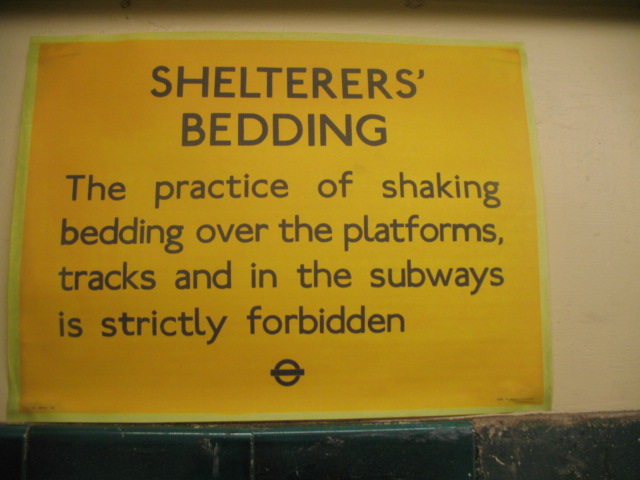
The tours begin in the neat but spartan ticket office, which is decorated with a number of wartime posters giving instruction about shelters and the blackout. You are greeted by an actor playing an Air Raid Precautions officer, whose monologue is interrupted by the forbidding wail of an air raid shelter. You meet three more such actors in the course of the tour, the best being the 1940s housewife who sits in the train down on the platform and can be quite saucy if you ask the right sort of questions.

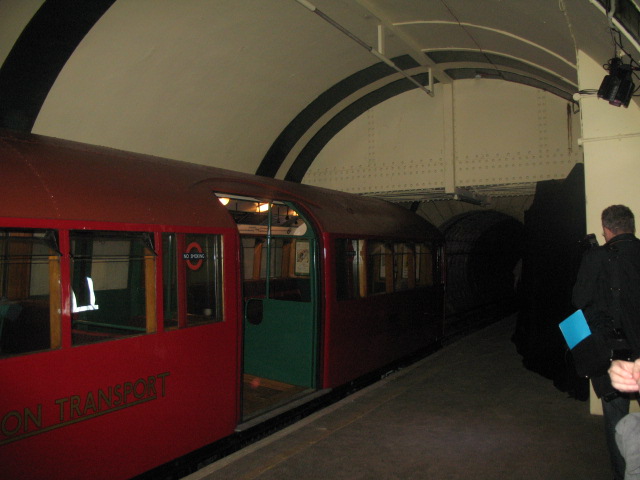
The chance to poke around the station and listen to actors recreating 1940s stereotypes is all well and good, but the star of the show is undoubtedly the 1938 train that has been brought out of retirement for the occasion.


I’m no train nerd, but this one is a beauty, as I’m sure better photographers than I will record this weekend.

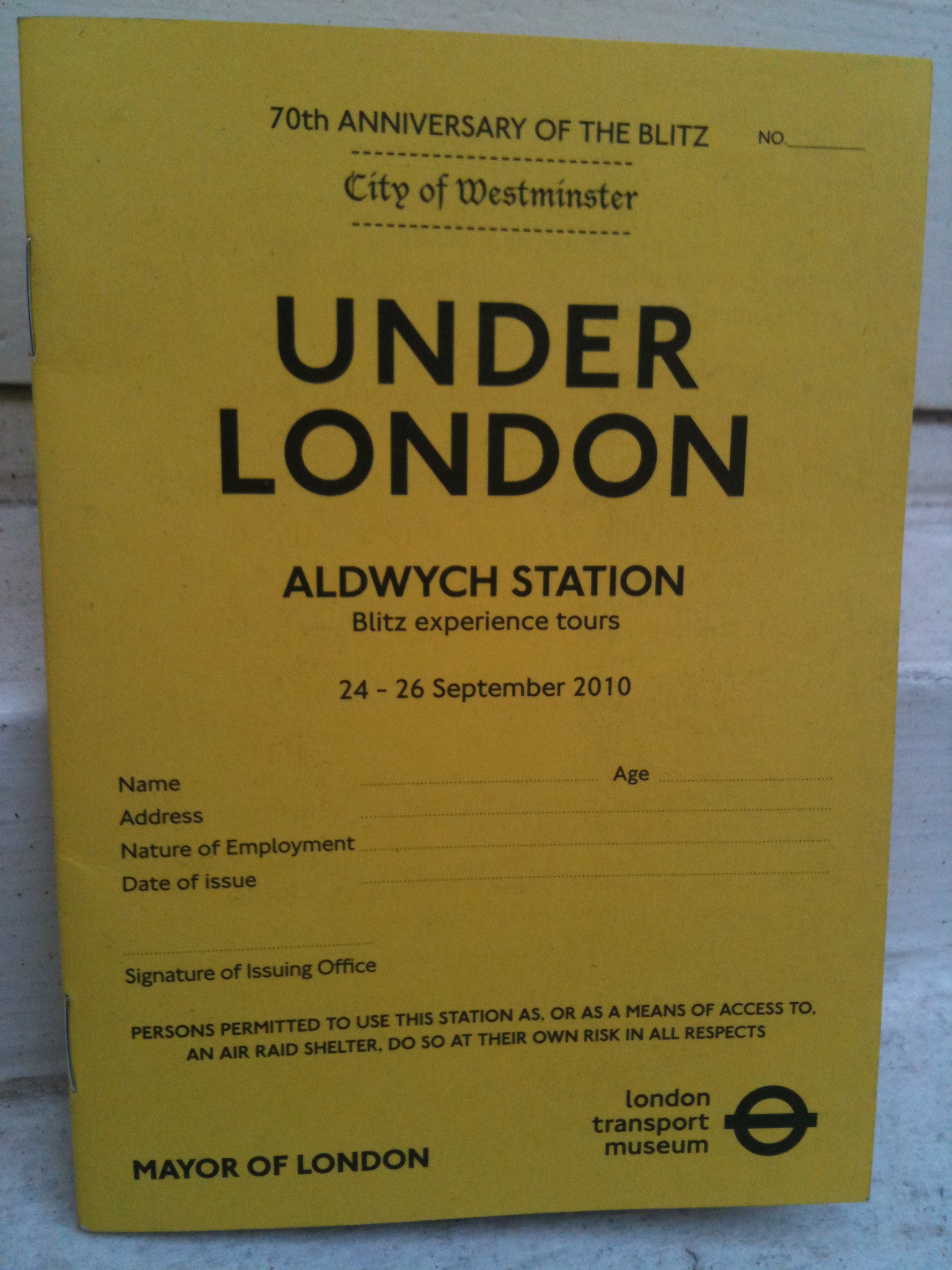
The other highlight is this cracking little souvenir book about Aldwych and the Blitz that is given to everybody who goes on the tour.

The tour ends with a deafening reconstruction of an aerial bombardment, with impressive sound and light, before the all-clear sounds and allows you to climb the steps back to the surface (no lifts or escalators, so prepare for a walk).

A recreation of the ‘Blitz experience’ is an almost impossible thing to pull off for obvious reason and this is neatly done in the circumstances, although it might have been nice to have bunks on the platform to give more of a flavour of what it was like to cower down there for a night.

Interest in the tours have been so great – an estimated 3,000 people will take part this weekend – that the London Transport Museum believe public tours of Aldwych will be reintroduced on an irregular basis in the future.

So that’s one ambition sated, only for another to take its place. Earlier this week I was talking to a curator at the LTM, who told me of his recent tour round Down Street, another abandoned station with wartime connections. It is, he told me, in ‘fabulous condition’. Anybody interested?

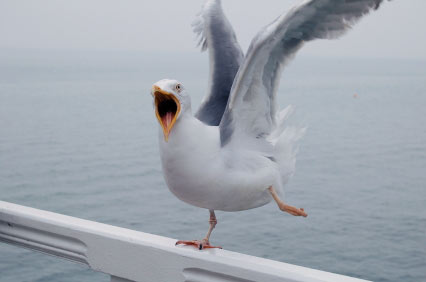
Is it racist to hate seagulls?

Somebody recently arrived at my blog having Googled ‘hating seagulls is like being racist’.

I am unconvinced by this argument. I had never really thought about it before, but I will now say unequivocally that no, hating seagulls is not like being racist.

However, I do think that hating Canada Geese is a bit like being racist, which is a problem because I hate Canada Geese.

Although I don’t actually want to do this to them.

I hope this helps.

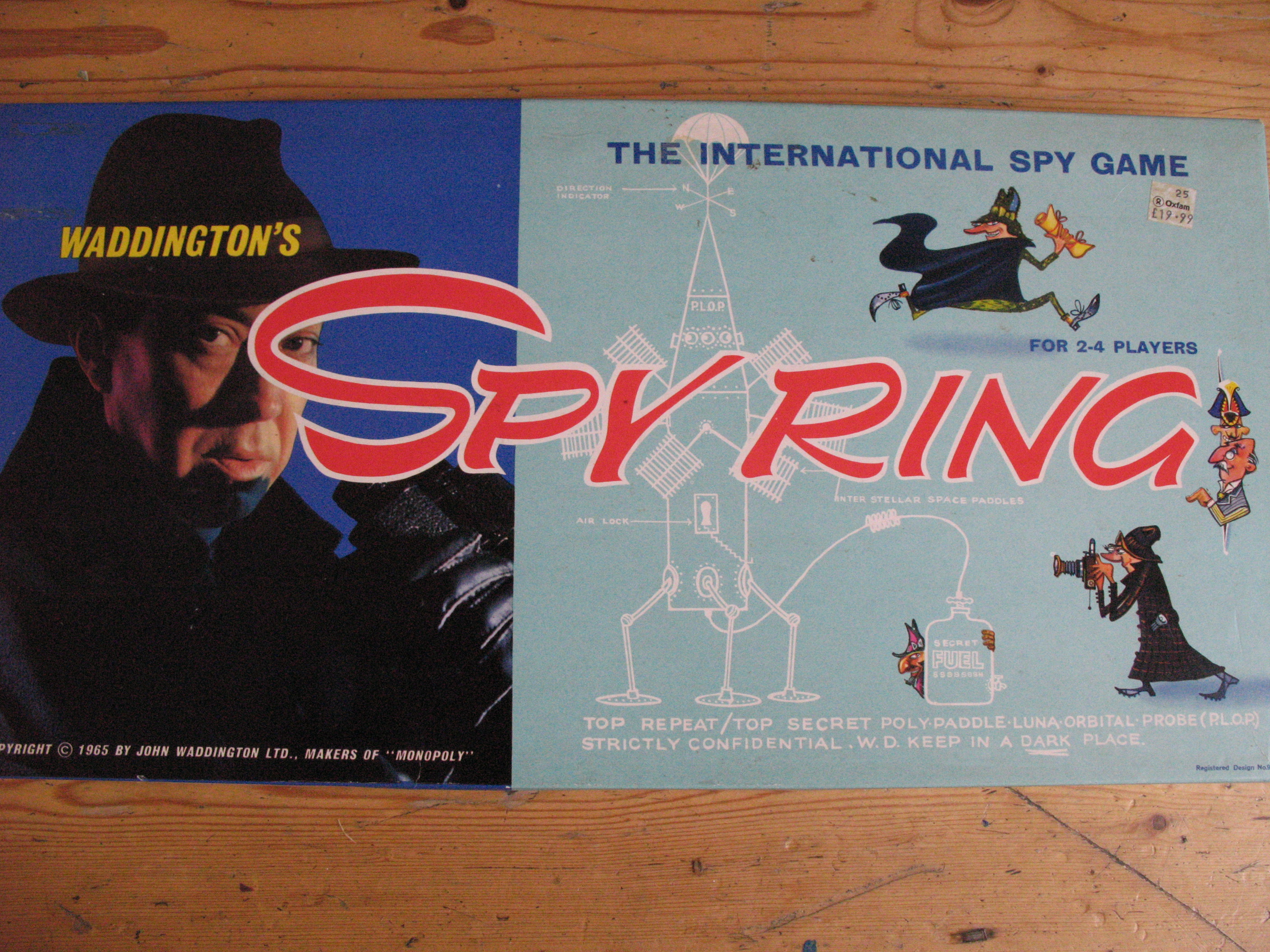
My life as a spy

Spies have been in the news recently which got me thinking about my brief dalliance with the half-life of espionage.

I was asked to go undercover by the Sunday Times in the mid-90s. and this assignment opened my eyes as to how journalism really works, for good and ill.

I was 19 and working on the sports desk as a dogsbody, tea-maker, fact-checker and column-writer. The call went up from the sweaty suits in the newsroom – they needed volunteers who were under 25 and hadn’t been to university. My sports editor put me forward, so for the first time since the Lesbian Avengers broke into the building and chained themselves to the desks, I trundled into the office where the serious journalists worked.

The story went thus: the ST editor had been having dinner with an old friend, who told him that some universities – mostly former polys – made it far too easy for students to get their degrees. Some of the tutors practically wrote the essays and answered all the questions in exams. They did this, so I was told, to increase the pass rate, which meant the universities got more funding.

The editor thought it would be a whizzbang idea if he sent a couple of journalists undercover, to enrol as students at former polys and reveal this nefarious business to our readers. And on this flimsy basis, I was to be given a large weekly stipend, leave of absence from the sports desk and an unlimited supply of pink chits – the blank taxi receipts that were the most highly valued currency in the building.

So I did it. I went to the University of North London on Holloway Road and enrolled in the only course they had left: Irish Studies. I was comfortable with this. I had recently left a Catholic school, so I’d been surrounded by plastic paddies for the best part of a decade, drank Guinness and could name the Republic of Ireland first XI without flinching. I came up with a cover story about my dad being from Ballymena but never talking about his Irish heritage, and winged it from there. They probably smelled a rat straight away – nobody was shy of talking about their Irish background in the mid-90s, when the craic and Big Jack were all the rage.  

My brief was to get close to the students and ask them leading questions about the nature of the tutoring they received, so I went to lectures and then hung out with my fellow students in pubs, drinking on expenses and getting free cabs home. It was quite the thing. Who wouldn’t relish the chance to get to play at spies? 

I quickly discovered three things.

  • I wasn’t a very good spy. I kept forgetting to record conversations or got drunk and couldn’t remember what had been discussed. I couldn’t think of any leading questions and regularly forgot my cover story.
  • I wasn’t a very good student. Studying bored me senseless and I couldn’t write the sort of essays required by universities.
  • This wasn’t a very good story, and even if it had been I didn’t want to write it. My fellow students were all older than me and from a far more disadvantaged background. They were genuinely enthused about this opportunity to receive further education and many of them had left secure jobs so they could do so. I had absolutely no desire to stitch them up at the bequest of the public scho0l and Oxbridge educated bigwigs back in Wapping, not for all the pink chits in London.

Like a double agent, I strung both groups along for a few weeks – the students, cos I it was fun; the journalists, because my access to taxi receipts had made me a minor legend among the peewees in the corridors of Wapping. But the whole thing was making me increasingly uncomfortable – having to lie to everybody – and I was really very bored of studying, so I wrote a heroically non-committal wrap-up memo to the news editor and then got the sports editor to insist I was recalled. 

Another journalist had enrolled at a different University and he stuck it out. After he’d done a full year, he ended up writing a SENSATIONAL two page expose that amounted to a whole lot of nothing, as he freely admitted.

And what did I learn from all this? A few things, all chastening. One was that newspapers made decisions about stories based on whims or chance encounters, and would follow these through to the bitter end even when it was clear there was nothing to write about, and that I wasn’t very good at doing this. Even if it had been a good story, I wasn’t tenacious enough to exploit it.  

The other was that I would never be a successful spy.

Another childhood dream, dashed.

Slime Out: the sequel

I wrote recently about the hate letter I received at Time Out a few years and how it changed my outlook on writing (Like A Demented Seagull: How Hate Mail Changed My Life).

At the end of the post I said that this prolific writer of hate mail, who had rather wittily rechristened the magazine Slime Out, had stopped sending his bile-laden missives to Tottenham Court Road.

Not so, it seems. A former colleague recently contacted me to say:

‘I didn’t want to leave a comment because I’m genuinely afraid he might read it and target me. But I can tell you that he didn’t stop writing the postcards. We have received three or four in the last year. They’re not as personally offensive about individual staff any more, but still mental. I imagine him to look like Buffalo Bill from ‘Silence Of The Lambs’.’

So he’s still out there, reading a magazine he despises and making sure they know it. Somehow, I find this reassuring, and I’m sure these days he has plenty to write about.

This might also be a good time to mention the best ‘hate’ letter I received. This was before I was neutered, when I still prided myself on writing vicious, witty, scathing criticism of anything that came into my sights.

It asked simply: ‘Peter Watts. Is he a short man?’

It still stings.

Is that a flagpole on your portico, or are you just pleased to see me?

The invasion begins!

Exotic animals of London No 1: the humped toucan

I waited all day, but I didn’t see one.