Category Archives: London

Up In Smoke

Up In Smoke: The Failed Dreams Of Battersea Power Station has a release date of April 26.

You can find out more at this website, which also tells you how to get in touch if you want me to do any talks or events.

UpInSmoke

Expect me to be writing about this a lot more in the next few weeks.

Secret London: South London’s lost canals

I wrote this piece in 2015 for the first issue of Waterfront magazine.

Some of the best secrets are hidden in plain sight. You don’t find them by exploring scruffy back streets and muddy fields, they are standing right in front of you, requiring only a translator to make sense of them. One sits in Burgess Park in Camberwell, ignored by cyclists, dogwalkers and joggers seeking respite from the Walworth Road, one of South London’s busiest byways. It takes the form of a pretty black-and-red iron footbridge with thick brick stanchions and strong stone steps straddling the path. It doesn’t serve any specific function – there’s nothing that needs to be crossed – so is known locally as the “bridge to nowhere”, but this was once a bridge with a purpose. It was built in 1906 to cross the Grand Surrey Canal, one of south-east London’s two lost canals. The park was once a busy industrial basin of wharves and warehouses but over time, the canal was abandoned, closed, filled in and forgotten. Soon, only the bridge remained, a relic or totem of this land’s previous life.

IMG00120-20120814-1050

Like many canals, the Grand Surrey was opened in the brief period between the onset of urban industrialisation and the arrival of railways. It began at Surrey Commercial Dock (now Surrey Quays), a 300-acre system of nine docks two miles east of London Bridge. The original plan was for the Surrey Canal Company to cut a canal from this starting point at Rotherhithe through the south London suburbs. From the main canal, branches would peel off, feeding significant towns on the way south. The object was to create a fast-moving route that could bring produce from Surrey farms into London. An Act was granted in 1801 to build as far as Mitcham, with branches to Deptford, Peckham, Borough and Vauxhall.

At the same time, permission for a second canal was granted. The Croydon Canal was originally going to be its own entity but the Grand Surrey Canal provided a convenient meeting point, and – after some negotiation – the two navigations joined at New Cross. This canal was intended to reach Epsom, but when it opened in 1809 in a ceremony featuring decorated barges, a 21-gun salute and a special song (“Long down its fair stream may the rich vessel glide; and the Croydon Canal be of England the pride”) it stalled at Croydon, having passed through 28 locks from the junction with the Grand Surrey Canal through Honor Oak, Sydenham and Norwood. Nonetheless, it was described by The Times as “one of the highest and best constructed canals in England” and the owners talked about extending it to Portsmouth. Plans for the Grand Surrey also proved over-ambitious, and when it opened in 1807 it went only as far as the Old Kent Road. It reached Camberwell in 1809 and branched off to Peckham in 1826, but got no further.

dooswharf

There are several bucolic illustrations of both canals, presenting them as splendid streams surrounded by countryside. At the opening of the Croydon Canal, a reporter wrote of “finding themselves gliding through the deepest recesses of the forest, where nothing met the eye but the elegant winding of the clear and still canal, and its border adorned by a profusion of trees, of which the beauty was heightened by the tint of autumn.” In 1811, the Grand Surrey Canal was peaceful enough to be used for bathing, causing one Camberwell resident to write a furious letter to The Times objecting to the “indecency” and “extreme offensiveness to females in so public a situation”. Soon after, ‘bank rangers’ – a sort of private police force – were appointed to keep an eye out for lewd or criminal behaviour.

Quickly, though, the landscape changed. Submitted to parliament alongside the proposals for the two canals, was another for the Surrey Iron Railway, which would become the country’s first public railway in 1803, linking Wandsworth to Croydon via Mitcham. Using carriages pulled by horses over iron tracks, the intention was to create an integrated transport network for the expanding suburbs, but ultimately it put the two technologies in direct competition. At first, they cohabited and connected, and the canal even proved superior, but as steam trains arrived, the canals lost any edge. Croydon Canal’s success was further hindered by its expensive, time-consuming locks and the company could tell where things were headed. The canal was dead by 1836, the first in the country to be closed by parliament. The land was purchased by the London And Croydon Railway, who built their line largely alongside the old canal and turned the basin into West Croydon station.

The Grand Surrey Canal was spared such a fate, even if it was to never fulfil the bravura plans made at the outset. Initially the canal was intended to transport numerous goods – the 1801 Act set out rates for freestone, limestone, chalk, bricks, slates, tiles, corn, hay, straw, faggots, dung, manure, stones, clay, cattle, calves, sheep, swine, lime, timber, hemp, tin, bark, iron-stone, pig-iron, pig-lead, coal, charcoal, coke, culm, flour, wheat, barley, oats, beans, peas, malt, potatoes, hops and fruit – but instead of becoming a vibrant link between garden suburbs and London docks, the canal was more like a gigantic wharf, an extension of the Surrey docks lined by warehouses, factories, yards and depots. The canal nonetheless became a useful part of the industrial infrastructure, drawing cargo from all over the world – including a 4ft snake from South America that was fished out the canal at Peckham in 1932 by an angler who at first believed he’d nabbed a particularly fine eel. The industry was largely dirty and unglamorous with numerous timber yards, but there were also R White’s, manufacturers of lemonade, and Edison-Bell, who made 78rpm records and had a recording studio on the premises.

After the Second World War, decline set in. The increase in road traffic offered tougher competition even than rail, while changes in freight transportation threatened the docks themselves. The canal closed in stages from the 1940s. The basin at Camberwell was first to be abandoned, becoming a playground for children, who went fishing for sticklebacks or tore doors off bombed-out houses to sail down the stagnant canal as rafts. Children determined their local sympathies by which side of the bridge they lived.

The bridge was still surrounded by the straggling detritus of light industry, but fears that children would drown – indeed, The Times reported more than a dozen had met this fate since the war, as several had before it – led to the area being cleared in 1974 and replaced by Burgess Park. The canal’s route was turned into a pathway and the bridge retained as a momento. There are further princely bridges on the Peckham arm of the canal, at Willowbrook Road and Commercial Way, while the Peckham basin is now the site of Peckham library. Nearby, a sliver of park connecting Burgess Park to Peckham High Street is known as the Surrey Linear Canal Park, presumably to confuse new arrivals. Elsewhere, there are further pointers: bits of wall, ghosts of towpaths, mooring rings, milestones, and in a park reclaimed from the old Russia Dock in Surrey Quays, a large amount of quayside.

One of the most interesting survivors is a rusting round bollard under a bridge near the junction of the Surrey Canal Road and Mercury Way in New Cross, once the meeting point of the Grand Surrey and Croydon Canals. Embedded in the grassy embankment, it looks as if it has been dropped from the heavens. Little of the Croydon Canal remains, although diligent historians have traced shadows of its passage in the topology of the land between New Cross and Croydon. Some tiny sections are extant in Dacres Wood, a small nature reserve in Forest Hill, and Betts Park in Anerley. The old reservoir in Norwood has been transformed into South Norwood Lake.

There is a strong sense here of what might have been. The Croydon Canal’s life was too brief, and too quickly swallowed by the dramatic forces leading to the rapid urbanisation of south London, to be saved, but the fate of the Great Surrey Canal is not so easily forgivable. Its potential was not unknown. In the 1960s, trip boats from Little Venice would take extended tours across the Thames into the depths of Peckham and Camberwell, and even in the 1970s, some insisted the canal should be saved. One report in 1971 noted the increasingly popularity of the Regent’s Canal and pondered whether similar could yet happen to “the poor, ugly Surrey Canal… [which] had the misfortune to run south of the river.” The author admitted there was an image problem: “Its waters are polluted and filled with rubbish and hunks of wood. Its banks are closed to the public and lined with disused factories and unkempt grass. To many local people it is just three miles of stinking water, which has to be dredged every time a child goes missing.” But should the drastic solution of eradication proposed by Southwark and the Port Of London Authority go unchallenged? “Suggest any redevelopment of Little Venice and fashionable owner-occupiers besiege the local town hall,” he wrote. “Down south of the river, however, they apparently order matters differently. Two public authorities have quietly decided between them to scrub off the map one of South London’s most precious potential assets.” And so disappeared the Grand Surrey Canal, not so much a lost secret as a missed opportunity.

Further reading: http://www.bridgetonowhere.friendsofburgesspark.org.uk/ and http://www.londoncanals.uk/

Power station problems

While writing my forthcoming book about Battersea Power Station, I often wondered why nobody had done so before.

The reason, I decided, was that as the various redevelopment projects were never completed, it was a very difficult tale to bring to a close. However, with the latest scheme being backed by serious money and as the buildings around the power station started to rise, it seemed as if the end was finally in sight.

I felt safe.

Too safe…

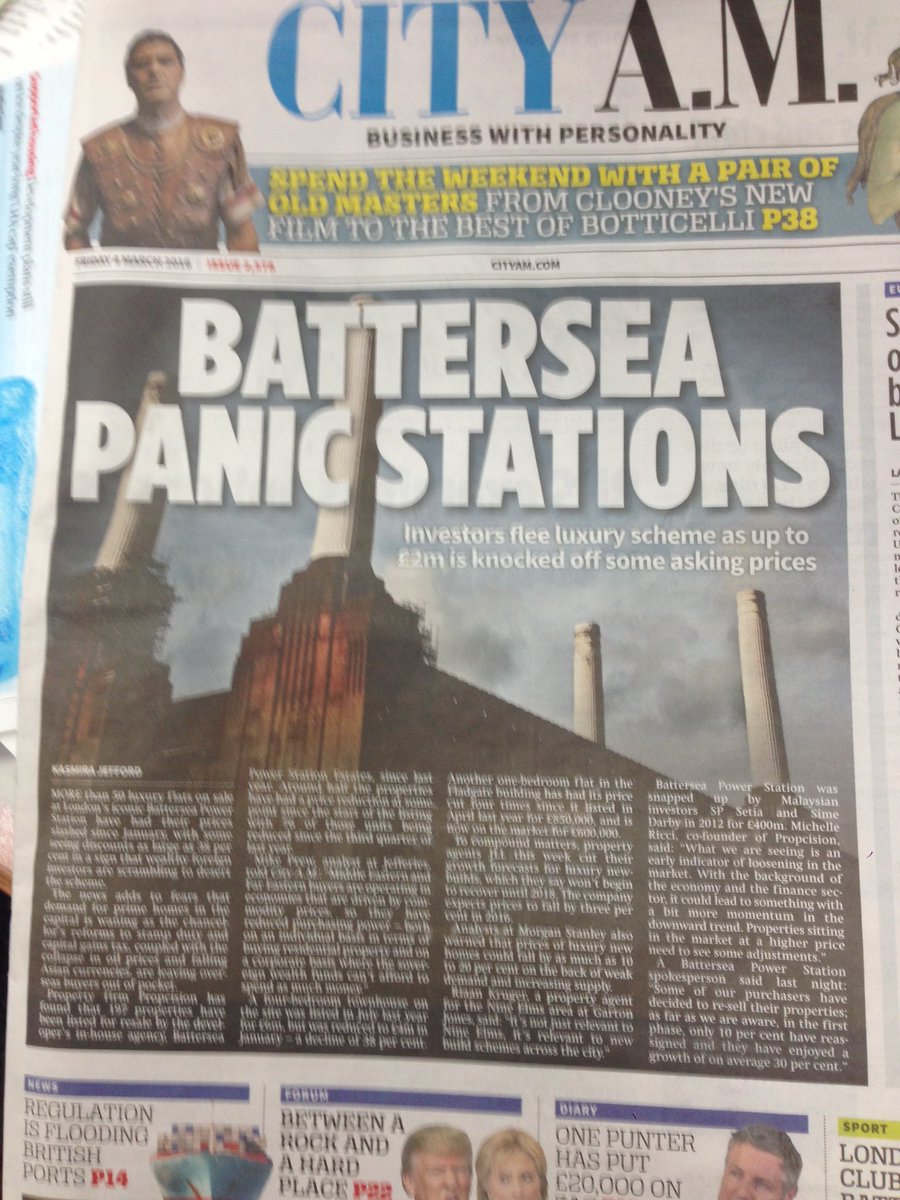
Today a report in City AM confirming what many have been saying for months – that the heat is coming out of the Nine Elms luxury property market, forcing developers to slash prices in a bid to retain the overseas investors on which so many hopes are pinned.

I was told a couple of times that this might happen, most notably when the chief executive of one previous development pointed out that the intensity of development on the Battersea site – not to mention elsewhere in the Nine Elms area, where thousands of similar flats are being built – meant that the Malaysian developers would be effectively competing against themselves on price. Unless it was managed carefully, and if the market ever dipped, there could be problems.

And so it has come to pass.

While those Londoners who decry the over-development of the power station may be excused at being amused by the problems being experienced by the developers, this is bad news for the building itself which is still far from secure: a hollow, roofless shell that is currently lacking three chimneys.

Wandsworth, who have presided over one of the most disastrous redevelopment projects in London for more than 30 years, had allowed the developers to build so many flats in advance of restoration so the developers could flog them to raise capital to pay to fix the power station. If those flats don’t sell, there is a danger that the power station will be left in a worse state than ever.

In these circumstances, demolition would be a serious possibility.

While we should be concerned, I don’t think it’s quite time to panic. The appeal of the Malaysian developers is that they are effectively being bankrolled by the Malaysian state in the shape of the country’s pension fund, which should mean pockets are deep enough to sustain these fluctuations in the property market.

But it does show that nothing is certain when it comes to the story of Battersea Power Station, except uncertainty.

Uncovering a London ghost: the half-life of David Litvinoff

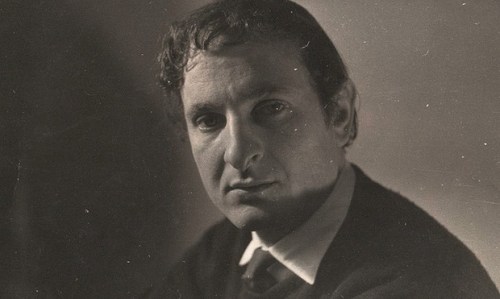
In the current issue of Uncut, I spoke to write Keiron Pim about his excellent book on David Litvinoff, Jumpin’ Jack Flash. Litvinoff is one of those characters that crops up in all sorts of strange places once you first notice him – in the last few years I’ve read books about the Krays, Performance and Operation Julie, and Litvinoff has featured in all of them as a mercurial, menacing muse. He also appears in Iain Sinclair’s books, but Sinclair is most interested in what he can use Litvinoff to represent – in this case a deliberately unknowable, shadowy figure who flits through London’s secret history, connecting the shadowy worlds of counterculture and crimes.

litv

Pim is a journalist, interested in people as people rather than as metaphors, and his book diligently puts flesh on the bones of Litvinoff’s known history, tracing this strange character’s ascent from the Jewish East End and into the worlds of art, crime and music, where he rubbed up against everybody from Lucien Freud to Eric Clapton.  It’s said that Litvinoff reached such elevated company he was even invited to Jimi Hendrix’s funeral – the invitation contained a tab of acid that the recipient was meant to take if they couldn’t physically attend.

Litvinoff was an unpredictable chancer who survived on his wits, making money here and there through schemes both legal and not. He worked for the Krays and Peter Rachman, but his defining role, as seen by Pim, is as consultant for Performance, that heady, troubling film that could be the finest ever made in this city. Litvinoff befriended and advised both Edward Fox and Mick Jagger on the ways of the underworld, and supplied his old Soho pal Donald Cammell with ideas for scenes and dialogue. One of the many memorable moments in the film – the shaving of one victim’s head by gangsters – was based on Litvinoff’s own experiences. This was a man who both delivered and received mob justice – and at times, he is unsympathetic to the point of psychopathy – until he discovered a form of salvation through drugs and the woolly world of hippie idealism.

performance

The story is ultimately a tragic one, as Litvinoff increasingly found himself left behind by friends, who could tolerate his wit and weirdness for only so long. He killed himself in 1975 as punk was breaking, and one sense that this movement of chaotic creativity, violence and contradiction would have suited him fine, although Malcolm McLaren may have baulked at the competition.

Given that Litvinoff didn’t actually leave much behind – no books or diaries, photographs or albums, little that is tangible or concrete – it’s difficult to put a pin in what he actually did. In an age in which we are increasingly defined by our jobs – commit a social media faux pas, and you are immediately reported to your employer – that’s strangely unsettling. The brilliant late artist Martin Sharp, a close friend of Litvinoff, makes a case that this needn’t be the case, that Litvinoff, by simply being himself and acting as muse and creative conspirator, did plenty. “It’s hard to earn a living doing it, but he made an enormous contribution to people’s lives,” says Sharp. “It’s not something you can send someone a bill for.”

Up In Smoke: The Failed Dreams of Battersea Power Station

I’ve written a book about Battersea Power Station.

It’s called Up In Smoke: The Failed Dreams Of Battersea Power Station and is out in the spring via Paradise Road, a new publisher concentrating on London non-fiction.

Battersea Power Station is one of London’s favourite buildings, but nobody before has told its story.

This will be the first book to explore the history of the building, from conception and construction, through use and obsolescence, and then into the long years of post-closure redevelopment.

I wanted to understand why so many people have been fascinated by Battersea over the years. I’ve spoken to former workers and designers of inflatable pigs, location scouts and photographers, politicians, Lords, architects, planners and entrepreneurs.

This is a book that tells us so much about London and the way it changes. It’s a story of power and land, of big ideas and broken dreams. It’s a story that takes in property and politics, architecture and popular culture. It’s a story about our city and our relationship with its most popular building.

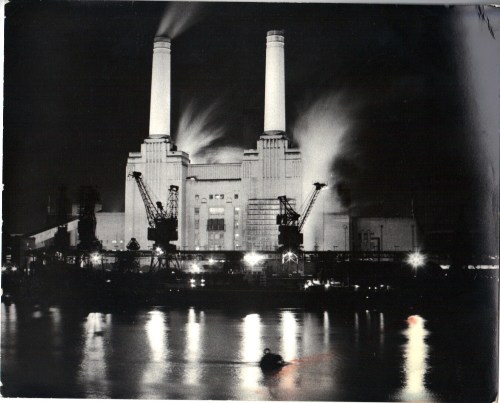
It asks how we went from this…

19-09-2014 104101

Battersea Power Station, 1975.

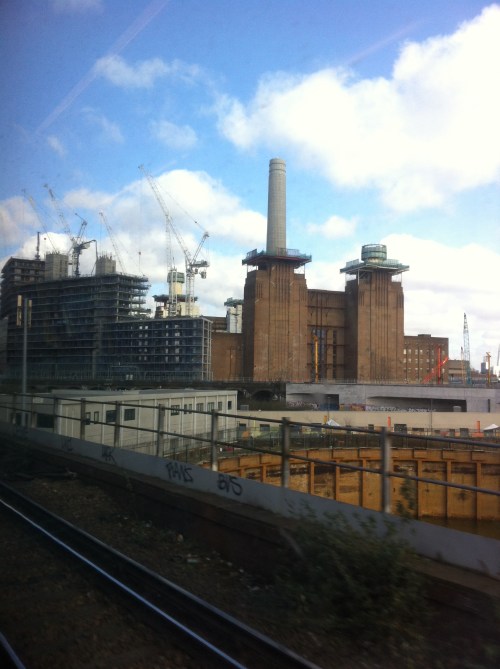
To this…

IMG_5309

Battersea Power Station, 2016

London’s latest museum – Jimi Hendrix’s Mayfair flat

This is a piece I wrote for Eurostar about the conversion of Jimi Hendix’s Mayfair flat into London’s first historic house dedicated to a rock star (a small exhibition was held in the flat in 2010). Interestingly, even before the death of David Bowie, the museum’s curators were concerned the flat would be turned into a shrine by fans.

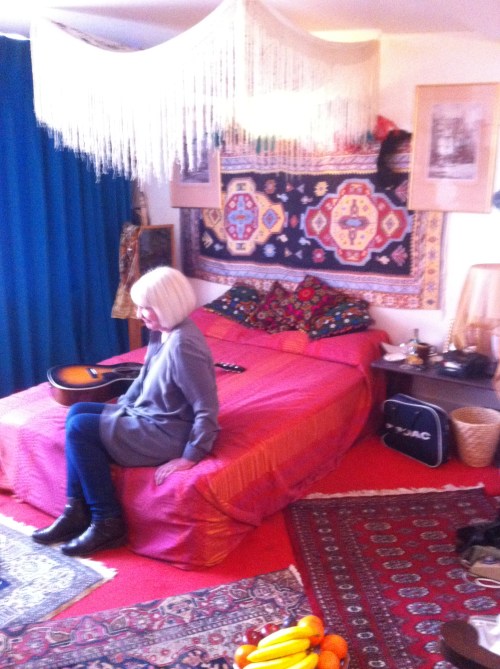
The museum is a strong addition to London’s cultural scene, filling a definite blank space. It begins with an informative timeline of Hendrix’s life focusing on his time in London, and then moves into this charming and evocative recreation of his tiny bedroom, which is both ostentatious yet surprisingly spartan. 

IMG_5296

Hendrix’s reconstructed bedroom, with former girlfriend Kathy Etchingham

When Barrie Wentzell photographed Jimi Hendrix at the rock star’s London flat in 1968, neither of them imagined that the colourful bedroom would one day be transformed into a museum. “I photographed him for Melody Maker,” says Wentzell. “It seemed so small when I went back recently. He’d have found it hilarious that it’s being turned into a museum.” Hendrix moved into 23 Brook Street in January 1968 with his girlfriend Kathy Etchingham, using it as a base to explore London as well as a space to conduct interviews and hang out with fellow musicians – George Harrison was one of those who stayed overnight on a camp bed. Since 2001, the flat was used as offices by the Handel House Museum who are located at the 18th-century composer’s old home next door at No 25. The entire space is now being renamed Hendrix & Handel In London, and Hendrix’s flat will open to the public in February 2016.

Hendrix arrived in London in September 1966 and began playing shows on his first night, immediately attracting the attention of a London music establishment who had seen or heard nothing like him. Incendiary, transformative early gigs in tiny West End clubs were witnessed by the likes of Eric Clapton, Pete Townshend and The Beatles. “All those guys, they played the blues but Hendrix had taken it to a different level,” says Wentzell. “He told me once, ‘Sometimes I play the guitar and sometimes the guitar plays me’. But he was very humble and soft-spoken, he kind of under-rated himself. He would talk about how great Clapton was and Clapton said the same about him. They had real love for each other.”

London boasted a powerful music scene packed into a small corner of the West End, and word about Hendrix soon spread. He became a star and as a result, he loved the city. Although he’d met Etchingham on his first day in London, he spent much of those early months moving between flats and hotels. “He moved around an awful lot and had lots of girlfriends who all thought they were the one,” recalls journalist Chris Welch, who interviewed Hendrix several times. Etchingham and Hendrix eventually moved in together, paying £30 a week for the pokey one-bed Mayfair apartment above a restaurant called Mr Love. Hendrix called it “the first real home of my own” and helped select ostentatious decorations of bright fabrics, peacock feathers, bric-a-brac and a rubber rat. The bedroom, which is where most of the entertaining took place, is being recreated for the museum after curators identified and tracked down around 70 items of furniture and fittings. Other exhibits include clothes, records and guitars as well as a timeline exploring Hendrix’ pivotal London months.

Although Hendrix spent his time in Brook Street enjoying some level of domesticity – he played Risk and watched Coronation Street – he also threw himself into the world of Swinging London, which was right on his doorstep. Promotors, agents, publicists, music papers, clubs, guitar shops, studios and fashion boutiques were all based in Mayfair and Soho. “He was in the best place to be,” says Welch. “Bands from all over the world converged on London and it was still the hippie era so if you were going to be accepted for being unusual anywhere it was the West End. He was adopted by Londoners very quickly.” Wentzell agrees. “There was a lot of love for Jimi,” he says. “He was only around for four years and he changed the world, he really did.”

Hendrix, who died in London in September 1970, always loved the flat’s connection to Handel – indeed, he believed he was living in Handel’s old home as Handel’s blue plaque was on the wall separating the two properties. “I remember him saying that he got this vibe of music from Handel and we joked about how he’d like to have jammed with him,” says Wentzell. “I guess now he is.”

Handel & Hendrix In London, 23-25 Brook Street. Opens on 10 February 2016.

Navvies, landlords and protest

I’ve written three pieces elsewhere recently.

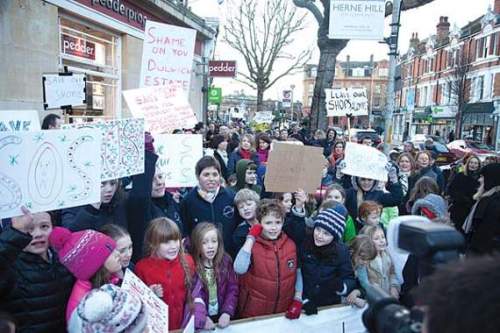
For Londonist, I wrote about the battle in Herne Hill between independent shops and the local landowner, Dulwich Estates, who some feel are taking more away from the community than they put in. A protest last week saw several hundred Herne Hillians march from the station to the local toy ship, which was forced out by a huge increase in rent. Several other tenants told me they feared they’d also be forced to move in the next year.

m5746


For Apollo, I wrote about a new exhibition of posters from Berkeley in 1970, when students protested about the ongoing Vietnam War and also the deaths of four student protesters on a campus in Kent State.


And for Waterfront, I wrote about the life of the navvies in London. I was intrigued by the urban legend that the four pubs in Camden with castle in the title – the Edinboro, Windsor, Dublin and Pembroke – were built for the navvies, to ensure separate nationalities drank apart and didn’t scrap. It quickly became apparent that the story wasn’t true, but as I researched the life of the navvies, I began to understand how the myth was raised and also learnt a lot about this tough breed of migrant worker.

Shrines of London


This is an edited version of a talk I gave last year for the London Fortean Society about London’s shrines. I decided to repost it after visiting the David Bowie shrine in Brixton last week.


To prepare for this speech and in an attempt to get my head around what a shrine was, I began thinking about the simplest shrines you see in London – that’s usually flowers tied to a lamppost after a sudden often violent death or the ghost bikes you see tied to lampposts after crashes.

That got me thinking about the largest shrine I’ve seen in London. This was in those strange weeks after Diana’s death. I was in my 20s and strongly Republican and so had little interest in the public mourning, but an older friend suggested we go and see what was taking place at Kensington Palace as it was something that only happens once in a lifetime. As we walked across Hyde Park this strange smell began to creep across the park – and I can still smell it to this day, the acid sweet stench of rotting flowers. It was indeed an incredible sight. The area in front of Kensington Palace was carpeted with flowers, thousands of bouquets, already turning to compost in the summer heat. People were walking among them, stooping like peasant farmers or bomb disposal experts to read a label. I’d never seen or smelled anything like it. You could not get near the palace gates.

Just look.

What fascinated me also about all this was that it had a seditious, outlaw aspect. There was a lot of noise in the press about whether the Queen was treating Diana’s death with sufficient respect, and this huge impromptu shrine – by the people, against the establishment – was given the atmosphere of an almost revolutionary act. It was a fascinating combination – the privacy of remembrance, carried out on a larger scale with political implications.

So perhaps these are some of the key elements for a memorable shrine: they need to be in memory of a colourful life cut short, possibly violently and unexpectedly, but also be plebeian or proletariat in nature, carrying a sort of unofficial, rebellious, streak, upsetting the forces of the order and establishment.

Unsurprisingly. London is filled with them.

RR-Freddie-Mercurys-door.jpg

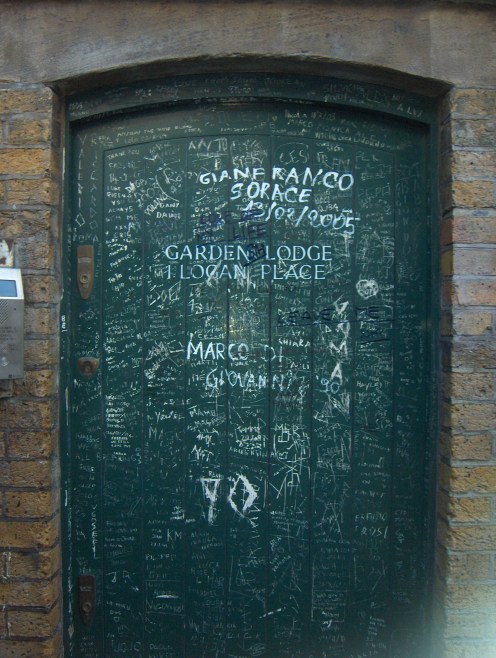
A disarming proportion are devoted to rock stars. This is Freddy Mercury’s old front door in West Kensington, featuring primitive scratched messages from fans all over the world.

There’s also a more or less permanent shrine outside Amy Winehouse’s house in Camden Square. It’s interesting to speculate why some musicians get this treatment and others don’t. For instance, why has Abbey Road become a shrine for Beatles fans but there’s nowhere similar for the Rolling Stones? Perhaps a shrine needs a magnetic location, and the Stones have never created that particular relationship with any single space in the city, perhaps we will need Mick or Keith to die before we find out.

I used to live near Abbey Road, and they had to repaint the wall every two weeks or so such was the flood of graffiti, even though you’d never actually catch anybody in the act of doing it.

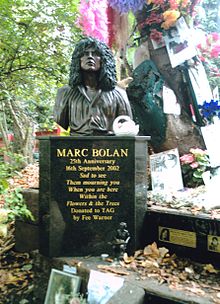
Similarly, I’ve always been slightly puzzled as to why Marc Bolan has attracted a shrine. This is the sycamore tree on Queen’s Drive in Barnes that Bolan’s Mini crashed into in 1977, killing him instantly. People have been leaving notes and flowers ever since, and now there’s a bust. Why Bolan? I like T-Rex but don’t really see him as the sort of shamanic, eternal talent you’d think attracted such a tribute.

Perhaps it’s simply the violent nature of the death that appeals to people. But the way his death tree – his cause of death – is being marked is inescapably macabre. In some ways, it makes me think of the old Bill Hicks line, that the last thing Jesus would want to see if he came back to Earth was another bloody crucifix.

That brings us neatly to the religious aspect of shrines. Even in the secular ones, it’s there under the surface, this primitive, sacred need to mark a spot and remember the dead devotionally. But London also has numerous religious shrines. There are two that particularly interest me. One is on Bayswater Road at Marble Arch, where there’s a small convent for nuns. In the basement is a chapel, with walls covered in ancient relics – skin, bone, bits of fingernails – pulled and plucked from some of the 350 Catholic martyrs who were hanged at Tyburn, the gallows nearby. Behind the altar is a replica of the gallows itself. It’s remarkably medieval and extremely weird, especially when a nice old nun is telling you about their favourite piece of shrivelled skin.

There’s also a really interesting element of the shrine found in the canals of west London. Here you often find coconuts floating in the water, sometimes cut in half and containing candles, sometimes tied with ribbons. I used to live on a narrowboat and would occasionally travel west to Uxbridge – the nearer you got to Southall the more you’d see.

I was told they were placed in the water by London’s Hindus in religious ceremonies, with the canal representing the Ganges. A recent article confirmed this: they are place in the canal as an offering to Maa Ganga who symbolises Mother Earth and also the elixir of life, as water is where all life begins. And why coconuts? A Hindu scholar has explained that “Coconuts are the fruit of the Gods – it’s a pure fruit with remarkable qualities, it takes in salt water and produces sweet fruit and it’s neatly packaged too. Also it’s a symbol of fertility, it reflects the womb, and has human qualities – it has two eyes, a mouth and hair.” It’s fascinating that this symbolism has been transported across hundred of miles and generations.

When I was researching this talk, I began to wonder whether London had any graffiti wall shrines – that’s public spaces that have been adopted by street artists to commemorate specific moments and remember people. I’m sure that these exist, but they are hard to pin down because of the transient nature of the form. London does have lots of murals, huge paintings, often commissioned by the community and with a political angle. There’s the Battle of Cable Street mural in Wapping and the Nuclear Dawn CND mural in Brixton. A lot of these are official, but it was interesting to read about the War Memorial Mural at Stockwell tube. This commemorates various aspects of war, with a section for Violette Szabo, who worked behind German lines in WW2 and lived in south London. More recently, artists decided to include on the memorial an image of Jean Charles De Menezes, who was murdered by the police in 2005. But there were disagreements – people felt he didn’t conform to the spirit of the overall piece. Eventually, he was painted out. But there is a small mosaic and shrine to De Menezes nearby.

Then there’s the really strange shrines. I had no idea until this week that the phone box near St Bart’s hospital had been briefly turned into a shrine to Sherlock Holmes after the TV show had him falling from the hospital roof. I don’t imagine there are that many shrines to fictional characters elsewhere in the world.

London also has a skateboard shrine. If you look over the side of the Jubilee Footbridge, you’ll see dozens of broken skateboards lying on one of those immense concrete feet that anchor the bridge to the Thames. These are boards that have been broken during skating sessions by the nearby skaters on the South Bank in the undercroft, and ceremoniously chucked over the bridge to form this strange graveyard.

Then there’s what for me is the saddest shrine of all, partly because it no longer exists. I used to see this all the time when I walked Farringdon, close to Mount Pleasant sorting office, where there are steps going up the viaduct. High up on the wall of one of these dank stairwells you’d see a dozen or so spoons stuck to the tiles.

I always wondered what this was about – even though I think I also partly knew. One day I asked the collective wisdom of Twitter and somebody told me what I’d always suspected: that these were placed here by heroin users in tribute to their dead comrades, each spoon marking a departed soul.

This summarises the essence of an urban shrine for me – it’s clandestine, it’s seditious, it’s violent, it’s about a form of martyrdom and above all it’s about remembrance. I was extremely sad to see the spoons had been removed when the bridge was recently repainted. It’s like those people, those lives, were erased from the public memory. Even as a shrine, they are not allowed to exist.

“I loved the brutality of it”: Suede and London

I wrote about Suede for the current issue of Uncut. This was something of a revelation for me, as I was able to remind myself how excited I was when I first heard Suede – I remember playing “Animal Nitrate” over and over again in my bedroom, thinking that I’d finally discovered a band I loved as much as The Smiths. Before interviewing the band, I went to see them play at the Roundhouse and all of that old energy was still there, and I was just as thrilled as I had been at 16.

One angle covered in wide-ranging interviews with Brett Anderson, Mat Osman and Neil Codling was the importance of London to the Suede aesthetic – this was a band that even renamed themselves The London Suede, albeit under duress, for their American releases.

suede.jpg

When the band were formed, Osman and Anderson shared a flat on Hilever Road in White City “on the border with Notting Hill – bohemia one way, estates the other,” Osman said, and Suede’s music came to occupy this very same sort of space, the sort of London written about by Patrick Hamilton, Dylan Thomas, Gerald Kersh and Roger Westerby in those novels about outsiders arriving in London and being instantly swallowed by vice and excitement. Doing something similar around this time was the TV version of Hanif Kureishi’s Buddha Of Suburbia, with a soundtrack by David Bowie – the combination of Suede and Kureishi is what led me to Bowie.

“London was a place where you can be what you want,” says Codling. “You can disappear, you can embrace any subculture, you can reinvent yourself and glamour is a possibility inherent in that.”

Anderson didn’t deny any of this. “I romanticised what London was,” he said. “I lived in a bit of a film fantasy. I loved the brutality of it, the loneliness and the hardness of it all. I really responded to that. But this is what we were living. I was part of this world I was writing about. I’ve always tried to find the romance in any situation I’ve been in and that happened to be the situation I was in. I’ve always loved art that deals with the prosaic. The Smiths aesthetic, I found that very powerful, ‘the riches of the poor’. There’s beauty in the brutality.”


Anderson told me he’s still inspired by London, often cycling the towpath from his home to West London to Camden, even if it doesn’t directly appear on the band’s new album. The excellent Night Thoughts is instead preoccupied by those unnerving concerns about children and fatherhood that keep Anderson – and myself – awake at night.

“I refute the tortured artist clichés, it’s bullshit, a lazy misunderstanding of what creativity is,” he said. “It’s not expected of authors and film-makers, Michael Haneke always seems very balance and his films are genius of discomfort. For me, a writer is finding those moments of friction, and those can occur in any existence, in any relationship, no matter how stable or content. There are always misunderstandings and moments of friction and this is what I write about.”


It’s all glass here now – the taming of St Giles and death of the West End

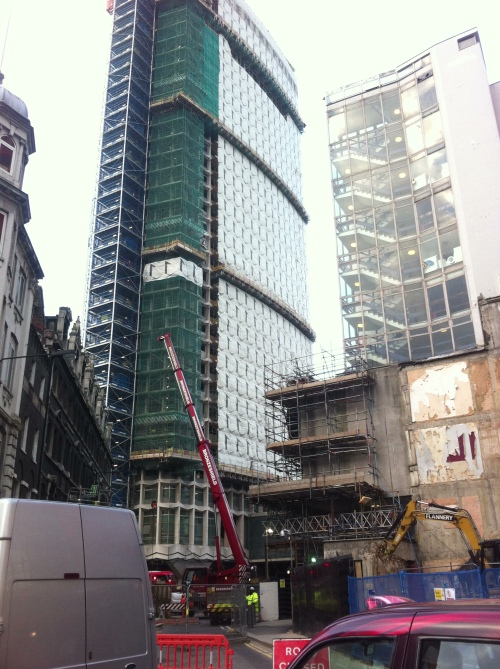
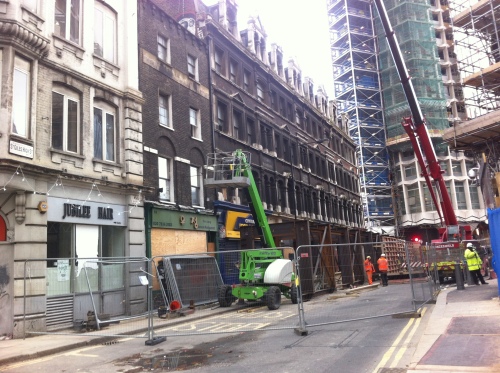
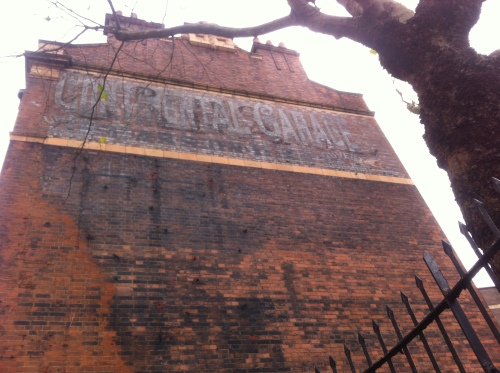
I have a piece in today’s Guardian about the disappearing London district of St Giles, for centuries a hive of villainy and low entertainment but which is now, finally, being aggressively domesticated by developers with no love of vernacular architecture or fun.

Last year, while walking round this junction of Tottenham Court Road, Charing Cross Road and Oxford Street, I was assailed by pneumatic drills, wrecking balls and nostalgia. This used to be my territory, where I’d play after working at Time Out on Tottenham Court Road, and now much of it was unrecognisable. The cafes, bars, restaurants and clubs that I’d known so well were gone. But this wasn’t simply a case of the passage of time and changing fashion causing old haunts close down – that I could accept, more or less. Here the buildings themselves had been pulled apart so nothing new or interesting could take their place.

Even Time Out‘s old office had been demolished, developers deciding that rather do any actual developing and modernise the entirely usable existing structure, it was easier to knock it down and start again. This was happening over and over, wherever I looked. It was like armaggedon, a building site several miles square, pouring concrete over memories and salting fertile ground.

With this wholesale demolition, the character of an entire area was being irrevocably and deliberately erased. People have been saying the West End was dead for decades, but in the borderland of St Giles something of the old  Soho and Covent Garden still lingered. Now, it’s gone. If it’s fun you want, give Zone One a skip. It’s all glass here now.

IMG_4940 IMG_4929 IMG_4932 IMG_4938 IMG_4932 IMG_4927 IMG_4925 IMG_4923