Category Archives: London

London’s crappest ghost: a Halloween post

London has many ghost stories and some are actually rather scary, like the Black Dog of Newgate. This spirit is said to haunt Amen Court near St Paul’s, where a wall from Newgate Prison remains. It manifests itself as a shapeless, black form slithering along the wall before it disappears into the shadows.

Considerably less spooky is the ghost said to haunt Pond Square in Highgate.

The story goes like this.

In January 1626, the writer and philosopher Sir Francis Bacon wanted to test his theory that ice could be used to preserve food, so he bought a chicken on Highgate Hill, killed and plucked it, and stuffed the carcass with snow. The frozen chicken had been invented, but the effort caused Bacon to contract pneumonia from which he died.

A sad tale, but one which doesn’t end there. For, ever since, on icy cold nights in the depths of winter, a shape resembling a partially plucked chicken has been seen flapping around Pond Square and squawking before vanishing spookily into the ether.

Yes, that’s right, London is haunted by the spirit of a featherless fowl.

Has there ever been a crapper ghost than this?

Urban legends: Phyllis Pearsall and the A-Z

The story of Phyllis Pearsall and the A-Z is one of London’s most enduring and endearing myths. To take but one example, here’s the Design Museum‘s version of how, in 1935, Pearsall couldn’t find her way to a party in Belgravia so decided to make a completely new map of London, which she did by getting up at 5am each morning and walking every one of London’s 23,000 streets – a distance of 3,000 miles. The result was the A-Z, the first street atlas of London.


You’ll find this story everywhere, often repeated word for word, which is usually a sign something is up. Here it is on the BBC. Here it is in Time Out. Here it is on Wikipedia.  And here’s some sap repeating it in an excerpt from a book on Amazon.

Peter Barber reckons it’s nonsense. And as the head of maps at the British Library, he should know.

‘The Phyllis Pearsall story is complete rubbish,’ Barber told me. ‘There is no evidence she did it and if she did do it, she didn’t need to.’

Barber maintains first of all that the first street-indexed map of London was made in 1623 by John Norden, but his reservations are not just academic. Pearsall’s father, Alexander Gross, had been a map-maker and produced map books of London that were almost identical to the A-Z in everything but name. They looked the same and used the same cartographical tricks. It’s Barber’s belief that Pearsall simply updated these maps to include the newly built areas of outer London and called the result the ‘A-Z’.

‘She was a great myth-maker,’ says Barber. ‘But English Heritage investigated the story and decided not to award her a blue plaque because it was not felt she’d done anything to deserve one [Pearsall does have a plaque, but it was awarded by Southwark]. It was marketing and it’s a very pervasive myth, she was a lovable character and people want to believe it.’

So did she really walk those streets or not? Here, Barber is hard to pin down. In writing he is equivocal, as the final comment here shows, but in conversation he makes his position pretty clear.

‘Pearsall was building on a body of information that had been around for years,’ he says. ‘What she may have done is be more thorough in mapping the new areas that cropped up between the wars, and there were two ways of doing this. You could either tramp the streets of outer suburbia for hours on end, or you could visit the local council office and ask for their plans. Which do you think she did?’

A common little London house

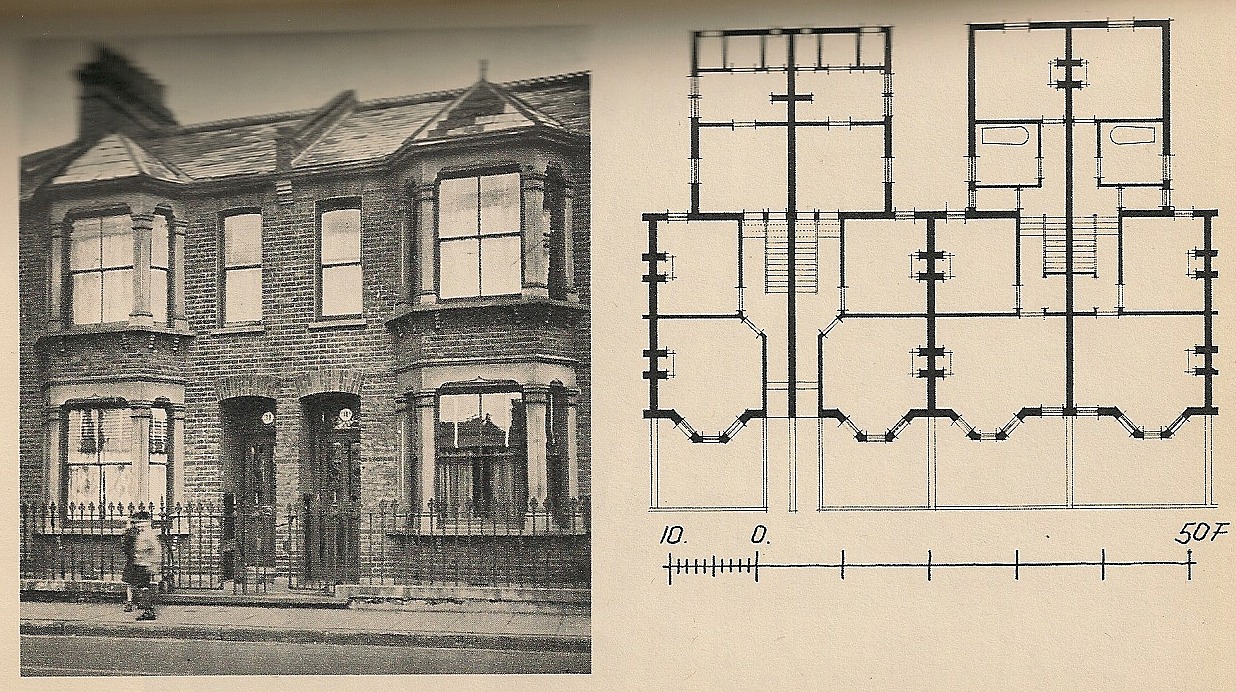
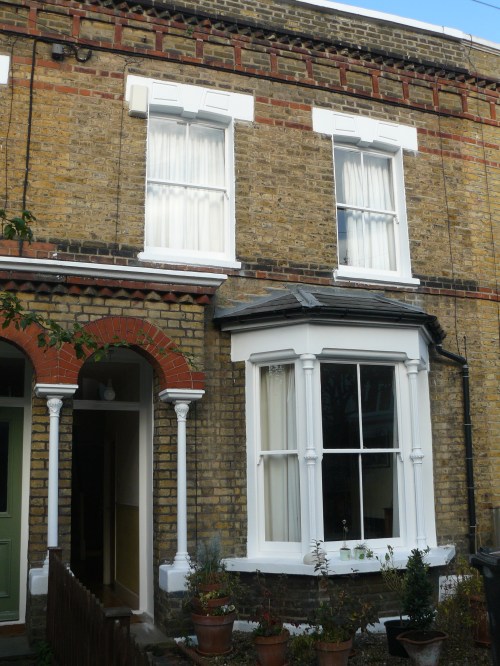
There is nothing special about this house, other than that I live in it. It is one of hundreds of thousands of almost identical houses built in the second half of the nineteenth century for a London population that was expanding at a ferocious rate.

This was the Great Wen that William Cobbett warned about. In ‘London: The Biography’, Ackroyd quotes ‘an observer perched on top of Primrose Hill in 1862, who looked at the growing city and noted that, “the metropolis has thrown out its arms and embraced us, not yet with a stifling clutch, but with ominous closeness.”‘

In ‘London: The Unique City’, Steen Eiler Rasmussen’s classic book about London architecture, he writes about houses just like this: ‘From railroads intersecting the suburbs of London we see interminable rows of these swarthy little houses with all their protruding little kitchen-wings. It is the most compact type imaginable for a street house.’ He includes a picture and plan of these houses. Look, it’s almost indentical to mine.
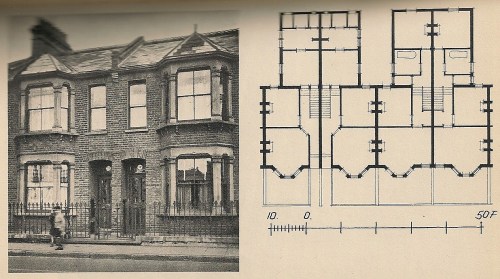
There is a reason for this ‘interminable’ consistency in London housing, and like most things in this country, it is to do with class. Rasmussen explains that in London, because the class system ensured people of the same social strata would invariably live alongside each other, segregated from those richer or poorer than themselves , it was ‘possible to standardise domestic houses: as people living in the same street have the same requirements all the houses can be absolutely uniform.’

This isn’t quite true of my street – at one end there are grand five storey double-fronted detached houses, which would have been for the very rich with domestic servents, and at the other end there are two-storey railway terraces, with every possible permutation in between. This would have meant unavoidable mixing of the classes and was the result of the street having been built over a number of years, starting with the posh end near the park and ending with the common end near the station. But it is certainly true that London houses of the era are near identical.

Rasmussen also knew the exact width of of my new house – 16 foot 6 inches. He writes, ‘the common little house of which there have been built thousands and thousands is only sixteen feet six inches broad. It has probably been the ordinary size of a site since the Middle Ages… but it is difficult to get information as to how typical houses were built in former days.’ After reading this, I measured the front of my house and he was right. Now everywhere I look, from Brixton to Holloway, I see 16 foot 6 inch house fronts. Try it yourself.

So why is this? For an answer, I turned to English Heritage’s photographic collection ‘Lost London’, in which Philip Davies explains exactly why London’s houses of a certain era are all exactly the same size. He writes of ‘a secret ingredient which conferred an innate harmony on the city, and which influenced everything from the layout of an entire neighbourhood to the size of a window pane – the Imperial system of measures.’

Davies continues. ‘Neighbourhoods were laid out by surveyors who used acres, furlongs, rods and chains – measurements which had been in common usage for marking out arable land since the ninth century. An acre was the length of a furlong (660ft) and its width was one chain (66ft). For shorter lengths a perch, a pole or a rod were used. There were four rods to one chain and a London workman’s house had a frontage of one rod – 16 ft 6 in – so entire districts were created based on endogenous proportional relationships.’

As this website explains, when a landowner wished to build a series of houses for his agricultural labourers on an acre of land, the surveyor could go out with his rod and immediately estimate how many houses there was room for.

So the size of the house in which I live in the twenty-first century was decided by a scale of measurement that dates back to the Dark Ages. For those who find London’s overall sense of scale overwhelming, this internal and very visible consistency might at least provide some comfort.

Secret London: the riddle of the Farringdon spoons

I first saw these spoons several years ago stuck on a wall in a miserable stairwell under Farringdon Road near Mount Pleasant. Nobody seemed to know anything about them or where they came from – the only reference I could find is a passing mention in this interview with the Greenwich Phantom on Londonist.  

I walked past them again the other day and tweeted about them. An answer came back within half-an-hour (from @mrrylln), who said: ‘They have been up there for about 10 years. The stairs were used by heroin addicts a lot… hence the spoon H-shrine.’

Not the most romantic of explanations, but an explanation all the same. Chalk up another one to Twitter.

A punch up the bracket: BS Johnson and Anthony Aloysious St John Hancock

In a comment on my previous post about BS Johnson,  BB writes: ‘To issue a threat ending in “up the bracket” is so much of its time it made me laugh out loud. I had a couple of jobs that involved working with men in their late 50s and early 60s, real Londoners,  and they had a particular argot and mode of expression, which was always making me laugh. Enquiring as to whether you wanted a punch up the bracket was a regular occurrence.’

I also love this phrase, and associate it with another of my heroes, Anthony Aloysious St John Hancock, the greatest British comedian of all time. (There’s a great piece about Hancock here, noting the similarities between Hancock and Seinfeld as well as Hancock’s use of ‘punch up the bracket’.)

Hancock and BS Johnson have much in common. Both were aspirational working-class/lower middle-class men defined by the 1950s who spoke in the language of outer-urban post-war London. Both were men of keen wit and sharp intellect who enjoyed – or couldn’t help – skewering their own occasional lapse into pomposity. Both were depressives with a gift for pointed, painful comedy. Both killed themselves. They even looked similar: thick, heavyset men with wounded eyes. And, most importantly, both referenced Chelsea in key texts (Hancock in ‘The Football Pools’ and Johnson in ‘Albert Angelo’).


I once interviewed Tim Lott – or was it Toby Litt? – who suggested that Hancock was London’s answer to the Angry Young Men of 1950s northern working-class fiction, and there’s something this, though I’m not sure Sillitoe or Wain ever came up with anything as dark as Galton and Simpson’s ‘The Poison Pen Letters’, in which Hancock is so consumed by self-loathing he starts sending himself hate mail in his sleep.

But this is something you can imagine BS Johnson writing, another angry, sad, brilliant man who went raging into the tragedy of premature death.

My London Library: No 4 – Street Children

  • Title Street Children by BS Johnson (text) and Julia Trevelyan Oman (photographs) (Hodder & Stoughton, 1964)
  • Cost £120 (yes, £120!)
  • Bought from Maggs Books, Berkeley Square
  • Genre Photographs

I became fascinated by BS Johnson after seeing the under-rated film adaptation of Christy Malry’s Own Double-Entry and then reading Jonathan Coe’s splendid biography, Like A Fiery Elephant.

Johnson was a London novelist and suicidal Chelsea fan who believed all fiction was lies and killed himself in 1973 after producing a number of extraordinary books, such as The Unfortunates (adapted for radio this week), in which all the chapters were individually bound so they could be read in any order, or Albert Angelo, a semi-autobiographical, superbly located, London-set novel in which the narrator declares mid-sentence towards the end ‘OH FUCK ALL THIS LYING’ before launching into an extraordinary stream of consciousness about all the pent-up shit that was swirling around Johson’s head as he was writing it. 

It sounds heavy, but it isn’t. Johnson is funny and smart and his books are short and punchy. Read them all.

In 1964, Johnson was asked to write the captions for a book of photographs of kids at play in the streets of South London. He did so in a typically original way that utterly perplexed the publishers.

Johnson places himself inside the heads of the children and then imagines what they might be thinking, using typographical tricks to get the point across. It’s an extraordinary conceit and one that is typical of Johnson.

  • Best bit It’s all good. The photos of kids playing on carless streets are lovely, and the bizarre captions from Johnson must have given the publisher kittens when he first handed them over. Johnson is an exquisite and brutally honest writer, and the text is strange but very funny.
  • Verdict This was bought for me as a leaving present from Time Out. It is the most expensive book I own, and for both these reasons I treasure it. I also like the fact I found this small card inside that had once been used as a bookmark.

Great nameplates of London

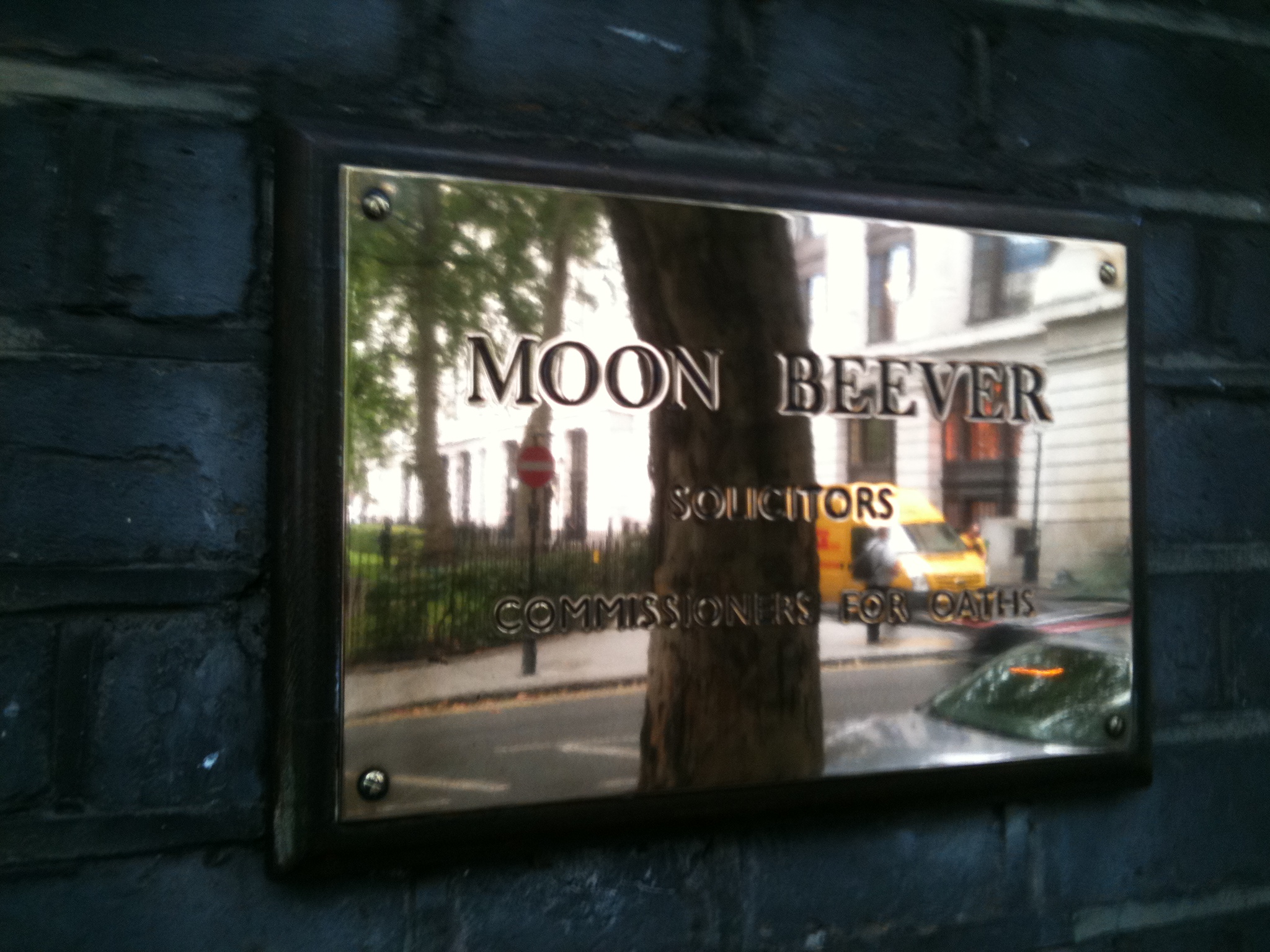
This is probably mine. What’s your favourite? What do you mean, you don’t have one?

Ain’t it a chain? Pizza Express comes to Herne Hill

One of the great things about Herne Hill is that unlike many parts of London, it has managed to avoid contamination from chain stores, bars and restaurants. We have independent chemists, delis, bakers, florists, a greengrocer, DIY store, bookshop, butcher, restaurants, cafes, clothes and furniture shops. I doubt there is any area of London with as flourishing an independent economy.

It gives the place a distinctive character. You can gossip with the shop owners, get advice in the DIY shop without relinquishing your masculinity, receive and suggest personal recommendations in the bookshop, even get credit in some of the food shops if you’ve been using them long enough. You may pay for these privileges, but it’s worth it.

The only chains are Oxfam and the World’s Worst Sainsbury’s, which is best used as a short-cut between the station and the bus stop and left at that.

Until today that is.

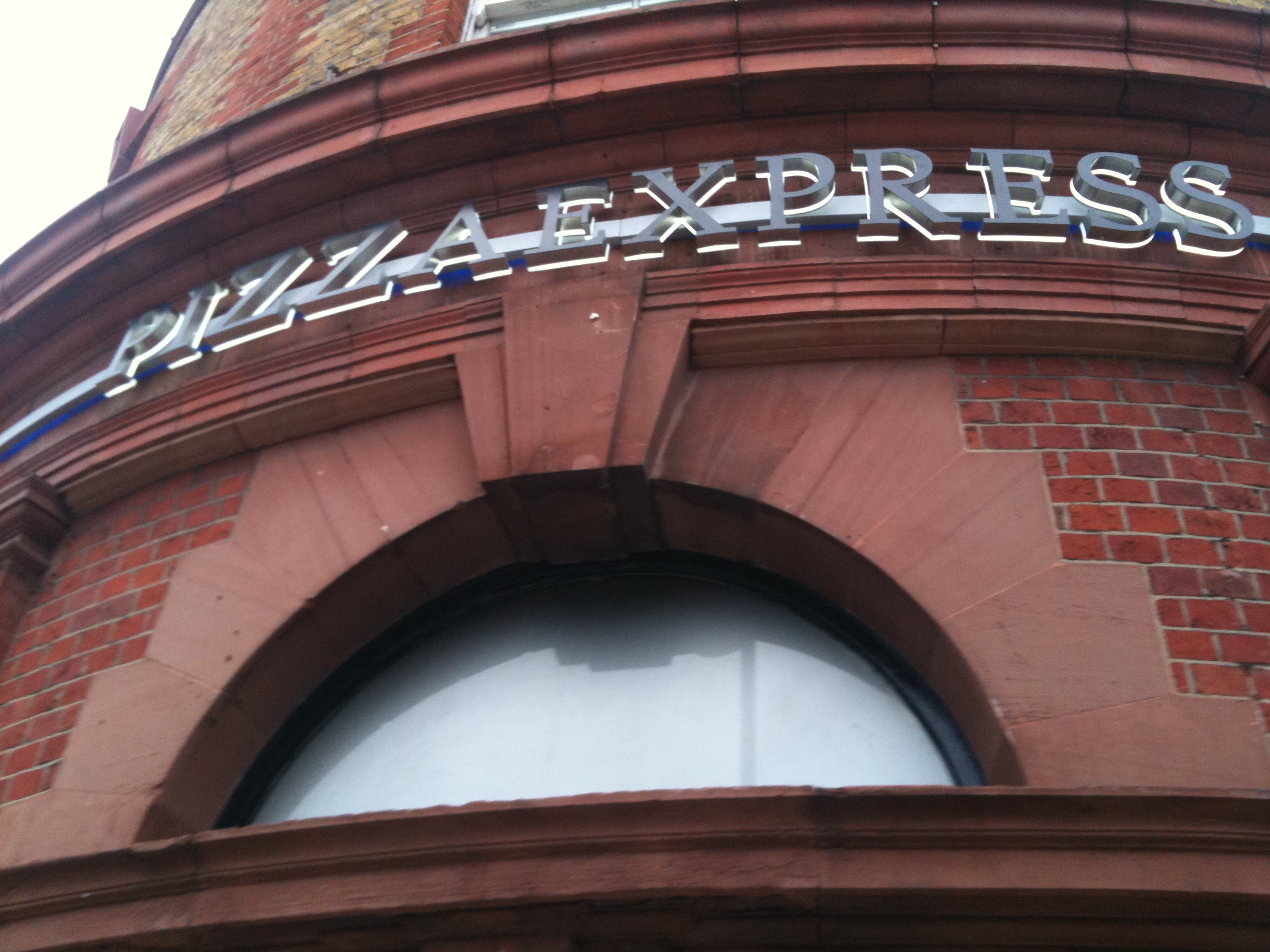
This afternoon, Pizza Express open a branch in Herne Hill.

The site they’ve taken is incredibly awkward. It’s a large wedge, part of which is unusable because it is taken up by a bridge that goes over the top of a large – and hard to fill – lower-ground floor. It’s a space most restaurants would struggle with – indeed two Indian restaurants have failed to make it work – but which Pizza Express can make a virtue of – think of their odd-shaped branches at Charing Cross or Kennington.

The arrival of the Pizza Express behemoth has had a mixed reception in Herne Hill. Some retailers hope it will bring increased footfall into the area, parents are pleased because Pizza Express is excellent for children, but many restaurants and bars are worried it will draw away much-needed custom.

As they should be, because many of the restaurants and bars in Herne Hill – with the honourable exceptions of Number 22 and The Lido Cafe – are shit, serving mediocre food at over-inflated prices and reliant on the fact Herne Hillers have nowhere else to take their custom.

I like independent venues, but I like good shops and restaurants more. If Pizza Express’s decent food, excellent service and good value improves competition, it is doubly welcome.

But there is a fear. Where one chain opens, others follow, chasing the money, extinguishing singularity and turning streets into Clone Towns.  A redevelopment is taking place under the arches by the station. The artist’s impressions says  it will look like this.

But what’s the betting it ends up like this?

Richmond

Herne Hill could easily go the way of Richmond and other indentikit middle-class outer-urbarn high streets. Be vigilant people, and support what’s best about our local economy.

Jeremy Deller’s Baghdad car at the Imperial War Museum

If the V&A’s latest exhibition demonstrates that big can be beautiful, the new acquisition at the Imperial War Museum shows that small can be profound.

It’s a car, badly damaged and barely recognisable, that was caught in a suicide bomb blast in Baghdad in 2007. The artist Jeremy Deller got hold of it and toured it across America on the back of a truck in the company of a US soldier and an Iraqi citizen for a piece entitled It Is What It Is. Now, shorn of any artistic element, it is on display at the Imperial War Museum. My review in the New Statesman can be read here.

After interviewing Deller, I avoided reading too much about the car before I wrote the piece other than this by Jonathan Jones in the Guardian. Jones, I think, slightly overdoes his praise – is it really true that ‘a dismembered body is what you immediately think of when you come into the museum and see a car’? – while the commentators beneath the line seem obessessed with the pointless and hoary argument about ‘what is art’.

They’ll never be able to answer that question from behind their computer screens because this compelling and thought-provoking piece needs to be seen on location and in context to be fully appreciated. It’s a fine and valuable addition to the IWM’s collection and makes a fascinating footnote in the history of war art.

Oh, and Jeremy Deller is one of the nicest famous people I have ever interviewed, right up there with Graham Taylor, the former England manager, belittled turnip and little appreciated ballet enthusiast.

How to tell the Story of London

The Story of London festival was introduced by Boris Johnson last year and immediately came under a lot of fire. Here’s something from Boris Watch plus stern words from Diamond Geezer.  

The festival is not a bad idea. It’s intended to cover the history of London in a way that includes all boroughs, all ages, all races and all genders – a riposte to Ken Livingstone’s habit of staging festivals for different minority groups at a Balkanised Trafalgar Square.

But it doesn’t work.

Part of the problem is publicity, and this is of the mayor’s own doing. In 2009, there was little or no attempt to promote the nascent festival by the city’s tourist office because their funding had just been slashed by Boris and they pretty much refused to help. 

The organisers then had to take their minute budget to Time Out, where I ended up knocking up a few pages to pull out of the middle of the mag that due to a hilarious production error did not actually pull out. It was nothing like the sort of lavish inserts the company can produce when given some cash and time. 

The other problem is that London already has loads of festivals – Open House, Meltdown, the London Film Festival, London Design Festival, the City of London Festival and dozens more – while institutions such as the Bishopsgate Institute regularly put on fantastic cultural events. And that’s before we even bring in the other museums, universities, galleries and scientific institutions.

 The Story of London simply does not have a distinct identity to compete with these established players.

With barely a niche to be found in London’s crowded cultural calender, Story of London has taken to hijacking and rebranding existing events, which doesn’t impress anybody. And they are so busy doing this they forget to organise any showpiece events that would help to give the festival a character of its own. Plus, they don’t have any money.

The result is a bit of a mess.

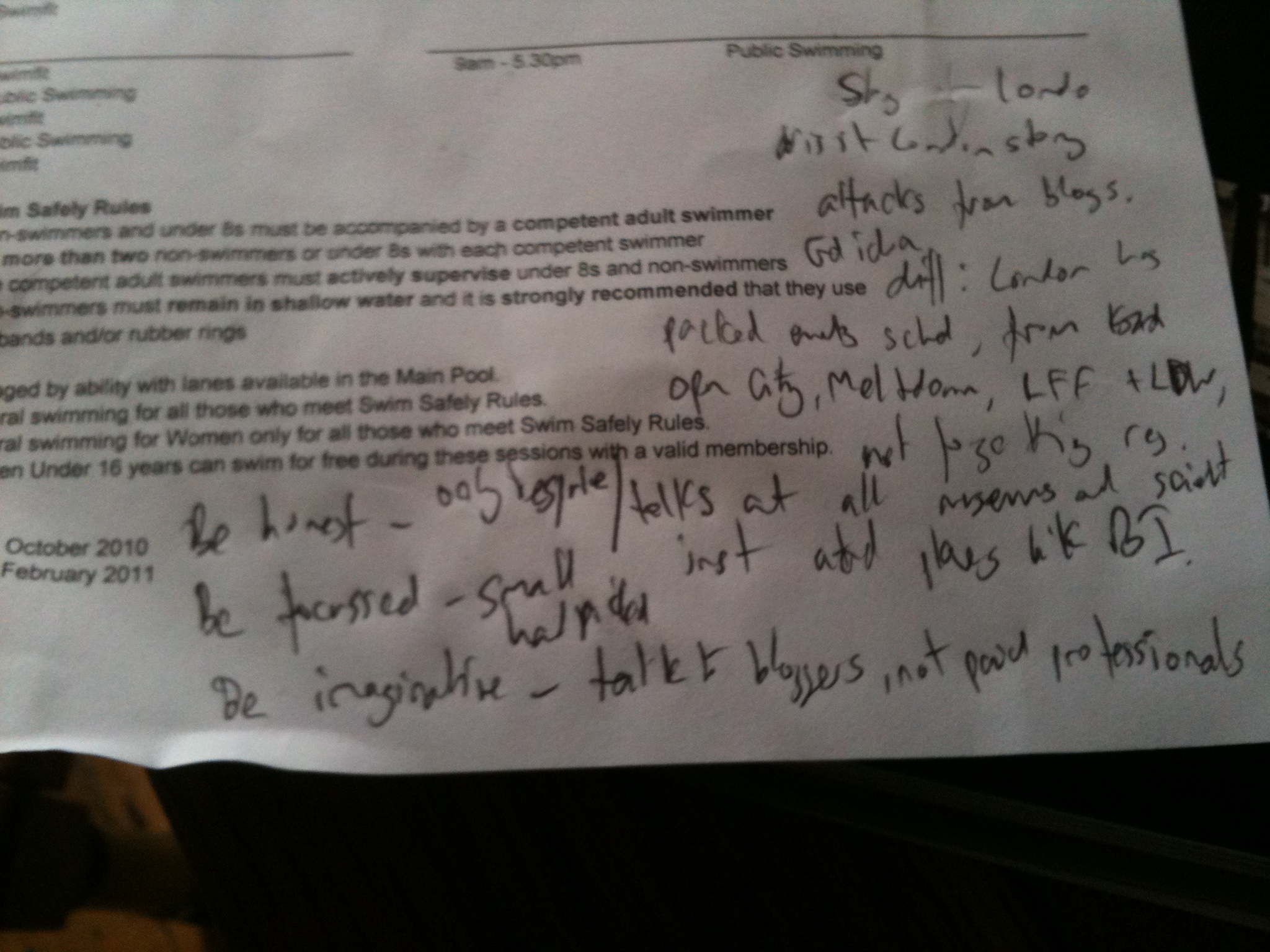
So what could they do? Fortunately for them, I was able to scribble a few suggestions on the back of a press release in between playing Secret of Monkey Island on my phone and wondering why I’ve rarely heard of a single person who appears in the Standard’s Londoner’s Diary.

  • Be honest – don’t hijack events that have nothing to do with you as it just looks cheap. And if you insist on this policy, it means that desperate organisers of terrible events will attempt to smuggle their substandard fare into your festival and you’ll have no way of keeping them out.
  • Bespoke – ensure that anything carrying the Story of London banner is new and brilliant and has genuinely been arranged specifically for the festival. That makes it fresh and makes it exciting and should ensure that you can keep an eye on the quality control.
  • Be focused – find a theme and stick to it. Make it broad and make sure that every borough has at least one institution participating. Narrow the time frame so it all takes place on a single weekend. Keep it tight at first and let it grow organically. At the moment it is a big blancmange of a festival when it should be as tight and pretty as an avocado stone.
  • Be clever – one of the best festivals the mayor currently has at his disposable is the Thames Festival, so hook the whole thing round that. A wee bit of rebranding – and yes, this is hijacking, but it’s hijacking with a point – and you have a ready-made spectacular way to close the weekend with the annual fireworks display.
  • Be imaginative – the guys from the Londonist website are already involved in one small event, but why not ask them to think up something big and crazy? These – and other – bloggers live and breath London in a way few paid professionals can compete with, so talk to them. They may not be interested, they may have terrible ideas, they may have no ideas, but they may just come up with a couple of events that curators and pros can turn into something special. Because at the moment, as Ian Visits says, the Story of London is just ‘a way for a lot of venues who are already planning to do something to get involved in a joint media campaign’.

And that’s as far as I got. LeChuck was causing all sorts of problems and I had to Google Laura Weinstock. But hey, it’s a start.