Category Archives: London

London bricks

‘The bricks – laid Flemish bond, headers and stretchers alternating – were all old London stock bricks, but of many kinds and colours: rust red, beige, grey, brown, nearly black. Here and there were yellow ones – malm bricks made with an admixture of clay and chalk. The cumulative effect was pleasing – the variety gave texture, interest and warmth to the surface of the wall. The eye approved the range of colour, the uneven look, the way in which each brick differed from its neighbour and yet was in subtle harmony. But, more that that, to look at it was to see the way in which this wall arose from the ashes of many buildings. Studying it, Matthew saw in his mind’s eye warehouses and churches, factories and shops, terrace houses like this one, blasted to the ground perhaps on some furnace night of 1940. He thought of how the city lifts again and again from its own decay, thrusting up from its own detritus, from the sediment of brick dust, rubble, wood splinters, rusted iron, potsherds, coins and bones. He thought of himself, living briefly on top of this pile, inheriting its physical variety and, above all, the clamour of its references. The thought sustained him, in some curious way, as he sat at his desk in the flat which was not yet a home, or as he moved through days and through the city, from Finsbury to Docklands to Covent Garden to Lincoln’s Inn.

Penelope Lively in ‘City Of The Mind’ (1991, Andre Deutsch).

Secret London: swastikas

One of the great London rumours is that somewhere inside the Royal Society’s building on Carlton House Terrace sits a giant swastika.  This is not because these esteemed scientists and thinkers are secretly Hitler-worshipping fascists, but because their home at Nos 6-9 was the location of the German Embassy (at Nos 8-9) during the pre-war Nazi era.

Carlton House Terrace was designed by John Nash between 1827-1832 to occupy a site previously taken by Carlton House. No 9 almost immediately became the seat of the Prussian Legation, which slowly evolved into the German Embassy. In the spirit of the time, it soon expanded to occupy the house next door at No 8.

In 1936, Joachim von Ribbentrop moved in, replacing the late Ambassador Leopold von Hoesch (whose dog’s gravestone can be seen under a tree near the Duke of York steps). Von Ribbentrop demanded a complete renovation of the property, and the Nazi’s top architect, Albert Speer, was called in to do the job. Exactly what he did remains something of a mystery, but the German Embassy website claims:

‘Only the fact that the Nash Terrace was a listed building saved the facades from being included in Ribbentrop’s plan to establish a model of the Third Reich architecture in the centre of the British capital. The renovation was exhaustive, money was no object.’

It is hard to discern exactly what alterations Speer made, but one diplomat wrote that the showy renovation of No 8 and 9 Carlton House Terrace had produced a style and furniture less suitable for an embassy and more comparable to that of German luxury liners of the time like the “Bremen”.  A contemporary set of photographs are lodged at the Library of Congress. The only one currently viewable is of the very modern-looking kitchen.

This decent phot0-set shows the building now, including Speer’s striking staircase, said to be constructed by marble supplied by Mussolini.

Albert Speer designed this

Among Speer’s embellishments was said to be the inclusion of a swastika mosaic on the floor of one of the public rooms. After the war, rather than remove the offending article, the swastika was said to have been simply covered with a carpet. (And this website claims there are still visible ‘border designs of swastikas on the floor of one public room’, which seems unlikely.)

Is it true?

Well, I’ve never seen a photo to substantiate the claim and people I know who have been inside the Royal Society are also none the wiser. However, I did once receive an email at Time Out from a builder who claimed to have renovated the building in the 1990s and seen a huge swastika under one carpet. Where, presumably, it still remains. Von Ribbentrop also had a house built for him in Pinner, which was said to have swastikas carved into the staircase.

If you do have a hankering to see a swastika in London, you should head for India House, where this plaque can be seen on the wall.

It represents the swastika when it was still an intriguing sign from the east, before it was appropriated by Hitler. In the first two decades of the 20th century, the swastika was a popular symbol in the west, often used as a good luck charm and adopted by groups as varied as the Boy Scouts and the Druids. My copy of Rudyard Kipling’s Just-So Stories still has a prominent swastika featured in one illustration and the British Museum is full of the things.

Indeed, so popular was the swastika, it was even used to liven up the decor at Hounslow Bus Garage. Click on that last link and zoom in and you’ll see the border of pretty little swastikas that featured in the staff canteen. These swiftly disappeared as the truth about Hitler became impossible to ignore.


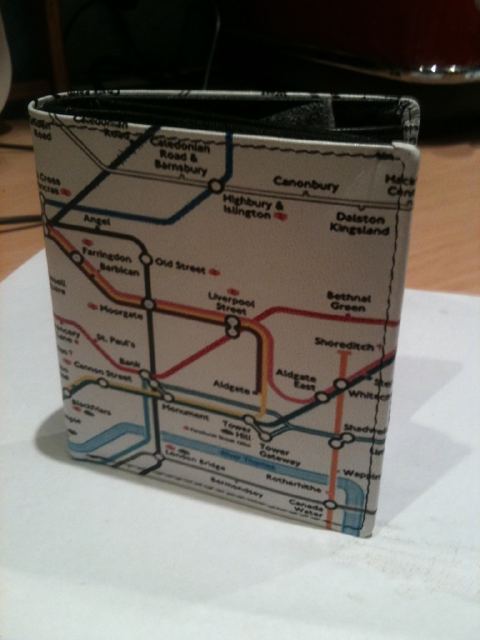
London accessories

I fear this purchase may mark the moment when future biographers decided I tipped over into self-parody.

Next stop, a manbag version of this. I’m sure it can be done.


Thomas Paine’s London bridge

Thomas Paine was many things. A writer, revolutionary and political philosopher, Paine was also an inventor and engineer, who made the world’s first smokeless candle. He was also an occasional Londoner, most notably when he stayed at the Angel Inn, Islington, around the time he began writing Rights Of Man in 1791. This monument celebrates that fact.

Considerably more interesting than this, though, is the rarely discussed fact that Tom Paine built bridges. Iron bridges. And he built one of them in London.

Paine was fascinated by bridges, admiring them for their architecture as much as their metaphorical meaning. John Keane, Paine’s biographer, writes that he ‘was stuck by their double meaning. Bridges were for him combinations of architectural beauty and practicality, works of genius that could be breathtaking in their simplicity… the rising spirit of an epoch translated into space.’

Paine first tried to raise the funds to build an iron bridge over the Harlem River in New York in 1785 and then another over the Seine in Paris in 1786, but without success. Bridges of this era were still largely constructed in stone and wood, making Paine’s ideas rather unusual. Plus, he had no real background in engineering or architecture.

But he persevered. In 1788-89, he attempted to build an iron bridge over the River Don in South Yorkshire and although the project was never completed it did secure him a patent for his bridge-building scheme. Paine now decided that he needed to build his prototype bridge in London, where potential investors could see for themselves the sort of brilliant bridge he was going  to make. He told Thomas Jefferson – who himself had many ideas about how the bridge should be built – that a London bridge would soon pay for itself in tolls. Jefferson was impressed, writing to a friend: ‘Mr Paine, the author of Common Sense, has invented an iron bridge, which promises to be cheaper by a great deal than stone, and to admit of a much greater arch. He supposes it may be ventured for an arch of five hundred feet. He has obtained a patent for it in England, and is now executing the first experiment with an arch of between ninety and one hundred feet.’

Paine had originally hoped to build this experimental bridge to nowhere in Soho Square, but when he wrote to George Washington on May 1, 1790 describing his single-arch bridge of 110 feet, he still hadn’t found an appropriate location. By the end of May he could tell the no doubt anxious Washington that a site had been found – a field next to a famous tavern called the Yorkshire Stingo, on the Marylebone Road near what is now Lisson Grove. This was at least partly appropriate, given that the bridge was being constructed by a Rotherham-based ironworker called Thomas Walker.

Paine moved into the Yorkshire Stingo and began erecting his 110-foot bridge on the neighbouring bowling green. By September it was finished. Jefferson wrote to him a very nice letter saying: ‘I congratulate you sincerely on the success of your bridge. I was sure of it before from theory: yet one likes to be assured from practice also.’

However, although there were many interested visitors, none of them were impressed enough to offer to invest in Paine’s scheme to build a bridge over the Thames. By October 1791, Paine’s bridge had been started to rust and Paine had lost interest, so it was dismantled and the iron returned to Yorkshire, where some was used in a bridge built over the River Wear in Sunderland in 1796, which at the time was the longest iron bridge at the world at 240 feet.

Nature: an apology

I was born in Epsom, one of those places on the fringe of London that mark the very boundary of the city, the point at which tarmac gives way to soil. As the picture below shows, just a few hundred yards from my road, Hookfield, the country begins in all its greenness.

This never much interested me in my youth. I was always more attracted by town than country. Nature passed me by. When I moved into the city proper, I took little notice in the pike or herons I saw from my boat on Regent’s Canal, or the ring-necked parakeets and woodpeckers I later found in Brockwell Park. If somebody told me they saw a badger in Regent’s Park or a cormorant on the Thames, I cared not a jot. And who needed peace and still when you had Hampstead Heath or Richmond Park nearby, even if I rarely actually bothered to go there.

A month in the Scottish Highlands changed that. For the first time I was able to observe hedgehogs, adders, shrews, woodmice, weasels, deer and eagles in the wild, and see traces of badgers, pine martens and wildcats. The sheer scale of the country was extraordinary, from the peaks of the Munros, to the endlessly unfolding glens. It was eye-opening and life-affirming.

Returning to London was difficult. I had previously viewed the city’s numerous parks as pastoral paradises. Now they seemed liked scratty scraps of green, a sad imitation of the real thing. The battering noise, smell and greyness of London was overwhelming.

But nature is still here, if we look for it. It’s there in the foxhole that occasionally appears at the bottom of my garden. It’s there in the resilient, remarkable weeds and visiting birds, as lovingly chronicled in Richard Mabey’s essential London wildlife book ‘The Unofficial Countryside‘. It’s there in Tales Of The City, the blog of Mel Harrison, in which she charts encounters with owls, snowflakes and brambles. It’s there in Herb Lester’s Untamed London map, which records those places ‘where nature still runs wild in the big city.

As I walked home from taking my daughter to nursery this week, along the horrible, traffic-clogged hill that takes cars from Herne Hill to Camberwell, I heard a faint, familiar sound as I passed a bus stop. It was the chirruping of a grasshopper. I stopped and looked and found it on a hedge. It looked at me, quite unmoved, before continuing to sing (or stridulate) defiantly. We gazed at each other for a minute, while commuters bustled past on foot and in car, and then quietly, and more contentedly, I went about my way.


Pirates from outer space

There are a couple of particularly interesting exhibitions open in London at the moment, and I’ve reviewed both of them for the Independent. The first is Out Of This World: Science Fiction But Not As You Know It, a thorough exploration of genre fiction at the British Library that offers much of interest for the careful reader, while the second is the Museum of London Docklands colourful Pirates: The Captain Kidd Story.

There’s plenty of London interest in both, from the apocalyptic and despotic visions of a future London by everybody from HG Wells to Alan Moore at the British Library, to the fascinating relationship between London’s rich and powerful and common pirates that is explored at the Museum of London Docklands.

‘My heart’s in the highlands, wherever I go’

I’ll be taking a break from the blog while I go to Scotland. Speaking of which, I’ve never really got my head round Rabbie Burns, but this statue in Victoria Embankment Gardens is rather lovely.

Sadly, it’s no match for the nearby attractions of the remarkable York Watergate…

London’s finest camel…

Or the weeping bare-breasted maiden who thrashes impotently (and rather fetchingly) at the memorial for Victorian composer Arthur Sullivan.

I’m sure many of you will feel this way about my absence, but don’t worry, I’ll be right back… after a few of these.

Secret London: Toulouse-Lautrec in Catford

Say what you like about South London, but it clearly has something about it. Why else would a trinity of the world’s greatest 19th-century artists have come here?

You probably know about Vincent Van Gogh’s time in Brixton because of the play from a few years ago. Van Gogh lodged in Hackford Road, Brixton in 1873 and regularly walked from there to Covent Garden where he worked as an art dealer.

This is the only surviving picture he sketched during this period It’s of the Georgian houses on Hackford Road itself.

Van Gogh also lived in Isleworth in 1876, at 160 Twickenham Road, when he later returned to London as a teacher. Hackford Road now has an English Heritage blue plaque for Van Gogh, and there used to be a Van Gogh Cafe on Brixton Road, but it’s closed down.

Camille Pissarro painted around a dozen pictures of Sydenham and Dulwich during his time in South London in 1870. I particularly like this one, of Lordship Lane Station.

As Michael Glover writes in the Independent: ‘The painting shows us a new kind of modernity. Here is London being mightily transformed by the growth of housing and the ever onward thrust of the railways in the second half of the 19th century.’ Pissarro lived at No 77 Westow Hill and then on Palace Road, and married at Croydon Registry Office. He returned to London a number of times. Lordship Lane station was demolished in 1954. A non-English Heritage blue plaque adorns the site of his house on Westow Hill and a restaurant called Pissarro is in Chiswick, but I’m pretty sure that’s named after his son Lucien.

Best of all, though, is the fact that Henri de Toulouse-Lautrec did time in Catford in 1896. The diminutive brothel-loving soak was a huge fan of cycling and in 1896 was asked by a company called Simpson to work on a poster for their new bike, which used a new type of chain. This, according to Wiki, ‘was composed of linked triangles forming two levels. The inner level was driven by the chainring and the outer drove the rear cog. Instead of teeth, the chainring and cog had grooves into which the rollers of the chain engaged.’

I’m not sure what that means, and probably neither did Lautrec, so he came to the newly built Catford Velodrome to watch the bike in action during special races, set up by Simpson to advertise their product. Lautrec produced a couple of images during his visit. The poster was one of the last he designed before his death in 1901.

The velodrome was knocked down in the 1990s and there is no trace of it left (it’s location was approximately around Sportsbank Road), but there is at least a brasserie in Kennington called Toulouse-Lautrec.

But perhaps Toulouse-Lautrec had more influence on Catford than we may have thought?

Consider the Black Cat famous poster advertising one of Lautrec’s favourite clubs by one of his contemporaries and very much in Lautrec’s style.

And the Catford cat itself.

If you do not wish to go all the way to Catford to pay homage, an exhibition of Lautrec’s work goes on display later in June at the Courtauld Gallery at Somerset House, where you can also see Pissarro’s lovely picture of Lordship Lane Station.

London, JFK and Profumo

As fans of conspiracy theories know, there is always a connection if you look hard enough, and the one between JFK and the Profumo Scandal is particularly intriguing.

The connection is called Mariella, or Maria, Novotny. Different sources give her different places of birth – London, Sheffield, Prague – but most agree that she was really called Stella Capes. She almost certainly wasn’t the niece of former Czech President Antonin Novotny as she claimed, nor had she spent four years in a Soviet camp. But what’s undeniable is that she lived quite the life.

It was Novotny who hosted the infamous Man In The Mask orgy in an apartment in Hyde Park Square in December 1961, where various members of high society consorted with glamorous woman such as Mandy Rice-Davies and Christine Keeler. Novotny, who called the party The Feast of Peacocks after what had been served for dinner (she also cooked badger), spent much of the evening wearing a corset in bed with a whip and six men. Stephen Ward, the mysterious society osteopath, was there wearing socks and nothing else. Everybody else – among them actors, MPs and judges – was naked except for a man wearing a gimp mask, who was tied between two pillars and whipped by everybody on entry. There has been much speculation as to his identity, with names including minor royalty and Cabinet Ministers, but he has never been named.

The Feast Of The Peacocks became public knowledge after featuring in Lord Denning’s 1963 report into the security implications of the Profumo Scandal. This was written in the wake of Conservative Minister John Profumo’s resignation from the Cabinet following revelations regarding his relationship with Keeler and Keeler’s relationship with Soviet naval attach Eugene Ivanov.

This was not the first political scandal Novotny was at the centre of. Wherever she was born, she had moved to London in 1958 to become a model, and was soon performing as a topless dancer in Soho.

In 1960, she married. Her husband, Horace ‘Hod’ Dibben was in his 50s and moved in serious company. He ran the Black Sheep Club in Piccadilly and knew both the Duke of Kent and the Krays. He was a sado-masochist and a friend of Stephen Ward. Through Hod, Novotny met Harry Towers, a mysterious and sinister figure, who persuaded her to go to New York for some modelling work.

Novotny was soon operating as a prostitute in New York, with Towers as her pimp. Before long Towers had introduced her to Peter Lawford, the film star and John F Kennedy’s brother-in-law whose main responsibility was to find willing women for the insatiable President.  Novotny was soon sleeping with JFK. On one occasion she and fellow prostitute Suzy Chang were asked to dress as nurses, with JFK the patient.

In May 1961, Novotny was deported from the US, returning to London on the Queen Mary where she began hosting her memorable parties. Guests are said to include everybody from Bobby Moore to Felix Topolski. She was also introduced by Ward to both Ivanov and Profumo before Keeler, but nothing developed from this. Novotny believed she had been used to ‘get’ JFK and was wary of the same thing happening again. Keeler was not so smart.

When the Profumo Scandal broke, JFK was said to be fascinated by it, demanding to be kept informed of ongoing events, at least in part because of his own tenuous connection. Robert McNamara, the US Defence Secretary, knew all about the President’s dalliances with this prostitute who claimed to be from Eastern Europe and said ‘he felt like he was sitting on a bomb’. On June 23, one American newspaper even hinted at the President’s involvement, until his brother Robert Kennedy forcefully intervened and the story was dropped. Nobody picked it up and the President took his secret to the grave.

What to make of this? Some believe the fact Novotny was connected to JFK and Profumo was no coincidence and here you could go down a rabbit warren of theories and counter-accusations. One argument is that Novotny was part of a honey trap operation, run by Lyndon Johnson’s office by Towers and Ward with the assistance of the sex-obsessed FBI, aimed at blackmailing powerful men in Britain and America. Others claim it was a KGB sting – Novotny claimed Czech heritage and Chang was Chinese – and Towers was using his women to try to infiltrate the United Nations. Still others  say Ward and Towers were working for MI5 to entrap Ivanov. Conspiracy journal Lobster has more. This stuff could drive you insane.

Novotny later worked for the police in same capacity, and was used to help bring down gangster Charles Taylor. She died of an overdose in 1983. Some, including Christine Keeler, claim it was murder. Novotny had attempted to write a book about her life shortly before her death, but mysterious things kept happening to her and the ghostwriter, causing them to nervously end the project. After her death, her house was burgled and her diaries disappeared.

She did write a book in 1971. It is a fictionalised account of her adventures called King’s Road and one of the worst books I’ve ever read. You can get it on Amazon for 14p.

The Monkees and Alf Garnett

I have a piece in the latest issue of Uncut magazine about the making of The Monkees 1967 hit “Alternate Title”, originally titled “Randy Scouse Git”.

The song was the band’s biggest hit in the UK reaching No 2 in the chart, which seems pretty appropriate given that it was written in London and is full of London references.  When Mickey Dolenz said it was called “Randy Scouse Git”, the English Monkee, Davy Jones, was a little perturbed. ‘They asked me what it meant,’ he told me, ‘and I tried to explain, but they just didn’t get it.’

Dolenz wrote the song during a visit to the UK. As he explains: ‘We were in London doing press and the Beatles threw us a big party . We were staying at the Grosvenor. Mike Nesmith and I had turned up on Top of the Pops to surprise everybody by saying hello – they’d smuggled us in in the boot of a car. That’s where I met my first wife Samantha who was a Top Of The Pops DJ, the record girl. We must have had a party and the next morning there were still a few people hanging around and Mama Cass was in town, and the Beatles were huge and I’d met this girl and I just start doodling with the guitar and singing about Samantha and my friend in the room and the waiter who came in with breakfast and the girls outside screaming day and night. It was like a diary, word association. There’s no deep hidden meanings in there.

It was an amazing experience in London. I am told I had a great time. And of course I met Samantha and we had a massive love affair.  Lots of stuff was going on. Brian Jones hid in one of our rooms when he was hiding from police and we got a letter from Princess Margaret asking if we could keep the fans quiet because she could hear them screaming over in the palace.

‘I must have been watching TV and Till Death Us Do Part was on and Alf Garnett called the kid, Tony Booth [later Tony Blair’s father-in-law], a “randy Scouse git”. I had no idea what it meant, no clue, but I thought it was funny. He said that line right in the middle of me writing the song and as was the way in those days I was just spontaneous –  ‘Wow man, what a cool title!’ – and wrote it down.’

So that is how you go from this…

…to this…