Category Archives: London

Norman Mailer and Christine Keeler’s bra

Jay Landesman was an American writer and eccentric entrepreneur who arrived in London in the mid-1960s and immediately flung himself headfirst into the emerging counterculture scene, largely because the first person he met when he arrived here was Peter Cook. Landesman later became best known as the male half of a famously open marriage, much to the shame of his son Cosmo, who gained revenge by marrying Julie Burchill. (‘She hated hippies, ex-hippies, food freaks, open marriages and old people,’ wrote Jay, ‘The only thing she liked about us, was that we were Jewish.’)

In his entertaining 1992 memoir Jaywalking, Landesman’s non-ideological dalliances on the fringes of the London scene make great reading, with walk-on roles for the likes of John Lennon (‘He was uptight about Wendy Cook’s insistence he sample her salade Nicoise, a dish he was highly suspicious of and couldn’t pronounce’), Tom Driberg (‘He took us to a pub whose entire clientele consisted of lesbians, transvestites, young Danish sailors, ageing pederasts and an assortment of amputees’) and Germaine Greer (‘I watched her challenge Jimi Hendrix to an arm-wrestling match, and win’). Although it’s never entirely clear what he did – bar run the disastrous UFO rip-off the Electric Garden for a couple of minutes – Landesman was clearly good company with a penchant for meeting interesting people, and at some point was asked by The Sunday Times to write about the art of giving a party. His ideal guest list is worth repeating in full:

Minimum of three potential celebrities; at least one real celebrity (any field); a foolish couple; a serious couple (straight feed for comics); an engineer or non-speaking Czech (to point out); six swinging teenagers (girls); a bitchy girl who can generate masochism in men; a gym instructress who drinks too much; an older woman who sits and smiles (who is she?); a rune beauty (who was she?); Christine Keeler; no fat people unless Peter Ustinov; nobody jet or Court Circular; no dogs; no Peter Hall, Jonathan Miller, David Frost (or equivalents); no crew cuts; a swinging accountant; a buff (a jazz-hair or gambling buff); two attractive lesbians (to get wrong); one international drug trafficker (to point out); a beautiful flawed couple; a gay MP; Tariq Ali (not Christopher Logue); an Irish showbusiness GP; a titled person (to show you’re not snobbish); no artists’ agents, editors or publishers; no children or headshrinkers (except RD Laing); an eccentric lawyer or priest (no respecters of confessionals); an articulate tradesman (electrician, cabinet maker, house painter, bank manager); a forgotten culture hero; a reliable loudmouth who’ll come early and leave early; the ex-wife of a world celebrity; a pop singer no one recognises; a girl with buck teeth, a corrective shoe, or both; an established figure who decides that night to drop out…

Landesman was fond of Christine Keeler. He met her soon after arriving in London at the Kismet, a Soho drinking club, and the pair became friends. He also knew Norman Mailer from the mid-1950s, Mailer having interviewed Landesman while researching his pioneering essay on hipsterdom, The White Negro. In London, Landesman had an opportunity to bring the two together.

The cause was Mailer’s decision to challenge for the Democrat candidacy as Mayor of New York under the slogan ‘Vote The Rascals In’. The sizeable US expat community in London – there were frequent baseball games in Hyde Park featuring the likes of Tony Curtis, Marlon Brando, John Cassavetes and Charles Bronson with Phil Silvers as umpire – decided to hold a fundraising event.

The Friends of Norman Mailer Committee was founded by charismatic rogue Harvey Matusow, and he put on a celebrity auction, featuring myriad bizarre offerings from Yoko Ono like ‘Dirt From Central Park’, ‘Air over Greenwich Village’, ‘Vial of Genuine New York Tears’ and ‘Jar of Captured Cloud Formations over the Bronx’ as well as bottles of Robert Lowell’s sweat and a slice of raw liver from Philip Roth’s fridge. The star exhibit, however, was supplied by Landesman: Christine Keeler’s bra.

Bidding began at £100. There were no takers. The auctioneer tried again, at £50. Nobody moved. Next he tried £10 for this ‘psychosexually historical’ item, but the opening bid was a measly 10 shillings. Landesman tried to get the bidding going and raised his own hand, but nobody followed suit and he ended up winning the item back for a mere 10s 6d. Later, he discovered it wasn’t even Keeler’s. ‘Christine doesn’t wear a bra,’ a mutual friend confessed, ‘But the deception was justified in a good cause.’ The mayoral election was just as successful – Mailer came fourth, in a field of five.
Turing at the Science Museum

There’s a rather fine exhibition at the Science Museum at the moment about Alan Turing, the pioneering computer scientist and philosopher who was born 100 years ago. What particularly appeals is that while there is only a limited number of objects, all of them matter.

This is hefty stuff, invaluable weighty objects that demand attention – so it’s blockbuster, but not in the usual way of throwing everything at a room in an attempt to wow the audience into submission at the sheer scale of things. Instead, the museum has cherry picked a dozen important objects that most reflect Turing’s life – the life of one of the most important figures of the 20th century – and let them tell the story. As the curator David Rooney told me, ‘A lot of what Turing did was very abstract. We wanted to show it had a real impact on the world.’

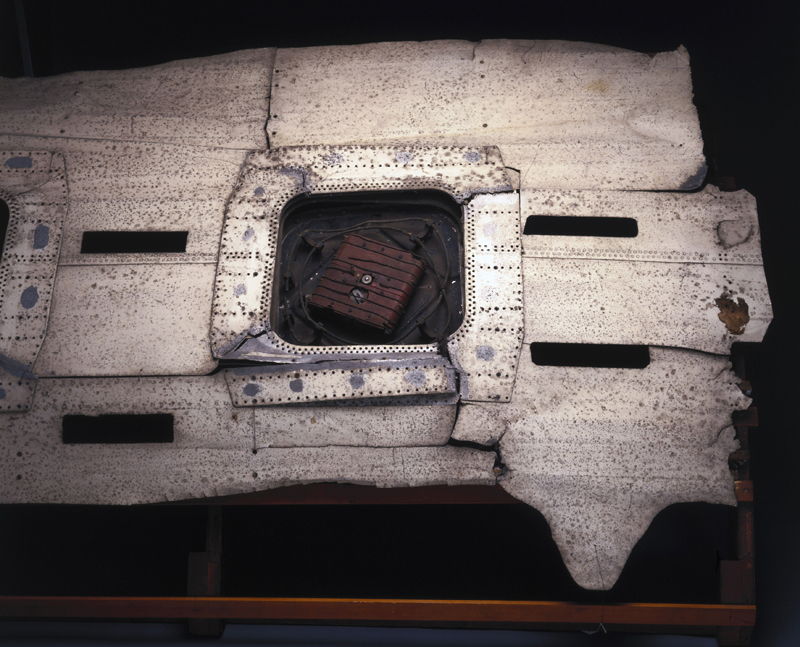
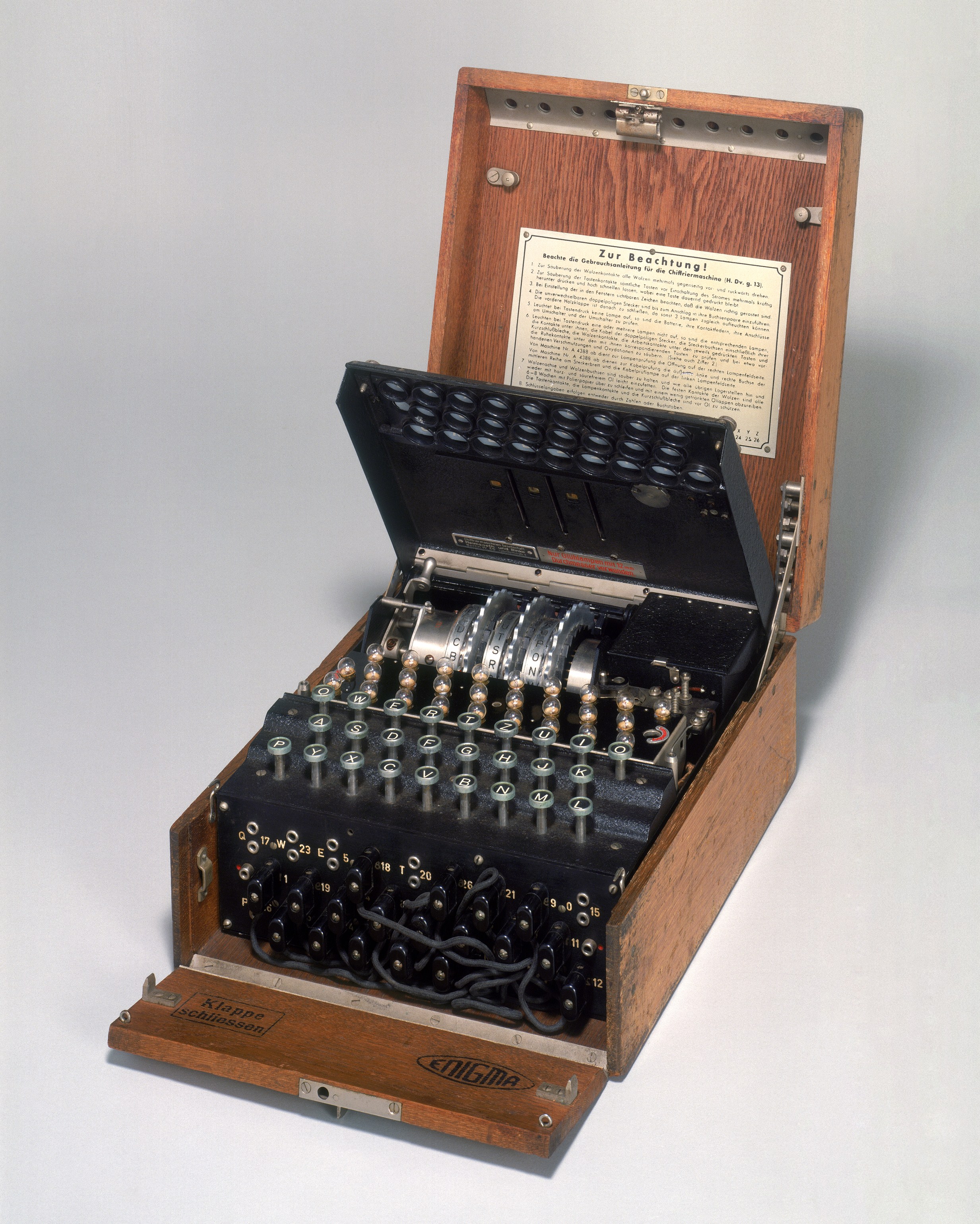
Featured items include an Enigma machine on loan from the secret staff-only museum at GCHQ, the Pilot ACE (one of the world’s first computers), a cybernetic tortoise, a 1930s differential machine made out of Meccano, Turing’s pathology report (which shows he drank a large amount of cyanide, more than you could consume by accident or put in an apple) and a section of a crashed Comet jet, which the Pilot ACE was used to analyse to see why it exploded in mid-air.

Enigma machine

Crashed Comet G-ALYP, 1954.

Pilot ACE

Meccano differential analyser

Here’s a film of the tortoise in action.

The South will rise again: trivial recruits needed

I have agreed to captain a South London team in Londonist‘s Londoner Challenge at the Museum of London.

To spare me complete humiliation at the hands of teams from the North, East and West, please apply to join my team so the South can come an apologetic third. Details here.

On old pubs, and getting older

Last week I went for a stroll around Soho for the first time in a while and spent most of the time in a state of shock and confusion at the lack of familiar landmarks: restaurants and bars had changed name, shops had appeared from nowhere, and everything appeared to have been cleverly redesigned to make me feel old and out-of-it.

Just about the only thing that remained consistent were the pubs: Bradleys, the French House, the Sun and 13 Cantons – venues in which I had spent much of my 20s were still present and correct. Indeed, while we can bemoan the undoubted withering of London’s traditional pub life, it’s still remarkable how many old-timers still cling in. The British Library has just republished The Epicure’s Almanack, an 1815 guidebook to London eating and drinking. Fascinating in its own right – did you know there used to be three inns near Westminster Abbey called Heaven, Hell and Purgatory? – it also has brilliant footnotes by Janet Ing Freeman, who maps and chronicles the history of the 650 establishments reviewed by Ralph Rylance 200 years before. In doing so, she notes those places that still exists: all are pubs rather than restaurants and include the still excellent Seven Stars in Holborn, as well as London legends like Wapping’s Town of Ramsgate, Ye Olde Cheshire Cheese in the City, the Windmill in Clapham and the  Spaniards Inn in Hampstead.

Town of Ramsgate, Wapping

Another London institution, the BFI, have also been looking at pubs. Their brilliant new two-disc DVD, Roll Out The Barrel, rounds up a great bunch of short films and documentaries about British pubs. A highlight for Londoners is Under The Table You Must Go, a 1969 film by Arnold Miller, the gonzo exploitationist behind London In The Raw and West End Jungle. His film visits half-a-dozen London pubs, almost all of which appear to no longer exist. The most intriguing for me is surely The Great Escape, a theme bar for RAF man that is filled with paraphernalia from WWII escape attempts (it’s now Mabel’s Tavern), but I also appreciated the moment when Jon Pertwee inexplicably popped up in a pair of lederhosen to serenade a crowd of pub goers with a burst of the classic Chelsea anthem Zigger Zagger. A trailer for the DVD can be seen here.

Secret London: the Victorian herbalist

This piece originally appeared in Completely London magazine. 

You don’t expect to find a shop as beautiful as Baldwin’s on the Walworth Road, the grimy but charismatic street that connects Elephant & Castle with Camberwell and is otherwise punctuated by pound shops and bookmakers. ‘We have the greatest range of herbal products in the UK,’ says owner Steve Dagnell proudly, and that is easy to believe. Baldwin’s is lined with aged apothecary drawers stuffed with herbs, gleaming wooden shelves holding big bottles of wood curls, lavender and liquorice and ancient signs that advertise pills ‘for piles, pains in the back, pimples and dizziness’ and tonic mixture ‘for lowness of spirits’.

Baldwin’s has been on this road for 150 years, selling herbs, tinctures, oils, beauty remedies and sarsaparilla to customers – among them celebrities such as Terence Stamp, Michael Caine and Max Bygraves, who came here for his throat sweets – since 1844. It started at No.77, but moved to 173 in 1969, taking many of the original fittings with it. The store is currently run by Dagnell, 57, whose grandfather started work at Baldwin’s in 1918. ‘At that time there were six shops in London, but the others were closing,’ says Dadnell. ‘His first job was to go round all the other shops with a handcart buying back the old stock.’

Dadnell himself began working there in 1981. The store stocks a mind-boggling variety of herbs – everything from agnus castus to yerba santa, including helonias root at £322 per 500g – as well as essential oils, shampoos, body washes and handmade soup. ‘We do an enormous range of essential oils and have developed a cosmetics range based on these,’ says Dadnell. ‘A lot of people use them to make their own shampoo, massage oil and soap.’ It’s a beautiful shop selling beautiful products, the hidden jewel of the Walworth Road.

Baldwin and Co, 171-173 Walworth Road, SE17. 

Hogarth was right: Beer and London’s brewing renaissance

This piece originally appeared in the May 2012 issue of Eurostar’s Metropolitan magazine. 

Beer Street by Hogarth

Is it a renaissance, or a revolution? In 2006, when Young’s left its brewery in Wandsworth to move to Bedford, it felt final orders had been called on brewing in London. The city that was once swimming in beer – literally, when a brewery exploded in Tottenham Court Road in 1814, causing the Great Beer Flood –had become a desert; only a handful of breweries remained. Six years later, everything has changed. London now has 21 breweries, in every corner of the capital, with more opening all the time.

‘London was once the brewing capital of the world,’ says Paddy Johnson, director of the Windsor & Eton brewery but speaking for the London Brewers Alliance, formed in April 2010 to represent London breweries. ‘It was bigger than Burton-on-Trent or bloomin’ Munich. We want to return to that. At our first meeting there were 13 brewers, ranging from Windsor & Eton, who had just done our first brew, to Fuller’s the biggest, oldest brewery in the capital. At our last meeting we had 21, and another six are on the way. It’s a vibrant scene. There is a real buzz about London beer. The public have cottoned on big time.’

So, why the change? It’s partly about microbrewing – a movement that began in America among people feel they weren’t getting sufficient taste, value or variety from the conglomerates that rule the beer world, so begin brewing their own. Microbreweries reached the UK in the 1980s and flourished after 2002, when tax rules were relaxed. London took a while to catch on, people put off by the barren London beer scene and the high-cost of starting up.

Camden Town Brewery

Under a railway arch down a cobbled mews in north London, Rob Gargan, brewmaster at Camden Town Brewery, takes a break from overseeing the production of 16,500 litres of beer a week to explain. ‘London is one of the last areas of the country to open up,’ he says, amid gleaming hi-tech equipment. ‘People realised that the beer they were drinking was from up north but there’s no reason why we can’t do it here.’ First to the pump was Meantime in Greenwich in 2000, but the new wave really began when Sambrook’s opened in 2008 in south-west London. Through 2010 and 2011 it felt a new brewery was opening every month as the resurgent London scene became the talk of the beer world. It isn’t just about microbreweries, either, Chiswick’s huge and venerable Fuller’s is a keen member of the LBA. ‘It’s not about micro it’s about local,’ insists Johnson. ‘Local beer for London is our mantra.’

And it is more than the rediscovery of a lost art, it’s about introducing a new drinking experience into London. There’s a running joke in ‘Asterix In Britain’ about the Englishmen’s baffling fondness for warm, flat beer, and while these classic brown ales are still brewed in London, the new breweries often look across the Atlantic for inspiration. Peter Holt, landlord at the award-winning Southampton Arms, explains: ‘English beers would be a bitter or mild made with Kentish hops, for an older generation. But a lot of the beers we sell use New World hops. Hops are measured in alphas and while English hops might be three, American hops are 13, 14 or 15. It’s much more intense.’

The Southampton Arms, the Campaign For Real Ale’s London pub of the year, only stocks beer and cider from small, independent breweries. It’s one of a growing number of London pubs to steer clear of mass-produced lagers and foamy bitters. ‘People are much more aware of what they eat and drink,’ says Holt. ‘People are conscious that you can buy Aussie lager in the supermarket for very little, so why go to the pub to pay three times as much when they have decent beer that can’t be found elsewhere?’

Southampton Arms

It’s not just locals. ‘Tourists desperately want to drink local beer,’ says Johnson. ‘When they go to a pub, they ask what’s local. London now has a huge range of award-winning beers to offer them.’

Most popular among these are the American-influenced pale ales (IPAs): golden, citrusy, stronger in alcoholic content, gassy and cold. Asterix and Obelix would approve. ‘Pale ale is the big thing,’ says Mark Dredge, a beer writer turned communications officer at Camden Town Brewery. ‘Most breweries sell more of them than anything else. It comes between a lager and a cask ale, so if you’re an ale drinker you can appreciate the flavours, and if you’re a lager drinker you can enjoy the texture and the fact it is colder. It’s the sort of beer anybody feels they can drink.’

Sambrook’s

Camden Town does a popular IPA, while the ones bottled by Kernel, a brewery near Tate Modern, have beer-lovers in raptures. But there’s variety among London brewers. Sambrook’s – founded by Duncan Sambrook, an accountant who attended CAMRA’s Great British Beer Festival in Earl’s Court, realised no London beers were available and decided to do something about it – specialises in traditional British beers. He talks me through the beer-making process. It’s a complex business. Who ever realised that if you got some barley, soaked it to the point of germination, and then rotated it on a flat floor with a large rake so the seeds didn’t know which way is up and can’t break into shoot, you could roast this malted barley, boil it, add hops, cool it, add yeast, add a fish’s bladder, call it beer, drink it and not kill yourself?

Adapt this basic method, and much can be made. Meantime does lager, pale ale, fruit and wheat beers, you can get a great thick bottled stout from former solicitor Gary Ward’s Redchurch Street Brewery in Shoreditch, while Redemption – which was opened by banker Andy Moffat in Tottenham in 2010 – and Brodie’s – run by a brother-and-sister team, James and Lizzie Brodie, in Leyton since 2008 – make beers that come somewhere between the pioneering Kernel and the traditional Sambrook’s. And that’s just for starters.

Camden Town’s big seller is lager. The brewery was founded by Jasper Cuppaidge, who realised that the beers he liked came from abroad so decided to make some himself. His beer is now in 120 pubs, mainly in London – for most London breweries, distribution is limited to the M25, although the LBA helps organise festivals of London beer all around the country, as well as having regular London beer showcases in different London pubs each week. The LBA also set up a marquee at London Zoo during their late-night summer openings, which was very popular among customers in their 20s and 30s. Many of the breweries themselves are run by similarly young, self-taught enthusiasts.

The LBA give these tyros the help they need. ‘A lot of our members are young so we assist them with distribution and technical problems,’ says Johnson. ‘We want to raise the bar for everybody brewing in London. We’re competitors, but we act co-operatively. If more people drink more London beer we all benefit.’

Five videos of Paul McCartney’s London

Inspired by this marvellous piece of Paul McCartney-related London trivia from Mark Mason, I thought we should look at five classic Macca In London videos on You Tube.

1 Press, 1986
Here’s Macca on the tube in this little known video from 1986. Check out the modestly greying locks, and drink in the 80s atmosphere and the now lost station architecture.

2 Busking, 1984
A dream sequence from Give My Regards To Broad Street features Macca busking outside Leicester Square tube.

3 Give My Regards To Broad Street computer game, 1984
This appalling Commodore 64 game based on the film sees Macca taking a cab around London to a brilliant, blippy 8-bit soundtrack of Band On The Run.

4 London Town, 1978
Paul and Linda take a boat trip down the Thames to promote London Town. Features many bridges and some fish and chips.

5 Oxford Street, 1983
And here’s Macca nipping round the West End in the back of a cab with Lesley Ash.

http://www.youtube.com/watch?v=z6dHRTQH-js


Secret London: the London Grill

I was recently asked to answer a few questions about Secret London by the blogging cabbies at Radio Taxis.

If you are interested in my favourite London building, London landmark and favourite London film and book, head here, where you will be rewarded with a mildly disturbing image of my face. 

Mind The Map at the London Transport Museum

Ever since the British Library’s London map exhibition in 2007, London museums have learnt to love cartography. The Museum of London’s Hand-Drawn London was a highlight of 2011, and now the London Transport Museum has joined the cool kids with a brilliant new Mind The Map exhibition.

This traces the relationship between transport and maps over the past 150 years or so and offers a brilliantly edited selection of material from the archives. The exhibition space at the museum isn’t vast, but the way it has been used here is superb. The twin focus is on the work of McDonald Gill and Harry Beck. Gill created the Wonderland map, a gorgeous, highly detailed map of London aimed at transport users. Here’s one of his, for Hyde Park.

The exhibition features a number of maps created by Gill – the brother of sculptor Eric Gill – and also this fascinating unfinished map of Temple, showing his working method. He begins with a serious flat plan of the city, before building up layers of impeccably detailed architectural illustration. Then on top of that go the speech bubbles, puns and references that make his maps so fascinating. Please excuse my poor photography.

In this section there are other decorative maps that were used by LT to promote different areas of London. Here is one featuring Cheam, where I grew up.

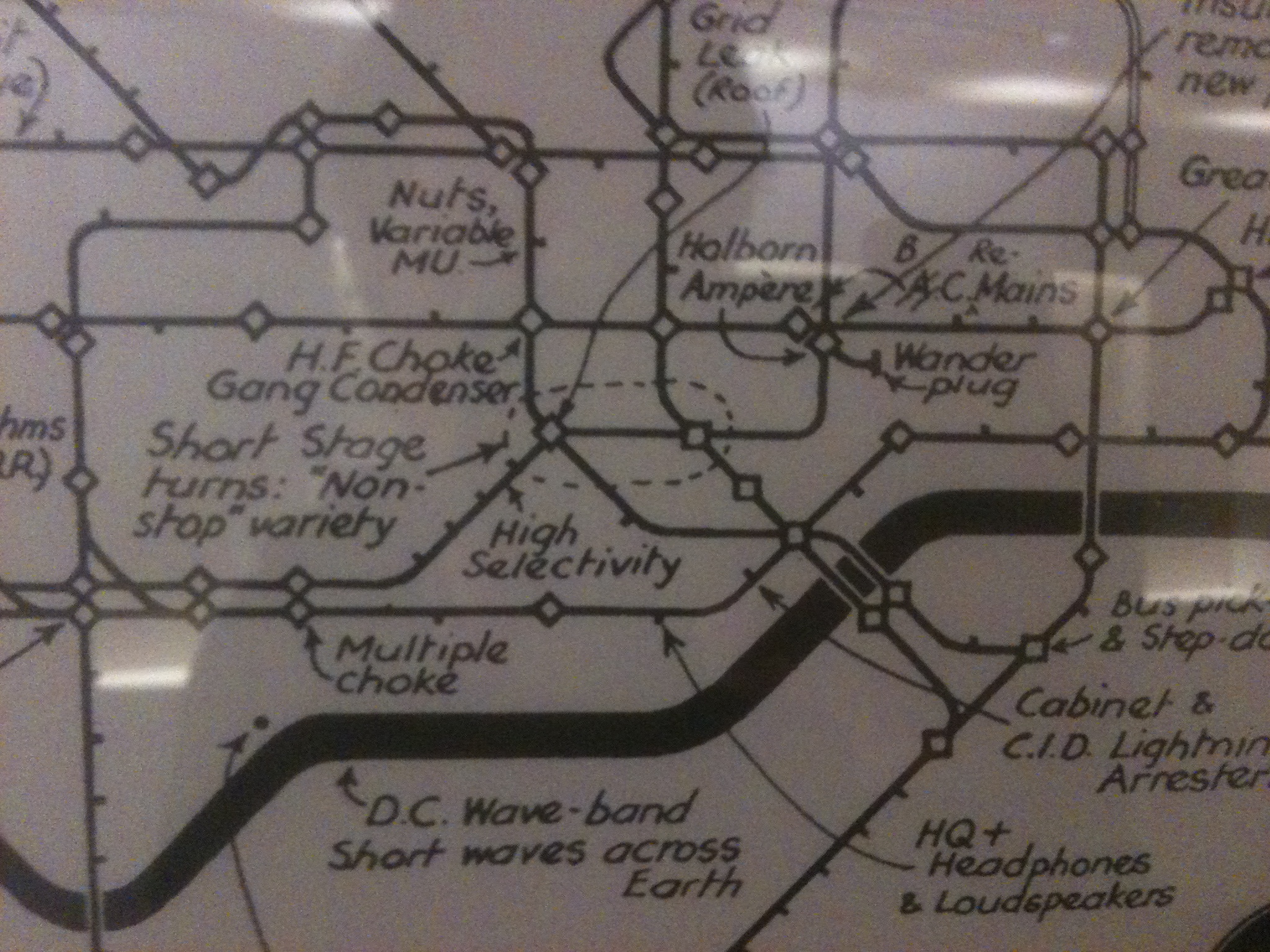
The Beck part of the exhibition is also brilliantly done given how much has already been done on the man who created the modern tube map. A personal highlight was this sketch from the London Transport staff newspaper in 1933, in which Beck gently mocks the popular notion that he got the idea for his diagrammatic map from a circuit board. He has redrawn his tube map as the interior of a transistor radio, thus creating the first mash-up/spoof of his iconic design and pre-dating The Great Bear by several decades.

Speaking of which, the LT Museum have commissioned six new pieces of art for the exhibition, and they are all great, which is quite unusual for these things. Simon Patterson has updated The Great Bear as Saptarishi, Jeremy Wood has created a new ghost map, tracing his movements through GPS and there’s a marvellous ‘Proustian’ map of London by Agnes Poitevin-Navarra.

My Ghost

Most exciting of all is Stephen (The Island) Walter’s new epic undertaking, London Subterranea, a stunningly detailed map of the London beneath our feet, executed in stark black and white and crammed with information and folklore.

When I talked to Walter a few years ago, he expressed a keenness to put The Island behind him despite some interesting related projects that had been suggested to him. I’m delighted that he has since decided to return to London mapping, as he is a master at it. I’m told he’s now working on an A-Z, which will incorporate The Island and London Subterranea.

Other highlights include a copy of the infamous 2009 tube map that omitted the Thames, a gorgeous 1932 enamel map from a station wall and a copy of Finchley Central by The New Vaudeville Band. There’s also a brilliant book by curator Claire Dobbin that accompanies the exhibition. Go see it!

Mind The Map opens 18 May until 28 October 2012. 

Cockney Visions: Writing Britain at the British Library

The British Library’s new exhibition Writing Britain, which runs until 25 September 2012, has big ambitions. It aims to study place and landscape in British literature, looking at how writers and poets have been informed by the land around them, and how their writing has transformed the way we view these spaces.

Phew!

The exhibition is divided into different thematic sections, and includes one on Cockney Visions about London writing, and another on the suburbs, which also has considerable London content.

It’s a remarkably bold concept, but the BL does not shy from a challenge – its exhibition on Liberty a few years ago was one of the most intellectually intense I have ever seen, while the one on Language was similarly involved.

This time, it doesn’t quite pull it off. The problem is the same that blighted last year’s science fiction exhibition – too many books. Entering a BL exhibition is like visiting a first rate antiquarian bookshop, but one were you can’t touch the books and none of them are for sale. It’s great to see these rare and beautiful books, but it’s also incredibly frustrating that you can’t pick them up, feel the pages, smell the history.

Paradoxically perhaps, books are also an insufficient way of examining landscape in the way the exhibition intends. If we can’t actually sit there and read Wuthering Heights, immersing ourself in this extraordinary place the writer has created, we need other ways to make the journey. The most evocative part of the exhibition is the one on the Lake District and Highlands, purely because there are some wonderful paintings on display, which help crystallise our vision of what Wordsworth, Keats and Scott were describing. Conversely, the London section takes in the usual suspects on that well-trod wander from Blake and De Quincey to Alan Moore, Neil Gaiman, Will Self and Iain Sinclair  (and includes a wonderful copy of the London Psychogeographic Society newsletter from the early 90s), but fails to really plunge us into the city of our imagination.

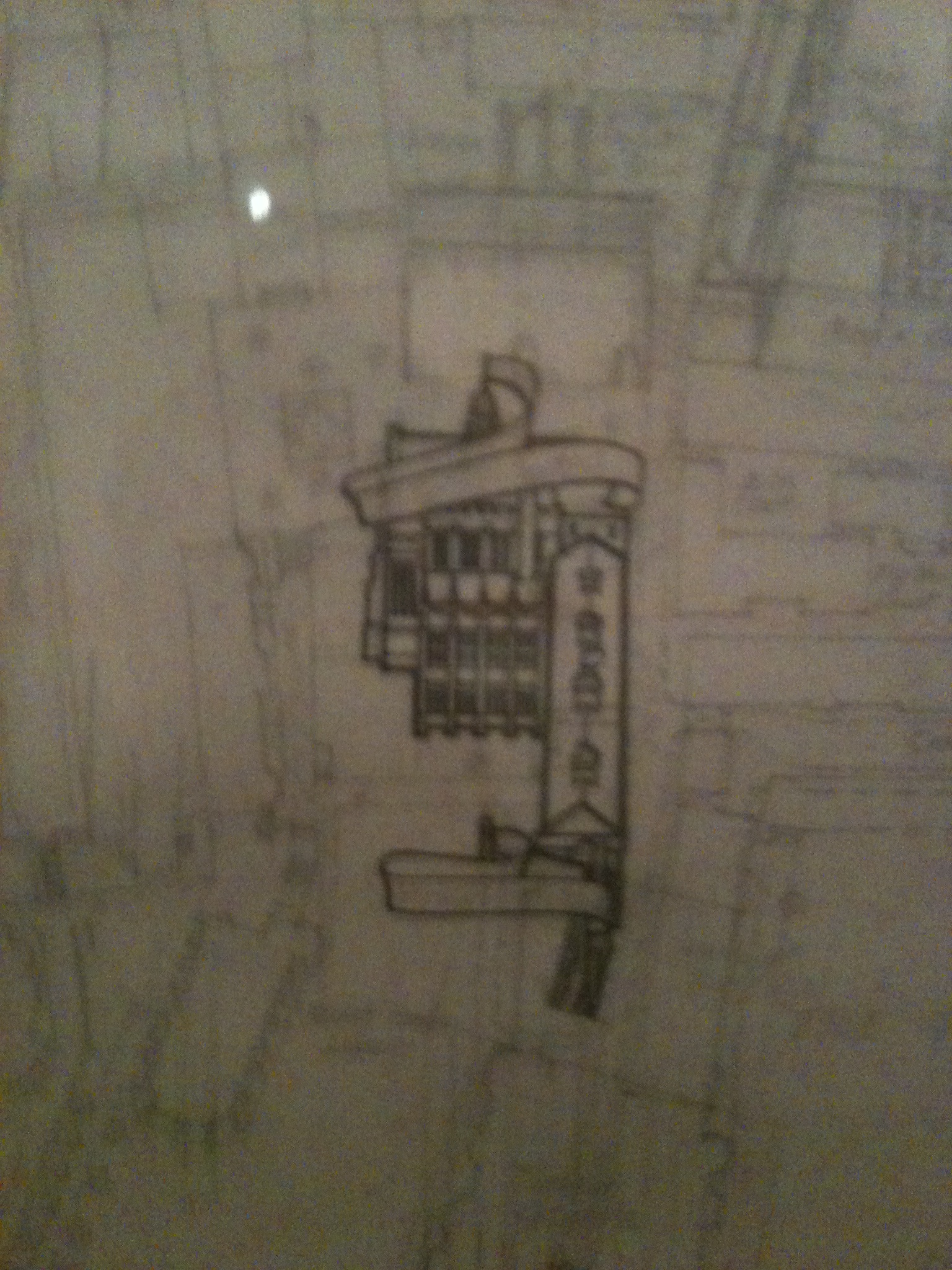
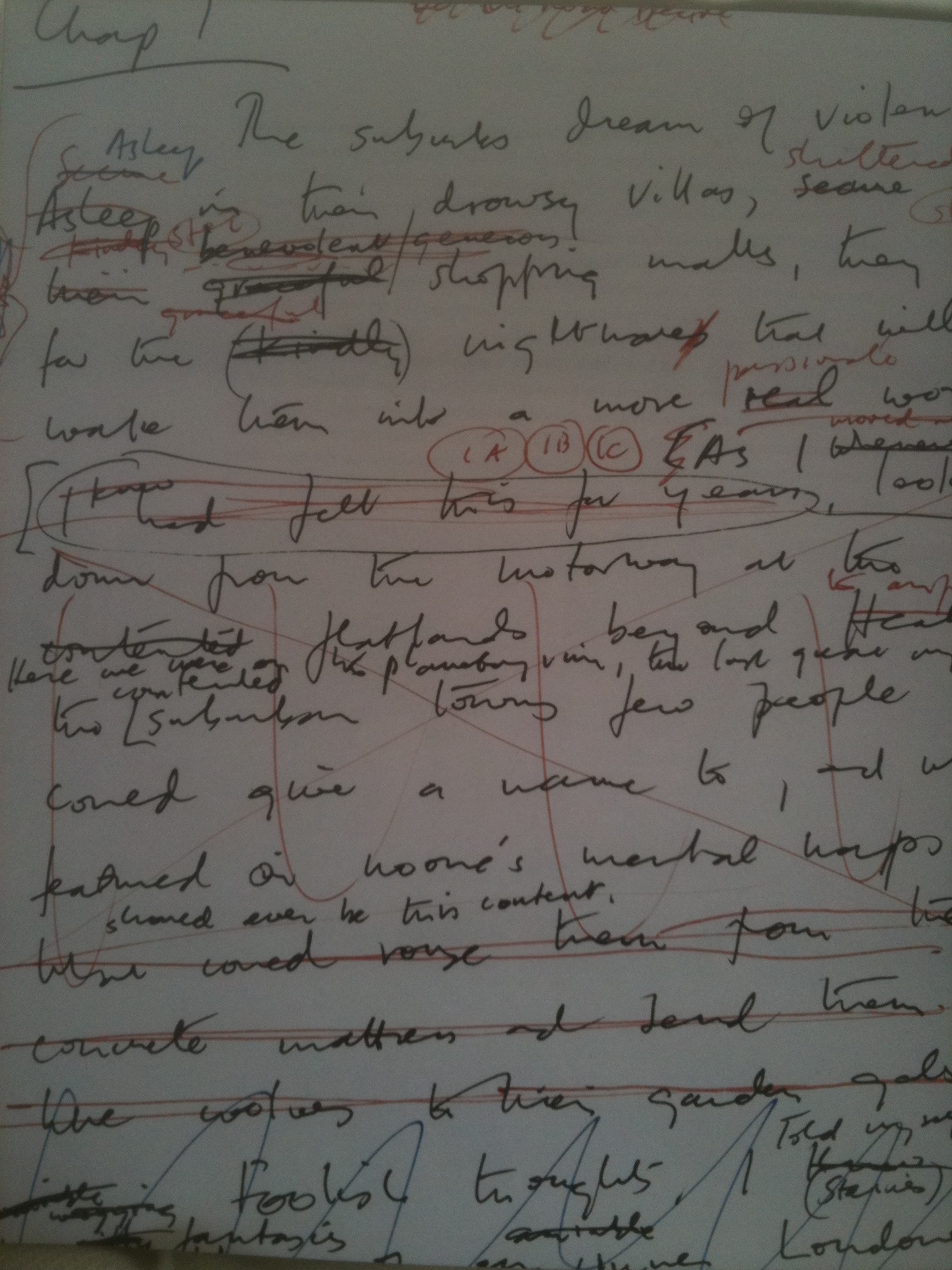
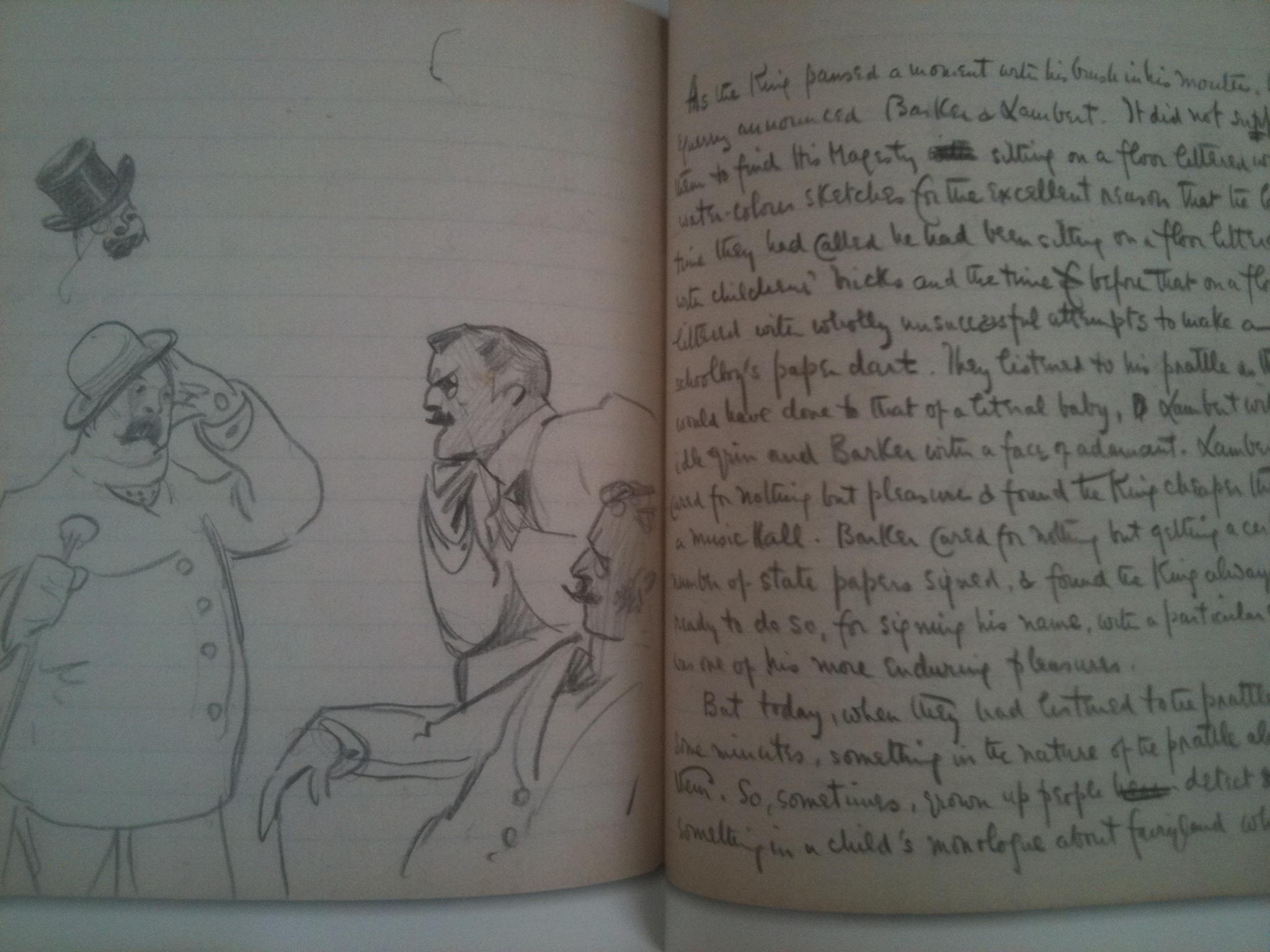
Where the exhibition – and the BL itself – really does excel is when it can produce original manuscripts, diaries and photographs. These messy, scrappy, lovingly flawed items show the writing process in a way a beautifully bound finished book never can. And some of the best of these are to be found in the sections of the exhibition related to London. There’s a sketch by John Betjeman of Dalston Station; an unpublished poem by Evelyn Waugh about the Crystal Palace (complete with Waugh’s drawing of the building); a couple of pages from JG Ballard’s collection, including the heavily amended opening pages to Kingdom Come and Crash; and a lovely drawing by GK Chesterton to accompany his notes for The Napoleon of Notting Hill.

Dalston Station by John Betjeman.

Kingdom Come manuscript

Notes for The Napoleon of Notting Hill by GK Chesterton

I loved also a letter by Conan Doyle sent to his mother from South Norwood, in which he carefully sketched the floorplan of a suburban house he was thinking of buying, and a copy of Pygmalion, which Shaw had phonetically annotated to show how he felt the cockney phrases should be pronounced.

a personal favourite was a draft of Albert Angelo by BS Johnson, showing how Johnson wished a section of one page to be cut out so it would reveal a sentence from later in the book, a brilliant way to create a  flash-forward or pre-cognition.

Best of all, though, was this photograph, which shows JM Barrie, GK Chesterton and George Bernard Shaw dressed as cowboys in 1914. For the full story, read this excellent blog post. It has very little to do with Writing Britain, but it’s bloody marvellous all the same.