Category Archives: London

Time Out – smoking hot and strikes

BBC Archive recently posted a fantastic video about Time Out magazine in 1978.

It’s a fascinating snapshot of London past, from the references to “seedy” King’s Cross and “trendy” Covent Garden to the fact that everybody appears to be smoking, all the time. The broadcast focuses around a couple of interviews with Tony Elliott, the magazine’s handsome founder and proprietor who looks like the lost member of Genesis.

It’s remarkable to think that despite his theoretical control, the magazine’s union was powerful enough to close down publication after Elliott had the temerity of appointing his wife, Janet Street-Porter, as deputy editor. That led to a strike and management climbdown. Another strike took place after the union chapel took offence to the appointment of a new TV editor, John Wyver, as they felt the job should have gone to an internal candidate – one of whom was broadcaster and writer Jonathan Meades.

As this film relates, at this time, almost all Time Out staff – there were a few exceptions – earned the same salary, whether they were editing a section or working as a receptionist. There were also other then groundbreaking initiatives, including mandated sabbaticals and paternity leave (“Do I have to take it?” asked one soon-to-be-father). Many of the staff members featured in this footage, including recently deceased news editor Duncan Campbell, would leave Time Out in 1981 after an extended strike following an ugly dispute regarding this pay arrangement. They went on to form City Limits, while Time Out relaunched and continued to enjoy great success.

Time Out stayed in their Covent Garden office until early 1994. That means that when I first started working there in the summer of 1998 it was still very much the new place, even though it already felt thoroughly lived in. Smoking by then was reserved for the eighth floor, where the entire top floor was given over to a massive smoking area, complete with sofas, daily newspapers and views across the West End. Different times, and great ones.

London – “a card-index system to an inexhaustible set of topics”

It doesn’t happen that often, but every now and then I read a description of London that makes me sit up – finally somebody sees London in the same way that I do! The following is from Penelope Lively’s very pleasant 1984 novel According To Mark – and is a perfect study of the overlapping Londons that exist inside my brain, and perhaps some of the other readers of this very occasional (sorry!) but still just about hanging on blog.

“To drive from south-west to north-east London is not just to spend a lot of time sitting in traffic-jams but also, for a certain kind of person, to pass through a system of references and allusions that ought to be more dizzying than it actually is. Mark, during the next hour and a quarter, found himself reflecting – in quick succession – upon Roman Britain, Whistler, Daniel Defoe, Harrison Ainsworth, Virginia Woolf, Isambard Kingdom Brunel and various other matters, all of these prompted by fleeting glimpses of the slivery glitter of the river, the dome of St Paul, a railway station or street name.

The city, indeed, seemed to exist not just on an obvious, physical and visual plane but in a secondary and more mysterious way as a card-index system to an inexhaustible set of topics… And all these references coexist in a landscape even though separated from one another by decades and centuries; the mind has no problem latching onto each one in turn, switching obediently from one level to another, providing without effort the appropriate furnishings by way of costume, language and action.

The head should be spinning, and yet it isn’t; it accepts quite calmly the promptings of what is seen and what is known.”

More soon, perhaps.

Battersea Power Station – updated paperback edition

When I completed Up In Smoke, my history of Battersea Power Station, in early 2016, the power station was still a derelict shell in the centre of a huge building site. Some believed it would always remain so. But in October 2022 the power station finally opened to the public after almost 40 years of failed dreams.

The new paperback edition brings this story up to date. It is still the only complete history of the power station from its inception and decades of electricity generation through the long years of abandon when successive developers tried to remake Battersea for the modern age. It includes interviews with people who worked at the power station in the 50s and 60s, plus the developers, architects and planners who worked on the many schemes that followed closure. There’s also a chapter about Pink Floyd’s flyaway pig.

Revised throughout with a new final chapter containing fresh interviews and insights about the completed development, we felt this needed a new cover and title. It is now called White Elephants And Flying Pigs: The Extraordinary Afterlife Of Battersea Power Station and is available through Paradise Road.

Sohemian Society talk – December 5

I have a talk coming up with the Sohemian Society on Thursday December 5, where I will be in conversation with writer and musician Max Décharné about Denmark Street: London’s Street Of Sound. The event will be held upstairs at the Wheatsheaf pub on Rathbone Place in Fitzrovia – tickets can be purchased here.

The Sohemian Society was founded in 2003 to celebrate Soho Bohemia and is organised by the cream of London nerdery, with input from the likes of Travis Elborough, John King and Paul Willetts – authors and speakers of great repute in the London-obsessed world.

I am really looking forward to talking to Max, who has written brilliant books about the Kings Road and Teddy Boys. Max is a musician with Gallon Drunk and Flaming Stars, so will have plenty of first-hand memories of Denmark Street from his career. The talk is at the Wheatsheaf, one of the classic London pubs and a short stroll across Oxford Street to Denmark Street itself.

It should be a great evening. Please do come along and say hello.

Rough Trade on Denmark Street

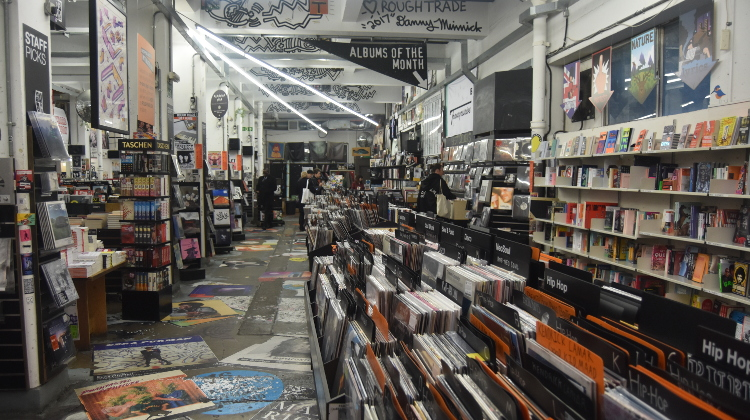
When I wrote my history of Denmark Street – Denmark Street: London’s Street Of Sound – I delivered what some felt was an overly optimistic conclusion. This commercial makeover might not be all bad, I said, citing one example: “Might Denmark Street even finally get a record shop like…. the new Rough Trade hidden inside a clothe’s shop… in west Soho?”

And so it has come to pass with the news that Rough Trade will be taking a lease at No 24, the former HQ of Noel Gay Music. This will be the first record shop for the street, which has been home to every other business related to music over the past 100-plus years but, as far as I could tell, never had a record shop.

While most observers painted the street’s future in apocalyptic terms seeing only a complete obliteration of history and tradition by evil developers, I was cautiously upbeat. Of course, when the scaffolding was removed Denmark Street would not be the same as it had been, but the history of the street had always been one of adaptation, as the shops and businesses that populated Denmark Street moved with the changing rhythms of the music industry. The publishers of the 20s and 30s had given way to the bands and managers of the 60s and 70s, who were then replaced by the guitar-purchasing amateurs of the 80s and 90s. Things change. They have to.

Music today occupies a different, less culturally vital role, but it’s still big business and Rough Trade’s stock of expensive coloured vinyl and related merch will be exactly what a younger audience is looking for. Add the continued survival of the instrument shops and the excellent work being done round the corner at Meanwhile where a new 500-capacity grassroots venue is taking shape, and you have a recipe for something genuinely interesting. The next step is improved programming at the developers own two venues, Here and The Lower Third, neither of which have really managed to take full advantage of their location.

This feels like something close to a homecoming for Rough Trade, whose old Covent Garden store was a favourite haunt of mine in the 1990s – something I wrote about here. But let’s not wallow in nostalgia. This isn’t about me. As I wrote in my book, “Denmark Street’s story is not done yet and there is still the possibility that future generations will visit Tin Pan Alley and leave with treasured memories of their own.”

Meanwhile… On Denmark Street

Flitcroft Street is the short street at the east end of Denmark Street. You might know it from its most famous building – the one with the huge door (theatre backdrops were painted here – hence the big door to get them out on to the street).

Flitcroft Street used to be known as Little Denmark Street. Readers of my book, Denmark Street: London’s Street Of Sound, might recall it was the location of Billie’s, a legendary London gay club populated by musicians in the 1930s that was the subject of a homophobic police raid.

Flitcroft Street is now home to Meanwhile, a gallery run by the Farsight Collective. Walk down Denmark Street, turn right and it’s right there. The Farsight Collective have huge plans for this site. The gallery will be on the ground floor. A couple of floors below, almost directly below Regent Sounds at No 4, that will be a cabaret bar – modeled partly on Billie’s. In the floor between there is space for a live music venue that will hold around 300 people. The Farsight Collective have considerable experience running both clubs and galleries in London so they know their stuff.

This is, in my view, the most exciting thing to happen in the West End for decades. It has the potential of confirming Denmark Street as an essential location for live music, particularly if it encourages the Lower Third (once the 12 Bar) and Here to up their game. Other new arrivals for the street – as yet unconfirmed – will add to this experience by filling in other gaps that are currently lacking in the street’s offering.

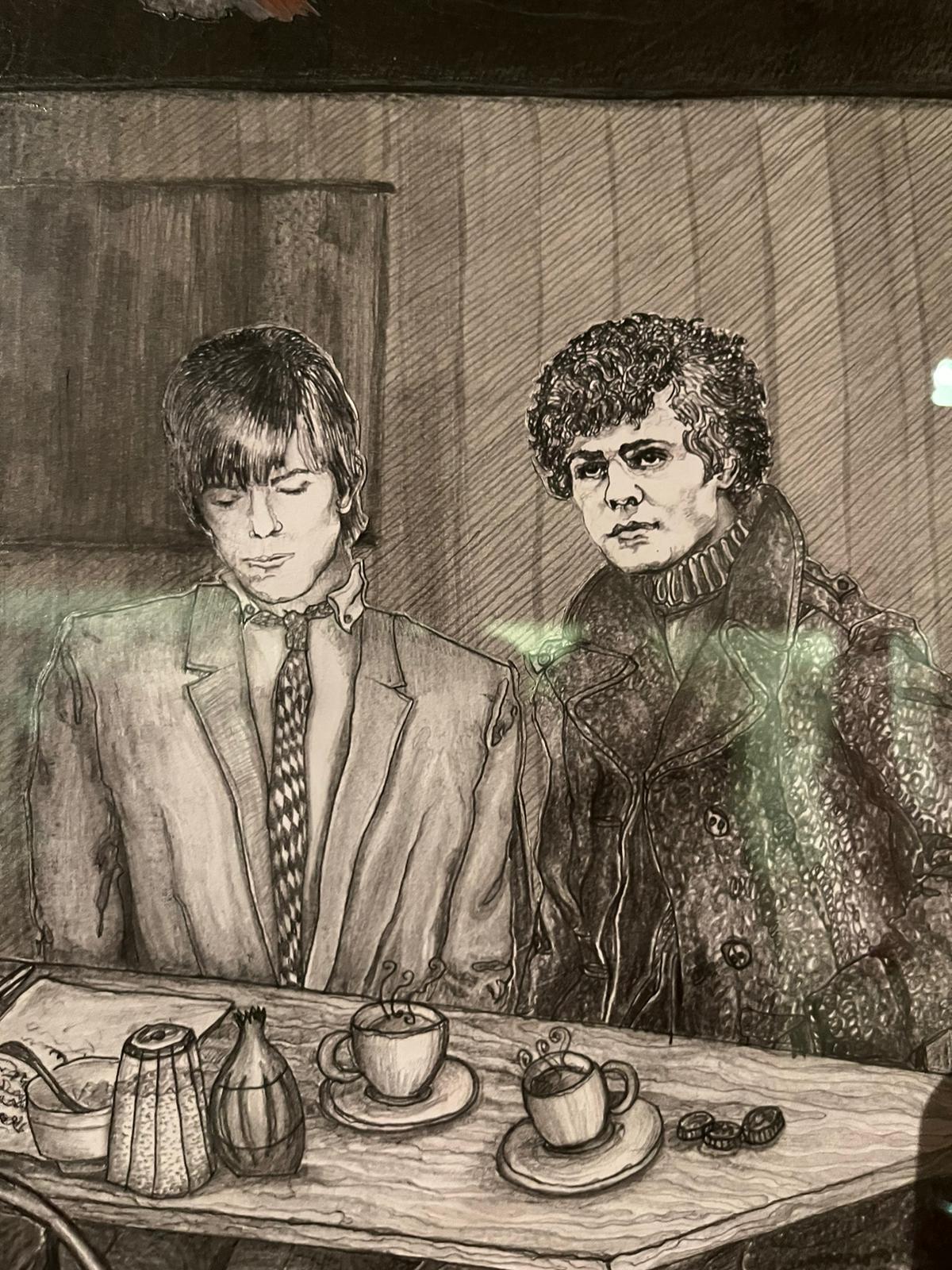
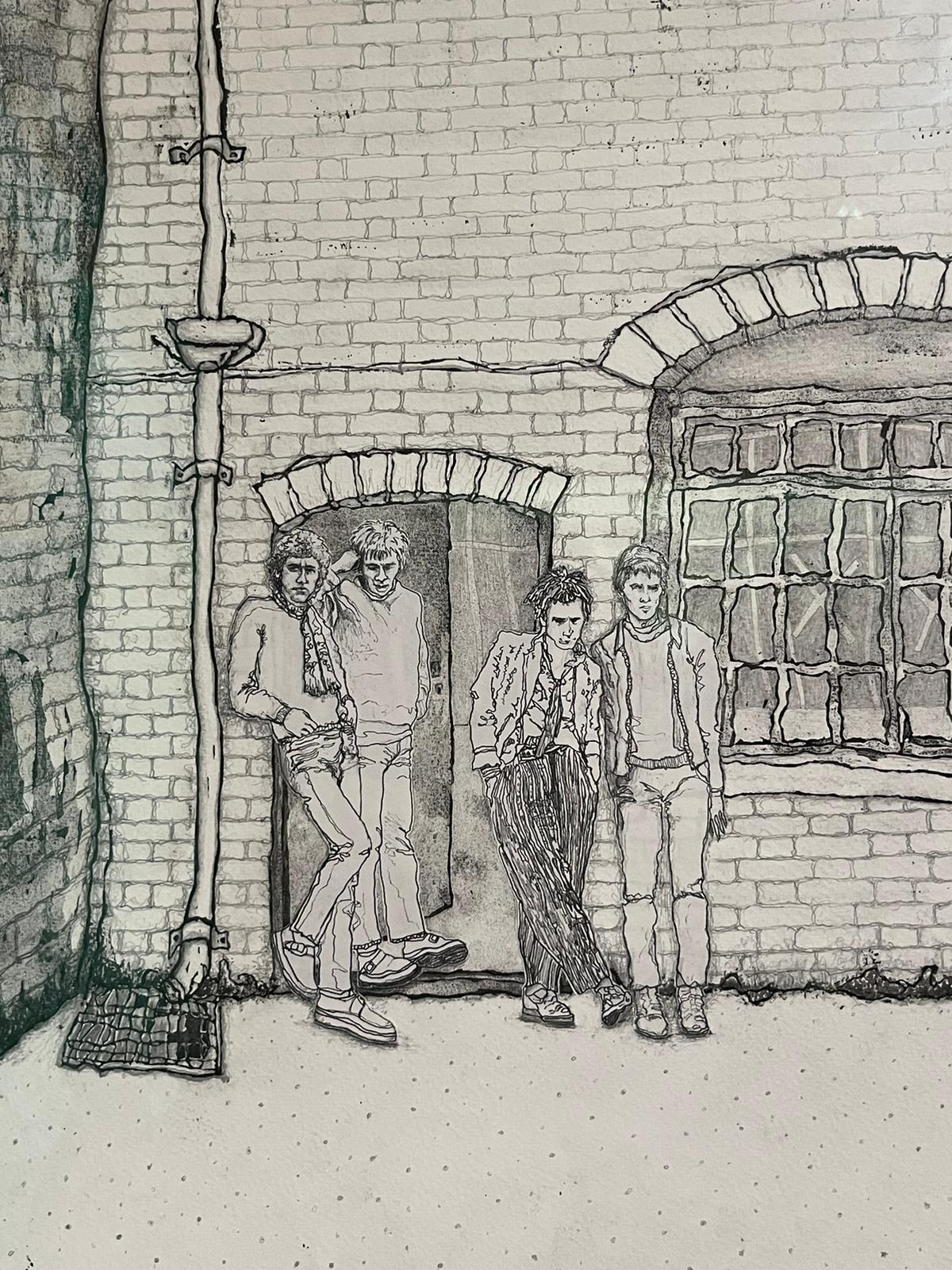
Meanwhile is open weekdays 12-6pm. It is currently hosting an exhibition that celebrates the musical history of Denmark Street and Soho. This includes photographs of great London nightspots from the past, covering everything from jazz to Trash. There’s a video timeline showing London clubs from 1900 to today – apparently there were more nightspots open in Soho during the Blitz than there are today – and some drawings of famous Denmark Street locations including Lawrence Wright House at No 19, Bowie and Bolan at La Gioconda and The Sex Pistols outside their outhouse at No 6.

‘Paintings from Regeneration City Blues exhibition © Jane Palm-Gold/DACS 2015

There is also a short history of every building on Denmark Street using text taken from Denmark Street: London’s Street of Sound.

Other displays discuss the plans for the location and how you can support their license application.

Highly recommended.

Meanwhile, Flitcroft Street, weekdays 12pm-6pm.

POSTPONED Denmark Street at Regent Sounds – free talk

No 4 Denmark Street could be the most important single address on Tin Pan Alley. It’s housed Regent Sound, the studio where the Rolling Stones recorded their debut album, the Helter Skelter bookshop that specialised in books about music, and is now home to Regent Sounds, London’s best guitar shop. Other residents include Johnny Dankworth and Essex Music, publishers of the Rolling Stones among others. There might even be a connection to the Krays.

I will be giving a talk about the general history of Denmark Street amid the Fenders at No 4 on Friday December 15 at 7.30pm, and then signing copies of the second edition of Denmark Street: London’s Street Sound. Crispin Weir, who owns Regent Sounds, will be talking about the history of No 4 in particular, having done extensive research into the building over the years. It should be a great event for anybody who loves music, books, history and guitars. Hope to see you there.

Denmark Street talk – at No 4 Denmark Street, WC1, on Dec 15, 7.30pm.

Events – drugs, clubs and Denmark Street

I have three events coming up in the next four weeks.

On Monday October 23, I will be talking to counterculture guru Carl Williams about the LSD Library. This is a free event organised by TANK magazine at their base on Great Portland Street but tickets must be booked. The LSD Library was the incredible collection put together by Julio Santo Domingo that contained thousands of books and items related to drugs, sex, magic, alternative politics and rock n roll. It is the subject of my book, Altered States.

Book your place here.

On Thursday November 23, I will be at the Horse Hospital to talk about music in London for the London Salon. I will talk about some of London’s lost venues, focusing on those around Soho and Covent Garden within walking distance of Denmark Street.

Get a ticket here.

On Thursday November 30, I will be at Battersea Bookshop at Battersea Power Station to talk about Denmark Street. Tickets aren’t available for that yet, but should be soon.

Hope to see some of you at any or all of these.

Londonist interview – Denmark Street

I’ve been doing a bit of publicity about Denmark Street: London’s Street Of Sound.

Here’s an interview I did with Matt Brown at Londonist that I think gives a good overview of the topics covered in the book. If you’ve bought, read and enjoyed the book, please do consider leaving a review on Amazon as it makes a big difference.

Denmark Street: London’s Street Of Sound

My new book, Denmark Street: London’s Street Of Sound, is now available for pre-order with publisher Paradise Road – link here. It will be available from the week of September 11.

There is surely no other street in London that can pack so much history into such a small area. There are numerous significant buildings in London – the British Library say, or Abbey Road – but there’s nowhere quite like Denmark Street, which connects musicians such as The Beatles, Rolling Stones, Lionel Bart, Joe Meek, Gracie Fields, The Kinks, The Sex Pistols, Pink Floyd, Bananarama, Elton John, Jimi Hendrix, Jimmy Page, David Bowie and Jeff Buckley in so many different ways.

Some recorded here, some performed, some lived, some worked in office jobs, some scavenged for session work, some bought or sold instruments – and many were ripped off by the managers and booking agents that occupied the offices of Denmark Street before they were told into shops that sold guitars.

I trace the story of this street from the moment the first music publisher arrived on Denmark Street before the First World War, and follow the way it has changed and developed alongside the needs of the music industry itself, right up to the present day. The text is enlivened by Rob Telford’s amazing photographs.

I hope you like it.