Category Archives: Books

Up In Smoke: The Failed Dreams of Battersea Power Station

I’ve written a book about Battersea Power Station.

It’s called Up In Smoke: The Failed Dreams Of Battersea Power Station and is out in the spring via Paradise Road, a new publisher concentrating on London non-fiction.

Battersea Power Station is one of London’s favourite buildings, but nobody before has told its story.

This will be the first book to explore the history of the building, from conception and construction, through use and obsolescence, and then into the long years of post-closure redevelopment.

I wanted to understand why so many people have been fascinated by Battersea over the years. I’ve spoken to former workers and designers of inflatable pigs, location scouts and photographers, politicians, Lords, architects, planners and entrepreneurs.

This is a book that tells us so much about London and the way it changes. It’s a story of power and land, of big ideas and broken dreams. It’s a story that takes in property and politics, architecture and popular culture. It’s a story about our city and our relationship with its most popular building.

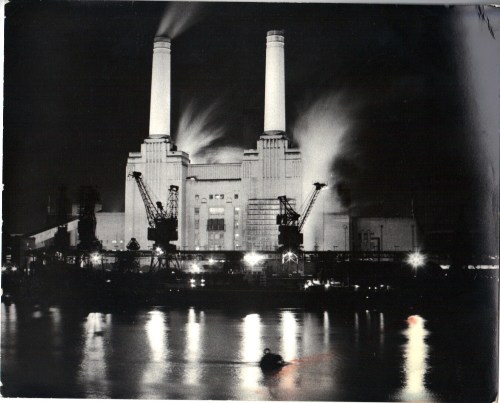
It asks how we went from this…

19-09-2014 104101

Battersea Power Station, 1975.

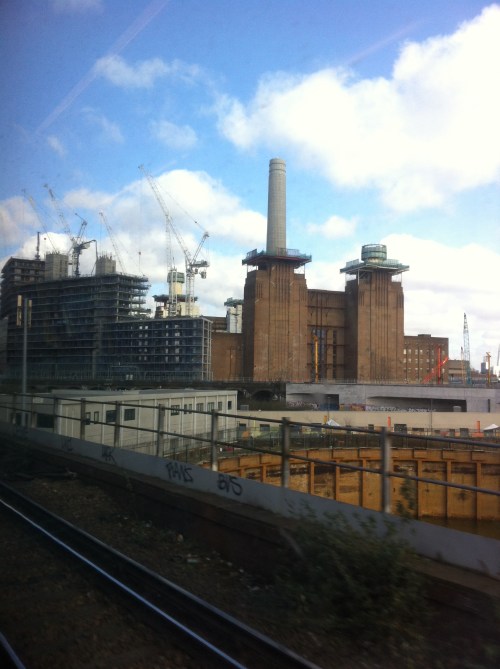
To this…

IMG_5309

Battersea Power Station, 2016

“I loved the brutality of it”: Suede and London

I wrote about Suede for the current issue of Uncut. This was something of a revelation for me, as I was able to remind myself how excited I was when I first heard Suede – I remember playing “Animal Nitrate” over and over again in my bedroom, thinking that I’d finally discovered a band I loved as much as The Smiths. Before interviewing the band, I went to see them play at the Roundhouse and all of that old energy was still there, and I was just as thrilled as I had been at 16.

One angle covered in wide-ranging interviews with Brett Anderson, Mat Osman and Neil Codling was the importance of London to the Suede aesthetic – this was a band that even renamed themselves The London Suede, albeit under duress, for their American releases.

suede.jpg

When the band were formed, Osman and Anderson shared a flat on Hilever Road in White City “on the border with Notting Hill – bohemia one way, estates the other,” Osman said, and Suede’s music came to occupy this very same sort of space, the sort of London written about by Patrick Hamilton, Dylan Thomas, Gerald Kersh and Roger Westerby in those novels about outsiders arriving in London and being instantly swallowed by vice and excitement. Doing something similar around this time was the TV version of Hanif Kureishi’s Buddha Of Suburbia, with a soundtrack by David Bowie – the combination of Suede and Kureishi is what led me to Bowie.

“London was a place where you can be what you want,” says Codling. “You can disappear, you can embrace any subculture, you can reinvent yourself and glamour is a possibility inherent in that.”

Anderson didn’t deny any of this. “I romanticised what London was,” he said. “I lived in a bit of a film fantasy. I loved the brutality of it, the loneliness and the hardness of it all. I really responded to that. But this is what we were living. I was part of this world I was writing about. I’ve always tried to find the romance in any situation I’ve been in and that happened to be the situation I was in. I’ve always loved art that deals with the prosaic. The Smiths aesthetic, I found that very powerful, ‘the riches of the poor’. There’s beauty in the brutality.”


Anderson told me he’s still inspired by London, often cycling the towpath from his home to West London to Camden, even if it doesn’t directly appear on the band’s new album. The excellent Night Thoughts is instead preoccupied by those unnerving concerns about children and fatherhood that keep Anderson – and myself – awake at night.

“I refute the tortured artist clichés, it’s bullshit, a lazy misunderstanding of what creativity is,” he said. “It’s not expected of authors and film-makers, Michael Haneke always seems very balance and his films are genius of discomfort. For me, a writer is finding those moments of friction, and those can occur in any existence, in any relationship, no matter how stable or content. There are always misunderstandings and moments of friction and this is what I write about.”


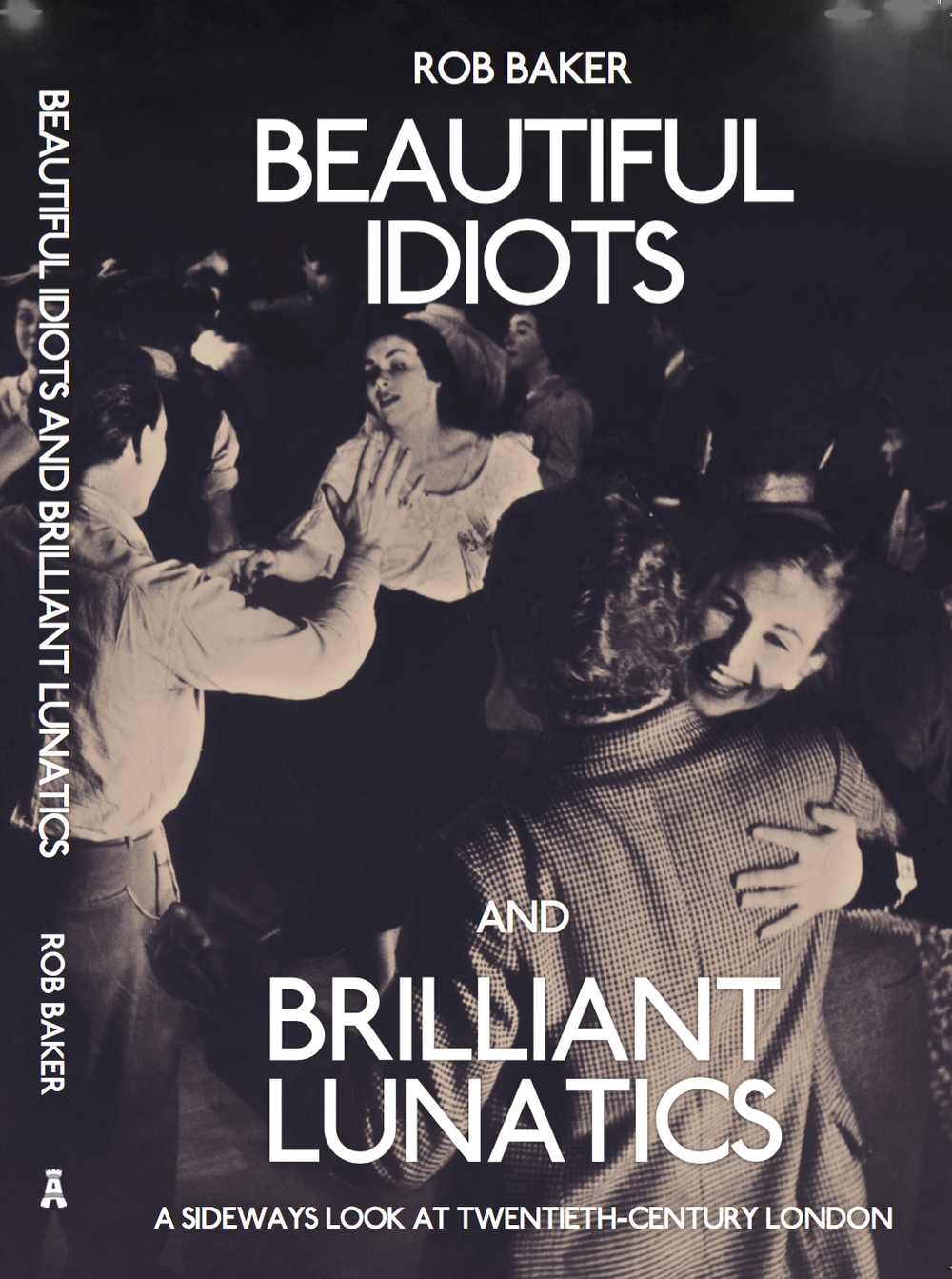
Beautiful Idiots and Brilliant Lunatics by Rob Baker

For several years, Rob Baker has written one of London’s best blogs, Another Nickel In The Machine, which explores the cultural history of London’s 20th century in a unique way. Rather than focus on, say, a musical genre or a particular locale or an identifiable concept such as celebrities or architecture, Baker simply finds great stories and researches the shit out of them. And now he’s turned it into an excellent book: Beautiful Idiots and Brilliant Lunatics.

As with his blog, Baker doesn’t pretend to find a unifying theme to artificially define the richness of his material, instead relying on his natural instincts to identify a good story and tell it for just the right amount of time. This is crucial. Some of these chapters cover some pretty big subjects – the Krays, Lord Haw-Haw, Christine Keeler, Pop Art – but Baker always manages to find a new angle without going on too long: for instance, his piece on Pop Art concentrates on Pauline Boty and the Anti-Ugly Movement while he looks at Blow-Up through a street in Stockwell that appears in the film. He’s brilliant at detail – clothes, weather, atmosphere, quotes – and tightly wound narrative (the section on the escape of spies Burgess and Maclean could come from a thriller), but he also loves exploring interesting tangents.

But his real skill is contextualising individuals within their era or locality. So his chapter on Benny Hill tells us much about the post-war comedy scene at the Windmill as well as Hill’s own rise and sad decline, the Profumo Scandal chapter is also about Soho and the Flamingo club in the early 1960s while the section of Winifred Atwell takes in Atwell’s strange career as a popular black performer but also the history of Brixton, where she lived.

This is essentially, the book of the blog, with several of the same stories, only expanded with new research. The blog also features great photography, just the right amount of which is reproduced here, including a cracking cover shot from the 100 Club, a venue that increases in importance with each year it avoids closure. Collectively, these photos and historical essays build a picture of London that captures some of the city’s chaotic sensibility far more truthfully than a conventional or even psychogeographical history, which will try and draw dry parallels between then and now, sometimes with lamentable results. Instead, Baker simply tells a story and then leaves you to think about what it means, if anything.

Some of these yarns I knew nothing about, such as the strange days James Earl Ray spent in Earl’s Court after assassinating Martin Luther King, or the spiv murder of Warren Street, or Charlie Chaplin’s wonderful return to Lambeth in 1921. Others I was familiar with, but still learnt more about, such as the plans to redevelop Covent Garden in the 1960s that was stopped by protesters – in the current climate, I wonder, would a similar protest have any success at all?  The net result is like being rattled round the London decades by a raconteur with a time machine, a sort of blue badge Doctor Who, who tells a story with wit and panache before whizzing you off to his next unpredictable destination.

The Blitz: missing buildings and false memories

While researching my recent feature on the Blitz and former bombsites in London, I was keen to find a site that had been destroyed and not yet redeveloped.

There were some tantalising leads.

Peter Larkham, professor of planning at Birmingham School of the Built Environment, provided me with an image he’d discovered years before of a derelict building on Lowndes Street, left fallow in memory of the Blitz.

Lowndes Street

“It was in the chartered surveyor professional magazine,” he explained. “The story was that it was owned by a family, bombed, and they never did anything to it in memory of a son that died in the war. Fifty years later, life had moved on, and the property came up for sale.”

It’s a compelling story but one that was difficult to confirm. The Bomb Damage Maps  showed a couple of strikes on Lowndes Street so I sent an email to Dave Walker, librarian at Kensington and Chelsea and writer of the formidable Library Time Machine blog. Dave put the query across to a colleague at Westminster, as Lowndes Street straddles the boundary between the two councils. Between the two of them, they discovered destroyed buildings at No 30 and Nos 11/12 Lowndes Street but both sites were developed by 1963. It would require further research to get to the bottom of the story as outlined by Professor Larkham and as tantalisingly revealed in the above photograph.

There was similar confusion with regard to another site. This was next to the Hat & Feathers pub on Clerkenwell Road.

Clarkenwell Road

Clarkenwell Road

According to local legend, the site had been demolished by a bomb and used as a car park ever since. For years, you could even see scraps of wallpaper from the destroyed building still attached to the neighbouring wall. The only problem was there was no record of a bomb landing anywhere near this property – itself rather extraordinary given how badly the area had been bombed. It appears that this was a false folk memory, but one that was still being shared today. In the end, I included no empty lots in my piece as I couldn’t find any that comfortably fitted the available facts.

After my piece was published, I was contacted by a photographer, Thom Atkinson. He was about to publish a book called Missing Buildings, looking at precisely this area – the missing spaces between London buildings ostensibly created by bombs. They’d even included an image of the Hat & Feathers site I’d been studying. Like me, Atkinson was intrigued with the way folk memory and evidence didn’t always correspond.

hatfeath

Photograph by Thom Atkinson

Thom said, “We came across the same sort of folklore thing a couple of times, and in a way that’s what the book is about. There’s a picture we made on Sclater Street, near Shoreditch Station, and the market traders there were talking about it being a bombsite when they were kids. When we looked at the map it didn’t quite fit their story – but they remembered it so clearly.”

There were several explanations for this, false memory being only one of them. As Thom explained, “Sometimes bombs are recorded and the site itself displays all the signs, but no building damage is shown on the LCC map. And of course the whole thing is complicated because the LCC maps only show damage during wartime – we’ve heard stories of buildings falling down or being demolished later on, because of underlying structural damage caused by the bombing – one of the guys who works in the processing lab (also a bombsite by the way!) has a house in East London with cracked foundations; the surveyor thinks they were caused by a bomb landing at the other end of the street.”

Missing Buildings is a wonderful book, showing the ghosts of London homes, many of which have long disappeared but still leave an imprint on neighbouring buildings in the form of shadows, new brickwork, girders and the spectres of chimney breasts. Others have been filled in with new buildings that stand out ridiculously against their neighbours, awkward and ugly, eternally temporary.

There are more of these spaces than you might imagine in London, but they are vanishing fast and this book is an exquisite record of the spaces that get left behind, often more by accident then design. You can buy it here.


The legacy of the Blitz

I wrote a piece for the Guardian about the way modern London is still shaped by the bomb damage of the Blitz. This was a subject I immersed myself for several weeks and the first draft of my article is very different to the version that was published. I thought it might be interesting to reproduce the original article on The Great Wen. 

————————–

When travel writer HV Morton surveyed London in 1951’s In Search of London, it was still scarred by war. The Blitz had started on 7 September 1940 and more than a decade later, London was a “city of jagged ruins, of hob grates perched in the sunlight in shattered walls, of cellars draped with willow-herb and Canadian fleabane.” As Morton wandered sadly round Cripplegate – an area now covered by the Barbican – he looked “across an area of devastation so final and complete that the memory of it will always rise in my mind whenever I hear the word Blitz. Thousands of buildings have been burnt and blasted to the cellars. Here and there the side of a building rises gauntly from the rubble, a detached gateway stands by itself in the undergrowth, the towers of a few churches, or a spire, lift themselves mournfully, like tombstones in a forgotten cemetery…. How can anyone reconstruct a town from its cellars?”

The scale of this destruction can be gleaned from the bombsight.org website, which uses information from the National Archives to pinpoint every individual bomb strike, and The Bomb Damage Maps 1939-1945, created by the London County Council and now published as a book, which show colour-coded bomb damage on a building-by-building basis. The maps were originally created for financial reasons, but post-war planning was always an issue. “The heart of it was insurance and compensation,” says Laurence Ward, the book’s editor and senior archivist at the London Metropolitan Archive. “But they had one eye on post-war reconstruction and the maps were essential tools for rebuilding London. They give a bird’s eye view of the damage and use a colour scheme that makes it easy to see areas that needed to be cleared.”

By cross-referencing Bomb Damage Maps with the A-Z and www.bombsight.org, London’s post-war evolution can be explored, with modern parks, offices and housing estates replacing black blocks of destruction. As Ward explains, “The maps help areas make sense, they show why the streets look like they do.” We look at six examples that show some of the ways the Blitz shaped contemporary London, and how that process is still continuing today.

Mayday Gardens, SE3

Alan Lee Williams was 10 when his home in Mayday Gardens, near Blackheath, was hit by a parachute mine. “It was meant for the Thames, but damaged 27 houses and took our roof off,” he recalls, now 84 and reflecting on a life that included a period as Labour MP for Hornchurch. Williams’ house was repaired but several houses – marked black for “total destruction” on the bomb maps – remained derelict throughout the war. “They became places for children to play,” says Williams. “They built a big water tank on them for the fire engines, and sometimes we’d swim in it.”

Visit Mayday Gardens now and you’d have no idea anything had happened here. Unlike other streets, where former bomb sites can be identified by the post-war housing blocks that interrupt Victorian terraces, the destroyed houses in Mayday Gardens were rebuilt exactly as before. “They look as if they have been there all the time and I’m sure most people living there have no idea what happened,” says Williams. Indeed, when a local resident – who declined to be named – was asked if they knew of the street’s history, they admitted it came as news to them. “There was no consistency with the reconstruction,” says Ward. “These have pretty good plots and they probably decided it would be easier to rebuild a couple of houses then build a low-rise block.” One issue would have been the material available, with bricks remaining in short supply until the 1950s despite the LCC’s ability to salvage 140 million from damaged houses. The reconstruction of these middle-class homes, though, comes as stark contrast to the way many working-class districts were treated.

IMG_1342

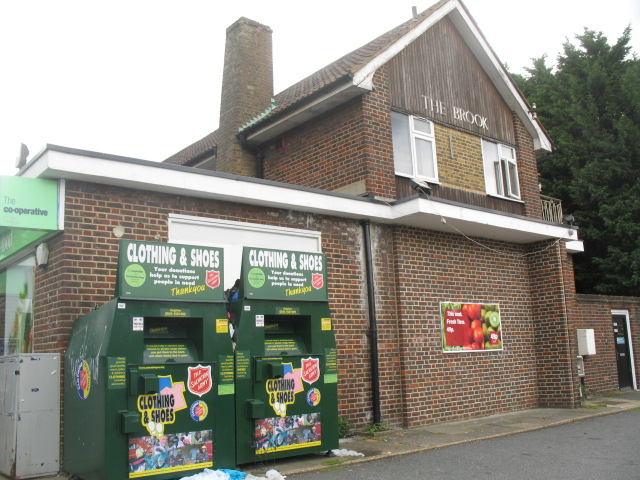
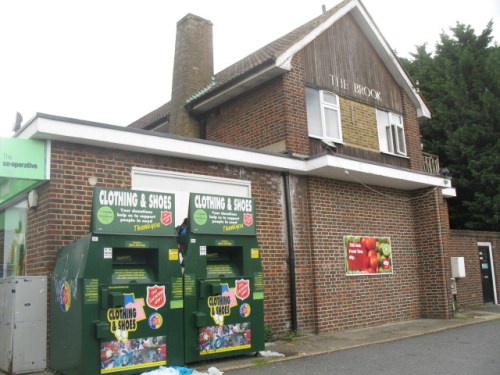
Co-Op, Brook House, Shooters Hill, SE18

A short walk from Mayday Gardens on the corner of Shooters Hill and Corelli Road is an ugly squat building housing a supermarket. This was the site of the Brook Hotel pub, which was hit by a V2 rocket in November 1944.

Alan Williams, then 14, was one of the first on the scene. “I was on a tram on Shooters Hill, when I heard an explosion and ran down the road just in time to see a No 89 bus explode,” he says. “The pub had been hit by the missile and the bus was passing and caught fire.”

Williams was pressed into service. “The fire officer called for silence so we could listen for people calling for help and we heard somebody,” he says. “The firemen were too big to go down, so they lowered me. I found a body still breathing and helped them pull it back up. We got to the top and the gas blew up beneath us – I never got out of a bombsite so quickly.”

He’d rescued a girl who had been playing with the publican’s daughter. “She lived in the same road as me, and her father was a high-ranking policeman,” says Williams. “He came to see us – my mother thought I’d been in trouble again!” In the carnage, 29 died but the pub was rebuilt immediately. “The pub was a lovely old building,” says Williams. “It was close to where soldiers were billeted so they rebuilt it before the end of the war.” Williams passes such bombsites frequently. “I still live in the area and I bow my head as I go past,” he says. “I can still see that 89 bus exploding. I always thought it was strange that there was never an explanation of what happened to these places. I thought they should have put up plaques. It’s always a puzzle why it didn’t happen, maybe they just wanted to forget.”
IMG_1340

Christ Church, Newgate

There are some memorials, if you know what to look for. Churches played an important role before and after the Blitz. Bombed churches were used as propaganda – a famous wartime photograph shows St Paul’s sheathed in smoke – and London’s churches took a pounding: 624 of 701 churches were damaged, of which 91 were destroyed. Many City churches were damaged by the fire bombs of 29 December 1940, which levelled entire streets.

Almost immediately, a debate began about what to be done with the most badly damaged churches. Architect Sir Edwin Lutyen argued in 1941 that “where there is no congregation I would leave the spaces occupied by destroyed churches as open”, partly as a memorial. In 1944, a letter in The Times presciently articulated this principle: “The time will come – much sooner than most of us to-day can visualize – when no trace of death from the air will be left in the streets of rebuilt London. At such a time the story of the Blitz may begin to seem unreal not only to visiting tourists but to a new generation of Londoners. It is the purpose of war memorials to remind posterity of the reality of the sacrifices upon which its apparent security has been built. These church ruins, we suggest, would do this with realism and gravity”.

The creation of these memorial-ruins was rooted in realism – with attendances in decline, churches simply weren’t always needed. The medieval church of Christ Church, Newgate had been rebuilt by Sir Christopher Wren in 1687 after the Great Fire and then razed again in the inferno of December 1940. It has been left in its ruined state in memory of the Blitz, but in bastardised form.

In 1981, neo-Georgian offices were added in imitation of the 1760 vestry – these currently house a dentist. Two walls to the east were removed in 1974 in a road-widening scheme, while the tower – with a steeple that Ian Nairn considered one of Wren’s finest – was transformed into a 12-storey private home in 2006. Merrill Lynch’s office squeezes against the wall of the church and the fact these gardens act as a memorial to the Blitz probably goes unnoticed by local workers – it’s all far too tidy for one thing. A short-lived campaign was launched in 2013 to turn this into a more thoughtful memorial to the sacrifice of Londoners, of which there are few. Christ Church at least fared better than another memorial-ruin: St Mary Aldermanbury was sold to Westminster College in Fulton, Missouri to act as a memorial to Winston Churchill. London still awaits a fitting tribute.

Old Market Square, Columbia Road, E2

A complex network of priorities faced London’s post-war rebuilders, many of whom had been agitating to reconstruct London since before the war. This bore curious fruit in Columbia Road in Bethnal Green, now the location of a flower market and genteel Victorian terraces but then considered a slum. On the first day of the Blitz, a bomb hit a shelter beneath Columbia Market, killing 38. “Columbia Market was a 19th century development founded by Angela Burdett-Coutts to regenerate the area and improve quality of life,” explains Ward.” The buildings were damaged during the war and subsequently demolished – but, it seems, they could have been repaired – the map notes that the main blocks suffered only general blast damage.”

Burdett-Coutts was a philanthropist and friend of Charles Dickens, and Columbia Market was a combination of market and social housing constructed in a dramatic neo-Gothic style that marked one of the first flowerings of Victorian social housing. The ambitious scheme was deemed a “splendid failure” by The Times in 1936 and after the war was being used for storage. Although salvageable and unquestionably important, it was demolished in 1960 and replaced by Ravenscourt Park and a modern tower block, named Old Market Square in a half-hearted nod to what was lost. This new estate is typical of the buildings that were thrown up after the war to solve the problem of slum housing. A campaign is ongoing to get a plaque erected in memory of those that died.

IMG_1352

In the haste to rebuild London, many important buildings were demolished, inadvertently spawning the modern heritage industry. “The idea of heritage and listing buildings only really started after the war, when things were demolished so rapidly we don’t know exactly what was demolished and what was valuable,” says Peter Larkham, professor of planning at Birmingham School of the Built Environment, who has written on post-war reconstruction. “It was launched as a problematic and ad hoc system that allowed councils to designate conservation areas. After development stopped with the 1970s oil crisis, conservation almost took over and we now have 10,000 conservation areas and half a million listed buildings. Some think we conserve too much.” The only remaining trace of Columbia Market is a section of railing outside a nursery. “It’s a fascinating building that most have cost a fortune and completely dominated the road,” says Ward. “Now you’d never know it existed.”

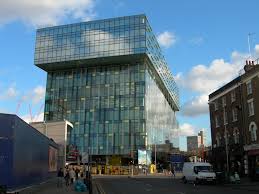
Palestra, Blackfriars Bridge Road, SE1

This 1990s office block sits atop a site with a fascinating jumbled history. In 1783, the Surrey Chapel was built amid fields by Georgian preacher Rowland Hill, who chose a circular – or octagonal – form as this meant there were no corners where the devil could hide. By 1910, it was being used as a warehouse when boxer Dick Burge decided to turn it into a boxing venue. The Ring was a success but was hit by a bomb on 25th October 1940 and then again in March 1941. According to the Bomb Damage Maps the spot was also later hit by a V1 flying bomb. Damage from one of these strikes can still be seen a few yards away under a railway bridge.

Like many bombsites, The Ring wasn’t replaced until the 1960s. “Some materials required for building were rationed until 1954,” says Larkham. “Every bomb-damaged city was arguing with the government for their allocation of steel and you might have a site and a plan but you might not be able to do anything with it. Britain was selling steel to Australia because the economy was more important than rebuilding.” Eventually Richard Seifert’s gaunt Orbit House was raised on the site. Seifert, one of the UK’s most prolific post-war architects, loved to give his buildings space-age names, and this one also had a circular nod to The Ring. It housed records for the India Office.

But Orbit House’s time was fleeting. In the 1990s it was replaced by Will Alsop’s gargantuan glass Palestra, which is used by TfL. Peter Rees, the City’s former head of planning, once told me that modern office buildings have a life of around 30 years – something that has more to do with the changing requirements of office life than architectural trends – and that’s how long Orbit House lasted. But with his new building, Alsop paid reference to both of Palestra’s forefathers: like Orbit House, it is raised above the road on a pedestal, while its name comes from the Greek word for a wrestling ring. What’s interesting, though, is that as with much of London’s post-war offices – include huge swathes of the City – this site is already on its second generation of development. Larkham questions if that is sustainable. “One of the worst products in terms of sustainability is concrete,” he says. “The fact we can put these building up and then pull them back – is that really the best solution? We need to design for more flexible longer-term planning.”
Elephant Park, SE17

You won’t find Sayer Street on a map but you can hunt it down in photographs. One on the IWM website shows a family sitting at a dinner table outside the Blitzed shell of Sayer Street School eating egg and bacon supplied by American aid.

Another shows Sayer Street before the Blitz, when it consisted of five-storey tenements in one of London’s poorest areas around Elephant & Castle. Elephant was badly hit by bombs, and Sayer Street is riddled with damage on the Bomb Damage Maps. Before the war, the street contained a fishmongers, cat meat dealer, grocer, saddler, bookbinder; after the war, it was the location of a car park, one of the most popular post-war uses for bombsites. The NPC car park empire began with the purchase of a £200 bomb site on Red Lion Square.

In his memoir The Likes Of Us, Michael Collins writes how in the 1960s he explored Elephant’s remaining bombsites, “on which relics of former homes hovered, exposed broken fireplaces and floral or barley corn wallpaper that had witness births, deaths, Christmases, parties, tears, arguments, laughter and sex.” Sayer Street survived this half-life into the 1960s, when it was chewed up by the Heygate Estate. The Heygate was originally conceived as one of three gigantic housing estates that would stretch from Elephant to Peckham, linked by walkways and ramps for two miles. “It was said the planners decided which streets would be erased in the back of a taxi as they were driven around the neighbourhood,” writes Collins, who was forced from his childhood home. One of those to disappear was Sayer Street.

As Larkham explains, “some of the plans were incredibly radical, sweeping away neighbourhoods irrespective of damage and replacing them with high-rise towers nobody wanted to live in.” These were fuelled by idealism, but as early as 1945, the planner CB Purdom had warned of the dangers in How Shall We Rebuild London?, explicitly rejecting Le Corbusier and “the megalomaniac proposals of those who regard the metropolis as a hive of near termites speeding their existence upon escalators or in tubes.” Such pleas were ignored and towers went up on bomb sites all over London. Some were successful like the Barbican, but most were bleak, poorly built and badly maintained.

The Heygate was rarely popular but it housed many of London’s poorest and now it too is gone, having lasted 37 meagre years. Southwark sold it to Land Lease, a private developer and demolition began in 2011. Former residents have been shipped miles from London, displaced even more brutally than those who once lived on Sayer Street. In its place will come Elephant Park, a residential village of towers and plazas, where a three-bed apartment costs £2.5m. “It says a lot about where London is heading, how it is become more like Paris with those areas of social housing being pushed further out,” says Ward. The ripples from London’s post-war redevelopment continue to be felt, and from Blitzed streets and lost bombsites, another London arises. How long will this one last?

John Peel didn’t mean shit to me: my radio education

I’ve been thinking a lot about radio recently. It’s partly to do with the launch of Apple’s new radio station but really began when I read London’s Pirate Pioneers by Stephen Hebditch, and continued when I started Bob Stanley’s excellent history of pop music, Yeah Yeah Yeah, which has some interesting thoughts on the way Radio One has shaped British music tastes and the roles played in this by different controllers and their chosen DJs. As ever, Stanley talks a lot about John Peel, who for many music fans was a lifeline to new, exciting music. For much of the 1980s, this was the only place you could hear music that other DJs might deem difficult or unpopular. Get a bunch of music fans of a certain age together, and they’ll soon talk about the important of Peel in their musical education.

It’s at this point I usually look at my shoes and hope the discussion moves on. Peel was a hero to most, but he never meant shit to me. That’s because when I was starting to seeking out music – a little later than most, I was in my late-teens before I discovered any music that really spoke to me – Peel was barely to be found on Radio One. He occupied a tea-time shift on Saturday afternoons when I was usually coming back from watching football. I’d listen when I could because the elder guardians of the NME/Melody Maker said I should, and I remember avidly listening to the Festive Fifty at Christmas despite the protestations of my parents. But my heart wasn’t in it no matter how much I adored Strange Fruit’s wonderful budget collection of Peel Sessions LPs.

Instead, I was a devoted listener to Mark Radcliffe, whose show ran from 10pm-midnight four nights a week (and before that, weekly on Radio 5, which I also listened to). Radcliffe was given the sort of freedom that was highly unusual in national radio. He could play pretty much anything he liked, and happily mixed old with new. It was here that I first heard bands like The Leaves, The Sonics and Paul Revere & The Raiders, and discovered I really liked garage rock. He played a fair amount of indie just as the genre went massive, but gave it some context by playing it alongside records from the 1960s and 1970s, largely guitar-based but not entirely.

This was important, there was no streaming then, no internet at all, and oldies stations like Capital Gold generally stuck to the standards, so the only way to hear this kind of marginal music was by tracking it down in record shops and taking the risk of the purchase, or hearing it on the radio.

But the other thing he did was place the music within a wider cultural context. Guests came in to talk at length about films and books. He even did poetry. And the guests were immaculately selected: Will Self did a weekly slot on cult books, his unsettling drone of a voice perfectly suiting portentous, absorbing discussions of Kafka, Hesse, Burroughs and Huxley. In contrast to the regal Self, Mark Kermode would enthuse about cult films like a woolly teenager. He usually manged to slip in a mention of The Exorcist but, like Self, would cover a range of genres and era, showing how the dots connected. He’d also, I think, point out interesting films being screened at 2am on C4 so you could set the video. Every week, this pair gave me suggestions for something new to get from the library, or at least talk about knowledgeably, as if I’d read or watched them myself.

Simon Armitage and John Hegley would recite poems, which even then I didn’t much like but hell, just think about that for a minute, weird northern poets on national radio talking to teenagers. There were other guests too, comedians, journalists, mates of Radcliffe and his sidekick Riley, who joined in with the daft quizzes and silly set-pieces, but it was the mix of old and new music, spiced with literature and cinema that I was listening for.

You see, I loved music, but it wasn’t the centre of my life, which is how John Peel always seemed to present it, with deathless, off-putting, intensity. Radcliffe in contrast used music as a crucial flavouring in a cultural casserole. It felt mind-expanding, and was a massive influence on my education, on how I perceive music even today.

I don’t know if Radcliffe’s show stands up now, I don’t really want to know, but here’s a link to a fan’s website and some clips from one of the shows.

Pirate radio in London: The Clash, Keith Allen and biscuits

There’s currently a small exhibition at the ICA looking at the history of London’s pirate radio. The Guardian recently ran a great photogallery on the subject.

pirate

Not coincidentally, I’ve been reading a new book on pirate radio, London’s Pirate Pioneers by Stephen Hebditch, who formerly edited a magazine dedicated to pirate radio. It’s a great book, crammed with detail and utterly absorbing.

My knowledge of pirate radio was restricted to the 1960s offshore stations, and then the 1980s dance stations. I knew about the latter because I sometimes stumbled upon them while retuning from Capital Gold to LBC in search of football results. There would be a javelin of static, a man shouting, booming bass and a general feeling of chaos. I also diligently watched Lenny Henry, so knew all about the illegal broadcasting activities of Delbert Wilkins, who ran the a pirate radio show in Brixton.

Hebditch’s book mentions Henry, who was a supporter of probably London’s most famous pirate, Kiss FM, which like many others broadcast using transmitters stuck above shops on Westow Hill in Crystal Palace. But he also talks in detail about aspects of pirate radio that are much less well known. The book looks at developments in the pirate scene year-by-year from the 1960s, starting with a general overview taking in major shifts in technology, approach, licensing laws and law enforcement, followed by a longer look at a couple of  the year’s most important stations, and then a round-up of all the other stations that broadcast that year – some of them only surviving a week.

The detail is astonishing and what really fascinated me was the range of stations that existed. Many were playing jazz, dub, soul, funk and reggae – and the story of the way Black Londoners embraced pirate radio in the 1980s is an important one. Hundreds were later playing dance music, but there was also stations for heavy metal, classic rock, pop, and rock and roll as well as for local community groups: Poles, Greeks and South Indians all had stations. There was even said to be a far-right station, Radio Enoch, broadcasting in the Midlands, which was shut down after members from one London rock station went to pay a visit.

From these stations came numerous DJs we know today – Tim Westwood, Gilles Peterson, Annie Nightingale, Pete Tong, Judge Jules and Steve Lamacq – but also a hint of the variety of music and programming that the radiowaves could support. Many paid their costs by charging advertisers; some even charged the DJs for the right to present.

A station like Phoenix (1981-1985) would play early indie – Ellery Bop, Nightingales, Inflatable Boy Clams – mixed with “dub, jazz, industrial and African”, with guest presenters like Robert Wyatt and The Monochrome Set. Similar was Network 21, that played alternative rock and dance, while also covering news, cinema listings, concerts, plays and exhibitions.

concord

Then there’s Radio Concord, which grew out of the west London squatting scene between 1972 and 1976, sometimes broadcasting from the house in Maida Vale where Joe Strummer lived with the 101ers. This was a politicised counterculture station, and would comment on issues like Northern Ireland and housing rights. “They have even been critical of the Queen,” the Daily Mail reported. One time, they were busted while broadcasting so stuck  a mike through the letterbox to try and interview the law live on air.

Then there was Radio Amanda, that lasted from 1982-1984 playing a pre-Resonance diet of space rock and electronic music. At roughly the same time, there was Our Radio, a station started by anarchists that had shows devoted to feminists, gay groups and Brixton-based anarchists. It had few listeners but the police hated it: in one court case it was described as an “anarchist, terrorist, homosexual” radio station.

Radio Wapping broadcasting briefly in 1986 to support the printworkers striking after News International’s move to Wapping. And in 1983, comedian Keith Allen launched Breakfast Pirate Radio, which was broadcast “using helium-filled balloons over Notting Hill” (ahem) and featured “comic-characters, malicious celebrity gossip, radio outtakes and the names of supposedly bent coppers.” Robbie Coltrane also featured and you can listen to it here.

Best of all, though, was a station called The Home Of Good Baking which broadcast for a few weeks in 1989 using a jingle from United Biscuit Network, the 1970s in-house radio station at United Biscuits in Hayes.

Archive: Julian Cope interview

I recently rediscovered this 2005 interview with Julian Cope from Time Out. It took place over the phone and my main recollection is that Cope went to the toilet halfway through, with the sound of his piss hitting the urinal adding a certain sonic tang to the transcription.

They say that every boy needs a hobby; over the years Julian Cope has had plenty. At first it was taking LSD on ‘Top Of The Tops’ and talking about Scott Walker. Later it was sitting beneath a tortoise shell and listening to krautrock. Now it’s playing monolithic sludge rock riffs and visiting ancient monuments. There’s no pattern, it’s just how things worked out.

But before we get into one of those ‘isn’t Julian Cope crazy?!’ mindsets, let’s clear one thing up: Cope isn’t a whacked-out, moondog, schizoid beam-chaser, or even a ga-ga, freaked-up, attention-seeking acid-eater, he’s just a lot more interesting (and, crucially, interested) than most rock stars. Let the man himself explain, as he prepares for his Friday night gig at the Royal Festival Hall: ‘Playing the role of Julian Cope means I can hide behind what Julian Cope is supposed to be. People always say, “You’re a lot more normal than I thought you would be”, and I say, “Yeah, but if I was as weird as you thought, I wouldn’t be able to achieve fucking anything”. The whole point is that it’s the subject matter that’s weird, not the person behind it.’

These days such achievements are often literary – particularly best-selling books on standing stones (The Modern Antiquarian and The Megalithic European). But Cope continues to record. His latest is Citizen Cain’d, an epic, guitar-shredding study of alienation and monotheism that is heavily informed by travels in Iran and stupidly heavy rock ’n’ roll.

‘We’ve all got an inner moron,’ he explains. ‘And rock ’n’ roll entertains your inner moron, but that doesn’t mean it can’t be smart as well. I thought it would be great to take garage rock and fuse it with genuinely amazing guitar. American punk bands always struck me as being better because they were great musicians playing down. One of the reasons I work with Doggen is that he’s one of the best guitarists I’ve ever heard. He’s amazing. But it’s context, I never put him in a good context. I’m never going to make him look like Eddie Van Halen if he’s got to come out of the swamp.’

Talking of swamp, support on Friday is from San Francisco’s Comets On Fire, quality purveyors of cosmic sludge, who are playing their first UK show. Cope has been a fan for a while. ‘The great thing about Comets is they very much know where they’re coming from. When I first got in touch with Ethan Miller (Comets main guy) I was saying, “Man, you’re totally Roky Erickson meets John Fogerty with Hawkwind backing”, and he said “Shit man, in my dreams that’s where we are”. But it’s not in their dreams, they’re there already.’

As he enthuses about favourite bands like Speed Glue And Shinky (‘I’m a fucking cunt for a singing drummer’) and Monoshock (‘They’re really vile. Like a sewer Stooges’), it’s clear that Cope is totally into this stuff. And when Cope gets into something, it normally gets into print. ‘I’m writing a book that’s just called ‘Rock ‘N’ Roll’, but it has the most portentous subtitle in the world. I can’t even remember it. On the back we’re going to have a massive question mark and underneath say “Who will entertain your moron?”’

Will this be written in his trademark stream-of-consciousness style? ‘Actually, I’m probably no more stream of consciousness than Robert Graves, I’m just fucking great at giving that impression. One thing I do is write what I want to say, then I go into an internet translator and turn it into German, turn the German into French and then the French back into English, and then pick out the nuggets. It ends up sounding like Faust lyrics. I’m happy that secret being leaked: the people who hear it and don’t take it seriously won’t learn anything, and the people that know wisdom is everywhere will take it on board and start doing it. Part of my job is to reveal other ways. I’m trying to be a facilitator rather than somebody who hides behind a cloak of mystery.’

And Friday? ‘Expect generic dark psychedelia. I’m really punishing the cliché. Get there early because we’re going to play two sets, one as people arrive, then after the Comets we’ll come back and do that monolithic sludge. It’s going to be a real vibe. Healthy amounts of mushrooms will be good and women should dress for the occasion.’

Three new London books: then, now, forever

I’ve been immersed in a trio of complementary London books in recent weeks, each of which adds further depth to any understanding of the city’s built environment.

London: Architecture Building And Social Change is a very useful, glossy overview looking at how London’s architecture has developed – or not – with the city’s needs. Sometimes the architecture has led to social change; sometimes social change has led to new architecture. Author Paul Knox focuses on 27 districts – largely central, which is understandable but slightly annoying – exploring how landowners and developers combined to give them their character, before looking at a dozen key buildings in closer detail. There’s rich detail here, as well as nice pictures and helpful maps. I was particularly grateful for being introduced to the word “super-gentrification” to describe London’s current toxic situation. Knox is particularly good at emphasising the city’s sense of scale – how it has repeatedly rejected density in favour of a more humanising style of urban living in the form of terraces or mansion blocks – and showing how this is once more under attack. The overall feel is a little like seeing London through a microscope: first the overview, then closing in on a specific area, then seeing how all this maps on to a single building. It’s also a terrific reference book.

If Knox’s angle is how we got from ‘then’ to ‘now’, Tom Bolton is more interested in what ‘now’ obscures of ‘then’. Vanished City: London’s Lost Neighborhoods hunts the streets for traces of London districts that have been eradicated by time, developers, fire and bombs. Bolton embraces the history, delving into archives to restore to life forgotten quarters such as Ratcliff, Cripplegate, Wellclose, Clare Market and, particularly fascinating, the strange lost towns of Old St Pancras. There’s much incidental overlap with Knox, but Bolton fills in some of the gaps, bringing us the stories of the people who lived in these lost towns rather than simply telling us who owned the land and what was built on it. Brilliantly researched and breezily written, the only drawback is a lack of maps, which would have really helped the reader pin the past on to the present. Instead, as with Bolton’s previous book with Strange Attractor, SF Said adds suitably spooky imagery.

Finally, the reprint of Ian Nairn’s Nairn’s London is a must for any Londonphile. Filling a space between Bolton’s largely historic musings and Knox’s contemporary report, Nairn looked at London at a very specific point in time, the mid 1960s, as the post-war redevelopment of the city was really getting underway. In this way, it makes a nice companion to HV Morton’s In Search of London, roving, individualistic, romantic and revealing. Nairn conceived it as “record of what has moved me, between Uxbridge and Dagenham”, and his idiosyncratic eye meant he was able to celebrate vernacular masterpieces like the Granada in Tooting (“Miss the Tower of London if you have to, but don’t miss this”) while waspishly dismissing some of Wren’s lesser works. Vivid and memorable, it’s like a three-dimensional A-Z. If you don’t already own it, snap one up.

London filth

Lee Jackson loves filth. His new book, Dirty Old London, is full of the stuff, as he explores Victorian London’s attempts to cleanse a city that is swilling in muck. I’ve often wondered what Victorian London would have smelled like, and Jackson’s book comes close to capturing what must have been a frightful stink. I knew about the horse shit and the smoke, but had never considered the mud, blood, unwashed bodies, corpses and human excrement that, collectively, would have made the Victorian city one of the foulest places on earth. It’s astonishing anybody wanted to live there.

Jackson shows how Victorians began to push against the tide of muck, which grew worse as London’s population swelled. Victorians did not consider dirt in itself to be a carrier of disease, but they believed the smell could be lethal as well as deeply unpleasant, so eventually set about doing something about it. They built pavements, sewers, public baths and indoor lavatories, improved housing, dug cemeteries and generally tried to do something about “that combined odour of stale fruit and vegetables, rotten eggs, foul tobacco, spilt beer, rank cart-grease, dried soot, smoke, triturated road-dust and damp straw’. They weren’t always successful – some of those aromatic problems lingered long into the 20th century when they were eventually dealt with, or in the case of horse manure, replaced by something even worse such as exhaust fumes.

In explaining how this happened, Jackson is far more entertaining than anybody has the right to be on such a subject. Rather than focus on the well-trod tales of John Snow and Joseph Bazalgette – both of whom barely feature, thankfully – Jackson resuscitates the lives of less well known figures in this lengthy campaign against dirt, characters like reformer Edwin Chadwick who laid much of the groundwork for what was to follow. In the process, he shows how Victorian London functioned – the haphazard, individual-driven nature that saw things get done, or not, as the case might be.

Embedded image permalink

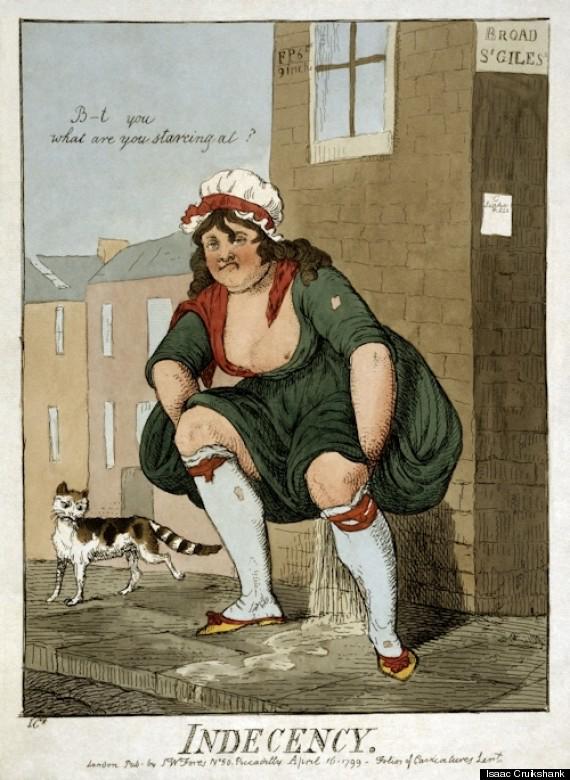
Indecency by Isaac Cruikshank

This is a history with potentially narrow focus, but Jackson – a general historian of the unstuffy, non-academic variety – is removed enough from the subject to be able to show its wider importance and long-term effects. One theme of the book is the way sanitisation – in the form of sewage, rubbish and housing – was the hinge on which London’s social contract turned. For much of the 19th-century, the bewildering array of local authorities that ran London saw their role as, essentially, to keep out the way. They did as little as necessary, thus keeping rates low and relying on private enterprise to fill the gap. But as London grew, getting bigger and smellier every year, this system began to creak. A good example is with the dustmen. Collecting and recycling London’s rubbish was a lucrative job for some entrepreneurs, but not so much for the dustmen themselves, who had to rely on tips to make a living. And given that tips were much more likely to be acquired in rich areas, the poorer streets were increasingly neglected, allowing rubbish to pile higher and higher. Local authorities had to step in to fix this, and it gradually became the accepted role of local authorities in the UK until Thatcherite councils like Wandsworth in the 1980s began to perceive different, pre-Victorian, way of running things.

Jackson also touches on a related angle: the increasing movement of public buildings into private hands. In this case, it’s centred round the Victorian public lavatories, which were only built after ferocious lobbying from some notable figures who recognised the desperate need on the streets for London loos.  The story of how those toilets were eventually built is fascinating in itself, but Jackson also notes the fact that so many have recently been closed, flogged, refurbished and then sold back to us as coffee shops, galleries and an “award winning urban spa”. Perhaps this is the fault of the Victorians, for making things so well and so adaptable, but you can’t help feeling that, now as then, it stinks.