It doesn’t happen that often, but every now and then I read a description of London that makes me sit up – finally somebody sees London in the same way that I do! The following is from Penelope Lively’s very pleasant 1984 novel According To Mark – and is a perfect study of the overlapping Londons that exist inside my brain, and perhaps some of the other readers of this very occasional (sorry!) but still just about hanging on blog.
“To drive from south-west to north-east London is not just to spend a lot of time sitting in traffic-jams but also, for a certain kind of person, to pass through a system of references and allusions that ought to be more dizzying than it actually is. Mark, during the next hour and a quarter, found himself reflecting – in quick succession – upon Roman Britain, Whistler, Daniel Defoe, Harrison Ainsworth, Virginia Woolf, Isambard Kingdom Brunel and various other matters, all of these prompted by fleeting glimpses of the slivery glitter of the river, the dome of St Paul, a railway station or street name.
The city, indeed, seemed to exist not just on an obvious, physical and visual plane but in a secondary and more mysterious way as a card-index system to an inexhaustible set of topics… And all these references coexist in a landscape even though separated from one another by decades and centuries; the mind has no problem latching onto each one in turn, switching obediently from one level to another, providing without effort the appropriate furnishings by way of costume, language and action.
The head should be spinning, and yet it isn’t; it accepts quite calmly the promptings of what is seen and what is known.”
When I completed Up In Smoke, my history of Battersea Power Station, in early 2016, the power station was still a derelict shell in the centre of a huge building site. Some believed it would always remain so. But in October 2022 the power station finally opened to the public after almost 40 years of failed dreams.
The new paperback edition brings this story up to date. It is still the only complete history of the power station from its inception and decades of electricity generation through the long years of abandon when successive developers tried to remake Battersea for the modern age. It includes interviews with people who worked at the power station in the 50s and 60s, plus the developers, architects and planners who worked on the many schemes that followed closure. There’s also a chapter about Pink Floyd’s flyaway pig.
Revised throughout with a new final chapter containing fresh interviews and insights about the completed development, we felt this needed a new cover and title. It is now called White Elephants And Flying Pigs: The Extraordinary Afterlife Of Battersea Power Station and is available through Paradise Road.
I have a talk coming up with the Sohemian Society on Thursday December 5, where I will be in conversation with writer and musician Max Décharné about Denmark Street: London’s Street Of Sound. The event will be held upstairs at the Wheatsheaf pub on Rathbone Place in Fitzrovia – tickets can be purchased here.
The Sohemian Society was founded in 2003 to celebrate Soho Bohemia and is organised by the cream of London nerdery, with input from the likes of Travis Elborough, John King and Paul Willetts – authors and speakers of great repute in the London-obsessed world.
I am really looking forward to talking to Max, who has written brilliant books about the Kings Road and Teddy Boys. Max is a musician with Gallon Drunk and Flaming Stars, so will have plenty of first-hand memories of Denmark Street from his career. The talk is at the Wheatsheaf, one of the classic London pubs and a short stroll across Oxford Street to Denmark Street itself.
It should be a great evening. Please do come along and say hello.
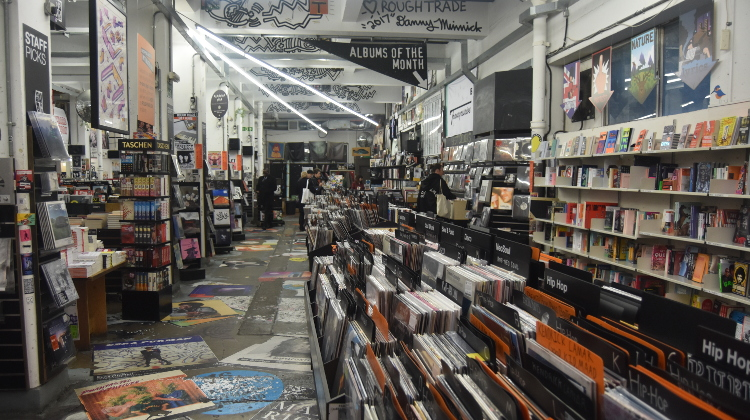
When I wrote my history of Denmark Street – Denmark Street: London’s Street Of Sound – I delivered what some felt was an overly optimistic conclusion. This commercial makeover might not be all bad, I said, citing one example: “Might Denmark Street even finally get a record shop like…. the new Rough Trade hidden inside a clothe’s shop… in west Soho?”
And so it has come to pass with the news that Rough Trade will be taking a lease at No 24, the former HQ of Noel Gay Music. This will be the first record shop for the street, which has been home to every other business related to music over the past 100-plus years but, as far as I could tell, never had a record shop.
While most observers painted the street’s future in apocalyptic terms seeing only a complete obliteration of history and tradition by evil developers, I was cautiously upbeat. Of course, when the scaffolding was removed Denmark Street would not be the same as it had been, but the history of the street had always been one of adaptation, as the shops and businesses that populated Denmark Street moved with the changing rhythms of the music industry. The publishers of the 20s and 30s had given way to the bands and managers of the 60s and 70s, who were then replaced by the guitar-purchasing amateurs of the 80s and 90s. Things change. They have to.
Music today occupies a different, less culturally vital role, but it’s still big business and Rough Trade’s stock of expensive coloured vinyl and related merch will be exactly what a younger audience is looking for. Add the continued survival of the instrument shops and the excellent work being done round the corner at Meanwhile where a new 500-capacity grassroots venue is taking shape, and you have a recipe for something genuinely interesting. The next step is improved programming at the developers own two venues, Here and The Lower Third, neither of which have really managed to take full advantage of their location.
This feels like something close to a homecoming for Rough Trade, whose old Covent Garden store was a favourite haunt of mine in the 1990s – something I wrote about here. But let’s not wallow in nostalgia. This isn’t about me. As I wrote in my book, “Denmark Street’s story is not done yet and there is still the possibility that future generations will visit Tin Pan Alley and leave with treasured memories of their own.”
No 4 Denmark Street could be the most important single address on Tin Pan Alley. It’s housed Regent Sound, the studio where the Rolling Stones recorded their debut album, the Helter Skelter bookshop that specialised in books about music, and is now home to Regent Sounds, London’s best guitar shop. Other residents include Johnny Dankworth and Essex Music, publishers of the Rolling Stones among others. There might even be a connection to the Krays.
I will be giving a talk about the general history of Denmark Street amid the Fenders at No 4 on Friday December 15 at 7.30pm, and then signing copies of the second edition of Denmark Street: London’s Street Sound. Crispin Weir, who owns Regent Sounds, will be talking about the history of No 4 in particular, having done extensive research into the building over the years. It should be a great event for anybody who loves music, books, history and guitars. Hope to see you there.
Denmark Street talk – at No 4 Denmark Street, WC1, on Dec 15, 7.30pm.
Here’s an interview I did with Matt Brown at Londonist that I think gives a good overview of the topics covered in the book. If you’ve bought, read and enjoyed the book, please do consider leaving a review on Amazon as it makes a big difference.
My new book, Denmark Street: London’s Street Of Sound, is out now. But why is Denmark Street so interesting anyway? Here are ten (mostly) music-related things that emerged from Denmark Street since the 1910s.
1 The charts
The first UK singles chart was compiled in 1952 by the NME from their office on Denmark Street. It’s arguably the single greatest innovation to come from the street’s long association with music.
2 The Rolling Stones
The Rolling Stones’ debut album was recorded at a pokey little Denmark Street studio, Regent Sound, in 1964.
3 Northern Songs
The Beatles’ publishing company was formed in 1963 at the office of music publisher Dick James, on the corner of Denmark Street and Charing Cross Road. It was a then revolutionary deal, which recognised that the Beatles were both performers and songwriters.
4 “South Of The Border”
Perhaps the best of the pre-rock ‘n’ roll songs published on Tin Pan Alley, “South Of The Border” was the work of Jimmy Kennedy and Michael Carr, two prolific pre-war Denmark Street songwriters.
5 Dark Side Of The Moon
One of the world’s best known album covers was conceived by designers Hipgnosis at No 6 Denmark Street.
6 Forbidden Planet
Denmark Street wasn’t just about music – the nerd emporium began life on Denmark Street, ensuring the street was briefly a mecca for comic lovers as well as music fans.
7 Live At The 12 Bar
Bert Jansch was one of many great musicians to perform at the tiny 12 Bar – this 1996 concert was officially released in 2015.
8 Cerberus
Cerberus was a pioneering internet-streaming music site that was located at No 21 Denmark Street in 1994 – years ahead of its time.
9 Theme to “News At Ten“
One of many famous theme tunes to emerge from the studio on Denmark Street owned by KPM – home to one of the largest music libraries in the world.
10 Spunk
The Sex Pistols had a rehearsal space at No 6 Denmark Street, where they recorded several songs that appeared on this legendary bootleg.
My new book, Denmark Street: London’s Street Of Sound, is now available for pre-order with publisher Paradise Road – link here. It will be available from the week of September 11.
There is surely no other street in London that can pack so much history into such a small area. There are numerous significant buildings in London – the British Library say, or Abbey Road – but there’s nowhere quite like Denmark Street, which connects musicians such as The Beatles, Rolling Stones, Lionel Bart, Joe Meek, Gracie Fields, The Kinks, The Sex Pistols, Pink Floyd, Bananarama, Elton John, Jimi Hendrix, Jimmy Page, David Bowie and Jeff Buckley in so many different ways.
Some recorded here, some performed, some lived, some worked in office jobs, some scavenged for session work, some bought or sold instruments – and many were ripped off by the managers and booking agents that occupied the offices of Denmark Street before they were told into shops that sold guitars.
I trace the story of this street from the moment the first music publisher arrived on Denmark Street before the First World War, and follow the way it has changed and developed alongside the needs of the music industry itself, right up to the present day. The text is enlivened by Rob Telford’s amazing photographs.
When I started working at Time Out in 1998, I was young but by no means a greenhorn having already done five years at the Sunday Times, where I encountered formidable figures such as Hugh McIlvenny, Steve Jones, Nick Pitt and Chris Lightbown, my own personal mentor. But the journalists at a Time Out where a different breed. They were all very smart, incredibly knowledgeable about their particular field and not shy of letting you know it.
One of the most prominent was Paul Burston, whose desk was just across the aisle from the sports section where I first worked as holiday cover for editor Andrew Shields. For a start, Paul was physically striking. Not quite a gym bunny but certainly more muscular and compact than any of the other scrawny hacks at Time Out who looked as if they barely saw daylight and subsisted entirely on a diet of cigarettes and cheap spirits. Paul spoke in a loud voice with a soft Welsh accent. He would get to his desk some time before midday, and immediately start fielding a seemingly endless torrent of phone calls, exchanging gossip, rumours, ideas and anecdotes with a string of friends.
These conversations were peppered with language that I’d never previously heard outside the playground – queer, dyke, poof. I didn’t know where to look. I soon worked out that Paul edited the Gay section and had been at Time Out for a while, forging a relationship as a journalist who was outspoken against homophobia and fought for gay rights but could be very critical of gay politics and lifestyle if he felt it necessary. I’d never really encountered such an outspoken and confident out gay man before – there were very few gay journalist at the Sunday Times and none, openly at least, in the sports department – nor was I particularly familiar with the gay world of London, despite having gone to Popstarz a few times.
One of my strongest memories of Paul was his sheer fury on the evening of the Admiral Duncan bombing, as he took phone calls about the unfolding horror before going into Soho to see what was going on.
We remained colleagues until I left Time Out in 2010, but I only really got an inkling of Paul’s background when I read an account of his life as an AIDS campaigner that he wrote in Time Out‘s 40th anniversary book, London Calling, in 2008. Now Paul has brought out a memoir – We Can Be Heroes – which covers his life in more detail, which includes striking reminiscences of gay life in London in the 1980s, partying hard while campaigning under the constant shade of AIDS and homophobia. It’s a great book that I recommend heartily for anybody interested in London subcultures and activist politics.
As I read We Can Be Heroes, I realised that while Paul was experiencing the trauma of seeing his friends die of AIDS I was still at secondary school laughing at jokes about the disease. On Facebook, my school’s old boy page was recently hijacked by a number of men recounting the frankly horrific physical abuse they endured at the hands of staff, including pupils from my own time at school who were caned, slapped, strangled and thrown against walls by out-of-control teachers.
I was never physically attacked by teachers but verbal abuse was common. Chief among this was homophobia. There was not a single out gay boy in our school of 800 – because how could any child admit to being gay during the era of Clause 28, when rugby teachers would call anybody who disliked physical violence “a Mary-Anne” and RE teachers told us that homosexuals would go to hell. As a result, in the playground gay insults were the major currency – poof, queer, bum bandit, bender and jokes about AIDS. It’s hard to imagine how this could have been endured by any of the gay boys in the school.
It came as a little surprise when my old school was drawn into controversy recently when the current school chaplain – a man who I realised had been in the same year as me at school and therefore exposed to the same environment of endless, normalised and officially sanctioned homophobia – was accused of banning a gay author from giving a talk to pupils. As Paul’s book shows, we’ve come an awful long way, but there’s still a long way to go.
Performance is probably the greatest London film of all time. When this strange and unsettling fusion of counterculture and crime was finally released in 1970, it was accompanied by a novelisation – a cheap paperback by William Hughes published by Tandem – that I chanced upon last week behind the counter in the fabulous Bookmongers on Coldharbour Lane. I love novelisations, so this was a no brainer.
Although I’ve read a few books about Performance – the best is Paul Buck’s 2012 biography of the film published by Omnibus, which frustratingly lacks an index – I’m not sure I was aware there had been a novelisation. There’s a short review here, but there’s little about William Hughes on the internet, although his name does crop up on Abe Book alongside some other novelisations of the era – 1968’s Secret Ceremony, 1971’s Lust For A Vampire, 1974’s The Marseille Contract, 1976’s Aces High and 1978’s Death Sport among others. A follower on Twitter suggested his real name was Hugh Williams.
UPDATE Head to the comments for a great twist on the “who was William Hughes” question…
It didn’t cost 9p
What particularly appealed was the knowledge that novelisations are often written from early drafts of scripts, which means there are interesting differences between the plots as told in the books and what you get in the finished films. I was very keen to see how Performance the book differed from Cammell and Roeg’s final film, and also curious at how the author would tackle some of the stranger moments from the film, including the famous ending. Incidentally, apparently the film’s dialogue coach and underworld/counterculture figure David Litvinoff wanted to write it, but was declined.
The book is, as you’d probably expect, a lot more conventional than the film – but that isn’t saying a great deal, as most things are more conventional than Performance. William Hughes is a decent writer who has a great sense of pace and solid grasp of genre, so he is pretty assured when dealing with the first half of the story – about the gangster Chas who oversteps the mark and has to do a runner. This all unfolds at great speed, but we are also treated to some insights into Chas’s background, motivations and general sense of unease at his chosen career as a heavy. We learn that Chas lives in a “luxury flat in predominantly working class” Shepherds Bush, and his activities take him to various parts of London including Campden (sic) Town, where he terrorises a mini cab firm, Mayfair, Liecester Square (sic) and the Temple, where a lawyer’s chauffer is shaved while his Rolls-Royce is covered in acid.
In the film, things get much weirder when the action moves to the home of a reclusive rock star in West London – in the film this is located at Powis Square but here it’s named as 22 Melbury Terrace, “behind Notting Hill Tube”. Hughes handles that transition fairly well and there’s a sense of Chas’s discomfort as he encounters Turner and his two female friends, Pherber and Lucy. But while in the film this relationship becomes relationship increasingly complex and sinister, the book – presumably following the initial script – has the two worlds quickly come to an understanding. They develop a sense of mutual respect and it all feels far more comfortable than it does on film. There’s also much less sex. Or as one Twitter user put it..
Just like the film, apart from the psychedelics, identity swaps, Borges riffs, and Litvinoff gangster dialogue. pic.twitter.com/XYW4T555j5
What that suggests is how ordinary a film Performance could have been without Cammell’s influence and without the performances of Edward Fox and Mick Jagger, whose uneasy sparring is one of the signature flavours of the film. Plot-wise, the most notable difference is right at the end, but there are other more subtle plot differences that affect the mood – for instance, at one point in the book we go into the garden at Powis Square/Melbury Terrace, while there’s also a pivotal, and topical, drug bust that never made it into the final film. Both these scenes would have diluted the claustrophobic, hallucinogenic nature of the second section of the film, which has one of the most peculiar atmospheres of any film by a major studio thanks, it seems, to the way Cammell and Anita Pallenberg manipulated Fox and Jagger. Oh, and the book also omits one of the greatest lines in the film: “Comical little geezer. You’ll look funny when you’re fifty.”
These aren’t the only differences. Chas runs to Powis Square/Melbury Terrace because he murders a rival, Joey Maddocks, bringing down unwanted heat on the mob led by Harry Flowers. In the film, there are strong suggestions that Chas and Joey were former lovers and that Chas’s repressed homosexuality is part of the “performance” but in the book this relationship is made explicit. By contrast, Flower’s own homosexuality, alluded to on film, makes no appearance in the book.
Being trivial, I also enjoyed some of the moments of trivia. We learn the name of Turner’s band – Turner And The Spinals, or Turner And The Spinal Cords – and the fact they scored seven No 1s and three No 2s. In fact, “not one of his singles ever missed the charts. Up until the end, I mean”, says his still faithful housekeeper. It turns out that Turner was such a star he shook the Queen’s hand at a film premiere. At one point, Chas even hums one of his hits.
“Of all the crap I ever perpetuated, that was the vilest, man,” says Turner.




 The Great Wen