Category Archives: Art

Small is beautiful: maps and models in London exhibitions

I’ve written before about my dislike of blockbuster exhibitions so was interested to read this piece by Stephen Moss the other day about how the age of the blockbuster may be coming to an end.  It may be wishful thinking, but support for his view comes from some surprising places.

Ken Arnold, the creative force behind the Wellcome Collection, recently told me that ‘Blockbusters are a depressingly greedy way to view exhibitions’. Arnold criticised the idea that any institution would want to cover a subject so definitively it left no avenues for others to explore, and also bemoaned the very experience of a blockbuster, which is often so unfulfilling for the spectator, who is shunted in and out on a timed ticket, having only seconds to view key works of art from behind a throng of tourists and daytrippers.

Small exhibitions might not get the column inches and posters on the tube, but they are often far more thoughtful, unusual and creatively curated. There are two crackers on display in London at the moment, and I’ve reviewed both of them. The Petrified Music of Architecture at the Sir John Soane Museum is a wonderful collection of tiny Victorian models of European cathedrals – I wrote about it for the New Statesman.

The Hand-Drawn London exhibition at the Museum of London is even better. Curated by the Londonist website, it features 11 idiosyncratic maps of London drawn by locals, and is one of the best exhibitions I’ve seen for a while. I reviewed it for the Independent.

Go and see them both.

Bin Laden world exclusive from Herne Hill

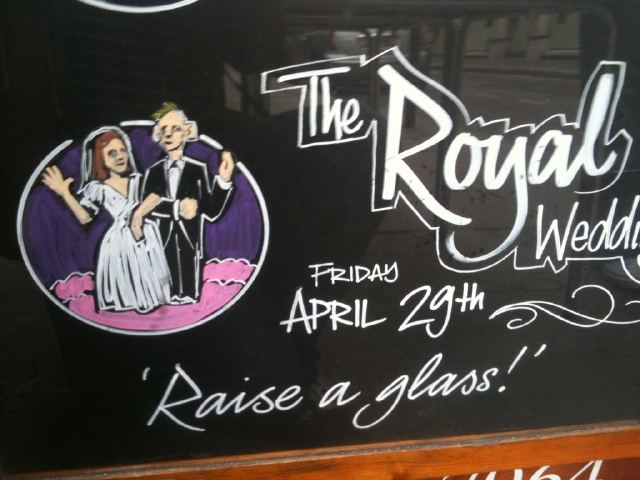
Terrible illustrations of the Royal Wedding outside London venues

Prince William as a zombie? Kate Middleton with a dislocated arm? Still, they’ve captured his receding headline and at least he has his father’s ears.

Check out Kate’s adams apple and Cruella De Vil grey streak.

I’m sure there are more out there. Enjoy the big day. I’ll be doing the gardening.

Marf: City Blues at the Guildhall Art Gallery

My review of Marf: City Blues, an exhibition at the Guildhall Art Gallery, appears in the Independent.

The Guildhall in the City is an appropriate venue for a series of cartoons about the financial crisis of 2008 and its aftermath. Marf is Canadian, but her cartoons are all set in London, and the Gherkin, St Paul’s and the tube all make appearances. The exhibition is on until June 20.

The Guildhall has recently become a free venue, which is slightly contrary to current trends, but the City of London has always done things a bit differently. It has a wonderful collection of London-related paintings, and is definitely worth a visit, and there are also plans to host regular paid-for temporary exhibitions. Marf, however, is free. The intention is that local workers, who are overwhelmingly from the financial services, will come to the gallery in their lunchtime to nose around.

I wonder what they will make of cartoons like the following when they do? Water off a duck’s back, probably.

Maps round-up

A quick post on maps. I have a small piece in the Independent about the Museum of London and Londonist’s forthcoming collaboration, Hand-Drawn London. This exhibition, opening on April 21, features maps drawn by Londoners.

I submitted a map drawn by four-year-old daughter of her daily walk to nursery, but it was harshly rejected. I have reproduced it here.

I have also been posting fairly regularly on maps at the Time Travel Explorer blog. Recent posts have included one on London’s first lido and another on London’s forgotten exhibition.

London’s seven statues of shame

When Mohamed ‘Al’ Fayed unveiled this extraordinary tribute to Michael Jackson at Craven Cottage, seasoned statue-watchers found themselves embroiled in a furious debate. Was this London’s worst statue?

Note: the statue is the one in the background

And then there are these: London’s statues of shame.

7. Peter The Great in Deptford
Because it is silly.


6 Queen Victoria at Buckingham Palace
Pompous and bloated.

5 Charles II at Soho Square
For its condition as much as its, er, execution. But even if this wasn’t horribly weathered, I reckon it would look a bit shit.

File:Statue of King Charles II in Soho Square.jpg

4 Oscar Wilde at Charing Cross
Disturbing. Like somebody tried to find the face of Jesus in a puddle of vomit.

3 Nelson Mandela at Parliament Square
I know, let’s imagine one of the great icons of the modern era, as if he was a THUNDERBIRDS PUPPET! The nearby statue of David Lloyd George’s cape is also appalling.


2. Horse’s head at Marble Arch
Stupid. Not to be confused with the almost as ridiculous Animals at War statue down the road on Park Lane.

1 The Meeting Place at St Pancras
Widely acclaimed as the worst statue in London, this monstrosity was brought to you by the same person responsible for the hideously smug Queen Mother statue on the Mall.

For a forensic analysis of this statue and its fauls, I point you towards Christopher Fowler‘s excellent critique of its numerous deficencies.

But the question remains: is Jacko worse than this?

Cult Of Beauty at the V&A

The V&A’s Cult of Beauty exhibition opened over the weeked. You can read my feature on the Aesthetic movement in the Independent on Sunday.

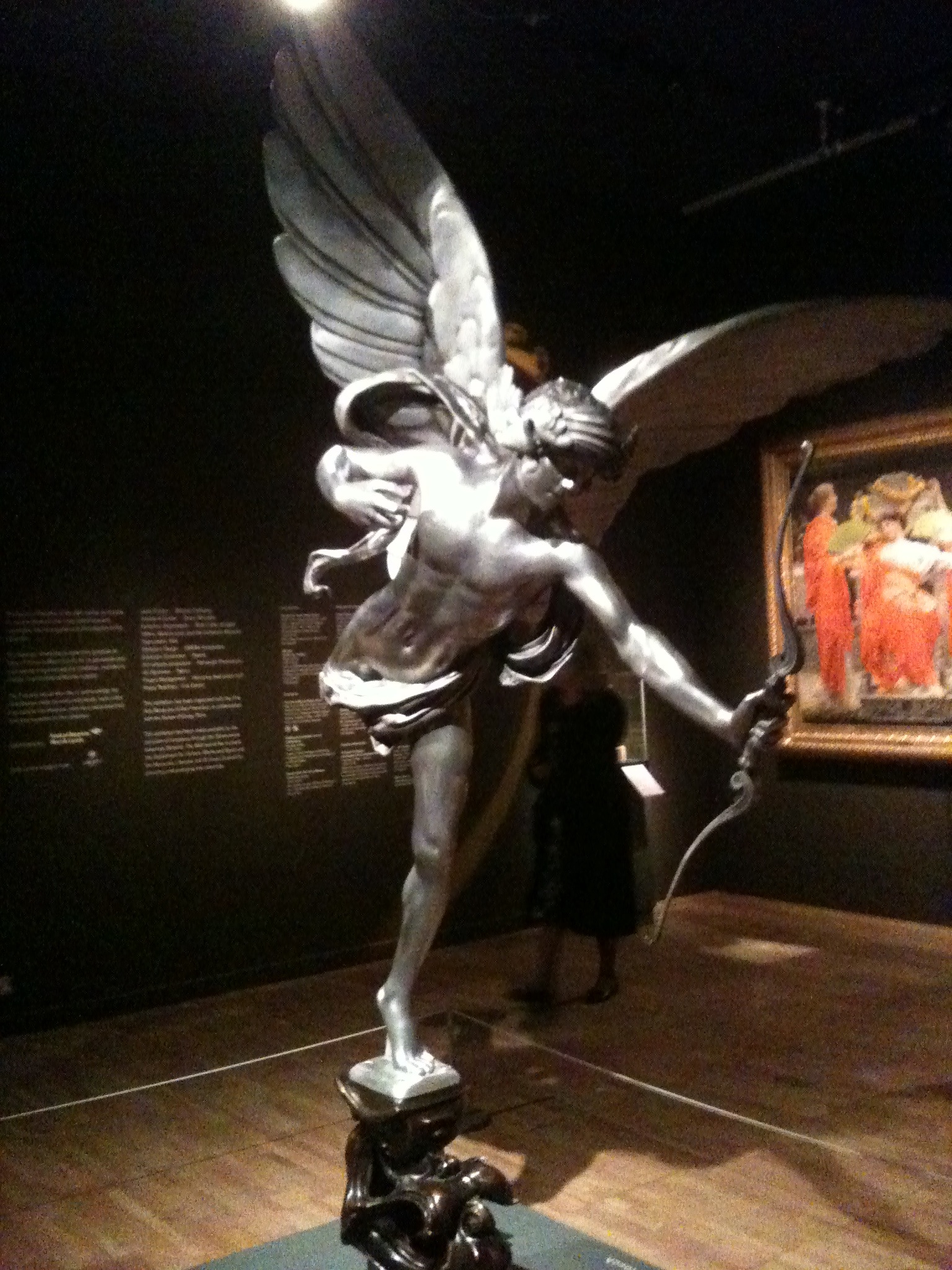
The highlight of the exhibition comes right at the end. Alfred Gilbert’s statue of Eros, or to be more precise Anteros, or to be even more precise, The Angel of Christian Charity, is easily overlooked in its usual home of Piccadilly Circus, located as it is in the second worst place in all of London. But lowered to eye level and removed of surrounding neon, tourists and traffic, it turns out to be a figure of real beauty, simultaneously delicate and robust, and gleaming in its shiny aluminium (this is a recent cast).

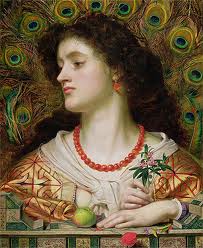
The rest of the exhibition is similarly eye-catching, as you wander round the gallery following what seems to be an endless procession of portraits of dark-haired, brown-eyed women painted between 1860 and 1900 by the Aesthetes. William Brown, the fictitious schoolboy and one of my chief inspirations, always admitted a soft spot for a certain kind of women: dark-haired, brown-eyed and dimpled. He was clearly inspired by the Aesthetes.

Midsummer

The Muppets in London

The Muppets have a long relationship with London. That’s partly because Jim Henson lived in Camden from 1977 and opened his workshop, the Jim Henson Creature Shop, in the area, filming many of the Henson films in London. A rather fantastic Muppets walk with all locations – including a Muppets bench on Hampstead Heath – can be found on the Camden website here.

Henson’s first workshop was at 1b Downshire Hill, NW3. It was initially used for the production of The Dark Crystal but remained in use from the late 1970s to 1990. It is said it had to be closed after neighbours complained about the strange smells coming from the factory, which reminds me of Charlie and the Chocolate Factory.

You can watch a (rather scratchy) tour of (I think) the second Creature Shop here.

I visited this second Creature  Shop in 2000 on the invitation of a model-maker who I met in a Camden pub. There was a definite magical/spooky Roald Dahl quality to the experience. This Creature Shop was located on Oval Road overlooking the canal, and was a huge mysterious building filled with puppets of all sizes. This is where the puppets for Animal Farm, 101 Dalmatians and The Muppet Christmas Carol were made.


The Creature Shop closed in 2005 and the building has since been demolished, but you can see London’s influence on the Muppets in a number of films. Here are five of my favourites.

1 ‘Maybe It’s Because I’m A Londoner’
This is from the time when Chris Langham was writing the Muppets. It’s an early, possibly rather clumsy, stab at celebrating London’s multiculturalism, and thus the sort of thing that would make Rod Liddle cry.

2 Burlington Bertie From Bow
A great version of one of the great London Music Hall songs, a repeated inspiration for Muppets songs.

3 The London Fog
Kermit reports from ‘London, England’ and interviews a cockney frog and a Beefeater.

4 The Muppets Christmas Carol
The superior Dickens adaptation is all London, obviously, but this first meeting with Michael Caine’s Scrooge sets the scene nicely. Plus: singing pigeons.

5 Wotcher (Knocked ‘Em In The Old Kent Road)
Another Music Hall classic, with Fozzie Bear dressed as a Pearly King (or possibly as an Old Compton Street stroller).

Celebrating the noble tradition of defacing London statues

It seems to happen every time a march or protest takes place in London. A much-loved statue or monument is defaced, horrifying the sort of people who are horrified by this sort of thing while the rest of us wonder why nobody’s got round to throwing a bucket of paint at that godawful Animals At War monstrosity on Park Lane.

On Saturday, after the TUC and some kids dressed in black marched through the London to complain about stuff, it was the turn for the Landseer lions at Trafalgar Square to take a pasting.

lion

While the statue of Charles I received a more artful reimagining.

statue

Interestingly, this Charles I statue had already been manhandled by the mob – albeit inadvertently – way back in 1867 when a reporter climbed the statue to get a better view of a passing protest and used the sword to steady himself. The sword promptly fell off and disappeared into the crowd, never to be seen again.

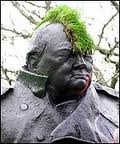
Most people think that this habit of deliberately defacing certain statues is a recent thing, dating back to the inarguably splendid Winston Churchill turf mohican on May Day 2000.

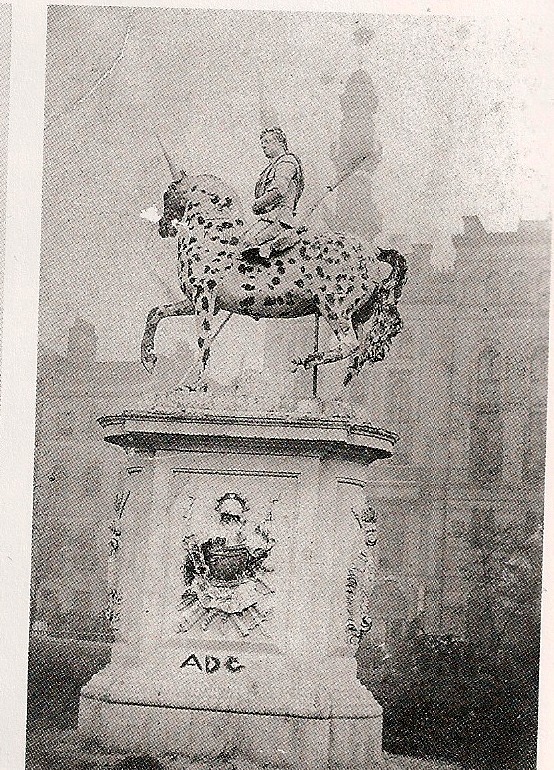
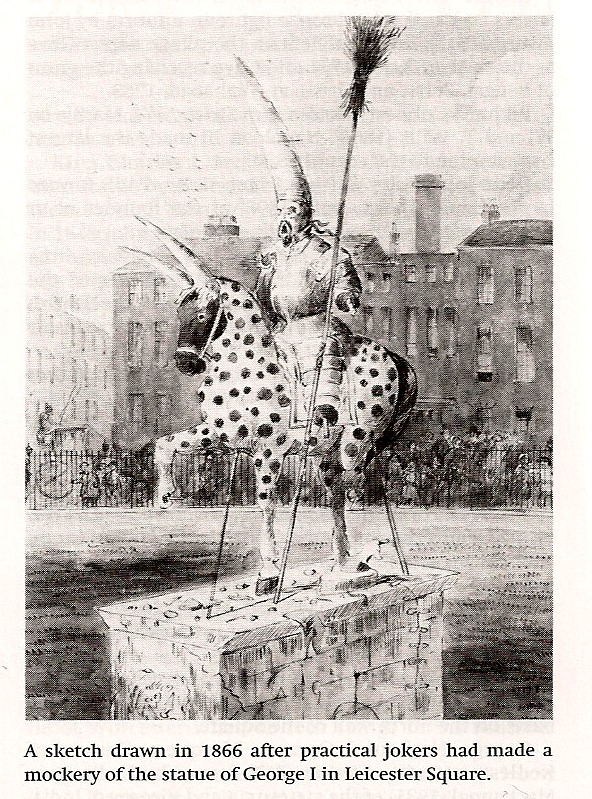
But the London mob has a rich tradition of dressing up (or down, depending on your viewpoint) London statues. My favourite example is the treatment dished out to the statue of a mounted George I, which was cast in 1716 and placed in Leicester Fields in 1784. This received serious punishment over the years as children clambered all over it, so both horse and rider lost bits, and at one point the poor king was without head, legs and arms. But worse was to come.

In October 1866, after the state of the statue had been discussed in the Times, guerilla jokers attacked the statue at night, painting black spots all over the horse, replacing the lance with a broomstick and putting a dunce’s hat from the nearby Alhambra Theatre on George’s bonce. Crowds flocked to see the spectacle. It was cleaned up, but eventually sold for £16 and pulled down in 1872.

As British History online website comments: ‘It would be almost impossible to tell all the pranks that were played upon this ill-starred monument, and how Punch and his comic contemporaries made fun of it, whilst the more serious organs waxed indignant as they dilated on the unmerited insults to which it was subjected.’

Nothing changes, once again.

London Street Photography at Museum of London

My review of the Museum of London’s excellent London Street Photography exhibition appears in the Independent today.

Street photography – the snatched and unposed glimpse of everyday life – is a fascinating genre even if it is never quite as authentic as it appears. Many of the strongest images in the exhibition reminded me of those Victorian journalists who investigated the slums of working-class London life in the 1880s and 1890s, reporting back in horror on what they found to their middle-class readers.

Thanks to these pioneeers, we now have evocative visual records of London life. My favourite were probably the images Roger Mayne took in the late 1950s to record the streets in West London that were scheduled to be demolished and replaced by Trellick Tower. A book of Mayne’s photographs has just been republished and can be purchased at the Museum of London bookshop, along with the excellent accompanying book for the exhibition.