Category Archives: Architecture

London’s strangest race: meeting the Tube Challenge

‘s

It’s probably London’s strangest race. The Tube Challenge first took place in 1959 and since then hundreds of people have attempted to visit each of London’s 270 tube stations on the same day – it’s very competitive and they even have their own forum. I recently interviewed Andi James, who currently holds the world record with his running partner, Steve Wilson, to ask him how about being a Tube Challenger.

Andi James, Tube Challenge champion

‘The Tube Challenge is visiting all 270 stations by Tube. If you are on a train, you don’t have to physically step on to the platform just pass through the station, and you can use buses or run between stations if you wish. The first official record was set in 1959. I don’t know anything about the guy who did it first but the master was Bob Robinson who got the record eight times over a period of 21 years.

I heard about it in 2007 and have been doing it ever since. I’ve done it about 46 times now. My winning time [held with Steve Wilson] is 16 hours 29 minutes and 13 seconds and that’s stood since 2011. I do it because I enjoy it. I find it gratifying when you’ve worked it all out on paper and then find it works in reality. I have a route in mind that can knock 40 minutes off my best time, but that would require everything to go perfectly – 20 minutes is certainly possible. Things always go a bit wrong, on my record run there was a 20-minute delay but we got lucky with a few bits here and there. I’m winding down though. I’m getting a little old for it. I’m quite fit and you need to be pretty fit to do some of the runs. I’m 37 and can keep up with 16-year-olds but not for much longer.

If you are going to do it, it needs to be when all the lines are running – that’s Monday to Friday – you need to have a good route and you need there to be no delays. There are some places that are difficult like Kensington Olympia, where there are only nine trains a day, which you have to take into account. You have to be fit as some of the runs are very long so prepare for a lot of pain. Research your door positions because you don’t want to get off at the wrong end and waste five minutes fighting through hundreds of people. I know door positions for every platform in London. There’s also an app for it, created by another Tube Challenger.

The first time I did the challenge, I spent about three weeks calculating all the exchanges and another week physically researching the different runs. The longest is between High Barnet and Cockfosters, 2.4 miles. Some people take the bus, but I know I can run it in 20 minutes. I can definitely improve on my winning route, but so can a lot of other people. There are about 100 people trying each year, and whenever I see people running at Finchley Central to Mill Hill East I know they are either on the Tube Challenge or they are really, really desperate to go to Mill Hill East.’

The last bus to London Bridge

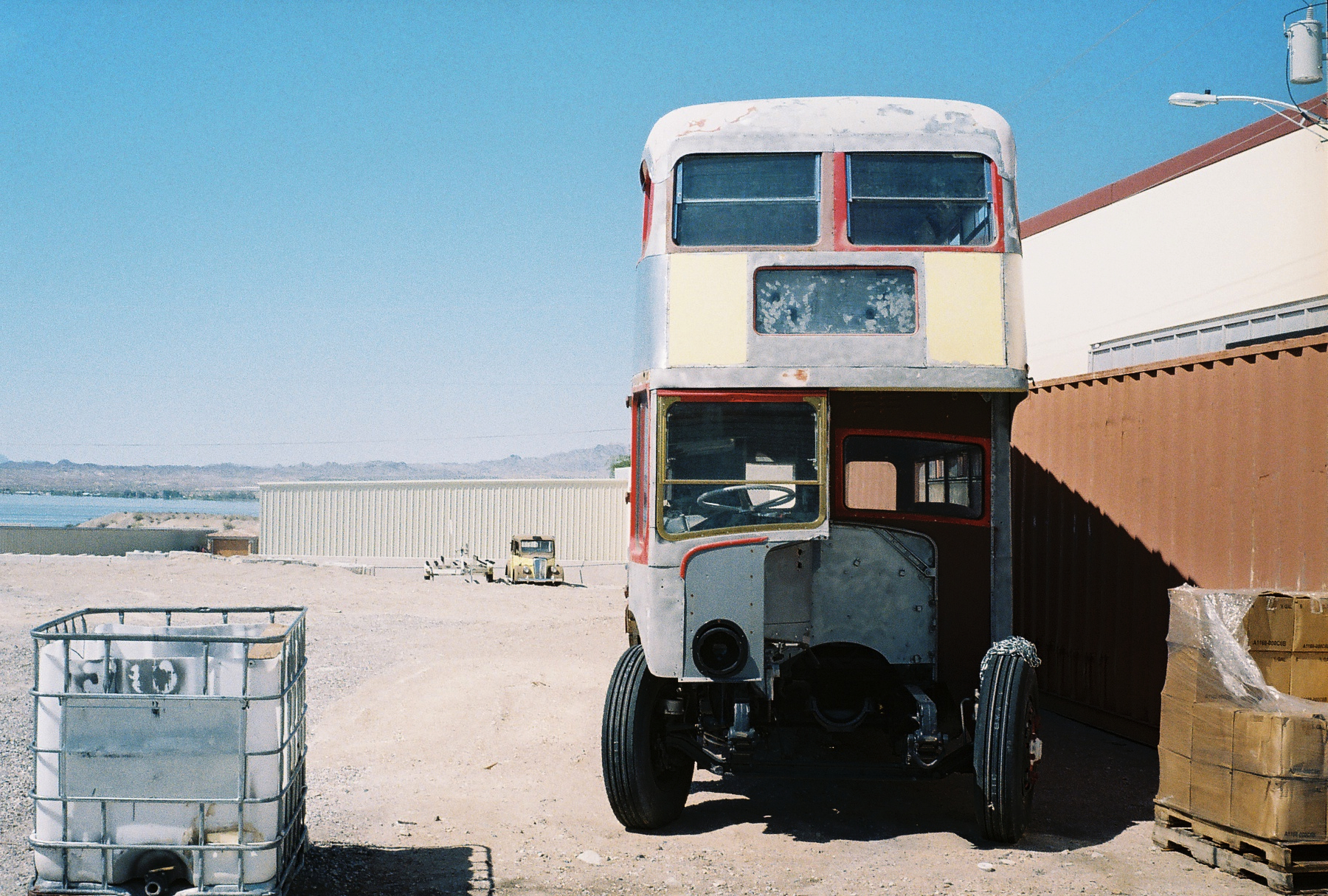
In the previous post, I linked to The Special London Bridge Special from 1972, which features Tom Jones travelling on a No 13 bus to Lake Havasu City, Arizona, where London Bridge had just been sold. Incredibly, that bus is still in Arizona but it isn’t in quite the same condition as the bridge.

BUS-CABINDISTANCE-COLOUR

Thanks to Travis Elborough for the picture. Travis – who has just published London Bridge In America: The Tall Story of A Translantic Crossing – also pointed me in the direction of this marvellous song by Cilla Black, lamenting love and the loss of London Bridge.

The Special London Bridge Special

This sensational slice of ham and song was made in 1972 to celebrate the purchase of London Bridge by an American theme park. It features a bizarre cast that includes Tom Jones, Rudolf Nureyev, The Carpenters, Kirk Douglas, Charlton Heston and Terry-Thomas and is basically the film the Olympic opening ceremony could have been.

It’s all here, but watch the intro especially, featuring Tom Jones singing his way round various London landmarks before engaging in a small slice of double entendre on a No 13 bus.

Inside London’s super-prime houses

I wrote this article in 2011 for Gulf Life about London’s super-prime property market.

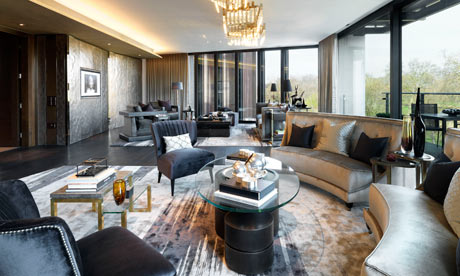
They call it super-prime. That’s the end of the London property market that starts at £15 million and goes as high as £150 million. It’s a market that operates in isolation from the rest of London and it’s one that is dominated by an international clientele, with buyers jetting in from the booming economies of the Far East, Russia and the Middle East. So what do they get for their bucks?

‘Buyers at this end of the market all have five demands,’ says Giles Hannah, who oversees the European operation of Christie’s Great Estates, the property branch of the venerable auction house, ‘security, space, parking, location and luxury features.’ Christie’s is currently selling a mansion on Cornwall Terrace, a dramatic John Nash-designed sweeping terrace overlooking Regent’s Park. It boasts six bedrooms, a home cinema, gym, steam room, study, state-of-the-art kitchen, mews house for staff, garage with blast-proof doors and majestic views of a royal park. Floors are covered by Italian marble, dark oak or silk carpet, there’s a chill room for furs and the walls are covered with paintings by Picasso and Damien Hirst on loan from the auction house. It’s yours for around £30 million.

‘This property was bought and developed in 2008,’ explains Hannah. ‘There are eight on the terrace and they are being released house by house into the market. London remains a key place to buy and although it’s been a difficult market since 2008, there are enough international buyers around. There are 1,100 billionaires in the world, all capable of purchasing a £30m house in any climate.’

The address they all want is Knightsbridge, which partly explains the prices fetched at One Hyde Park, a development by Christian and Nick Candy. One Hyde Park is a gleaming Richard Rogers-designed tower of luxury that sits almost above Knightsbridge tube, with Hyde Park on one side and Harvey Nichols on the other. A penthouse is said to have sold for more than £100 million and, according to Savills, the selling agent, 60 per cent of the 86 apartments have been snapped up.

A five-bedroom apartment costs upwards of £50m and takes up an entire floor – around 10,000 square feet. The hallway stretches the length of the flat from master bedroom to reception room, one end overlooking the park, the other Knightsbridge. To give an idea of the scale, a baby grand piano in the corner of the living room looks like a coffee table. Off the corridor are a further four bedrooms, two reception rooms, a TV room, study, dining room and two kitchens (one for staff). The building contains a squash court, 22-metre pool, games room, party room and meeting room.

‘You don’t need to leave the development,’ says Ned Baring, Associate Director of Savills. ‘You can live, work and play here. What makes this different to other complexes is that we have 50 dedicated staff at the Mandarin Hotel next door who can provide any service you need, from setting up a dinner party to doing your dry-cleaning. It’s like living in the best hotel in the world, but with your own private residences.’

The Candy brothers have invested a fortune in One Hyde Park – how much, nobody will say– banking on continued high demand for super-prime London property. ‘In the morning you can speak to Asia and in the afternoon you can speak to New York,’ says Baring. ‘There aren’t many cities where you can do that. You might not be here 365 days, but you need to be here.’

Hannah says much the same, ‘Your average Christie’s client will be ultra-high worth and may use this property just a couple of times a year. They’ll also have a place in the south of France, one in New York and a chalet in Courchevel.’

If the ostentation of One Hyde Park doesn’t appeal, a short stroll away – but crucially, still in Knightsbridge – you’ll find the discreet charm of Ovington Square, a classic London garden square located between South Kensington, and Chelsea. ‘This part of Knightsbridge is very popular with Middle Eastern buyers, especially from Qatar, Lebanon, Syria and the UAE,’ says Noel De Keyzer of Savills. ‘They like traditional houses, and will come in the summer to avoid the heat at home.’

The house, refurbished in 2008, was recently rented by a Lebanese family (another renter was Bill Gates), but is now on the market for just under £20 million. The selling point is the vast two-floor pre-war extension taking up the entire back garden, itself the size of a normal house. This holds the reception room and master bedroom. The five-bedroom house also has a sub-basement beneath the lower-ground-floor kitchen, containing a gym and steam room.

‘This end of the market stayed very strong in 2008,’ says De Keyzer. ‘But in 2009, it was dead. People weren’t buying. It picked up again in March 2010, helped by weak sterling.’ The problem now is one of supply. ‘There will be an acute shortage of properties in 2011,’ says De Keyzer. ‘A lot of vendors don’t think they’ll realise their expectation because the super-prime market is still 10 per cent below its peak in 2008. You are dealing with very affluent people who have no need to sell in an uncertain market, and if they’re selling to buy somewhere else, they have nowhere to go.’

There are, according to Hannah, only three developments ready for the super-prime market: Cornwall Terrace, One Hyde Park and The Lancasters. The latter is a fascinating project on the north side of Hyde Park in Bayswater. A regal Victorian terrace has been transformed. The old building behind the gorgeous Grade II-listed facade has been knocked down and replaced by an impressive new complex of 77 apartments, retaining the original front with its huge windows and exceptional views of Hyde Park.

‘These buildings were built in the same style and grandeur as Belgravia,’ says Mark Cherry of Minerva, joint developers with Northacre. ‘It was a high-profile wealthy area and is now going through a revival. Some people will only buy Mayfair and Knightsbridge, but others will want better lifestyle and better buildings, so they will come here. We’re offering a high-level of service for people that expect high service, with three concierges on site at all time. I spoke to somebody who was moving from a mansion block and they said they want to be in a building where the pipes don’t rattle and they don’t have to rely on a single elderly grumpy porter. People want classic British houses with American-style service.’

The surprising thing about all four properties is how similar they are. All are decorated in dark masculine colours. All have Gaggenau kitchens and Crestron systems to control sound, security and lighting. None have gardens. All have flat-screen TVs in the walls of every room. The houses have lifts – ‘Middle Eastern clients don’t like using the stairs,’ says Hannah – while the apartments encourage ‘lateral’ living. There are separate bedrooms and entrances for staff–at The Lancasters and One Hyde Park, some clients also purchase a separate apartment for staff. All have serious security, and all have space. Lots of space. The most breathtaking is One Hyde Park, the best views are from The Lancasters and Cornwall Terrace and the most charming is Ovington Square.

The properties can even be sold fully furnished. ‘The keyword is “turnkey”,’ says De Keyzer. ‘International clients are busy and want to move in straightaway with their suitcases.’ That’s not to say they’ll rush to make the purchase. ‘They’ll look at everything available,’ says Hannah. ‘They like to have choice. This isn’t a financial purchase, it’s a personal one.’

The super-prime market is very lucrative for estate agents. ‘It’s competitive, but in the £10 million-plus range Savills and Knight Frank have more than 50 % of the market between us,’ says De Keyzer. ‘That’s because we are international companies with very good contacts. Our fees are 2.5% for sole agency and 3% joint agency but it’s negotiable. We can afford low fees because our values are higher and we have a large turnover of properties. In London the average house is sold every five years, but on the continent people hold on to property for generations.’

That could be about to change. ‘Over the last few years, the lack of property has become apparent,’ says Hannah. ‘The best properties have been bought by international clients and they won’t be traded for many years. People who purchase a premier address will keep it as an asset for a while.’

Because of this, Hannah anticipates good times lie ahead. ‘London is London, arguably the centre of the world and a major financial hub,’ he says. ‘Clients need to be here, they want to be here, they understand the tax implications and they have good accountants. We’re expecting 30% growth over the next three years.’

Cherry agrees. ‘The market at this level is strengthening. Because people want certain key locations, the market can never be saturated, there are listings, conservation areas, it takes ages to get planning permissions and there are strict limits on tall buildings – it’s a very good market to be in.’ If you can afford it, obviously.

Image

Lambeth Surrealism

pix 006

Secret London: inside a cabmen’s shelter

File:London taxi shelter.jpg

This piece was published in Time Out in March 2006.

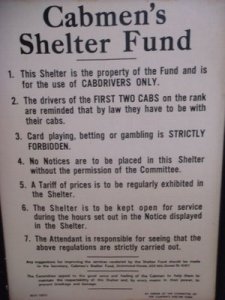
You must have noticed them: jolly green garden sheds that squad in odd spots of London like displaced emerald Tardises, steam coming out the windows and queues of black cabs lining the streets outside. These are London’s few remaining cabmen’s shelters – 13 in all, for 23,000 drivers – places where cabbies can gather to enjoy tea and sympathy away from the hopeful eyes and raised arms of the stranded, late and lazy who make up their regular custom. The Russell Square shelter is the domain of Maureen, 52, who runs a tight ship, keeping an eye on regulars like Ken (‘Say I’m 21’) and Malcolm (‘I’ve been a cabbie for 37 years. That’s all you need to know’).

‘These places are very interesting to the outsider,’ I say, by way of introduction.

‘They’re even more interesting when you’re on the inside,’ Malcolm replies.

He and Ken come in every day, more or less, to swap tales of fares and roadworks, grumble about Ken Livingstone, talk football, and have something to drink and a bite to eat. They’re keeping alive a long tradition. The Cabman’s Shelter Fund was created by Sir George Armstrong, a newspaper publisher who get fed up waiting for cabs in the rain when drivers had decamped to the nearest pub. He started a fund to supply drivers with a place to get out of the cold and enjoy a cheap meal without straying from the cab stand. The first shelter, erected in 1875, was located on the stand nearest his house (in Oxford). Because the shelters stood on a public highway, the police stipulated they weren’t allowed to be any larger than a horse and cart. At their peak, there were more than 60 in London. Although meant for cabbies, the public could also pop in. Ernest Shackleton was said to frequent the Hyde Park Corner shelter, while the Piccadilly one was nicknamed the ‘Junior Turf Club’ by bright young things, who smuggled in champagne despite the strict teetotal licensing regulations.

Their number declined after WWII as they fell victim to bombs and road-widening schemes, but for a time where a notable feature of London life. HG Wells wrote about ‘the little group of cabmen and loafers that collects around the cabmen’s shelter at Haverstock Hill’, while PG Wodehouse went into greater detail in ‘The Intrusion of Jimmy’ in 1910.

‘Just beyond the gate of Hyde Park… stands a cabmen’s shelter. Conversation and emotion had made Lord Dreever thirsty. He suggested coffee as a suitable conclusion to the night’s revels…. The shelter was nearly full when they opened the door. It was very warm inside. A cabman gets so much fresh air in the exercise of his duties that he is apt to avoid it in private life. The air was heavy with conflicting scents. Fried onions seemed to have the best of the struggle, though plug tobacco competed strongly. A keenly analytical nose might also have detected steak and coffee.’

Food, warmth and companionship are the key. As WJ Gordon wrote in 1893’s The Horse World of London: ‘The cabman is not so much a large drinker as a large eater. At one shelter lately the great feature was boiled rabbit and pickled pork at two o’clock in the morning, and for weeks a small warren of Ostenders was consumed nightly.’

The menu doesn’t stretch to rabbit now, with cabbies preferring tucker that is more in keeping with what a tired cabbie needs, and prices to match. Tea and coffee are 50p. Hot food starts at a quid.

Maureen We do soup, sarnies, fry-ups, curries, jackets… I know what everybody wants. I know everybody who comes in, what he eats and what he don’t eat. Malcolm here had boiled eggs with cucumber in rolls. Except Wednesday. He has baked beans on toast on Wednesday. Ken, he don’t eat nothing. He has a cup of tea.

Time Out You don’t eat here?

Ken No! And I haven’t been in hospital either. Look at the pictures: there’s three up there, four, five, six. All dead. And they used to eat in here.

Malcolm That’s why we’ve got the sign up there: ‘God’s waiting room.’

TO It’s for older cabbies then?

Ken No, anyone can use it. We have one young lad comes in – how old’s Gary, Maur?

Maureen Forty-four. Some of the other shelters are very cliquey – no, I won’t tell you which. If a stranger comes in, they’ll say, ‘You can’t sit there, it’s so-and-so’s seat.’ But we’re not like that.

Malcolm We just check ’em straight out.

Maureen No, we’re friendly here.

TO There’s lots of Arsenal flags, do you have to be an Arsenal fan?

Ken We get a lot of Arsenal, unfortunately.

Malcolm The Tottenham fans get in and out early.

Ken We let the Arsenal in here ‘cos they’re not allowed in the other shelters.

Maureen This one’s been going since 1901. It used to be in Leicester Square, but moved up here.

Ken That was in 1960-something. When I started cabbing in 1967, it was in Leicester Square. I reckon it moved in around 1969.

Malcolm They’re not all the same size.

Maureen They’re similar, but some are longer or wider. They never used to look like this inside though. They used to have seating all round the sides and a big square heater in the middle. People would bring their own food to cook, but there was no kitchen – it was really for keeping warm. Now it’s more like a caravan, with a kitchen at one end and tables at the other.

TO I read they were originally built to keep cabbies out of pubs.

Ken Well, that didn’t work did it?

TO Can non-cabbies come in here?

Ken Builders come in sometimes and have a cup of tea, but if it gets crowded they have it away and let the drivers in.

Malcolm Cabbies get priority. 

TO Who owns this one?

Maureen I rent it off the Trust Fund. I pay the rent and the bills out of what I make. It’s all right in the summer, but in winter it gets very cold. Once you start letting people in, it’s okay, and in the summer we have all the doors open or sit outside. We get heat from the ovens as well.

Ken That’s why they have us two come in here before the rest, to warm it up.

TO What are your opening hours?

Ken That’s a sore point.

Malcolm When she wakes up.

Maureen These are the only two who come in at this time, so I open for them.

Ken We’re up early – we go out at 4.30 or 5am. The others don’t start till seven or eight, so they don’t want a cup of tea or a sandwich until about 12 but we get hungry before. I eat elsewhere. I ate here once and was laid up for two years.

TO When do you close?

Maureen About half-five. We get some people sitting here all day.

Malcolm We get a lot of people that put their head round the door looking for cabs or information.

Maureen There’s a bloke from Holland who’s fascinated with black cabs. He comes over now and then to talk. We get people all the time. Who’s that bloke off the radio who talks and talks?

Ken Robert Elms

Maureen Yeah, he’s been in here.

Ken And what’s-his-name, Ricky Gervais, he’s always walking past, says hello. Angela Rippon popped here head in the other day.

Maureen And then there’s that bleeding Madonna. She came in to try and get a cab.

TO Do you get any women cabbies?

Maureen Yeah, we’ve got Marion. But they don’t seem to stay – they have one look and go straight out again. We’ve too many nutters. We’ve Mad Bob, Cockhead, the Village Idiot…

Ken We’re all different in here and we’ve all got our stories.

Malcolm We come in to keep track of who is alive and who is dead.

Maureen You’d be surprised how many we can fit inside. It holds ten or 12 sitting but for Christmas dinner we have 30 or 40 standing inside.

Ken We get slung out, me and Malcolm. It’s better anyway  – if anybody’s going to get a turkey with bird flu, it’s Maureen.

Maureen doesn’t rise to the bait. She’s used to it. And, as it has every day for more than 100 years, the hut fills with the smell of fried onions. The cabbies start to file in for lunch, and I have it away to let them grumble, joke and eat in peace.
A brief history of Covent Garden

There are many reasons to cherish Covent Garden, not least of which is that it exists at all. The area nearly didn’t make it past 1973, when it was scheduled for ‘redevelopment’ after the fruit and veg market moved out. The GLC drew up enthusiastic plans to replace 96 historic acres with a conference centre and lots of roads. The plan was defeated by locals who believed Covent Garden could have a different sort of future, one that didn’t involve hundreds of buildings being demolished and everything getting covered in asphalt. They were eventually proved right, although nobody anticipated that Covent Garden would turn into the upmarket open-air shopping mall it has since become.

Inigo Jones might have approved of its current status, though. It was he who built an elegant Piazza on an old abbey garden in 1630, transplanting a piece of Italy to the centre of London and unwittingly creating that definitively London piece of architecture, the residential square. The area grew in significance after the Great Fire destroyed much of the City, but then decline set it. We may now see Covent Garden as the place where Eliza Doolittle met Henry Higgins, a halfway house between the posh Englishness of Mayfair and louche Frenchness of Soho, but the place got pretty debauched in the 18th century, a hive of taverns, theatres and coffee shops, all haunts for prostitutes like Peg The Seaman’s Wife, Long-Haired Mrs Spencer of Spitalfields and the delightful Fair Rosamund Sugarcunt.

The area’s drift in tone came as the market expanded and the gentry who occupied the Piazza decamped to the newer squares of Berkeley, Grosvenor and St James’s. At around the same time, Charles II reintroduced theatre to the UK, and companies gradually moved from the nearby Inns of Court into Covent Garden by way of Drury Lane. Theatres brought rowdy audiences and actresses who doubled as bawds, and were a magnet for lowlife figures. In 1722, there were 22 gambling dens, countless brothels (one pimp published an annual guide to London’s prostitutes called Harris’s List of Covent Garden Ladies) and street brawls were commonplace. In 1951, HV Morton argued that Covent Garden provided ‘the most accessible glimpse that remains to us of Hogarth’s London’, but post-war Britain offered nothing quite as depraved as the third plate from Hogarth’s Rake’s Progress, set in Covent Garden’s infamous Rose Tavern. Hogarth depicted the Rose as a den of sin, full of drunks, thieves and whores. The tavern specialised in women who engaged in flagellation, both giving and receiving. Pepys was a regular, although he only seems to mention the food, for which it was also famous.

Given such carnage, it is little surprise that in 1754 Henry Fielding would organise the Bow Street Runners, the progenitors of the Met, from Covent Garden, and the area slowly improved from a hotbed of crime into a straightforward slum. Throughout, the market remained central – Charles Fowler’s fine market building was erected in the 1830s and the Flower Market arrived in 1870 – so it was easy to believe that when that moved to Nine Elms, Covent Garden would wither and die.

Amazingly, though, Covent Garden survived. That is largely due to its fringe attractions, which expanded to fill the vacuum left by the market. Theatre was key – opera was now a decidedly upmarket pursuit – but by the 1980s the area also boasted decent restaurants and, on Neal Street, trendy shops like Red Or Dead and Duffer Of St George. Credit must go to Nicholas Saunders, who opened a wholefood shop in Neal’s Yard in 1976. His alternative empire slowly spread to other buildings, creating a colourful corner of the counterculture in the heart of Covent Garden even as anti-hippie punks gathered round the corner, in the Roxy on Neal Street. Neal’s Yard still has an idiosyncratic flavour – the blue plaque to ‘film-maker’ Monty Python seems well placed (Palin and co had offices here).

What Neal’s Yard illustrates is the way that amid the ubiquitous stage doors, posh shops and cobbled streets, the different parts of Covent Garden retain an individual imprint, from the bookshops of Charing Cross Road to the boutiques of Floral Street, where Paul Smith still has a rickety presence. Seven Dials is one of London’s more interesting shopping areas, while the Piazza has been transformed from a ragged craft market into a chi-chi mall. The idea is to attract Londoners as well as tourists, and the Piazza has certainly smartened up, with the central market a mecca for shoppers, serenaded by opera singers and overlooked by a fancy Apple store in one corner and refurbished London Transport Museum in another.


Covent Garden is a patchwork then, more diverse than superficially similar areas like Soho and Spitalfields and still boasting enough fascinating nooks and crannies to keep even the most experienced Londoner busy for hours, even if Hogarth and Fair Rosamund Sugarcunt might no longer recognise the streets they once adored. 


150 years of the London Underground

To mark the 150th anniversary of the London Underground, here is a piece I wrote for Time Out in 2007.

It was, on the face of it, a stupid idea. Running trains, and steam trains at that, in tunnels underneath the London streets. In 1862, the Times described it as an ‘insult to common sense’ and it was probably right. But the London Underground turned out to be one of the great engineering feats of modern times, the world’s only steam-driven underground railway and the first electrified underground railway. A socially egalitarian and liberating phenomenon, it helped drive London’s rapid expansion and got people to work on time, while providing the city with a bold new identity through impeccable branding that incorporated iconic typography, cartography and architecture.

And yet… And yet…

It’s fair to say that the Underground remains unloved by Londoners, and it would take a more dishonest contrarian than I to defend the grime, the delays, the heat, the way it’s so busy and unreliable and the fact that, year after year, we are asked to pay more for a service that doesn’t seem to be getting any better, cleaner, quicker or cooler. But that’s a fault of management and decades of underinvestment, not of a system that remains something Londoners should treasure as remarkable, groundbreaking and emphatically ours.

The story began with Charles Pearson, the first in a succession of underground visionaries. It was he who first proposed the notion of ‘trains in drains’ in 1845, when the railway was a relatively new invention (the first steam passenger service only opened in 1830). Pearson, instrumental in the removal of the anti-Catholic inscription on the foot of the Monument, was a progressive and a pioneer – his persistence helped persuade the House of Commons to approve a bill in 1853 to build a subterranean railway between Paddington and Farringdon.

The reason such a hare-brained, experimental scheme received approval was one of necessity. London roads were suffering from terrible overcrowding and the mainline railways all stopped on the fringes of the West End and City thanks to a Royal Commission of 1846 that declared central London a no-go area for railway companies. A method of linking the mainline stations of Paddington, Euston and King’s Cross was needed, and Pearson’s plan fitted the bill. He helped raise the finance from private investors and the City of London, and excavation began in 1860, with a shallow trench dug beneath Euston Road and then covered over. Thousands of poor residents were displaced in the process.

The Metropolitan Line opened for business on January 10 1863, clocking 30,000 passengers on the first day. A celebratory banquet had been held the previous day at Farringdon. Pearson was not among the guests, having passed away the previous year. Another absentee was Prime Minister Lord Palmerston, who was approaching his 80th birthday, and said he wanted to spend as much time above ground as he possibly could (he died two years later).

The Metropolitan was a success, with 11.8 million passengers (the population of London was about 3.2 million) braving the foul, smoke-filled conditions in its first year. The Metropolitan’s owners claimed the ‘invigorating’ atmosphere ‘provided a sort of health resort for people who suffered from asthma’, but they also allowed drivers to grow beards in a futile bid to filter out the worst of the fumes. A civil servant who had spent time in Sudan said the smell reminded him of a ‘crocodile’s breath’. One attempt to improve conditions saw smoking banned, until an MP objected and insisted that all railways provided a smoking carriage. Smoking was not banned again on the trains until 1985, and at stations until after the King’s Cross fire of 1987, itself the culmination of 30 years of neglect.

Among those to benefit most from the new railway were the lowest-paid workers, who were entitled to use a special, cheap pre-6am train. Social journalist Henry Mayhew interviewed some such passengers in 1865, first explaining that ‘this subterranean method of locomotion had always struck us as being the most thoroughly Cockney element of all within the wide range of Cocaigne’. The labourers he spoke to all voiced their enthusiasm for a service that allowed poorer Londoners to live further out, sparing them a six-mile walk to work and allowing their families to live in two rooms rather than one. As the Metropolitan expanded westwards, it opened up new areas for Londoners to move to, and the overcrowded city d slowly started to expand – one of the reasons that London still has such a relatively low population density. When Hammersmith received its first station in 1864 it was still a village ‘best known for spinach and strawberries’, writes Christian Wolmar in his definitive ‘The Subterranean Railway’ (2004), but it soon became a major interchange. This pattern was repeated throughout the Underground’s history. When the Northern Line hit Morden in 1926, it was a village of 1,000 inhabitants; five years later, its population was 12,600.

The success of the Metropolitan led to the building of the District Line along the Victoria Embankment, and then the creation of a Circle Line to link the two. Unfortunately, the two east-west lines were run by rivals, James Forbes and Edward Watkin, whose perpetual bickering meant the Circle took twenty years to complete. When it was finished in 1884, Watkins’ Met operated trains that ran clockwise, while Forbes’ District controlled those in the other direction; such was the antagonism between the two, the companies refused to sell tickets for their rival line, meaning a passenger might end up paying for 20 stops rather than seven. When the Circle was finally electrified in 1905 the companies used different systems which proved incompatible, resulting in a further three-month delay. Because the Underground was built haphazardly by private investment and with no central planning, there were many such inconsistencies. Some destinations had more than one station, built by competing interests, which explains why there is such a poor interchange at Hammersmith between the Hammersmith & City and District Lines, and why Oxford Circus has two different surface stations on either side of Argyll Street. This is also why there are so many ghost stations on the network – about 40 – built without adequate knowledge of whether they were actually needed.

The completion of the Circle Line marked the last of the sub-surface lines, built by the simple, cut-and-cover method. Advances in tunnelling and the use of electrified rails now allowed for the building of deep-level lines that gave birth to the phrase ‘tube’ and allowed London’s network to really connect the dots beneath the capital. The first was the cramped City & South London line from City to the Elephant & Castle, later incorporated into the Northern Line, which was opened in 1890 by the future king Edward VII. This was followed by the Waterloo & City, Central, Bakerloo, Piccadilly and Charing Cross, Euston and Hampstead (now the Charing Cross branch of the Northern), all before 1907.

This splurge of lines occurred within a narrow window of opportunity after the invention of suitable tunnelling technology and before the appearance of the motorised bus. It was aided by gullible investors (who never quite received the returns they were promised), public demand and London’s favourable geological conditions – the capital’s clay being an ideal substance through which to tunnel.

Several of these lines were built by American financier Charles Tyson Yerkes, who also controlled the District and was the first person to attempt to realise a unified vision of London’s chaotic underground network. A property speculator with a questionable reputation (he served time in prison in Philadelphia for embezzlement) Yerkes put together numerous complex financial schemes to get his lines built, often using capital from the States, but never got the chance to cash in on his success, dying in 1905.

Yerkes left an extraordinary legacy. While lines such as City & South London never proved popular with the public – something that had much to do with the fact that the trains, or ‘padded cells’, were built without windows because the manufacturers figured there was nothing to see down there – his Central Line was a hit. This was largely because, like the Metropolitan half a century before, it served major transport routes, relieving strain on crowded streets above. There were drawbacks – the line followed the road pattern because the tunnellers didn’t want to pay compensation to surface landowners, so there were unnecessary kinks – but the Central Line was a groundbreaking service, attracting 100,000 passengers daily. For a start, it only had one class of travel, and one price, hence the nickname the d d Twopenny Tube. It also had some innovative engineering aspects (each station was built atop a slight incline, meaning trains naturally slowed when entering stations and sped up when leaving, while the flat face of the train pushing air in front of it provided much-need ventilation) and carriages were considerably plusher than on the City & South London. Yerkes’ desire for a unified service also led to the introduction of what can be seen as the first attempt at branding on the tube – the Leslie Green-designed distinctive dried-blood-coloured tiles of the surface stations – something pursued by the man who followed.

Frank Pick began working for Yerkes’ Underground Electric Railway Limited (UERL), which owned all the underground lines other than the Metropolitan and the Waterloo & City, in 1906. Over the next 30 years, in partnership with Lord Ashfield, general manager of UERL and future chairman of London Transport, he helped make the tube the ‘most famous and respected transport system in the world’. Historian Nikolaus Pevsner believes Pick’s accomplishments to be greater still: in 1942 he described him as ‘the greatest patron of the arts whom this century has so far produced in England and indeed the ideal patron of our age’. He is certainly one of the few transport gurus to have met Stalin, Hitler and Churchill.

Pick’s reputation was based on his eye for design. He introduced the roundel, borrowed from the London General Omnibus Company, but made famous by the tube; he asked calligrapher Edward Johnston to design the tube’s unique font; commissioned beautiful posters by Man Ray, Graham Sutherland and Edward Nash; introduced each line’s distinctive patterned seat-covers or moquettes; appointed architect Charles Holden to design modernist stations, most famously at Arnos Grove; and in 1931 he paid Harry Beck five guineas to come up with a new kind of map that would simplify the most complicated transport system in the world. All the while, the tube continued to spread east, west, north and even – occasionally – south, and was by 1934 carrying 410 million passengers a year. Pick can be said to be as responsible for the image London projects around the world as Christopher Wren, George Gilbert Scott or Norman Foster. Even today, Transport for London is well aware of the value of the brand, and jealously guards icons such as the roundel and Beck’s map from even the most loving of imitators.

Pick’s definition of the tube did not end there. In tandem with Lord Ashfield, he also arranged the integration of London’s various transport systems in 1933 under the umbrella London Transport, ensuring that an underground network that had hitherto been privately funded and unprofitable became publicly supported, thanks in part to Leader of London County Council (and Peter Mandelson’s grandfather) Herbert Morrison.

Finance has always been the failing of the tube, largely because, as Wolmar astutely points out, the early railwaymen ‘were building a fantastic resource for Londoners whose value could never be adequately reflected through the fare box which was their only source of income’. This was as true in the days of private entrepreneur and public ownership as it is with today’s uncomfortable mish-mash, the great experiment of the Public Private Partnership. All too briefly London Transport papered over this failing through a combination of Ashfield and Pick’s acumen and the fact that, following the depression, there was greater confidence in public ownership, and more skill in the manner with which it was executed. But this was soon diluted with World War II (in which the tube played its own valuable role), after which, rebuilding the country took precedence.

Which, more or less, is where we are today. The tube has acquired only two new lines since Yerkes’ frenzy: the Victoria, which took 20 years from planning to opening in 1968, and the Jubilee, hewn in part from the Bakerloo Line and extended magnificently in 2000. Years of under-investment have taken their toll, and the system looks haggard and worn. Recent years have seen some improvement, but the cost to users has soared. Even the ongoing improvements leave the system, temporarily at least, worse off – with stations closed for months and entire lines closed weekend after weekend, reinforcing the public’s lack of sympathy for this ancient marvel.

So it’s no wonder that we look upon the city’s mighty works and despair. But perhaps we should, every now and then at least, reflect on what the city would be like if the tube had never existed, be thankful for the visionaries of the past, and hopeful that their legacy will once more receive the attention and adulation it deserves.

Une saison en Camden: Rimbaud and Verlaine in Victorian London

I am an ephemeral and a not too discontented citizen of a metropolis considered modern because all known taste has been avoided in the furnishings and the exterior of the houses as well as in the plan of the city. Here you would fail to detect the least trace of any monument to superstition.

Arthur Rimbaud on London in Illuminations

Getting a face full of wet fish is usually associated with Monty Python at Teddington Lock rather than French poets in North London, but such is the warping power of Camden Town. Arthur Rimbaud and Paul Verlaine were the Gallic rhymers in question. The pair enjoyed a tempestuous relationship in a variety of London addresses, which culminated in the aforementioned fish-slapping incident in Camden.

rimbverl

They had arrived in London in September 1872 after fleeing scandal in Paris. Rimbaud was 17, Verlaine ten years older, married with a child. Verlaine’s brother-in-law described Rimbaud as ‘a vile, vicious, disgusting little schoolboy’, but Verlaine found him an ‘exquisite creature’ probably for much the same reasons. At first they settled in Howland Street in Fitzrovia. They became part of Soho’s expat anarchist dissident set, reportedly attending meetings helmed by Karl Marx in Old Compton Street, drinking heavily, taking hash and opium (Rimbaud advocated ‘derangement of all the senses’) and keeping warm at the British Museum, where Rimbaud’s name  – but not Verlaine’s – was later added to the Reading Room roll of honour. Neither were particularly politically motivated, but the anti-establishment environment would undoubtedly have appealed to the outlaw couple.

Drawing by Verlaine of Rimbaud in Canon Street

They both loved London. Rimbaud felt that by comparison Paris looked like nothing more than a ‘pretty provincial town’ and loved the ‘interminable docks’, while Verlaine was captivated by the ‘incessant railways on splendid cast iron bridges’ and the ‘brutal, loud-mouthed people in the streets’. Together they travelled on the river, visited Hampstead Heath and rode the newly opened underground railway. They visited Hyde Park Corner, Madame Tussaud’s, the National Gallery and the Tower Subway (‘It stinks, it’s hot and it quivers like a suspension bridge, while all the while you hear the sound of the enormous volume of water,’ they reported back).

They wrote as well. Parts of Rimbaud’s Illuminations and Une Saison en Enfer were written in London, and his relationship with Verlaine is recorded in the latter’s lines: ‘On several nights, his demon seized me, we rolled around together, I wrestled with him!—At nights, often, drunk, he lies in wait in the streets or in the houses, to frighten me half to death… In the hovels where we used to get drunk, he would weep at the sight of those around us, miserable beasts…’ Verlaine was also influenced by the hectic modernity of the docks, and wrote a poem about Regent’s Canal.

Their sojourn in Fitzrovia was briefly commemorated with a plaque written in French and erected in 1922, although it only mentioned Verlaine – Rimbaud’s name was omitted on grounds of morality. Unfortunately, the street numbers had changed by this time, so the plaque on No 34 was almost certainly commemorating the wrong house. These defects were solved in 1938 by simple means – the house was demolished. It’s said the plaque was saved from destruction, but if so it has long since been lost.

There is a plaque for their next house however, left by ‘unknown hand’ according to Simon Callow. This is on their residence at 8 Great (now Royal) College Street, which they moved to in May 1873, living in two rooms on the top floor for three months. Here the pair’s self-destructive instincts really blossomed. They argued relentlessly, and often fought physically. This reached its nadir one July morning when Verlaine returned from Camden market carrying fresh fish and olive oil. It was a hot day and Verlaine had a hangover, but Rimbaud, watching from an upstairs window, was unsympathetic. He laughed and bellowed, ‘Ce que tu as l’air con!’ (‘What a cunt you look!’). Verlaine responded with a kipper in the face (hurt, he later wrote to a friend rather pathetically,  ‘I retaliated, because, I can assure you, I definitely did not look ridiculous’), packed his bags and fled to Brussels. Rimbaud eventually followed, only to receive two bullets in his wrist for his troubles.

Verlaine was sentenced to two years in prison, which he spent in part reading Une Saison en Enfer, and that was pretty much the end of that relationship. Rimbaud returned to London in 1874, living at Stamford Street, SE1 with the poet Germain Nouveau and later taking a room at No 12 Argyll Square in 1875. He then disappeared for four months – biographers still speculate about whether he was in Scotland, Scarborough or Reading. He barely wrote another word and died, one-legged, in 1891. Verlaine also returned to England, teaching in Boston and Bournemouth, before returning to Paris where he succumbed to alcoholism and died in 1896. Camden can do that.

Photo by Dornac of Paul Verlaine in the Café François 1er in Paris on May 28, 1892

HG Wells, My White Bicycle and hygienic seats: a brief history of cycling in London

This piece is in the current issue of BMI Voyager. The photo of Herne Hill Velodrome is via Adrian Fitch

It’s unlikely that any of the world’s top cyclists will be thinking about London’s history with the bike when they set off from the Mall for the gruelling 250km Olympic road race on Saturday (July 28th), but if they do pause for thought, they’re starting from the right place. The route will take cyclists through Putney, Richmond and Hampton Court deep into the scenic Surrey countryside of Woking and round Box Hill, but it starts and finishes near Hyde Park, which is where cycling in the UK first really took off.

Cycling had premiered in Battersea Park in the 1880s, but it was in Hyde Park that the great Victorian cycling craze went overground in the 1890s. London was still a horse-happy city at the time, so when 2,000 cyclists – mainly women, dressed demurely with natty bonnets– formed a parade to cycle round the park in the spring of 1896, those on horseback didn’t know quite what to make of it. Bicycles were still a new thing. Penny-Farthings had been around for a while, but were about as common a sight in Victorian London as they are now, and it took the invention of the ‘safety bicycle’ – one with wheels the same size and pneumatic tyres – in the 1880s for that to change. Indeed, such was the enthusiasm with which women took up cycling, that Victorians were torn between trying to find ways to make money out of it, and trying to ensure it was morally appropriate. With typical Victorian ingenuity, they managed to do both – the Chaperon Cyclists’ Association supplied female escorts for solo women cyclists for 3s 6d an hour, while to avoid any dangerous friction you could purchase special ‘hygienic’ bike seats, which had a modest dip in the area where a lady’s genitalia would usually meet the saddle.

Hygienic seat or not, this was, almost without exception, a hobby enjoyed by the upper classes – the Lady Cyclists Association of 1895 was founded by the Countess of Malmesbury – and the Olympic road race aptly passes through some of the poshest areas of London, along the luxury-lined Knightsbridge and down through the smart streets of Chelsea to Putney Bridge. In 1896, the Countess wrote wittily in The Badminton Magazine about the dangers of cycling around these very Belgravia streets thanks toa new sport’ devised by Hansom Cab driver: ‘chasing the lady who rides her bicycle in the streets of the metropolis’ excited by the ‘petticoat which “half conceals, yet half reveals”… I cannot help feeling that cycling in the streets would be nicer, to use a mild expression, if he’d not try to kill me.’

It wasn’t until 1934 that a solution to this perennial problem arrived, when the UK’s first bike lane was opened not far from where the road race course makes its progress through West London. This specialist cycle lane stretched for two-and-a-half miles alongside the Western Avenue and was a belated response to the scarcely believable statistics that recorded 1,324 deaths of cyclists on British roads the previous year. Despite these awful figures, cycling groups opposed the innovation, arguing bikes should not be forced to give up their place on the road to the new-fangled motor car. It’s not an argument they were ever likely to win.

Roads will be close to traffic on July 28, however, and as the Olympic cyclists make their way towards the river, they will pass Kensington Olympia, the huge exhibition hall built in 1883 and used for all manner of spectacular entertainment –promoters would think nothing of flooding the arena to recreate Venice In London, for instance. Anything fashionable was fair game and cycling races were held here during the 1890s. A mixed-tandem race – one male rider and one female – attracted huge crowds in January 1896. Weird events like this were common at the time –the Crystal Palace in Norwood hosted a bicycle polo international in 1901 between Ireland and England (Ireland won 10-5).

After crossing Putney Bridge, the race continues through Putney, where one of London’s many Victorian velodromes was once located, drawing crowds of 10,000. Putney also featured in one of the first cycling novels, The Wheels of Chance, by HG Wells, a writer who always had an eye for a new invention. In it, the hero, Mr Hoopdriver, leaves his dull job in Putney to go on a cycling holiday on the South Coast following a route out of London very similar to the one that will be taken by the Olympic racers. The race later passes through Woking, where Wells lived and set part of War Of The Worlds – Woking has boasted a huge statue of a tripod since 1998.

From Putney, the cyclists whizz through lovely Richmond – mind the deer! – before hitting the river at Twickenham, where they pass Eel Pie Island, nexus of London’s mid-1960s rock ‘n’ roll revolution. Numerous legendary bands played shows at the charismatic old dancehall on this tiny island in the Thames, including the Rolling Stones, the Yardbirds, Eric Clapton, Jeff Beck and Rod Stewart. Among them was Tomorrow, one of England’s first psychedelic bands (featuring Steve Howe, later of prog-monsters Yes), whose 1967 single “My White Bicycle” was a big counterculture hit in 1966. This splendid slice of trippy frippery was written in homage to the pro-cycling scheme launch by Dutch anarchist collective Provo, who left 50 unlocked white bicycles all over their home city of Amsterdam in 1965, inviting the public to enjoy ‘free communal transport’ and rid themselves from the tyranny of the automobile. The Dutch police swiftly impounded the offending bikes, but the idea finally caught on in recent years in the form of the Paris bike-sharing scheme, Vélib. This idea was appropriated by London in 2010 and came to be christened Boris Bikes after London’s mayor, Boris Johnson, who inherited the scheme from his predecessor Ken Livingstone.

Boris Bikes can be hired by anybody with a chip and pin card at around 500 docking stations in central London. The bikes come without helmet or lock and are pretty hefty, but they are a fairly common sight in London. Although there is an ‘access fee’ (£5 for a week), the first 30-minutes of any ride are free, so smart users hop between docking stations and effectively ride around London for next to nothing. It’s all part of a belated attempt to make London a more-bike friendly city – four giant bike lanes, the blue-painted Cycle Superhighways, have alsobeen created in key commuter routes, with four more planned for 2013. If you want to borrow a Boris Bike to follow the 2012 road race route be careful, as there are few docking stations outside central London and costs soon mount if you go over the initial 30 minutes – while the fines for a late return are high.

From Twickenham, the race heads through Bushy Park and passes the Tudor palace of Hampton Court, before disappearing into the Surrey countryside. After a tour of the Surrey hills, the cyclists will then make the return journey, via Kingston, to the Mall. Sadly, then, there is no time to head to south-east London, where there are a couple of other prime London cycling landmarks. The first is the Herne Hill Velodrome, tucked behind suburban houses down a quiet street near Dulwich. This is the last stadia from the 1948 London Olympics still in use today. Built in 1891, the velodrome had all but closed during the Second World War but was brought out of retirement when London was awarded the 1948 games. It’s had a few scares since then – the gorgeous Victorian grandstand has been a no-go area for years – but was recently awarded £400,000 of Olympic legacy money and plans are afoot to construct a new grandstand, cafe and gym. The venue has played its part in nurturing the latest breed of British champion – Tour de France winner Bradley Wiggins raced here.

Herne Hill Velodrome

While Herne Hill lives on, the velodrome at Catford was demolished in the 1990s. Like the stadia at Putney and Herne Hill, this was built in the 1890s, when it attracted a very special guest. Absinthe-soaked dwarf artist Henri de Toulouse-Lautrec is usually associated with the Montmartre area of Paris, but in 1896 he turned up in the particularly drab suburb of Catford. Lautrec was a cycling fan, and had been asked by a company called Simpson to design a poster for their bike, which used a new type of chain. Lautrec was taken to the newly built Catford Velodrome to watch the bike in action during special races, set up by Simpson to advertise their product, and he produced a couple of images during his visit. The poster was one of the last he designed before his death in 1901, just as the Victorian bike craze was coming to an end.