Category Archives: Architecture

Up In Smoke

Up In Smoke: The Failed Dreams Of Battersea Power Station has a release date of April 26.

You can find out more at this website, which also tells you how to get in touch if you want me to do any talks or events.

UpInSmoke

Expect me to be writing about this a lot more in the next few weeks.

Secret London: South London’s lost canals

I wrote this piece in 2015 for the first issue of Waterfront magazine.

Some of the best secrets are hidden in plain sight. You don’t find them by exploring scruffy back streets and muddy fields, they are standing right in front of you, requiring only a translator to make sense of them. One sits in Burgess Park in Camberwell, ignored by cyclists, dogwalkers and joggers seeking respite from the Walworth Road, one of South London’s busiest byways. It takes the form of a pretty black-and-red iron footbridge with thick brick stanchions and strong stone steps straddling the path. It doesn’t serve any specific function – there’s nothing that needs to be crossed – so is known locally as the “bridge to nowhere”, but this was once a bridge with a purpose. It was built in 1906 to cross the Grand Surrey Canal, one of south-east London’s two lost canals. The park was once a busy industrial basin of wharves and warehouses but over time, the canal was abandoned, closed, filled in and forgotten. Soon, only the bridge remained, a relic or totem of this land’s previous life.

IMG00120-20120814-1050

Like many canals, the Grand Surrey was opened in the brief period between the onset of urban industrialisation and the arrival of railways. It began at Surrey Commercial Dock (now Surrey Quays), a 300-acre system of nine docks two miles east of London Bridge. The original plan was for the Surrey Canal Company to cut a canal from this starting point at Rotherhithe through the south London suburbs. From the main canal, branches would peel off, feeding significant towns on the way south. The object was to create a fast-moving route that could bring produce from Surrey farms into London. An Act was granted in 1801 to build as far as Mitcham, with branches to Deptford, Peckham, Borough and Vauxhall.

At the same time, permission for a second canal was granted. The Croydon Canal was originally going to be its own entity but the Grand Surrey Canal provided a convenient meeting point, and – after some negotiation – the two navigations joined at New Cross. This canal was intended to reach Epsom, but when it opened in 1809 in a ceremony featuring decorated barges, a 21-gun salute and a special song (“Long down its fair stream may the rich vessel glide; and the Croydon Canal be of England the pride”) it stalled at Croydon, having passed through 28 locks from the junction with the Grand Surrey Canal through Honor Oak, Sydenham and Norwood. Nonetheless, it was described by The Times as “one of the highest and best constructed canals in England” and the owners talked about extending it to Portsmouth. Plans for the Grand Surrey also proved over-ambitious, and when it opened in 1807 it went only as far as the Old Kent Road. It reached Camberwell in 1809 and branched off to Peckham in 1826, but got no further.

dooswharf

There are several bucolic illustrations of both canals, presenting them as splendid streams surrounded by countryside. At the opening of the Croydon Canal, a reporter wrote of “finding themselves gliding through the deepest recesses of the forest, where nothing met the eye but the elegant winding of the clear and still canal, and its border adorned by a profusion of trees, of which the beauty was heightened by the tint of autumn.” In 1811, the Grand Surrey Canal was peaceful enough to be used for bathing, causing one Camberwell resident to write a furious letter to The Times objecting to the “indecency” and “extreme offensiveness to females in so public a situation”. Soon after, ‘bank rangers’ – a sort of private police force – were appointed to keep an eye out for lewd or criminal behaviour.

Quickly, though, the landscape changed. Submitted to parliament alongside the proposals for the two canals, was another for the Surrey Iron Railway, which would become the country’s first public railway in 1803, linking Wandsworth to Croydon via Mitcham. Using carriages pulled by horses over iron tracks, the intention was to create an integrated transport network for the expanding suburbs, but ultimately it put the two technologies in direct competition. At first, they cohabited and connected, and the canal even proved superior, but as steam trains arrived, the canals lost any edge. Croydon Canal’s success was further hindered by its expensive, time-consuming locks and the company could tell where things were headed. The canal was dead by 1836, the first in the country to be closed by parliament. The land was purchased by the London And Croydon Railway, who built their line largely alongside the old canal and turned the basin into West Croydon station.

The Grand Surrey Canal was spared such a fate, even if it was to never fulfil the bravura plans made at the outset. Initially the canal was intended to transport numerous goods – the 1801 Act set out rates for freestone, limestone, chalk, bricks, slates, tiles, corn, hay, straw, faggots, dung, manure, stones, clay, cattle, calves, sheep, swine, lime, timber, hemp, tin, bark, iron-stone, pig-iron, pig-lead, coal, charcoal, coke, culm, flour, wheat, barley, oats, beans, peas, malt, potatoes, hops and fruit – but instead of becoming a vibrant link between garden suburbs and London docks, the canal was more like a gigantic wharf, an extension of the Surrey docks lined by warehouses, factories, yards and depots. The canal nonetheless became a useful part of the industrial infrastructure, drawing cargo from all over the world – including a 4ft snake from South America that was fished out the canal at Peckham in 1932 by an angler who at first believed he’d nabbed a particularly fine eel. The industry was largely dirty and unglamorous with numerous timber yards, but there were also R White’s, manufacturers of lemonade, and Edison-Bell, who made 78rpm records and had a recording studio on the premises.

After the Second World War, decline set in. The increase in road traffic offered tougher competition even than rail, while changes in freight transportation threatened the docks themselves. The canal closed in stages from the 1940s. The basin at Camberwell was first to be abandoned, becoming a playground for children, who went fishing for sticklebacks or tore doors off bombed-out houses to sail down the stagnant canal as rafts. Children determined their local sympathies by which side of the bridge they lived.

The bridge was still surrounded by the straggling detritus of light industry, but fears that children would drown – indeed, The Times reported more than a dozen had met this fate since the war, as several had before it – led to the area being cleared in 1974 and replaced by Burgess Park. The canal’s route was turned into a pathway and the bridge retained as a momento. There are further princely bridges on the Peckham arm of the canal, at Willowbrook Road and Commercial Way, while the Peckham basin is now the site of Peckham library. Nearby, a sliver of park connecting Burgess Park to Peckham High Street is known as the Surrey Linear Canal Park, presumably to confuse new arrivals. Elsewhere, there are further pointers: bits of wall, ghosts of towpaths, mooring rings, milestones, and in a park reclaimed from the old Russia Dock in Surrey Quays, a large amount of quayside.

One of the most interesting survivors is a rusting round bollard under a bridge near the junction of the Surrey Canal Road and Mercury Way in New Cross, once the meeting point of the Grand Surrey and Croydon Canals. Embedded in the grassy embankment, it looks as if it has been dropped from the heavens. Little of the Croydon Canal remains, although diligent historians have traced shadows of its passage in the topology of the land between New Cross and Croydon. Some tiny sections are extant in Dacres Wood, a small nature reserve in Forest Hill, and Betts Park in Anerley. The old reservoir in Norwood has been transformed into South Norwood Lake.

There is a strong sense here of what might have been. The Croydon Canal’s life was too brief, and too quickly swallowed by the dramatic forces leading to the rapid urbanisation of south London, to be saved, but the fate of the Great Surrey Canal is not so easily forgivable. Its potential was not unknown. In the 1960s, trip boats from Little Venice would take extended tours across the Thames into the depths of Peckham and Camberwell, and even in the 1970s, some insisted the canal should be saved. One report in 1971 noted the increasingly popularity of the Regent’s Canal and pondered whether similar could yet happen to “the poor, ugly Surrey Canal… [which] had the misfortune to run south of the river.” The author admitted there was an image problem: “Its waters are polluted and filled with rubbish and hunks of wood. Its banks are closed to the public and lined with disused factories and unkempt grass. To many local people it is just three miles of stinking water, which has to be dredged every time a child goes missing.” But should the drastic solution of eradication proposed by Southwark and the Port Of London Authority go unchallenged? “Suggest any redevelopment of Little Venice and fashionable owner-occupiers besiege the local town hall,” he wrote. “Down south of the river, however, they apparently order matters differently. Two public authorities have quietly decided between them to scrub off the map one of South London’s most precious potential assets.” And so disappeared the Grand Surrey Canal, not so much a lost secret as a missed opportunity.

Further reading: http://www.bridgetonowhere.friendsofburgesspark.org.uk/ and http://www.londoncanals.uk/

Power station problems

While writing my forthcoming book about Battersea Power Station, I often wondered why nobody had done so before.

The reason, I decided, was that as the various redevelopment projects were never completed, it was a very difficult tale to bring to a close. However, with the latest scheme being backed by serious money and as the buildings around the power station started to rise, it seemed as if the end was finally in sight.

I felt safe.

Too safe…

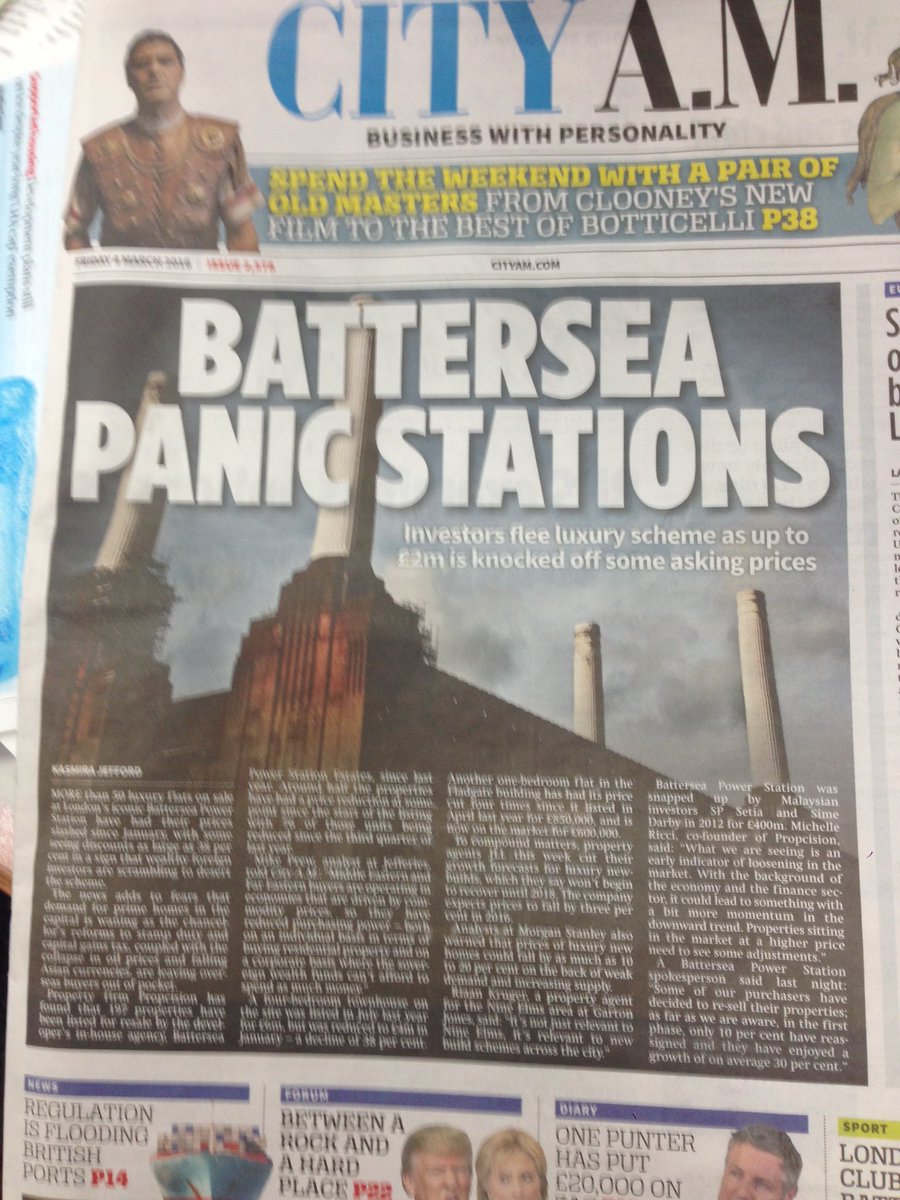
Today a report in City AM confirming what many have been saying for months – that the heat is coming out of the Nine Elms luxury property market, forcing developers to slash prices in a bid to retain the overseas investors on which so many hopes are pinned.

I was told a couple of times that this might happen, most notably when the chief executive of one previous development pointed out that the intensity of development on the Battersea site – not to mention elsewhere in the Nine Elms area, where thousands of similar flats are being built – meant that the Malaysian developers would be effectively competing against themselves on price. Unless it was managed carefully, and if the market ever dipped, there could be problems.

And so it has come to pass.

While those Londoners who decry the over-development of the power station may be excused at being amused by the problems being experienced by the developers, this is bad news for the building itself which is still far from secure: a hollow, roofless shell that is currently lacking three chimneys.

Wandsworth, who have presided over one of the most disastrous redevelopment projects in London for more than 30 years, had allowed the developers to build so many flats in advance of restoration so the developers could flog them to raise capital to pay to fix the power station. If those flats don’t sell, there is a danger that the power station will be left in a worse state than ever.

In these circumstances, demolition would be a serious possibility.

While we should be concerned, I don’t think it’s quite time to panic. The appeal of the Malaysian developers is that they are effectively being bankrolled by the Malaysian state in the shape of the country’s pension fund, which should mean pockets are deep enough to sustain these fluctuations in the property market.

But it does show that nothing is certain when it comes to the story of Battersea Power Station, except uncertainty.

Up In Smoke: The Failed Dreams of Battersea Power Station

I’ve written a book about Battersea Power Station.

It’s called Up In Smoke: The Failed Dreams Of Battersea Power Station and is out in the spring via Paradise Road, a new publisher concentrating on London non-fiction.

Battersea Power Station is one of London’s favourite buildings, but nobody before has told its story.

This will be the first book to explore the history of the building, from conception and construction, through use and obsolescence, and then into the long years of post-closure redevelopment.

I wanted to understand why so many people have been fascinated by Battersea over the years. I’ve spoken to former workers and designers of inflatable pigs, location scouts and photographers, politicians, Lords, architects, planners and entrepreneurs.

This is a book that tells us so much about London and the way it changes. It’s a story of power and land, of big ideas and broken dreams. It’s a story that takes in property and politics, architecture and popular culture. It’s a story about our city and our relationship with its most popular building.

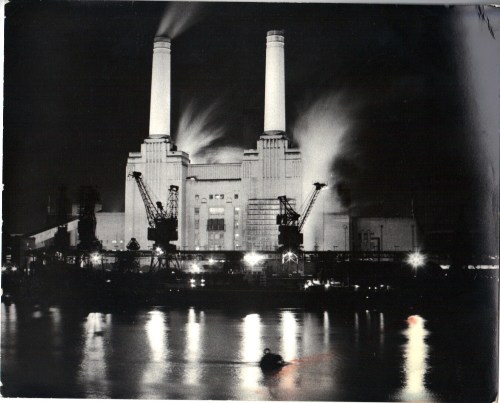
It asks how we went from this…

19-09-2014 104101

Battersea Power Station, 1975.

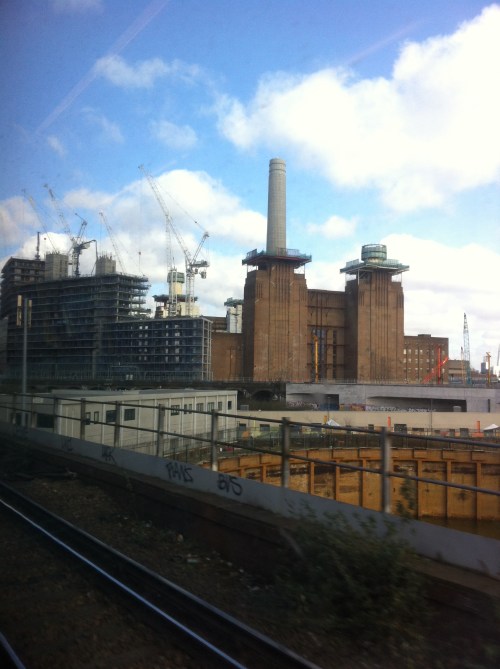
To this…

IMG_5309

Battersea Power Station, 2016

It’s all glass here now – the taming of St Giles and death of the West End

I have a piece in today’s Guardian about the disappearing London district of St Giles, for centuries a hive of villainy and low entertainment but which is now, finally, being aggressively domesticated by developers with no love of vernacular architecture or fun.

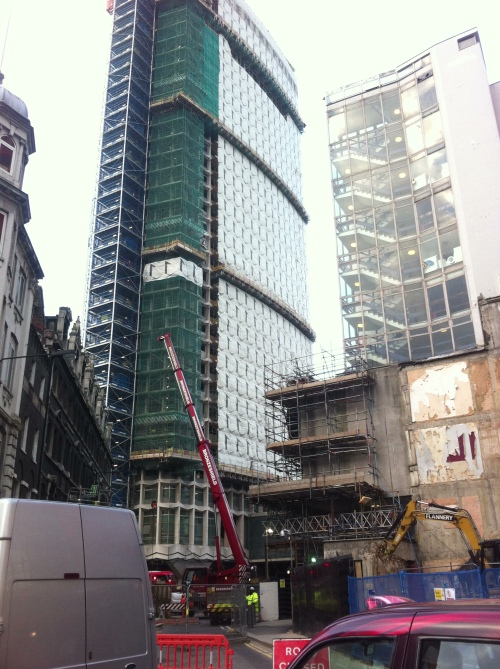
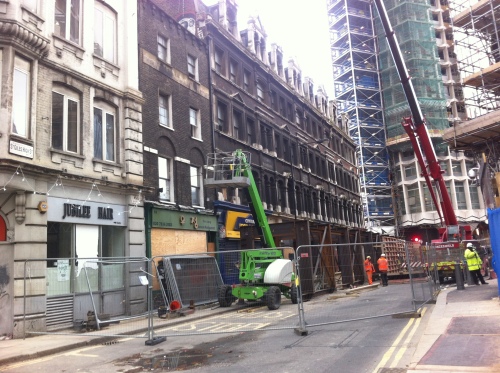
Last year, while walking round this junction of Tottenham Court Road, Charing Cross Road and Oxford Street, I was assailed by pneumatic drills, wrecking balls and nostalgia. This used to be my territory, where I’d play after working at Time Out on Tottenham Court Road, and now much of it was unrecognisable. The cafes, bars, restaurants and clubs that I’d known so well were gone. But this wasn’t simply a case of the passage of time and changing fashion causing old haunts close down – that I could accept, more or less. Here the buildings themselves had been pulled apart so nothing new or interesting could take their place.

Even Time Out‘s old office had been demolished, developers deciding that rather do any actual developing and modernise the entirely usable existing structure, it was easier to knock it down and start again. This was happening over and over, wherever I looked. It was like armaggedon, a building site several miles square, pouring concrete over memories and salting fertile ground.

With this wholesale demolition, the character of an entire area was being irrevocably and deliberately erased. People have been saying the West End was dead for decades, but in the borderland of St Giles something of the old  Soho and Covent Garden still lingered. Now, it’s gone. If it’s fun you want, give Zone One a skip. It’s all glass here now.

IMG_4940 IMG_4929 IMG_4932 IMG_4938 IMG_4932 IMG_4927 IMG_4925 IMG_4923


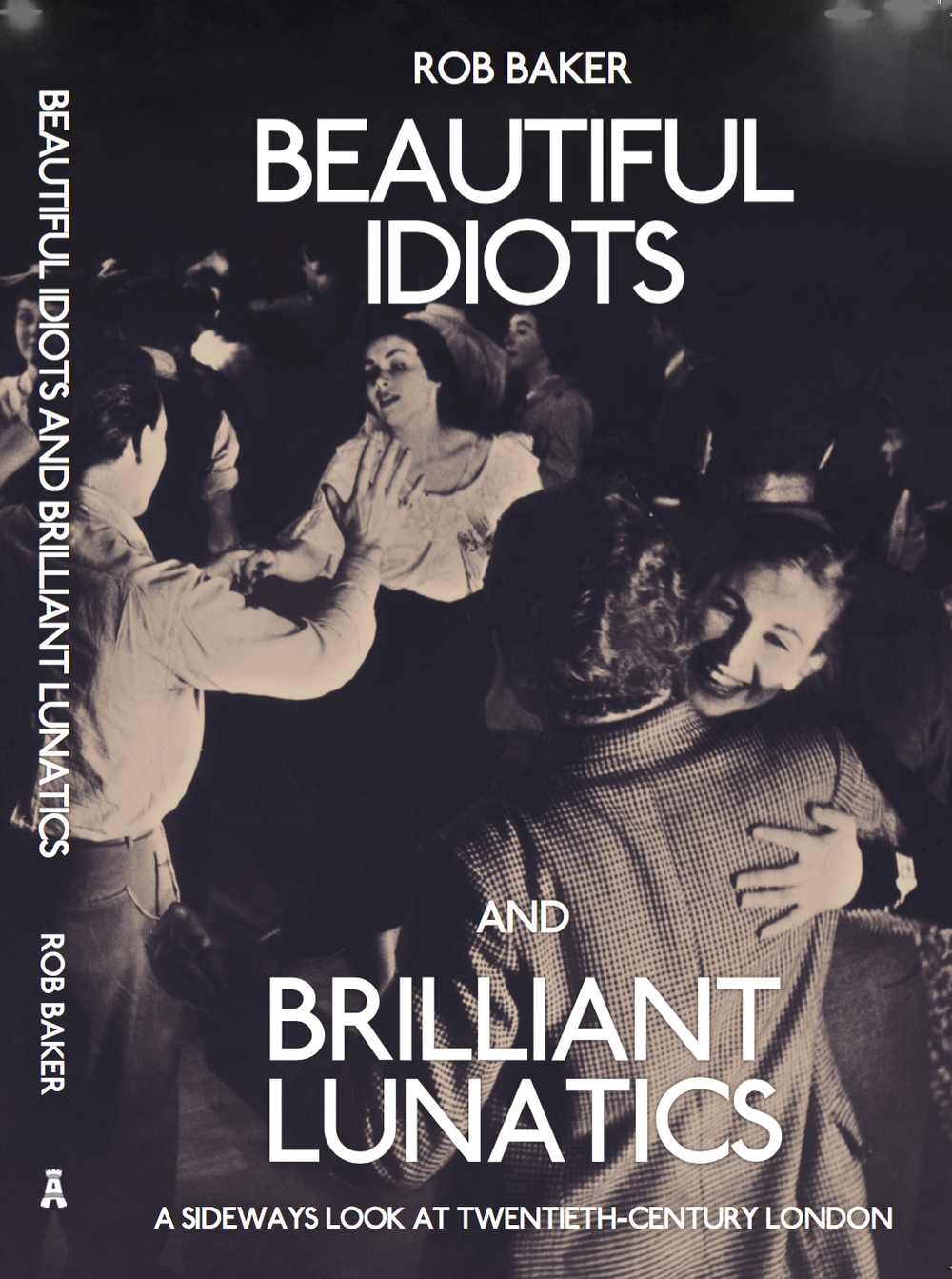
Beautiful Idiots and Brilliant Lunatics by Rob Baker

For several years, Rob Baker has written one of London’s best blogs, Another Nickel In The Machine, which explores the cultural history of London’s 20th century in a unique way. Rather than focus on, say, a musical genre or a particular locale or an identifiable concept such as celebrities or architecture, Baker simply finds great stories and researches the shit out of them. And now he’s turned it into an excellent book: Beautiful Idiots and Brilliant Lunatics.

As with his blog, Baker doesn’t pretend to find a unifying theme to artificially define the richness of his material, instead relying on his natural instincts to identify a good story and tell it for just the right amount of time. This is crucial. Some of these chapters cover some pretty big subjects – the Krays, Lord Haw-Haw, Christine Keeler, Pop Art – but Baker always manages to find a new angle without going on too long: for instance, his piece on Pop Art concentrates on Pauline Boty and the Anti-Ugly Movement while he looks at Blow-Up through a street in Stockwell that appears in the film. He’s brilliant at detail – clothes, weather, atmosphere, quotes – and tightly wound narrative (the section on the escape of spies Burgess and Maclean could come from a thriller), but he also loves exploring interesting tangents.

But his real skill is contextualising individuals within their era or locality. So his chapter on Benny Hill tells us much about the post-war comedy scene at the Windmill as well as Hill’s own rise and sad decline, the Profumo Scandal chapter is also about Soho and the Flamingo club in the early 1960s while the section of Winifred Atwell takes in Atwell’s strange career as a popular black performer but also the history of Brixton, where she lived.

This is essentially, the book of the blog, with several of the same stories, only expanded with new research. The blog also features great photography, just the right amount of which is reproduced here, including a cracking cover shot from the 100 Club, a venue that increases in importance with each year it avoids closure. Collectively, these photos and historical essays build a picture of London that captures some of the city’s chaotic sensibility far more truthfully than a conventional or even psychogeographical history, which will try and draw dry parallels between then and now, sometimes with lamentable results. Instead, Baker simply tells a story and then leaves you to think about what it means, if anything.

Some of these yarns I knew nothing about, such as the strange days James Earl Ray spent in Earl’s Court after assassinating Martin Luther King, or the spiv murder of Warren Street, or Charlie Chaplin’s wonderful return to Lambeth in 1921. Others I was familiar with, but still learnt more about, such as the plans to redevelop Covent Garden in the 1960s that was stopped by protesters – in the current climate, I wonder, would a similar protest have any success at all?  The net result is like being rattled round the London decades by a raconteur with a time machine, a sort of blue badge Doctor Who, who tells a story with wit and panache before whizzing you off to his next unpredictable destination.

Paul Weller in Uncut

I’ve written the cover story for the latest issue of Uncut about a couple of days I spent in San Francisco with Paul Weller in October.

I enjoyed the incongruous location – Weller was staying in the Japanese district and played a country music festival at Golden Gate Park and a show at hippie landmark Fillmore West – as well as the chance to spend time backstage with Weller and his band unaccompanied by any label management or press officer.

Weller discussed his forthcoming projects, including an avant-garde film soundtrack he’s composed, and also reminisced about early tours of America with The Jam. On one occasion, he said, the band were asked to celebrate their London credentials by posing outside an English pub in Santa Monica with a double decker bus.

The_Jam_bus

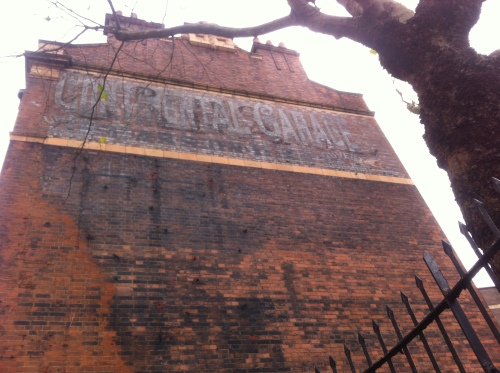
I also got the chance to explore San Francisco – where I discovered ghost signs, parrots, a punk-themed restaurant called The Brixton, coyote warnings and a complete absence of cranes, billboards, pneumatic drills and the general intensive building work that blights daily life for so many Londoners.


Save the Half Moon in Herne Hill

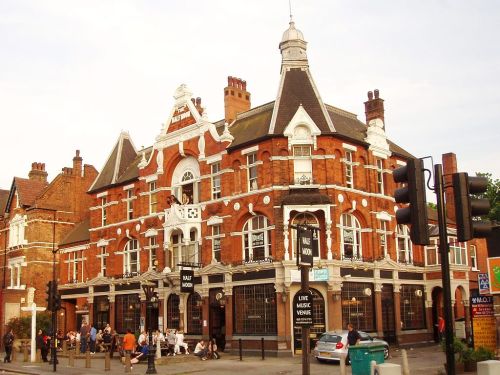
There has been a hole in the centre of Herne Hill since August 2013. That’s when a water main flooded Half Moon Lane closing most of the businesses. All eventually reopened (although some subsequently closed again, defeated by the insurance process) except what’s arguably the most important one: the Half Moon pub, a glorious gargantuan neo-Gothic late Victorian Grade II-listed pub that should be Herne Hill’s crown jewel but has instead been allowed to fester for more than two years, to the lasting shame of landlords Dulwich Estate. This is a fine London pub, which opened in 1896 – a pub has been on the site since the 17th-century – and has featured in graphic novels by Alan Moore, hosted gigs by U2 and Frank Sinatra, comedy shows by Eddie Izzard, and whose former drinkers include Dylan Thomas, who took the name of Under Milk Wood from the nearby Milkwood Road. Now, it’s dead, boarded up, dilapidated and rotting from within.

So how has this come to pass?

half moon

Locally, rumour and counter-rumour have swirled about its fate. The chief sticking point is that there are several floors above the pub – these once contained boxing a gym where I spent an exhausting three minutes being chased round the ring by a former middleweight champion – that represent a huge financial opportunity. Attempts to convert them into residential flats went nowhere and it’s said that Dulwich Estate, who look after the interests of the wealthy nearby private schools as well as a couple of other pubs, wish to turn it into some kind of boutique hotel as they are doing with the Crown and Greyhound in Dulwich Village.

This would almost certainly spell the end of live music at the large function room attached to the pub. This 200-capacity room has a surprisingly rich history as a London venue, as I discovered when talking to Peter Blair, who is leading the Save The Half Moon campaign with the Herne Hill Forum, fed up of the secrecy, silence and endless rumours.

Last week, Blair submitted to Southwark papers that would see the Half Moon listed as an Asset of Community Value that focus on its history as a music venue. He believes that while the pub will eventually reopen – because of the listing status, Dulwich Estate can’t really do anything else with the handsome ground floor bars – the live music component needs to be understood, celebrated and protected. The closure of London’s live venues has reached such epidemic proportions that even the mayor wants to do something about it.

“To have one of south London’s few independent live music venues shut in this way is terrible,” he says. “It’s the flagship of Herne Hill and it just sits there empty on the corner.”

Campaigners have been exploring the pub’s history and have discovered it was a crucible for London’s live blues scenes in the 70s – sessions featured an array of musical talent from the most popular bands of the era including members of the Jeff Beck Band, Rory Gallagher band, Thin Lizzy, and 7th Wave. An account of its history can be seen in this film.

It remained a music venue for the next four decades. In 1980, U2 played an early gig. In the 90s, the house PA was owned by Alabama 3 and gigs included Big Joe Turner and Geno Washington. More recently it hosted Devon Allman from The Allman Brothers and guitarist Albert Lee.

“It’s been a live music venue since the 60s and we can’t lose that live music function,” says Blair. “It has such a great history and was a great venue. Everybody I’ve spoken to says it was such a special place to play. This is a local community pub but it’s also much more than that.”

Damn straight: Leslie Nielsen even filmed a commercial in there.

If the campaigners win their bid to get the pub listed as an Asset Of Community Value, it will mean Dulwich Estate will have to consult the Herne Hill Forum over their plans, finally bringing them out into the open. “Out understanding at this point is that they wish to use the function room as a restaurant,” says Blair. “We want them to explain their plans in full, and to ensure live music is a key component of the new pub, whenever it opens. If it is converted as a hotel, how will that effect the music venue? We have no intention of making it unviable but we want to know what it will be when it opens.” The campaigners have no interest in purchasing the venue, which would cost a fortune but have been in discussion with the nearby Ivy House, who used Asset of Community Value status to purchase their local pub from developers.

There’s also the question of when it reopens. While Dulwich Estate is said to be in negotiations with several pub chains – “everybody you speak to has a different name” – it’s unlikely to open in the next 12 months. Since it closed, no restoration has taken place at all and it’s said the pub, which was at the very centre of the flood and thus under water for some time, is in very poor condition. It seems astonishing that a listed venue can be left to rot by a landlord that is supposed to have local interests at heart, especially when one presumes there is insurance money on hand to fix the damage.

It’s a sad state of affairs for what should be a south London landmark.

To keep up to date with the campaign, see the Facebook group.

The Blitz: missing buildings and false memories

While researching my recent feature on the Blitz and former bombsites in London, I was keen to find a site that had been destroyed and not yet redeveloped.

There were some tantalising leads.

Peter Larkham, professor of planning at Birmingham School of the Built Environment, provided me with an image he’d discovered years before of a derelict building on Lowndes Street, left fallow in memory of the Blitz.

Lowndes Street

“It was in the chartered surveyor professional magazine,” he explained. “The story was that it was owned by a family, bombed, and they never did anything to it in memory of a son that died in the war. Fifty years later, life had moved on, and the property came up for sale.”

It’s a compelling story but one that was difficult to confirm. The Bomb Damage Maps  showed a couple of strikes on Lowndes Street so I sent an email to Dave Walker, librarian at Kensington and Chelsea and writer of the formidable Library Time Machine blog. Dave put the query across to a colleague at Westminster, as Lowndes Street straddles the boundary between the two councils. Between the two of them, they discovered destroyed buildings at No 30 and Nos 11/12 Lowndes Street but both sites were developed by 1963. It would require further research to get to the bottom of the story as outlined by Professor Larkham and as tantalisingly revealed in the above photograph.

There was similar confusion with regard to another site. This was next to the Hat & Feathers pub on Clerkenwell Road.

Clarkenwell Road

Clarkenwell Road

According to local legend, the site had been demolished by a bomb and used as a car park ever since. For years, you could even see scraps of wallpaper from the destroyed building still attached to the neighbouring wall. The only problem was there was no record of a bomb landing anywhere near this property – itself rather extraordinary given how badly the area had been bombed. It appears that this was a false folk memory, but one that was still being shared today. In the end, I included no empty lots in my piece as I couldn’t find any that comfortably fitted the available facts.

After my piece was published, I was contacted by a photographer, Thom Atkinson. He was about to publish a book called Missing Buildings, looking at precisely this area – the missing spaces between London buildings ostensibly created by bombs. They’d even included an image of the Hat & Feathers site I’d been studying. Like me, Atkinson was intrigued with the way folk memory and evidence didn’t always correspond.

hatfeath

Photograph by Thom Atkinson

Thom said, “We came across the same sort of folklore thing a couple of times, and in a way that’s what the book is about. There’s a picture we made on Sclater Street, near Shoreditch Station, and the market traders there were talking about it being a bombsite when they were kids. When we looked at the map it didn’t quite fit their story – but they remembered it so clearly.”

There were several explanations for this, false memory being only one of them. As Thom explained, “Sometimes bombs are recorded and the site itself displays all the signs, but no building damage is shown on the LCC map. And of course the whole thing is complicated because the LCC maps only show damage during wartime – we’ve heard stories of buildings falling down or being demolished later on, because of underlying structural damage caused by the bombing – one of the guys who works in the processing lab (also a bombsite by the way!) has a house in East London with cracked foundations; the surveyor thinks they were caused by a bomb landing at the other end of the street.”

Missing Buildings is a wonderful book, showing the ghosts of London homes, many of which have long disappeared but still leave an imprint on neighbouring buildings in the form of shadows, new brickwork, girders and the spectres of chimney breasts. Others have been filled in with new buildings that stand out ridiculously against their neighbours, awkward and ugly, eternally temporary.

There are more of these spaces than you might imagine in London, but they are vanishing fast and this book is an exquisite record of the spaces that get left behind, often more by accident then design. You can buy it here.


Getting lost in London: an experiment on Twitter

I recently gave a talk at the Design Museum about walking, and so I  talked about getting lost in London. This is an edited version of my talk.

Five years ago I got my first smartphone and everything changed. I was in Paris on a day trip and I got lost, but instead of doing what I’d always done, which is walk around, try to work out where to go by following my instincts while surreptitiously staring at a map upside down and trying not to look like a tourist, I went straight to my phone, clicked on the map app and immediately located myself – right down to the direction I was facing in. I realised then that I’d never be able to get lost in a city again – or at least until I came up with the idea of an experimental social media walk for the Design Museum, in which I would try to get lost through the misguidance of complete strangers on Twitter.

But let me digress a little.

Getting lost is a valuable experience. Your senses are sharpened, you see more and remember more. I’m sure that getting lost sharpens the imagination – some might say that it’s only by getting lost that we can find ourselves or some such pseudo-psychogeographical bullshit – but my interests are more material. Getting lost is fun. It’s interesting. It’s a great way to explore a city and learn how it is put together.

When I was growing up I was terrified of getting lost in London. When I blogged about my typical Saturday trip as a teenager from the suburbs to London, I was surprised at how repetitive those day trips were, what a narrow furrow I ploughed. My friends and I were only interested in records, clothes and football fanzines, so we’d get the train to Victoria, then the tube to Covent Garden, walk up Neal Street, along Shaftesbury Avenue, up Charing Cross Road, along Oxford Street, down Berwick Street and back along Shaftesbury Avenue to Piccadilly Circus, stopping at various shops along the way. We did this week after week, never straying from these paths.

The other day, I was watching a TV documentary about the sengi, which is a sort of African elephant shrew, and it talked about how these rodents construct runs for themselves in the long grass. These pathways give them a sense of safety, of security, but they can also become a trap: when predators or bush fires arrive, the sengi can’t escape the routes they know so well.

That’s a bit like how I was in London.

That changed when I moved on to a boat in Lisson Grove and began to explore the surrounding streets, getting more familiar with the way London knitted together and using the towpath as a sort of guide rope like a mountain climber. This was partly a matter of circumstances – I had lots of time and little money, so it was cheap to walk and I could afford to take my time getting anywhere, following whatever route seemed most interesting and appropriate. This is what first gave me a sense of the scale of the city, and how endlessly fascinating it can be – the domestic architecture, the quirky shops, the street furniture, the plaques to people you’ve never heard of, the sudden squares – but mostly the curious nature of the topography, which is neither gridlike nor quirkily medieval but something in between, with loads of random curves and bends, making it very hard to navigate.

Later, I conducted more ambitious, planned walks. I walked from St Paul’s to Hampton Court, 26 miles along the river, criss-crossing bridges to stay on the Thames Path. I walked the course of the buried Effra from Gipsy Hill to Vauxhall with a dowser, who used a sort of oversized Allen key to trace the path of this ancient river and in the process got us thoroughly lost in a council estate in Stockwell during a snowstorm. Most memorably, I walked underground from King’s Cross to Blackfriars following the river Fleet with a pair of urban explorers, who spend their spare time breaking into drains.

Spring walks in London: river Effra

In more recent years, opportunities for walks have diminished and I’ve rarely got lost. That’s partly because of the tyranny of the smartphone. With a phone, you always know exactly where you are and the sugary appeal of the web makes it almost impossible to avoid clicking.

So when the Design Museum got in touch, I began to think about walking and technology and wondered whether the power of the smartphone could be harnessed for good: could I use the phone to help myself got lost? I conceived the idea of a walk that would be guided by social media. I’d take a starting pointing – which was obviously the Design Museum – and then ask my followers on Twitter where I should go: left, right or straight ahead. Every now and then I’d take a photograph but otherwise I wouldn’t reveal my location until the end.

The results were mixed. Part of the problem was one of integrity. Should I ask people directions at every single junction, or only ones that looked kind of interesting? I soon realised I couldn’t ask at every single junction, as there were so many of them, and some of them just took me straight back to where I’d come from, or to somewhere I already knew, or on to a long straight road with no end in sight. Conversely, sometimes I’d see a really interesting side street which I couldn’t explore because my followers didn’t send me down it.

Another problem was that my phone is quite old so has a tendency to crash. That meant I stood at a junction on Old Jamaica Road for about ten minutes turning the phone on and off and on and off and on.

The final problem was simply and fairly obviously that staring at a phone while walking, even if this is being done in the service of getting lost, makes it almost impossible to absorb the sights around you and relish the experience it’s all been designed for.

But I did enjoy the interaction with other people – occasionally I’d post a picture and those who recognised it would send me information about the building or street, tell me something interesting about the area, historically or personally. Others talked about doing similar experiments, sometimes in cars, with the passenger telling the driver to turn left or right at random. And while I didn’t get lost, there were definitely several occasions where I didn’t exactly know where I was, until twitter, rather brilliantly steered me back towards the river, which seemed a fitting place to end. The biggest surprise was that I only covered just over a mile in 45 minutes.

walk

There are other ways of getting lost or just exploring London in a more chaotic fashion. The members of the London Psychogeographical Association once explored Globe Town in Mile End using an old US Civil War battlefield map. Somebody once attempted to see how far they could travel from Trafalgar Square without ever crossing a road – he managed to go 17 miles before he began walking in circles somewhere in Hackney. Another acquaintance composed a series of walks that were both complex and rather beautifully simple – he’d walk from the first street beginning with A in the A-Z index to the last beginning with A, then do the same with every other letter in the alphabet.

I also recently discovered a book – Ways To Wander, which has a series of ideas about walking from writers and poets. I liked several especially No 26, which is a version of the twitter walk only using a wooden spoon. You take a spoon, throw it in the air, then walk in the direction it points until you hit a wall, when you do it again. Continue for as long as appropriate.

I quite like the lo-fi nature of that. Perhaps that’s the best way to get lost in London. Leave your phone at home, carry a wooden spoon, and wander.