Category Archives: Archaeology

London’s mapping renaissance

The growth of online mapping – as seen by the excellent London Mapping website, which collects some of the best digital maps around – has not meant the end of paper maps.

Image of Untamed London

I’ve mentioned Herb Lester‘s lovely themed maps before with reference to their 1960s map of London’s West End, Wish You Were There, and they continue to add new maps to their range, branching into different cities and themes while maintaining an impeccable eye for design. Untamed London, for nature-lovers, is their latest offering.

I’ve also finally got my hands on the Museum of London’s Londonium map and it is hugely impressive. This has been produced by MOLAS, the Museum of London Archeological Service, and is a huge map of the City, with the Roman topography superimposed over a plan of the contemporary city – a little like a paper version of the technology used for the Time Travel Explorer app.

Key Roman finds are listed, with an explanation of what they are and how they can be accessed, while the reverse side has a potted history of Roman London, with many illustrations. The map is printed on good thick paper so won’t tear easily (a constant problem for frequently folded paper maps), and works beautifully as both a decorative item and a practical plan for hunting down the existing remains of Londonium.

It costs just £6.25 and should it prove to be a big seller – which I imagine it will – I hope the Museum can persuade their friends at MOLA to produce more maps along the same lines.

One for the Olympic Park at around this time next year, perhaps?

London bricks

‘The bricks – laid Flemish bond, headers and stretchers alternating – were all old London stock bricks, but of many kinds and colours: rust red, beige, grey, brown, nearly black. Here and there were yellow ones – malm bricks made with an admixture of clay and chalk. The cumulative effect was pleasing – the variety gave texture, interest and warmth to the surface of the wall. The eye approved the range of colour, the uneven look, the way in which each brick differed from its neighbour and yet was in subtle harmony. But, more that that, to look at it was to see the way in which this wall arose from the ashes of many buildings. Studying it, Matthew saw in his mind’s eye warehouses and churches, factories and shops, terrace houses like this one, blasted to the ground perhaps on some furnace night of 1940. He thought of how the city lifts again and again from its own decay, thrusting up from its own detritus, from the sediment of brick dust, rubble, wood splinters, rusted iron, potsherds, coins and bones. He thought of himself, living briefly on top of this pile, inheriting its physical variety and, above all, the clamour of its references. The thought sustained him, in some curious way, as he sat at his desk in the flat which was not yet a home, or as he moved through days and through the city, from Finsbury to Docklands to Covent Garden to Lincoln’s Inn.

Penelope Lively in ‘City Of The Mind’ (1991, Andre Deutsch).

Mudlarking

Last winter, I went mudlarking on the Thames shore. This is an edited version of the article I subsequently wrote for Eurostar (image below from Knowledge Of London).

You’ll see them at low tide, wandering alone with bent necks along the damp and desolate mudflats of the Thames. These are the mudlarks: amateur archaeologists, beachcombers and scavengers who delight in rediscovering lost detritus from London’s past. Although they are wearing waders and carrying metal detectors, they look much like giant birds, storks or herons, as they walk with heads bowed and eyes fixed on the floor, scrutinising the mud and pebbles for hidden treasure. They’ll occasionally scratch at the surface with an extended toe if they see something they fancy. And then they’ll pounce, darting down to peck something from the ooze, before deciding whether to add it to the day’s hoard.

The tidal Thames has been described as ‘London’s largest and richest archaeology site’ and it’s certainly the longest in the country, stretching from the Thames Barrier to Teddington Lock. For centuries, the river in central London was used by boats bringing cargo from all over the world. Thousands of people worked in these docks and warehouses, and items that have fallen from boats or pockets or been casually discarded by Tudor dockers are still lodged in the London mud, waiting to be revealed whenever the tidal river withdraws.

Mudlarks have been prowling here for centuries. In Georgian and Victorian times, they were the desperately poor searching for things to eat or sell. By the 1960s, the term referred to unofficial archaeologists who formed the Society Of Thames Mudlarks in 1980. A few years later the Port of London Authority (PLA) – the body in charge of the river – offered the mudlarks licences to dig on the foreshore in return for having their finds officially recorded by the Museum of London. The mudlarks have thus helped build an unparalleled record of everyday life on a medieval river.

Ian Smith is one of them. His patch is the north bank of the Thames between London and Southwark Bridges, outside Customs House, where pre-Victorian cargo ships would have been checked for contraband. This was once the Pool of London, the main unloading point for boats that could not fit between the pillars of old London Bridge, and a place rich in treasures. ‘I started in 1973 as a schoolboy,’ says Smith on a bracing winter morning. ‘I grew up in Battersea and saw a TV show about a man who found these old clay pipes in the Bristol Channel. So I came down to see what I could find. I spent about a year working down the river bit-by-bit until I got to Blackfriars where I saw this group of people, a little cluster of them, and I went over with my collection of pipes. And where they’d been poking about there were pipes everywhere, loads of them, they were just ignoring them and looking for other stuff. So I started chatting and that’s how I got started.’

The thick black mud of the Thames conceals rich treats, everything from prehistoric flints to Victorian toys. The mud is anaerobic – without oxygen – so preserves just about anything. Kate Sumnall works for the Museum of London and the Portable Antiquities Scheme as a Finds Liaison Officer; it is her job to manage the licence scheme and register everything the mudlarks find. She says, ‘London is different to most places in terms of the preservation and the proportion. You wouldn’t get iron daggers in a field, it would be eroded, but Thames mud is anaerobic so things don’t decay. And you also don’t have aggressive chemicals and ploughs, which damage items in the ground. You can still find medieval leather in the Thames.’

Smith believes the Thames has three other benefits. ‘London is almost unique,’ says Smith. ‘Most rivers aren’t tidal, so that’s one thing, but you’ve also got the river going through the centre of town rather than round the outside. And the third thing is that in the Victorian era all the docks got moved over to the Isle of Dogs, so that means the early stuff has been left in the ground rather than dredged away centuries ago.’

This is what makes the Thames such a popular and lucrative haunt for the mudlarks. There are around 50 with official permits, granted by the PLA after an individual has spent at least two years on the foreshore getting experience and demonstrating a history of recording their finds. ‘The mudlarks have huge value,’ says Sumnall. ‘They have sold us entire collections in the past and these have gone on to form a crucial part of the museum. But they are also immensely helpful in recording where things are discovered over time, which helps build up a bigger picture of London history.’

When Sumnall is contacted by somebody who wants to be a mudlark, she’ll often put them in touch with Smith, who has an unrivalled knowledge of the river and its secrets, knowing where to look and when. At low tide, he clambers down the steps on to the foreshore carrying the tools of his trade – a bucket and spade and a battered metal detector wrapped in waterproof plastic – to begin his hunt. After just a few minutes he returns with a 13th-century arrowhead, 16th century pipes, medieval buttons and a shard of Tudor pottery. But this is bric-a-brac to an experienced mudlark. Smith, an antiques dealer by trade, specialises in medieval pewter pilgrims badges which were sold at points of pilgrimage, but has found all sorts of things. ‘I found a hoard of forged coins from 1470,’ he says. ‘People would clip a bit of silver off the edges of coins and these forgers must have been chased so they flung the bag of coins into the river to get rid of it and I found it centuries later.’

London’s history as a world port dates back to the Roman era, which can make for interesting finds. Sumnall tells the story of a bone harpoon that they originally thought came from the Stone Age, but after carbon dating turned out to be from around 1650. ‘That really threw us, but we realised it came from a part of the foreshore where the whaling docks were located and it’s possible it came from an Arctic civilisation and arrived in London on a whaling ship. But obviously we can’t be sure.’

Another recent discovery was a 400-year-old lead toy coach, found by a London decorator, Albert Johanessen, who says his most important equipment is not a metal detector but ‘his eyes and a stout pair of wellies’. Smith possesses these, but after 40 years of mudlarking is realistic about what he’s going to find. ‘You’re never going to find treasure like the Staffordshire Hoard because nobody is going to bury gold in a river, but you find ordinary everyday stuff that people chuck away: tools, rings, badges, glass and pottery.’

You certainly find a lot of clay pipes. These carpet the foreshore in London, thousands of them dating back to the sixteenth century when tobacco was first introduced to the capital. The pipes were sold pre-filled and although they were reusable were often discarded, thrown into the river by those who worked in the docks. These 400-year-old fragments are fascinating to newcomers but to the trained eye are more like Tudor cigarette ends and rarely get taken to the museum to be registered.

But there is one Londoner who is interested. Jane Parker is a designer who last year began to collect pipes to make into necklaces and bracelets. She currently sells them on her website but hopes to get a stall at a London market soon. ‘I went to the Museum of London Docklands (in Canary Wharf) and afterwards walked to the river,’ explains Parker. ‘The tide was out so I went down on to the beach. I saw these clay pipe stems and decided I’d make something from them and started making them for friends who had left London as a momento.’

Parker doesn’t have a PLA licence, which means she can’t dig but is allowed to collect anything from the surface. With pipes that’s all she needs. At the right spot, Parker reckons she can pick up 400-500 usable pipe stems in an hour. ‘I want stems that have been pummelled by the tide, and are soft and worn at the ends. The smaller and finer, the newer they are. Some of them have a line down the middle that show they’ve been cast in a mould, while the bigger, chunkier ones are hand-made, the holes aren’t centred and they aren’t smooth.’

You can also see the fruits of the foreshore in a special display at the Museum of London devoted to items found in the river, covering everything from prehistoric axes to medieval skulls. The museum takes in around 1,000 items a year from the mudlarks and despite Smith’s belief that ‘the best times are over, so much has already been found’, Sumnell thinks there’s still plenty to discover. ‘We’re definitely finding different things,’ she says. ‘They heyday of the pilgrim badges may have passed but we’re seeing more Roman stuff than I can keep up with, especially in areas of heavy erosion. There’s still a lot of interest in mudlarks, and we’re always getting new ones.’ A new generation itching to uncover the secrets of the Thames.

London’s lost rivers

There is almost endless fascination with London’s lost rivers, as can be seen with the publication of Paul Talling‘s fine – if brief – new book on the subject. I have written about them a number of times and this article first appeared in Time Out in 2008.

Londoners love what they cannot see. Take the excitement that is generated by ‘ghost tube stations’ such as Museum and Aldwych that sit unused beneath our feet and can occasionally be glimpsed from trains. Yet people rarely blink when they descend escalators into the remarkable interiors of busy, living stations. Concealment and abandonment excited the mind more than the here and now.

So it is with London’s lost rivers. Anybody can check out the quirky Lea or watch the Wandle weave serenely past Merton Savacentre, but mention Brixton’s Effra or the City’s Walbrook rivers and the eyes of a certain sort of Londoner will light up, and a torrent of trivia about lost rivers will gush forth. This is an interest that can take us to unusual places. When Design for London recently mounted London Open City, an exhibition about creating new spaces in the capital, the idea of restoring buried rivers got people talking. The Sunday Times claimed Boris Johnson was going to greenlight the scheme and Peter Bishop, then director of Design for London, said: ‘When these rivers are opened up, Londoners will be absolutely amazed.’

Which was great news for James Bowdidge, a property developer with a yen for the Tyburn. ‘As soon as I learnt about it, I became fascinated with the old river and the way you could see it in street patterns,’ says Bowdidge, who channelled his enthusiasm into a curious project – ‘an angling society for a river that didn’t exist’. The Tyburn Angling Society, an irregular supper club, was born – Ken Livingstone attended their 600th anniversary dinner, 600 being a number they plucked out of thin air.

So far, so whimsical.

However, Bowdidge – a London buff with half an eye on property prices – has also looked into raising the Tyburn, which was covered in 1750 but still meanders underground from Hampstead to Westminster. ‘I asked an architect to draw up plans of the building that would have to go. We write to Westminster City Council about it every now and then. But they are sceptical because this particular plan requires the demolition of their headquarters.’

Now Bowdidge’s hope is renewed. ‘If you look at the planning statement the Mayor brought out, you can see a degree of support for this sort of project. And now the subject is live it’s worth thinking about seriously – what could you do? There’s no reason why you couldn’t reinstate the river through Regent’s Park. You don’t have to demolish billions of pounds of property, there are places where you could really bring it back if you looked at it pragmatically.’

Well, perhaps. The notion that Boris has gleefully embraced the scheme is not supported by the raised-eyebrows reaction of a GLA spokesperson, who told me: ‘Opening up parts of London’s subterranean river networks is one of many ideas proposed at the exhibition… As with all the ideas designed to stimulate thinking, a full study would need to be undertaken before any could be taken forward.’

In other words: Never. Gonna. Happen.

At least, not with the Mayor’s money. But there are always other pockets to pick. In 2003, the Environment Agency rescued the Quaggy, a tributary of the Ravensbourne, from an underground culvert in Kidbooke’s Sutcliffe Park, and there are plans to restore the Ravensbourne itself in Lewisham town centre, paid for by a regeneration group called Urban Renaissance in Lewisham (which includes the Quaggy Waterways Action Group). Architect Will Alsop has floated a similar scheme for Croydon, where a branch of the Wandle is interred. He says, ‘The buried river thing Boris is banging on about is a really good idea. In Croydon, the Wandle was only buried in 1967 so you can easily bring it back in patches: ponds or lakes or some elements of river. And you don’t even have to bring them back; you can leave some underground and go and see them there.’

Which brings us neatly to the most interesting scheme, that of Nick Robertson, a designer and London obsessive who once walked the Thames from source to sea with Peter Ackroyd (‘every Saturday for a year’) and harbours a fascination for the Fleet. Bowdidge refers to the infamously filthy Fleet as ‘the ditch’, and Robertson does not disagree. ‘There’s nothing artistic about the Fleet,’ he says. ‘It was bricked up for good reason. He’s right to call it a ditch. But some ditches are worth celebrating.’

Robertson’s plan was ‘the confluence of several ideas’. One was a walk he completed along the course of the Fleet – ‘it was a river route, you could see it in street names, and in the topography and geology; a river that wasn’t there, but was.’ A second influence was an exhibition at the Royal Academy in 1996 called ‘Living Bridges’, which author Stephen Bayley has said marked the ‘moment when bridges have become showpieces of architects rather than engineers’. And the third was a visit to the Monument, the column raised by Wren and Hooke in 1677 to commemorate the Great Fire.

Robertson explains: ‘What interested me about the Monument was that it wasn’t representational. You climbed this big Doric column and saw what you saw, which was the extent of the destroyed city. The Monument is not the monument – what you see, the rebuilt city, is the monument. Stylistically, it’s of its time but conceptually, it’s way ahead.’

Robertson and an architect friend Iain Johnston explored options. ‘We discussed whether it was a good idea to open up the river and very quickly dismissed it because most plans to open up the hidden river are missing the point. The point is this river is covered. That’s what is interesting. To open it up is to ignore the historical process. And it’s ignoring the mystery, the charm. If you opened up the Fleet, it would regress to what it was, an urban river: charmless, shit-filled.’

Instead, Robertson ‘thought it would be interesting to have a bridge that went underground and the obvious site was Ludgate Circus because that was the site of the Fleet Bridge and Wren’s bridge when he tried to turn the Fleet into a canal.’ They designed a subterranean chamber that went under the road and had a glass floor through which visitors could observe the still-living Fleet. ‘A warped bridge over a warped bridge’.

He sent his proposal to the head of Thames Water where, as far as he knows, it still resides. The Fleet and the Tyburn were incorporated into Joseph Bazalgette’s sewer system in the 1860s and both Bowdidge and Robertson have blagged trips underground with Thames Water sewer workers. Says Robertson: ‘One of the things I found most interesting was the amount of decoration. The designers stopped and thought what they were doing even though nobody was going to see it – it’s effectively dressing up shit.’

It’s true. London river-sewers are artfully constructed, beautiful things that deserve celebration, both for what they are now and what they used to be. The Guardian’s Ian Jack disagrees. When confronted with Bowdidge’s cheerful scheme of tree-lined tributaries, he wrote that the Tyburn was a ‘sewer owned by Thames Water and more remotely by pension funds in Canada and Australia. It has been a sewer for hundreds of years as part of a combined system, far too expensive to separate, that carries rainwater and human waste.’

And that’s that. Robertson at least sees a way past this brutal approach, and while his Fleet Bridge is the sort of imaginative scheme destined to go nowhere, he also believes the Fleet should be remembered in simpler ways, such as surface markers along its course of which there are none. It seems London is ashamed of its lost rivers, or at least of its treatment of them.

‘The Fleet is something London has buried,’ says Robertson. ‘So it appeals to people who feel strongly about the occluded side of London history.’ The best way to deal with it, he thinks, is to go down and confront this ‘trapped nerve’.

‘It was once a bubbling brook of bucolic bliss, then it turned into an open sewer, then it was bricked up,’ he says. ‘Now it needs to recreate itself in a different way. To open it up is to miss the point, pandering to a nostalgic view of London. London should never be nostalgic.’

Spoken like a true Ballardian (and Ian Jack would surely approve), but everybody, even a ruthless modernist, is allowed to look back every now and then and wonder. So Robertson tells me to head up Farringdon Road and down Ray Street towards Back Hill. There, in the road outside The Coach & Horses, is a grill, and ‘when you stand over it,’ says Robertson, ‘you can hear the Fleet belting beneath your feet.’

So it does, the magnificent sound of a torrent of water battering its way downhill directly beneath London streets. Sewer or river, call it what you will, but the Fleet lives on. Deep waters run still.

Inside the Fleet: exploring London’s lost rivers

I wrote this piece for Time Out in 2005 and for some reason it’s never been available online. Until now.

It’s only as the filthy brown water rises above my thigh-high waders and my feet struggle to grip the tunnel’s slimy floor that I realise that drowning in a river of shit after breaking into a London sewer would be a really, really crap way to die.

It all began so well. I found Jondoe and Stoop, two urban explorers who get their kicks investigating drains, lost rivers and derelict buildings, on the internet and asked them if I could come on their next journey beneath the city streets.

We met near Farringdon. The plan is to explore one of London’s lost rivers, the Fleet, which once flowed from Hampstead to Blackfriars. Although long bricked over, the Fleet, like many of London’s old rivers, still flows underground through a series of pipes and culverts. Joseph Bazalgette integrated these rivers into his sewer system, using them as storm-relief drains to carry overspill into the Thames when the main east-west sewers were swelled beyond capacity. These days, heavy rain can still cause sewage to flow into the river via the Fleet.
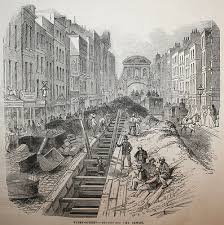
Jondoe and Stoop have been in the Fleet before, but turned back when the stench became overwhelming for even these experienced drainers. This time, they are determined to reach the end. They believe no other UK urban explorer has made the trip, largely because it takes considerable planning to find a way into London drains. Urban explorers are driven by a combination of adrenalin and curiosity, and take their hobby seriously. This trip has been months in the planning. They’ve popped many manholes looking for the right entry point, and the weather has to be right – no rain for at least three days before we enter.

In a nearby car park, we change into waders, boiler suits, flourescent vests and hard hats – the latter more for disguise than protection. Carrying a couple of traffic cones, we’re suddenly transformed into construction workers, practically invisible to passers-by. Nobody bats an eyelid as we walk through busy streets to the selected manhole, stick some cones round it, lift the cover and climb down the ladder into the gloom.

We enter a feeder tunnel with a five-foot ceiling, which means we have to abandon our hats and walk with cricked necks. It’s cramped, damp, dank and dirty but doesn’t smell too bad. Stoop and Jondoe glide like skaters along the slippery floor while I splash clumsily behind, using slimy walls to keep my balance. We head downwards along a series of mini-waterfalls. The light and noise that intermittently emerges from the grates overhead suggest we aren’t getting deeper, but simply following the gradient of the road. It’s a curious feeling, being isolated in the dark but with occasional glimpses of London reminding us that normal life continues up above.

Eventually we reach the end of the feeder tunnel and swing into the Fleet itself using broadband cables that make useful subterranean handrails. It stinks in here and the air is heavy with a strange mist. Jondoe points north, to where the Fleet is blocked by the main east-west sewer. Ominous clumps of matter fester in pools all around. ‘Don’t disturb them,’ he says. ‘It’ll be full of gas that just sits there and collects.’
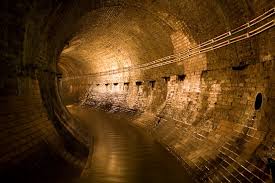
As he speaks, one of the hard hats we’d left by the entry point shoots out of the feeder tunnel on a wave and floats towards the Thames, bobbing along the shallow water that moves sluggishly down the centre of the tunnel.

We follow, heading south. The tunnel is around ten feet tall and wide, so we can walk two abreast. It’s about the same size as a tube tunnel. The smell slowly subsides, although lumps of faeces and toilet paper gather in places where they’ve washed against the brickwork. Otherwise, there’s just a trickle of brown water ferrying the odd cotton-bud downriver.

It’s no hellhole, but still a far cry from the Fleet’s sixteenth-century heyday as one of London’s key tributaries, when, flanked by wharves and warehouses, it was a centre of London commerce. It separated Westminster from the City and carried cargo to the Thames, was compared unfavourably with the four rivers of Hades by Ben Jonson, was briefly turned into a canal and then covered in portions from 1732, by which time it was little more than an open sewer.

But this was not the end of it. In 1846, the Fleet exploded, its sewage gasses bursting the street above, rendering King’s Cross Road impassable, destroying Clerkenwell poorhouses and smashing a Thames steamboat against Blackfriars Bridge. This river, it seems, has a habit of coming back to ambush those who thought it dead and buried.

Almost two centuries later, traffic and police sirens are audible overhead, competing with the constant crash of water that flows from numerous side tunnels, feeding the central trickle. Rats stop and stare as we walk past. I nervously keep my torch shining on them until we have moved on.

Before Ludgate Circus, the Fleet splits into two parallel tunnels, directly replicating the pattern of Farringdon Street overhead. Otherwise, it’s impossible to work out exactly where we are. The tunnel heads south, but is full of turns. At one point we notice large iron rings cemented into the wall. They are support for scaffolding, but look like mooring rings. Throughout, the Victorian brickwork is surprisingly beautiful for something that is so rarely seen.


After about two miles of trudging, we emerge into an enormous end chamber, more than 20-feet high and elaborate in design and construction. Two short tunnels lead from here, ending in huge metal flaps, which we assume open directly into the Thames.

After taking pictures, we head back. Immediately, we realise there’s a problem. It’s much harder to walk uphill against the flow of water. On the way down, the water was a stream, heading back, it’s more like a river. We labour onwards and upwards in the dark, but it’s tough work.

Stoop eventually says what we’ve all been thinking. ‘Is it just me,’ he asks, ‘Or is the water getting deeper?’

Water which before barely covered our feet is now above our knees, flooding downhill towards us at pace and rising slowly all the time. Wading into the tide, our clothes are heavy with water and our feet struggle to grip the slimy stone floor. Panicking rats scurry up the walls to get out the way of the bubbling water.

 It’s frightening. Nobody knows we are down here and as our pace slows I begin to ponder our options. Should we press on, or brave a side tunnel, where a ladder may at least take us above water level, so we can sit it out. But how long would that take? And what if the water keeps rising and the side tunnel we’re in doesn’t have access to the street? 

We reach a turn where the water has become a torrent and Stoop tries to brace himself against the tide but instead starts sliding backwards towards me, threatening to skittle us all into the dirty water. For a split second I consider what an undignified death this would make, and with one final effort we press on, forcing ourselves to a point where we can stand without getting knocked off our feet. But we’re exhausted.

Then Jondoe shouts, ‘That’s where we came in!’ It is indeed. We pull ourselves up into the feeder drain via the broadband cable and watch the river below us boil to a frenzy. The Fleet is back with a vengeance. Later Jondoe explains, ‘Somewhere further up the sewer they must have been doing some maintenance and so diverted the flow down the Fleet.’ It is, he says, something he’s never experienced before.

Twenty minutes later, after an exhausting walk through the smaller drain in the course of which I bang my head several times on overhanging pipes and bricks, I haul my battered, sodden body up the ladder and into the sunshine. It’s bright outside. The air smells clean. Half-a-dozen people across the road pay us no heed as we emerge from the manhole and sit slumped in the road, moving only to remove our waders and empty them back down the drain.

We trek back to the car in soaking socks, leaving a trail of footprints behind us.

Stoney Jack and the Cheapside Hoard

The Cheapside Hoard is one of the great treasures of the Museum Of London. A vast collection of Tudor jewellery, it was found by two workmen in the cellar of a house on Cheapside in 1912 and eventually made its way into the museum’s collection.

The story is a fascinating one, outlined in HV Morton‘s seminal London history ‘In Search Of London’.

Morton, a journalist and insatiable London enthusiast with the knack of knowing not so much the right people as the really interesting ones, begins by describing GF Lawrence, ‘or Stoney Jack as he was known by every navvy who worked in the City’.

Stoney Jack was an asthmatic antiques dealer with a shop on West Hill, Wandsworth. He also had a job as Inspector of Acquisitions at what was then called the London Museum, based in Lancaster House, St James’s.

Since the 1970s, every building site in the UK must by law be visited by a team of archaeologists to ensure no great treasures are missed, but in Lawrence’s time there was no such requirement. Lawrence’s job then was ‘to haunt every demolition site in the City and make friends with the navvies, so that they would bring to him anything that had been found during excavation’.

Morton writes that there was a lot of building work taking place at this time and Lawrence knew it may be the last chance to find any antiquities that might still be hidden in the soil. In his not entirely public-spirited determination to ensure nothing crucial was lost, workmen received rudimentary archaeological training during ‘mysterious transactions behind hoardings and in the tap rooms of City public-houses’.

In this way, Lawrence was able to purchase items from ‘a procession of navvies with mysterious objects wrapped in spotted handkerchiefs’ and flog them on to the London Museum, earning himself a tidy profit. Anything the museum didn’t buy, went into his shop. And even if the navvies brought him something worthless, he always gave them enough cash to buy a pint of beer. In this way, he built up much of the Roman and Medieval collection that is now in the Museum of London.

Morton continues:

I cannot count the times I have been present when navvies have appeared and passed their treasures across the counter with a husky, “Any good to yer, guv’nor?” I have seen handkerchiefs unknotted to reveal Roman pins, mirrors, coins, leather, pottery and every kind of object that can lie concealed in old and storied soil.

I was with him one day when two navvies handed over a heavy mass of clay found beneath a building in Cheapside. It was like an iron football, and they said there was a lot more of it. Sticking in the clay were bright gleams of gold. When they had gone, we went up to the bathroom and turned the water on to the clay. Out fell pearl earrings and pendants and all kinds of crumpled jewellery. That was how the famous hoard of Tudor jewellery, the Cheapside Hoard, was discovered.’

Morton recalls that for this great find, now worth millions, Stoney Jack received a thousand pounds. For their part, the navvies were rewarded with ‘something like a hundred pounds each, and I was told that these man disappeared, and were not seen again for months!’

London’s floating world

When I first moved to London in 1996 I lived on a boat. This is one of a number of articles I’ve written about this experience. It appeared in ‘Talk Of The Town’, the Independent On Sunday’s short-lived New Yorker-style supplement, on April 20, 2003.

Heading north from the Surrey suburbs, the back seat of my dad’s car stacked with clothes, books and CDs, it all seemed straightforward. I was a boat sitter, pure and simple, looking after a canal boat moored in Lisson Grove (where was that? Who cared?) for a couple of months, just the summer, while I waited for something better, something drier to come along. It was a foothold into London life, but no more. I certainly wouldn’t be there for long.

That was seven years ago. This summer, I’ll finally be packing up my bric-a-brac, much of it the same in fact, and heading back south over the water, back to dry land. Boat life is over; while it lasted, it was everything.

In the summer of 1996, Dazzler was – is, the old girl still exists after all – a small, slapdash, cosy vessel, ineptly painted in green and red and just 23 feet from bow to stern. But inside was everything that young man, newly freed from home, would ever need. TV, fridge, oven, shower, toilet, double bed and an 0171 telephone number; Camden was a mile in one direction, Notting Hill a mile in the other and the West End just a short trek south. Idyllic.

The mooring itself was ludicrously unattractive, a slab of urban ugliness slapped between the twin charms of Regent’s Park and picture perfect Little Venice (‘Do you live in Little Venice?’ people would ask. ‘Not quite,’ I’d reply). On one side of the ragged and uneven towpath, weeds spilling through the cracks, was a huge brown-brick electrical substation that, we would proudly boast, had once been a target for IRA bombers. Periodically, it would let forth a monstrous, shuddering belch as it poured electricity through the wires that ran along the road at the top of the towpath. On the other side was a massive, grey, sprawling council estate, built upon the site of an old schoolyard and now home to lairy kids who, every school holiday without fail, would pelt our pretty, targetable boats with bricks and bottles. ‘A narrowboat? It must be so peaceful,’ people would ask. ‘Not quite,’ I’d reply.

At first, my fellow boaters were an intimidating lot. They’d gather by the largest boat, so big it was moored parallel with the towpath rather than sticking out into the canal as the others were. It was a long, hot summer and the crowds would stand at the nearby barbecue drinking, chatting and laughing, everybody brown and weathered, with hands and torsos lined by ropes and engines the hard outdoors. They’d fall silent as I, pasty pale and thin with unmarked skin, scurried past. One or two would maybe nod in vague recognition. ‘New lad, Dazzler,’ the whispered explanation would follow me aboard, where I would shut the curtains and turn up the music to drown out the carousing that lasted long into the night.

It was thanks to my next-door neighbour that I broke through and become an honorary boater. She was my age, bright, attractive, posh and loud. Great fun. A bit loopy. A powerful personality, she forced her friendship upon me, and me upon my neighbours. I learnt who they were: the actors, perennially resting, the couriers, students, bankrupts, welders, writers, dossers and drinkers; riff-raff, drifters from the acceptable fringes of society. Once a year this patchwork neighbourhood would, in its entirety, up moorings and take their boats round the London ring, from Paddington to Limehouse, Limehouse to Brentford, Brentford to Paddington. Friends and neighbours waving to each other and taking photographs as they floated past the Houses of Parliament.

Nights on the ring, like nights on the towpath, would be fabulous social affairs. Barbecues would last all summer long. Sometimes, you’d be on your way home, or heading out, on a Friday night and be asked to stop and have a drink with one of the gossipy groups that would inevitably congregate along the towpath at the first sight of sunshine. Bottle followed bottle and so Friday would slip into Saturday and Saturday would become Sunday. Lazy, warm and indolent. Before long, I came to recognise another pattern: one of new arrivals. Although I felt it had taken me an age to be accepted I soon realised that it had happened practically overnight. So it was with others. You’d meet them briefly one weekend; a week later they’d be taking to your old friends as if they were their old friends. Also routine was the way I’d been dragged in – renting for a few months and staying for a few years. Fresh faces – passing friends or overnight guests – would still be there weeks, months, years later, joining the throng round the barbecue, laughing at joggers and in turn scrutinising new faces. It had that appeal, that attraction for a certain kind of person.

Time passes and things change and London’s creeping gentrification is difficult for even this hardbitten community to avoid. A new breed cottoned on to our secret life. ‘But boats in central London must be very expensive?’ people would ask. ‘Not quite,’ I’d reply.

Boaters realised that the floating houses they owned were fetching London property-market rates. Drifters by nature, they moved on and away, to other ways of life, to other moorings in other parts of the country. Having appeared abruptly, they faded away, appearing less and less often, their places taken by bankers and accountants and managers and assorted nine-to-fivers. Or so it seems.

Some remain, those who make a living of the boats and off the new green boaters, still gathering in ever-decreasing to chuckle about the newbies and exchange news about old friends. Stories are swapped. Of Pump-Out Mick, who sold a boat and disappeared, they said, when he was told he had months to live. Of the bon vivant banker turned vicar, who married my next-door neighbour and took their boat to Cambridge. Of Irish Eddie, whose wife would return from work to measure his humour by the amount of wine he’d consumed – ‘so it’s been a tw0-bottle lunch has it Eddie?’ she’d say if he was being particularly gregarious. Of others: Frank, the one-time ‘Dr Who’ monster, Buzz the publican, Yorkshire Mick, the ice-cream seller and Smiley Pete. ‘You must have met some interesting characters,’ people would ask. Oh, quite.

IMG_1540