Tag Archives: London

The magic, mayhem and mystery of Ziggy’s last show

I have a piece in the latest edition of Uncut about the final Ziggy Stardust show at Hammersmith Odeon in July 1973. It’s an oral history, for which I spoke to fans who attended the show as well as the two surviving Spiders, engineer Ken Scott and singer Dana Gillespie. The fans include a largely unimpressed Vic Godard, later to form Subway Sect, an eight-year-old boy from Devon who was smuggled in by his wild-sounding babysitter, a West London tearaway who broke in with his pals through a fire escape, and a teenager from Surrey who is captured on film, open mouthed in shock, after Bowie makes his bombshell “retirement” speech before the final number. “I cried for the rest of the show,” she admitted. “I cried all the way home.”

It was an awful lot of fun chatting to fans about their memories of this momentous show. It was also interesting to speak to Woody Woodmansey and Mike Garson about their very different feelings about the show, Woody having effectively been sacked on stage without knowing anything about it, something Garson clearly has a form of survivors guilt about. Woody never played with Bowie again but he told me they did manage to clear the air later in the decade, and stayed on good terms thereafter.
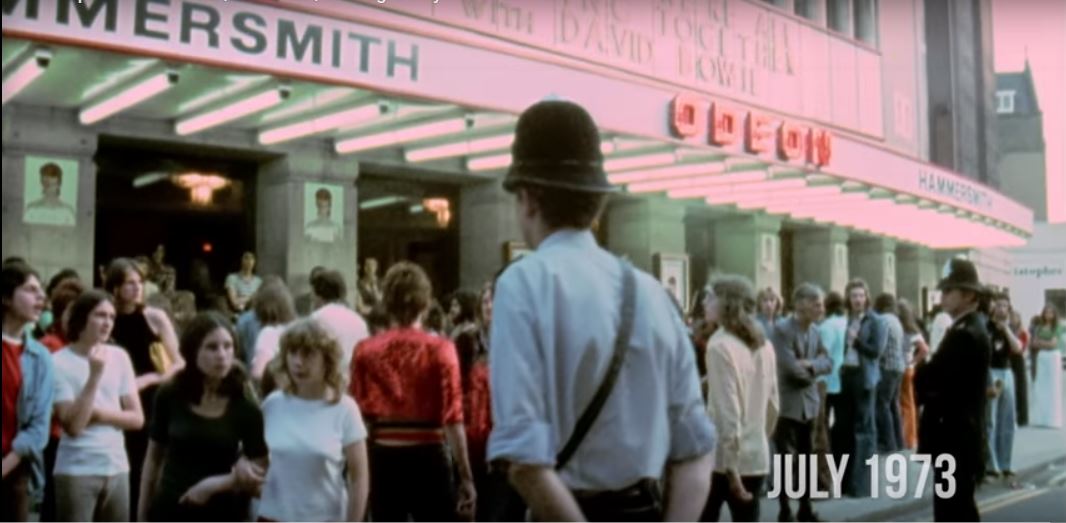
I also spoke to Lee Grant, a Bowie fan trying to solve a photographic mystery from the evening of the show. That section of the article didn’t make the final cut, so I am including it here.

The after-show party at Café Royale became known as Bowie’s Last Supper and featured a panoply of celebrities, several of whom posed for a famous photograph. This group shot features Mick Ronson, Lulu, Jeff Beck and his girlfriend Celia Hammond, Ringo and Maureen Starr, Edgar Broughton, Bianca Jagger, David Bowie and Angie, plus another individual who has never been identified.

Bowie fan Lee Grant created his Bowie Mystery Guest blog to solve the mystery and has so far discounted Tim Buckley, Elliott Gould, Cat Stephens, Ossie Clark and Bowie’s friend Geoff MacCormack plus several others. He first heard about the mystery guest from a Bowie podcast. “I thought I could solve the problem in about ten minutes and here we are five years later,” he says. “What I tried to do was eliminate some of the main suspects and wait for somebody to come forward.  It’s as simple and pointless that.”

Grant has contacted numerous members of the Bowie circle in his bid to solve the problem – many of whom suggest names he has already been able to eliminate such as MacCormack and Buckley. Having discounted most of the proposed names, Grant’s current theory is that the mystery man is a non-celebrity who happened to be at the Cafe Royale was invited to join the group shot because he was mistaken for MacCormack, who he certainly resembles. That makes identifying him all the harder but not impossible – perhaps with the help of other photographs from the evening which might show who the mystery figure was with.

“I’d love to find out who he was, why he was there and then get on with my life,” he says. “It’s in the back of my head all the time.” If you happen to know the answer, please put Lee out of his misery and let him know at https://bowiesmysteryguest.com.

Heroes and villains

When I started working at Time Out in 1998, I was young but by no means a greenhorn having already done five years at the Sunday Times, where I encountered formidable figures such as Hugh McIlvenny, Steve Jones, Nick Pitt and Chris Lightbown, my own personal mentor. But the journalists at a Time Out where a different breed. They were all very smart, incredibly knowledgeable about their particular field and not shy of letting you know it.

One of the most prominent was Paul Burston, whose desk was just across the aisle from the sports section where I first worked as holiday cover for editor Andrew Shields. For a start, Paul was physically striking. Not quite a gym bunny but certainly more muscular and compact than any of the other scrawny hacks at Time Out who looked as if they barely saw daylight and subsisted entirely on a diet of cigarettes and cheap spirits. Paul spoke in a loud voice with a soft Welsh accent. He would get to his desk some time before midday, and immediately start fielding a seemingly endless torrent of phone calls, exchanging gossip, rumours, ideas and anecdotes with a string of friends.

These conversations were peppered with language that I’d never previously heard outside the playground – queer, dyke, poof. I didn’t know where to look. I soon worked out that Paul edited the Gay section and had been at Time Out for a while, forging a relationship as a journalist who was outspoken against homophobia and fought for gay rights but could be very critical of gay politics and lifestyle if he felt it necessary. I’d never really encountered such an outspoken and confident out gay man before – there were very few gay journalist at the Sunday Times and none, openly at least, in the sports department – nor was I particularly familiar with the gay world of London, despite having gone to Popstarz a few times.

One of my strongest memories of Paul was his sheer fury on the evening of the Admiral Duncan bombing, as he took phone calls about the unfolding horror before going into Soho to see what was going on.

We remained colleagues until I left Time Out in 2010, but I only really got an inkling of Paul’s background when I read an account of his life as an AIDS campaigner that he wrote in Time Out‘s 40th anniversary book, London Calling, in 2008. Now Paul has brought out a memoir – We Can Be Heroes – which covers his life in more detail, which includes striking reminiscences of gay life in London in the 1980s, partying hard while campaigning under the constant shade of AIDS and homophobia. It’s a great book that I recommend heartily for anybody interested in London subcultures and activist politics.

As I read We Can Be Heroes, I realised that while Paul was experiencing the trauma of seeing his friends die of AIDS I was still at secondary school laughing at jokes about the disease. On Facebook, my school’s old boy page was recently hijacked by a number of men recounting the frankly horrific physical abuse they endured at the hands of staff, including pupils from my own time at school who were caned, slapped, strangled and thrown against walls by out-of-control teachers.

I was never physically attacked by teachers but verbal abuse was common. Chief among this was homophobia. There was not a single out gay boy in our school of 800 – because how could any child admit to being gay during the era of Clause 28, when rugby teachers would call anybody who disliked physical violence “a Mary-Anne” and RE teachers told us that homosexuals would go to hell. As a result, in the playground gay insults were the major currency – poof, queer, bum bandit, bender and jokes about AIDS. It’s hard to imagine how this could have been endured by any of the gay boys in the school.

It came as a little surprise when my old school was drawn into controversy recently when the current school chaplain – a man who I realised had been in the same year as me at school and therefore exposed to the same environment of endless, normalised and officially sanctioned homophobia – was accused of banning a gay author from giving a talk to pupils. As Paul’s book shows, we’ve come an awful long way, but there’s still a long way to go.

Among The Foetuses

Last week I was able to visit the reopened Hunterian Museum at the Royal College Of Surgeons on Lincoln’s Inn Field. This is an anatomical, pathology and natural history collection originally started by 18th-century Scottish surgeon John Hunter, who acquired thousands of specimens – human and animal – in his desire to understand the natural world. Here is one of my favourites, a cute little foetus of a sloth.

A sloth foetus

I wrote about the collection and Hunter’s motivations for Apollo and you can read that article here.

It’s easy to cast the Hunterian as a sort of sophisticated freak show – a place where you can see diseased organs, strange animals, skeletons and a large number of dead babies. And to a certain extent – or at least to modern eyes – that is exactly what it is. But it’s important to understand the collection in the context of the time, before X-rays, aspirins, anaesthetic and all the other miracles of modern medicine that we take entirely for granted.

Hunter collected because he wanted to understand and he wanted to understand because he wanted to improve. His curiosity and motivation (and his approach to ethics) is very similar to that of John Soane, whose own vast jumble of artistic and architectural wonders can be viewed on the other side of Lincoln’s Inn Field.

Take just a moment to think about that. Here are the two cultures – art and science – in the form of two collections amassed by obsessed and committed individuals, facing each other across a large garden square in a pair of incredible free museums, either of which would be the envy of most national or city collections. London is by no means perfect, but – much like the scientific improvements that Hunter’s inquisitive mind helped propagate – such marvels should never be overlooked or underestimated.

Statute to statue – remembering Brian Haw, peace campaigner

Word reaches me that plans are afoot to start a campaign to erect a statue to London peace campaigner Brian Haw, whose peace camp was a fixture at Parliament Square for many years.

I interviewed Brian in June 2005 for Time Out, by which time his shanty town and placards had been housed opposite the Houses of Parliament for several years. His arrival predated the Iraq invasion of 2003 but grew and grew, drawing much more attention after the conflict started. It’s worth remembering that the current Conservative government’s illiberal approach to protest was very much previewed by the way New Labour reacted to Haw, changing the law multiple times in an authoritarian attempt to erase what they saw as an embarrassing protest. And in some ways, Haw was a trendsetter for the kind of high-visibility permanent protests seen over Brexit, although now the protesters are permanently armed with camera phones to ensure they get that attention-grabbing soundbite for a tweet that might go viral. Haw could be noisy, but was generally more stoic in his approach to protest – sitting opposite Parliament like a human scowl, a permanent blight on the house’s collective conscience.

When I interview Haw in 2005, we ended up talking for two hours. Or rather he talked, while I listened.

His life was extraordinary and seems to have been defined by his strong Christian belief and the unresolved trauma of his father’s experience as a WWII sniper who liberated Belsen and later took his own life.

What I most remember was his utter, almost frightening, determination – there was an almost messianic steel behind the eyes that reminded me in a strange way of the manner in which his nemesis Tony Blair was depicted by cartoonist Steve Bell. I’m sure neither man would like the comparison.

Haw sadly died in 2011 having defied several attempts to remove him – indeed his, peace camp was at one point famously recreated at the Tate by Mark Wallinger, winning the Turner prize.

Is a permanent statue likely to follow? News of the campaign will soon emerge.

In the meantime, here’s my interview with Brian from 2005.

The Marquee

The first indoor gig I ever want to was at the Marquee in September 1992. I’d already been to a couple of huge outdoor shows that summer – Reading, Madstock – but there was something special about going up town on a weekday to see a gig in a dark, sticky floored venue that stank of fags. It was the Irish band, Sultans Of Ping FC, best known for novelty hit “Where’s Me Jumper”, and I remember very little about the show or the venue for that matter other than the noise, the crush of people and the fact that everybody in the audience was asked to lie on their backs and wave their legs in the air for the final number. Oh, and I lost my watch in the moshpit.

I’m not sure whether I was even aware at the time that this wasn’t “the real” Marquee. That had been located on Wardour Street, whereas the Marquee I went to was at the bottom of Charing Cross Road pretty much opposite Sportspages. It closed a few years later and was turned into a Wetherspoons. The story of the Marquee – which started life underneath a cinema on Oxford Street before moving to Wardour Street – is told in a new book, co-written by Robert Sellers and Nick Pendleton. Nick is the son of Harold and Barbara Pendleton, the founders of the Marquee – and I interviewed Barbara for a piece in the Telegraph.

The Wardour Street Marquee was an extraordinary venue because of Harold and Barbara’s open-minded booking policy. The venue was open every night so there were plenty of slots to fill, which is why so many huge bands got their break at the Marquee – and continued to do so as tastes and genres changed. A lot of club venues become locked into a single scene, or even a single band – think of the Cavern or Eric’s in Liverpool for perfect examples – whereas the Marquee was much more promiscuous. It started with jazz but quickly embraced blues and R&B, before following those threads through to the 80s, taking in psych rock, hard rock, prog, pub rock, punk, new wave, heavy metal, goth, indie and hair metal. Name the leading band from any of these scenes – the Stones, Who, Pink Floyd, Cream, Hendrix, Led Zeppelin, Queen, Yes, King Crimson, Dr Feelgood, Sex Pistols, Wire, The Cure, Iron Maiden, Joy Division, Stone Roses, Guns N Roses – they all played the Marquee. Just about the only important band that didn’t was The Beatles. One of the charms of the book is seeing some of these line-ups and realising that pretty much every week for around 25 years, a legendary bands was on stage at the Marquee.

Playing the Marquee became a rite of passage for bands on the way up, while by the 80s it became the first port of call for many US bands. It was used for filming, and it was also used for secret shows – Bowie, The Stones, The Who, Tom Petty, The Police and loads more used it for warm-ups or special events.

The Pendletons developed parallel businesses, including artist management and promotion. They started an outdoor festival in Richmond that turned into the Reading festival – and for years, Reading was every bit as important as Glastonbury. There was also a studio, where The Moody Blues recorded “Go Now!”, Chelsea FC recorded “Blue Is The Colour” and Killing Joke recorded their debut LP – three of the finest records in anybody’s collection. The Marquee studio was where the Stock Aitken and Waterman team came together, working on Dead Or Alive’s “You Spin Around”, before they left for their own space.

The book goes into this in detail with plenty of great anecdotes about some of the most famous personalities to have played the venue, including Bowie, the Stones, Lemmy, Gilbert & George and Metallica. It’s a great read and an excellent way of understanding what arts and culture can do for a city and how many lives can be touched with memories that never leave them. That’s invaluable, and there are aren’t many places where it still happens in Soho.

The Marquee was revived a couple more times – once in Angel, now the 02, with a consortium that included Dave Stewart – and then back in the West End. The brand’s current owner tells me he does one day hope to reopen a Marquee in Soho, if he can find a willing partner- ie, a landlord prepared to accept their wider responsibility for maintaining the historic culture of an area rather than simply a devotion to their own bottom line. We can all dream, can’t we?

Marquee: Story Of The World’s Greatest Music Venue by Robert Sellers and Nick Pendleton is published by Paradise Road.

Battersea Power Shopping Station

The reopening of Battersea Power Station last week drew a lot of publicity, much of which summarised the contents of Up In Smoke, my book on the power station, while sanitising most of the politics.

The reason I wrote the book was because I felt that much of what has happened to modern London – indeed, modern England – could be located within the bricks of the power station.

Battersea was always a symbol of prevailing trends and it still is today – from industrial powerhouse to decrepit ruin, reimagined as a retail experience for the ultra wealthy. Here is a landmark piece of British architecture on a patch of prime central London once owned by the British state but sold for a pittance to chaotic private enterprise only to end up in the hands of another country’s state pension fund.

If that doesn’t highlight the relationship between the short-sightedness and failure of imagination of privatisation and our current economic situation, where just about every British asset seems to be owned by other countries, I’m not sure what does.

When writing the book, I found one of the most honest interviews to be with Sir David Roche, the power station’s overlooked first developer. Sir David came on the scene in 1983 after a distant relative saw a competition in the Times inviting applicants with ideas to redevelop the power station. Roche’s relative, an architect, wanted to build a science-theme park but Roche went along with it but privately thought that was a daft idea.

“To me,” he said. “It was a shopping centre.”

Roche’s secret plan was to come up with a design that had a few rides in prominent places in and around the power station, while filling most of the space with shops. “We’d win the competition on the basis it was a theme park as that is jolly nice and makes people comfortable and exciting. But to make money it had to be a retail destination.”

As cynical as he was, Roche has proved to be completely correct, it’s just taken 40 years for everybody to admit it. The problem at the time was that Tory-controlled Wandsworth didn’t want to build shops because they didn’t want to threaten Clapham Junction town centre, just as they didn’t want to build houses because they didn’t think people would buy them. The fact there was no other viable use of the power station – an art gallery is a lovely idea but it’s too damn big – meant developers were forced to conceive completely unpractical uses for decades. That only changed when Wandsworth admitted that okay, maybe shops and houses were a good idea after all – but only for really rich people. By then, most of the developers either went bankrupt or sold to people who would eventually go bankrupt.

Roche was one of the latter. To make the theme park idea work he needed somebody with experience and brought on board John Broome, the owner of Alton Towers. Broome was even more cynical than Roche and outmaneuvered his rival to take control of the consortium, paying Roche a tidy sum to walk away – before going bankrupt trying to achieve the impossible.

That made Roche the first of several developers to pocket a tidy profit without have done all that much to earn it.

“It was mega bullshit by lots of people including me,” he admitted quite cheerfully. “But the problem with bullshit is it can sometimes work but when it doesn’t the whole thing falls apart.”

Welcome to Britain 2022. We hope you enjoy your stay.

In praise of scavenging

If there was anything good to come out of lockdown, which there wasn’t, it was the fact that many people took the opportunity to clear out their homes of supposed junk. This meant that during my state-sanctioned daily 60-minute constitutional around SE24, there was nearly always a house somewhere on my route were the owners had left a pile of books on the pavement for passers-by to scavenge through. Now, I cannot walk past a box of books without rifling through it, hoping that amid the crap – so many books about coding and old travel guides – there would be an wanted gem. The tiny victories I had in lockdown were a rare source of pleasure in a miserable time.

I struck lucky time after time. There was that set of National Geographic from the late 1990s, which made excellent bathroom reading for most of 2020. When those were done, I found four months’ worth of The New Yorker from May-August 2020, which took me another 18 months to work through, containing as they did many more reminders than I needed of that awful summer of Coronavirus, George Floyd and Trump. More happily, I had wanted to read Joyce Carol Oates’s Blonde ever since I’d heard it was being adapted for cinema by Andrew Dominik, and there it was one afternoon waiting for me alongside William Maxwell’s marvelous novella So Long, See You Tomorrow.

I’d also long felt I needed to read Infinite Jest by David Foster Wallace and once more, there it was. And thank god I hadn’t had to pay for it because after three months and 150 painful pages I finally gave it up with considerable relief, placing it rather guiltily on my own garden wall for some poor sucker to take home.

Then there were the books I would never otherwise have read, such as The Dog Of The South by Charles Portes. This had a good cover and promising blurb, and I was intrigued to see that Portes had also written High Noon, but all the same it sat unread on my shelf for a year until I attended a birthday party where somebody gave this very same book to the host as a present. That was recommendation enough for me, and I devoured it in a few days. The novelisation of Wargames? A Jack London compendium? An unproofed review copy of Dan Hancox’s excellent history of grime, Inner City Pressure? Each one found a willing home.

I thought such bounties would end with lockdown but this week I had the finest haul of all. Check a load of these goodies below.

Such a haul, and not even a lockdown to suffer for it.

See you on the other side of summer, when I might have made my way through some of the above.

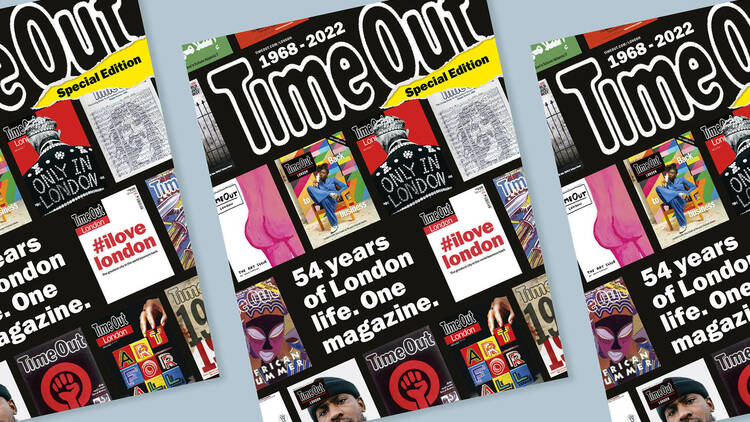
Time Out special edition

Time Out ceased publication – in physical terms at least – a few weeks ago. However, there is a special one-off final issue on the street today, which looks at the history of London over the past 54 years through the prism of the magazine.

I feel very privileged to have been part of Time Out’s story, so was delighted to be asked to contribute to this issue.

It’s a real souvenir edition, so grab one if you can. You can also access it online here.

Performance in Powis Square

Performance is probably the greatest London film of all time. When this strange and unsettling fusion of counterculture and crime was finally released in 1970, it was accompanied by a novelisation – a cheap paperback by William Hughes published by Tandem – that I chanced upon last week behind the counter in the fabulous Bookmongers on Coldharbour Lane. I love novelisations, so this was a no brainer.

Although I’ve read a few books about Performance – the best is Paul Buck’s 2012 biography of the film published by Omnibus, which frustratingly lacks an index – I’m not sure I was aware there had been a novelisation. There’s a short review here, but there’s little about William Hughes on the internet, although his name does crop up on Abe Book alongside some other novelisations of the era – 1968’s Secret Ceremony, 1971’s Lust For A Vampire, 1974’s The Marseille Contract, 1976’s Aces High and 1978’s Death Sport among others. A follower on Twitter suggested his real name was Hugh Williams.

UPDATE Head to the comments for a great twist on the “who was William Hughes” question…

It didn’t cost 9p

What particularly appealed was the knowledge that novelisations are often written from early drafts of scripts, which means there are interesting differences between the plots as told in the books and what you get in the finished films. I was very keen to see how Performance the book differed from Cammell and Roeg’s final film, and also curious at how the author would tackle some of the stranger moments from the film, including the famous ending. Incidentally, apparently the film’s dialogue coach and underworld/counterculture figure David Litvinoff wanted to write it, but was declined.

The book is, as you’d probably expect, a lot more conventional than the film – but that isn’t saying a great deal, as most things are more conventional than Performance. William Hughes is a decent writer who has a great sense of pace and solid grasp of genre, so he is pretty assured when dealing with the first half of the story – about the gangster Chas who oversteps the mark and has to do a runner. This all unfolds at great speed, but we are also treated to some insights into Chas’s background, motivations and general sense of unease at his chosen career as a heavy. We learn that Chas lives in a “luxury flat in predominantly working class” Shepherds Bush, and his activities take him to various parts of London including Campden (sic) Town, where he terrorises a mini cab firm, Mayfair, Liecester Square (sic) and the Temple, where a lawyer’s chauffer is shaved while his Rolls-Royce is covered in acid.

In the film, things get much weirder when the action moves to the home of a reclusive rock star in West London – in the film this is located at Powis Square but here it’s named as 22 Melbury Terrace, “behind Notting Hill Tube”. Hughes handles that transition fairly well and there’s a sense of Chas’s discomfort as he encounters Turner and his two female friends, Pherber and Lucy. But while in the film this relationship becomes relationship increasingly complex and sinister, the book – presumably following the initial script – has the two worlds quickly come to an understanding. They develop a sense of mutual respect and it all feels far more comfortable than it does on film. There’s also much less sex. Or as one Twitter user put it..

Concise summary.

What that suggests is how ordinary a film Performance could have been without Cammell’s influence and without the performances of Edward Fox and Mick Jagger, whose uneasy sparring is one of the signature flavours of the film. Plot-wise, the most notable difference is right at the end, but there are other more subtle plot differences that affect the mood – for instance, at one point in the book we go into the garden at Powis Square/Melbury Terrace, while there’s also a pivotal, and topical, drug bust that never made it into the final film. Both these scenes would have diluted the claustrophobic, hallucinogenic nature of the second section of the film, which has one of the most peculiar atmospheres of any film by a major studio thanks, it seems, to the way Cammell and Anita Pallenberg manipulated Fox and Jagger. Oh, and the book also omits one of the greatest lines in the film: “Comical little geezer. You’ll look funny when you’re fifty.”

These aren’t the only differences. Chas runs to Powis Square/Melbury Terrace because he murders a rival, Joey Maddocks, bringing down unwanted heat on the mob led by Harry Flowers. In the film, there are strong suggestions that Chas and Joey were former lovers and that Chas’s repressed homosexuality is part of the “performance” but in the book this relationship is made explicit. By contrast, Flower’s own homosexuality, alluded to on film, makes no appearance in the book.

Being trivial, I also enjoyed some of the moments of trivia. We learn the name of Turner’s band – Turner And The Spinals, or Turner And The Spinal Cords – and the fact they scored seven No 1s and three No 2s. In fact, “not one of his singles ever missed the charts. Up until the end, I mean”, says his still faithful housekeeper. It turns out that Turner was such a star he shook the Queen’s hand at a film premiere. At one point, Chas even hums one of his hits.

“Of all the crap I ever perpetuated, that was the vilest, man,” says Turner.

Crowley’s London

Several years ago, I commissioned a writer at Time Out to go and explore what we then described as one of occultist and writer Aleister Crowley’s few remaining London homes – an apartment at 73 Chancery Lane, that was about to be turned into offices. In these rooms, Crowley had set up a temple for his magical friends, the Order of the Golden Dawn, and our writer made a valiant attempt at conjuring up a spooky atmosphere from what was probably a rather forgettable set of empty rooms. He even quoted a builder working on the site who claimed to have discovered a human skull and pentangle formed from sticks.

Time Out article on Crowley’s temple, Jan 18 2006

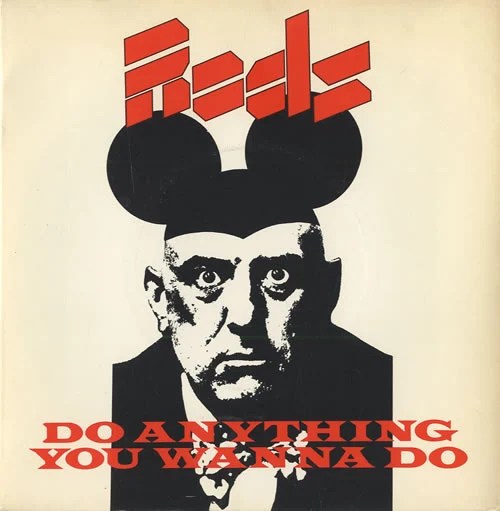
This seemed an entertaining and fairly useful thing to do because even though London is replete with memorials and blue plaques to long-forgotten politicians and music hall artists, there are no blue plaques for Aleister Crowley. London has a plaque for the dog that inspired the HMV logo, but even today, the one-time “wickedest man alive” is beyond the pale for the heritage industry despite his decent literary output and outsized influence on popular culture. (I have written about one such story here.)

Phil Baker’s fabulous new book, City Of The Beast, corrects that oversight. This is a biography of Crowley told through London locations – 93 in all, a number with magical significance for Crowley’s Thelamic religion. Baker, whose biography of artist and occultist Austin Osman Spare is a minor classic, began the book as a lockdown project, listing London places associated with Crowley as something to do to pass the time and stop worrying about the end of the world. He’d soon listed dozens of Crowley homes thanks to Crowley’s inability to settle anywhere for long. That residence at Chancery Lane is mentioned, along with numerous apartments around Piccadilly plus others in Chelsea and Fitzrovia. At times, Crowley resided in such unlikely spots as Streatham, Surbiton, Richmond and Paddington, sometimes living for only weeks, fleeing in advance of creditors as his circumstances declined. It’s likely that most of us will have walked past one or two of Crowley’s front doors and certainly visited the same shops or drank in the same pubs. London overlaps – that’s one of the reason we like blue plaques. As Baker notes at one point, Caxton Hall in Westminster, the site of a public performance of a Crowley rite in 1910, was also the location of “Churchill’s election speech; the assassination of Sr Michael O’Dwyer in revenge for the Amritsar Massacre; the founding of the National Front; and the wedding of Ringo Starr”.

This is more social history than psychogeography, thank goodness. Drawing from Crowley’s unpublished personal diaries, Baker presents Crowley’s rather sad progression through homes and temples as well as the museum, shops, restaurants, printers and courtrooms of Edwardian London. We follow Crowley’s dramatic, even thrilling rise and then a rather pathetic long decline, a petering out, as he hops, heroin-addicted, from home to home, desperately trying to maintain his image and reputation. That must have been awful for a man who once supped with giants – Augustus John, Anthony Powell, WB Yeats, Nina Hamnett, W Somerset Maugham, Auguste Rodin – and in the diaries, some of the frustration comes through. We also get to meet many other remarkable figures who are now largely forgotten such as Labour MP and Crowleyite Tom Diberg, Allen Bennett, who lived with Crowley at Chancery Lane and later became a leading proponent of Buddhism in England, and composer and occultist Peter Warlock, father of the great art critic Brian Sewell. A typical entry will introduce a character like JFC Fuller, a successful soldier who loved yoga the occultism and fascism, becoming one of only two Englishmen invited to Hitler’s 50th birthday parade.

Crowley’s magical and philosophical beliefs are explored in outline, as are his literary achievements, his impressive sexual exploits (these were carefully recorded as Crowley practised sex-magic) and, rather wonderfully, his recipes. Crowley loved to cook and enjoyed strong flavours: a Crowley recipe book could surely be created for the niche occult-gastronomic market, although it would take a brave soul to sample some of these recreations.

Baker presents Crowley as a man whose outlook was formed in the decadent 1890s, one who never really adapted to the changing world, his own age or the reduced circumstances that meant a gentleman without money could no longer shop at Fortnums and live on Jermyn Street and would, instead, have to spend some time in a bedsit near Praed Street drinking at the Royal Oak. He quotes Cyril Connolly’s observation that Crowley bridged “the gap between Oscar Wilde and Hitler”, and that’s a neat way of looking at Crowley both in terms of the age he occupied and the principles and philosophy he espoused. That makes this a very rewarding social history – a look at London in the first decades of the 20th century, still clinging to the veneer of Victoria, like Jeeves And Wooster with magic.

It’s ultimately a very human study of the man, stripping him of much of his mystic allure without making him seem ridiculous, which could easily be the case when dealing with figure who did as many ridiculous things as Crowley. It’s hard not to see Crowley as analogous to those pop stars of the 1960s who worshipped Crowley’s libertarianism and whiff of stage-conscious evil who are still living a priapic life with full heads of hair, clinging to those glory days. And frankly, who can blame them?

City Of The Beast by Phil Baker (Strange Attractor).