Ballardian

I spent this morning at the British Library, looking at the recently acquired archive of JG Ballard. Ballard is one of those authors whose work I have devoured, absorbed, appreciated, exalted and admired but never really adored or even enjoyed, absolutely, that is without reservation.

I read him partly because I feel I should, not necessarily because it gives me the escapist satisfaction of my favourite writers. That’s not to say I read him out of dour and unwilling duty, like a GCSE student forced to confront Conrad, but it is markedly different to how I approach writers like James Ellroy, Jose Saramago or John Lanchester. With them, I know that no matter what the subject, I’m going to have a blast. With Ballard, it’s more complex. I know what I’m going to get, I’ll admire the way it is written, but I won’t be knocked off my feet, not any more anyway.

Ballard’s enthusiasts – among them Will Self and Iain Sinclair – often attribute to him extraordinary powers of insight and perspicacity, of having an almost mystic-like view of what awaits the world. There is some truth in this, as he accurately anticipated an atmosphere of suburban psychosis and predicted a society of disconnected and violent insular communities who have a paranoid fear of the ‘outsider’. But in general, it’s all a bit overstated.

His best novel is 1975’s ‘High Rise’, where he first put together a plot he then relentlessly repeated for almost 35 years – an enclosed community, a charismatic professional, a tribal awakening, a middle-class orgy of destruction.  Many of the books that followed were almost identical, just with the location changed (one of the best is ‘Super-Cannes’ from 2000).

By 2003’s ‘Millennium People’, his dire penultimate novel set in contemporary London, the methodical working through of these familiar tropes had passed firmly into the territory of self-parody. It was still ecstatically reviewed by critics, obsessed with the man rather than the novel he had written. Personally, I have more time for his early short stories, which are more or less straight science fiction and absolutely brilliant but often dismissed by those who are more interested in what he did after the seismic auto-porn ‘Crash’.

All that said, the archive acquired by the British Library is fascinating and will keep biographers busy for years. Expect many of them to mention his early school report for English, which says he ‘has remarkable ability… but with greater concentration, his work could be even better’.

What astounds when looking at the archive is the amount of revision Ballard applied to his work. His first typeset draft of ‘Crash’ is loaded with handwritten amendments, almost every word appears to be changed in a visual, violent display of self-editing. The level of self-criticism is terrifying – it’s enough to put you off the idea of ever being a novelist.

The British Library member of staff in charge of cataloguing the archive says that the most exciting part of his job is getting a new collection in from a great writer and taking the lid off the box to see their novels in draft form. ‘What’s it going to look like? How did they write?’

Those interested in the answers to those questions should get to the British Library from Friday, June 11, where two pages from ‘Crash’ will be on display at The Sir John Ritblat Gallery: Treasures of the British Library.
The funfair

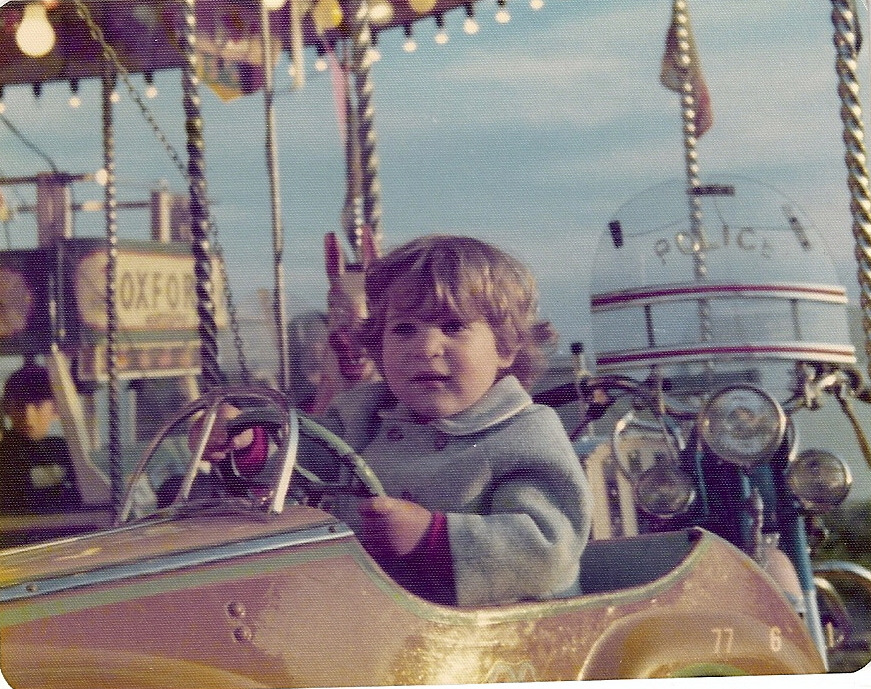
This week, I went to the fair at Brockwell Park. I don’t have a picture of that, but here’s me at another funfair in 1977. I was not a particularly pretty child, nor a thin one, nor one that actually looked all that much like a boy. And what is that coat I’m wearing? But along with a photograph of me and my dad riding the dodgems taken a year later – me marginally cuter, he like the Brummie James Dean – it is one of my favourite images from my youth.

That’s because it was taken at the Epsom Derby funfair, where we went as a family every year. It is almost impossible for an adult to now understand how exciting the funfair is to a small child – the colour and clatter of the rides, the sweet smell of popcorn, onions and candy floss, the sheer thrill of being outside after dark – but this picture brings a lot of that back to me. It’s a pure pleasure, one without any compromises or guilt. By contrast, most grown-up fun tends to come with the feeling that one is doing something one shouldn’t, and will pay for it later, either with a hangover or an empty wallet. Or perhaps that’s just the Catholic in me talking.

When I was a teenager, fairs were still about thrillseeking, just in a different way. There were the rides of course, but now it was more because this was were you went to meet girls (or watch your friends meet girls, or watch your friends talk about how they’d like to meet girls). You also went along in fear/search of some real danger – the possibility of getting chased round the park by the semi-mythical Roundshaw gang, who supposedly spent every evening roaming the borough, looking for people to beat up. Such bifftastic activity has been circumvented by the organisers of the Brockwell Park fair, who have a ‘No Gangs’ notice prominently displayed and a police van on constant vigil. I’m not sure whether this is a good or a bad thing. The parent says ‘good’, the teenager says not.

And it’s as a parent that I take my daughter to the funfair every time it comes to Brockwell Park. That’s partly for her sake, because she loves it so much, but it’s also partly for me, because I want to remember what it’s like to feel this way.

Here she is last week, on a violently orange airplane.


I read an article last week about the dishonesty of most funfairs, how it is impossible to win any prizes and the whole thing is essentially a tiny, tacky, travelling confidence trick. It’s very difficult to visit the fair as an adult and not see the sleaziness. But to a child, unaware that the coconut might be glued to the stand, this is paradise. It is wonderful to witness, but also slightly depressing, because it is impossible to share in the innocence, to see the funfair through an eye unstained by prejudice.

My daughter had more fun at Brockwell Park funfair than I think it is possible for an adult to comprehend, when everything is costed in terms of money and time. I hoped that when I went with her, I’d vicariously absorb some of her glee. And I was happy to see her happy, but I also ended up wallowing in nostalgia and misremembered romance. Is that such a bad thing?

This guy knows what I mean, or at least I used to think he did.

Is that a flagpole on your portico, or are you just pleased to see me?

To whom it may concern: Poetry Incarnation at the Royal Albert Hall

The new issue of Uncut magazine contains my feature about the International Poetry Incarnation, which took place 45 years ago this month on June 11, 1965. It begins like this:

Allen Ginsberg is drunk. Big, bald and bearded, like a Jewish bear stuffed in a suit, the beat poet stands tall in the Royal Albert Hall, London’s sacred haven of the high arts, and proclaims to 7,000 fellow thinkers:

“Fuck me up the asshole”.

In the crowd was Heathcote Williams, the future poet, playwright and artist. Williams recounts what happened next: “A man with a bowler hat, beside himself with anger, shouted out: ‘We want poetry. This is not poetry’, and Ginsberg retorted, looking up towards the gods: ‘I want you to fuck me up the asshole.’”

And it goes on in a similar manner for another 2,400 words. If you think that sounds like fun, head down to your local newsagent now.

The International Poetry Incarnation – which featured Allen Ginsberg, Adrian Mitchell, Gregory Corso and Michael Horovitz – is said to be the moment that signalled the arrival of the 1960s counterculture movement in London. However, in ‘White Heat’, his otherwise splendid history of the 1960s, Dominic Sandbrook writes dismissively: ‘Seven thousand people was indeed an enormous attendance… on the other hand, it was still considerably smaller than the typical crowd for a Second Division football match… to millions of people, the event meant absolutely nothing. What is more, it had not even been a very good reading.’

Oh, really? Watch this extraordinary clip of Adrian Mitchell from Peter Whitehead’s film of the reading, ‘Wholly Communion’, and tell me it has the same impact as Torquay vs Rochdale.

Like a demented seagull: how hate mail changed my life

This is a letter I received several years ago. It begins ‘Dearest Peter, why don’t you just go and drown in your own shit’, goes on in a similar vein for six impeccably crafted pages before signing off ‘U.R.A. Deadman’. It was written by a mad man and it changed my life.

At the time, I prided myself on writing savage, pithy reviews for Time Out (rechristened Slime Out by the writer). I was vicious and splenetic, with the self-righteous confidence of a 20-year-old who believes they have invented authenticity and everybody else is a fool and a fraud. I verbally annihilated such high-profile targets as Toploader’s second album, anybody who ever appeared on Channel 5, ‘Grumpy Old Men’, Lord Robert Winston and Vigo Mortensen’s chin. 

Mr U Deadman (possibly not his real name) had noted my work and enraged by a particularly malicious piece I had written deriding the ridiculous sport of rugby union (clue: the section was titled ‘Rant’), decided it was time for payback. And how.

Much of what he wrote was plain wrong. The man was unbalanced, a bit racist and rather scary. He had extraordinary recall of past Time Out writers, many of whom I had never heard of, whose supposed sins (and, more worryingly, physical appearances) he would discuss at length. 

He also had a wicked turn of phrase. The key paragraph was the following, a rhetorical question that inadvertently changed everything. He asked me:

‘Are you looking forward to your retirement, to the day when you can look back over your working life and think “I slagged people off. That’s what I did with my life. I spent years – in fact, decades – SLAGGING PEOPLE OFF… screaming relentlessly like a demented SEAGULL. I was Slime Out’s top hatchet man in 2003. No-one else could touch me. Not even Lewis”?’

(The latter is a reference to the internationally respected music critic John Lewis, who was also a bit of a meanie back in the day.)

At the time, I laughed it off as the witterings of a deranged sociopath – albeit one with lovely script and excellent phrasing – but it also made me think. Yes, I could be funny, I could wind people up, but really what was the point? At around the same time I proudly showed my girlfriend a furious review I’d written about some vacuous celeb-loaded TV show about dancing and she wasn’t just unimpressed, she looked at me as if I had crapped in her handbag. Being cruel, I realised belatedly, wasn’t nice, or cool, or clever. Well, it was clever, but not in a nice or cool way.

I should have known this already, after the Jason Lee incident at the Sunday Times, when a throwaway comment about a haircut in my TV column was appropriated by ‘Baddiel and Skinner’s Fantasy Football’ with unfortunate repercussions for the career of an innocent pineapple.

So I changed. I stopped reviewing terrible films, only wrote about albums I liked and threw my TV set in the canal. I started to spend more time thinking about the things I enjoyed and wanted to recommend, and less time thinking about funny ways to slag off things I thought were crap.

I probably became more boring and less memorable as a writer, because there are few things more intoxicating than a really wicked piece of invective (pace Brooker), but I think it made me a better writer. I definitely became a happier person. And I still  have no desire to be the sort of person who uses their privileged space in magazines, newspapers and websites to wind-up readers and make asinine generalisations, even if that is the easy way to get noticed (pace a list far too long to mention).

The mysterious mad letter writer continued to treat Time Out to his acidic thoughts, occasionally in the form of epics like the above but usually as mellower postcards, mainly focused on music. He barely mentioned me again, although Lewis got it in the neck a couple of times, and rightly so.

He stopped writing to Time Out completely about a year ago and I often wondered what happened to him. Did he merely cancel his subscription like so many others (to drive off an obsessive, that is impressive), did he get some new, better,  medication, or did something tragic befall him, not entirely unlikely given his clearly troubled mind?

I hope he is okay. I hope he is a happy. And I’ll always keep his letter to remind me of what I never want to become.

Update: Slime Out: The Sequel.

Museum of London reopening

My review of the Museum of London reopening appeared in yesterday’s Independent On Sunday. The museum has refurbished its entire collection from the Great Fire to the present day, something that necessitated closing down the lower-ground floor of the museum for four years. I’ve been on site at a number of times during the refurbishment, so had a good idea of what was intended, but was still hugely impressed (and, in a strange way, rather relieved as so many things can go wrong with these things) by the final result.

The museum now has a great blend of the old and new, with some genuinely impressive modern interactive but also loads of good old-fashioned things in cases. Check it out when it opens to the public on Friday May 28 (it is opening till 9pm on the first day). 

I suppose that a museum ideally wants the visitor feel they’ve ‘got it’ after just one visit, but not ‘got it’ so much that they won’t come back . They don’t want people to be so overwhelmed by information they can’t see what story the museum is telling, but they equally don’t want them to feel they’ve absorbed it all in one go, seen everything there is to see and so never bother returning. The Museum of London, I think, pulls off this delicate balancing act, while also being lots of fun, which is something every good museum wants and needs to be. 

Museum nerds might note that they also manage to subtly highlight a couple of their less appreciated areas of expertise – the excellent costume collection, which gets two strong displays – and their outstanding collection of oral history, which is used to tell the story of the Blitz.

I am particularly interested in oral history. These first-hand recollections from largely ordinary Londoners could be vitally important to future historians, and the museum continues to expand its collection at an impressive rate. One thing I firmly believe is that everybody has a fascinating story to tell, they just don’t always realise what it is about their lives that makes them unique and therefore interesting. Most people are too self-conscious when they write, so oral history is the best way to break down this barrier and capture those stories before they disappear forever.

Finally (and no, I’m not on the payroll), the museum also has a very good (and free) new iPhone app. Check it out here.

The invasion begins!

Magnificent Maps at the British Library

The British Library currently has an excellent new exhibition about maps called Magnificent Maps. I reviewed it for New Statesman (get me), and tried to focus on the sort of political aspects of the maps on display that would appeal to the generally Labour-supporting readers of the New Statesman, seeking any sort of diversion from the electoral massacre they had recently witnessed.

Diamond Geezer also took inspiration from contemporary politics with his review. He wins, I think.

The highlight of the exhibition for many Londoners will undoubtedly be Stephen Walter’s incredible idiosyncratic The Island, which you can study in detail here. This is a very personal and witty look at London by an artist. I particularly like the rather condescending but still satisfying comment he puts next to Herne Hill – ‘If I lived south of the river it would be here’. What finer praise could a North Londoner offer?

If you like maps a lot, you should also check out the hand-drawn gallery at Londonist. A little bird tells me that these may soon get a museum exhibition of their very own.

Exotic animals of London No 1: the humped toucan

I waited all day, but I didn’t see one.

BBC memo: Fawlty Towers ‘dire’ and a ‘disaster’

Some time in the past few years, a copy of this memo came into my possession via the ex TV editor of Time Out, Alkarim Jivani (whose entry in the Urban Dictionary has to be the nicest ever).

It’s from the Comedy Script Editor of the BBC in 1974, who dismisses ‘Fawlty Towers’ as ‘dire’ and ‘a collection of cliches and stock characters’.

Sadly, the coffee stain is not contemporary, dating only from circa 2008.

John Cleese discusses the memo here. He has framed his copy, but I just gave mine to my mate Gabriel. Oh well.