I have always considered Green Park to be the dullest of all central London parks. Look. There’s really nothing there. It’s just a very big lawn.
But twas not always this way. High Society, the Wellcome Collection’s superb new exhibition on drugs in culture – which I recently reviewed in New Statesman – includes a great story from 1799 concerning a doctor, Everard Brande, who was called to the London house of a family suffering from some form of poisoning.
Concerned for his sick family, the father had gone out to seek help but was soon found in a confused state, unable to remember where he was going or why. He was rescued by neighbours and eventually the doctor pieced the story together.
The family had been out gathering mushrooms in Green Park, which they had cooked into a broth, and this had upon the parents and four children an extraordinary effect. All were giddy – with high pulse rates and intense breathing – and all were seeing things. While the adults seemed struck by a morbid fear of death, eight-year-old Edward ‘was attacked by fits of immoderate laughter’ and his staring pupils were massively dilated.
After treatment from Dr Brande, the family recovered (aka came down). I’ll never see Green Park in quite the same way again. I’m sure they didn’t.
For more, see Michael Jay‘s excellent accompanying book.
This newsclip of the London Anti-University from 1968 is wonderfully evocative, not just for the interviewees’ earnest insistence that they could change the world of education, but also through the grim tattiness of late 1960s Shoreditch, reproduced in glorious colour.
The London Anti-University was formed after participants at 1967’s Congress on the Dialectics Of Liberation at the Roundhouse decided they wanted to continue to explore some of the themes and conversations that had started there (sample debates: The Future of Capitalism; Black Power; Imperialism and Revolution in America).
Based at 49 Rivington Street – previously home of the Vietnam Solidarity Campaign – the Anti-University was opened in February 1968 by David Cooper and Alan Krebs, and featured lecturers such as Cornelius Cardew, CLR James, Robin Blackburn, Bob Cobbing, RD Laing, Yoko Ono, Jeff Nuttall, John Latham and Alex Trocchi – all key figures on the intellectual left-wing of the 1960s counterculture. The Anti-University syllabus covered three main areas: radical politics, existential psychiatry and the artistic avant-garde.
An idea of the direction of the Anti-University can be gleaned by a reported exchange at Joseph Berke’s course on ‘anti-universities, anti-hospitals, anti-theatres and anti-families’.
He asked the class: ‘How can we discuss how we can discuss what we want to discuss?’ After a long silence, somebody answered ‘Maybe we don’t need to discuss it.’ Berke pondered this for a while and then left; the class continued for an hour despite his absence.
The Anti-University lasted almost a year, which isn’t bad by the standards of the time, but it’s premises soon became squatted, and the landlords, the Bertrand Russell Peace Foundation, reclaimed the campus.
But the Anti-University’s most important legacy may have come from a conversation in the classroom of psychoanalyst Juliet Mitchell, who lectured on literature and psychology.
One of Mitchell’s students, Diana Gravill, had inherited some money and was intending here to spend it on a women’s refuge. Mitchell instead persuaded her to put it towards a bookshop. This she did, and the shop, named Compendium, was opened by Gravill and her partner Nicholas Rochford on Camden High Street in August 1968.
Over the next thirty years it became one of the world’s great bookshops, stocking everything from academic studies of the women’s movement to punk fanzines. It was still going strong when I used to go there in the late 1990s, fascinated and intimidated by the content of the bookshelves. It eventually closed in 2000, a sad end to one of London’s greatest counterculture institutions, but a longstanding tribute to the ideas and passions raised by the London Anti-University.
This exquisite map of the 1960s West End is one of the most interesting ways I’ve seen of making tangible that fascinating era that remains tantalisingly out of reach and hard to comprehend. Produced by Herb Lester Associates, Wish You Were There is a fascinating physical attempt to bridge the gap in time, to fill in some of the blanks.
It is also a beautiful artefact, a fold-up map that offers a ‘retrospective guide to London’s shops, clubs, boutiques and sundry diversions, 1960-66’. Included are such diverse pleasures as Better Books, home of the Beats, the offices of promoter Don Arden and restaurants like Cranks and The Nosh Bar alongside better known clothes shops, bars and venues.
On one side is a map of central London, and on the other a written guide to the 130 locations, padded out with period advertisements.
Wish You Were There can be purchased here for a bargain £4.
My feature on the birth of British R&B at Eel Pie Island is in this month’s issue of Uncut.
It includes interviews with Pete Townshend, Ron Wood, Kenny Ball, Top Topham and the inventor Trevor Baylis, who still lives on the island and told me.
‘I moved to the island in the 1970s when I’d made enough money as an underwater escape artist in Berlin to buy a plot of land, but I went there regularly from 1957. They were wild times. If you wanted to get your leg over, that’s where you went. It was notorious. There was no bridge, the only way to get there was on a chain ferry. On the island, a little old lady sat in a tollbooth and stamped the back of your hand. The hotel was very Dickensian, a bit of a tramshed just about hanging together, but it had a dance floor that was like a trampoline so if you couldn’t dance when you went in you certainly could when you came out.’
South-west London was a fertile territory for music in the early 1960s, and the likes of Keith Richards, Eric Clapton, Jeff Beck, Rod Stewart and Jimmy Page all learnt their craft in the venues of Richmond and on Eel Pie Island.
As Ian McLagan of the Small Faces explained: ‘The audience was full of musicians. Loads of them. You’d see them all in the front row – “Do you see that?”, “Yeah”, “Well I can do that too”. We were all kids, but when you saw the Stones it was “Fuck me, it’s possible…” ’
Diamond Geezer visited Eel Pie Island recently and writes about it here.
When I first saw this advert, my initial thought was that the cretin rebranding various parts of London was at it again. As I’ve written before, we not only have we got Holborn as ‘Midtown’ and Fitzrovia as ‘Noho’, but also the bizarre decision to call a Pimlico development ‘Westrovia’. (My preference is to rename areas in the manner of American towns with their pragmatic Business District and Meatpacking Quarter, so you’d have Comic Strip for the comic shops around the British Museum and a Ukulele Quarter for the bit of Brick Lane where the Duke of Uke shop can be found. It hasn’t caught on.)
But on reflection and as a proud London snob I rather like this idea of rebranding Northampton as North Londonshire and see no reason why it can’t be expanded to the rest of the country. Most of Britain, after all, really wishes it was in London and hides its jealousy of our superior ways in various silly ways, such as pretending that nobody in London talks to anybody else. In truth, the only people Londoners don’t talk to is northerners, and that’s just a magnanimous gesture intended to help them stop feeling guilty about abandoning their oldest friends and frail, elderly parents in a frankly selfish attempt to find work and a decent cup of coffee.
So, to that end, here are some ideas I had for other parts of the UK that could be renamed after bits of London. Some, like Stoke, clearly modelled on Stoke Newingston, are already doing this themselves.
Yesterday’s protests by schoolchildren were by no means the first time London’s schoolkids have chosen to withdraw their labour from the classroom, as Clive Bloom discusses in his recently updated ‘Violent London’.
There were waves of strikes in 1889 and 1911 around issues such as corporal punishment, the length school day, leaving age, holidays and bullying teachers. In 1889 there were strikes in Finsbury Park, Homerton, Woolwich, Plumstead, Kennington, Charlton and Lambeth and in 1911 in Enfield, Islington, Hoxton, Fulham, East Ham and Deptford. Strikes continued until long into the 20th century. I’m pretty sure Grange Hill went on strike a couple of times as well.
These original strikes featured pickets, marches and demos with flags and banners, and often ended with some casual window-breaking, for which the pupils would invariably receive disproportionate punishment such as being birched in front of the whole school or sent to the workhouse.
That was because the authorities were terrified about these strikes, firstly because of the lack of discipline it demonstrated but also because they suggested the children were developing a political consciousness that challenged and threatened the establishment. Kids were learning to think for themselves and were bold enough to shout about it. Some in Bethnal Green even carried red flags.
Newspapers argued that strikes were ‘manifestations of a serious deterioration in the moral fibre of the rising generation’, argued that ringleaders ‘could prove dangerous centres of moral contamination’ and claimed that ‘such movements as this do not spring up spontaneously. They are always evidence of a deep conspiracy against social order… the doom of the Empire must be near at end if the country is honeycombed with Secret Societies of schoolchildren.’
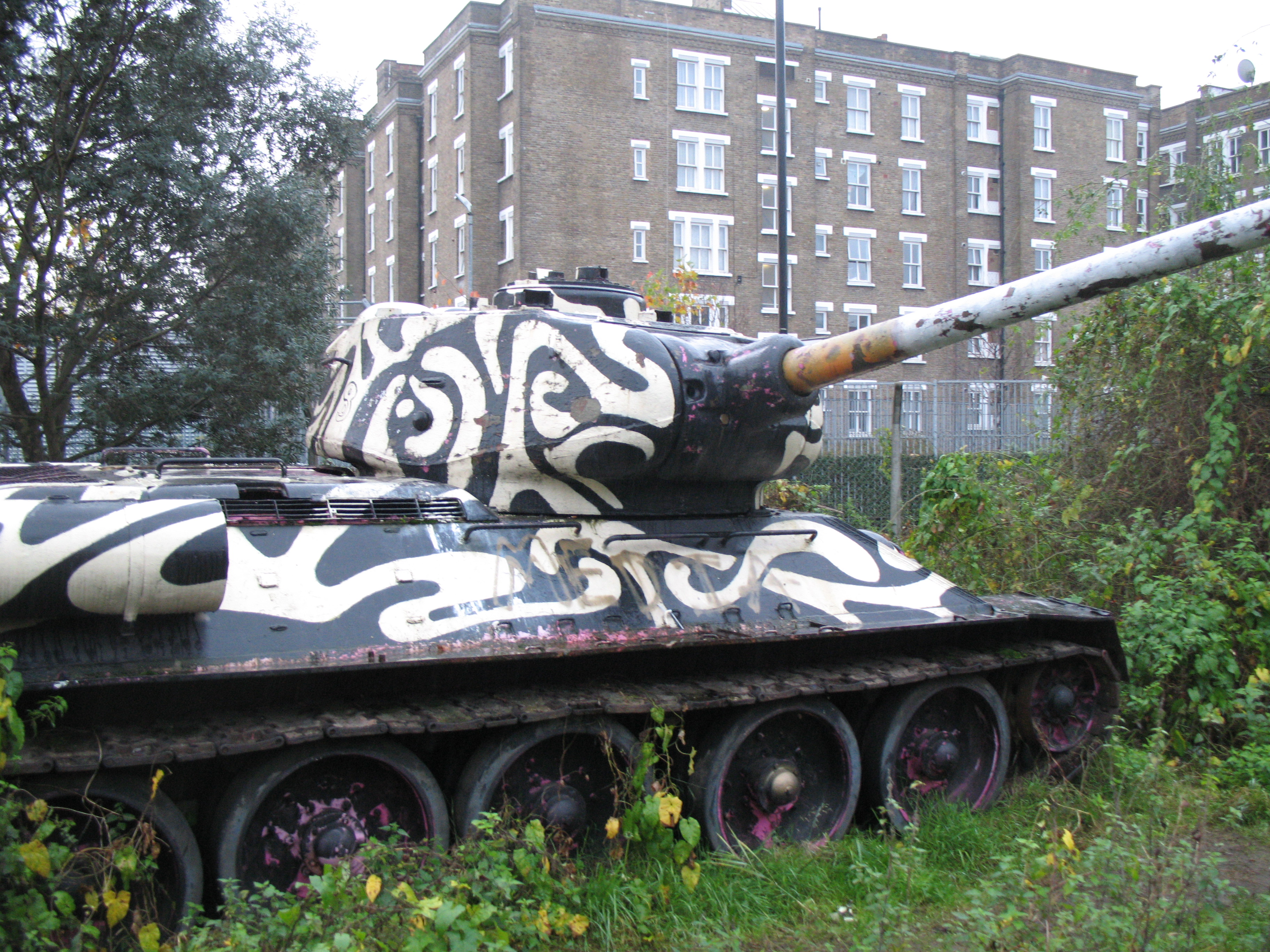
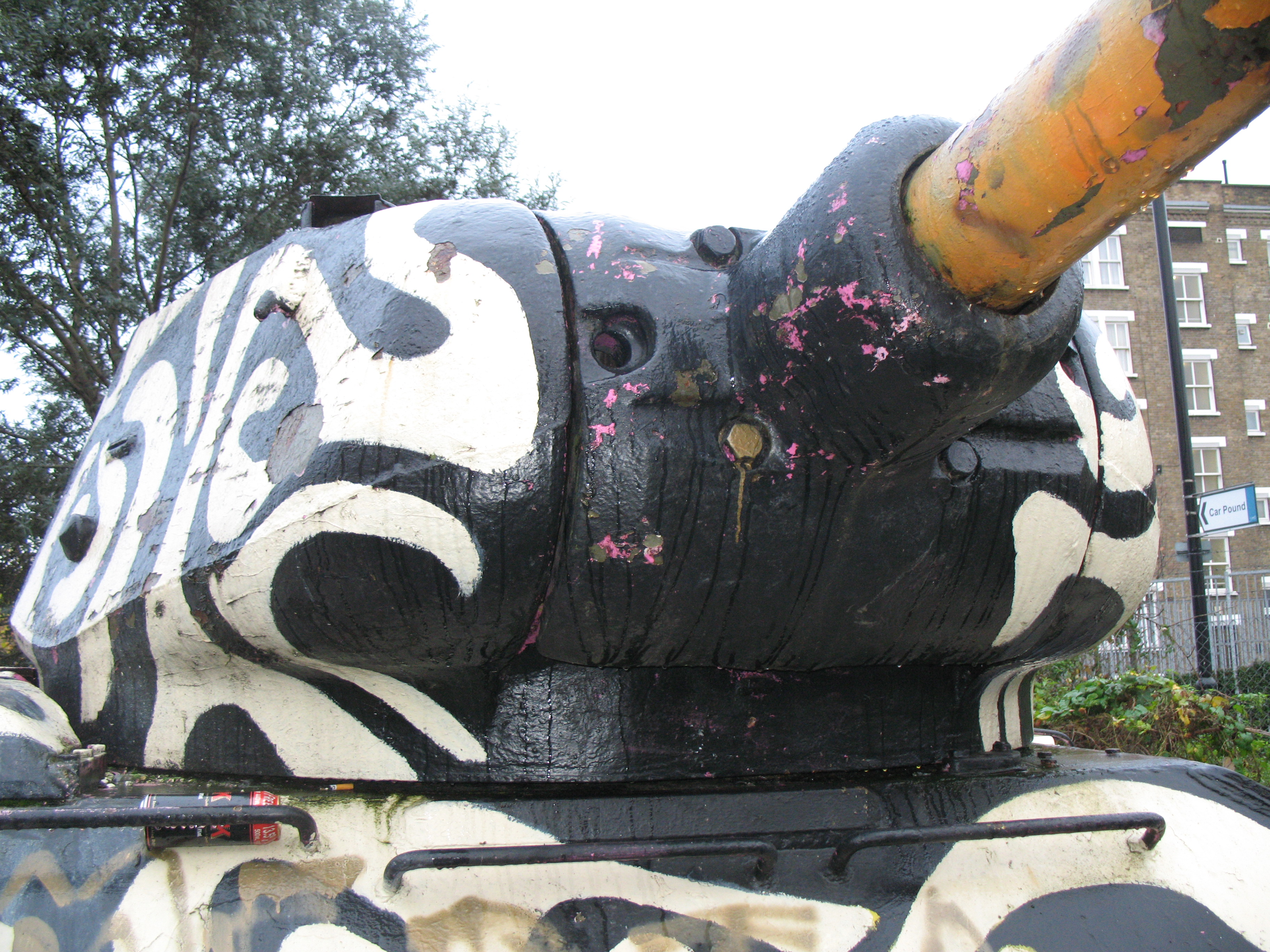
That there is an authentic Russian tank parked in a patch of wasteland on a side street off the Old Kent Road is one of those things that is so brilliant it should be mentioned on the news at least once every day. (I felt much the same way about Gordon Brown’s glass eye. A Prime Minister with a glass eye! How cool was that! What a wasted opportunity.)
The tank is a T34 Russian tank that was possibly used against the Czechs in the Prague Spring uprising of 1968. It arrived in London in 1995 when it was used for the filming of Richard III. The tank was then purchased by Londoner Russell Gray as a sort of giant and very expensive pun after Southwark refused him planning permission to build houses on the site. Gray instead applied for permission to put a tank on the site. They thought he meant water tank, but he didn’t. The tank’s gun is trained on the council office.
How much truth there is to that story is surely irrelevant. It feels right. And when it comes down to it, all that matters is that there is a bloody great Russian tank on the streets of South London and people don’t seem to realise quite how incredible this actually is.
The Cheapside Hoard is one of the great treasures of the Museum Of London. A vast collection of Tudor jewellery, it was found by two workmen in the cellar of a house on Cheapside in 1912 and eventually made its way into the museum’s collection.
The story is a fascinating one, outlined in HV Morton‘s seminal London history ‘In Search Of London’.
Morton, a journalist and insatiable London enthusiast with the knack of knowing not so much the right people as the really interesting ones, begins by describing GF Lawrence, ‘or Stoney Jack as he was known by every navvy who worked in the City’.
Stoney Jack was an asthmatic antiques dealer with a shop on West Hill, Wandsworth. He also had a job as Inspector of Acquisitions at what was then called the London Museum, based in Lancaster House, St James’s.
Since the 1970s, every building site in the UK must by law be visited by a team of archaeologists to ensure no great treasures are missed, but in Lawrence’s time there was no such requirement. Lawrence’s job then was ‘to haunt every demolition site in the City and make friends with the navvies, so that they would bring to him anything that had been found during excavation’.
Morton writes that there was a lot of building work taking place at this time and Lawrence knew it may be the last chance to find any antiquities that might still be hidden in the soil. In his not entirely public-spirited determination to ensure nothing crucial was lost, workmen received rudimentary archaeological training during ‘mysterious transactions behind hoardings and in the tap rooms of City public-houses’.
In this way, Lawrence was able to purchase items from ‘a procession of navvies with mysterious objects wrapped in spotted handkerchiefs’ and flog them on to the London Museum, earning himself a tidy profit. Anything the museum didn’t buy, went into his shop. And even if the navvies brought him something worthless, he always gave them enough cash to buy a pint of beer. In this way, he built up much of the Roman and Medieval collection that is now in the Museum of London.
Morton continues:
I cannot count the times I have been present when navvies have appeared and passed their treasures across the counter with a husky, “Any good to yer, guv’nor?” I have seen handkerchiefs unknotted to reveal Roman pins, mirrors, coins, leather, pottery and every kind of object that can lie concealed in old and storied soil.
I was with him one day when two navvies handed over a heavy mass of clay found beneath a building in Cheapside. It was like an iron football, and they said there was a lot more of it. Sticking in the clay were bright gleams of gold. When they had gone, we went up to the bathroom and turned the water on to the clay. Out fell pearl earrings and pendants and all kinds of crumpled jewellery. That was how the famous hoard of Tudor jewellery, the Cheapside Hoard, was discovered.’
Morton recalls that for this great find, now worth millions, Stoney Jack received a thousand pounds. For their part, the navvies were rewarded with ‘something like a hundred pounds each, and I was told that these man disappeared, and were not seen again for months!’
I cocked up at work the other day. It wasn’t anything major, but it was enough to reignite that familiar feeling: stomach lurching, chest tightening, face reddening, bottom squeaking. A mix of self-loathing – ‘how could I be so stupid????’ – and indignation – ‘it wasn’t my fault!!!’ Then you start to wonder if you can get away with it, or should fess up forthwith.
In general, the best solution is to find that person who is at a similar or lower level of seniority to yourself, but way more competent and powerful (you know the one), and politely beg them to sort it out. But I work on my own, so had to bluff it out, which I did more or less.
It reminded me of other great cock ups of the past:
The time I forgot to include Coronation Street in the TV listings.
The time I asked if I could interview somebody who was dead.
The time I said on the cover of a magazine that the first phone call had taken place in London when it was really in New York.
The time I got the world 100m record wrong in the Guinness Book Of World Records.
The time I compiled the squad lists for a Premier League preview and completely forgot about Sheffield Wednesday.
The time I left the ‘S’ off Scunthorpe in the fixture list for a national paper (actually, I did this on purpose).
Ah, happy times and no lasting damage done.
The good news is that over the years I’ve witnessed far greater cock ups from people considerably more important than myself, so it’s clearly not a career-breaker in my chosen line of work.
Here’s to journalism, and gleefully calling other people’s cock ups to account while studiously ignoring our own.
I’ve seen three new exhibitions since being bored senseless by the British Museum’s Book of the Dead, and all of them are vastly superior to that banal blockbuster.
While the British Museum takes a complacent Tesco-like approach of pile it high and intimidate people with sheer weight of history, the Imperial War Museum, Wellcome Collection and British Library all have to work a little harder to get any attention and the results are far more satisfying.
Take Evolving English at the British Library, a superb exhibition about the history of the English language that offers both intelligence, insight and, most tellingly, the cheerful sense of humour that is lacking from Great Russell Street.
There are showstopping exhibits here, such as manuscripts of Jane Austen’s ‘Persuasion’ and Joyce’s ‘Finnegans Wake’ and a copy of ‘Beowulf’, while the curators were ecstatic about a cabinet that featured side-by-side four historic bibles – the Wycliffe, Tyndale, Book of Common Prayer and King James.
But there are also wilder treats hidden in the margins.
One section on the differences between spoken and written English was illustrated by letters from schoolchildren to their teacher, my beloved BS Johnson, written in a glorious mixture of slang, formality and stream of consciousness that later found their way verbatim into his novel ‘Albert Angelo’. (‘Mr Johnson has a poor outlook towards us, calling us peasants and other insulting names of which we would like to contradict… Mr Johnson on the whole although he isn’t all there is a rotton teacher but not proffesionally for he teaches well… in school Mr Johnson is an authentic nit.’)
The section on profanity is illustrated with a copy of ‘Lady Chatterley’s Lover’ and a copy of Viz, while you can explore London English by reading extracts from Charles Dickens or you can just listen to ‘Gertcha!’.
London English, we are reminded, adopts words from many different cultures and I was intrigued to learn about the history of the Black London idiom ‘aksed’ for ‘asked’. This apparently originated in south-west England and found its way to the Southern US states and the Caribbean through emigration, before returning to London via the West Indian diaspora. Take it away, Smiley Culture.