Secret London: streets beneath streets of London

Paul, the librarian at Time Out, first told me about the street beneath Charing Cross Road in around 2005. He promised to show it to me, but never did.

Then, last month, I saw it. I was mooching around Cambridge Circus, noting the loss of London’s best-named book shop, Lovejoys, a landmark from the time I used to be a dedicated fanzine-browser across the road at Sportpages, also since departed. I had always assumed Lovejoys was a wittily named Soho porn shop, but it actually stocked cheap classics and DVDs. The shop taking over the site will be a sex shop it seems, albeit of the modern, seedless, air-brushed, air-conditioned variety rather than Soho’s traditional damp basement. With the erasure of any trace of character at the arse-end of Berwick Street, the old Soho sex shop is nearly gone. Indeed, much of this post is about things that have been removed, including Paul the librarian, who left Time Out shortly before I did.

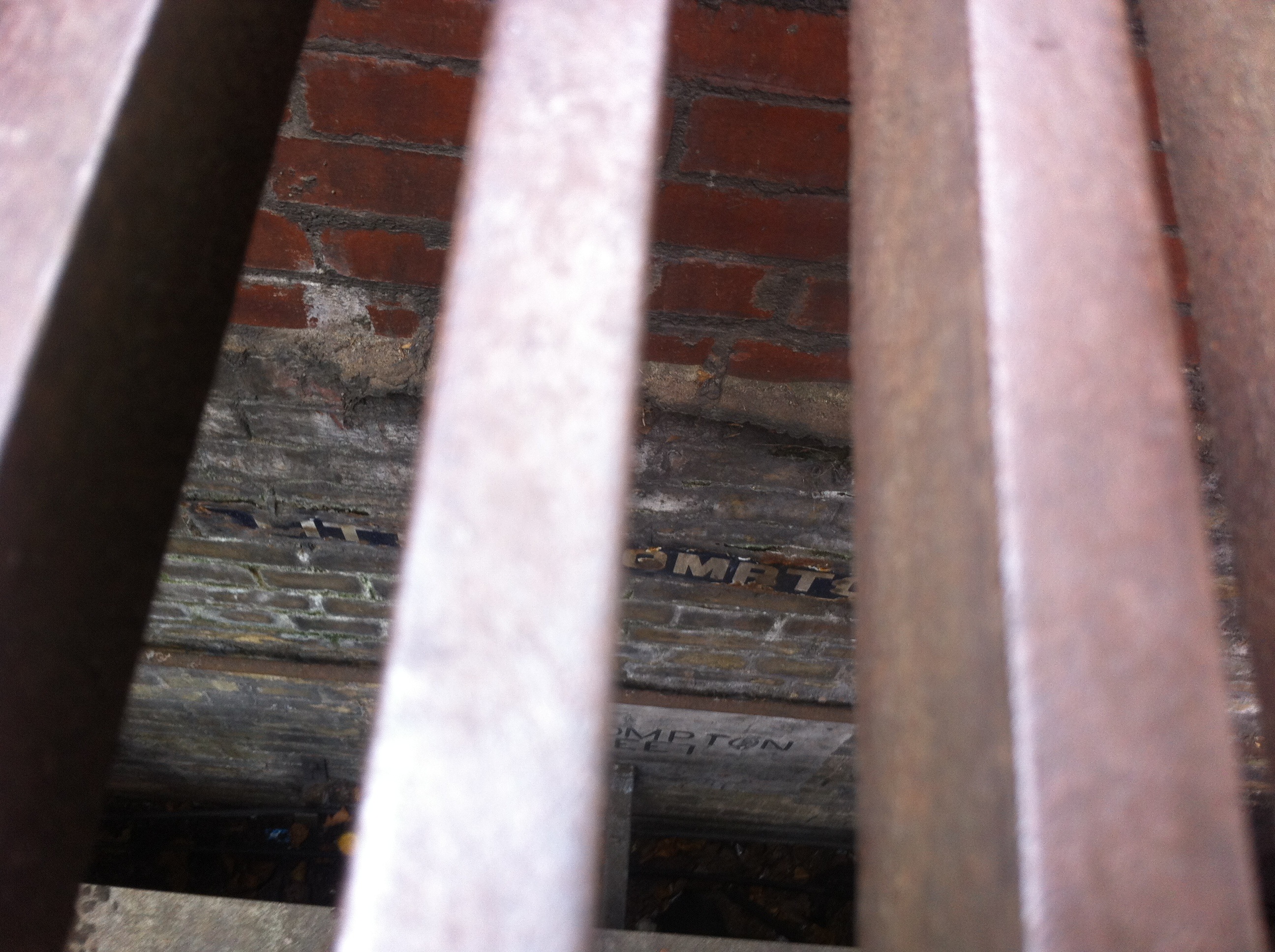
As I crossed Charing Cross Road from Soho and stood on an island in the middle of the road waiting for a No 24 bus to pass, I happened to look into the grille beneath my feet. I have instinctive curiosity when it comes to London holes but this is the first time I’ve really seen anything of interest, as, to my surprise, I could make out what appeared to be a subterranean street sign set into the wall a few feet below the ground.

IMG_1992

I leaned in closer and there they were – not one, but two street signs for Little Compton Street, one blue enamel and the other painted on to brick. Here was London’s buried street.

IMG_1990

Although Little Compton Street has its own Wikipedia page, it is not entirely clear how the signs got here. The street itself was obliterated by the construction of Charing Cross Road – here you can see Little Compton Street on an old map of 1868, intersecting with Crown Street (which is marked by green as Soho’s border, though surely red would be more appropriate) just before Cambridge Circus. Little Compton Street ceased to exist in around 1896 and is now part of the Cambridge Circus utility tunnels, which some urban explorers write about here. (Apparently, Rimbaud and Verlaine used to drink in a pub on Little Compton Street during their dramatic London stay.)

map1868

Were the underground signs accidentally left behind when Charing Cross Road was run roughshod over the top of Crown Street or was it a careful act of preservation by an unnaturally thoughtful council? Or were they removed from a wall by unknown hand and deliberately placed down here, where Little Compton Street has existed ever since, entombed beneath London feet and offering a tantalising glimpse of those fantasy Londons from countless dreams and dramas. There’s an echo of China Mieville, Neil Gaiman and the Borribles, but also of Malcolm McLaren’s mysterious and misremembered subterranean Victorian road (neatly discussed here) that is said to exist intact beneath Selfridges on Oxford Street.

One wonders whether the brutal Crossrail redevelopment of this bedraggled part of the West End will allow any such traces to remain. I hope so. And I hope they also have this last-gasp, accidental feel, of something that London can’t quite let go, like dying fingernails clawing a wall, leaving behind a ghost, a whisper, of one of London’s many pasts.

For some great old images of Charing Cross Road, browse here with leisure and a little sadness.

The many voices of Bon Scott

While there’s no such thing as a romantic rock death, there are few as bleakly pathetic as that of Bon Scott, the AC/DC frontman who died drunk in the passenger seat of a Renault 5 outside a friend’s flat in East Dulwich, just a short distance from where I live.

I wrote about Bon Scott’s life in the current issue of Uncut, which allowed me to revisit some of the fabulous archive footage of Scott and AC/DC you can find on You Tube. The band spend much of the late 1970s based in London, where they were able to build up a large fanbase thanks to regular gigs at the Marquee. Here Scott is interviewed by Australian TV while walking through Covent Garden in a pair of the smallest shorts I’ve ever seen. I’m still not entirely sure where he produces that banana from.

A considerable amount of Scott’s charm as well as his brilliance as a vocalist is captured in this coruscating video for “Let There Be Rock”. Just watch it all the way through, and you can see how Scott worked the camera almost as well as he did the stage.

This is the Bon Scott I knew and loved, but researching the article I discovered more about Scott’s Australian life pre-AC/DC when he performed a pair of bands that were radically different from both each other and from AC/DC. Try this out for size, it’s Scott’s Perth-based teenybop 1960s act, The Valentines, singing, er, “Nick Nack Paddy Whack”. The main singer is Vince Lovegrove. Scott stands at the back next to the drummer, you can see his embarrassed grin at around 90 seconds. (The Valentines also recorded a jingle for Coca-Cola, which lifts you up when you are feeling down apparently.)

After The Valentines broke up, Scott did a complete turnabout and joined Fraternity, a bunch of Aussie hippies who lived in a commune in Adelaide and wanted to be The Band. Here he is, bearded and playing recorder, on a profoundly serious cover of “Seasons Of Change”.

No wonder, then, that he leaped at the chance to join AC/DC, and release some of his natural impish spirit. Here he is doing “I’m A Rocker” in London in 1977, the very image of the 1970s hard rock frontman and one of the best of his generation.

http://www.youtube.com/watch?v=xY8vl1CrO3o

Scott’s “It’s A Long Way To The Top” is one of the great songs about being in a band. Scott wrote it from the heart. He knew. And that is why he could sing it like this, from the Marquee in 76.

http://www.youtube.com/watch?v=mXKnJIxW6uw

And this is where it all ended: 67 Overhill Road, East Dulwich. How about a plaque, Southwark? It’s the least the man deserves.

London by the bollards

I have a piece in the Autumn 2013 issue of Completely London about London experts, those Londoners who specialise in esoteric subjects like lion statues, ghost signs and stinkpipes. You can read part of it here. My interview with John Kennedy, London’s bollard supremo, didn’t make the cut so I have reproduced it below.

John Kennedy, 47, taxi driver & writer of Bollards Of London
Most people in London get excited about the Tower of London and Buckingham Palace but when you drive a taxi you get bored of the norm and start to look around and notice other things. With me, it’s bollards. It actually began as a bet with ‘Big’ George Webley, a radio presenter. He challenged me to write a blog about something weird and it got picked up by the Guardian. Now I’m really interested in bollards, the way they look, where they are located, what they are used for and how we interact with them.


Bollards have so many uses but most people don’t notice them no matter how colourful, ornate or dandy they are. I really like the Anthony Gormley bollards in Peckham. I love that one of our great contemporary artists is making street furniture. I picked up Charles Saatchi recently and we ended up talking bollards, he found it quite amusing that I had a blog with pictures of 330 bollards. You do get some odd looks when you photograph a bollard – the other day I was spotted taking a picture by somebody. He said, ‘You must be the bollard man.’

Know London

City-lit London

This is an edited extract of an introduction I wrote for City-Lit London, a superb anthology of London writing, from 2009.

I don’t really know London. This despite having lived and worked within the collar of the M25 for my entire life, something that is simultaneously a source of great pride and creeping shame. I’ve explored it, sure. I’ve gazed down at dawn on drowsy Londoners from atop a thirteenth-century church tower in Hackney. I’ve listened to the hum of traffic passing overhead from deep within the buried Fleet River beneath Holborn Circus. I’ve walked the Thames one Sunday afternoon from St Paul’s to Hampton Court, been to the end of more than half the tube lines, sniffed Billingsgate Market’s early-morning buzz and fed the black-tongued giraffes at London Zoo. I’ve even travelled every bus from 1 to 50 in numerical order, a task that’s taken me to every point of the compass from Debden in the north-east to Fullwell in the south-west (no, I’d never heard of them before I started, either). But I still don’t know London. Not really. There are vast tracts of its urban geography that are a total mystery to me, a no-man’s land, vacant lots, blank space in my internal A-Z.

This is not an unusual condition. Indeed, it might even be a necessity for living a sane, balanced London life because most of the city’s residents seem to suffer from it, some quite contentedly, perfectly happy to stay within the few square miles where they live and the West End where they work. This could be because there is simply too much London to handle ― too many streets, too many people, too much history, too many inconsistencies. The London cabby, scientists say, has developed a larger-than-average hippocampus ― the part of the brain that processes navigation – simply to cope with all the information. One of them, Fred Housego, even won ‘Mastermind’ in 1980.

Most of us don’t even try to deal with all this geographical sludge. In Soft City, Jonathan Raban’s charismatic study of the modern city from 1974, he noted: ‘The Greater London Council is responsible for a sprawl shaped like a rugby ball about twenty-five miles long and twenty miles wide; my London is a concise kidney-shaped patch within that space, in which no point is more than seven miles from any other… I hardly ever trespass beyond those limits, and when I do, I feel I’m in foreign territory, a landscape of hazard and rumour. Like any tribesman hedging himself in behind a stockade of taboos, I mark my boundaries with graveyards, terminal transportation points and wildernesses. Beyond them, nothing is to be trusted and anything might happen.’

This is a common way of behaving, retreating within self-imposed borders and putting up the fences to the darkness on the other side. It’s captured by Tarquin Hall’s passage from Salaam Brick Lane and the stark single-line confession: ‘Most of London, the city of my birth, was as foreign to me as Prague’. The bard of Cricklewood, Alan Coren, explored a related theme in typically whimsical fashion in which he imagined his intended tour of all the London landmarks he has never actually visited – the Tower of London the Monument and the Serpentine — having decided to leave that sort of thing to the tourists.

No wonder and no shame. If you’re born in Harrow, what should you understand of Harlow? If you live near Crystal Palace park, why would you need to know Hampstead Heath? How many Londoners have ever toured the Houses of Parliament or been into the Whispering Gallery of St Paul’s? The greatest area of neglect is the City — if you don’t work within that glorious square mile that contains all history from the Romans to the Credit Crunch why would you ever have a reason to go there? Londoners leave it to tourists and bankers.

And then there are the contradictions. This is the city that features some of the wealthiest real estate within some of the most deprived boroughs in the United Kingdom; the city whose ships helped spread English around the world but is now home to more than 250 different languages and has schools where the native tongue is barely spoken; the city that when called upon to appoint a new mayor, replaced a left-wing, working-class, car-hating socialist with a right-wing, public-school educated, neo-Thatcherite motoring correspondent, two iconoclasts who seemed to have nothing in common bar a quick wit and mutual contempt for orthodoxy. Who can get their head round that?

So, how can you learn to master this metropolis, the first great city of the modern age and still the world leader in art and commerce? Well, you could follow in the footsteps of Phyllis Pearsall, the creator of the single greatest London book – and one that is understandably omitted from this anthology – the A-Z. In the 1930s, Pearsall claimed to have walked every one of London’s 23,000 streets – that’s around 3,000 miles of serious perambulation – in her determination to produce the most comprehensive map of London that is humanly possible. It’s almost certainly an urban myth, but the conceit is admirable.

Alternatively, you could save on leatherwear and consult some of the other classics of London literature, those writers who have made it their business to understand the city, or at least their particular patch of it. After all, will anybody ever show off Soho like Colin McInnes, or capture Camden like David Thomson? Virginia Woolf’s West End is so beautifully developed, so perfectly drawn, so hyper-real, it almost dwarfs the genuine article. And Monica Ali’s Brick Lane places it as firmly on the tourist map as Big Ben and the Wheel, so you can tell yourself that there really isn’t any need to check it out for yourself.

London books allow you to travel in time as well as space. McInnes’s Soho is the good one, the one we’ve all heard about from the 1950s, when it was still raw, neon-lit, jazz-fuelled and edgy rather than a shallow cluster of over-priced restaurants and drunken daytrippers wondering where all the loucheness has gone (it’s still there, just, in secret drinking clubs and members’ bars hidden behind nameless Georgian façades). And Thomson’s Camden is one on the verge of massive change, a working-class district of pubs and markets that is about to experience the first invasion by the middle-classes that will recondition the area beyond all recognition, setting off a chain reaction of gentrification around London’s inner suburbs from Notting Hill to Islington. For those of us who only know these places in their current incarnation, this stuff has an extraordinary archaeological value that their authors could never have intended, like the background of family photographs that show furniture and fittings everybody forgot about long ago because they never bothered to record them.

But that’s not to say things were so much better in the old says. Indeed, one of the most important things about this volume is that it emphasises the current prodigious strength of London writing. Yes, there’s Dickens and Woolf and Conrad and Wilde and Conan Doyle – as there should be – but there’s also Ackroyd and Sinclair and Self, the titanic trinity of contemporary London writing. Since the 1980s they have done more to resurrect the concept of London writing as a standalone genre than anybody since the Victorians, when London, the New Jerusalem, was seen to embody the contradictory values of Empire and became a rich source of fiction and journalism. They have encouraged the rediscovery of some of the lost classics of London literature and fostered the climate in which anthologies like this one can flourish. In their wake, modern classics have followed, from Justin Cartwright’s snappy satirical novel Look At It This Way to Sukhdev Sandhu’s invaluable nocturnal jaunts into the belly of sleeping London in Night Haunts. This regained respect for London writing also allows the voice of the new Londoner to be heard — the 27.1 per cent of the population that the 2001 census considered to be non-native-born ― through authors such as Xiaolu Guo, with her faux-naïve extracts from A Concise Chinese-English Dictionary for Lovers. In Rebecca Taylor’s ‘London Lives’ we even meet one of these recent arrivals in the form of a young brother and sister who travel to London from Poland to begin their new lives, part of the huge wave of Eastern European immigration that has transformed the city in recent years.

It is authors from this final category who could provide some of the finest and boldest London writing of the twenty-first century, because they will come to the city with a fresh mind and open eye, prepared to live and work in those parts of London that are closed by personal choice to most natives. None of them, of course, will ever really get on top of London, even if they choose to stay here for the rest of their lives — but every little bit helps. And if you put all the fragments together, you may one day get something close to the full picture, the London that we all love, even if it’s not the one we know.

Secret London: eight London shrines

I wrote this for the wonderful Curiocity, London’s finest pocket-sized trivia-and-map-packing magazine. Issue E, with a pilgrimage theme, is available at all good London bookshops. 

Tyburn martyrs
On Bayswater Road at Marble Arch is a small convent, unlikely home to a ‘cloistered community of benedictine contemplatives’, aka nuns. In the basement chapel, the walls are covered with ancient relics – skin, bone, bits of fingernails – from some of the 350 Catholic martyrs who were hanged on the three-sided Tyburn Tree during the Tudor wars of religion. Behind the altar of this ghoulish Martyr’s Shrine is a replica of the Tyburn gallows itself.

Giro, The Nazi Dog
One of London’s best known ‘secret’ sites, this little stone on Carlton House Terrace marks the grave of Giro, beloved pooch of (Hitler-opposing) German ambassador Leopold von Hoesch. Giro died while the German Embassy was at No 8-9 (now the Royal Society) during the pre-war Nazi era. He wasn’t really a Nazi, incidentally, as dogs rarely express a political preference (although I did once know one that would bark like a maniac if you said ‘Labour party’).

Bolan’s Tree
A sycamore tree on Queen’s Drive in Barnes has been a shrine to Marc Bolan since 1977 when Bolan’s Mini crashed into it, killing the singer instantly. A bronze bust of Bolan stands nearby.

Spoons

Holborn’s junkie spoons
Underneath a dank stairwell in Farringdon close to Mount Pleasant sorting office you might stumble across a wall stuck with a dozen mysterious spoons. Urban legend says these were placed here by heroin users in tribute to their dead peers, each spoon marking a new death.

Cross Bones graveyard
This parcel of disused land in Borough has been claimed by locals as a shrine to prostitutes said to have been buried on unconsecrated land since the 1500s, and they come here to lay flowers for the forgotten dead. In truth, Borough had many such graveyards and Cross Bones was used to bury the poor of both sexes.

Regent’s Canal coconuts
The further west you head along Regent’s Canal towards Southall the more likely it is you will come across a coconut floating in the water, sometimes cut in half and containing candles. These are placed there by London Hindus in religious ceremonies that sees the tiny canal replace the mighty Ganges.

Skateboard graveyard
Look over the side of the Jubilee Footbridge and you’ll see dozens of broken skateboards lying on one of the concrete feet that anchor the bridge to the Thames. These are boards that have experienced one olley too many and, beyond repair, been dropped to join their kin by South Bank skateboarders.

Postman’s Park
A shrine to everyday heroes, this park features a number of ceramic tiles dedicated to Londoners who died while saving the lives of others. A remarkable, very touching little spot created by the Victorian artist GF Watts.

Football and anti-Semitism

The debate about the use of the word ‘Yid’ in football is all over the papers at the moment, including, with breathtaking insensitivity, this front page. I’m not easily offended, but found this headline is horrendous.

The topic of Jews and English football is the subject of an exhibition, Four Four Jew, opening next month at the Jewish Museum London. I interviewed the curator and we touched on the controversy around the ‘Y word’ , as she phrased it. She said that while the exhibition would look at the use of ‘Yid’ it ‘wouldn’t come down on either side of the argument’.

Ultimately, whether you are comfortable calling somebody a ‘Yid’, either in support or in hate, is a personal decision. I made up my mind where I stand a long time ago and here is an updated version of an article I wrote on the subject in Time Out a few years ago.

———

I’d been calling Spurs ‘the Yids’ for a couple of years before my dad told me it was racist. ‘Don’t you know it’s anti-Semitic?’ he said. I didn’t, nor had I worked it out from one of my favourite Chelsea chants: ‘He’s only a poor little Yiddo/He stands at the back of the Shelf/He goes to the bar/To buy a lager/And only buys one for himself’. Racial stereotypes were clearly not one of my strong points as a 13-year-old.

I’d like to say that I immediately stopped using the word, but I didn’t. Chelsea fans – like those at Arsenal and West Ham – had been calling Tottenham ‘Yids’ for decades. Given that Spurs devotees called themselves the ‘Yid army’ I didn’t see how it caused any harm. I didn’t consider it racist or anti-Semitic, just a near-the-knuckle nickname for a rival football club.

I’ve stopped now. The eureka moment for me came when I was at a game in the mid-90s. Chelsea fan David Baddiel, who is Jewish, was spotted by the crowd after half-time as he returned to his seat with a cup of tea, and several hundred people began chanting ‘Yiddo, Yiddo’ at him, in what I imagine they considered to be an affectionate manner. Baddiel smiled it off – but the penny dropped that this was straightforward racist abuse. Baddiel later wrote:  ‘I told myself that it didn’t matter, that for most of these fans, “Yiddo” simply meant a Tottenham player or fan and that the negativity was about that and not about race.’ However, when Chelsea fans aimed the chant at non-Tottenham Israeli players, Baddiel ‘realised “Yiddo” may mean Tottenham fan but it also means Jew.’ He has since become an outspoken opponent of the use of the word by all supporters, earning him much scorn from Spurs fans. 

It used to be worse. In the 1980s hissing to imitate the release of gas was said to be commonplace, but I have never heard this – or chants about Auschwitz, bar from two drunks on The Shed in a League Cup tie in 1990 –  in more than 25 years of attending Chelsea-Spurs fixtures home and away. By the early 1990s, many fans had realised that was a step too far. I’m sure it still occurs but, in my experience, it’s pretty rare. Although by all accounts, West Ham are still at it. 

The canard that hissing is regularly heard at Chelsea games is often used by Spurs fans, as they attempt to defend their own use of ‘Yid’ but Jeremy Vine, a former Times journalist and another Jewish Chelsea fan, agrees it doesn’t happen often. ‘I’m sure I would notice hissing as it would most likely come from the Matthew Harding Stand, where I sit.’ Vine stopped attending games in the 1980s due to racism and says: ‘Without doubt some of those who chant “Yid” are anti-Semites at heart… but I don’t believe all are.’ The problem is that ‘personal jibes are part of the language of the terraces. Anything goes. And so the boundaries of decency and offensiveness become blurred.’

What muddies the water further is that since the 1970s, Spurs fans have reclaimed what was originally coined as a term of abuse (nobody knows why, Tottenham being no more ‘Jewish’ than Arsenal or Chelsea). Former Chelsea chairman Ken Bates, always torn between defending Chelsea supporters while confronting their excesses, argued that, ‘It is hard to criticise Chelsea fans for calling Tottenham supporters something that they call themselves.’ Chelsea have since rejected this line and now take a zero tolerance approach. It’s worked, to some extent. My old favourite, ‘He’s only a poor little Yiddo’ is rarely heard at Stamford Bridge these days. Spurs still get plenty of abuse, but – within the ground, certainly – the tone of it is much changed. 

A few years ago, Spurs conducted a ‘full consultation exercise’ over the use of ‘Yid Army’ because of fears it led to ‘casual anti-Semitism’, but this was criticised by many of their own supporters who felt the chant united Jewish and non-Jewish Tottenham fans. ‘If you are Tottenham, you are a Yid,’ is the line many take. That is what annoyed them so much about the recent FA instruction that all uses of Yid must cease, an argument that David Cameron has now blundered into. Many argue there’s a distinction between chanting ‘Yiddo’ and singing about concentration camps, which is broadly true – unless you’re racist. I’d even go so far to contend that Spurs have won the argument – they’ve reclaimed a term of abuse. But when it leads to casually racist headlines like that published above – and let’s remember that most Jewish people who see that headline will not support Tottenham –  one wonders quite where this will end.

It is, as Joanne Rosenthal, the Jewish Museum curator, told me ‘very complicated. Even if it appears black and white the two poles are very strongly opposed. Fan culture has this nastier side and we can’t ignore it. It’s now become part of Tottenham’s heritage. It’s difficult to tell people what they can or can’t do.’

Perhaps not, and I’m a huge fan of tribalism at football, but sometimes everybody just needs to grow up and move on. Maybe that Metro headline, as trivial and offensive as it is, will give people pause for thought.


The Clash in Soho

The Clash have opened a, wait for it, pop-up shop in Soho to promote the release of their new box set. It’s only open for a couple of weeks, and I happened to be in the West End yesterday so paid a quick visit, joining a crowd made up entirely, and unsurprisingly, of middle-aged men.

I wasn’t actually expecting a great deal, but was pleasantly surprised by what I found. While the upstairs is essentially a Clash mini-mart, flogging copies of the band’s albums as well as the Sound System box, the downstairs is more like a mini-museum of Clash memorabilia, featuring the iconic alongside pleasing ephemera.

So while the biggest draw was the buggered bass guitar that Paul Simonon is seen smashing on the cover of London Calling

IMG_1934

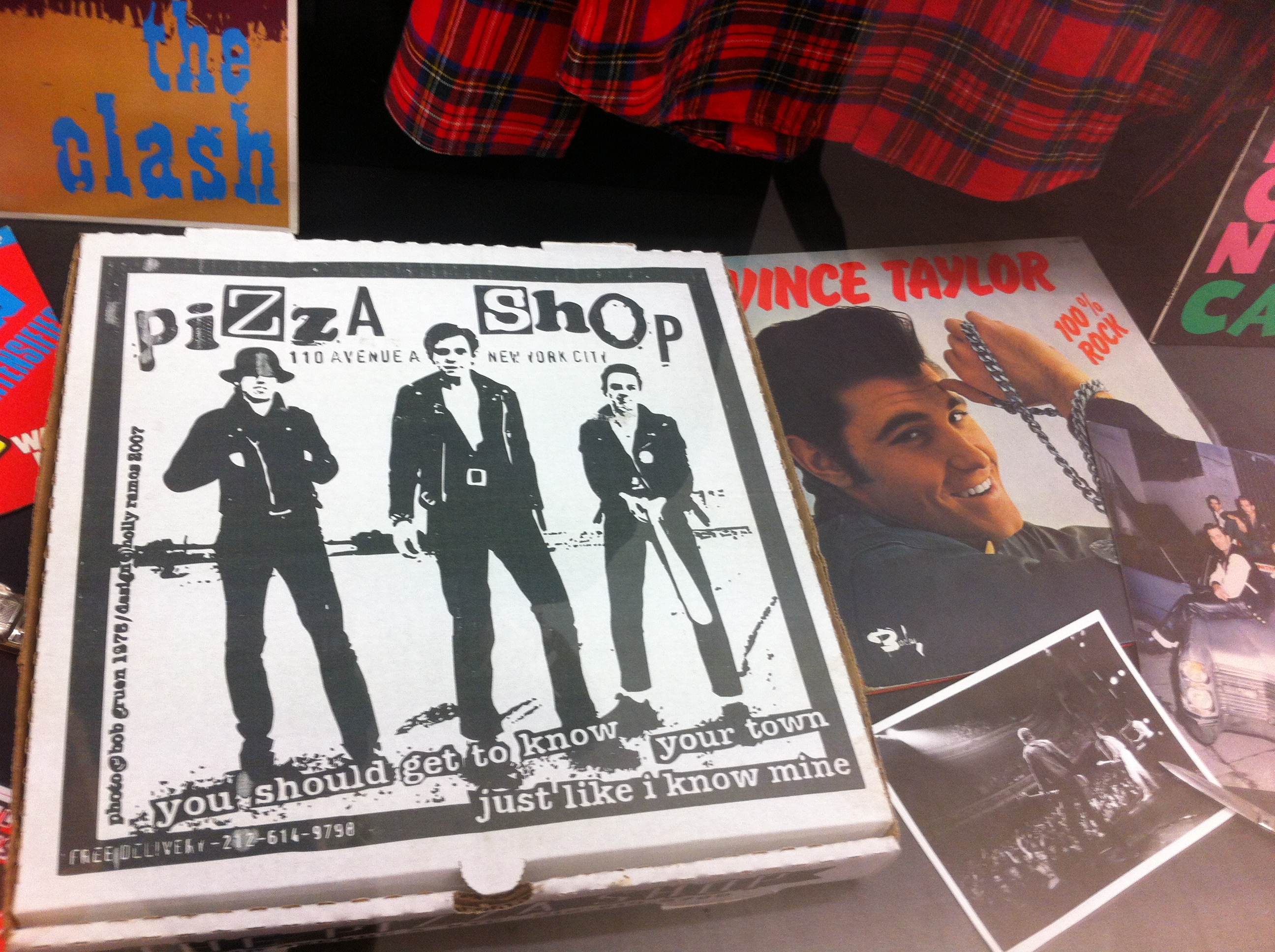
… I rather preferred witty juxtapositions like this, which places a punk-referencing pizza box alongside a Vince Taylor LP.

IMG_1930

A long cabinet acts like a timeline of the band’s history, crammed with ephemera relating to the band personally and politically, but also to the musical and literary influences they were absorbing along the way. So the section around the time of, say, Sandinista!, is full of South American political paraphernalia, lyric sheets and cassettes of the music they were discovering, while further along, at the time of Combat Rock, it’s all about cowboys and indians, and the US military. It was a bit like the Bowie V&A show in miniature with a better developed sense of humour, and ably demonstrated that the three-dimensional, technicolor world of rock and roll offers huge potential for entertaining and informative exhibitions when handled with the right blend of respect and irreverence. One day, one hopes, somebody will do a Beatles exhibition that works along similar lines.

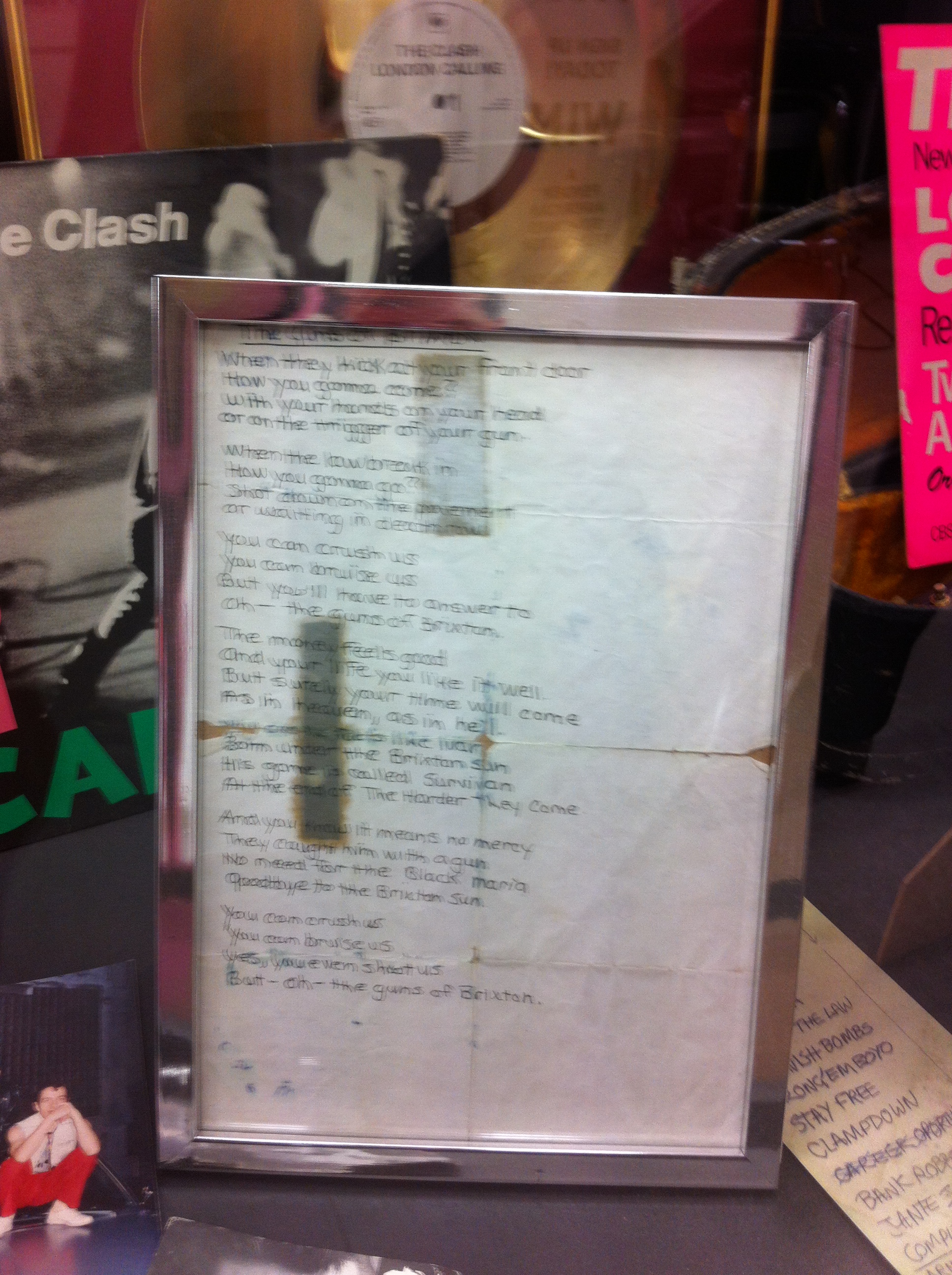
Other items of interest included the Clash’s map of the world, Paul Simonon’s certificate of appreciation from the Guardian Angels, the hand-written lyrics to “Guns Of Brixton” and an old beat box, with rather touching home-made cassettes. Everything is offered entirely without explanation, which is part of the fun. Check it out.

IMG_1933

IMG_1932

IMG_1931

IMG_1935

Black Market Clash, 75 Berwick Street, W1. Open until September 22.

Jonathan Gili, on collecting and connecting

Paul McCartney-designed wrapping paper for Indica bookshop and gallery.

Paul McCartney-designed wrapping paper for Indica bookshop and gallery.

The wonderful new catalogue by Maggs counterculture is dedicated to (a fragment) of the vast collection amassed over four decades by the film-maker Jonathan Gili. An insight into Gili’s collecting instinct comes from this article by Anthony Gardner:

Lift the lids of the boxes, and you can scarcely believe your eyes. There are bottles of Star Wars bubble bath and packets of Beatles bubblegum; fridge magnets shaped like kettles and Danish pastries; hair clips
commemorating the Queen’s coronation; Camembert boxes and plastic lizards and packets of tortilla chips. It is as if all the flotsam and jetsam of post-war consumer society had been washed up on a concrete shore and painstakingly catalogued by an tireless, obsessive beachcomber.

Although the catalogue focuses on the recognised brilliance of London’s 1960s psychedelic poster artists like Martin Sharp and Haphash And The Coloured Coat, Gili would collect anything – indeed, Gardner notes he was particularly drawn to sardine tins and even self-published a book about them. The items Maggs has for sale includes such magpie oddities as shopping bags, wrapping paper (albeit designed by Paul McCartney) and old newspaper posters, such as this one regarding Joe Orton’s murder, taken from a newstand in London in 1967.

1465_28

In 1986, Gili wrote an article about his collection asking rhetorically: ‘Who could resist records shaped like Elton John’s hat or Barry Manilow’s nose? They have poor sound and often can’t be made to play at all… but as art objects they are sublime.’

Sadly, there are no records shaped like Barry Manilow’s nose in this catalogue as much of Gili’s collection went to a private collector sympathetic to the intentions and ambitions of Gili. But what makes somebody collect stuff like this? In his short, thoughtful, introduction to the catalogue, Carl Williams – who knows much about collectors – ponders that question. Collectors are often said to be creating a bulwark against their own death, but perhaps, speculates Williams, they also wish to act as a guardian for those things that would otherwise be ‘forgotten, scorned or destroyed’ as tastes and times change?  Today’s trash is tomorrow’s museum piece; yesterday’s lunatic is the future’s visionary. Gardner touches on this, with an anecdote in which Gili ‘rescues’ a particularly revolting object from a garage forecourt. It’s a revealing story. By the very nature of his collecting this worthless item, Gili has given it value. But he’s also, clearly and very simply, enjoyed the moment, relishing both the acquisition and the reaction it will get from his co-conspirator. Why collect? Why not!

Lucinda Lambton tells a story which epitomises Gili’s passion for acquisition. ‘We were driving through the outskirts of Guildford,’ she says, ‘and he suddenly shouted “Stop!” Then he jumped out of the car while it was still moving and ran across this huge, horrible garage forecourt. When he came back, he was triumphantly waving a gold-lamé-clad Michael
Jackson doll.

Collections also gain their own momentum, and I sometimes wonder how many collections have been made almost by accident – one minute you are idly picking up old books about London from secondhand shops and markets, the next thing you know you have 250 of the things and, inadvertently, the beginnings of a minor collection. And if you’ve started, you might as well finish. What else is there to do with your time?

More obviously, collectors hoard items that carry the echo of a cherished memory, certain pieces that remind them of a special moment in their past, or of a past they wished they had. Many of the items being sold by Maggs are focused around the London underground scene of the 1960s. I’m not sure quite what relationship Gili had with the counterculture, but he was clearly an interested observer at the very least – and he edited cult London film Bronco Bullfrog, with soundtrack by 1960s Gilbert & George support act, Audience.

Gili’s 1960s collection includes a number of items from that era that have always been regarded as important and beautiful, such as these stunning posters by Martin Sharp, one of my favourite psychedelic artists and, in my view, a rival to anything that came out of the more lauded Bay Area poster scene.

Cream by Martin Sharp

Cream by Martin Sharp

Purple Dylan by Martin Sharp

Purple Dylan by Martin Sharp

Oz magazine

Oz magazine

UFO Club poster

UFO Club poster

Many of the objects are related specifically to the London scene – the shops, clubs, galleries and ‘fun palaces’ of 1960s London. Gili, then, had a close relationship with this city. One of his best-known films is the charming To The World’s End, about the No 31 bus journey from Islington to Chelsea. Interestingly, 1960s historian Jonathon Green recalls a map of this very bus route once published as a cover of IT newspaper, showing how it connected some of the key points of swinging London – ‘The hippie highway: all the way from Granny Takes a Trip to the Roundhouse’, as Green puts it.

A semi-thorough scouring of the ever-so-distracting IT archive has not turned up this delightful sounding map, so perhaps it was produced by one of the many other underground papers of the era. But it is not a massive leap to speculate that Gili, the great collector of underground London, noted this off-kilter way of observing and uniting the London villages, and later chose to make a film taking precisely that approach. Collections, like buses, are a way to make connections.

fotoflexer_photo

Pubs

I’ve only ever really had one local, that is a pub I visited at least once a week for a couple of years. But what a local. Crocker’s Folly was one of London’s best pubs, a beautiful old gin palace, with a stunning saloon bar that featured 50 kinds of marble, Romanesque marble columns, Jacobean ceiling, cut glass, chandeliers and carved mahogany.

The pub even had a great back story. It was built by Frank Crocker in 1889, who got wind that a new station was to open at Marylebone and so placed his extravagant new hotel at what he believed was going to be the perfect location to attract the thousands of travellers. Sadly, the station was constructed half-a-mile  to the south and – it’s said – a ruined Crocker leapt to his pavementy death from one of the upstairs window. (In truth, he died in 1904 of natural causes.)

I used Crocker’s when I lived on the nearby canal at Lisson Grove, popping there for a pint after work, for a quick lunch or long dinner, to watch the football, for a sneaky drink between visits to the launderette, to take part in the pub quiz, to meet friends, to be alone. We had a great landlord and the pub was always full of canal folk and locals, a place you felt welcome, where there was always somebody to talk to or enough room for you to settle down on your own, with a packet of cigarettes, a newspaper and a couple of quid for the fruit machine.

Then, pretty abruptly, things changed. A new landlord was brought in by the owners and you couldn’t tell exactly what he was doing wrong, but it was clearly something. Dodgy kids from nearby estates become more prominent. The quality of ale declined. Less events were held. The food menu got worse. Suddenly, Crocker’s became a little rough – it was no longer the sort of place you’d expect to encounter the annual Christmas party held by national newspaper crossword compilers, as had once been the case in the late 1990s – and so we’d walk past it on our way to other, now better, pubs around Warwick Avenue. That’s the problem with pubs. If they aren’t good enough, there’s always a better one around the corner. Until that one closes as well.

I noticed on one of my last visits to Crocker’s that the door policy had changed to an almost unheard of ‘Over-25s only’. In 2002, shortly before I left the canal behind, it closed.

It’s still closed.

Lord know what Crocker’s looks like inside, even though it is a listed building and being carefully watched by CAMRA members. Last time I passed it was as boarded up as ever, but there is planning permission for flats to be installed in the many upstairs rooms. Work has begun, I’ve heard, but CAMRA do not think a pub is part of that plan. What this means for that astounding ground floor, I do not know.

Crocker’s Folly was a beautiful building, open to all Londoners, serving many needs and creating a community around it, and it’s demise is as great a tragedy as that imagined for its creator, more so because it always felt deliberate, as if the company that owned the pub were opting for managed decline, an excuse to close the pub and find a way to sidestep planning permission so they could sell it to developers. That never happened and so the pub was left to rot, like so many others in London.

If you can stand it, scroll through this amazing Flickr archive of London’s lost pubs. I knew some of these, once.

I’ve written about the threats to London pubs and what can be done to save them in this month’s Metropolitan magazine for Eurostar. 

Secret London: torture at the Temple

In some parts of London you can travel in space as well as time. Take the Temple. This characterful cluster of medieval buildings, gardens, courts and alleys wedged between Fleet Street and the Thames seems to have been uprooted from an Oxbridge college and dropped brick-for-brick in central London, just a heartbeat from the Embankment.

The Temple is a maze of cobbled paths and narrow arched doorways leading to small courtyards that have names like Pump Court and King’s Bench Walk. Most of the buildings are offices occupied by lawyers – this is London’s legal quarter, where barristers receive their training – but the area is also popular with tourists, who have found their way into this most secluded spot. They are here to see the Temple Church, one of London’s oldest churches and, with its distinctive circular nave, also one of the most atmospheric. It’s a building that exudes medieval mystery, and rightly so. Temple Church was founded by one of the world’s most intriguing secret societies, and continues to exude a curious, almost sinister vibe, a feeling that there is more to the Temple than meets the eye.

Even those who know the place well can sense the mood. ‘Buildings have memories,’ says Oliver the verger. ‘And this building has seen some turbulent times.’ Oliver is an intense young man who holds the keys to the secret parts of Temple Church. But that must wait. First, he offers a potted history, one that explains why the Temple is off the beaten track but very much on the tourist trail.

The great London writer HV Morton wrote in 1951 that ‘The Temple brings into the heart of a great city the peace of some ancient university town and the dignity of a past age’, and although the Temple area is redolent of Oxbridge its holy centrepiece is actually a stand-in for a more distant city. The Temple Church was built by the Knights Templars in the twelfth century. The Templars were a holy order formed in 1118 to protect European pilgrims visiting the Holy Land. Their base in Jerusalem was supposed to be the site of the Temple of Solomon, so the warrior-monks became known as the Knights Of The Temple of Solomon of Jerusalem, soon shortened to Knights Templars. The Knights Templars had churches and land all over Europe. In London they settled in Holborn but moved nearer the river in 1162, where they built the church. This great round edifice, the New Temple, was consecrated in 1185. Its circular nave paid direct homage to the Church of the Holy Sepulchre in Jerusalem, the idea being that Londoners could visit Jerusalem without leaving the city. Such symbolism was easily grasped by medieval worshippers, who understood how one place could represent another and how the present could fold into the past.

The Knights Templars’ management of the routes in and out of the Middle East soon brought them great wealth, with which came great power, with which came great enemies. Rumours – started by rivals in other religious orders and the nobility – began to spread of their nefarious conduct, and of their sacrilegious and obscene initiation ceremonies, which took place on sacred ground, in London’s case in the crypt beneath the church. It was said that members spat on the cross, worshipped cats and practised ‘unnatural vice’ with each together. As hostility heightened, the end was inevitable and bloody. Phillip IV of France, who, coincidentally no doubt, was heavily in debt to the order, arrested leading French Templars in 1307 and through torture and imprisonment, gained lurid confessions about their immoral conduct. The order was dissolved in 1312.

Although the end for English Templars was not quite so brutal, the abrupt dissolution of the order – and the rumours that surrounded it – has provided fertile ground for conspiracy theorists. Some argue that the Templars were abolished because they knew more about the origins of the organised church than they should, others claimed that the Templars did not disappear, but were merely pushed underground and continue to operate to this day as a clandestine force that shape the world order. Novelist Dan Brown seized on versions of these myths for his blockbuster ‘The Da Vinci Code’, and, having done his research, settled on Temple Church as a suitably spooky location for some key aspects of the action.

52 TEMP 14.jpg

Brown was doubtless drawn by the dominant feature of the church, the ten statues of knights that lie on their backs on the floor in the centre of the circular nave. These stone effigies of dead Templars are frozen in time like Neolithic humans dredged from a peat bog. Despite having lain here since the twelfth century (one, commemorating Geoffrey De Mandeville, is dated 1144 making it older than the church itself; it is said to be here, because no other church would bury him), some have sharp, fine feature, while others have faces melted by German incendiary bombs. All look like they are covering something, perhaps an opening to a secret chamber. They certainly appear to serve some function greater than mere decoration. When you stand in the airless centre of this strange church, looking at this ancient stonework, you can feel the clammy arm of history encircling you. For centuries, Londoners and travellers will have stood at this spot, and bar some cosmetic changes – the church has been refurbished three times, by Christopher Wren, by the ever-busy Victorians and after the Second World War – will have gazed upon the same sight. Nothing has changed.

Oliver the verger interrupts my reverie with some subtle key jangling. We head over to a small door, which he unlocks to reveal a spiral stone staircase. We are seeking the penitential cell. This is where the Master of the Temple – the gloriously authoritarian title given to the church’s head priest – used to punish the unholy. The unfortunate Walter Bachelor was left to starve to death in the penitential cell after disobeying the Master, which is a particularly serious form of penance  as you can’t really repent after you are dead. The cell is halfway up the stairs and now has the appearance of a broom cupboard. It’s tall, but narrow, so a man can stand but not lie flat. Most disturbingly, it has windows overlooking the interior of the church, so those sentenced to starve could look down upon the statues of the crusaders, who would bear silent witness to the suffering taking place above. When we talk of a punishment being medieval, this is what we mean.

Oliver does not enjoy talking about the penitential cell, understandably uncomfortable with such ugly things occurring in the place he has to work every day. He also maintains a theological distance. He says this cruel punishment must have been a Templar thing, nothing to do with the organised church of the time. The Templars, it seems, are destined to play the role of scapegoats for centuries to come.

Oliver and the current Master, though, are happy to play the Templar connection to their advantage when it suits. Dan Brown’s novel brought unprecedented interest in their church, and the Temple suddenly became a hit on the tourist circuit. The Master wrote a book debunking the myths and generally tapped into the new-found interest. Now ‘The Da Vinci Code’ fever has worn off, but the Church has stayed in travel guides on its own merits, remaining a must-see for tourists from all over the world. Here they learn about the Temple Church’s history after the order was dissolved. After passing into the hands of the crown, the surrounding Templar land was given to barristers in 1608. They had begun to locate here from around the fifteenth century. After receiving the land rent-free, the barristers agreed to maintain the church and the Master in perpetuity. The most colourful example of them protecting the church occurred in 1678 during an outbreak of fire. The junior barristers quelled the flames with beer; it took six years for them to settle the brewer’s bill.

In preparation for the arrival of the day’s first tourists – and some are already milling outside waiting for their chance to snoop the ancient masonry – Oliver throws open the vast West Door. This huge arched door opens on to an easily overlooked alleyway, on the opposite side of the church to the large square that fronts the main entrance. It is a magnificent piece, thick regal wood surrounded by an arch of elaborate carved stonework. Nobody knows its age, although Oliver points out that some of the faded figures are wearing buttons, which were supposedly unheard of in Britain before the fourteenth century as they were associated with Muslims, the very foe the Templars were formed to fight.

Standing in this quiet spot round the back of the aged church staring at a door that by implication if not construction dates back to the twelfth century, it is easy to feel that you have slipped through time. One London writer, James Bone, said in 1919 that ‘At Temple, you are as close as an echo to the past’. Here, the echo resounds loudest and longest.