Ten weird London films from Pathe: featuring leopards, scooter jousting, Willesden oil wells and Peter Cushing’s toy soldiers

1. Japes! It’s a fight between students in Brixton over a stolen stuffed owl, featuring many flour bombs. These days, this wouldn’t lead to a jaunty newsreel as much as apocalyptic headlines in the Evening Standard. 1957

2. A secretary in Kensington takes her pet leopard for a walk, 1968.

3. Jousting on scooters in Wembley, 1957.

4. Marcus the chimp cycles around London, 1940s. 

5. Dog blessing ceremony in Swiss Cottage, 1939.

6. Ever wanted to see Peter Cushing play with his collection of toy soldiers? From 1956.

7.  Some great Pathe footage comes in the form of out-takes, like this silent colour footage of a man pogo-ing into a Soho strip club in 1962.

8. An oil well in Willesden, 1947.

9. Kentish Town children hold a protest march to demand a zebra crossing, 1962.

10. A look at fashion featuring I Was Lord Kitchener’s Valet and a couple dressed as Bonnie & Clyde pretending to murder a man wearing an Afghan, 1969.

Pathe newsreel: London time machine

These are all taken from the recent cache of thousands of Pathe newsreels loaded on to You Tube.

1. A trip to Swinging London in 67. Is that Yoko reading International Times at Trafalgar Square? Surprisingly sympathetic beneath the patronising tone. I love those Bob Dylan paper dresses. And at 4:50 you get to meet Keith Albarn, father of Damon, as he organises a happening. Also features Mary Quant, the Speakeasy, the Scotch of St James and much more.

2. This Is London, with commentary by Rex Harrison. A tour of the capital for the British Travel Association, starting at the Tower of London, into Fleet Street and Temple then into the West End and Westminster. It’s all very quaint and polite, but great for location spotting. The shots from Chelsea at 10:42 are extraordinary.

3. Platform shoes, 1977. A wide range of Londoners discuss platform shoes – “they’re not natural,” says one cockney. I think this was filmed around the King’s Road.

4. Tracking shots of Soho at night, 1968. No sound or context here, just a series of tracking shots around Soho at night. It’s incredibly atmospheric and full of strange glimpses into past lives, especially the laughing man at 3:22, whose companions have slipped off to an upstairs flat.

5. West End, 1977. Similar to the above, this is a series of disconnected, fairly random shot of London and the West End starting in Chinatown. Silent but fascinating as a sort of moving street photography. Note the number of Scotland fans around Piccadilly Circus, the porn shops, and the huge amount of scaffolding that appears to be everywhere.

7. Making a psychedelic light machine, 1968. A sitar plays while Mike Leonard constructs his machine for a light show. For 60s scene nerds, this is pretty fascinating.

8. White Defence League, 1959. Footage from Notting Hill, featuring an interview outside the HQ of the White Defence League (soundtrack starts around 1.20min). Staggering racism, unapologetically voiced.

Mount London – a book about London’s hills

Mount London: Ascents in the Vertical City

I am surrounded by hills. North-east is Denmark Hill, south is Tulse Hill, west is Brixton Hill and beneath my feet is Herne Hill. From the highest point of Brockwell Park, I can see the wooded tip of Sydenham Hill and the Autobot mast of Crystal Palace, which sits on top of a stomach-looping hill at Cystal Palace. And there’s more – Knights Hill, Beulah Hill, Forest Hill, Streatham Hill –  all within a few miles, usually to the south on land that slowly undulates into deep suburbia.

One of the things I like about Herne Hill is that the hill it is named after takes the form of an easily ignored road that snakes up towards Camberwell while the town itself sits in a hollow at the bottom, where it often floods. You don’t usually get a flooded hill, but that’s Herne Hill for you. Maybe that’s in keeping with the contradictory nature of London hills. Elsewhere, a hill lifts you above the fray but London hills tend to accentuate the clutter, confirming the claustrophobia of London life.

Tom Chivers is from Herne Hill, and perhaps that prompted him to commission and edit, along with Martin Kratz, Mount London, a book of essays about London hills and other raised areas. A team of 23 urban topographers study 25 spots: famous viewpoints like Parliament Hill, suburban sprawls like Stamford Hill, lost City of London hillocks like Ludgate Hill, plus the odd, witty, wild card – Battersea Power Station’s chimneys or the emergency stairs at Hampstead Underground Station.

Early on, Sarah Butler captures the curious charm of London’s hills  – ‘I’d stand and look,’ she writes in her chapter on Dartmouth Park Hill, ‘and I would always be struck by the fact that London stretched right out to the horizon and as far left and right as I could see. Do the equivalent in Manchester, and you can see where the city ends, the edges fading out into fields.’ London has no edges.

Contributions are a mix of autobiography, psychogeography and history. One of my favourites was Tim Cresswell’s elegant take on Northala Fields, an artificial hill constructed from the rubble of Wembley Stadium and including the remains of London’s failed attempt at building an Eiffel Tower. Londonist’s Matt Brown demonstrates his usual nose for an oddity with his piece on Windmill Hill, a municipal dump on Moorfields constructed from dung and bones. Submarine author Joe Dunthorne takes on the Shard, astutely noting that ‘since the arrival of the Walkie-Talkie, it may not even be the most evil skyscraper in London.’

Chivers tackles Snow Hill – a place I always associate with terrible London-set computer game Driver – and in doing so manages to capture that strange, uplifting sight: the Fleet Valley from Holborn Viaduct. ‘To stand on the Viaduct and look over Farringdon Road is to experience London’s vertical axis; the city not as streetplan write large but a three dimensional environment with depth as well as spread. And even to the untrained eye, the view from the Viaduct is unmistakably that of a river from a bridge.’ This is a perspective almost impossible to capture in a photograph. I have always thought it had to be experienced in person, but Chivers has it nailed.

Chivers and Kratz are poets, and there is a bias towards a certain tricksy type of inward-looking London writing – the school of Sinclair – with particularly abstract or experimental musings coming from Kratz on Richmond Hill and Tamar Yoseloff on Farringdon shitheap Mount Pleasant. That’s fine, but I would have welcomed a little more variety in styles. Mary Paterson brings the only touch of fiction to her piece on Denmark Hill and while I enjoyed Katy Evans-Bush’s supernatural glimpse of Stamford Hill, even this was intensely personal. Amber Massie-Blomfield’s piece on Gypsy Hill is typical, interweaving 18th-century south London gypsies with musings about her grandfather, who once lived in a caravan in Lossiemouth,

But maybe such naval-gazing is in keeping with the very nature of London hills, and also the introspective activity of solo walking. London is not a city that looks particularly good from the air – notable exceptions being Parliament Hill and Greenwich Hill, neither of which feature here. Instead, elevated views merely reinforce the sense that we are stuck in the middle of an endless mega city. The only respite lies within.

‘Some friends once lived in a double-fronted Georgian on Brixton Water Lane,’ writes Karen McCarthy Woolf of Brixton Hill. ‘Their garden was large and L-shaped and a good proportion of it used to be the car park of the pub now called The Hootenanny. Their garden also had a well in it that sank into the subterranean Effra.’

I know that Georgian, I know that garden, I know that well. In London, no matter how high we climb, we will never escape from each other, and from other hills.

Mount London: Ascents In The Vertical City edited by Tom Chivers and Martin Kratz (Penned In The Margins, £12.99).

Comics at the British Library

Action 1976-77, by Jack Adrian and Mike White. Action, used with permission from Egmont UK Ltd.

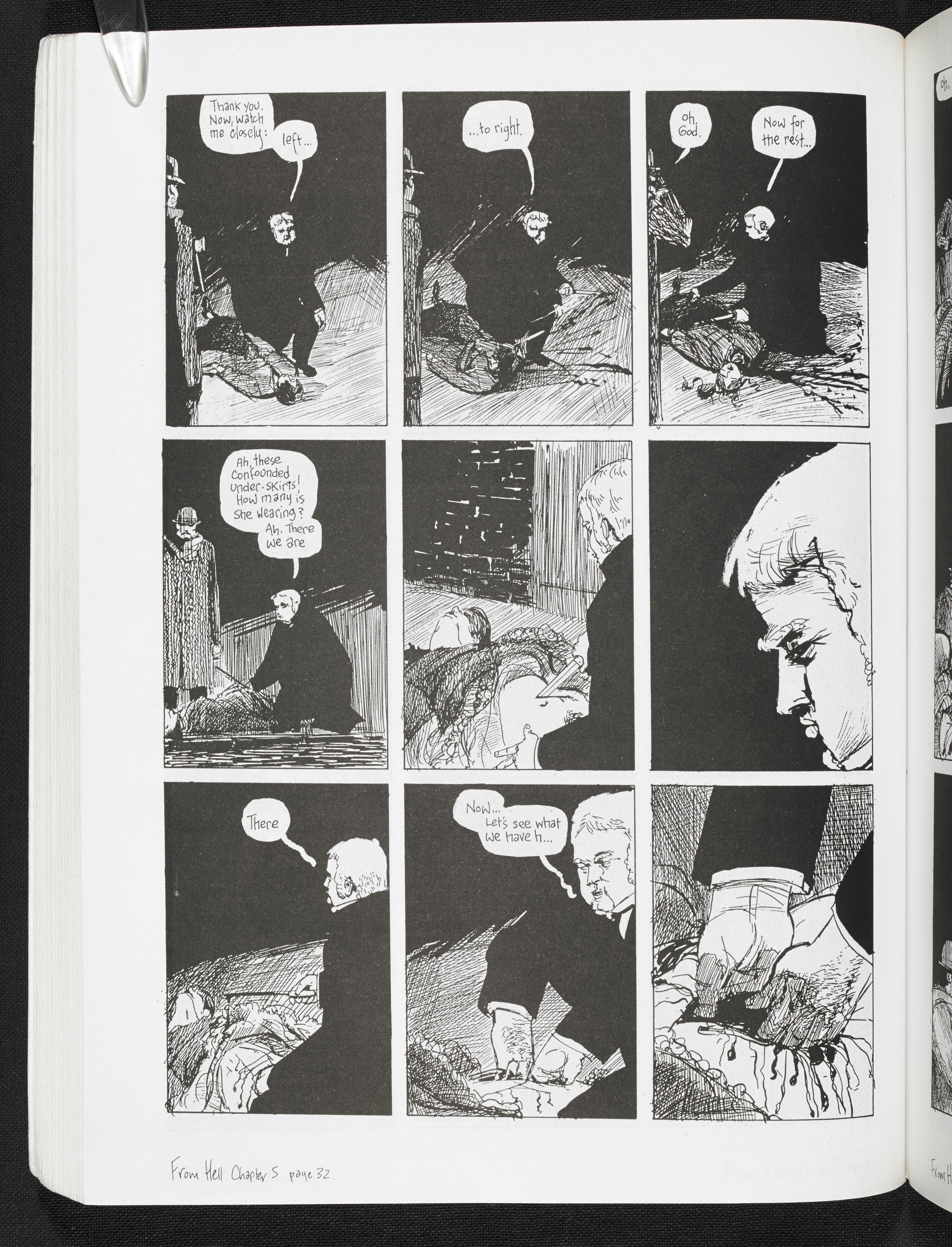
The British Library’s current exhibition, Comics Unmasked: Art And Anarchy In The UK is one of their best for a while. A thematic study of seditious comics in the UK, it covers a lot of ground without over-cramming – a consistent fault of BL exhibitions to date. And while exhibitions devoted to books can get a little frustrating – essentially, you are staring at hundreds of book covers you cannot read – comics work perfectly as you can read a single page and at a glance grasp an awful lot about the concept from the artwork and a couple of panels, such as this from Alan Moore and Eddie Campbell’s London classic From Hell.

From Hell, by Alan Moore & Eddie Campbell published by Knockabout Ltd. 1999 (c) Knockabout

Another plus is that the exhibition never makes excuses for its content matter so we are spared yet another analysis of why comics are for grown-ups. Instead it shows that comics have always been for grown-ups, right back to George Cruikshank (whose work is presented in a tremendous juxtaposition with an OZ strip about Edward Heath). The exhibition also takes a bold step by looking at the historical inspirations for comics writers’ love of magic and fantasy, with exhibits including John Dee’s spell book, the first draft of Crowley’s Diary Of A Drug Fiend and one of his tarot cards. These items are somewhat tenuous, but they are also marvellous and suggest an area a future BL exhibition could explore.

Original painting of Aleister Crowleys tarot card 'The Universe', on loan from The Warburg Institute. Photography (c) Tony Antoniou

There are several items with particular London resonance or import. I was fascinated by Riot, a book written in the immediate aftermath of the 1981 Brixton riot about which I’d love to know more. I also enjoyed the juxtaposition of Batman with Spring-Heeled Jack. There were also several contemporary strips, including Janette Parris’s Arch, about life in Archway, and Katriona Chapman’s contribution to Ink + Paper about renting in modern London. Oh, and there was a comic written by William Burroughs during his London sojourn.

Riot

Riot

Spring-Heeled Jack

Spring-Heeled Jack

IMG_2515

Other countercultural exhibits included a beautifully bound copy of IT, with the cover a reprint of a Situationist comic the publishers had found stuck on their office door (or a lamppost, I forget which) and a comic about the Nasty Tales trial, the IT spin off that was charged with obscenity.

The Trials of Nasty Tales, 1973, cover art (c) Dave Gibbons and Richard AdamsThere’s also loads of stuff on Batman and Superman, with particular reference to the work of Alan Moore and Grant Morrison, while Moore’s Lond0n-set V For Vendetta is a recurring motif. And there’s a decent amount of 2001, including Judge Dredd’s helmet and a never-reprinted Judge Dredd strip about a war between fans of Burger King and fans of McDonald’s – featuring a psychotic Ronald McDonald – that has never been reprinted for fear of a law suit. I also learned that tedious busybody Dan Dare of the Eagle had originally been created as an intergalactic space vicar, which probably explains why I never much liked the man.

Judge Dredd's helmet loaned by DNA Films - producers of 'Dredd'. Photography (c) Tony Antoniou

Now do you want to hear the flaws? There were only three I really noticed. One was the design, which was never quite as weird and psychedelic as I’d have liked (though that may be why I am not an exhibition designer). Another was that there wasn’t enough about the artists, who while by no means neglected were never quite given the attention and praise they deserve. And finally I’d like to have seen more about the development of the grammar and rules of comic book art – how artists have torn up the traditional episodic, thought-and-speech-bubble panel-based framework – which was addressed only superficially towards the end. These though, are little more than quibbles. Go see.

V for Vendetta mask on a manequin in Comics Unmasked. Photography (c) Tony Antoniou


Syd, psychedelia, If…. and the Olympics: an interview with Kevin Whitney

I have a piece in the current issue of Uncut about Psychedelia,  a film made in 1969 and featuring Syd Barrett. The film has been sitting underneath Kevin Whitney’s bed for 40 years, but will be shown in June 2014 at the ICA ahead of its sale. Whitney was on the fringes of the psychedelic movement in the late-1960s and later became the first official artist of the Olympic movement. ‘In my work there are still hints of psychedelic imagery,’ he tells me. ‘But using beautiful athletes instead of mad freaks.’ 

Psychedelia can be seen at Room&Book: ICA Art Book Fair, ICA, 6-8 June. 

——-

‘I was at art school until 1970 and during I was making the film. I was inspired by psychedelic light shows, which I’d screen on the front of Chelsea Art School  at underground pop shows at the Roundhouse. Chelsea Art School was a modern building off the Kings Road. It was the only building built in the 20th century to be used as an art school. It’s now a hotel. It was very anarchic. Art is now geared towards corporate success and Saatchi but then that sort of thing was frowned upon, you weren’t supposed to make any money out of it. You did conceptual things, it was against the system. Now it’s the opposite and has no balls. We were very privileged to be around then. We took art into the streets.

We smoked our first joint together at Christchurch Park in Ipswich. We did a thing where about 12 of us would get on a bus and we’d have these sheets of Perspex the size of a newspaper. We cut out the title of the paper and glued it to the Perspex and then sit next to people on the bus pretending to read the stories from this empty sheet of Perspex. Everybody thought we were bonkers.

I never did light shows at the UFO Club. I went there but they had some Americans, Joe’s Lights, who got the contract and nobody else could do it. I knew them and admit I was influenced by their ideas but I also showed them some of my tricks. One was fabulous. You’d get two pieces of Perspex and put in some olive or vegetable oil, then drop some vegetable dye – bright blue, red or yellow – and then close the Perspex together. You’d put that in the projector, which had a very powerful light and would heat up the dye and send it shooting to the edges of the Perspex. It was like going through a timewarp. Joe’s Lights liked this and used it at the Roundhouse for the big Jefferson Airplane/Door show in 1968. [Editor note: I think that while Joe’s Lights did the Roundhouse gig, the Boyle Family did projections at UFO.]

In 1968, I began making my film, Psychedelia. Syd was part of the scenario. Well, he was the scenario. Anybody that would agree I got to appear in the film, which was done at this basement on Old Church Street in Chelsea in a house owned by Antonia Chetwynd [regular visitors included Donald Cammell, David Bowie, Marc Bolan and Anita Pallenberg]. One day I went to Wetherby Mansions to pick up Syd. I was going to take him to the art school to this red and green painted studio I had in the annexe where I was making the film.

On the way, Syd offered me half a Mandrax. It’s like a sleeping pill that makes you very randy. We took half each. Then we got to the art school and I realised my camera didn’t have a cassette in it and all the shops were closed. So I said we’d do it tomorrow in Old Church Street. In the evening I called Duggie Fields [Syd’s flatmate, still resident at Wetherby Mansions] to check Syd had got back okay and Duggie told me he’d gone to Ibiza. He had a passport with him and he’d just gone to the airport and taken a flight to Ibiza.

When he got back we went to the basement and did the filming. I just had the camera with this psychedelic lighting. It was very amateur and everyone was very stoned. I’d sit people down and tell them to do whatever they wanted. Some took their tops off, some stared at the camera, talked, had a cup of tea… and I just filmed it because they were fabulous people. I filmed so many. In the scene I shot with Syd was Geoffrey Cleghorn, who was a friend of the Who and the Stones. I’d met him at art school in Ipswich and he’d followed when I moved to London and got involved in the whole scene. He’s an amazing guy. There was another chap called David Crowland. There’s a chap called Rupert [Webster], who was the very pretty boy in “If….”.


I screened it while playing Velvet Underground’s Sister Ray. I also use them on the other film I made Red And Green, when they are actually on the soundtrack, the Syd film was silent though I would have been playing Velvet Underground in the basement when making it. I was obsessed with them. It was all very Warholesque.

I gave my camera to Derek Jarman, I was living with the artist Luciana Martinez and she said, ‘You’ve finished with films and Derek’s a lousy painter, so why not give him your camera.’ He’d just finished making The Devils with Ken Russell, doing the sets. I did that and the rest is history. I then got totally into paining, film was an art student fling. In 1982 I got involved with the Olympis and been there ever since.

I knew Syd as well as anybody could know Syd. He definitely wasn’t on this planet but he was lovely, very charming, and he seemed to like my paintings. He liked to paint himself and because I was pretty good he warmed to me. Also, I don’t hold him in awe, I was the same with Bowie, they were friends and I’d talk to them like that. I’d ask to draw them but treat them as I would anybody. People can treat pop stars in a different way and they can get very isolated. Most people were too much in awe of Syd to ask to film him and I think that comes across in the film. He was a very troubled mind and this wasn’t a great time. He’d been eased out of the Floyd and Dave Gilmour had taken over. But people who knew him said he looks so happy.’


Mama Cass in London: drugs, towels, Michael Caine and Charles Manson

I have a piece about Mama Cass Elliot in the current issue of Uncut. One area I didn’t have space to cover was Cass’s arrest in London in 1967 when The Mamas & The Papas were travelling by boat to England to play a show at the Albert Hall. They had arrived at Southampton when they were told police were waiting with a warrant for Elliot’s arrest. The band frantically tried to destroy their stash of weed and then went on to the dock where they were supposed to meet label boss Lou Adler and his friend Andrew Loog Oldham. They were instead greeted by six of the Met’s finest, who bundled Elliot into a police car and drove her to Scotland Yard.

Elliot was stripsearched and questioned, then denied bail and held overnight. The police said the charges related to a stay in London six months previously at Queen’s Gate Terrace, when she had absconded with an unpaid bill and several towels. Outside the police station, The Mamas & The Papas – Denny Doherty, John Phillips and Michelle Phillips – were joined by Scott McKenzie, brandishing FREE MAMA CASS placards while they waited for Elliot’s release. The Albert Hall concert was cancelled.

Elliot told the press she had been treated well, but not been given enough blankets. ‘Believe me,’ she said, ‘One blanket doesn’t go far round this chick.’ After a trial at West London Magistrates Court, at which no evidence was offered for the prosecution, she was released without charge and left the courtroom munching on a hash cookie that she found in her handbag. That may account for the big smiles in the photo below, taken shortly after her release.

While such heavyhanded treatment by the authorities of rock stars was fairly common at this time, it later emerged that Elliot’s arrest actually had more to do with her occasional boyfriend, Pic Dawson, who the British police believed was involved in a major drug-smuggling operation. According to Michelle Phillips, this was the only subject the police in London were really interested in.

Pic Dawson and Cass Elliot at Whisky A Go Go.Dawson, who died of a drug overdose in the 1980s, was certainly an interesting figure with connections to the underworld. Numerous rumours circulate about him partly thanks to his peripheral involvement in the Manson Family murders.

Dawson knew several of the victims – basically, he supplied them drugs – and after the murders John Phillips is said to have told the police that the bloody PIG daubed on Sharon Tate’s wall actually said PIC. The LA police were also informed that Dawson, along with another of Elliot’s drug-dealing boyfriends, Bill Doyle, had been ejected from a party at the Polanski house shortly before the murders. Dawson was subsequently arrested, questioned and cleared, as was Doyle.

These were not Elliot’s only connections with the Manson murders. Dave Mason recalls, “One of the freakiest parts was that at Cass’s I saw a lot of Abbie Folger and Wojciech Frykowski until the Manson crew slaughtered them” and she knew all the victims well. But she also knew the murderers – in his autobiography, Michael Caine of all people recalls attending a party in Hollywood with Jay Sebring and Sharon Tate, where Mama Cass introduced him to a ‘scruffy little man’. His name was Charles Manson.

‘Last time I went into central London I needed a lie down’: life on London’s floating bookshop

An interview with Paddy Screech, a floating bookseller, for a piece I wrote for Time Out in June 2013.

Paddy Screech, 47, Word On The Water

‘By terms of the continuous cruising licence I have to move to a new mooring every two weeks. In the winter I try and stay around the urban bits and in the summer I stay near the parks. We try and stay north-east because my business partner has a little girl at school in Stoke Newington. We go to Paddington, Camden, Angel, Broadway Market, Mile End Park, Victoria Park and Springfield Park. We can’t go much further because our supply lines start to get stretched as we have relationships with five or six charity shops in this area. These are our friends and were we get our stock and also this is where our boating friends are. If we move to far afield we don’t have a world there.

What’s the appeal? Well, on a day when I have a carpet wrapped around a broken propeller and I have to have my boat towed in a strong wind, I can’t quite recall. Generally, I love the freedom and the less regulated life. London can be a chilly place. On the canal, people behave like they are living in the country even though you are only four metres from the road. As soon as you put a towpath there, people start talking, being friendly. It’s true of everybody, boaters and passersby. It’s very strange, like magic. On the other side of this fence there is a different culture.

It’s like a village. There are a lot of boats in London but if you put them all together you’d have a village, but a village where you can get away from people if you want to just before you start annoying each other. I have a little world in each place I stop: I usually know some of the other boats, I have a favourite coffee shop, I know how to get to the launderette. I like Springfield Park the best. Everybody makes the book barge feel welcome, whether they are permanent residents or not.

I’ve been on this boat for two years, running it as a bookshop, and I’ve been on the canal for six years. I try not to leave the canal. Last time I went into central London I needed a lie down. I lived in Upper Clapton for seven years. In all that time I met one of my seven neighbours once, as I sat rotting in front of a computer and seeing one of my dozen friends each week. Now I have about 300 friends, only look at the computer for an hour a day and never watch TV. I spend most of my time trying to stop the barge blowing away, or trying to light a fire.

The boat is called Diante, which means diamond in Italian. She’s a 1920s coal barge from Amsterdam and was converted into a houseboat in around the 1960s. She’s beautiful, but has a very thin bottom so will need replating. The engine is very old and just about clinging to existence. Every four years you need to take a boat drydock for a bigger service but if you do that properly a boat can last for decades. I’m not very practical but am much better than I was seven years ago. Anything that requires expertise or tools I need to call in favours. The fun thing about a Dutch barge is that it has no weed hatch so I have to put on a wet suit and get in the canal with all the urine and clear it with a knife.

I have a sea toilet which can’t be used on the canal so I visit the local establishments when I need the loo. There are lots of pubs and cafes that are sympathetic. It’s a simple life, I have no hot running water. I had a gas boiler but took it off because it wasn’t going to pass the safety certificate. It seemed a bit of luxury. My shower is now used for book storage. I wash with landlubber friends. Thanks to the kindness of friends I get a bath every other day. Working boats come up and down the canal delivering coal and diesel to all the moorings.

I have no mains electricity but a substantial amount of solar panelling that runs the lights and a 12v PA. There’s also an alternator on the engine, which creates electricity when you run the engine. It means there’s one less corporation in your pants. I do all my electronic stuff on my smartphone. Some boats have widescreen TVs and generators, but I’m not interested. Boats take up a lot of time and so I’m always pottering around doing something, I’m done with sitting on my arse watching bad television.

My business partner is John Privett, we started the shop about two years ago. We survive against overwhelming odds, but our costs are low and in the winter we live like feral water rats. We don’t get much custom when it is raining so in the winter we contract our horns and live on less. For our stock, we get given donations but mainly we select the best from charity shops.

The main expense is the licence and safety certificate. The business license for a trading boat is the same cost as a residential one as long as you are making less than £60k a year. There are around 15 trading books in London now, including a hat boat, a sandwich boat, a cocktail barge, a vegan cake barge, a herbal practitioner and a Slovak restaurant. We are hoping to find a permanent site for a floating market. It’s nice to move every two weeks but we might do better if we could stay in the same place.

I have absolutely no interest in going back to dry land. As long as I can borrow a friend’s bath every now and then there’s nothing about land life that appeals to me. I’m in the city now but when I wake up tomorrow I’ll be in  park underneath some trees and I’ll still have my coffee and my cats [Queenie and Skitty]  around me. To take your house and plonk it into the countryside after 24 hours is pretty special.

I don’t wish for more space. Boats change your expectation about how much space you need. I got rid of four-fifths of my items when I moved aboard and I don’t miss them. You just learn not to accumulate things. Except books. I can usually find something to read.’

Richard Fortey’s secret tour of the Natural History Museum

Some years ago, the writer and scientist Richard Fortey took me on a tour of his favourite items in the Natural History Museum. His book, Dry Store Room No 1, is one of the best books I’ve read about London museums.

1 ‘This is the collection of all known species of humming birds which I used as the cover for my book. It goes back nearly 200 years to the earliest days of natural history as spectacle. One of the amazing things is that the colours, the iridescent feathers, have survived so long. You can even see the tiny eggs, with the appropriate egg in it. This whole bird gallery is a survivor to the old days of the museum, preserved almost apologetically as an example of the classic gallery, but a lot of people still stop and look at it even though it’s just stuffed birds.’

‘This one of the great sea dragons, an ichthyosaur, a marine reptile. This one is particularly beautiful and informative because within the body cavity you can see here outlined in red, the remains of other smaller individuals. The question originally was ‘were they cannibals or did they give birth to live young’ and the answer is almost certainly the latter. These animals are very like porpoises and almost certainly lived the same way, gregariously and pursuing a very fast life that gave them no time to sit on eggs. But this is very easy to miss.’

‘The building itself. You can choose anything from the various animals and birds that adorn the interior. Even the pillars are based on the bark of trees. On the whole, the building moves from living to fossil as you go from one end to another and that is true also of the animals portrayed. In the mineral gallery, right at the end above a door on the left is a dodo. I also think that one of the monkeys has been made to look a little like Darwin.’

4. ‘The mineral gallery has probably changed the least since my early days and it’s also the least visited. It’s a classic systematic approach where all the minerals are laid out in cases arranged by chemical composition, so you could come here and learn some serious mineralogy if you started at one end and worked your way through. At the end, in the Vault, where particularly precious minerals are displayed, is something  called bournonite with black wheels shaped like cogwheels. This came from a Cornish mine that has since closed so this is really the only good specimen that will ever be found with this particular chemical composition. It’s now extremely valuable because the rarer something gets, the more valuable it becomes.’

5. ‘The blue whale, it might be obvious but it is remarkable. For a while, during the war, some people working here kept an illicit still in the belly of the whale. So even with the best-known exhibit, there are secrets to be had.’

6. ‘Finally, head for the geology section in the mezzanine level. This used to be an old-fashioned museum in its own right but now it has been changed and in making space they only put back about ten per cent of the specimens. Each one is individually highlighted so it doesn’t give you the systematic overview or leave room for the quirkier items. But this table is still here. It’s a collection of North European ornamental stones all made into one table. You can even make out fossilised nautiloids of around 450 millions year in some of them, and also fossilised coral. There’s no label for it, nothing to say what it is and where it came from. You and I are probably the first people to have stopped and look at this for several weeks.’

London: ale and hearty

I like beer, but I do not fully understand it. By which I mean, I vaguely understand how it is made and I know how much of it I can drink (less with each year), but while I know fairly quickly whether I do or do not like a particular beer, I am never entirely clear exactly what it is I like about it. Is it the hoppiness, the finish, the strength, the, I dunno, malt? Search me guv.

I took this ignorance with me when I interviewed Evin O’Riordain, owner of the Kernel Brewery, at his microbrewery in Bermondsey. Evin is an intense fellow. In lots of ways he reminds me of people  who run independent music labels, absolutely committed to a certain ethic, a particular way of doing things, not because it is easiest or will bring the most rewards, but because it is right. Indeed, Kernel’s stark labels even remind me of Peter Saville’s Factory Records sleeves.

Evin talked me through his brewing philosophy, lubricating his lecture with samples from his stocks. We tried a session ale, an IPA, a porter, a stout and a saison. Evin told me about each style’s particular history – how it came to be brewed, who it was originally for – and then explained Kernel’s sophisticated fundamentalist take on it.

It was a very pleasant afternoon.

The result of that chat with Evin, and four other London brewers (none of whom actually come from London), can be seen in my piece on London’s brewing renaissance in this month’s London Magazine.

New London writing, or What the fuck is psychogeography anyway?

I don’t think anybody, with the possible exception of Will Self, really knows what psychogeography means but that doesn’t mean there’s not a lot of it about. For years, the London writing landscape has been dominated by three masters of the genre, the Ackroyd-Sinclair-Self trinity (in this interview, Self distinguishes between their different approaches) – it’s hard to find a book in the Museum Of London bookshop that doesn’t have an intro penned by one of them – but that is starting to change. In the past year or so, three books have been written by debutant writers that take a broadly psychogeographical approach – you can tell this by the use of words like ‘palimpsest’ and liminal’ –  to the city or patches thereof but are happy to present it in a more approachable, less LRB-approved style.

The man above is Nick Papadimitriou, and his Scarp is the most Sinclairian of the three, written by a man obsessed with a small parcel of land on the city’s northern border. ‘I’m trying to get below the surface into something that’s moving in my mind as much as in the landscape,’ he says, which doesn’t say a great deal and is therefore as neat a summary of his obscure methodology as you are likely to find. Scarp is a wonderful book, a brilliantly obsessive and beautifully observed celebration of the meditative quality of what Papadimitriou calls deep topography and the rest of us know as walking. It’s also classic psychogeography in that you read it in the knowledge that a significant proportion of the theorising is total codswallop, but at least it is entertaining codswallop, an intriguing combination of the occult and broad generalisations about place drawn from a tiny physical space.

Next up in This Other London by John Rogers, a lighter but similarly intentioned account of ten walks – ‘a plunge into the unknown’ – around fairly random parts of London that were previously just strange names on old maps to the author, a film-maker and good egg. Rogers has none of the astonishing familiarity with his territory as Papadimitriou and he makes a virtue of this, imbuing the book with the joy of new discovery. It is, as a friend noted, a salute to the rewards of simple rambling, of going somewhere unusual and just strolling, or flaneuring to use the specific vernacular of psychogeography. As an alternative guide to London walks – or an inspiration to do the same yourself – it is a marvel.

Finally, came Gareth Rees‘s Marshland, hallucinatory, speculative non-fiction about the marshes of Hackney and Walthamstow that combines Scarp‘s deep knowledge about a specific locality with the dry wit and accessibility of This Other Land. Again, Rees is fond of that psychogeographical turn of phrase – ‘There is no final draft of London’, being a particularly fine example – but laces it with humour as he explores this odd landscape of rave holes, filter beds, football pitches and reservoirs (and a fascinating landscape it is too), mixing in a bit of fiction and even offering an audio soundtrack. Rees has a tremendous, natural, written voice and the book fairly skips along. I loved it.

All three books are a lot of fun and that is the great, dirty, secret of psychogeographical writing – it is hilariously fun to do as you train your brain to make grandiose statements about people, place and history that you are fairly sure won’t stand up to any great inquisition but look fucking brilliant on paper. Bill Drummond’s neat summary of psychogeography is perfect – ‘An intellectual justification for what I have been doing most of my life’.

I do not consider myself to be a psychogeographical writer (and here I express some of my dislike of it), but that’s not to say I’ve never indulged in it myself of occasion (as here, when writing about Wappingness), particularly when asked to do so by property developers, who seem to love this style of writing as a way to signify their deeper engagement with the city they are hoping to exploit.

By my experience then, psychogeography is used as much to shift property as it is to expand and combine the frontiers of space and mind, which is perhaps inevitable in London, where any amount of folklore and fauna only really has any value if it can be seen to have a positive effect on land prices. I’m not entirely sure that this is what Guy Debord was hoping for when he first conceived his theory, but given that he’s long gone there’s not a great deal he can do about it.

Situationists at the Sailors' Society in London during the 4th Conference of the Situationist International. Those assembled included (from l. to r.): Attila Kotányi, Hans-Peter Zimmer, Heimrad Prem, Asger Jorn (covered), Jørgen Nash (front), Maurice Wyckaert, Guy Debord, Helmut Sturm, and Jacqueline de Jong. To ensure that the proceedings were kept away from any contact with artistic circles or London newspapers, the conference took place in Limehouse, "a district renowned for its criminals."

Guy Debord’s Situationists in Limehouse, in search of Wappingness and investment opportunities.