Category Archives: Transport

All aboard the Boris Bus!

Boris Johnson’s much touted new bus launched in London on Monday, and I managed to take a trip on it. It wasn’t easy: the bus left Victoria two hours late after breaking down twice and being slipstreamed by a Routemaster filled with anti-Boris protesters, but the public cared not a jot. Read my piece for Time Out here.

The bus is a classic example of how far bluster and bullshit can carry you, if the public are even half-interested in your vision. This is not a Routemaster, it carries fewer passengers than the bus it is replacing, has cost a fortune to develop, it doesn’t stop fare dodgers, the back platform closes in the evenings and the conductors aren’t allowed to take fares – but it’s still, in my view, a guaranteed vote winner because people like the look of it and aren’t going to look at the downsides too deeply. And maybe they are right, because when all is said and done, a fleet of these on London streets in a few years won’t look too shabby, and all the complaints – accurate as they may be – will look like so much narrow-minded nitpicking.

New Bus for London

‘Ladies who bus’

This is a piece I wrote for the Speed issue of the excellent Completely London magazine. 

Sometimes, it feels like there are few slower ways of getting round London than by public transport. And the bus –so often a victim of roadworks and burst water mains – can be the slowest of all. But for some, that slowness is part of the attraction. Jo Hunt (67), Mary Rees (68) and Linda Smither (64) are ‘ladies who bus’. Since March 2009, they have been taking all of London’s buses in numerical order, starting at No 1, travelling each route from one end to the other, and then writing about it on their blog. As a way to pass the time, it is a distinctively London thing to do. There are, after all, over 500 routes in London; more if you include those that start with letters, like the A10 or X68.

File:London Bus route 23.JPG

‘It began when I retired from my last job,’ says Jo, the head buskateer and a former teacher. ‘People asked what I was going to do. I said I’d just loll about or play computer games, but then I decided I’d get every bus in London.’

From that moment of whimsy came a plan, which became a blog and has now evolved into something like a mission. Jo, Mary and Linda have acquired matching sweatshirts with their blog address on it – these proved to be handy in winter when one bus’s central heating was broken – and they have printed business cards to hand to drivers at the end of journeys to explain what they are up to. Online, they have built up a following among London nerds and bus enthusiasts.

Jo got the idea when she got on a bus and saw it was terminating at Ponder’s End. ‘I thought, “Where’s Ponder’s End?”’ and elected to find out. ‘Then I thought if I was going to do one, I should do them all, and if I was going to do them all, I should do them in the right order.’ Linda and Mary were both ready for retirement as well, so – armed with their Freedom Passes –they agreed to come along. Jo’s son created a blog, and 200 buses later we are now travelling by bus from Brixton to Mitcham on one of the hottest days of the year.

And here I must make a confession. I also spent a couple of years on the buses, writing a weekly column for Time Out about exactly this topic – taking every bus in London in numerical order, from end to end. Well, it started as a weekly column, but soon lethargy took over, the column became fortnightly and then monthly and in the end I never made it further than the low 60s. Jo, Linda and Mary have persevered, resolve stiffened by each other’s company – and by Jo’s determination to complete the task. ‘Jo is the leader,’ confesses Mary. Jo plans each route a week in advance, working out how they are going to get to and from the stops that bookend the route, and she and Linda take turns writing them up on the blog.

But they are clearly enjoying themselves as well. There is much to appreciate about a lazy morning spent taking a bus for no other reason than the sheer fun of travel, watching London knit together while everybody outside rushes about their daily business without time to stop and absorb the city around them. As we slip languidly through south London streets, the trio note familiar landmarks and reminisce about other routes that have passed this way. They are also able to recall what an area was like 5, 10, 20, even 40 years previously. ‘It’s evocative,’ says Linda of the experience of revisiting old haunts. She also comments on how they have watched London change in the two-and-a-half years they’ve been doing the routes. When they began, the Strata Tower at Elephant & Castle was a building site – now it’s one of the tallest buildings in London. A rapid transformation, observed at leisure.

They are fascinated by London’s arcane history of– such as the Balham estate we pass that was reported to be Hitler’s choice for a home if he successfully invaded Britain – but also by the present, especially in Tooting, as South Indian restaurants slowly give way to West African clothes shops and Mary contemplates hopping off to pick up three crates of mangoes for £10.

London as seen by bus is a city of delights and surprises. ‘I’ve been surprised at how good the drivers are,’ says Jo. ‘I’ve really enjoyed being able to understand how London ties together. And sometimes you’ll be bumbling along and then suddenly you are in the country, surrounded by green. It’s like you’ve reached the end of the world.’ Or the end of London, which sometimes feels like much the same thing.

Walking London: rivers and tubes

‘What a bounteous banquet of costly viands is spread before an ardent-minded, grateful-spirited Perambulator!’ Old Humphrey’s Walks In London

‘One must perambulate early and late in all weathers, to know a little about London’. The London Perambulator

London is a gift for those who wander. Sometimes you can pick a new area and just stroll wherever the whim strikes you; sometimes you can take a different route between two familiar destinations. Either way, you’ll find your appreciation of the city is inordinately increased.

There is a healthy industry in London walking – M@ recently compiled a list of his ten favourite for the Guardian – but if you need something cheaper and more challenging, you can always take a self-guided walk over a longer distance. I once walked the Thames from St Paul’s to Hampton Court on a Sunday afternoon, criss-crossing bridges and sticking as close to the river as possible. It was particularly satisfying to see how easy it is to walk on the river bank – the only place I had to take a significant detour was around the ever-weird Chelsea Harbour.

In a similar vein, a couple of books have recently come out on the theme of London walking. Walk The Lines is about Mark Mason‘s decision to walk every tube line in London, above ground, an overall distance of 403 miles that takes him everywhere from Amersham in the north-west and Epping in the far east to Morden in the deep south.

Mason enjoys discovering new parts of the city and peppers his book with brilliant London trivia but is at his best when writing about the pleasure walking can provide. As he writes, ‘Once you’ve caught the bug, you feel an urge to plan your walks, be it thematically, geographically or by some other means. There must be a raison d’être for your ramble.’ This, he thinks, taps into a similar mentality to that of a collector: ‘It’s not about studying, about observing or noting. It’s about collecting. About claiming the city’s greatness, or at least some small part of it, for yourself.’

Mason’s book is a fun read, but you couldn’t very well use it to walk the tube lines yourself, even if you were lunatic enough to want to do so. Tom Bolton’s London’s Lost Rivers, however, bills itself as ‘A Walker’s Guide’ and is a terrific mix of history, topography and practicality. It maps – astonishingly diligently – the courses of eight of London’s buried rivers, so walkers can follow them for themselves, pointing out items of interest they can see along the way while also offering some historical context about the subterranean rivers.

Along with Nicholas Barton’s The Lost Rivers of London, it’s essential for any fan of buried rivers (Diamond Geezer says much the same here). The atmospheric Polaroid photographs by SF Said are a nice touch, as is the introduction by the great Londonphile Chris Fowler. Highly recommended.

Secret London: swastikas

One of the great London rumours is that somewhere inside the Royal Society’s building on Carlton House Terrace sits a giant swastika.  This is not because these esteemed scientists and thinkers are secretly Hitler-worshipping fascists, but because their home at Nos 6-9 was the location of the German Embassy (at Nos 8-9) during the pre-war Nazi era.

Carlton House Terrace was designed by John Nash between 1827-1832 to occupy a site previously taken by Carlton House. No 9 almost immediately became the seat of the Prussian Legation, which slowly evolved into the German Embassy. In the spirit of the time, it soon expanded to occupy the house next door at No 8.

In 1936, Joachim von Ribbentrop moved in, replacing the late Ambassador Leopold von Hoesch (whose dog’s gravestone can be seen under a tree near the Duke of York steps). Von Ribbentrop demanded a complete renovation of the property, and the Nazi’s top architect, Albert Speer, was called in to do the job. Exactly what he did remains something of a mystery, but the German Embassy website claims:

‘Only the fact that the Nash Terrace was a listed building saved the facades from being included in Ribbentrop’s plan to establish a model of the Third Reich architecture in the centre of the British capital. The renovation was exhaustive, money was no object.’

It is hard to discern exactly what alterations Speer made, but one diplomat wrote that the showy renovation of No 8 and 9 Carlton House Terrace had produced a style and furniture less suitable for an embassy and more comparable to that of German luxury liners of the time like the “Bremen”.  A contemporary set of photographs are lodged at the Library of Congress. The only one currently viewable is of the very modern-looking kitchen.

This decent phot0-set shows the building now, including Speer’s striking staircase, said to be constructed by marble supplied by Mussolini.

Albert Speer designed this

Among Speer’s embellishments was said to be the inclusion of a swastika mosaic on the floor of one of the public rooms. After the war, rather than remove the offending article, the swastika was said to have been simply covered with a carpet. (And this website claims there are still visible ‘border designs of swastikas on the floor of one public room’, which seems unlikely.)

Is it true?

Well, I’ve never seen a photo to substantiate the claim and people I know who have been inside the Royal Society are also none the wiser. However, I did once receive an email at Time Out from a builder who claimed to have renovated the building in the 1990s and seen a huge swastika under one carpet. Where, presumably, it still remains. Von Ribbentrop also had a house built for him in Pinner, which was said to have swastikas carved into the staircase.

If you do have a hankering to see a swastika in London, you should head for India House, where this plaque can be seen on the wall.

It represents the swastika when it was still an intriguing sign from the east, before it was appropriated by Hitler. In the first two decades of the 20th century, the swastika was a popular symbol in the west, often used as a good luck charm and adopted by groups as varied as the Boy Scouts and the Druids. My copy of Rudyard Kipling’s Just-So Stories still has a prominent swastika featured in one illustration and the British Museum is full of the things.

Indeed, so popular was the swastika, it was even used to liven up the decor at Hounslow Bus Garage. Click on that last link and zoom in and you’ll see the border of pretty little swastikas that featured in the staff canteen. These swiftly disappeared as the truth about Hitler became impossible to ignore.


London accessories

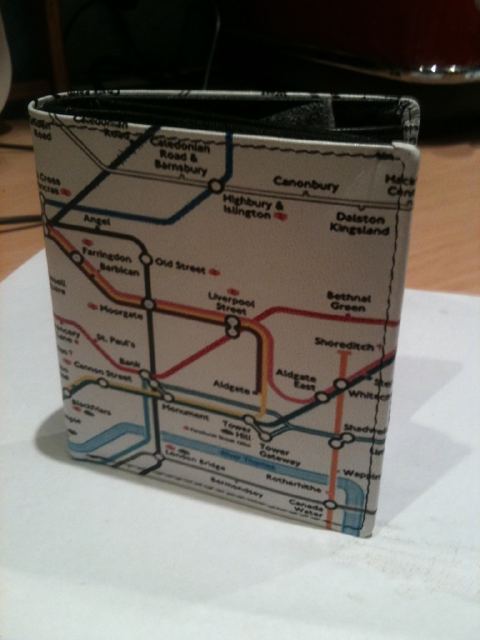
I fear this purchase may mark the moment when future biographers decided I tipped over into self-parody.

Next stop, a manbag version of this. I’m sure it can be done.

District Moquette Handbag

Moonlighting

I am going to be blogging current affairs type stuff over at Snipe, in the illustrious company of Adam and Darryl.  

My first post about the Old London Underground Company can be read here.

You can also read more of my stuff over at the Time Travel Explorer blog, which is devoted to maps and history. My latest piece is about the constancy of one London burial ground.

Secret London: the Russian tank of Bermondsey

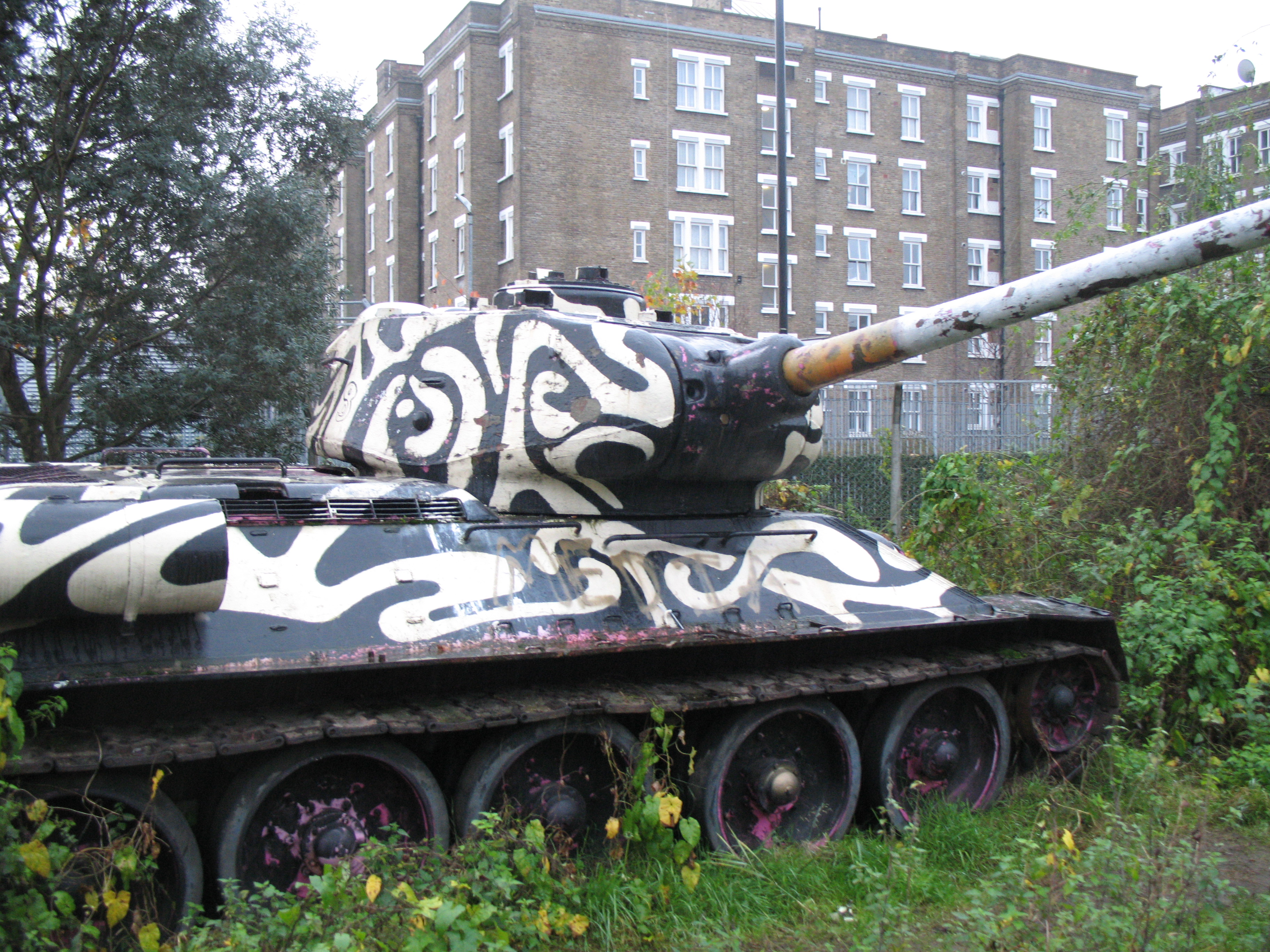
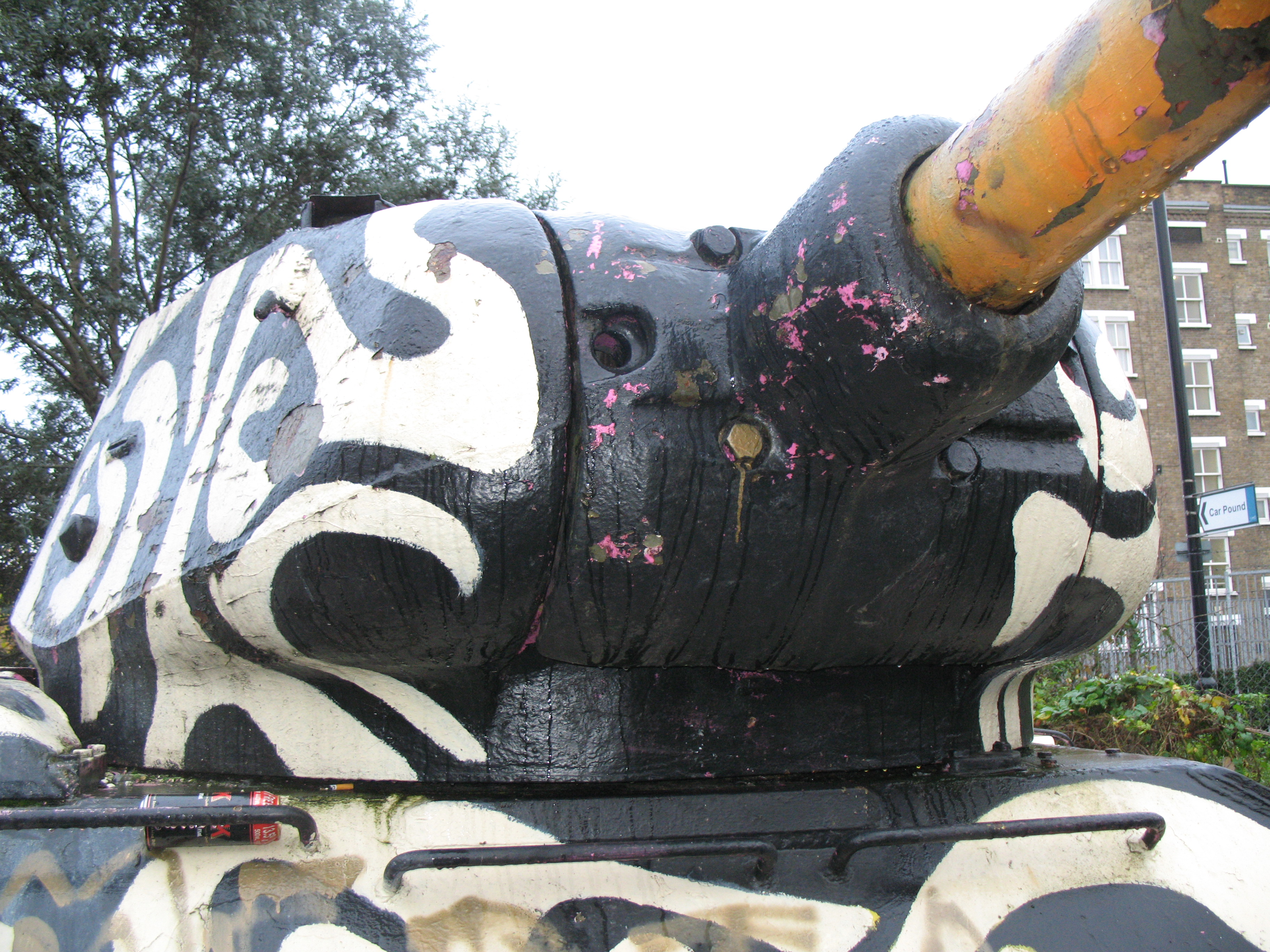
That there is an authentic Russian tank parked in a patch of wasteland on a side street off the Old Kent Road is one of those things that is so brilliant it should be mentioned on the news at least once every day. (I felt much the same way about Gordon Brown’s glass eye.  A Prime Minister with a glass eye! How cool was that! What a wasted opportunity.)

The tank is a T34 Russian tank that was possibly used against the Czechs in the Prague Spring uprising of 1968. It arrived in London in 1995 when it was used for the filming of Richard III. The tank was then purchased by Londoner Russell Gray as a sort of giant and very expensive pun after Southwark refused him planning permission to build houses on the site. Gray instead applied for permission to put a tank on the site. They thought he meant water tank, but he didn’t. The tank’s gun is trained on the council office.

How much truth there is to that story is surely irrelevant. It feels right. And when it comes down to it, all that matters is that there is a bloody great Russian tank on the streets of South London and people don’t seem to realise quite how incredible this actually is.

Urban legends: Phyllis Pearsall and the A-Z

The story of Phyllis Pearsall and the A-Z is one of London’s most enduring and endearing myths. To take but one example, here’s the Design Museum‘s version of how, in 1935, Pearsall couldn’t find her way to a party in Belgravia so decided to make a completely new map of London, which she did by getting up at 5am each morning and walking every one of London’s 23,000 streets – a distance of 3,000 miles. The result was the A-Z, the first street atlas of London.


You’ll find this story everywhere, often repeated word for word, which is usually a sign something is up. Here it is on the BBC. Here it is in Time Out. Here it is on Wikipedia.  And here’s some sap repeating it in an excerpt from a book on Amazon.

Peter Barber reckons it’s nonsense. And as the head of maps at the British Library, he should know.

‘The Phyllis Pearsall story is complete rubbish,’ Barber told me. ‘There is no evidence she did it and if she did do it, she didn’t need to.’

Barber maintains first of all that the first street-indexed map of London was made in 1623 by John Norden, but his reservations are not just academic. Pearsall’s father, Alexander Gross, had been a map-maker and produced map books of London that were almost identical to the A-Z in everything but name. They looked the same and used the same cartographical tricks. It’s Barber’s belief that Pearsall simply updated these maps to include the newly built areas of outer London and called the result the ‘A-Z’.

‘She was a great myth-maker,’ says Barber. ‘But English Heritage investigated the story and decided not to award her a blue plaque because it was not felt she’d done anything to deserve one [Pearsall does have a plaque, but it was awarded by Southwark]. It was marketing and it’s a very pervasive myth, she was a lovable character and people want to believe it.’

So did she really walk those streets or not? Here, Barber is hard to pin down. In writing he is equivocal, as the final comment here shows, but in conversation he makes his position pretty clear.

‘Pearsall was building on a body of information that had been around for years,’ he says. ‘What she may have done is be more thorough in mapping the new areas that cropped up between the wars, and there were two ways of doing this. You could either tramp the streets of outer suburbia for hours on end, or you could visit the local council office and ask for their plans. Which do you think she did?’

Jeremy Deller’s Baghdad car at the Imperial War Museum

If the V&A’s latest exhibition demonstrates that big can be beautiful, the new acquisition at the Imperial War Museum shows that small can be profound.

It’s a car, badly damaged and barely recognisable, that was caught in a suicide bomb blast in Baghdad in 2007. The artist Jeremy Deller got hold of it and toured it across America on the back of a truck in the company of a US soldier and an Iraqi citizen for a piece entitled It Is What It Is. Now, shorn of any artistic element, it is on display at the Imperial War Museum. My review in the New Statesman can be read here.

After interviewing Deller, I avoided reading too much about the car before I wrote the piece other than this by Jonathan Jones in the Guardian. Jones, I think, slightly overdoes his praise – is it really true that ‘a dismembered body is what you immediately think of when you come into the museum and see a car’? – while the commentators beneath the line seem obessessed with the pointless and hoary argument about ‘what is art’.

They’ll never be able to answer that question from behind their computer screens because this compelling and thought-provoking piece needs to be seen on location and in context to be fully appreciated. It’s a fine and valuable addition to the IWM’s collection and makes a fascinating footnote in the history of war art.

Oh, and Jeremy Deller is one of the nicest famous people I have ever interviewed, right up there with Graham Taylor, the former England manager, belittled turnip and little appreciated ballet enthusiast.

Underground again at Aldwych


Transport for London allowed Aldwych station one of its periodic reopenings this weekend, with 1940-themed tours of the station and platform to commemorate the 70th anniversary of the Blitz.

The tours – which are completely sold out so don’t even try – were arranged to complement the Under Attack exhibition at the London Transport Museum, as explained by museum director Sam Mullins in this BBC clip.

As a part-time moleman who has never been inside Aldwych, I was down there like a greedy ferret in a goldmine. Aldwych, a pointless spur on the Piccadilly Line, closed in 1994 and its history can be read at the wonderful Subterranea Britannica or Abandoned Stations. Ian Visits and Diamond Geezer also have posts about the station.

I’ve wanted to get inside it for ever such a time.

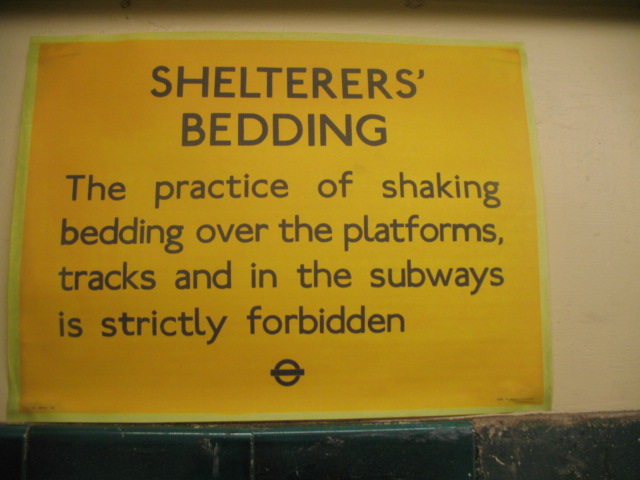
The tours begin in the neat but spartan ticket office, which is decorated with a number of wartime posters giving instruction about shelters and the blackout. You are greeted by an actor playing an Air Raid Precautions officer, whose monologue is interrupted by the forbidding wail of an air raid shelter. You meet three more such actors in the course of the tour, the best being the 1940s housewife who sits in the train down on the platform and can be quite saucy if you ask the right sort of questions.

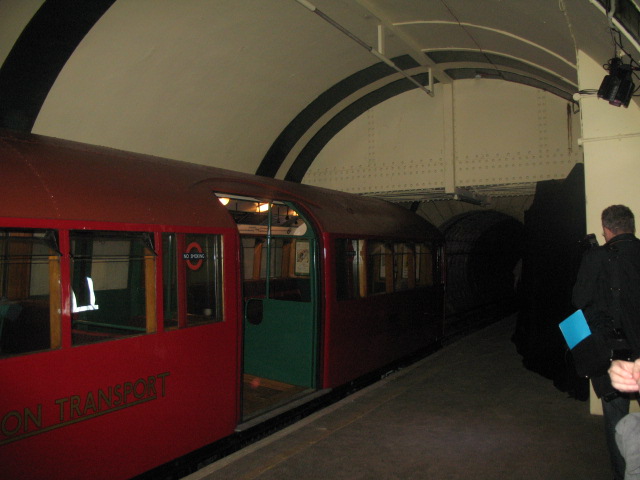
The chance to poke around the station and listen to actors recreating 1940s stereotypes is all well and good, but the star of the show is undoubtedly the 1938 train that has been brought out of retirement for the occasion.


I’m no train nerd, but this one is a beauty, as I’m sure better photographers than I will record this weekend.

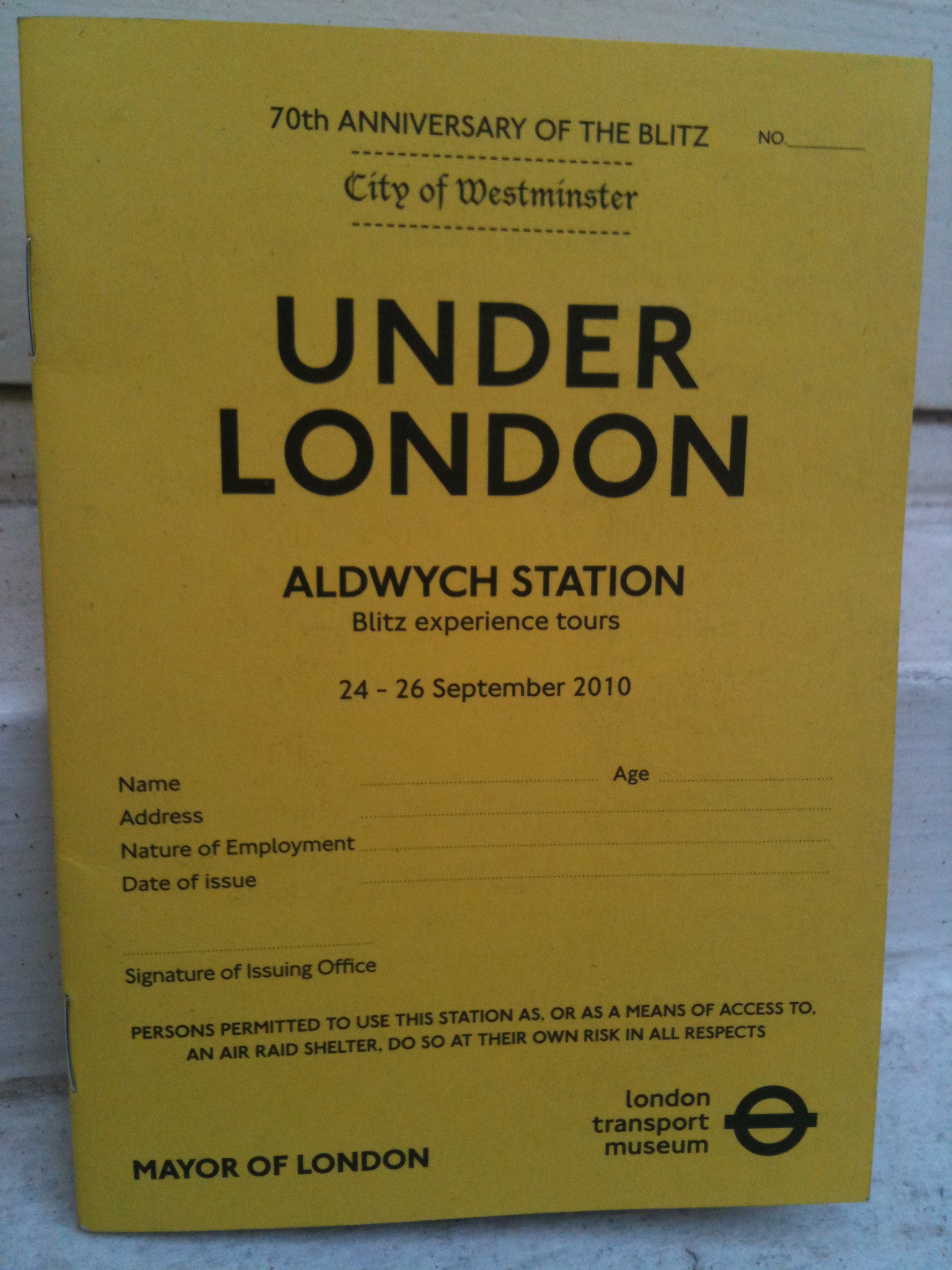
The other highlight is this cracking little souvenir book about Aldwych and the Blitz that is given to everybody who goes on the tour.

The tour ends with a deafening reconstruction of an aerial bombardment, with impressive sound and light, before the all-clear sounds and allows you to climb the steps back to the surface (no lifts or escalators, so prepare for a walk).

A recreation of the ‘Blitz experience’ is an almost impossible thing to pull off for obvious reason and this is neatly done in the circumstances, although it might have been nice to have bunks on the platform to give more of a flavour of what it was like to cower down there for a night.

Interest in the tours have been so great – an estimated 3,000 people will take part this weekend – that the London Transport Museum believe public tours of Aldwych will be reintroduced on an irregular basis in the future.

So that’s one ambition sated, only for another to take its place. Earlier this week I was talking to a curator at the LTM, who told me of his recent tour round Down Street, another abandoned station with wartime connections. It is, he told me, in ‘fabulous condition’. Anybody interested?