Category Archives: Secret London

Five unknown London pleasures

1 London’s first artificial ice rink
The Glaciarium opened in 1842 at the Baker Street Bazaar near Portman Square. The backdrop was ski chalets and snow-capped mountains, the ‘ice’ was churned-up hogs’ lard and sulphur. On hot days it smelt of cheese. It closed in 1844.

2 The clown and the geese
In 1884, a clown called Barry was watched by a huge crowd as he sailed down the Thames from Vauxhall to Westminster in a washtub pulled by four geese.

3 One-legged cricket
In 1796, Montpelier Gardens in Walworth hosted a cricket match between eleven one-armed Greenwich pensioners and eleven one-legged Greenwich pensioners. Interest was so great that a fence was broken and spectators fell through a stable roof. The match was drawn, but the one-legged team won a replay, earning themselves 1,000 guineas.

4 London’s first public museum
This was opened in a coffee house near Chelsea Old Church in 1695 by James Salter, a former servant of Hans Sloane, the man whose collection later formed the British Museum. Sloane reputedly handed Salter – renamed Don Saltero – some of the less important of his 80,000 objects, including a giant’s tooth,  a necklace made of Job’s tears and a bonnet that belonged to Pontius Pilate’s wife’s chambermaid’s sister (it actually came from Bedford).

5 The Peace of 1814
On Monday August 1, 1814, London celebrated the abdication of Napoleon Bonaparte with a series of festivities. It began with a balloon ascent at Green Park; the balloon was captured by the winds and sent towards the Estuary until the ballooneer cut a hole and landed on Mucking Marshes near Tilbury. Next came a miniature Battle of the Nile on the Serpentine, followed by a firework display in Green Park, for which John Nash had designed a new pagoda. Sadly this caught fire, killing two people. The crowd applauded, assuming it was all part of the fun.

All these came from Pleasures of London, a book available at the Museum of London bookshop for £30. It is my new favourite London book. It should have been published in 1992, but was delayed repeatedly and by the time it was published by the London Topographical Society in 2009 the authors, Felix Barker and Peter Jackson, had both died.

What the pair had created was an endlessly browsable book on all the fads and fancies that have occupied Londoners leisure since the Dark Ages, from Frost Fairs to black-faced minstrels, lidos to the Great Exhibition. There are brilliant throwaways  – such as those mentioned above – as well as short but thorough looks at things like music halls, pleasure gardens (which I still don’t get the point of), museums and the origins of sports like cricket, football and boxing.

Buy it.

Strippers, beatniks, bikers and mods: celebrating BFI Flipside

I have a small piece in the Independent celebrating BFI Flipside, the BFI’s DVD label for forgotten, weird British films from the 1960s and 1970s.

The key Flipside films for any self-respecting London nerd are ‘London In The Raw’ and ‘Primitive London’, two endlessly fascinating exploitation documentaries that ‘lay bare’ the London of the mid-60s, with much emphasis on the weird and the shocking.

These are dayglo Soho-obsessed precursors to the rightly cherished London classic ‘The London Nobody Knows’, but possibly more entertaining for their utter shamelessness: here you’ll find strippers, wife-swapping, prostitution, Jack The Ripper re-enactments – anything that may titillate and tantalise.

It’s pretty tame stuff now of course, which is partly what makes it so intriguing. This is a key point of London history – as the hairy freaks massed their forces in preparation for the myriad cultural explosions of the late-60s – and these films capture some of that sense of a city teetering on the brink of… something. Check them out, you won’t be disappointed.

Inside the Fleet: exploring London’s lost rivers

I wrote this piece for Time Out in 2005 and for some reason it’s never been available online. Until now.

It’s only as the filthy brown water rises above my thigh-high waders and my feet struggle to grip the tunnel’s slimy floor that I realise that drowning in a river of shit after breaking into a London sewer would be a really, really crap way to die.

It all began so well. I found Jondoe and Stoop, two urban explorers who get their kicks investigating drains, lost rivers and derelict buildings, on the internet and asked them if I could come on their next journey beneath the city streets.

We met near Farringdon. The plan is to explore one of London’s lost rivers, the Fleet, which once flowed from Hampstead to Blackfriars. Although long bricked over, the Fleet, like many of London’s old rivers, still flows underground through a series of pipes and culverts. Joseph Bazalgette integrated these rivers into his sewer system, using them as storm-relief drains to carry overspill into the Thames when the main east-west sewers were swelled beyond capacity. These days, heavy rain can still cause sewage to flow into the river via the Fleet.
Jondoe and Stoop have been in the Fleet before, but turned back when the stench became overwhelming for even these experienced drainers. This time, they are determined to reach the end. They believe no other UK urban explorer has made the trip, largely because it takes considerable planning to find a way into London drains. Urban explorers are driven by a combination of adrenalin and curiosity, and take their hobby seriously. This trip has been months in the planning. They’ve popped many manholes looking for the right entry point, and the weather has to be right – no rain for at least three days before we enter.

In a nearby car park, we change into waders, boiler suits, flourescent vests and hard hats – the latter more for disguise than protection. Carrying a couple of traffic cones, we’re suddenly transformed into construction workers, practically invisible to passers-by. Nobody bats an eyelid as we walk through busy streets to the selected manhole, stick some cones round it, lift the cover and climb down the ladder into the gloom.

We enter a feeder tunnel with a five-foot ceiling, which means we have to abandon our hats and walk with cricked necks. It’s cramped, damp, dank and dirty but doesn’t smell too bad. Stoop and Jondoe glide like skaters along the slippery floor while I splash clumsily behind, using slimy walls to keep my balance. We head downwards along a series of mini-waterfalls. The light and noise that intermittently emerges from the grates overhead suggest we aren’t getting deeper, but simply following the gradient of the road. It’s a curious feeling, being isolated in the dark but with occasional glimpses of London reminding us that normal life continues up above.

Eventually we reach the end of the feeder tunnel and swing into the Fleet itself using broadband cables that make useful subterranean handrails. It stinks in here and the air is heavy with a strange mist. Jondoe points north, to where the Fleet is blocked by the main east-west sewer. Ominous clumps of matter fester in pools all around. ‘Don’t disturb them,’ he says. ‘It’ll be full of gas that just sits there and collects.’
As he speaks, one of the hard hats we’d left by the entry point shoots out of the feeder tunnel on a wave and floats towards the Thames, bobbing along the shallow water that moves sluggishly down the centre of the tunnel.

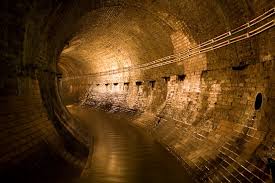
We follow, heading south. The tunnel is around ten feet tall and wide, so we can walk two abreast. It’s about the same size as a tube tunnel. The smell slowly subsides, although lumps of faeces and toilet paper gather in places where they’ve washed against the brickwork. Otherwise, there’s just a trickle of brown water ferrying the odd cotton-bud downriver.

It’s no hellhole, but still a far cry from the Fleet’s sixteenth-century heyday as one of London’s key tributaries, when, flanked by wharves and warehouses, it was a centre of London commerce. It separated Westminster from the City and carried cargo to the Thames, was compared unfavourably with the four rivers of Hades by Ben Jonson, was briefly turned into a canal and then covered in portions from 1732, by which time it was little more than an open sewer.

But this was not the end of it. In 1846, the Fleet exploded, its sewage gasses bursting the street above, rendering King’s Cross Road impassable, destroying Clerkenwell poorhouses and smashing a Thames steamboat against Blackfriars Bridge. This river, it seems, has a habit of coming back to ambush those who thought it dead and buried.

Almost two centuries later, traffic and police sirens are audible overhead, competing with the constant crash of water that flows from numerous side tunnels, feeding the central trickle. Rats stop and stare as we walk past. I nervously keep my torch shining on them until we have moved on.

Before Ludgate Circus, the Fleet splits into two parallel tunnels, directly replicating the pattern of Farringdon Street overhead. Otherwise, it’s impossible to work out exactly where we are. The tunnel heads south, but is full of turns. At one point we notice large iron rings cemented into the wall. They are support for scaffolding, but look like mooring rings. Throughout, the Victorian brickwork is surprisingly beautiful for something that is so rarely seen.


After about two miles of trudging, we emerge into an enormous end chamber, more than 20-feet high and elaborate in design and construction. Two short tunnels lead from here, ending in huge metal flaps, which we assume open directly into the Thames.

After taking pictures, we head back. Immediately, we realise there’s a problem. It’s much harder to walk uphill against the flow of water. On the way down, the water was a stream, heading back, it’s more like a river. We labour onwards and upwards in the dark, but it’s tough work.

Stoop eventually says what we’ve all been thinking. ‘Is it just me,’ he asks, ‘Or is the water getting deeper?’

Water which before barely covered our feet is now above our knees, flooding downhill towards us at pace and rising slowly all the time. Wading into the tide, our clothes are heavy with water and our feet struggle to grip the slimy stone floor. Panicking rats scurry up the walls to get out the way of the bubbling water.

 It’s frightening. Nobody knows we are down here and as our pace slows I begin to ponder our options. Should we press on, or brave a side tunnel, where a ladder may at least take us above water level, so we can sit it out. But how long would that take? And what if the water keeps rising and the side tunnel we’re in doesn’t have access to the street? 

We reach a turn where the water has become a torrent and Stoop tries to brace himself against the tide but instead starts sliding backwards towards me, threatening to skittle us all into the dirty water. For a split second I consider what an undignified death this would make, and with one final effort we press on, forcing ourselves to a point where we can stand without getting knocked off our feet. But we’re exhausted.

Then Jondoe shouts, ‘That’s where we came in!’ It is indeed. We pull ourselves up into the feeder drain via the broadband cable and watch the river below us boil to a frenzy. The Fleet is back with a vengeance. Later Jondoe explains, ‘Somewhere further up the sewer they must have been doing some maintenance and so diverted the flow down the Fleet.’ It is, he says, something he’s never experienced before.

Twenty minutes later, after an exhausting walk through the smaller drain in the course of which I bang my head several times on overhanging pipes and bricks, I haul my battered, sodden body up the ladder and into the sunshine. It’s bright outside. The air smells clean. Half-a-dozen people across the road pay us no heed as we emerge from the manhole and sit slumped in the road, moving only to remove our waders and empty them back down the drain.

We trek back to the car in soaking socks, leaving a trail of footprints behind us.

The Siege Of Sidney Street

My review of the Museum of London Dockland’s exhibition on the Siege of Sidney Street can be read in the New Statesman.

For once, I have little more to add. It’s an excellent exhibition and I recommend heading to Docklands before it ends in April. For more on the siege, you can see Pathe newsreel footage here or read Caroline’s article here.

Or you can watch a clip from the 1960 movie loosely based on the events.

Secret London: inside the Black Museum

I first read about the Black Museum when I was a boy, a macabre museum run by the police filled with artefacts taken from their most gruesome cases. I always wanted to visit, but the museum was out of bounds to the public. When I was at Time Out, I asked the Met to let me write about the museum and after some badgering – and to my great surprise – they finally agreed. The result was not quite what I expected. There is an interesting coda to this piece. Upon publication, the press officer phoned me to say how disappointed they were with the tone of the article; at exactly the same time, the Curator sent me an email saying the piece was the best description of the museum he had read. Make of that what you will…

The Curator pulls open a drawer full of shotguns. ‘Which of these are real and which are replicas?’ he asks. I nervously peer inside.
‘Too late,’ he says. ‘You’re dead.’

Welcome to the Black Museum, the Met Police’s private memorial to  London’s worst crimes. The public isn’t allowed inside, and after a half-hour tour, I wish I hadn’t been either.

Death masks and weapons from the Black Museum

The Black Museum (renamed the Crime Museum after complaints from officers in areas with large ethnic minority populations) has been one of the world’s most macabre and inaccessible museums for over a century, acquiring a certain infamy among hardcore Londonphiles and the sort of people who spend their spare time reading ‘The World’s Greatest Serial Killers’.

The museum is closed to the public but, after repeated requests, The Curator has allowed Time Out inside, albeit under duress that he makes no attempt to disguise. From his office in Scotland Yard’s Room 101 (and who says the police have no sense of humour?), where the walls are covered in police badges from forces around the world and shelves stuffed with books such as, er, ‘The World’s Greatest Serial Killers’, The Curator – two parts John Thaw to one part librarian – lays down the law. He doesn’t want to be named or photographed, and if the piece results in people phoning him up to try to get access to the museum, well, he’ll hold me responsible.

Ground rules established, The Curator unlocks the door, and the tour begins. The Crime Museum has been at Scotland Yard since 1874, moving with the Met from Whitehall to Victoria Embankment in 1890 and then Victoria Street in 1967. It was set up by Inspector Neame after an 1869 law allowed the police to retain prisoners’ property for ‘instructional purposes’. Neame felt it was important that police officers could see the tools of the criminals’ trade – a function the museum still fulfils today – and gradually built up the museum’s collection.

In 1877, a reporter from the Observer was refused entry and wrote about Scotland Yard’s ‘black museum’. The name stuck, and the museum became a popular destination for Victorian celebs: Gilbert and Sullivan, Sir Arthur Conan Doyle, Harry Houdini and Laurel and Hardy all had a ghoulish gander.

The room we enter has been mocked up to resemble the original Whitehall museum, with a false fireplace and sash window. The first thing you see is a hangman’s noose, followed by a desk covered with knives and guns, and a chest of drawers topped with a glass case containing submachine guns. An opening leads from this ante-chamber into the museum proper.

We start at the gun drawer. As well as rifles and replica rifles, it contains walking sticks, umbrellas, flick knives and other random bits of metal. The Curator asks me to guess which of these items are guns, pauses for a heartbeat, before stabbing with his finger: shotgun, shotgun, pistol, shotgun, pistol. They’re all guns, the walking stick and umbrella, even the flick knife. And all have been used on London streets. He takes out a walking stick, demonstrates how quickly and easily it converts into a gun and back again, and shuts the drawer firmly.

The Curator is enjoying himself, less begrudging by the minute. He picks up a sword and hands it to me. As I take it by the scabbard, he pulls off the hilt, which is a short, detachable, vicious blade, and imitates gutting me with it, which, he says, is exactly what happened to the police officer who first encountered this duplicitous double-weapon. It’s called the Cop Killer, he says. And, just like that, any lingering sense of fun wafts out the window.

The point of this drawer, The Curator explains, is to show new coppers the dangers they face from disguised weapons (the walking-stick gun et al were legal until 1959).  The inference is clear: anything is a potential weapon.

The Curator is passionate about the museum’s purpose and happiest when discussing the history of crime. Everything that comes into the museum, he emphasises, is for teaching purposes, and not just for cadets. Senior officers come here for briefings and lectures to discover historical parallels of contemporary cases.

We move into a large room with the fusty atmosphere of a regional museum. Display cases that mark out a mazy circuit of London’s criminal history. One of the first is on serial killer Dennis Nilsen, who boiled the flesh of his victims on his stove before poured their fat down his drains. I look at the Nilsen display. It’s a badly stained cooker topped by a battered aluminium cooking pot. I feel sick.

Nilsen’s cooking pot

The rest of the tour passes in a blur. There’s a display on officers killed in the line of duty; the protective apron used by John Haigh, the Acid Bath Murderer; vials of poison; forensic photographs; blood-stained weapons; a crossbow used by the Krays; a ketchup bottle from the Great Train Robbery (‘I can’t talk about that,’ says The Curator cryptically); evidence related to Crippen, Christie and cannibalism; explosives used by Fenian terrorists; the IRA rocket launcher that fired at the MI6 building in 2000; and the tiny ricin-loaded pellet pulled out of Georgi Markov’s leg, where it had been inserted with an umbrella.

It’s a tough tour, not because of any individual items (Nilsen’s cooking pot excepted) but through the accumulated weight of otherwise anodyne objects that collectively represent the many horrible things people have done to each other. It’s a chilling, unsettling experience that sits somewhere between the self-chosen prurience of reading a book about Fred West and the necessary horror of the Imperial War Museum’s Holocaust gallery.

The Curator reassures me that visitors, police officers included, regularly faint during tours, but this is clearly a museum that has been designed by the police, for the police. That point is underlined by one of the last displays, a huge pile of weapons taken from demonstrators at an anti-Vietnam War march in 1968, a so-called peace march comments The Curator, as well as riot shields from Brixton, melted by petrol bombs, and Broadwater Farm, peppered by bulletholes. This is what you are up against, the display says. Trust nobody.

Police at Broadwater Farm

The result is a museum that works on two levels: one is the straightforward practical side that allows policemen to see and handle real evidence and learn how it was used to solve cases, while the other, possibly more important, is psychological, showing the police what the people out there will do to them, and each other, given half a chance. In so doing, it validates the Met’s instinctive suspicion – as embodied by The Curator – of outsiders, the public, the people they protect and serve.

I leave the Crime Museum in a sober mood, sure of only one thing: having tried so hard to get inside, I’m in no hurry to return.

Eel Pie Island

ImageShack, share photos of eel pie island, eel pie island fire, trevor bayliss house eel pie island, share pictures of eel pie island, eel pie island fire, trevor bayliss house eel pie island, share video of eel pie island, eel pie island fire, trevor bayliss house eel pie island, free image hosting, free video hosting, image hosting, video hosting.

My feature on the birth of British R&B at Eel Pie Island is in this month’s issue of Uncut.

It includes interviews with Pete Townshend, Ron Wood, Kenny Ball, Top Topham and the inventor Trevor Baylis, who still lives on the island and told me.

 ‘I moved to the island in the 1970s when I’d made enough money as an underwater escape artist in Berlin to buy a plot of land, but I went there regularly from 1957. They were wild times. If you wanted to get your leg over, that’s where you went. It was notorious. There was no bridge, the only way to get there was on a chain ferry. On the island, a little old lady sat in a tollbooth and stamped the back of your hand. The hotel was very Dickensian, a bit of a tramshed just about hanging together, but it had a dance floor that was like a trampoline so if you couldn’t dance when you went in you certainly could when you came out.’

South-west London was a fertile territory for music in the early 1960s, and the likes of Keith Richards, Eric Clapton, Jeff Beck, Rod Stewart and Jimmy Page all learnt their craft in the venues of Richmond and on Eel Pie Island.

As Ian McLagan of the Small Faces explained: ‘The audience was full of musicians. Loads of them. You’d see them all in the front row – “Do you see that?”, “Yeah”, “Well I can do that too”. We were all kids, but when you saw the Stones it was “Fuck me, it’s possible…” ’

Diamond Geezer visited Eel Pie Island recently and writes about it here.

Secret London: the Russian tank of Bermondsey

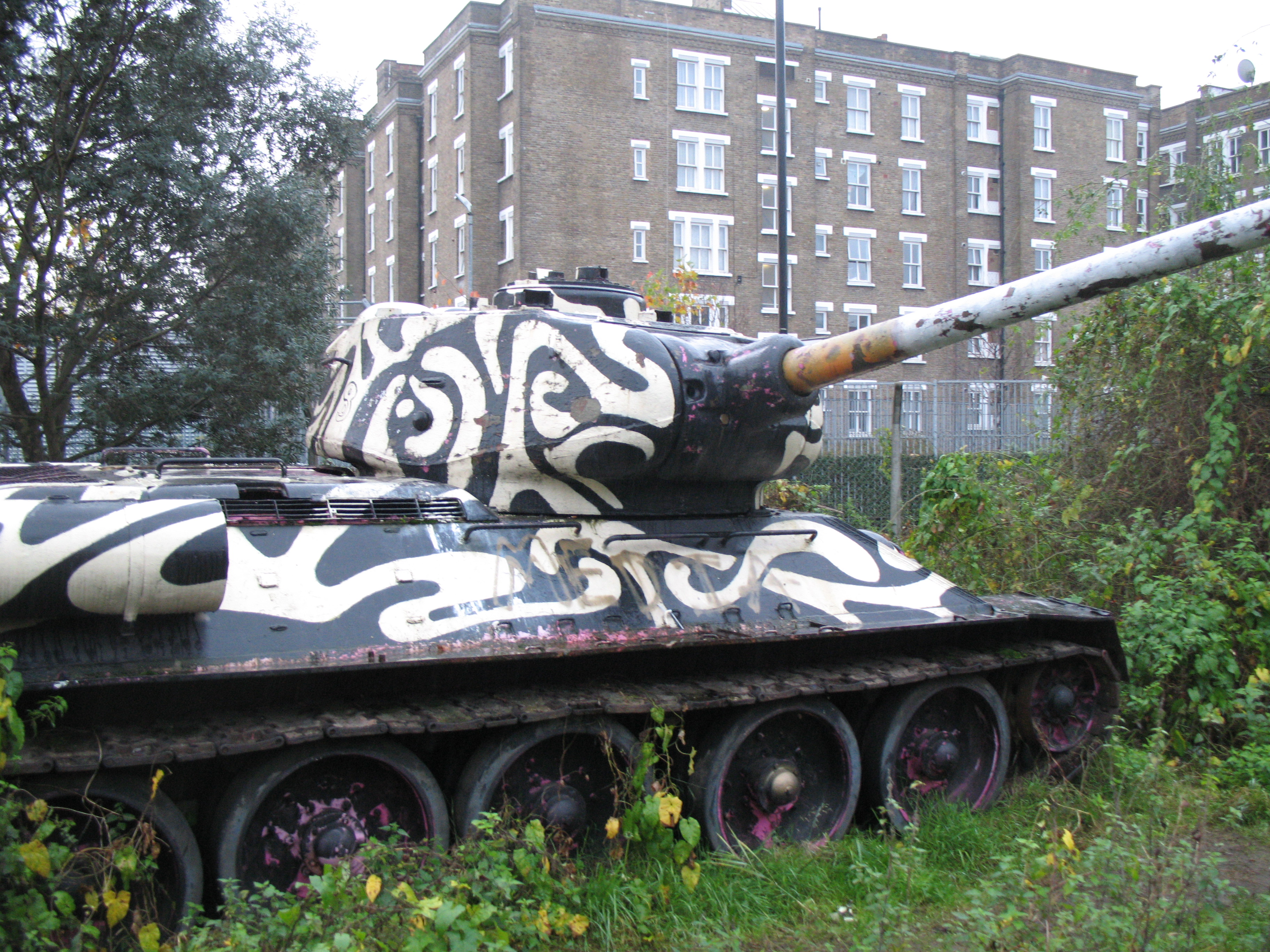
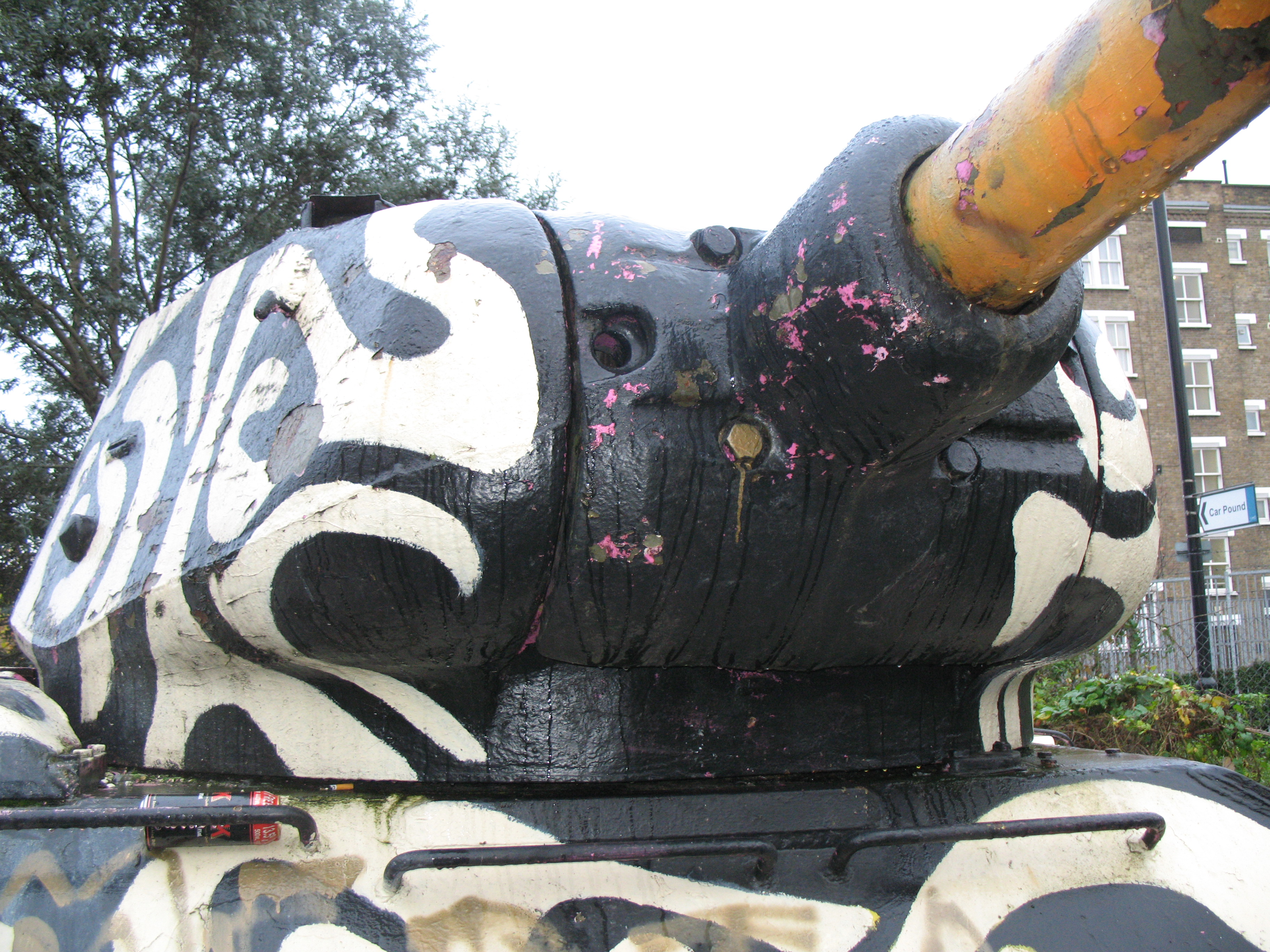
That there is an authentic Russian tank parked in a patch of wasteland on a side street off the Old Kent Road is one of those things that is so brilliant it should be mentioned on the news at least once every day. (I felt much the same way about Gordon Brown’s glass eye.  A Prime Minister with a glass eye! How cool was that! What a wasted opportunity.)

The tank is a T34 Russian tank that was possibly used against the Czechs in the Prague Spring uprising of 1968. It arrived in London in 1995 when it was used for the filming of Richard III. The tank was then purchased by Londoner Russell Gray as a sort of giant and very expensive pun after Southwark refused him planning permission to build houses on the site. Gray instead applied for permission to put a tank on the site. They thought he meant water tank, but he didn’t. The tank’s gun is trained on the council office.

How much truth there is to that story is surely irrelevant. It feels right. And when it comes down to it, all that matters is that there is a bloody great Russian tank on the streets of South London and people don’t seem to realise quite how incredible this actually is.

Stoney Jack and the Cheapside Hoard

The Cheapside Hoard is one of the great treasures of the Museum Of London. A vast collection of Tudor jewellery, it was found by two workmen in the cellar of a house on Cheapside in 1912 and eventually made its way into the museum’s collection.

The story is a fascinating one, outlined in HV Morton‘s seminal London history ‘In Search Of London’.

Morton, a journalist and insatiable London enthusiast with the knack of knowing not so much the right people as the really interesting ones, begins by describing GF Lawrence, ‘or Stoney Jack as he was known by every navvy who worked in the City’.

Stoney Jack was an asthmatic antiques dealer with a shop on West Hill, Wandsworth. He also had a job as Inspector of Acquisitions at what was then called the London Museum, based in Lancaster House, St James’s.

Since the 1970s, every building site in the UK must by law be visited by a team of archaeologists to ensure no great treasures are missed, but in Lawrence’s time there was no such requirement. Lawrence’s job then was ‘to haunt every demolition site in the City and make friends with the navvies, so that they would bring to him anything that had been found during excavation’.

Morton writes that there was a lot of building work taking place at this time and Lawrence knew it may be the last chance to find any antiquities that might still be hidden in the soil. In his not entirely public-spirited determination to ensure nothing crucial was lost, workmen received rudimentary archaeological training during ‘mysterious transactions behind hoardings and in the tap rooms of City public-houses’.

In this way, Lawrence was able to purchase items from ‘a procession of navvies with mysterious objects wrapped in spotted handkerchiefs’ and flog them on to the London Museum, earning himself a tidy profit. Anything the museum didn’t buy, went into his shop. And even if the navvies brought him something worthless, he always gave them enough cash to buy a pint of beer. In this way, he built up much of the Roman and Medieval collection that is now in the Museum of London.

Morton continues:

I cannot count the times I have been present when navvies have appeared and passed their treasures across the counter with a husky, “Any good to yer, guv’nor?” I have seen handkerchiefs unknotted to reveal Roman pins, mirrors, coins, leather, pottery and every kind of object that can lie concealed in old and storied soil.

I was with him one day when two navvies handed over a heavy mass of clay found beneath a building in Cheapside. It was like an iron football, and they said there was a lot more of it. Sticking in the clay were bright gleams of gold. When they had gone, we went up to the bathroom and turned the water on to the clay. Out fell pearl earrings and pendants and all kinds of crumpled jewellery. That was how the famous hoard of Tudor jewellery, the Cheapside Hoard, was discovered.’

Morton recalls that for this great find, now worth millions, Stoney Jack received a thousand pounds. For their part, the navvies were rewarded with ‘something like a hundred pounds each, and I was told that these man disappeared, and were not seen again for months!’

London’s crappest ghost: a Halloween post

London has many ghost stories and some are actually rather scary, like the Black Dog of Newgate. This spirit is said to haunt Amen Court near St Paul’s, where a wall from Newgate Prison remains. It manifests itself as a shapeless, black form slithering along the wall before it disappears into the shadows.

Considerably less spooky is the ghost said to haunt Pond Square in Highgate.

The story goes like this.

In January 1626, the writer and philosopher Sir Francis Bacon wanted to test his theory that ice could be used to preserve food, so he bought a chicken on Highgate Hill, killed and plucked it, and stuffed the carcass with snow. The frozen chicken had been invented, but the effort caused Bacon to contract pneumonia from which he died.

A sad tale, but one which doesn’t end there. For, ever since, on icy cold nights in the depths of winter, a shape resembling a partially plucked chicken has been seen flapping around Pond Square and squawking before vanishing spookily into the ether.

Yes, that’s right, London is haunted by the spirit of a featherless fowl.

Has there ever been a crapper ghost than this?

Secret London: the riddle of the Farringdon spoons

I first saw these spoons several years ago stuck on a wall in a miserable stairwell under Farringdon Road near Mount Pleasant. Nobody seemed to know anything about them or where they came from – the only reference I could find is a passing mention in this interview with the Greenwich Phantom on Londonist.  

I walked past them again the other day and tweeted about them. An answer came back within half-an-hour (from @mrrylln), who said: ‘They have been up there for about 10 years. The stairs were used by heroin addicts a lot… hence the spoon H-shrine.’

Not the most romantic of explanations, but an explanation all the same. Chalk up another one to Twitter.