I interviewed Peter Tatchell at his house in 2008 for a piece that was intended to be the first in a series on Living London Legends but never ran. It seemed appropriate to reproduce it now in LGBT History Month.
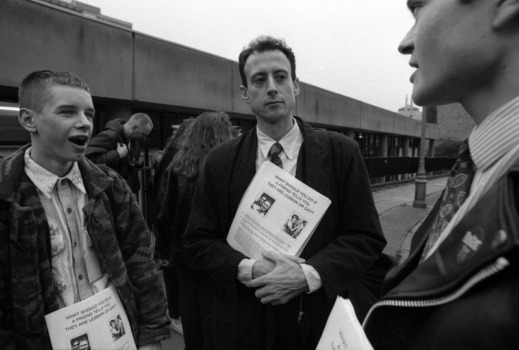
The picture is courtesy of Ralph Erle (www.ralpherlephotography.co.uk).
Peter Tatchell speaks with frightening precision. It’s the style of a man who has spent half his life being misquoted and the rest composing press releases. ‘In 1988 I organised the world’s first AIDS and human rights conferences to coincide with the World Health Organisation summit,’ he says, before the self-editing begins. ‘The pressure we exerted resulted in it adopting a declaration… unexpectedly and unscheduled… unexpectedly adopting an unscheduled… unexpectedly adopting a previously unscheduled declaration condemning discrimination against people with HIV.’
Tatchell works as hard at getting his message across as he does at getting it right. He’s been doing this for years – ’40 years an unpaid human rights activist’, he says. ‘Yes, it is a big commitment and that’s why I’m still living in the same one-bedroom council flat in Elephant and Castle.’ Tatchell’s office is his lounge, a living space reduced by two bicycles (‘very bourgeois’) and piles of literature on human rights. On the walls are large cork noticeboards covered in leaflets and badges: ‘Whores Against Wars’, ‘Rockingham Against Racism’, ‘Lesbians Support The Miners’: niche, witty, passionate. If you planned an exhibition about half a century of human rights activism in London, it would end up looking a lot like Peter Tatchell’s living room. Indeed, some of Tatchell’s personal history is loaned to Manchester’s People’s History Museum.
But Tatchell isn’t so much of a martyr that he likes it this way. ‘The idea of being on 60k, having an office and a dozen staff is very attractive,’ he says. ‘I can’t get the funding. I’m regarded as too much of a maverick because I work both inside and outside the system. I will lobby government ministers, but I’ll also arrest presidents in the street.’
Tatchell’s devotion to human rights began as a 16-year-old in Melbourne in 1967, with the case of Ronald Ryan, an Australian prisoner who faced the death penalty when he was accused of killing a warden during an escape attempt. Tatchell mounted a passionate defence of Ryan, graffitiing walls and writing to the press. His parents were horrified.
‘My friends and family thought I was crazy. My father denounced me for defending a murderer; my mother was a bit more understanding but didn’t believe the government would send an innocent man to the gallows.’
Tatchell had been brought up in a strict Baptist household and even taught at Sunday School as a teenager, but he developed a different understanding of religion to his family.
‘My parents had no social dimension to their beliefs whatsoever. For them, Christianity was a personal matter – they never related it to issues of social justice. But I connected with Martin Luther King’s idea that Christianity was about not just how we behave personally with other individuals but how society was organised. I saw Christianity as an instrument for human and social liberation. My parents always taught me “Stand up for what you believe”. I gave up my religious beliefs at 19, but it influenced my politics and commitment to challenge oppression.’
Tatchell realised he was gay when he was 17. Homosexuality was still illegal in Australia. ‘You could be jailed and forced to undergo psychiatric treatment to ‘cure’ your homosexuality. There were no gay organisations at all, not even any switchboards or counselling services. There weren’t even any clubs, all you had was a couple of seedy bars. Most people met each other on cruising areas, which were very dangerous.’
Tatchell wanted to change that and again utilised his zeal for campaigning. He wrote letters to newspapers, initially anonymously but later under his name, and urged friends to help him set up an orginisation for gay rights. ‘They were too afraid,’ he recalls. ‘They said: “You’re crazy!You’ll get us all arrested and locked in jail, go away you stupid young boy.”‘
So he did, fleeing to London to escape the Vietnam draft. ‘It was only my intention to stay until there was an amnesty,’ he says, ‘but when I got here the Gay Liberation Front (GLF) had just been set up, I fell in love, got a good job, a nice flat – a temporary stay became permanent.’
On his second day in London, Tatchell saw a lamppost sticker advertising a GLF meeting. ‘So within a few days I attended a meeting and within a month organised my first protests.’ Already a veteran of direct action, he was ‘aghast’ at how supine the British protest movement was. ‘Australia was much more radical than Britain. Britain was pathetic,’ he says. ‘I was expecting direct action, civil disobedience, blocking of military installations – the sort of stuff we did in Australia. Even the quite radical Brits thought I was rather extreme and ran a mile at anything provocative.’
Under Tatchell’s influence, that changed. The GLF arranged sit-ins at pubs that refused to serve gays and lesbians; ‘zapped’ Professor Hans Eysenck, who adocated electric shock aversion therapy for homosexuals; and invaded Foyle’s on Charing Cross Road for selling books that the GLF considered to be homophobic.
‘It felt like being part of a revolution,’ recalls Tatchell. ‘Our slogan was “Gay is good” and those three words turned on their head everything people thought was true about gay people, that we were mad, bad and very, very sad. We were challenging the homophobia of millennia. The GLF were the first time in British history that thousands of people came out and marched to demand their liberation. We wanted to transform the laws, institutions and values of the whole society to liberate everyone, gay and straight, from sexophobic and puritan oppression.’
Unfortunately, many on the ‘non-aligned revolutionary left’ did not want to be liberated by homosexuals. ‘The vast majority of the left, particularly the Communists and Trotskyites, were viciously hostile to gay people,’ says Tatchell. ‘They denounced us as bourgeois degenerates and we were physically attacked.’
This partly changed in 1973, when Tatchell staged a one-man gay rights protest in East Berlin that ended with him getting interrogated by the Stasi and the bravery of which went some way towards challenging the homophobic mindset of the left. Similarly, his attempt to arrest Robert Mugabe in 1999 – ‘he was like a frightened 10-year-old boy’ – helped gain the respect of a right-wing establishment who had previously denounced him as a ‘homosexual terrorist’. The Telegraph even recently suggested he should be given a medal.
Tatchell studied at the Polytechnic of North London and worked as a store designer. He lived in various parts of London and spent a year travelling, before settling in south London where he worked with the homeless of Waterloo and joined the Labour party. ‘Quite a few people were surprised. Alarmed! What motivated me to join was the rise of the left within the party and the moves to make it more democratic and accountable to grass roots members.’
Tatchell took his policy of direct action into party politics when he was elected secretary of the Bermondsey Labour party in 1981. One campaign saw him occupy HMS Belfast in protest at plans to build office blocks along the river front. ‘We bought a group concession in the name of the East Dulwich Tennis Club,’ he recalls, ‘and then strung huge banners from the bridge.’
Tatchell had more or less abandoned gay politics by this time, but he returned to the cause in the wake of the hugely controversial Bermondsey by-election. He says the ‘unwritten story about the Bermondsey by-election is that I was standing up against property developers for local working class communities.’ During it he was subject to homophobic abuse, much of it personal.
‘I came to symbolise the battle in the Labour party between left and right,’ he says. ‘Those who wanted to manage capitalism and those who wanted to redistribute wealth and power. There was also the pure unvarnished homophobia of some people who didn’t like gay people and thought we were perverted and revolting. Those are the three things that came together.’
After Bermondsey, Tatchell realised that homophobic prejudice was far more widespread and vicious than he had realised. ‘That’s why I decided to put most of my energy into challenging homophobia. I had no idea it was a lifetime commitment.’
Tatchell argues that ‘women and gay people are the litmus test of whether a society is democratic and respecting human rights. We are the canaries in the mine’ and his commitment to gay rights still leads him into regular confrontations with theoretical allies as much as homophobic enemies. ‘Some on the left have savagely attacked me for pointing out oppression within minority communities,’ he says of recent run-ins concerning Islamic fundamentalists. ‘But I am defending women and gay people within those communities who have the same entitlement to human rights as the rest of us. If I ignored their suffering – that would be racist.’
Tatchell’s chosen way of life is one guaranteed to bring disappointed such are the forces stacked against him. ‘Yes, it induces a certain pessimism, but that is countered by the optimism that comes from a successful result. Somebody once described me as the patron saint of lost causes but often I manage to turn round lost causes and win them. That’s what keeps me going. my enthusiasm and inspiration comes from the many successes I’ ve had in helping individuals and contributing to successful campaigns. I’ve helped secure asylum for lots of genuine refugees and prisoners who are unjustly incarcerated – to see their joy is what keeps me going.’


 The Great Wen