Category Archives: Politics

The Siege Of Sidney Street

My review of the Museum of London Dockland’s exhibition on the Siege of Sidney Street can be read in the New Statesman.

For once, I have little more to add. It’s an excellent exhibition and I recommend heading to Docklands before it ends in April. For more on the siege, you can see Pathe newsreel footage here or read Caroline’s article here.

Or you can watch a clip from the 1960 movie loosely based on the events.

Andy Coulson: getting it

In 1999, I happened to share a dinner table with the recently disgraced Tory director of communications Andy Coulson.

Coulson was then editor of the Sun‘s Bizarre column and he spent a large part of the evening holding court and talking loudly about those celebrities who ‘got it’ and those that didn’t ‘get it’. Chris Evans ‘got it’ he said, but Hugh Grant didn’t ‘get it’.

‘It’ was that the celeb in question understood and accepted that having their names, families, relationships and reputations trashed each day in the tabloids was all just a bit of fun, fair game, cheeky banter, part and parcel of what comes with being famous. Evans went along with it and didn’t complain; Grant, on the other hand, was less compliant.

After what’s happened in recent weeks, I can’t help but wonder whether Andy Coulson ‘gets it’.

Why I love Pat Nevin

I remember when I fell in love with Pat Nevin. It was in the playground and somebody was passing round a 1985 Panini sticker album. I turned straight to the Chelsea page to see my heroes.

There was Kerry Dixon, bluffly handsome with golden hair, azure eyes and self-confident grin. There was Colin Pates, a brick-wall centre-back with disco dancer hair. There was Doug Rougvie with a nose that looked like it had lost an argument with a spade.

And there was Pat Nevin. Pasty-faced, greasy-haired, nervous, thin and sullen. He looked like a smackhead. Who wouldn’t fall in love?

I only saw Nevin play once for Chelsea, a 3-0 victory at Watford in 1988 about which I remember little, but his legend loomed large over the following years. By the time I started watching Chelsea regularly the next season, the club were in the Second Division and Nevin was at Everton, but my bible, the Chelsea Independent fanzine, spoke of little else.

They drooled over Nevin’s dribble against Newcastle, when he beat eight players in a slalom run that took him from one end of the pitch to the other. They marvelled at his free kick against Sheffield Wednesday, when he chipped the ball over the defensive wall, ran round the other side and lofted a perfect cross on to David Speedie’s goalscoring noggin. They giggled at his famous penalty miss against Manchester City.

The love seemed mutual. When Nevin was injured playing for Tranmere, he attended a Chelsea-Everton game at Goodison Park and paid to go in the Chelsea end. This was important. Chelsea fans, then as now, were despised, but if somebody like Nevin loved us, maybe there was hope, maybe there was redemption,

And Nevin was the sort of player that fans love – an exciting, creative, unpredictable dribbler, but there was more to it than this. Nevin was smart. Nevin was cool. Nevin was different.

He angrily attacked his own supporters for their racist, violent and anti-semitic predilections – to the delight of the left-wing students at the Chelsea Independent. He read French and Russian literature. His favourite bands were Joy Division, Jesus And Mary Chain and the Cocteau Twins. He once insisted on being substituted at half-time in a friendly so he could attend a gig. He brought Brechtian principles to the club programme when he interviewed himself – yes, himself – for a player profile. He was friends with John Peel. For the teenager who read Camus and listened to Sonic Youth it was a no-brainer: if you could be a footballer, you’d be Pat Nevin.

NME described Nevin as the first post-punk footballer, although it may have been more accurate to say he was the first art school footballer. He was also the last. 

When at Everton, Nevin gave a lengthy to the Chelsea Independent, and talked at length about football, music and literature, and what it was like drinking in Soho with George Melly. I’d never heard of Melly, but here I was, learning about jazz and the counterculture from a footballer, in a fanzine. Would that happen now? 

When I interviewed Colin Pates – who is not a stupid man, by any means -he still seemed bemused by the fact Nevin would read books on the way to away games rather than play cards. Nevin, though, never seemed to get bullied about his interests. He was clever, but he was also proudly working-class and therefore more acceptable to other footballers and more capable of sticking up for himself than the middle-class Guardian-reading Graeme Le Saux who followed him as Chelsea’s token intellectual.

In the early 1990s, I finally got to see Nevin play at Stamford Bridge. He was wearing an Everton kit, but when he scored the Shed gave him a standing ovation – the only time I have ever seen Chelsea fans applaud an opposition goal. Pat Nevin was a very intelligent footballer and when he was around, fans seemed to use their brains a little bit more as well.

Pussyfoot Johnson and the London mob

My review of Ink And The Bottle, an exhibition about cartoons and alcohol, appears in the Independent.

One of the cartoons at the gallery is based on the story of William ‘Pussyfoot’ Johnson, an American who was active in the temperance movement and came to London on Nov 13, 1919 to give a talk.

Johnson was leader of the Anti-Saloon League and after success in America, he headed to the Old World to spread the anti-drinking word. He argued, ‘There is more bootlegging and more moonshining in Europe than in the whole United States.’

He may have been right. This temperance movement map from 1886 attempted to show the scale of the problem by depicting all of London’s pubs in its ‘Modern Plague of London’ map.

Modern Plague, London

Pussyfoot earned his nickname for his habit of amending laws by stealth, and this did not go down well with the London mob. As one anti-temperance advocate told the New York Times, ‘You know how the majority of Englishmen look upon prohibition and Mr Johnson’s activities? The thought of not being able to have the well-known pint of bitter fills them with horror. The war was terrible enough but it was something that happened before. There have always been wars. Taking away the drinks is attacking the divine rights of the Britisher. I can tell you they don’t like it!’

They certainly didn’t, and decided to do something about it. While Johnson was speaking at Essex Hall, he was captured by medical students from nearby King’s College who dragged him out the buildin, poured a bottle of beer over his head and marched him around the West End chanting ribald songs. It was noted that the police ‘seemed lacking in sympathy with the missionary’.

Johnson was hauled hatless on a stretcher around Regent’s Street, Leicester Square and Oxford Street while the students chanted ‘What won the war? Rum!’ and ‘We’ve got Pussyfoot meow, send him back to America’.

Such larks, what fun and games! 

And so what if Johnson lost his right eye in the incident? The lesson was learnt. Not many people have tried to take the Britisher’s beer away from him since.

The London Anti-University

This newsclip of the London Anti-University from 1968 is wonderfully evocative, not just for the interviewees’ earnest insistence that they could change the world of education, but also through the grim tattiness of late 1960s Shoreditch, reproduced in glorious colour.

The London Anti-University was formed after participants at 1967’s Congress on the Dialectics Of Liberation at the Roundhouse decided they wanted to continue to explore some of the themes and conversations that had started there (sample debates: The Future of Capitalism; Black Power; Imperialism and Revolution in America).

Based at 49 Rivington Street – previously home of the Vietnam Solidarity Campaign – the Anti-University was opened in February 1968 by David Cooper and Alan Krebs, and featured lecturers such as Cornelius Cardew, CLR James, Robin Blackburn, Bob Cobbing, RD Laing, Yoko Ono, Jeff Nuttall, John Latham and Alex Trocchi – all key figures on the intellectual left-wing of the 1960s counterculture.  The Anti-University syllabus covered three main areas: radical politics, existential psychiatry and the artistic avant-garde. 

 Poster announcing the opening of the Antiuniversity of London (1968)

An idea of the direction of the Anti-University can be gleaned by a reported exchange at Joseph Berke’s course on ‘anti-universities, anti-hospitals, anti-theatres and anti-families’.

He asked the class: ‘How can we discuss how we can discuss what we want to discuss?’ After a long silence, somebody answered ‘Maybe we don’t need to discuss it.’ Berke pondered this for a while and then left; the class continued for an hour despite his absence.

The Anti-University lasted almost a year, which isn’t bad by the standards of the time, but it’s premises soon became squatted, and the landlords, the Bertrand Russell Peace Foundation, reclaimed the campus.

But the Anti-University’s most important legacy may have come from a conversation in the classroom of psychoanalyst Juliet Mitchell, who lectured on literature and psychology.

One of Mitchell’s students, Diana Gravill, had inherited some money and was intending here to spend it on a women’s refuge. Mitchell instead persuaded her to put it towards a bookshop. This she did, and the shop, named Compendium, was opened by Gravill and her partner Nicholas Rochford on Camden High Street in August 1968.

Over the next thirty years it became one of the world’s great bookshops, stocking everything from academic studies of the women’s movement to punk fanzines. It was still going strong when I used to go there in the late 1990s, fascinated and intimidated by the content of the bookshelves. It eventually closed in 2000, a sad end to one of London’s greatest counterculture institutions, but a longstanding tribute to the ideas and passions raised by the London Anti-University.

Schools Out! The moral contamination of schoolkid strikers

Yesterday’s protests by schoolchildren were by no means the first time London’s schoolkids have chosen to withdraw their labour from the classroom, as Clive Bloom discusses in his recently updated ‘Violent London’.

There were waves of strikes in 1889 and 1911 around issues such as corporal punishment, the length school day, leaving age, holidays and bullying teachers. In 1889 there were strikes in Finsbury Park, Homerton, Woolwich, Plumstead, Kennington, Charlton and Lambeth and in 1911 in Enfield, Islington, Hoxton, Fulham, East Ham and Deptford. Strikes continued until long into the 20th century. I’m pretty sure Grange Hill went on strike a couple of times as well.

These original strikes featured pickets, marches and demos with flags and banners, and often ended with some casual window-breaking, for which the pupils would invariably receive disproportionate punishment such as being birched in front of the whole school or sent to the workhouse.

That was because the authorities were terrified about these strikes, firstly because of the lack of discipline it demonstrated but also because they suggested the children were developing a political consciousness that challenged and threatened the establishment. Kids were learning to think for themselves and were bold enough to shout about it. Some in Bethnal Green even carried red flags. 

Newspapers argued that strikes were ‘manifestations of a serious deterioration in the moral fibre of the rising generation’, argued that ringleaders ‘could prove dangerous centres of moral contamination’ and claimed that ‘such movements as this do not spring up spontaneously. They are always evidence of a deep conspiracy against social order… the doom of the Empire must be near at end if the country is honeycombed with Secret Societies of schoolchildren.’ 

Things never change all that much, do they?

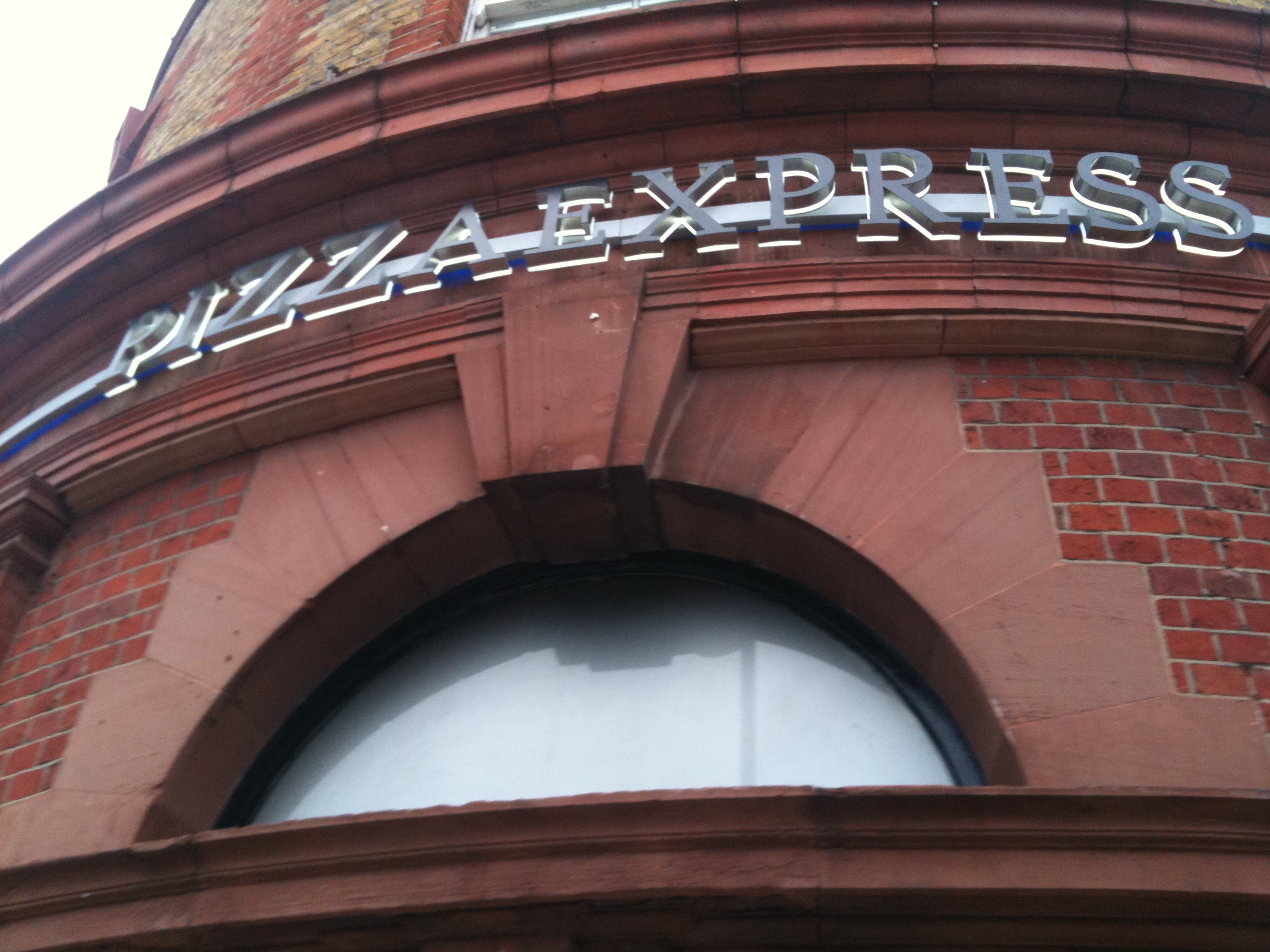
Ain’t it a chain? Pizza Express comes to Herne Hill

One of the great things about Herne Hill is that unlike many parts of London, it has managed to avoid contamination from chain stores, bars and restaurants. We have independent chemists, delis, bakers, florists, a greengrocer, DIY store, bookshop, butcher, restaurants, cafes, clothes and furniture shops. I doubt there is any area of London with as flourishing an independent economy.

It gives the place a distinctive character. You can gossip with the shop owners, get advice in the DIY shop without relinquishing your masculinity, receive and suggest personal recommendations in the bookshop, even get credit in some of the food shops if you’ve been using them long enough. You may pay for these privileges, but it’s worth it.

The only chains are Oxfam and the World’s Worst Sainsbury’s, which is best used as a short-cut between the station and the bus stop and left at that.

Until today that is.

This afternoon, Pizza Express open a branch in Herne Hill.

The site they’ve taken is incredibly awkward. It’s a large wedge, part of which is unusable because it is taken up by a bridge that goes over the top of a large – and hard to fill – lower-ground floor. It’s a space most restaurants would struggle with – indeed two Indian restaurants have failed to make it work – but which Pizza Express can make a virtue of – think of their odd-shaped branches at Charing Cross or Kennington.

The arrival of the Pizza Express behemoth has had a mixed reception in Herne Hill. Some retailers hope it will bring increased footfall into the area, parents are pleased because Pizza Express is excellent for children, but many restaurants and bars are worried it will draw away much-needed custom.

As they should be, because many of the restaurants and bars in Herne Hill – with the honourable exceptions of Number 22 and The Lido Cafe – are shit, serving mediocre food at over-inflated prices and reliant on the fact Herne Hillers have nowhere else to take their custom.

I like independent venues, but I like good shops and restaurants more. If Pizza Express’s decent food, excellent service and good value improves competition, it is doubly welcome.

But there is a fear. Where one chain opens, others follow, chasing the money, extinguishing singularity and turning streets into Clone Towns.  A redevelopment is taking place under the arches by the station. The artist’s impressions says  it will look like this.

But what’s the betting it ends up like this?

Richmond

Herne Hill could easily go the way of Richmond and other indentikit middle-class outer-urbarn high streets. Be vigilant people, and support what’s best about our local economy.

How to tell the Story of London

The Story of London festival was introduced by Boris Johnson last year and immediately came under a lot of fire. Here’s something from Boris Watch plus stern words from Diamond Geezer.  

The festival is not a bad idea. It’s intended to cover the history of London in a way that includes all boroughs, all ages, all races and all genders – a riposte to Ken Livingstone’s habit of staging festivals for different minority groups at a Balkanised Trafalgar Square.

But it doesn’t work.

Part of the problem is publicity, and this is of the mayor’s own doing. In 2009, there was little or no attempt to promote the nascent festival by the city’s tourist office because their funding had just been slashed by Boris and they pretty much refused to help. 

The organisers then had to take their minute budget to Time Out, where I ended up knocking up a few pages to pull out of the middle of the mag that due to a hilarious production error did not actually pull out. It was nothing like the sort of lavish inserts the company can produce when given some cash and time. 

The other problem is that London already has loads of festivals – Open House, Meltdown, the London Film Festival, London Design Festival, the City of London Festival and dozens more – while institutions such as the Bishopsgate Institute regularly put on fantastic cultural events. And that’s before we even bring in the other museums, universities, galleries and scientific institutions.

 The Story of London simply does not have a distinct identity to compete with these established players.

With barely a niche to be found in London’s crowded cultural calender, Story of London has taken to hijacking and rebranding existing events, which doesn’t impress anybody. And they are so busy doing this they forget to organise any showpiece events that would help to give the festival a character of its own. Plus, they don’t have any money.

The result is a bit of a mess.

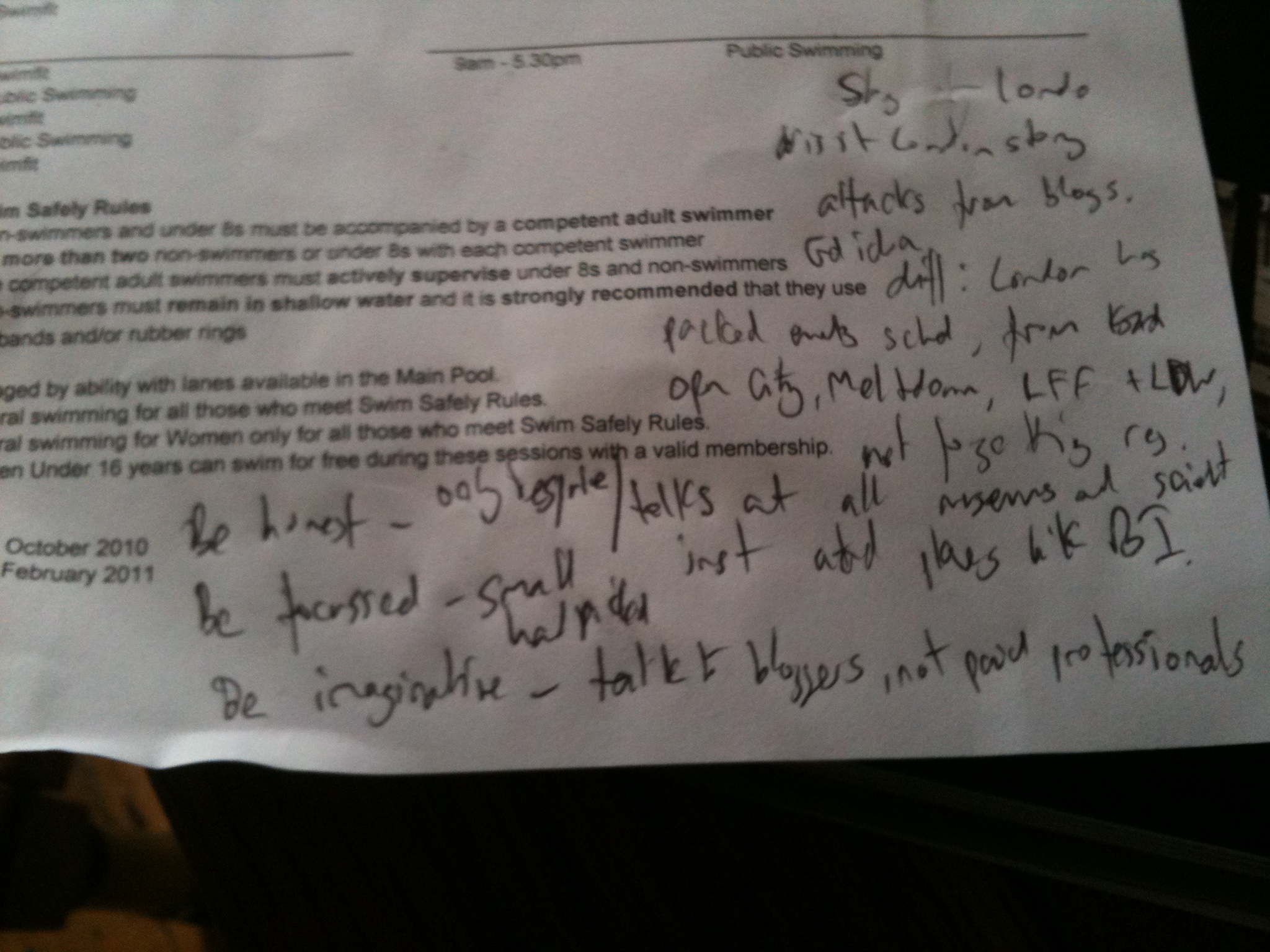
So what could they do? Fortunately for them, I was able to scribble a few suggestions on the back of a press release in between playing Secret of Monkey Island on my phone and wondering why I’ve rarely heard of a single person who appears in the Standard’s Londoner’s Diary.

  • Be honest – don’t hijack events that have nothing to do with you as it just looks cheap. And if you insist on this policy, it means that desperate organisers of terrible events will attempt to smuggle their substandard fare into your festival and you’ll have no way of keeping them out.
  • Bespoke – ensure that anything carrying the Story of London banner is new and brilliant and has genuinely been arranged specifically for the festival. That makes it fresh and makes it exciting and should ensure that you can keep an eye on the quality control.
  • Be focused – find a theme and stick to it. Make it broad and make sure that every borough has at least one institution participating. Narrow the time frame so it all takes place on a single weekend. Keep it tight at first and let it grow organically. At the moment it is a big blancmange of a festival when it should be as tight and pretty as an avocado stone.
  • Be clever – one of the best festivals the mayor currently has at his disposable is the Thames Festival, so hook the whole thing round that. A wee bit of rebranding – and yes, this is hijacking, but it’s hijacking with a point – and you have a ready-made spectacular way to close the weekend with the annual fireworks display.
  • Be imaginative – the guys from the Londonist website are already involved in one small event, but why not ask them to think up something big and crazy? These – and other – bloggers live and breath London in a way few paid professionals can compete with, so talk to them. They may not be interested, they may have terrible ideas, they may have no ideas, but they may just come up with a couple of events that curators and pros can turn into something special. Because at the moment, as Ian Visits says, the Story of London is just ‘a way for a lot of venues who are already planning to do something to get involved in a joint media campaign’.

And that’s as far as I got. LeChuck was causing all sorts of problems and I had to Google Laura Weinstock. But hey, it’s a start.

Why is there no London monument for the Blitz?

‘When I reached the end of Milk Street, I looked out towards Moorfields across an area of devastation so final and complete that the memory of it will always rise in my mind whenever I hear the word Blitz. There is a savagery, a fury and a hideous wickedness about the ruins of London – and of Berlin also – that chills the heart.’

From HV Morton’s ‘In Search of London’

The Blitz began on September 7th, 1940, seventy years ago today, when London was attacked by 300 German bombers. It lasted three months as London was bombed for 57 consecutive nights. Between September 7 and May 11, 1941, 18,800 tonnes of high explosive was dropped on Holborn, the City, Westminster, Shoreditch, Southwark and Stepney. Up to 20,000 Londoners were killed, many thousands were wounded and 3.5 million houses were damaged or destroyed.

And yet, astonishingly, London – a city of a thousand statues – still does not have a single worthwhile monument to the citizens who suffered the Blitz.

The story of the Blitz is a familiar one – see this wonderful propaganda film for an emotional contemporary look at London under attack – and while the ‘Blitz Spirit’ narrative can be trite and over-mythologised, there was undoubtedly some truth to it. Londoners had to deal with the Blitz in part because they had no other choice, but there is evidence that Londoners did more than just survive, they almost relished the battering they received. As  Humphrey Jennings wrote at the time, Londoners were ‘secretly delighted with the privilege of holding up Hitler’, while Phillip Ziegler said in ‘London At War’ that ‘Londoners made a deliberate attempt to seem nonchalant and unafraid’.

Peter Ackroyd suggests that Londoners might have been able to cope because of spiritual kinship with the destruction of the Great Fire, an idea that HV Morton pre-emptively pooh-poohs in his elegiac 1951 classic ‘In Search of London’. ‘The Fire was an accident and it lasted a matter of days. The Blitz was the deliberate attempt of an enemy to subdue a city whose watchword has always been freedom… the effect of these two events upon the population cannot be compared.’

Yet while London has a Monument for the Fire, it still does not properly commemorate those who experienced the Blitz. There’s a small park in Wapping, a couple of minor plaques – one by St Paul’s, near the firefighters monument, and one in St James’s Churchyard on Piccadilly – and dozens of plaques to individual explosions.

But there is no single iconic statue or monument prominently placed and devoted to the citizens of London in the manner of that for, say Animals In War, or any of the numerous monuments for different branches of the armed forces (Bomber Command are the latest).

This was first pointed out to me in 2006  during an interview with Jack Lohman, the Director of the Museum of London, and his museum does now contain a stunning WWII tribute. The Blitz room is a single stark shadowy space, with an unexploded bomb hanging from the ceiling. The walls show still images of the Blitz, while survivors recount their experiences on audio. It’s incredibly moving, but it isn’t enough.

Why doesn’t London pay sufficient tribute to its Blitz Spirit? I asked Jane Furlong, project co-ordinator of the UK National Inventory of War Memorials, and her answer boiled down to one word:  politics.

Furlong told me: ‘As with all memorials, it’s down to whether individual groups or people want to commemorate something. Also, is there a need of it among those who lived to tell the tale? There are lots of service veterans who want to make sure what they did is never forgotten and a memorial is the best way to do that and so they can go away and organise and make sure it happens. It is all down to having that desire, the community needs to take the lead.’

Bomber Command is a ready-made community that can easily mobilise to commemorate their place in history; London’s civilians are not. Of course, that didn’t stop the Animals In War memorial from getting built, but they managed to enlist the high-profile support of patrons such as the Princess Royal, Kate Adie, Vera Lynn and Joanna Lumley. 

If London is to get the Blitz Spirit memorial it deserves – a dignified sculpture in a prominent public place, dedicated to all Londoners who experienced the Blitz – it requires somebody to take the initiative. And that, ironically, would chime against the spirit of the Blitz: one of exaggerated nonchalance at what took place over London in the winter of 1940-1941.

So it seems for now that the sad and powerful room at the Museum of London and an easily overlooked plaque in the shadow of St Paul’s are the best we are going to get. 

But I think that is a great shame and that ordinary working Londoners, as Ken Livingstone might put it, deserve better.

Connections: Boris bikes, psychedelic rock and Dutch anarchists

This week, I interviewed Top Topham, founder member of the Yardbirds. At one point he told me: ‘I also remember seeing Keith West’s Tomorrow, who had Steve Howe (later with Yes) on guitar. He was brilliant, a completely different style. They were a very interesting experimental band. ‘My White Bicycle’ was quite infectious, very ahead of its time.’

Tomorrow were a fascinating mid-60s band who had close ties with the London counterculture, regularly performing at head venues like the UFO Club and the Roundhouse.

‘My White Bicycle’ was inspired by the Dutch anarchist group the PROVOS. Counterculture writer Stewart Home explains:

‘The PROVOS announced in a leaflet that white bicycles would be left unlocked throughout the city for use by the general population. The prototype of this ‘free communal transport’ was presented to the press and public on 28th July 1965 near the statue of Lieverdja. The plan proved an enormous success as a ‘provocation against capitalist private property’ and ‘the car monster’, but failed as a social experiment. The police, horrified at the implications of communal property being left on the streets, impounded any bicycle that they found left unattended and unlocked.’

You can read more about the PROVOS at the British Library. Here’s a nice picture of them and their bikes from the International Institute of Social History.


I wonder if Boris Johnson knows that his bike scheme is at least indirectly inspired by a bunch of sixties anarchists?