‘Yoko One was one of the most boring artists I came across, but she had the ability to put people into a state of expectancy that didn’t always result in a satisfactory outcome. I went to a happening at Conway Hall. There were rows of seats all occupied with people, and she started at the front on the left and whispered something in somebody’s ear. They whispered the message in the ear of the person next to them and it went on person by person, row by row for 30 minutes, until it reached the last person at the back of the hall. Then that person went over to Yoko and whispered the message in her ear, and Yoko stood up and said “Thank you” and walked out.’
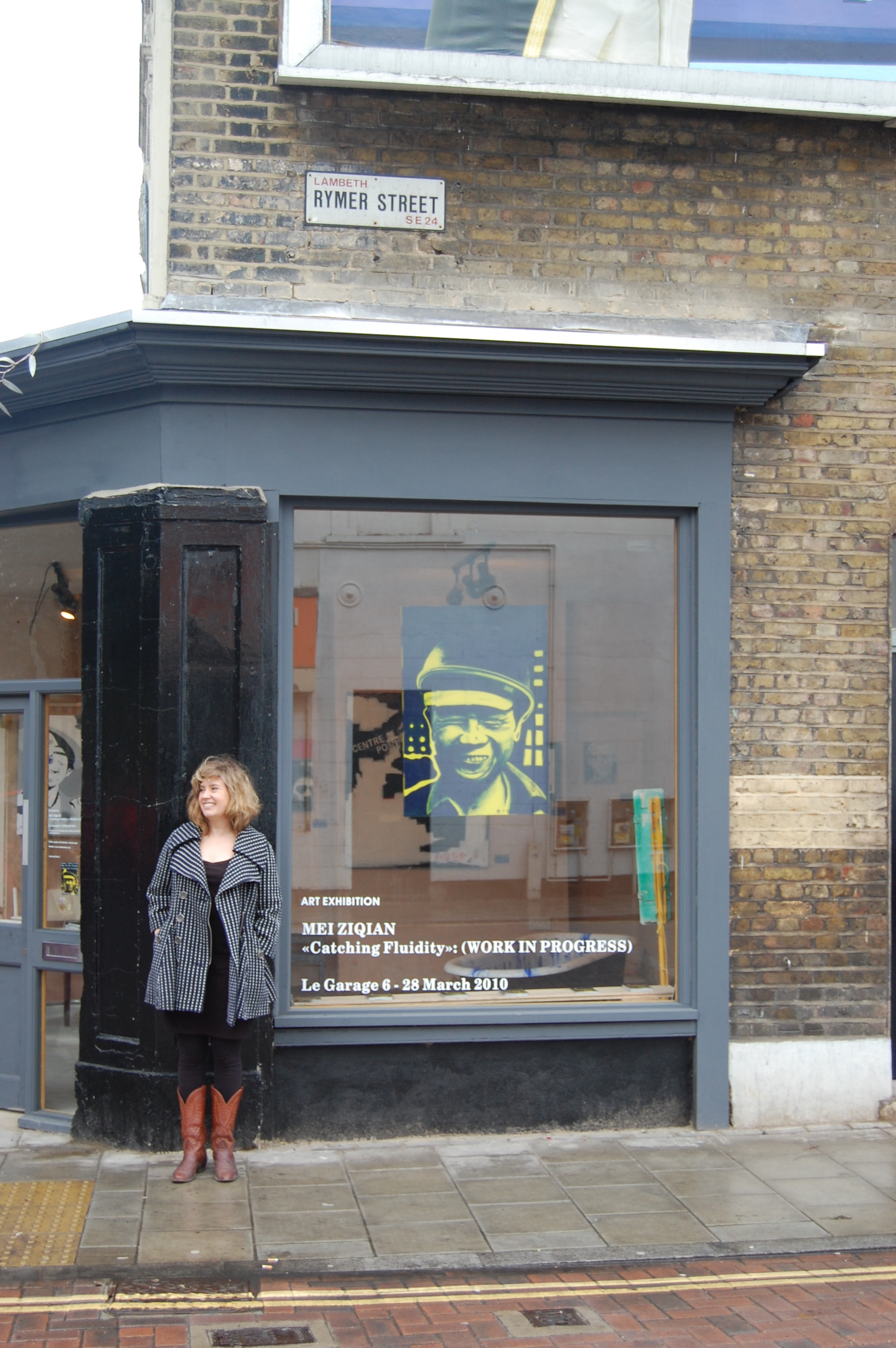
Plonked on a prominent corner site on Dulwich Road, just opposite Brockwell Lido, is La Garage. You can’t miss it. It’s the one with huge floor-to-ceiling windows through which you’ll see an antique bath filled with blue water.
Le Garage is Herne Hill’s newest art gallery. It’s the creation of Alice Bailey, a Canadian who bought the building in auction about three years ago (the name tells you what is used to be) and then started to think about what she was going to do with it. A friend suggested she turn the downstairs space into a gallery, so that’s what she did as soon as she’d finished rebuilding the upstairs and refurbishing it with things she found in junk shops (‘it’s kind of random,’ she says).
‘It was a total accident, I just thought they were great windows and I should put something in them,’ she says, so she did. Currently on display (until March 28) are paintings, photographs and the paint-filled bath by pseudonymous artist Mei Ziqian, and Alice already has three more shows lined up including a photographer, a shadow puppet play and an artist who does embroidered portraits of characters from ‘Coronation Street’. After that, she wants some street art, but is open to any ideas. Drop by if you have something to offer.
‘I want it to be organised but free and organic,’ she says. ‘There are a lot of artists who can’t get shows in London, although I know I’m a bit out of the way here in Herne Hill. A lot of people have already contacted me after seeing this and so far the work I’ve seen has been great. The photographer showing next is quite well-known, but she wants to do something different from what she usually does, and she doesn’t want to do it under her own name.’
The space is still not fully developed, and Alice is wondering how to use the back room and pondering about turning the garden into a cafe – inspired partly by Scootercaffe on Lower Marsh, where she lived previously. ‘It’s so nice living above your business,’ she says. ‘I really want it to be fun, because it’s a fun space, informal and friendly.’
Since reading this post by Rob Smyth in the Guardian, I’ve been thinking about some really depressing Chelsea matches I’ve witnessed. Because, why not? So here they are wrist-slashing reverse order.
6 First Divison play-off, 1988: Chelsea 1 Middlesbrough 0
The only Chelsea game that has made me cry. We were playing Second Division Middlesbrough for the right to play First Division football in 1988-89 (despite having been second in October) and were 2-0 down from the first leg. Gordon Durie gave us an early lead, but we lost on aggregate and the crowd rioted, as was the fashion at the time. The play-off system was changed shortly afterwards and Chelsea therefore became the only team to ever get relegated from the top flight through the play-offs, an honour we can place alongside being the first team to refuse to play in the European Cup and the first team to be created purely as a commercial means to fill an empty ground. It’s all history, you know.
5 Premier League, 1996: Coventry 1 Chelsea 0
A meaningless game, but typical pre-(and post-) Mourinho Chelsea. The week before we had tortured Middlesbrough 5-0 with a staggering performance of perpetual motion and effortless beauty, inspired by the man-god Ruud Gullit. Thousands of Chelsea fans made the trip to Cov for what we imagined would be a repeat performance from a vibrant, thrilling, all-conquering Chelsea. We flopped. Gullit made one sublime pass to Paul Furlong, who fell over. Same old Chelsea.
4 Champions League semi-final, 2009: Chelsea 1 Barcelona 1
Because it stank but also because we outplayed the best team in Europe with a performance that for many reasons will never be fully appreciated for its brilliance and intelligence. Only placed this low to reflect the contempt with which one should regard the rich man’s roulette that is the vile, venal, corrupt and corrupting Champions League.
3 Premier league, 1997: Chelsea 2 Arsenal 3
No, not the Kanu game. By then I was used to seeing Chelsea capsize against Arsenal, and in many ways it was an honour to witness such an extraordinary individual performance. Four times I’ve seen Chelsea take a 2-0 lead against Arsenal but not win the game; four times I’ve seen their full-backs belt last-minute howitzers past our hapless keepers. These memories of dominance and submission can never be erased. This game was a cracker and we looked like we were hanging on for a deserved point when Nigel Winterburn let rip in the 89th minute and scored the best goal of his life. It hurt. I mean, at least Kanu was a great player.
2 League Cup semi-final 2002: Spurs 5 Chelsea 1
It was once said that the only predictable thing about Chelsea was their unpredictability; later this was changed to the only predictable thing about Chelsea is that they will beat Spurs. Before this game, we hadn’t lost to Tottenham since 1990 when Lineker scored a last-minute winner at the Bridge. Since then we’d beaten them by every score from 6-1 to 1-0, and before this semi-final second leg were 2-1 up from the first leg. At White Hart Lane, we were smashed, humiliated, gutted, hung out to dry. The only redeeming features were that Spurs still managed to lose the final and later that season we went on to beat them 4-0, twice, in the same week that I, erm, got together with the delightful Ms GreatWen. Karma.
1 FA Cup quarter-final: Sunderland 2 Chelsea 1
This is the game that festers in the darkest place of my soul. It is the one moment when I considered renouncing my club and football in the conviction that I had been duped into backing a complete stinker, a club that would never come close to winning a trophy in my lifetime. This game is the reason that even now when I consider a potential cup draw, I always wish for the game that will hurt least to lose, rather than the one that will be most enjoyable to win. As a Chelsea fan, I live in constant fear because of games like this.
This was one of those seasons when all the good teams except a so-so Liverpool had been knocked out the cup. Chelsea were drawn against Second Division Sunderland and, stupidly, we felt we had a good chance of getting to the final, or at least the semis, for the first time since 1970.
In the first leg in London, we took the lead but tension mounted. At Chelsea in those days the crowd’s terror was so intense that they would actually turn off the scoreboard with ten minutes to go so nobody knew when the final whistle was coming. Imagine that!
On this occasion, it didn’t matter whether the scoreboard was on or off; everybody was terrified. Sunderland won a free kick, the Shed shat themselves, so did the players, the ball was knocked long, bounced around a bit and John Byrne scored. Replay.
But we could still do it. We went up to Sunderland and battered them, hit the bar, hit the post, their keeper stopped everything and they scored. Despair! Worse was to come. Dennis Wise equalised with five minutes to go. Hope! Then Sunderland won a last-minute corner in front of a delirious away end and a forgettable centre-back in red-and-white stripes hammered home an unstoppable header from about 300 yards out.
Watch this video and you can just hear in the background, somewhere in Sutton in fact, a small boy’s heart breaking in two.
That was it. The best chance Chelsea had of reaching a semi in my lifetime, and they’d blown it. Arsenal, Liverpool and Manchester United fans won’t get it, but every other football fan in the country knows what I mean when I say that in this exact moment, I was convinced I would never see Chelsea win a sausage. Not een half a sausage. Not the discarded package that the sausages came in.
And the memory of this match has never left me. It made the demon-blitzing FA Cup win in 1997 so exhilarating, but it’s still there, trapped in my heart, my throat, my guts, waiting to get me every time I’m considering taking any kind of success for granted.
And I think it’s the reason why Chelsea will never be a big club, at least not as long as my generation, who witnessed this sort of hope-decimating match with mundane regularity, goes to games.
We know how easy it is to fail, what disappointment really tastes like, how fruitless hope is, and we are terrified that we are just a couple of poor signings away from a return to the days of Andy Myers, Ian Porterfield and Gareth Hall. You can smell it in the crowd at the Bridge when Chelsea go 1-0 down against a crap team, or are leading 1-0 with minutes to go, or are taking part in a penalty shoot-out. Big clubs don’t have this fear, it’s not in their genes, but it’s very much a part of my Chelsea and I wouldn’t change it for the world.
I never had much interest in London’s subterranean bits until my Dad took me on a tour of Victoria station’s hidden depths. This was the late 80s, and he was then a contractor working for London Underground to improve station facilities. Together, with a big bunch of keys, we went to those parts of the station that commuters never see. Mysterious doors on platforms were opened to reveal networks of corridors filled with machinery or left damp and abandoned. In one room there was a massive well, dank, dark and dripping. Another had walls covered in thrillingly pornographic graffiti. And every now and then our adventure would end at a closed door, for which nobody had the key and everybody assumed was part of the government’s clandestine tunnels. Secrets within secrets! I was hooked.
Since then I have been under the skirts of the city a number of times. In the crypt of a convent at Marble Arch; in the vaults of the Bank of England; underneath Tower Bridge; in the deep-level Tube shelter at Chancery Lane, built for Blitz protection but later requisitioned by spooks; under Waterloo Station for immersive theatre that reminded me of ‘Doom’; in the Fleet sewer; in Henry VIII’s wine cellar under the Ministry of Defence; and in the old Holborn tramway tunnel under Kingsway. I’m like a ferret, if there’s a hole, I’m in it.*
This morning’s escapade took me – and every other underground/transport nerd in London – to Rotherhithe station for a very rare chance to see inside the first tunnel built under the Thames, indeed, the first underwater tunnel built anywhere in the world.
The Thames Tunnel was started in 1807, abandoned and then taken up again by Marc Brunel in 1823, who had invented a new form of tunnelling machine modelled on a woodworm. Brunel, accompanied by his son Isambard Kingdom, abandoned work again in 1828 after loss of life due to pollution and occasional inundations, but picked it up 1835, completing the tunnel in 1843. Marc died in 1849. Read a proper history here or here.
It remained a foot tunnel until the 1860s, when it was converted into a railway tunnel for the East London line, linking Rotherhithe and Wapping. This weekend, the tunnel reopened as a foot tunnel for what we were assured will be the very last time in its history, which is just the sort of hyperbole I like to hear on a Friday morning.
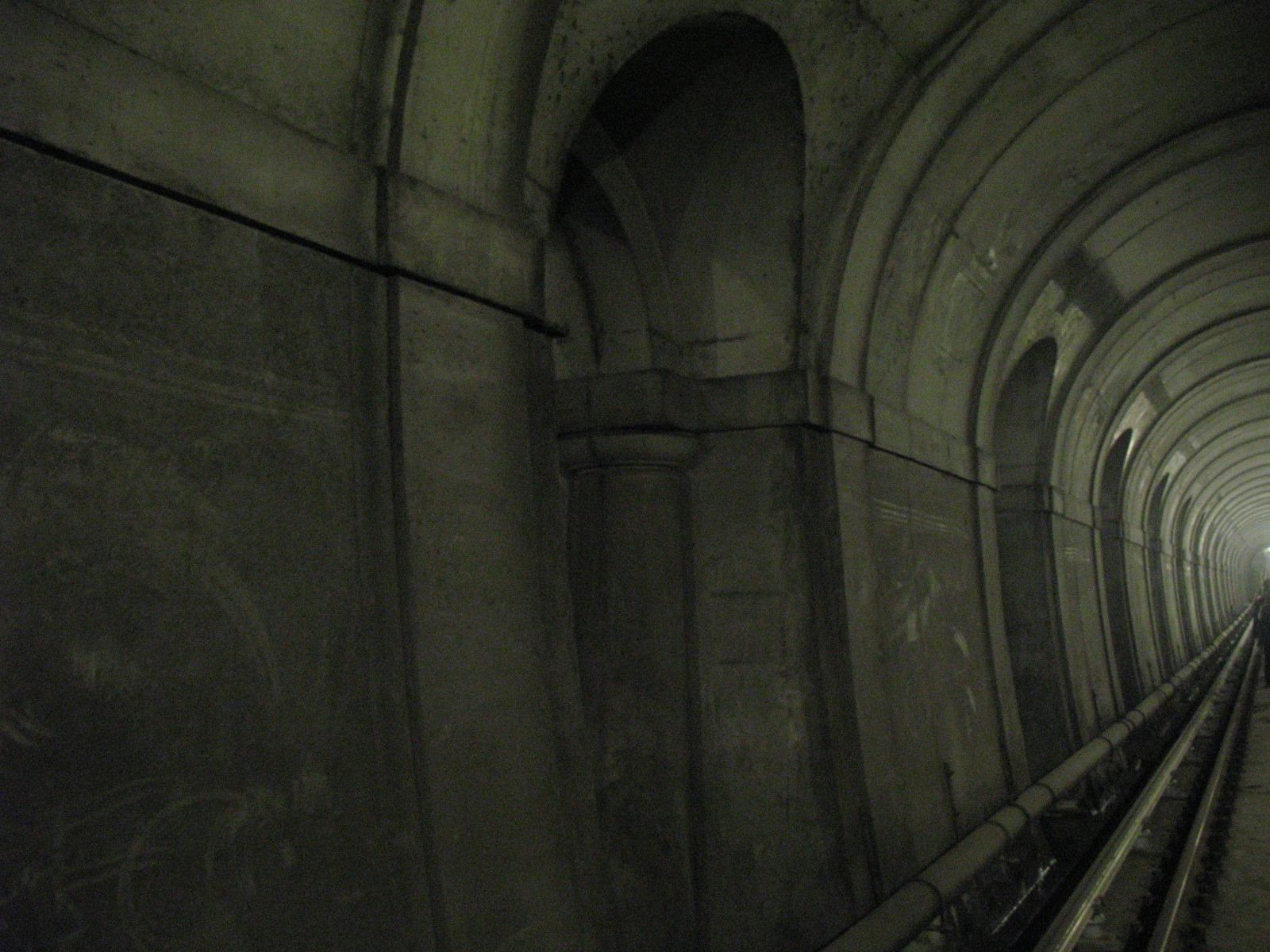
The tunnel is now pretty much indistinguishable from any other underground line. The only sense you get that you are heading under the river is that it is rather damp and chilly. Although most of the tunnel’s original brickwork has been concreted over, there are some areas where you can still the original bricks, beautiful but damaged.
Arches bisect the tunnel throughout its length. These were originally used as small shops, as the tunnel became the world’s first underwater shopping arcade. These spaces are tiny, and would have been cramped, dark, cold and damps places to work from. I imagine they are rather like those booth-cum-shops you get along Brixton’s Atlantic Road, where people flog phonecards and reggae from the stairwells of blocks of flats.
Here, though, you can get a sense of the detailing that distinguishes so much Victorian architecture.
And that was it, an entertaining diversion into the depths of history, made all the better for the fact that I happened to bump into fellow blogger Darryl of 853 for the first time and so got the chance to have a good natter about politics and football while walking through a landmark Victorian tunnel several metres beneath the Thames. (Darryl’s post is now up and Annie Mole is rounding up some of the London bloggers who have written about the tour.)
A coda: upon leaving Rotherhithe station, Darryl and I were accosted by a young man from the Southwark News, eager for eyewitness reports of this momentous occasion and then slightly disconcerted that he had somehow managed to approach a pair of freelance journalists masquerading as innocent bystanders. I suggested he choose an alternative career for me; crisp shop proprietor, perhaps?
*I would just like to point out that while I didn’t use the joke here about certain Premier League footballers, that doesn’t mean I didn’t think of it.
‘I walked back up the East India Road and caught a bus back to London. But then what, I asked myself, is London? To me, London is one thing; but to the inhabitants of Bermondsey, Wapping, Stepney and Poplar it is quite another. There are hundreds of London, all of them equally real to those who live in them.’
I love these flyers you get in London promoting the work of African spiritualists. I’m not sure how much cause there is for them in Herne Hill, but who doesn’t want to ‘regain fidelity’ or receive the ‘immediate return of affection and of forever love’?
When I moved to Herne Hill three years ago the one thing I thought it lacked was a bookshop. In Waterloo, we’d had the excellent Crockatt And Powell (now sadly closed) as well as numerous shops selling second-hand and remaindered book. In Herne Hill, all we had was the brilliant but not-for-adults Tales On Moon Lane, a children’s bookshop.
Fast forward a few years and we have not one but two grown-up bookshops. Rejoice! But this bliss for booklovers, has not come without controversy.
The Bookseller has the background, but for those who can’t be bothered to click through, here’s the story. Shortly before Christmas, Herne Hill Books opened near the station. It’s a lovely shop albeit in the smallest space I have ever seen, but with good stock and helpful, friendly stuff – exactly what an independent should be like. It did well before Christmas and was seen as a welcome and overdue addition to the area.
Then, last month, a competitor arrived around the corner on Half Moon Lane. But this was no ordinary competitor, this was a branch of Oxfam Books. I was delighted, the more bookshops the better say I!, but Alastair Kenward at Herne Hill Books was less pleased. I bumped into him last week while he was out walking his dog, and we discussed the problem, which boils down to this.
Oxfam Books are not like any other business. They are a huge company with all the economies of scale that go with that, but they do not pay staff and do not pay for stock, which gives them an even greater advantage over their rivals. And to cap it all, they are a lovely fluffy charity, so you can’t criticise them without being called an evil sod who steals shirts from the backs of starving orphans, as happened to Kenward when he spoke out in The Bookseller.
I have a lot of sympathy with his position, especially given the threats indie booksellers already face from the internet and supermarkets.
So here’s the issue: should Oxfam go about their business like any other company even though we have established they are not actually like any other company?
Should they, as a charity, be beholden to a higher moral principle, one that is perhaps ludicrously idealistic and impractical but which is that they endeavour to only open in areas where there no existing local independent businesses to threaten?
Or does being a charity mean they should exploit every loophole and advantage they can, because at the end of the day all the money they make will theoretically make the world a better place?
I take the middle view, with many caveats, but that won’t stop me using both shops, which in the end do serve slightly different markets- new and second-hand – and together with Tales On Moon Lane make Herne Hill south London’s answer to Hay-on-Wye.
Perhaps all three shops should get together and organise SE24’s first literary festival?
I must have walked past this shop on Oxford Street hundreds if not thousands of times. Yet it’s only now that I ask: who is Beard Papa? What is a cream puff? Why would anybody eat one? Are they really fresh? ‘N natural? Why are they advertised by Ken Bates? How did this shop get here from its original location in a suburban Belgian railway station? Who is Muginoho? And 1952, really?
‘Gustav Metzger and John Sharkey were prosecuted under the Obscene Publications Act for organizing Hermann Nitsch’s Abreaktionsspiel No 5 at the St Bride’s Institute in 1966. This consisted of a film showing male genitals controlled by wires and dipped in various liquids projected on an eviscerated lamb carcass used as a screen.’
P154, ‘London Calling: A Countercultural History of London since 1945’ by Barry Miles (Atlantic, £25).
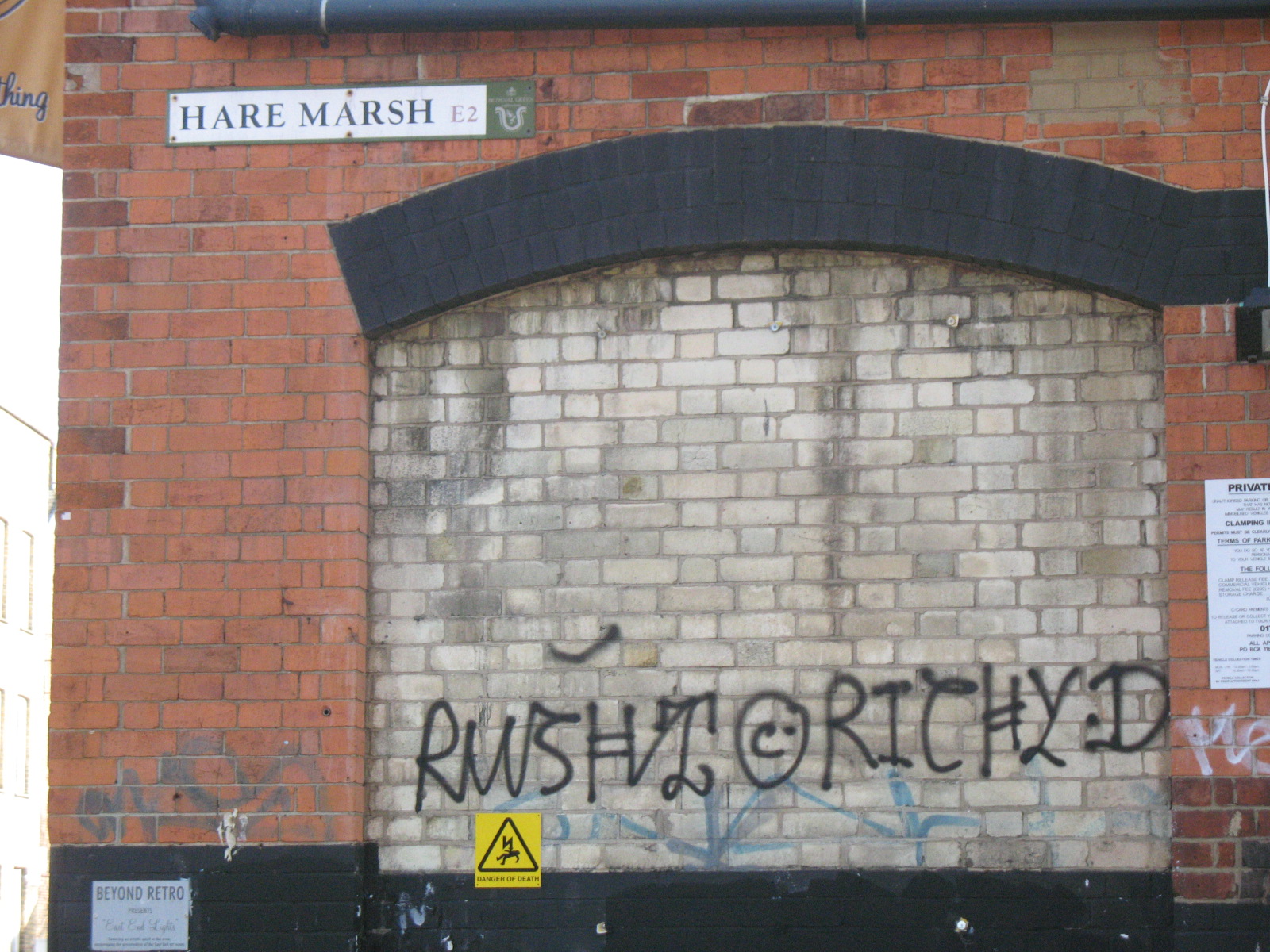
In ‘King Dido’, his 1969 novel about Dido Peach, a docker turned criminal, Alexander Baron set the action in a shabby Bethnal Green alleyway called Rabbit Marsh. This was directly inspired by Baron’s memories of Hare Marsh, a tiny cul-de-sac that still exists near Brick Lane. Here, Baron gives us a careful description of the squalid street.
‘In 1911, although the crowding was less abominable and the old Hogarthian bedlam had vanished, the street was still a slum, the roadway narrow and cobbled, the houses black and decayed, many of the ground floors turned into miserable shops and workshops… the railway lines ran behind high brick walls on an embankment behind Rabbit Marsh.’
It hasn’t changed much, has it?
Although a new block of luxury flats sits on the right-hand side, the left wall is an old workshop, the street is still cobbled and it ends abruptly and noisily at the railway. Dido Peach lived above his mother’s rag shop, so it is perhaps apposite that the building to the left is now a second-hand clothes shop.
Here it is again in 1973, in a brilliant, bleak image by Jonathan Barker on Flickr. Scroll down and Barker also has a great picture of it later that year with Cheshire Street’s atmospheric market in full swing.
Baron writes.
‘Imagine a narrow ravine whose floor consists of worn cobbles running between pavements of uneven flags. Such was Rabbit Marsh. That was all the street was; two narrowly facing rows of such buildings, leaning forward with age, cleft by an alley here or there or pierced at the base by a porch leading into a yard.’
Alexander chose his location carefully – the contrast between the rural idealism of the name and the reality of the space is crucial; the words ‘rabbit’ and ‘marsh’ also have insinuations, of over-breeding and of getting stuck – but he also cheated a bit. Although we know that Rabbit/Hare Marsh is a short dead-end street in the book it is still large enough to contain several dozen shops and houses (Dido lives at No.34) as well as a pub (the Railway), and we are told it hosts a street market on Sundays. The real Hare Marsh simply isn’t large enough for all of that.
Nowhere in the book does Baron mention Hare Street (as Cheshire Street was then named), the now trendy road that links Hare Marsh to Brick Lane, and my assumption is that the author conflated Hare Marsh and Hare Street to give Rabbit Marsh a little extra space for him to play with than really existed. So Rabbit Marsh is stretched, the residents allowed more room in which to breath.
He did not have to imagine much. Opposite Hare Marsh is a pub that looks a lot like the one described in the book.
This is the Carpenter’s Arms. In another nod to reality, there is real villainy here. Dido Peach ends up becoming a kind of local enforcer, taking protection money from local shopkeepers, and the Carpenter’s was once owned by the Krays. All three Krays – Ron, Reg and Charlie – had their funerals at the nearby St Matthew’s church.
Baron’s descriptions of Hare Marsh are captivating, but they are necessarily evocative. Dido Peach’s universe is tiny, and we have to believe in it. This was true to life. In this era, the average Londoner was born, lived, worked and died within a three-mile circle and Peach’s world is similarly shrivelled. The furthest north he gets is Dalston; south is the impenetrable barrier of the river. His one trip west takes him as far as Liverpool Street station, where he heads for the Tube platform and sits watching the trains coming and going, but never considers getting on board.
In ‘The People Of The Abyss’, Jack London’s 1902 account of the East London poor, he writes of one young soak: ‘From the moment of his birth, all the forces of his environment had tended to harden him, and he viewed his wretched, inevitable future with a callousness and unconcern I could not shake.’
This is also the tragedy of Dido Peach’s life, the limitations of possibility and how poverty destroys self-belief and any means the protagonist has of escape, but it is what makes the book so acute and so realistic. Seek it out, then take the pilgrimage to this tiny and otherwise forgotten dead-end alleyway in E2, where fact and fiction collide in gritty, grotty greatness.








 The Great Wen