Category Archives: Journalism

London: a cycling city

I wrote about the challenges facing cycling in London for The London Magazine

Every time I hear that another cyclist has been killed on one of London’s many lethal junctions, I pray to a god I don’t believe in that it isn’t one of my friends. The idea of cycling in London terrifies me. That’s partly because I haven’t ridden a bike more than twice in 20 years, and partly because I have seen so many incidents, altercations and near fatal collisions involving cyclists during my walks around the city.


I’m aware of the figures – the fact that cycling is overall a pretty safe form of transport, even if it could always be better – but it’s hard to shake off that impression that it’s anything but. I’ve seen cyclists get hit by taxi doors and narrowly avoid getting squashed by buses. I’ve seen them shouting with rage and fear at drivers who’ve turned out of a side street in front of them without looking. I’ve seen them cycle headlong into pedestrians who weren’t looking where they were going (and vice versa). I’ve seen them getting into squabbles with bus drivers about ownership of bus/cycle lines that end with blows being traded. I’ve seen them picking themselves and their bent bikes off the pavement after minor crashes. And I’ve seen the blood getting washed off the road after major ones. It looks anything but fun.

So despite the fact I see people cycling quite easily and happily on London streets every day, I still think it’s one of the last things I’d ever want to put myself or my family through on a daily basis.

That is something that needs to change if London is ever going to be a cycling city, which it desperately needs to if it is to remain in any way a human and pleasant place to live in. People like me need to be persuaded that London cycling is safe and that a trip on the bike to the shops won’t result in a serious injury or a shouting match. As Mike Cavenett of the London Cycling Campaign admitted to me “the striking thing is that Dutch cyclists just look like Dutch people”, by which he means you see the elderly and children, men and women, all cycling in their normal clothes – not like London, where cyclists wear tight, bright clothing and manage to look simultaneously over and under dressed.

When London’s cyclists start to look normal, that’s when we know we are heading the right way. And for that to happen, London needs better infrastructure, streets on which cyclists feel safe and are able to relax, making the whole experience better for everybody. Everybody I spoke to – including Andrew Gilligan, the Mayor’s cycling tsar – seemed united on this and agreed on the direction that London needed to go in. Whether it actually happens, whether there is the political will to spend the cash to keep the promises, remains to be seen. But here’s hoping it starts to happen, because a cycling city would be better London for everybody.

London’s Huguenots

I wrote this last year for Metropolitan magazine. The Huguenots of Spitalfields Festival runs from 9-20 July 2014. 

Up to 400,000 French people have settled in London in recent years, but this is not the first time the French have moved to London in great numbers. While today’s arrivals come willingly, with passports, bank accounts and mobile phones, those of 1685 were in reluctant flight, arriving with next to nothing. Calling themselves the réfugiés, these Huguenots – the persecuted French Protestant minority – were the world’s first self-described refugees, coming by the thousand to seek sanctuary in London. An adolescent boy with three siblings, including a baby unable to walk. A teenage girl disguised as a man. Husbands without wives. Children without parents. Houses and jobs left behind. They came hidden in salt barrels, pregnant, shoeless and with diamonds sewn into their cloaks. But like many of their modern counterparts, these French arrivals were young and ambitious, bringing with them a sense of adventure and enterprise, ready to transform the city they now called home.

Hogarth’s Huguenots


‘Britain owes a great but barely acknowledged debt to the Huguenots,’ writes historian Lucy Inglis in Georgian London of the biggest French invasion since 1066. The Huguenots brought with them exotic food like oxtail soup, caraway seeds and pickles, new ideas about industry and banking, brilliance in textiles, watchmaking, horticulture and medicine, and enough numbers – as many as 40,000 – to transform the geography of London, pushing it west into the ‘French Quarter’ of Soho, allowing London to become one of the great multinational capitals of the world. Inglis expands on this in conversation. ‘They were real self-starters, that’s what I admire about them, the way they arrived with nothing and just got on with it. A lot of them were very young. They arrived in London and began to make a splash straight away.’

This was the first serious test of London’s toleration of outsiders, and the city took it well, with just a few grumbles about the whiff from the garlic sausages that the Huguenots hung to dry outside their windows. Otherwise, the Huguenots were a sober presence. For decades, the Huguenots had been tyrannised by France’s Catholic majority until a vague equality was established with the Edict of Nantes in 1598. When this was revoked by Louis XIV in 1685, Protestantism was effectively outlawed. Hundreds of thousands of Huguenots ignored a ban on emigration and fled France in their search for religious freedom.

Many settled in the new district of Soho, where Huguenot craftsmen could be close to the gentry of Westminster. Soho’s French character lingered for centuries – even now you can dine at L’Escargot, get cake from Maison Bertaux or pernod from The French House. In 1720, 40% of Soho’s residents were French speakers and one contemporary noted the area ‘so greatly abounds with French that it is an easy matter for a stranger to imagine himself in France’. French currency was accepted by London Huguenots into the 1720s and as late as 1924 a London guidebook would comment, ‘In Soho you may see Frenchwomen shopping exactly as they do in France, bareheaded, as no Englishwomen would.’ Scandalous!

Huguenot church, Soho Square


Just as many of today’s London French work in and around the City, when the Huguenots arrived, most headed to the long-established French Church on Threadneedle Street. London already had a small population of wealthy Huguenots – among them John Houblon, the first Governor of the Bank of England – and they, observing Louis’s despotic behaviour from afar, had been expecting the exiles. A soup kitchen was already established and accommodation secured for pregnant women. New arrivals had often become separated from their spouses so posted their details on a huge board outside the church. ‘It’s a horrible analogy,’ says Inglis. ‘But it was like the aftermath of 9/11.’

The Huguenots descended on a city on the rise. ‘Daniel Defoe wrote about the corruption of luxury, the way people could suddenly afford luxury goods,’ says Inglis. ‘But the Huguenots were plain people, they didn’t wear wigs, perfume or make-up, they had a real dignity and that meant they appeared trustworthy. As a people they were very upright in their business and to a city that was booming, this was quite welcome.’

Not every Englishman responded to this in quite the right way. One was accused of kidnapping an English girl named Christian Streeter, raping her and then having her hair cut ‘in the French way’, such was the appeal of the short-cropped French women on London’s streets. He was eventually acquitted. For the most part, though, the French presence was accepted, even as they set about revolutionising the silk business.

‘The wealthier ones went to Soho and the rest went to Spitalfields and Shoreditch, where they began to set up business as weavers, establishing a factory system and employing a lot of people,’ explains Inglis. ‘They had a massive influence on the earliest part of the Industrial Revolution.’ So many Huguenot weavers left France that the country went from being an exporter of silk to an importer in a few years. Silk was used for clothes, furnishing and wall coverings, and the Huguenots produce huge amounts of the material. The stunning patterns created by one Huguenot designer, James Leman, are now in the V&A Museum. Another weaving family were the Courtaulds, who later founded the Courtauld Insitutute of Art in Somerset House. The weavers, with the fine eye for style of many Huguenots, erected grand-looking houses, most notably along Fournier Street, one of which is now occupied by the artists Gilbert & George.

James Leman textiles


Another London artist, William Hogarth, was still able to reference the Huguenots as a stylish, sober but alien presence in his 1737 etching Noon, completed more than 50 years after their arrival and Inglis notes that ‘until the 1730s they almost exclusively married within the community.’ By 1780, however, the Huguenots were integrated into the London landscape, even adopting English names – Dubois becoming Wood, Roussel become Russell – the first of many groups of refugees who arrived in London with a bang, and then slowly became absorbed into the city’s heaving, evolving mass having altered it for ever.

Georgian London by Lucy Inglis (Penguin) is out now in paperback.

London timewarp: James Smith & Sons umbrella shop, Holborn

smith


This article appears in the current issue of Completely London magazine

When you first stumble upon James Smith & Sons, it’s tempting to believe you have slipped through a timewarp in the Holborn pavement and landed in Victorian London or, more prosaically, chanced upon a perfectly realised film set. The plate windows of the New Oxford Street shop are crowded with umbrellas and walking sticks, while the polished frontage of carved mahogany, brass, enamel and engraved glass boasts, in richly painted font, that James Smith & Sons was “Established 1830”. It’s easy to believe it hasn’t changed a jot since then.

The interior is every bit as spectacular as the outside, and English Heritage have listed the whole thing at Grade II*, noting that it is a ‘typical high-class late Victorian or Edwardian shop and as such is a rare survival in London’. The shop has been occupied by James Smith & Sons since 1867 and while there have been some updates – a new till, electric lighting – much of the façade and interior date to then. “There have been some changes but not many,” says Robert Harvey, the owner. “A few years ago we spent a considerable amount refurbishing the shop and on the day we opened a customer came in, looked around and said, “I thought you were having it redecorated?’.”

London_-_James_Smith_and_Sons_-_1819-2.jpg

Fittingly for such a classic-looking shop, James Smith & Sons, which is still owned by descendants of the original James Smith, specialise in the very British trade of umbrellas and walking sticks – as one writer has noted, “the art of applying the shade to the ribs with just the right amount of tension is no small matter”. The umbrella is still seen as a key piece of kit for a well-equipped Londoner looking for protection from the elements in this most rainy of cities, and an umbrella from James Smith & Sons is as desirable as a pair of shoes from John Lobb or suit from Savile Row. The shop is also popular with foreign visitors, who purchase English umbrellas as well as walking sticks and seat sticks (collapsible seats, originally for shooting but now more likely to be found at Glyndebourne). They also once sold items like swordsticks and swagger sticks as well as ceremonial sun shades for African chiefs; according to legend, one American customer asked the company for walking sticks made from every English wood possible and received more than 70. The range of umbrellas stretches into the thousands and about 30% of the stock is unique, existing as just a single item, with its own combination of material, colour, wood and style of handle.

The shop’s appearance is, admits Harvey, an anomaly as well as something of an accident. “Looking through the records, the business survived by a miracle,” he says. “The Smiths never had enough money to refurbish and I’m not sure they were the sort of people who looked long-term – they were never sure how long the business would last.” The appearance eventually became a trademark, and the shop has made regular appearances in London guidebook, even appearing in novels, in one instance when the villain of a thriller purchases a murderous swordstick from a strange old shop “marooned on an island surrounded by traffic”.

But while the appearance is identical to the Victorian shop, the attitude is different. “Unlike the Smiths in the 19th century we see the business as having a future providing a great product,” says Harvey. “But we also try very hard to retain that original character, not as a museum piece but as an example of 19th-century commercialism in the 21st-century.”

London’s new invasive species, and how the Daily Mail has welcomed them to the city

This piece first featured in the April issue of Metropolitan. Interestingly, the Daily Mail had not discovered the aesculapian snakes when I wrote this piece but did so very shortly afterwards. I sincerely hope my article was not what alerted them to this harmless colony.

When workers began clearing the Hackney site that was to become the 2012 Olympic Park, one of the biggest problems they faced amid polluted soil and world war explosives came from a plant. Japanese knotweed is a scarily resilient and fast-growing weed that infested the waterway and removing it was a laborious process that began with chemical treatment before the dense root structure was dug out. Next came cutting, hand-sorting, incineration and burial of the remains inside a welded physical membrane on landfill sites in five-metre pits. Only after this was the plant, introduced by Victorians because it looked pretty, deemed safe. It cost £70m.

London is home to around 76 such ‘invasive species’, leading to the creation of the London Invasive Species Initiative, which monitors those alien invaders that have found a predator-free London life to their liking, causing serious damage to the city’s ecosystem even if they add an exotic splash to the urban landscape. Many, like the knotweed, arrived in the 19th century. “There was a flowering of ‘acclimatisation societies’, which were specifically set up to introduce new species,” says Tim Blackburn of the Zoological Society of London. “The Zoological Society envisioned a golden age where we would have herds of elands [African antelopes] roaming the south of England. But the impacts are pervasive and affect so many aspects of life.’

But not every alien species is dangerous and London is home to hundreds of non-native species that merrily co-habit with London’s longer-term residents. “There are many species we think of as part of our national heritage that were originally non-native,” points out Alex Robb, a London Wildlife Trust warden, in defence of the ring-necked parakeet, which has adapted to London life so successfully it has been adopted as the country’s first naturalised parrot. It is unlikely, however, that Japanese knotweed will ever be regarded so warmly.

Muntjac deers
Originally from: China.
Now found: Mill Hill, Barnet, Enfield, Edgware and Bethnal Green.
Daily Mail headline: Two-Foot Muntjac Deer Cause Thousands Of Crashes Every Year, Sept 2011.

bambi

For centuries, London parks have contained red and fallow deer, generally doing little other than giving dogs something to bark at. Now there’s also the muntjac deer, introduced to Britain in the 19th century. As muntjac began escaping from zoos or were deliberately released, the population expanded to today’s 2 million. The muntjac is small and shy, with stubby antlers and an unappealing call that sounds like a smoker’s cough. It can usually be seen in north London suburbs munching roses, but some have been spotted as centrally as Bethnal Green and they have an annoying habit of running into the road, causing accidents.

Japanese knotweed
Originally from: Japanese volcanoes.
Now found: Everywhere, especially alongside railways.
Daily Mail headline: The Dreaded Alien Eating Your Garden And Home, July 2013

knotwwed

Japanese knotweed was introduced by Victorians as an ornamental plant. Big mistake. The bamboo-like plant is one of the country’s most invasive species with a frightening rate of growth – up to 10cm a day to a height of three metres and with a root system (rhizome) that can expand seven metres in all directions. It’s persistent too. It can push through cracks in cement and tarmac, and has been known to grow through floorboards, wrecking houses. Knotweed is devilish to remove, requiring intensive herbicide treatment and even then, freakishly, a new plant can spring from a fragment of rhizome the size of a fingernail that’s lain dormant for 20 years. The problem is so great some banks refuse to give mortgages to properties that have knotweed within sight of the walls. The good news? A predatory insect has been shipped in from Japan that’s meant to control the triffid. Another alien species introduced from overseas – what could possibly go wrong?

Red-eared terrapins
Originally from: The Americas
Now found: Regent’s Canal and other waterways.
Daily Mail headline (after related scare in Lake District): Terrapins That Can Bite A Child’s Finger Off Are Being Dumped By Owners, August 2013

terrapins

Terrapins arrived during the brief but annoying Teenage Mutant Hero Turtle craze of the 1990s when parents bought baby terrapins for demanding children but then dumped the creatures in the nearest pond when playground tastes turned to Pokemon. These red-eared terrapins love London lakes, with meals of fish and ducklings helping them grow to around 30cm. Terrapins can live for 40 years and while it was believed London would prove too cold for them to breed, a baby terrapin was spotted in Regent’s Canal in 2013. Will warm summers may see a generation of even tougher, London-born terrapins take over our waterways? Worse still is the American signal crayfish, an armour-plated monstrosity that was introduced in the 1970s, escaped and set about annihilating the native white claw crayfish. Fortunately, the signal crayfish has one predator, “Crayfish Bob”, who has turned the epidemic into an opportunity, serving Thames-caught crustaceans at pop-up restaurants around London.

What the terrapins may look like if they discovered martial arts and were fans of the Beatles

Ring-necked parakeets
Originally from: Afro-Asian.
Now found: Originally south-west London, now widespread.
Daily Mail headline: Native British Birds Are So Scared Of Invading Parakeets That It’s Putting Them Off Their Food, April 2014.

parakeets

There are several legends about how shrieking flocks of green parakeets came to colonise south-west London. The most popular is that they are descendants of a pair released by Jimi Hendrix while he lived in Notting Hill. Another is they escaped from Shepperton while The African Queen was being filmed in 1951. Or maybe they fled from exiled King Manuel II of Portugal’s Fulwell aviary in the 1920s. The population has rocketed since the 1990s, when flocks were concentrated around Esher, Richmond and Twickenham. Mobs of noisy parakeets are everywhere, and the splendid ease with which this hardy, convivial, colourful bird has adapted to London life has made it increasingly popular among Londoners.

Oak processionary moth
Originally from: central and southern Europe.
Now found: Kew and across south-west London.
Daily Mail headline: Rise Of Poisonous Caterpillar That Can Cause Lethal Asthma Attack Is Unstoppable, May 2012

moth

It’s the caterpillars you have to watch. These hairy toxic insects arrived in London in 2006 on imported oak trees and established colonies around Kew. While the caterpillars can damage oak bark, they are also a pain for humans thanks to 60,000 poisonous hairs that irritates skin, eyes and throats, or provoke allergic reactions. Fears were raised by newspaper that the caterpillar would cause carnage during the 2012 Olympics but fortunately this came to nothing. The pest has spread from Ealing, Richmond, Brent and Hounslow to Bromley and Croydon.

Aesculapian snake
Originally from: Former Yugoslavia, now found across mainland Europe
Now found: Regent’s Park.
Daily Mail headline: London Hit By Outbreak Of Eight-Foot SNAKES That Could Kill Cats Or Small Dogs, May 2014.

snakes

While the aesculapian snake is common in mainland Europe, London only discovered its colony in around 2007, when several were found in Regent’s Park alongside the canal near the zoo. Nobody knows how the snakes got there, but they are the first examples of non-native snakes breeding successfully in the wild in London. The snake can grow to 3-4 metres and is harmless to humans – although they can bite – developing instead a fondness for rats, of which London has plenty.

Panther
Originally from: Asia, Africa, Americas
Now found: Sydenham
Daily Mail headline: The Night I Was Mauled By London’s Black Panther, March 2005

panther

Police with taser guns were called to south-east London in March 2005 when a man was attacked by a huge black beast. ‘I could see these huge teeth and the whites of its eyes just inches from my face,’ he said. ‘I believed it was trying to do some serious damage.’ The “Beast of Sydenham” was seen again in 2009, chasing a jogger through Dulwich Woods, but has since gone quiet. While such stories often turn out to be nonsense – the Essex Lion of 2012 was a large ginger cat – strange mammals, escaped from zoos, farms and private menageries, do turn up in London, most recently two wallabies in Highgate Cemetery and an American mink in Thamesmead.

Syd, psychedelia, If…. and the Olympics: an interview with Kevin Whitney

I have a piece in the current issue of Uncut about Psychedelia,  a film made in 1969 and featuring Syd Barrett. The film has been sitting underneath Kevin Whitney’s bed for 40 years, but will be shown in June 2014 at the ICA ahead of its sale. Whitney was on the fringes of the psychedelic movement in the late-1960s and later became the first official artist of the Olympic movement. ‘In my work there are still hints of psychedelic imagery,’ he tells me. ‘But using beautiful athletes instead of mad freaks.’ 

Psychedelia can be seen at Room&Book: ICA Art Book Fair, ICA, 6-8 June. 

——-

‘I was at art school until 1970 and during I was making the film. I was inspired by psychedelic light shows, which I’d screen on the front of Chelsea Art School  at underground pop shows at the Roundhouse. Chelsea Art School was a modern building off the Kings Road. It was the only building built in the 20th century to be used as an art school. It’s now a hotel. It was very anarchic. Art is now geared towards corporate success and Saatchi but then that sort of thing was frowned upon, you weren’t supposed to make any money out of it. You did conceptual things, it was against the system. Now it’s the opposite and has no balls. We were very privileged to be around then. We took art into the streets.

Chelsea Art School on Manresa Road, built in 1963

Previously, I’d been at art school in Ipswich with Brian Eno. We smoked our first joint together at Christchurch Park in Ipswich. We did a thing where about 12 of us would get on a bus and we’d have these sheets of Perspex the size of a newspaper. We cut out the title of the paper and glued it to the Perspex and then sit next to people on the bus pretending to read the stories from this empty sheet of Perspex. Everybody thought we were bonkers.

UFO Club flyer

I never did light shows at the UFO Club. I went there but they had some Americans, Joe’s Lights, who got the contract and nobody else could do it. I knew them and admit I was influenced by their ideas but I also showed them some of my tricks. One was fabulous. You’d get two pieces of Perspex and put in some olive or vegetable oil, then drop some vegetable dye – bright blue, red or yellow – and then close the Perspex together. You’d put that in the projector, which had a very powerful light and would heat up the dye and send it shooting to the edges of the Perspex. It was like going through a timewarp. Joe’s Lights liked this and used it at the Roundhouse for the big Jefferson Airplane/Door show in 1968. [Editor note: I think that while Joe’s Lights did the Roundhouse gig, the Boyle Family did projections at UFO.]

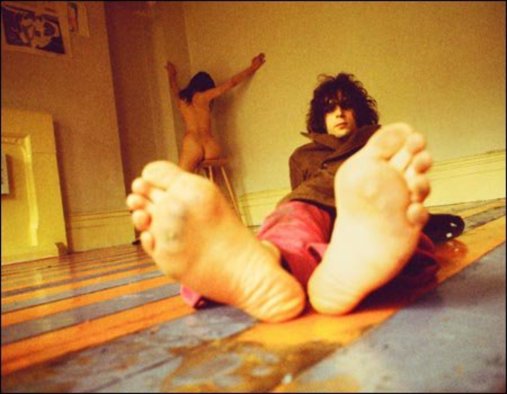
In 1968, I began making my film, Psychedelia. Syd was part of the scenario. Well, he was the scenario. Anybody that would agree I got to appear in the film, which was done at this basement on Old Church Street in Chelsea in a house owned by Antonia Chetwynd [regular visitors included Donald Cammell, David Bowie, Marc Bolan and Anita Pallenberg]. One day I went to Wetherby Mansions to pick up Syd. I was going to take him to the art school to this red and green painted studio I had in the annexe where I was making the film.

Syd Barrett in Wetherby Mansions

On the way, Syd offered me half a Mandrax. It’s like a sleeping pill that makes you very randy. We took half each. Then we got to the art school and I realised my camera didn’t have a cassette in it and all the shops were closed. So I said we’d do it tomorrow in Old Church Street. In the evening I called Duggie Fields [Syd’s flatmate, still resident at Wetherby Mansions] to check Syd had got back okay and Duggie told me he’d gone to Ibiza. He had a passport with him and he’d just gone to the airport and taken a flight to Ibiza.

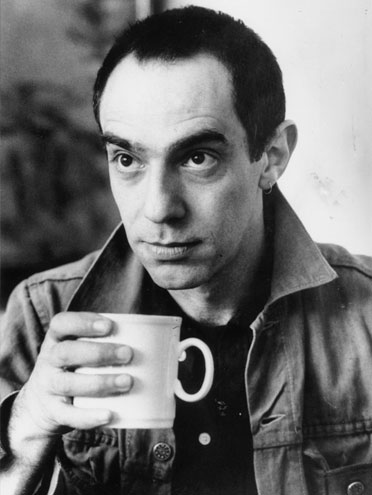
When he got back we went to the basement and did the filming. I just had the camera with this psychedelic lighting. It was very amateur and everyone was very stoned. I’d sit people down and tell them to do whatever they wanted. Some took their tops off, some stared at the camera, talked, had a cup of tea… and I just filmed it because they were fabulous people. I filmed so many. In the scene I shot with Syd was Geoffrey Cleghorn, who was a friend of the Who and the Stones. I’d met him at art school in Ipswich and he’d followed when I moved to London and got involved in the whole scene. He’s an amazing guy. There was another chap called David Crowland. There’s a chap called Rupert [Webster], who was the very pretty boy in “If….”.


I screened it while playing Velvet Underground’s Sister Ray. I also use them on the other film I made Red And Green, when they are actually on the soundtrack, the Syd film was silent though I would have been playing Velvet Underground in the basement when making it. I was obsessed with them. It was all very Warholesque.


I gave my camera to Derek Jarman, I was living with the artist Luciana Martinez and she said, ‘You’ve finished with films and Derek’s a lousy painter, so why not give him your camera.’ He’d just finished making The Devils with Ken Russell, doing the sets. I did that and the rest is history. I then got totally into paining, film was an art student fling. In 1982 I got involved with the Olympis and been there ever since.

“Female gymnast”, 1984

I knew Syd as well as anybody could know Syd. He definitely wasn’t on this planet but he was lovely, very charming, and he seemed to like my paintings. He liked to paint himself and because I was pretty good he warmed to me. Also, I don’t hold him in awe, I was the same with Bowie, they were friends and I’d talk to them like that. I’d ask to draw them but treat them as I would anybody. People can treat pop stars in a different way and they can get very isolated. Most people were too much in awe of Syd to ask to film him and I think that comes across in the film. He was a very troubled mind and this wasn’t a great time. He’d been eased out of the Floyd and Dave Gilmour had taken over. But people who knew him said he looks so happy.’


Mama Cass in London: drugs, towels, Michael Caine and Charles Manson

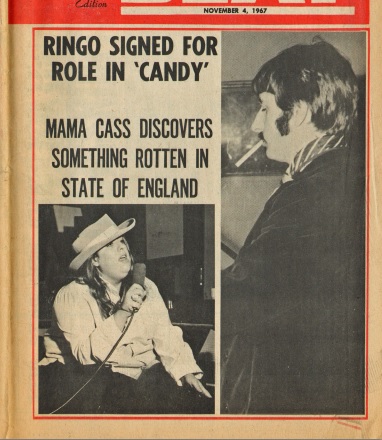
I have a piece about Mama Cass Elliot in the current issue of Uncut. One area I didn’t have space to cover was Cass’s arrest in London in 1967 when The Mamas & The Papas were travelling by boat to England to play a show at the Albert Hall. They had arrived at Southampton when they were told police were waiting with a warrant for Elliot’s arrest. The band frantically tried to destroy their stash of weed and then went on to the dock where they were supposed to meet label boss Lou Adler and his friend Andrew Loog Oldham. They were instead greeted by six of the Met’s finest, who bundled Elliot into a police car and drove her to Scotland Yard.

Cass

Elliot was stripsearched and questioned, then denied bail and held overnight. The police said the charges related to a stay in London six months previously at Queen’s Gate Terrace, when she had absconded with an unpaid bill and several towels. Outside the police station, The Mamas & The Papas – Denny Doherty, John Phillips and Michelle Phillips – were joined by Scott McKenzie, brandishing FREE MAMA CASS placards while they waited for Elliot’s release. The Albert Hall concert was cancelled.

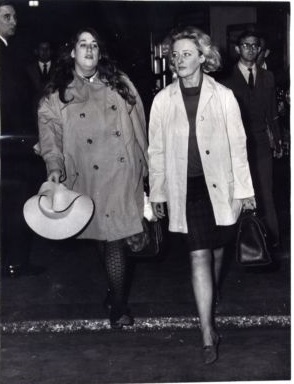
Elliot escorted to the police station in Waterloo.

Elliot escorted to the police station.

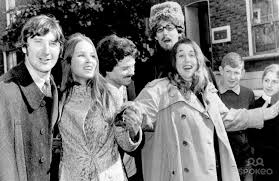
Elliot told the press she had been treated well, but not been given enough blankets. ‘Believe me,’ she said, ‘One blanket doesn’t go far round this chick.’ After a trial at West London Magistrates Court, at which no evidence was offered for the prosecution, she was released without charge and left the courtroom munching on a hash cookie that she found in her handbag. That may account for the big smiles in the photo below, taken shortly after her release.

Elliot on release.

Elliot on release.

The Mamas & The Papas with Scott McKenzie after Elliot's release.

The Mamas & The Papas with Scott McKenzie after Elliot’s release.

The Mamas and the Papas with Scott McKenzie in London.

The Mamas and the Papas with Scott McKenzie in London.

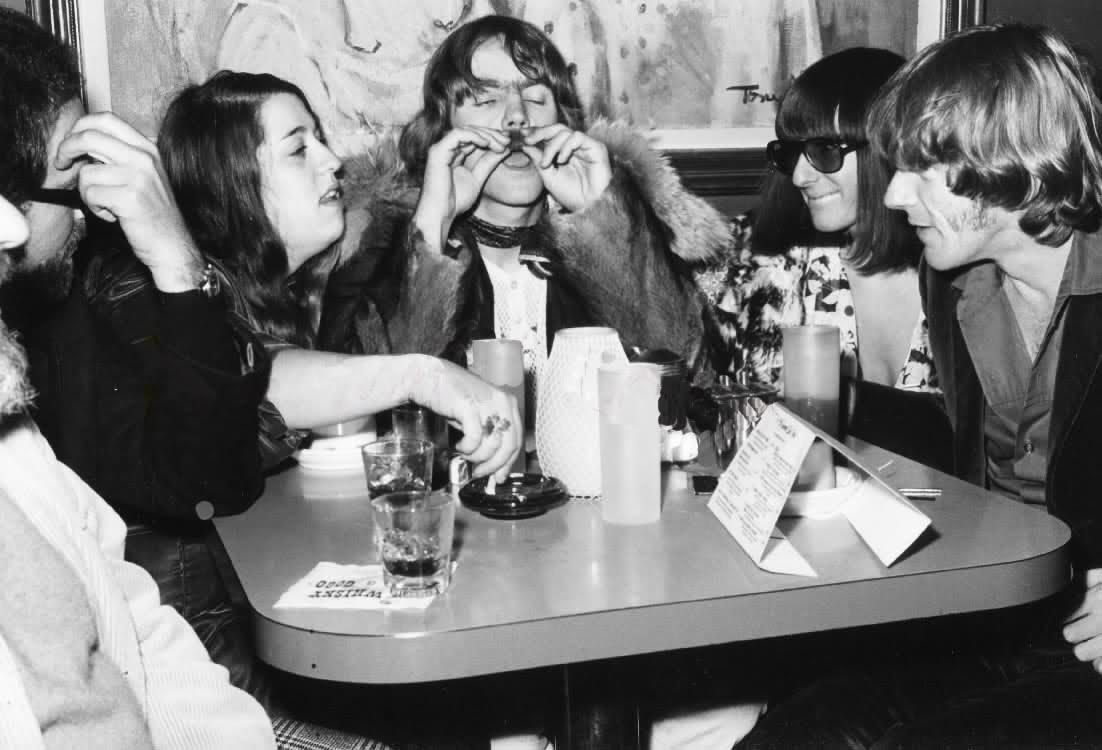
While such heavyhanded treatment by the authorities of rock stars was fairly common at this time, it later emerged that Elliot’s arrest actually had more to do with her occasional boyfriend, Pic Dawson, who the British police believed was involved in a major drug-smuggling operation. According to Michelle Phillips, this was the only subject the police in London were really interested in.

Pic Dawson and Cass Elliot at Whisky A Go Go.

Pic Dawson and Cass Elliot at Whisky A Go Go.

Dawson, who died of a drug overdose in the 1980s, was certainly an interesting figure with connections to the underworld. Numerous rumours circulate about him partly thanks to his peripheral involvement in the Manson Family murders.

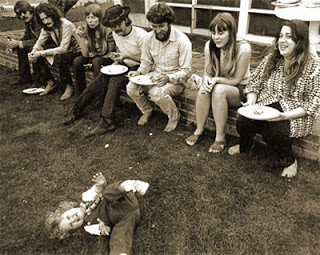
Dawson, left, and Elliot, right, at Mama Cass’s house with guests including David Crosby and Eric Clapton

Dawson knew several of the victims – basically, he supplied them drugs – and after the murders John Phillips is said to have told the police that the bloody PIG daubed on Sharon Tate’s wall actually said PIC. The LA police were also informed that Dawson, along with another of Elliot’s drug-dealing boyfriends, Bill Doyle, had been ejected from a party at the Polanski house shortly before the murders. Dawson was subsequently arrested, questioned and cleared, as was Doyle.

These were not Elliot’s only connections with the Manson murders. Dave Mason recalls, “One of the freakiest parts was that at Cass’s I saw a lot of Abbie Folger and Wojciech Frykowski until the Manson crew slaughtered them” and she knew all the victims well. But she also knew the murderers – in his autobiography, Michael Caine of all people recalls attending a party in Hollywood with Jay Sebring and Sharon Tate, where Mama Cass introduced him to a ‘scruffy little man’. His name was Charles Manson.

‘Last time I went into central London I needed a lie down’: life on London’s floating bookshop

An interview with Paddy Screech, a floating bookseller, for a piece I wrote for Time Out in June 2013.

Paddy Screech, 47, Word On The Water

‘By terms of the continuous cruising licence I have to move to a new mooring every two weeks. In the winter I try and stay around the urban bits and in the summer I stay near the parks. We try and stay north-east because my business partner has a little girl at school in Stoke Newington. We go to Paddington, Camden, Angel, Broadway Market, Mile End Park, Victoria Park and Springfield Park. We can’t go much further because our supply lines start to get stretched as we have relationships with five or six charity shops in this area. These are our friends and were we get our stock and also this is where our boating friends are. If we move to far afield we don’t have a world there.

What’s the appeal? Well, on a day when I have a carpet wrapped around a broken propeller and I have to have my boat towed in a strong wind, I can’t quite recall. Generally, I love the freedom and the less regulated life. London can be a chilly place. On the canal, people behave like they are living in the country even though you are only four metres from the road. As soon as you put a towpath there, people start talking, being friendly. It’s true of everybody, boaters and passersby. It’s very strange, like magic. On the other side of this fence there is a different culture.

It’s like a village. There are a lot of boats in London but if you put them all together you’d have a village, but a village where you can get away from people if you want to just before you start annoying each other. I have a little world in each place I stop: I usually know some of the other boats, I have a favourite coffee shop, I know how to get to the launderette. I like Springfield Park the best. Everybody makes the book barge feel welcome, whether they are permanent residents or not.

I’ve been on this boat for two years, running it as a bookshop, and I’ve been on the canal for six years. I try not to leave the canal. Last time I went into central London I needed a lie down. I lived in Upper Clapton for seven years. In all that time I met one of my seven neighbours once, as I sat rotting in front of a computer and seeing one of my dozen friends each week. Now I have about 300 friends, only look at the computer for an hour a day and never watch TV. I spend most of my time trying to stop the barge blowing away, or trying to light a fire.

The boat is called Diante, which means diamond in Italian. She’s a 1920s coal barge from Amsterdam and was converted into a houseboat in around the 1960s. She’s beautiful, but has a very thin bottom so will need replating. The engine is very old and just about clinging to existence. Every four years you need to take a boat drydock for a bigger service but if you do that properly a boat can last for decades. I’m not very practical but am much better than I was seven years ago. Anything that requires expertise or tools I need to call in favours. The fun thing about a Dutch barge is that it has no weed hatch so I have to put on a wet suit and get in the canal with all the urine and clear it with a knife.

I have a sea toilet which can’t be used on the canal so I visit the local establishments when I need the loo. There are lots of pubs and cafes that are sympathetic. It’s a simple life, I have no hot running water. I had a gas boiler but took it off because it wasn’t going to pass the safety certificate. It seemed a bit of luxury. My shower is now used for book storage. I wash with landlubber friends. Thanks to the kindness of friends I get a bath every other day. Working boats come up and down the canal delivering coal and diesel to all the moorings.

I have no mains electricity but a substantial amount of solar panelling that runs the lights and a 12v PA. There’s also an alternator on the engine, which creates electricity when you run the engine. It means there’s one less corporation in your pants. I do all my electronic stuff on my smartphone. Some boats have widescreen TVs and generators, but I’m not interested. Boats take up a lot of time and so I’m always pottering around doing something, I’m done with sitting on my arse watching bad television.

My business partner is John Privett, we started the shop about two years ago. We survive against overwhelming odds, but our costs are low and in the winter we live like feral water rats. We don’t get much custom when it is raining so in the winter we contract our horns and live on less. For our stock, we get given donations but mainly we select the best from charity shops.

The main expense is the licence and safety certificate. The business license for a trading boat is the same cost as a residential one as long as you are making less than £60k a year. There are around 15 trading books in London now, including a hat boat, a sandwich boat, a cocktail barge, a vegan cake barge, a herbal practitioner and a Slovak restaurant. We are hoping to find a permanent site for a floating market. It’s nice to move every two weeks but we might do better if we could stay in the same place.

I have absolutely no interest in going back to dry land. As long as I can borrow a friend’s bath every now and then there’s nothing about land life that appeals to me. I’m in the city now but when I wake up tomorrow I’ll be in  park underneath some trees and I’ll still have my coffee and my cats [Queenie and Skitty]  around me. To take your house and plonk it into the countryside after 24 hours is pretty special.

I don’t wish for more space. Boats change your expectation about how much space you need. I got rid of four-fifths of my items when I moved aboard and I don’t miss them. You just learn not to accumulate things. Except books. I can usually find something to read.’

Richard Fortey’s secret tour of the Natural History Museum

Some years ago, the writer and scientist Richard Fortey took me on a tour of his favourite items in the Natural History Museum. His book, Dry Store Room No 1, is one of the best books I’ve read about London museums.

1 ‘This is the collection of all known species of humming birds which I used as the cover for my book. It goes back nearly 200 years to the earliest days of natural history as spectacle. One of the amazing things is that the colours, the iridescent feathers, have survived so long. You can even see the tiny eggs, with the appropriate egg in it. This whole bird gallery is a survivor to the old days of the museum, preserved almost apologetically as an example of the classic gallery, but a lot of people still stop and look at it even though it’s just stuffed birds.’

Pregnant ichthyosaur fossil showing three skeletons of young inside her bodys 2. ‘This one of the great sea dragons, an ichthyosaur, a marine reptile. This one is particularly beautiful and informative because within the body cavity you can see here outlined in red, the remains of other smaller individuals. The question originally was ‘were they cannibals or did they give birth to live young’ and the answer is almost certainly the latter. These animals are very like porpoises and almost certainly lived the same way, gregariously and pursuing a very fast life that gave them no time to sit on eggs. But this is very easy to miss.’

45 NHMX 4597.jpg

3 ‘The building itself. You can choose anything from the various animals and birds that adorn the interior. Even the pillars are based on the bark of trees. On the whole, the building moves from living to fossil as you go from one end to another and that is true also of the animals portrayed. In the mineral gallery, right at the end above a door on the left is a dodo. I also think that one of the monkeys has been made to look a little like Darwin.’

4. ‘The mineral gallery has probably changed the least since my early days and it’s also the least visited. It’s a classic systematic approach where all the minerals are laid out in cases arranged by chemical composition, so you could come here and learn some serious mineralogy if you started at one end and worked your way through. At the end, in the Vault, where particularly precious minerals are displayed, is something  called bournonite with black wheels shaped like cogwheels. This came from a Cornish mine that has since closed so this is really the only good specimen that will ever be found with this particular chemical composition. It’s now extremely valuable because the rarer something gets, the more valuable it becomes.’

5. ‘The blue whale, it might be obvious but it is remarkable. For a while, during the war, some people working here kept an illicit still in the belly of the whale. So even with the best-known exhibit, there are secrets to be had.’

The Natural History Museum's table tops

6. ‘Finally, head for the geology section in the mezzanine level. This used to be an old-fashioned museum in its own right but now it has been changed and in making space they only put back about ten per cent of the specimens. Each one is individually highlighted so it doesn’t give you the systematic overview or leave room for the quirkier items. But this table is still here. It’s a collection of North European ornamental stones all made into one table. You can even make out fossilised nautiloids of around 450 millions year in some of them, and also fossilised coral. There’s no label for it, nothing to say what it is and where it came from. You and I are probably the first people to have stopped and look at this for several weeks.’

London: ale and hearty

I like beer, but I do not fully understand it. By which I mean, I vaguely understand how it is made and I know how much of it I can drink (less with each year), but while I know fairly quickly whether I do or do not like a particular beer, I am never entirely clear exactly what it is I like about it. Is it the hoppiness, the finish, the strength, the, I dunno, malt? Search me guv.

I took this ignorance with me when I interviewed Evin O’Riordain, owner of the Kernel Brewery, at his microbrewery in Bermondsey. Evin is an intense fellow. In lots of ways he reminds me of people  who run independent music labels, absolutely committed to a certain ethic, a particular way of doing things, not because it is easiest or will bring the most rewards, but because it is right. Indeed, Kernel’s stark labels even remind me of Peter Saville’s Factory Records sleeves.

Electronic Beats - Kaufen: FACT 14

Evin talked me through his brewing philosophy, lubricating his lecture with samples from his stocks. We tried a session ale, an IPA, a porter, a stout and a saison. Evin told me about each style’s particular history – how it came to be brewed, who it was originally for – and then explained Kernel’s sophisticated fundamentalist take on it.

It was a very pleasant afternoon.

Photo by Josh Shinner.

The result of that chat with Evin, and four other London brewers (none of whom actually come from London), can be seen in my piece on London’s brewing renaissance in this month’s London Magazine.

New London writing, or What the fuck is psychogeography anyway?

I don’t think anybody, with the possible exception of Will Self, really knows what psychogeography means but that doesn’t mean there’s not a lot of it about. For years, the London writing landscape has been dominated by three masters of the genre, the Ackroyd-Sinclair-Self trinity (in this interview, Self distinguishes between their different approaches) – it’s hard to find a book in the Museum Of London bookshop that doesn’t have an intro penned by one of them – but that is starting to change. In the past year or so, three books have been written by debutant writers that take a broadly psychogeographical approach – you can tell this by the use of words like ‘palimpsest’ and liminal’ –  to the city or patches thereof but are happy to present it in a more approachable, less LRB-approved style.

The man above is Nick Papadimitriou, and his Scarp is the most Sinclairian of the three, written by a man obsessed with a small parcel of land on the city’s northern border. ‘I’m trying to get below the surface into something that’s moving in my mind as much as in the landscape,’ he says, which doesn’t say a great deal and is therefore as neat a summary of his obscure methodology as you are likely to find. Scarp is a wonderful book, a brilliantly obsessive and beautifully observed celebration of the meditative quality of what Papadimitriou calls deep topography and the rest of us know as walking. It’s also classic psychogeography in that you read it in the knowledge that a significant proportion of the theorising is total codswallop, but at least it is entertaining codswallop, an intriguing combination of the occult and broad generalisations about place drawn from a tiny physical space.

Next up in This Other London by John Rogers, a lighter but similarly intentioned account of ten walks – ‘a plunge into the unknown’ – around fairly random parts of London that were previously just strange names on old maps to the author, a film-maker and good egg. Rogers has none of the astonishing familiarity with his territory as Papadimitriou and he makes a virtue of this, imbuing the book with the joy of new discovery. It is, as a friend noted, a salute to the rewards of simple rambling, of going somewhere unusual and just strolling, or flaneuring to use the specific vernacular of psychogeography. As an alternative guide to London walks – or an inspiration to do the same yourself – it is a marvel.

Finally, came Gareth Rees‘s Marshland, hallucinatory, speculative non-fiction about the marshes of Hackney and Walthamstow that combines Scarp‘s deep knowledge about a specific locality with the dry wit and accessibility of This Other Land. Again, Rees is fond of that psychogeographical turn of phrase – ‘There is no final draft of London’, being a particularly fine example – but laces it with humour as he explores this odd landscape of rave holes, filter beds, football pitches and reservoirs (and a fascinating landscape it is too), mixing in a bit of fiction and even offering an audio soundtrack. Rees has a tremendous, natural, written voice and the book fairly skips along. I loved it.

All three books are a lot of fun and that is the great, dirty, secret of psychogeographical writing – it is hilariously fun to do as you train your brain to make grandiose statements about people, place and history that you are fairly sure won’t stand up to any great inquisition but look fucking brilliant on paper. Bill Drummond’s neat summary of psychogeography is perfect – ‘An intellectual justification for what I have been doing most of my life’.

I do not consider myself to be a psychogeographical writer (and here I express some of my dislike of it), but that’s not to say I’ve never indulged in it myself of occasion (as here, when writing about Wappingness), particularly when asked to do so by property developers, who seem to love this style of writing as a way to signify their deeper engagement with the city they are hoping to exploit.

By my experience then, psychogeography is used as much to shift property as it is to expand and combine the frontiers of space and mind, which is perhaps inevitable in London, where any amount of folklore and fauna only really has any value if it can be seen to have a positive effect on land prices. I’m not entirely sure that this is what Guy Debord was hoping for when he first conceived his theory, but given that he’s long gone there’s not a great deal he can do about it.

Situationists at the Sailors' Society in London during the 4th Conference of the Situationist International. Those assembled included (from l. to r.): Attila Kotányi, Hans-Peter Zimmer, Heimrad Prem, Asger Jorn (covered), Jørgen Nash (front), Maurice Wyckaert, Guy Debord, Helmut Sturm, and Jacqueline de Jong. To ensure that the proceedings were kept away from any contact with artistic circles or London newspapers, the conference took place in Limehouse, "a district renowned for its criminals."

Guy Debord’s Situationists in Limehouse, in search of Wappingness and investment opportunities.