Category Archives: Exhibitions

London’s lost rivers

There is almost endless fascination with London’s lost rivers, as can be seen with the publication of Paul Talling‘s fine – if brief – new book on the subject. I have written about them a number of times and this article first appeared in Time Out in 2008.

Londoners love what they cannot see. Take the excitement that is generated by ‘ghost tube stations’ such as Museum and Aldwych that sit unused beneath our feet and can occasionally be glimpsed from trains. Yet people rarely blink when they descend escalators into the remarkable interiors of busy, living stations. Concealment and abandonment excited the mind more than the here and now.

So it is with London’s lost rivers. Anybody can check out the quirky Lea or watch the Wandle weave serenely past Merton Savacentre, but mention Brixton’s Effra or the City’s Walbrook rivers and the eyes of a certain sort of Londoner will light up, and a torrent of trivia about lost rivers will gush forth. This is an interest that can take us to unusual places. When Design for London recently mounted London Open City, an exhibition about creating new spaces in the capital, the idea of restoring buried rivers got people talking. The Sunday Times claimed Boris Johnson was going to greenlight the scheme and Peter Bishop, then director of Design for London, said: ‘When these rivers are opened up, Londoners will be absolutely amazed.’

Which was great news for James Bowdidge, a property developer with a yen for the Tyburn. ‘As soon as I learnt about it, I became fascinated with the old river and the way you could see it in street patterns,’ says Bowdidge, who channelled his enthusiasm into a curious project – ‘an angling society for a river that didn’t exist’. The Tyburn Angling Society, an irregular supper club, was born – Ken Livingstone attended their 600th anniversary dinner, 600 being a number they plucked out of thin air.

So far, so whimsical.

However, Bowdidge – a London buff with half an eye on property prices – has also looked into raising the Tyburn, which was covered in 1750 but still meanders underground from Hampstead to Westminster. ‘I asked an architect to draw up plans of the building that would have to go. We write to Westminster City Council about it every now and then. But they are sceptical because this particular plan requires the demolition of their headquarters.’

Now Bowdidge’s hope is renewed. ‘If you look at the planning statement the Mayor brought out, you can see a degree of support for this sort of project. And now the subject is live it’s worth thinking about seriously – what could you do? There’s no reason why you couldn’t reinstate the river through Regent’s Park. You don’t have to demolish billions of pounds of property, there are places where you could really bring it back if you looked at it pragmatically.’

Well, perhaps. The notion that Boris has gleefully embraced the scheme is not supported by the raised-eyebrows reaction of a GLA spokesperson, who told me: ‘Opening up parts of London’s subterranean river networks is one of many ideas proposed at the exhibition… As with all the ideas designed to stimulate thinking, a full study would need to be undertaken before any could be taken forward.’

In other words: Never. Gonna. Happen.

At least, not with the Mayor’s money. But there are always other pockets to pick. In 2003, the Environment Agency rescued the Quaggy, a tributary of the Ravensbourne, from an underground culvert in Kidbooke’s Sutcliffe Park, and there are plans to restore the Ravensbourne itself in Lewisham town centre, paid for by a regeneration group called Urban Renaissance in Lewisham (which includes the Quaggy Waterways Action Group). Architect Will Alsop has floated a similar scheme for Croydon, where a branch of the Wandle is interred. He says, ‘The buried river thing Boris is banging on about is a really good idea. In Croydon, the Wandle was only buried in 1967 so you can easily bring it back in patches: ponds or lakes or some elements of river. And you don’t even have to bring them back; you can leave some underground and go and see them there.’

Which brings us neatly to the most interesting scheme, that of Nick Robertson, a designer and London obsessive who once walked the Thames from source to sea with Peter Ackroyd (‘every Saturday for a year’) and harbours a fascination for the Fleet. Bowdidge refers to the infamously filthy Fleet as ‘the ditch’, and Robertson does not disagree. ‘There’s nothing artistic about the Fleet,’ he says. ‘It was bricked up for good reason. He’s right to call it a ditch. But some ditches are worth celebrating.’

Robertson’s plan was ‘the confluence of several ideas’. One was a walk he completed along the course of the Fleet – ‘it was a river route, you could see it in street names, and in the topography and geology; a river that wasn’t there, but was.’ A second influence was an exhibition at the Royal Academy in 1996 called ‘Living Bridges’, which author Stephen Bayley has said marked the ‘moment when bridges have become showpieces of architects rather than engineers’. And the third was a visit to the Monument, the column raised by Wren and Hooke in 1677 to commemorate the Great Fire.

Robertson explains: ‘What interested me about the Monument was that it wasn’t representational. You climbed this big Doric column and saw what you saw, which was the extent of the destroyed city. The Monument is not the monument – what you see, the rebuilt city, is the monument. Stylistically, it’s of its time but conceptually, it’s way ahead.’

Robertson and an architect friend Iain Johnston explored options. ‘We discussed whether it was a good idea to open up the river and very quickly dismissed it because most plans to open up the hidden river are missing the point. The point is this river is covered. That’s what is interesting. To open it up is to ignore the historical process. And it’s ignoring the mystery, the charm. If you opened up the Fleet, it would regress to what it was, an urban river: charmless, shit-filled.’

Instead, Robertson ‘thought it would be interesting to have a bridge that went underground and the obvious site was Ludgate Circus because that was the site of the Fleet Bridge and Wren’s bridge when he tried to turn the Fleet into a canal.’ They designed a subterranean chamber that went under the road and had a glass floor through which visitors could observe the still-living Fleet. ‘A warped bridge over a warped bridge’.

He sent his proposal to the head of Thames Water where, as far as he knows, it still resides. The Fleet and the Tyburn were incorporated into Joseph Bazalgette’s sewer system in the 1860s and both Bowdidge and Robertson have blagged trips underground with Thames Water sewer workers. Says Robertson: ‘One of the things I found most interesting was the amount of decoration. The designers stopped and thought what they were doing even though nobody was going to see it – it’s effectively dressing up shit.’

It’s true. London river-sewers are artfully constructed, beautiful things that deserve celebration, both for what they are now and what they used to be. The Guardian’s Ian Jack disagrees. When confronted with Bowdidge’s cheerful scheme of tree-lined tributaries, he wrote that the Tyburn was a ‘sewer owned by Thames Water and more remotely by pension funds in Canada and Australia. It has been a sewer for hundreds of years as part of a combined system, far too expensive to separate, that carries rainwater and human waste.’

And that’s that. Robertson at least sees a way past this brutal approach, and while his Fleet Bridge is the sort of imaginative scheme destined to go nowhere, he also believes the Fleet should be remembered in simpler ways, such as surface markers along its course of which there are none. It seems London is ashamed of its lost rivers, or at least of its treatment of them.

‘The Fleet is something London has buried,’ says Robertson. ‘So it appeals to people who feel strongly about the occluded side of London history.’ The best way to deal with it, he thinks, is to go down and confront this ‘trapped nerve’.

‘It was once a bubbling brook of bucolic bliss, then it turned into an open sewer, then it was bricked up,’ he says. ‘Now it needs to recreate itself in a different way. To open it up is to miss the point, pandering to a nostalgic view of London. London should never be nostalgic.’

Spoken like a true Ballardian (and Ian Jack would surely approve), but everybody, even a ruthless modernist, is allowed to look back every now and then and wonder. So Robertson tells me to head up Farringdon Road and down Ray Street towards Back Hill. There, in the road outside The Coach & Horses, is a grill, and ‘when you stand over it,’ says Robertson, ‘you can hear the Fleet belting beneath your feet.’

So it does, the magnificent sound of a torrent of water battering its way downhill directly beneath London streets. Sewer or river, call it what you will, but the Fleet lives on. Deep waters run still.

Marf: City Blues at the Guildhall Art Gallery

My review of Marf: City Blues, an exhibition at the Guildhall Art Gallery, appears in the Independent.

The Guildhall in the City is an appropriate venue for a series of cartoons about the financial crisis of 2008 and its aftermath. Marf is Canadian, but her cartoons are all set in London, and the Gherkin, St Paul’s and the tube all make appearances. The exhibition is on until June 20.

The Guildhall has recently become a free venue, which is slightly contrary to current trends, but the City of London has always done things a bit differently. It has a wonderful collection of London-related paintings, and is definitely worth a visit, and there are also plans to host regular paid-for temporary exhibitions. Marf, however, is free. The intention is that local workers, who are overwhelmingly from the financial services, will come to the gallery in their lunchtime to nose around.

I wonder what they will make of cartoons like the following when they do? Water off a duck’s back, probably.

Maps round-up

A quick post on maps. I have a small piece in the Independent about the Museum of London and Londonist’s forthcoming collaboration, Hand-Drawn London. This exhibition, opening on April 21, features maps drawn by Londoners.

I submitted a map drawn by four-year-old daughter of her daily walk to nursery, but it was harshly rejected. I have reproduced it here.

I have also been posting fairly regularly on maps at the Time Travel Explorer blog. Recent posts have included one on London’s first lido and another on London’s forgotten exhibition.

Cult Of Beauty at the V&A

The V&A’s Cult of Beauty exhibition opened over the weeked. You can read my feature on the Aesthetic movement in the Independent on Sunday.

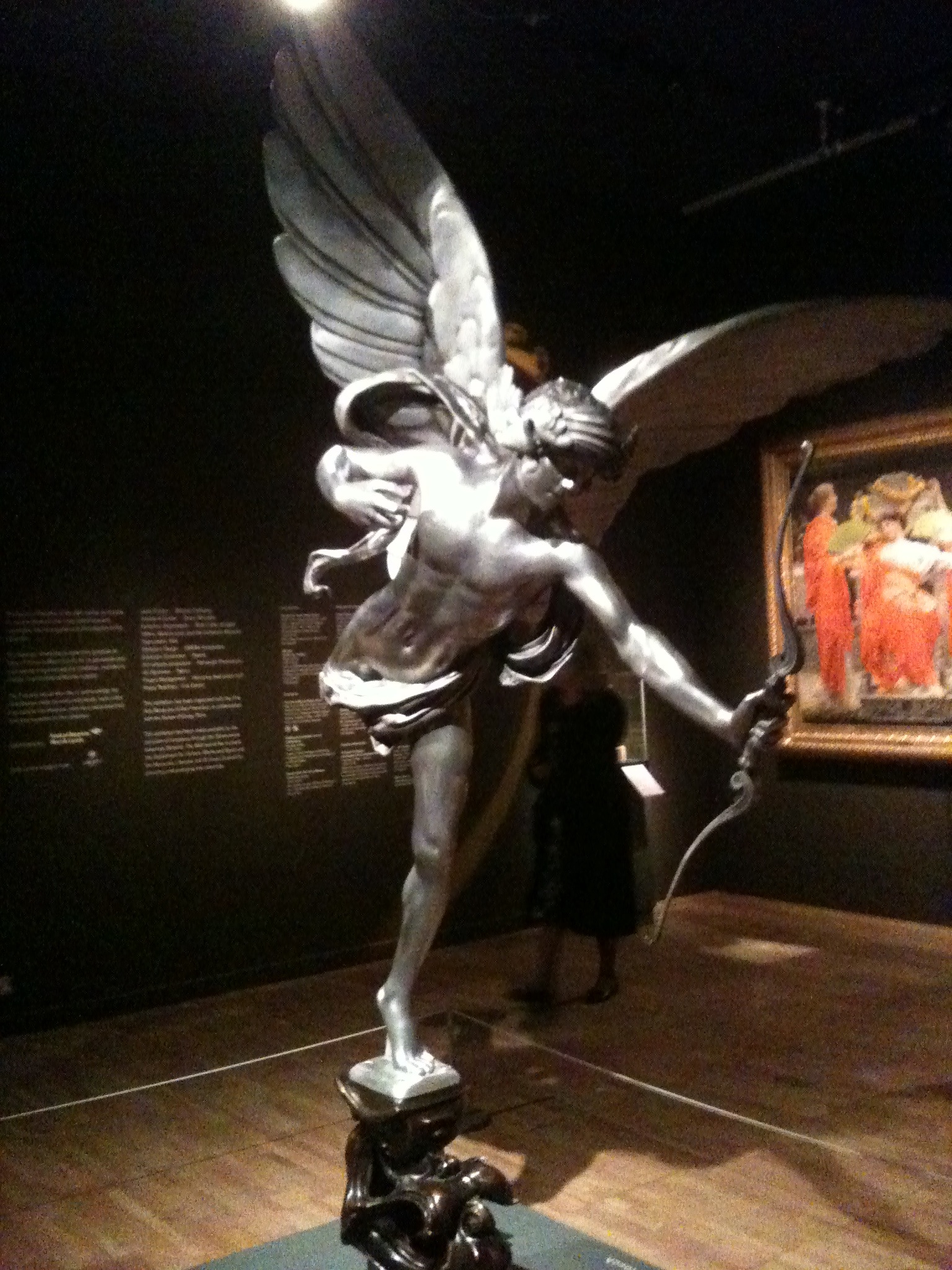
The highlight of the exhibition comes right at the end. Alfred Gilbert’s statue of Eros, or to be more precise Anteros, or to be even more precise, The Angel of Christian Charity, is easily overlooked in its usual home of Piccadilly Circus, located as it is in the second worst place in all of London. But lowered to eye level and removed of surrounding neon, tourists and traffic, it turns out to be a figure of real beauty, simultaneously delicate and robust, and gleaming in its shiny aluminium (this is a recent cast).

The rest of the exhibition is similarly eye-catching, as you wander round the gallery following what seems to be an endless procession of portraits of dark-haired, brown-eyed women painted between 1860 and 1900 by the Aesthetes. William Brown, the fictitious schoolboy and one of my chief inspirations, always admitted a soft spot for a certain kind of women: dark-haired, brown-eyed and dimpled. He was clearly inspired by the Aesthetes.

Midsummer

Among the moles at the Grant Museum

My short piece about the recently reopened Grant Museum of Zoology appears in today’s Independent.

If you haven’t been to the Grant Museum in either its old or new guises, do go and check it out one lunch break. This is the only museum in the country where you can see 18 baby moles stuffed in a sweet jar.

It also has one of only seven quagga skeletons that are known to exist in the world. The discovery of the quagga says much about the delightful way the Grant goes about its business.

The museum had two zebra skeletons, but curators were convinced that one was actually a quagga, so in the 1970s they got an expert to make the requisite calculations.  To their delight it turned out that one of the zebras was indeed a quagga, and this was unveiled to great publicity. However, less happily, it seemed that the other zebra was actually a donkey. Both are now displayed in the new museum, the quagga in pride of place near the entrance, the donkey out of sight on the first-floor balcony. But zebras, there are none.

Grant Museum of Zoology, UCL, Rockefeller Building, 21 University Street, WC1E 6DE. Open Mon-Fri, 1-5pm.

Five unknown London pleasures

1 London’s first artificial ice rink
The Glaciarium opened in 1842 at the Baker Street Bazaar near Portman Square. The backdrop was ski chalets and snow-capped mountains, the ‘ice’ was churned-up hogs’ lard and sulphur. On hot days it smelt of cheese. It closed in 1844.

2 The clown and the geese
In 1884, a clown called Barry was watched by a huge crowd as he sailed down the Thames from Vauxhall to Westminster in a washtub pulled by four geese.

3 One-legged cricket
In 1796, Montpelier Gardens in Walworth hosted a cricket match between eleven one-armed Greenwich pensioners and eleven one-legged Greenwich pensioners. Interest was so great that a fence was broken and spectators fell through a stable roof. The match was drawn, but the one-legged team won a replay, earning themselves 1,000 guineas.

4 London’s first public museum
This was opened in a coffee house near Chelsea Old Church in 1695 by James Salter, a former servant of Hans Sloane, the man whose collection later formed the British Museum. Sloane reputedly handed Salter – renamed Don Saltero – some of the less important of his 80,000 objects, including a giant’s tooth,  a necklace made of Job’s tears and a bonnet that belonged to Pontius Pilate’s wife’s chambermaid’s sister (it actually came from Bedford).

5 The Peace of 1814
On Monday August 1, 1814, London celebrated the abdication of Napoleon Bonaparte with a series of festivities. It began with a balloon ascent at Green Park; the balloon was captured by the winds and sent towards the Estuary until the ballooneer cut a hole and landed on Mucking Marshes near Tilbury. Next came a miniature Battle of the Nile on the Serpentine, followed by a firework display in Green Park, for which John Nash had designed a new pagoda. Sadly this caught fire, killing two people. The crowd applauded, assuming it was all part of the fun.

All these came from Pleasures of London, a book available at the Museum of London bookshop for £30. It is my new favourite London book. It should have been published in 1992, but was delayed repeatedly and by the time it was published by the London Topographical Society in 2009 the authors, Felix Barker and Peter Jackson, had both died.

What the pair had created was an endlessly browsable book on all the fads and fancies that have occupied Londoners leisure since the Dark Ages, from Frost Fairs to black-faced minstrels, lidos to the Great Exhibition. There are brilliant throwaways  – such as those mentioned above – as well as short but thorough looks at things like music halls, pleasure gardens (which I still don’t get the point of), museums and the origins of sports like cricket, football and boxing.

Buy it.

Natural selection

My review of the Natural History Museum’s very good exhibition on Sexual Nature, about the mating habits of animals, can be read at the New Statesman. It features slug sex, Guy the Gorilla and Isabella Rossellini.  

For more on this sort of thing, you should read Melissa Harrison’s Tales Of The City blog, who writes about blossom, snowdrops, daffodils and foxes from the urban wilderness of sunny Streatham.

Waxworks at war

The other day I headed to London Bridge to investigate Winston Churchill’s Britain at War Experience, a peculiar attraction on Tooley Street next to the London Dungeon that opened in 1992.

This strange place attempts to recreate the experience of wartime London feels rather like a private collection of eccentric memorabilia that has been thrown together in a space under a railway arch. There are no shiny monitors and well-lit cases; some of the labels are handwritten.

I quite liked it, although not at the £13 it would have cost if Laura at About London hadn’t got me in for free.

It begins with a film screened in a mocked-up air raid shelter, features various displays about life in London during the war (evacuation, fashion, rationing, entertainment, land girls), has a real Anderson Shelter to sit in and ends with a gloriously dramatic and gruesome life-size reconstruction of a bombed pub, complete with smoke and severed limbs.

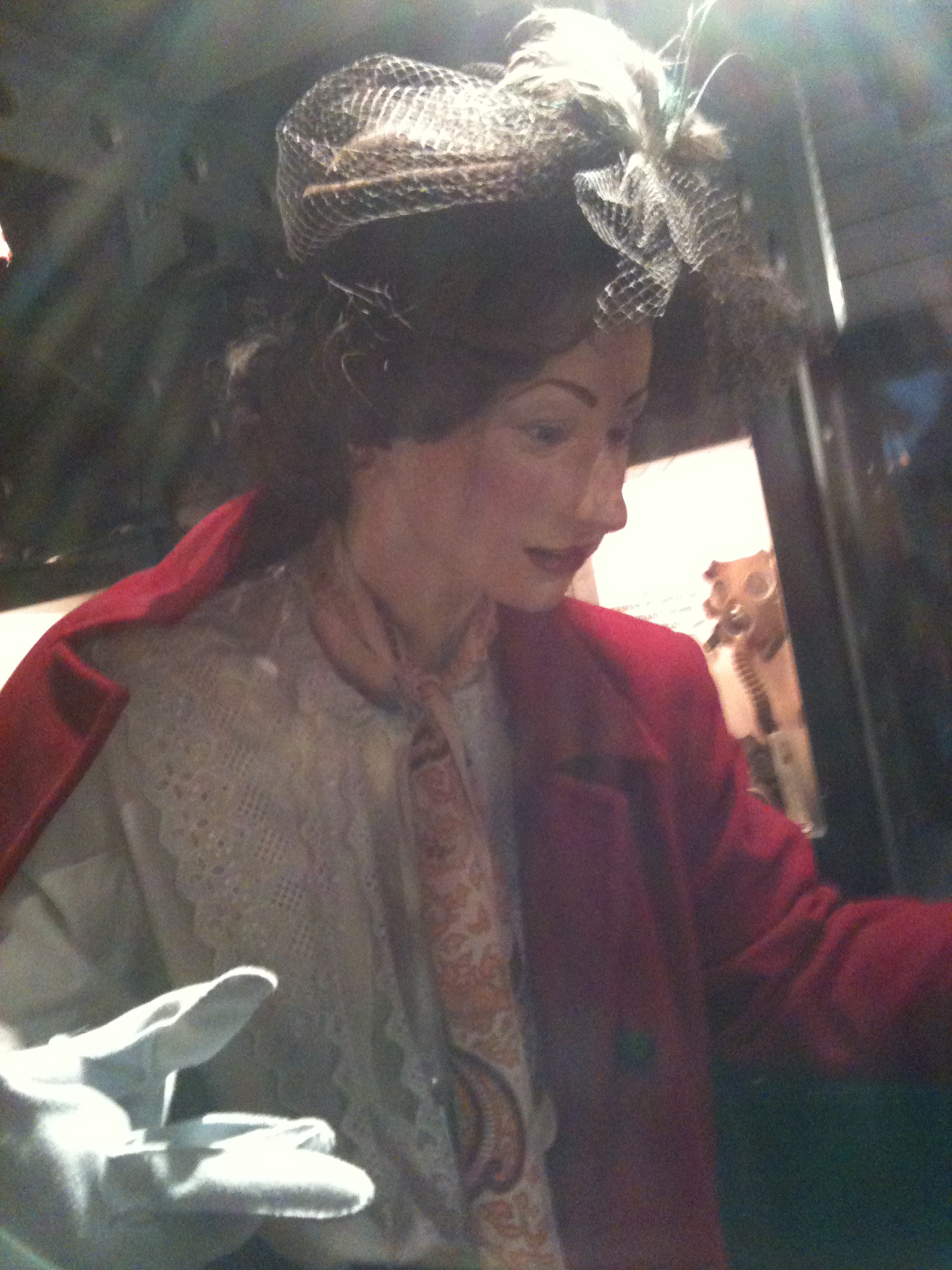
What I liked best, were the waxworks. You don’t get many waxworks in museums these days but there are loads at the Britain At War Experience and they are mostly terrible. Unfortunately, I only managed to photograph a couple, missing out on the frightening one of a small child asleep in an air-raid shelter, looking like a little corpse, and also a brilliant Winston Churchill with a head the size of Gibraltar (this may in fact be physically accurate).

But here are the ones I got.

This one is quite normal. It’s a man using a switchboard. It shows what they can do with waxworks when they put their mind to it.

But then they get progressively weirder. This woman with a massive nose is demonstrating wartime fashion, although I think she is actually a man who dresses like a woman to avoid war service and because he likes the freedom it offers him.

This woman is a fire warden with a bad back. 

At the end, in the bombed pub, this woman can be seen bravely selling tea even though she has clearly suffered terrible burns and should be taken to the nearest hospital. This could be to demonstrate the implacability of London spirit during the Blitz, or it could be because they ran out of artificial hair.

So there you go, if you like weird wartime waxworks and have thirteen quid to spare, get down to Tooley Street before they all come alive and take over the London Bridge Quarter.

London Street Photography at Museum of London

My review of the Museum of London’s excellent London Street Photography exhibition appears in the Independent today.

Street photography – the snatched and unposed glimpse of everyday life – is a fascinating genre even if it is never quite as authentic as it appears. Many of the strongest images in the exhibition reminded me of those Victorian journalists who investigated the slums of working-class London life in the 1880s and 1890s, reporting back in horror on what they found to their middle-class readers.

Thanks to these pioneeers, we now have evocative visual records of London life. My favourite were probably the images Roger Mayne took in the late 1950s to record the streets in West London that were scheduled to be demolished and replaced by Trellick Tower. A book of Mayne’s photographs has just been republished and can be purchased at the Museum of London bookshop, along with the excellent accompanying book for the exhibition.

The Siege Of Sidney Street

My review of the Museum of London Dockland’s exhibition on the Siege of Sidney Street can be read in the New Statesman.

For once, I have little more to add. It’s an excellent exhibition and I recommend heading to Docklands before it ends in April. For more on the siege, you can see Pathe newsreel footage here or read Caroline’s article here.

Or you can watch a clip from the 1960 movie loosely based on the events.