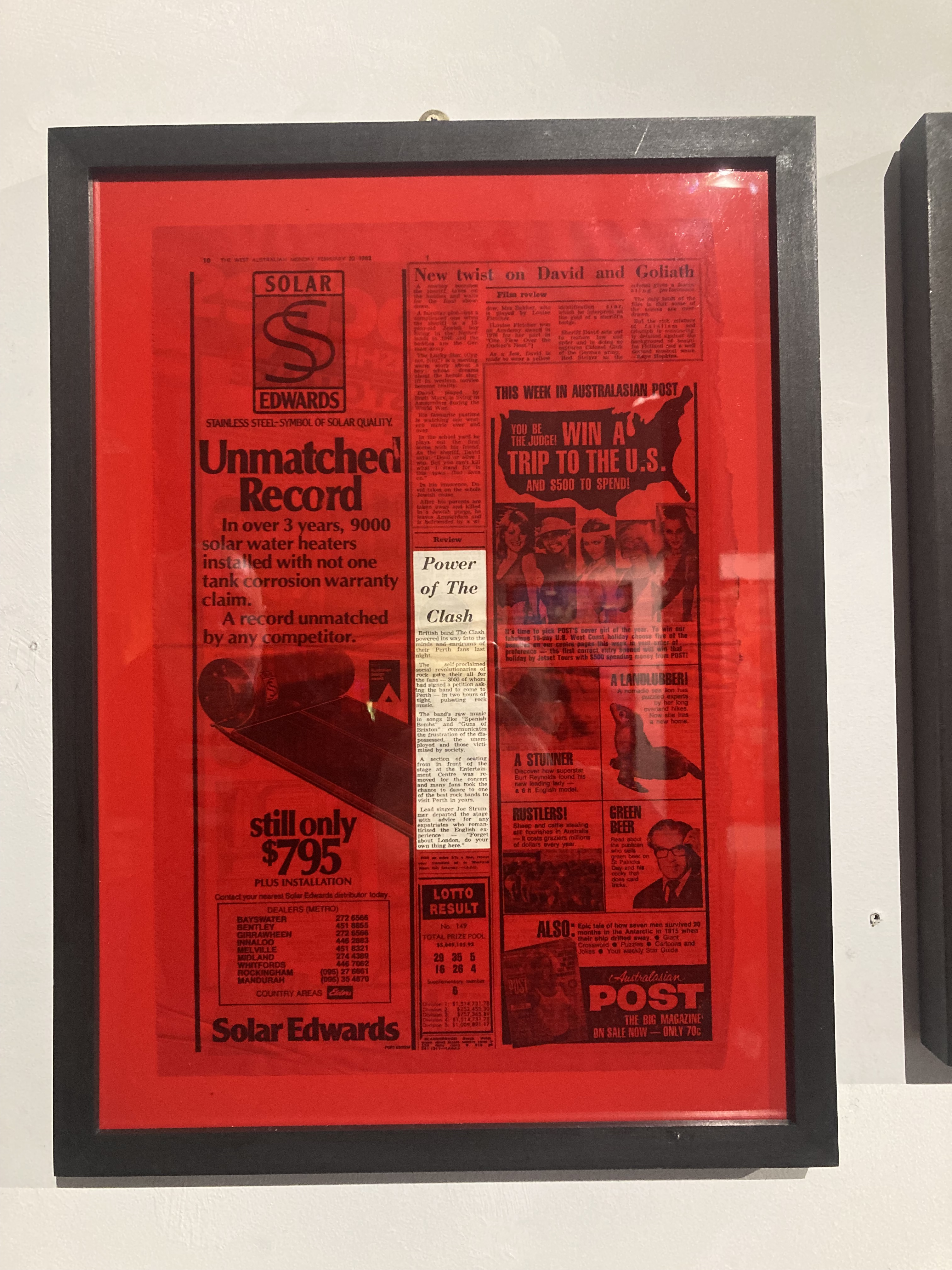
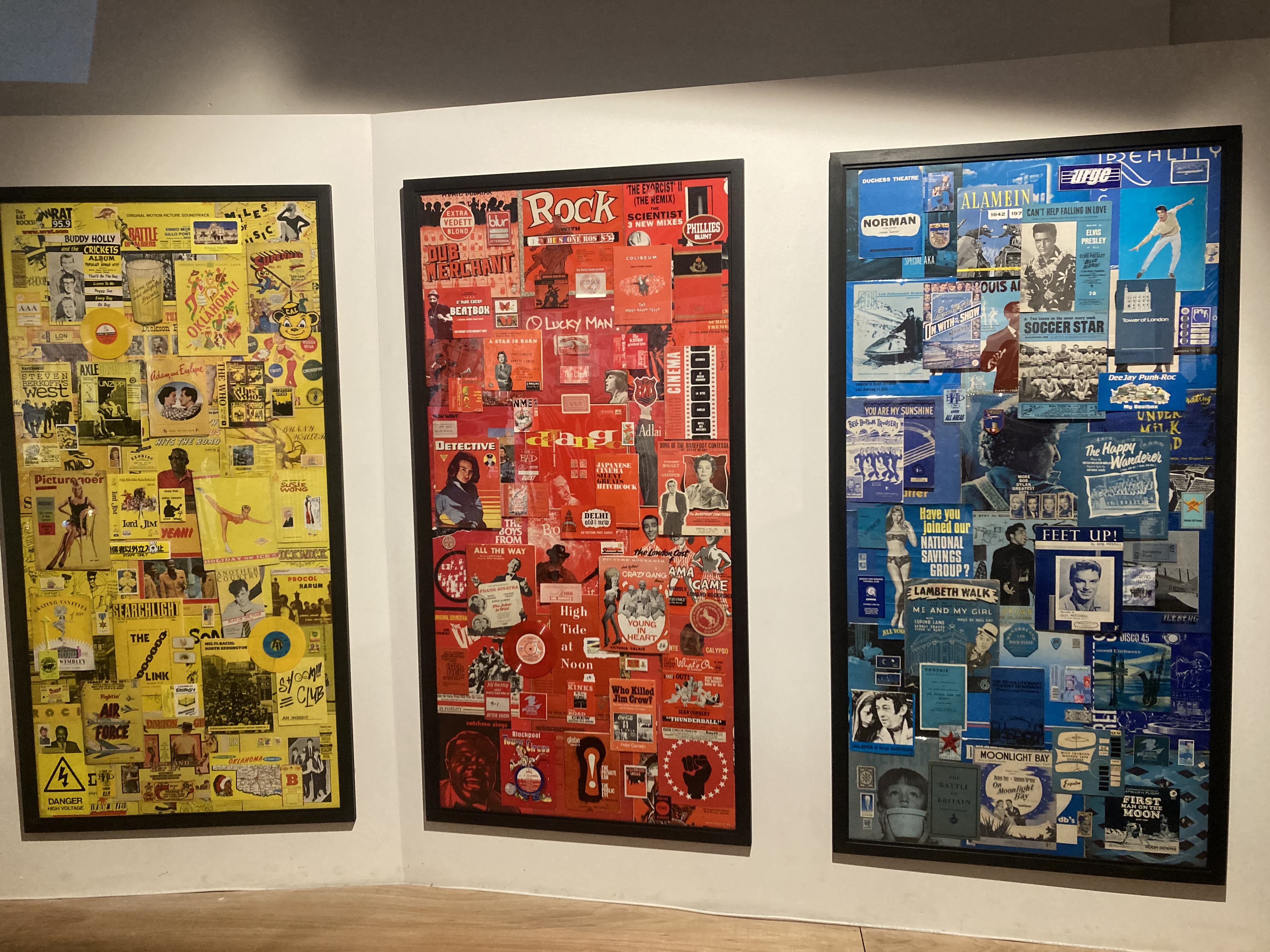
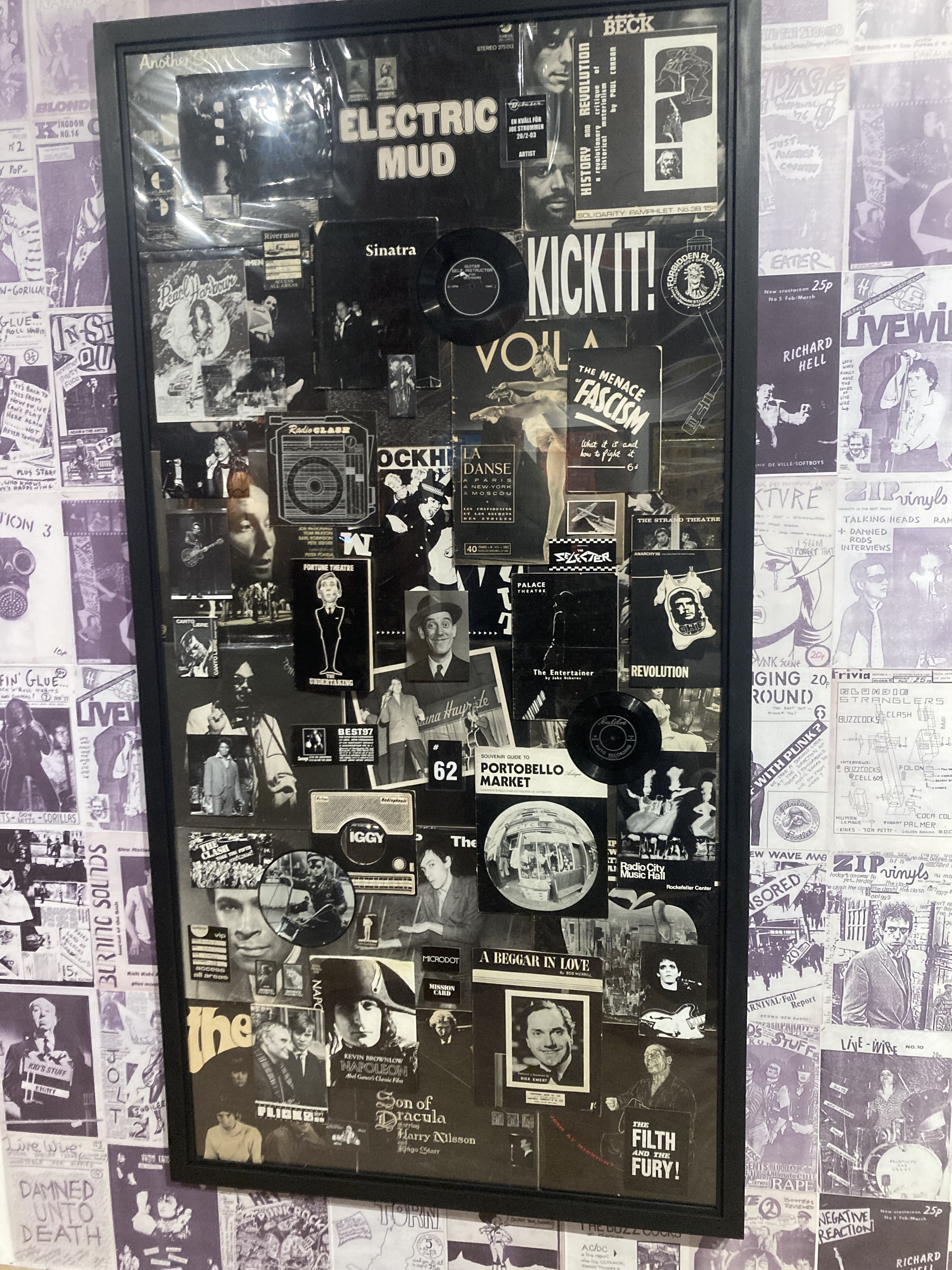
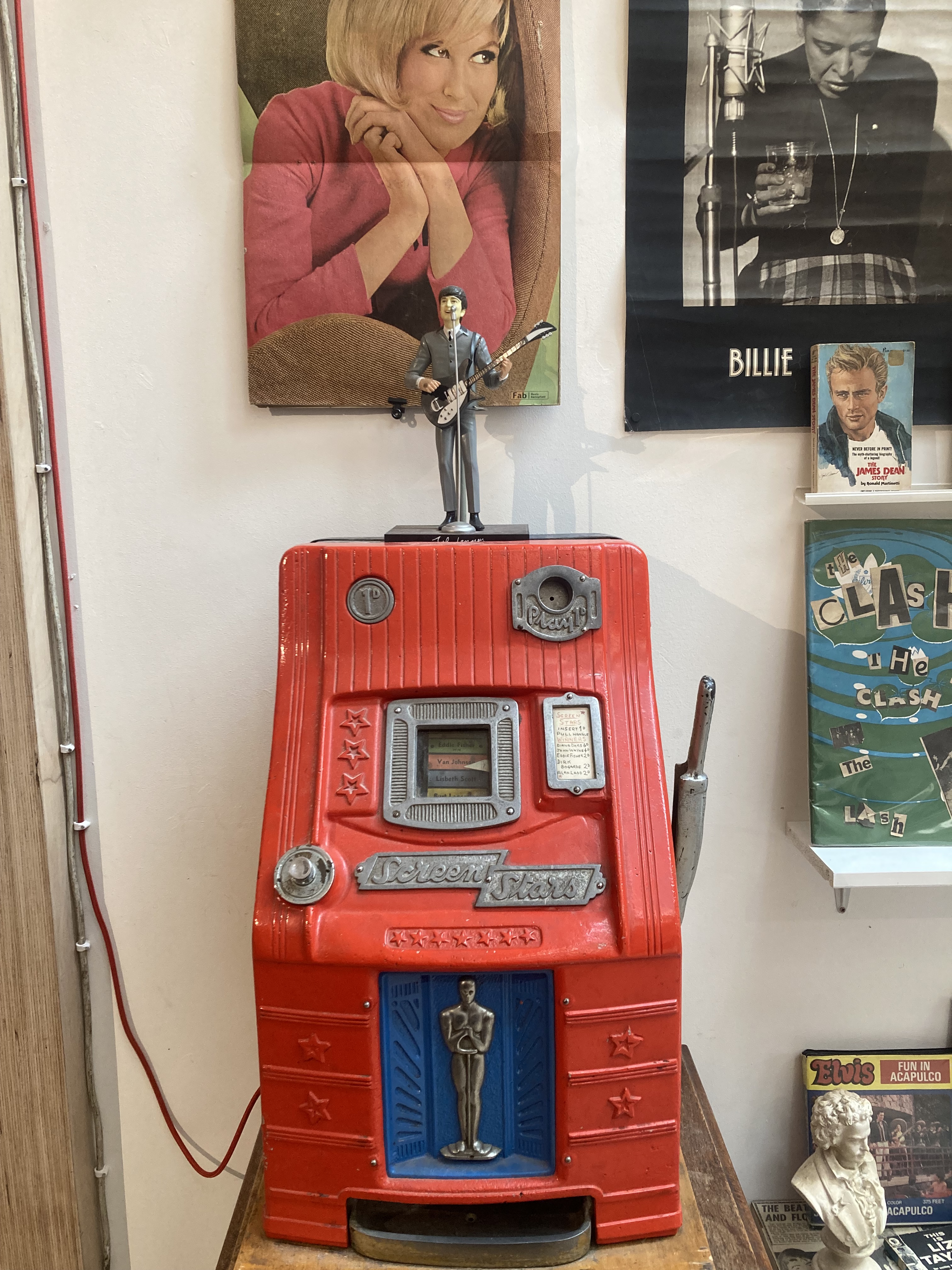
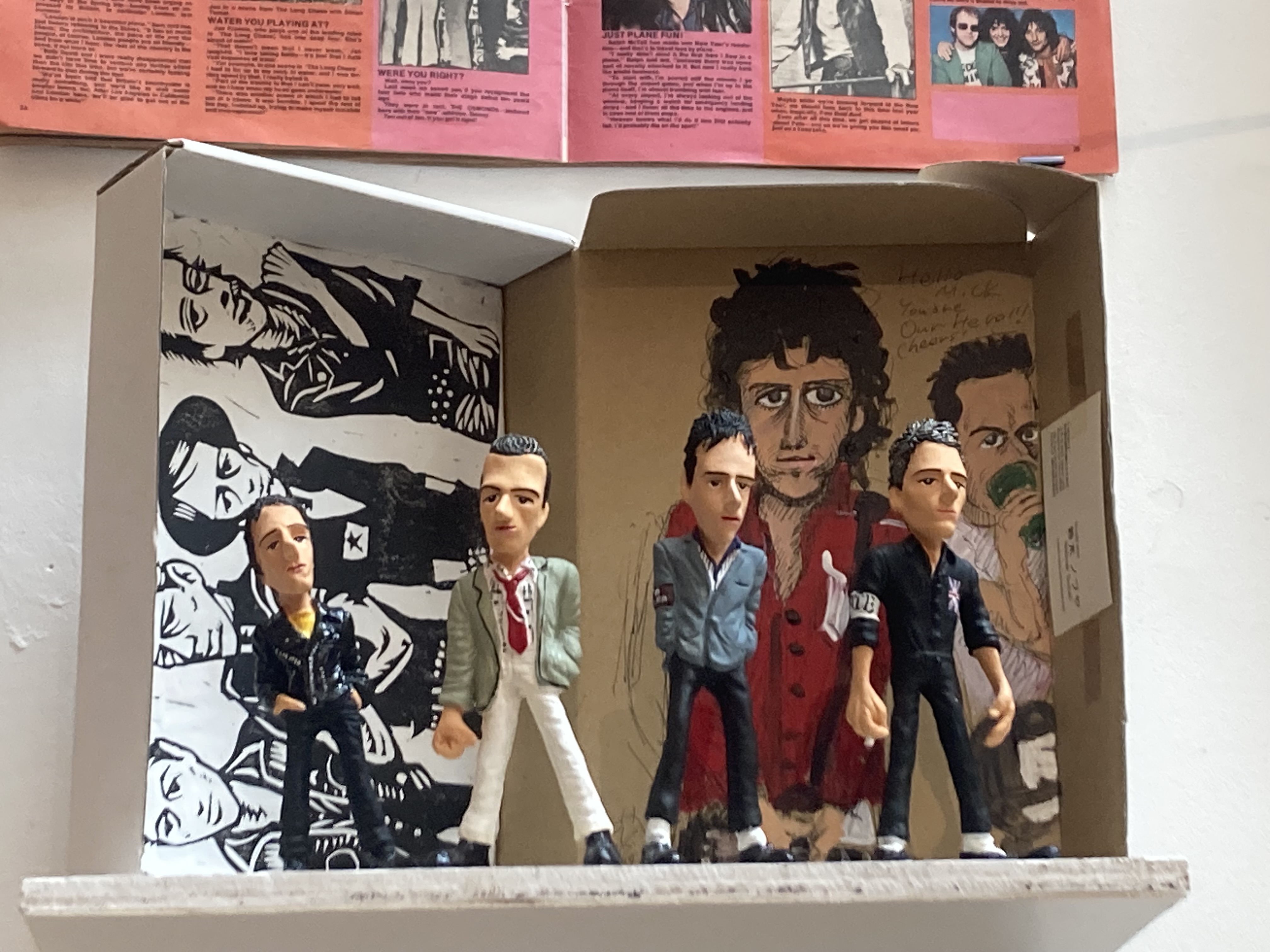
I am not usually the type of person who can summon a quote off the top of their head but one came to mind as I looked around the Rock And Roll Public Library in St Giles. This is a collection of pop culture and ephemera accumulated by Mick Jones – of The Clash and Big Audio Dynamite – and it’s gloriously random nature reminds me of something I once read about collecting: “The most important item in any collection is always the next one”.
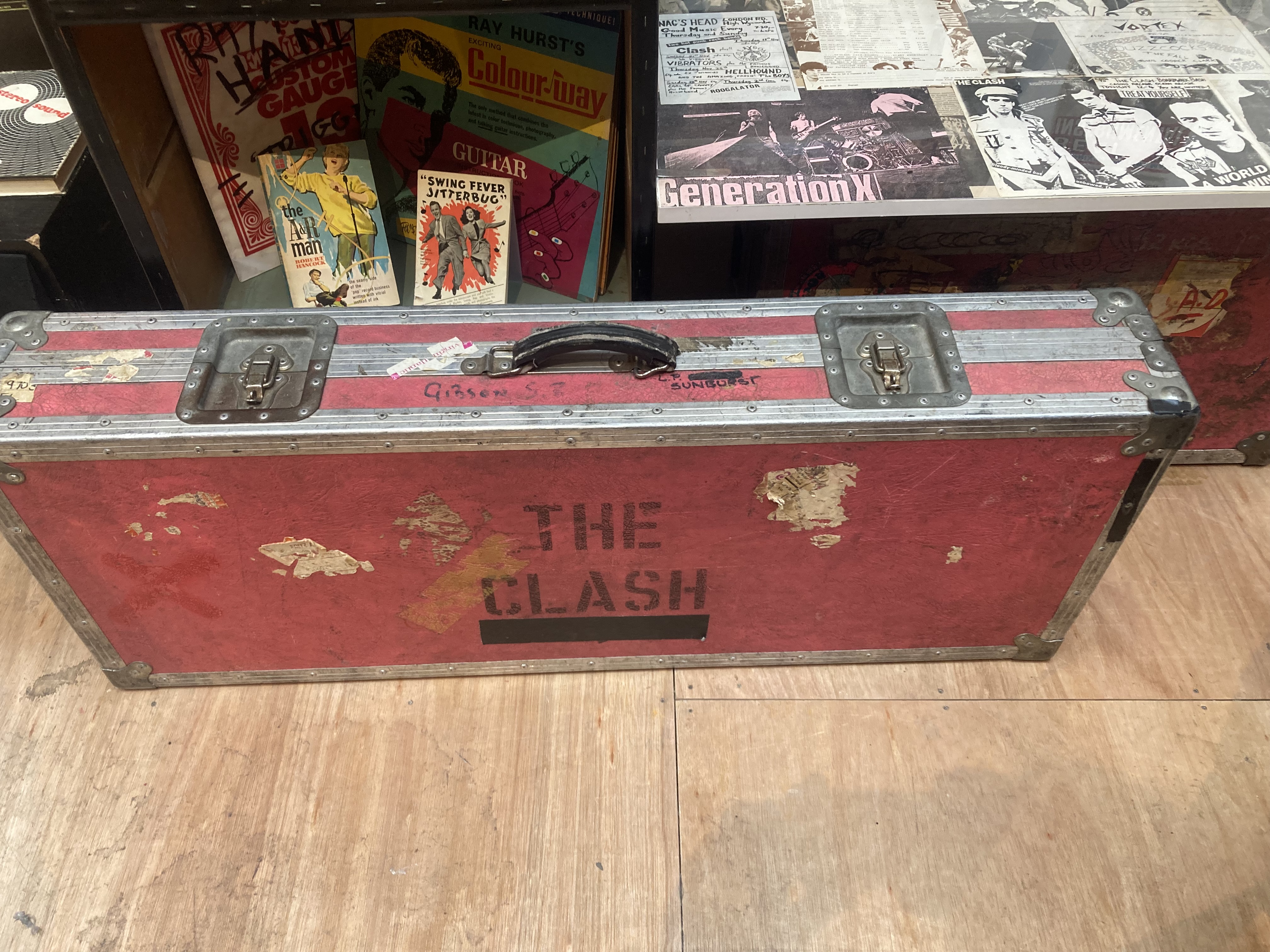
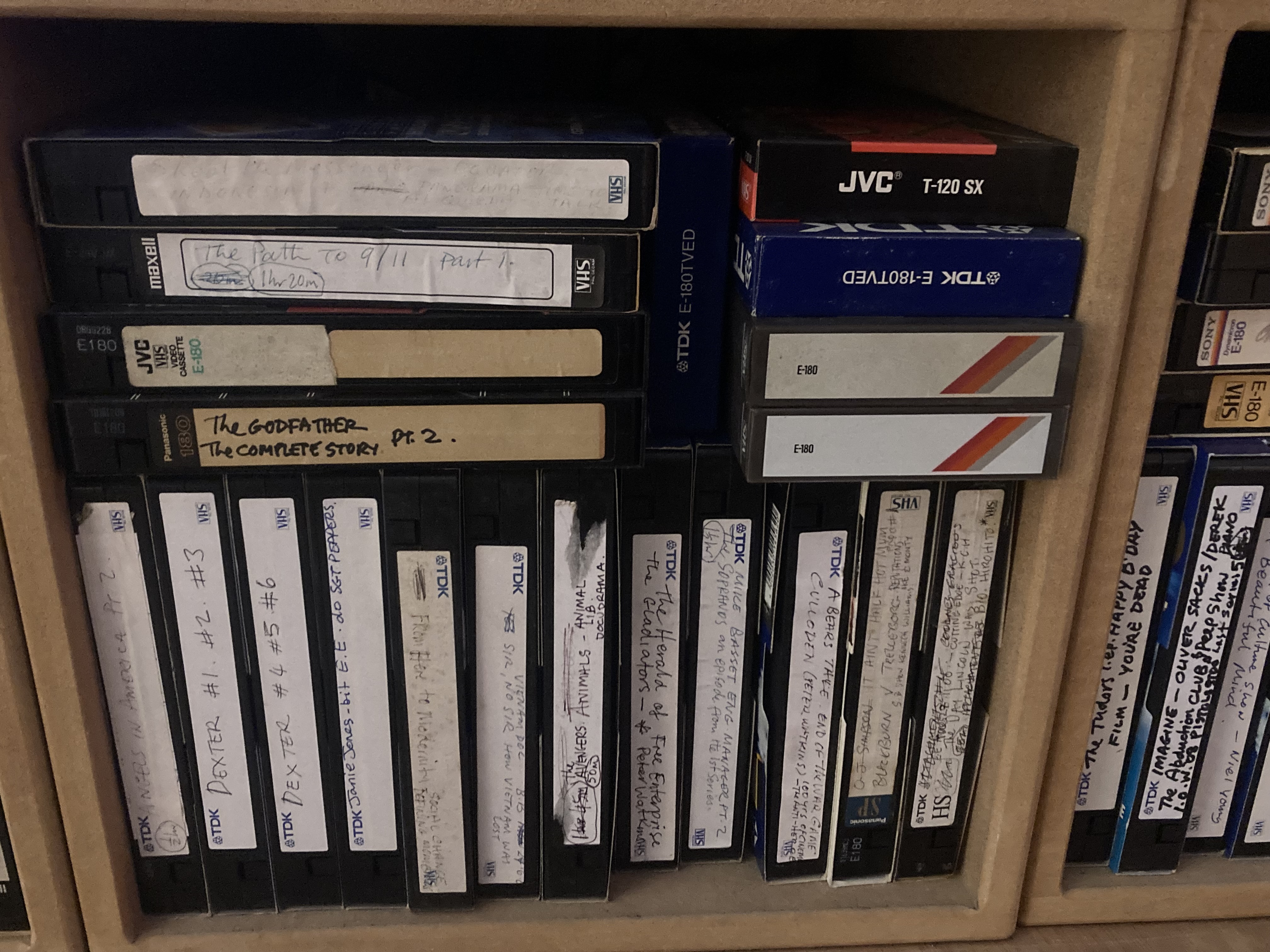
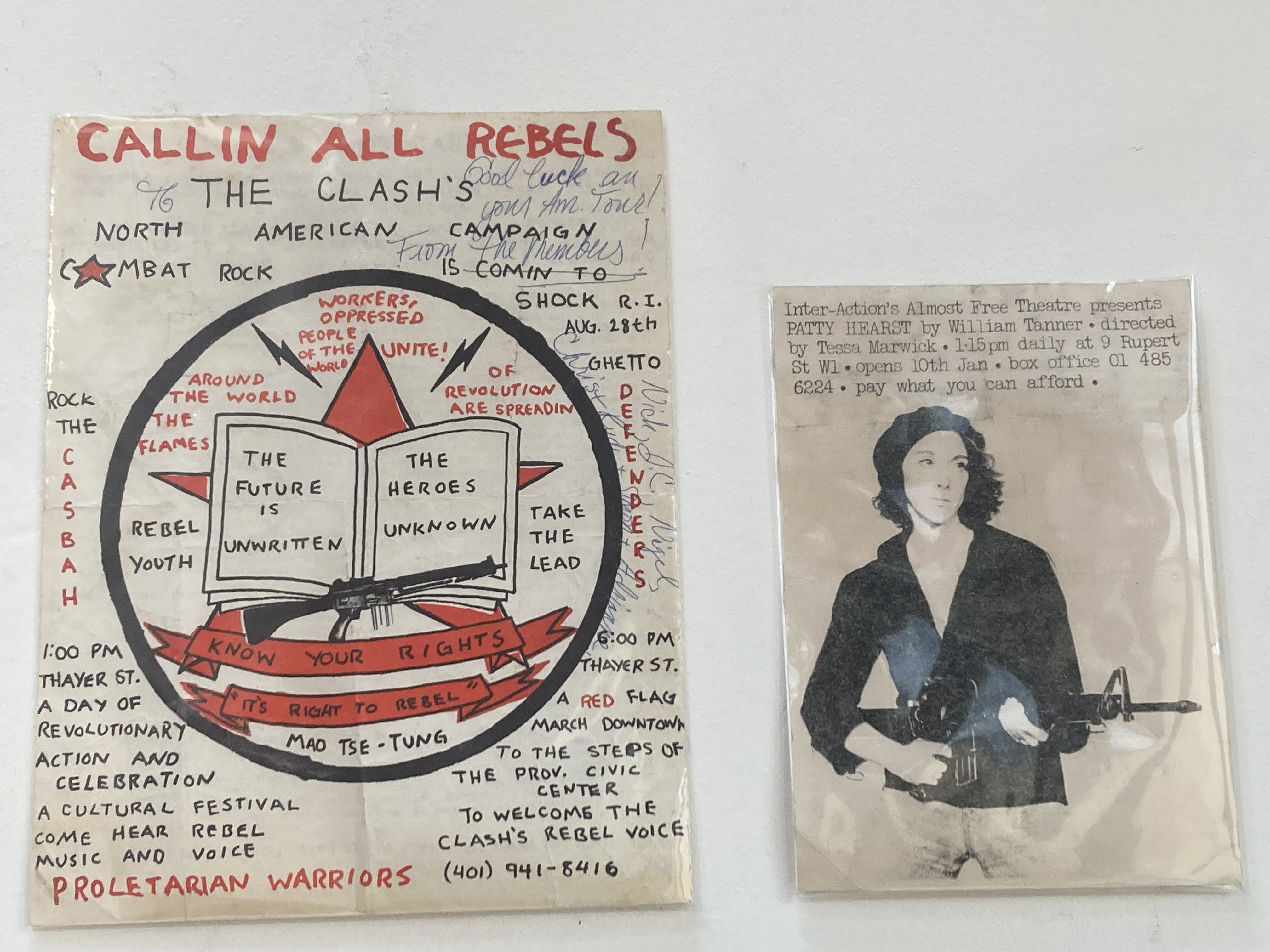
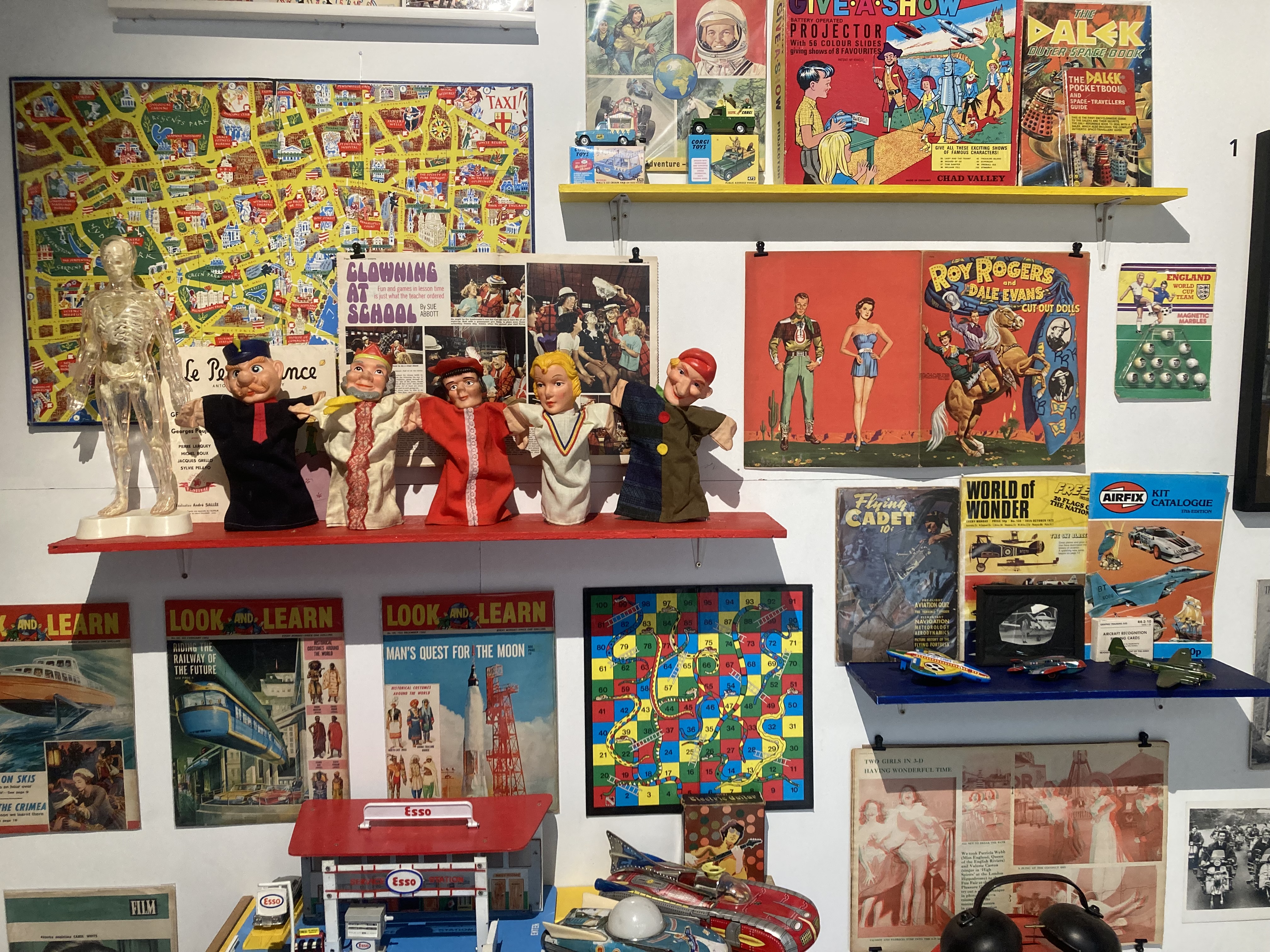
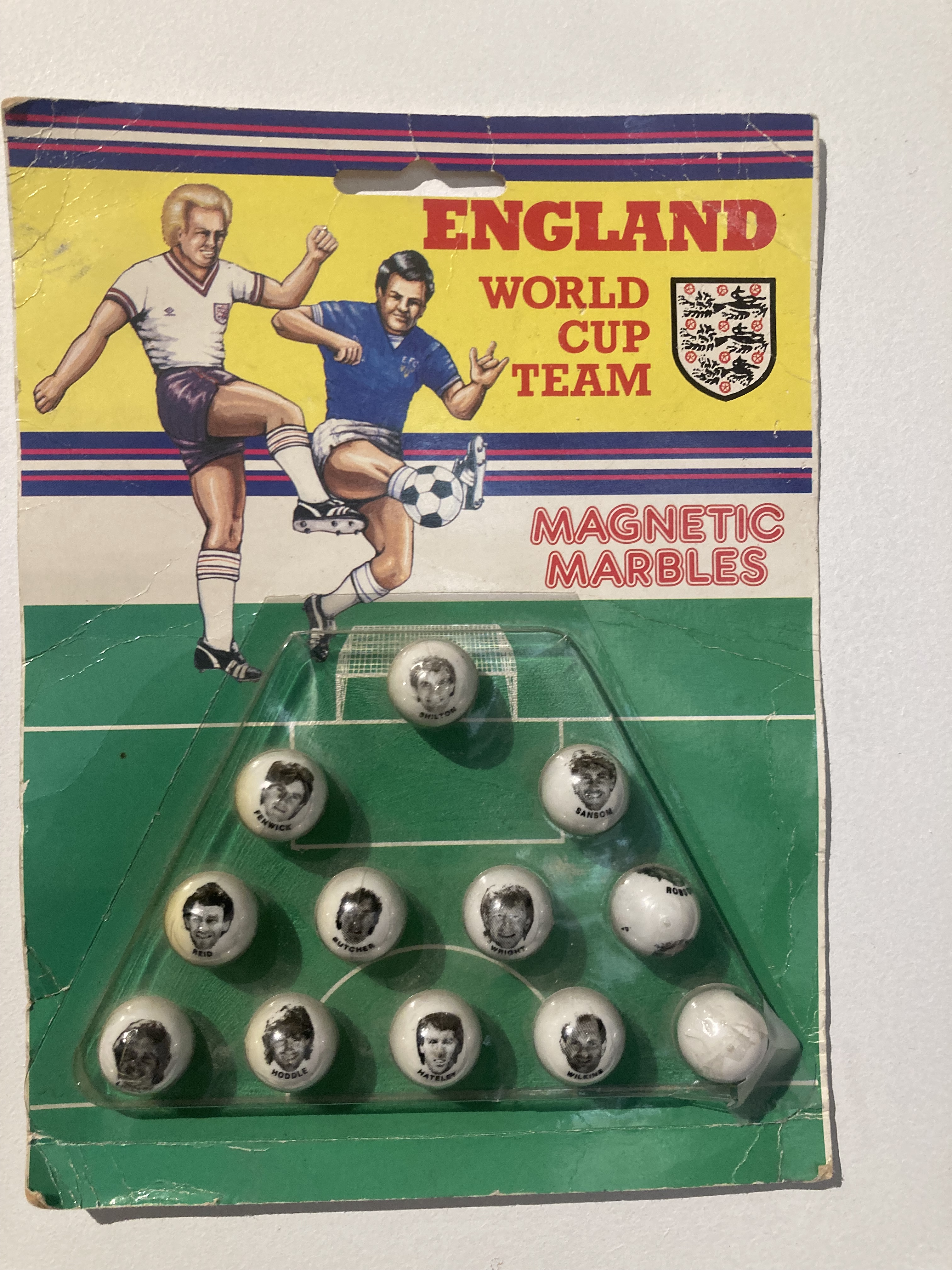
The Rock And Roll Public Library includes all manner of Clash and BAD-related material: lyrics, tapes, costumes, instruments, props etc. But it also includes loads of stuff. Comics, VHS tapes, posters, flyers, toys, board games – the sort of ephemera that collectively explains how we become ourselves, how we develop our areas of interest and points of references, our personal passions or things that, for some reason, struck a chord at a particular moment in our lives.
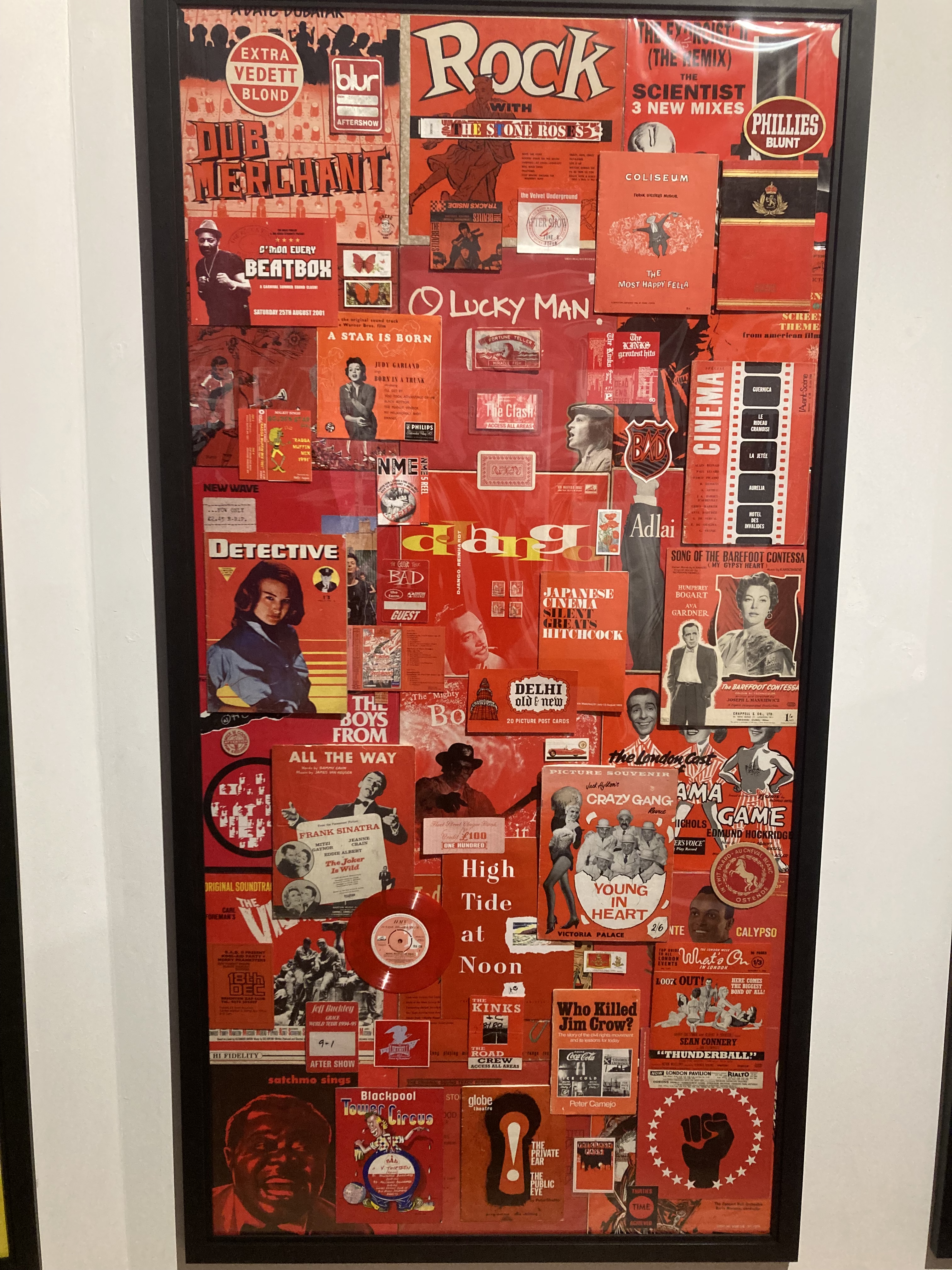
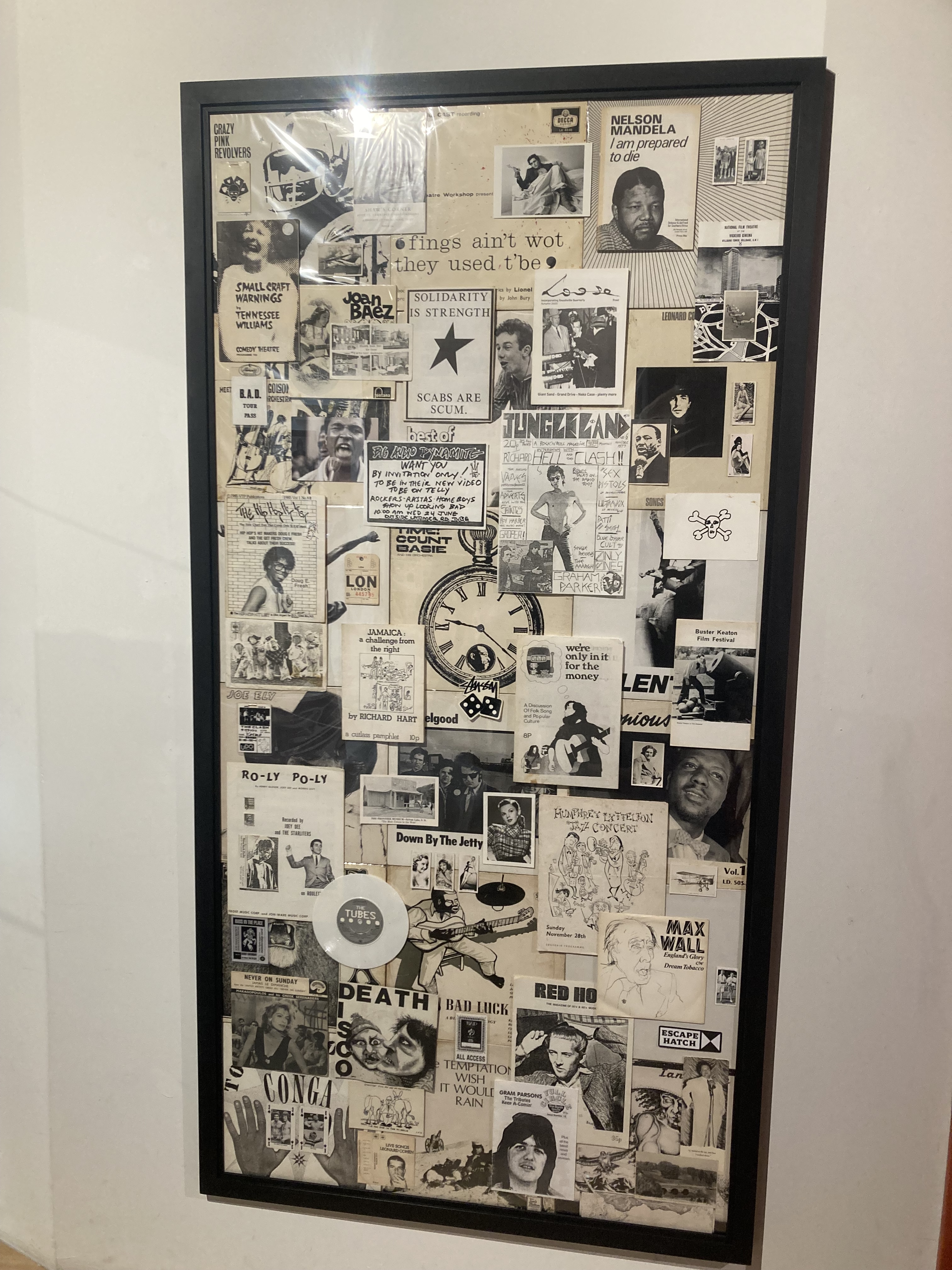
I particularly liked the colour-coordinated montages of otherwise unconnected items. There were also areas set up to look like Jones’s childhood home, and areas that focused on specific themes – Americana, Elvis and WWII for instances – showing how these influenced his musical approach both in the Clash and BAD.
I’m told that this this exhibition constitutes less than half-a-percent of the objects that Jones has collected – and continues to collect. The exhibition at the Farsight Gallery on Flitcroft Street – comes with a fantastic hardback magazine about the collection, the first of three planned issues that will come out during the year.
It’s open daily 12-7pm and entry is free. Get there before it closes on March 16 – although there are rumours of an extension.
I have a talk coming up with the Sohemian Society on Thursday December 5, where I will be in conversation with writer and musician Max Décharné about Denmark Street: London’s Street Of Sound. The event will be held upstairs at the Wheatsheaf pub on Rathbone Place in Fitzrovia – tickets can be purchased here.
The Sohemian Society was founded in 2003 to celebrate Soho Bohemia and is organised by the cream of London nerdery, with input from the likes of Travis Elborough, John King and Paul Willetts – authors and speakers of great repute in the London-obsessed world.
I am really looking forward to talking to Max, who has written brilliant books about the Kings Road and Teddy Boys. Max is a musician with Gallon Drunk and Flaming Stars, so will have plenty of first-hand memories of Denmark Street from his career. The talk is at the Wheatsheaf, one of the classic London pubs and a short stroll across Oxford Street to Denmark Street itself.
It should be a great evening. Please do come along and say hello.
I have three events coming up in the next four weeks.
On Monday October 23, I will be talking to counterculture guru Carl Williams about the LSD Library. This is a free event organised by TANK magazine at their base on Great Portland Street but tickets must be booked. The LSD Library was the incredible collection put together by Julio Santo Domingo that contained thousands of books and items related to drugs, sex, magic, alternative politics and rock n roll. It is the subject of my book, Altered States.
On Thursday November 23, I will be at the Horse Hospital to talk about music in London for the London Salon. I will talk about some of London’s lost venues, focusing on those around Soho and Covent Garden within walking distance of Denmark Street.
On Thursday November 30, I will be at Battersea Bookshop at Battersea Power Station to talk about Denmark Street. Tickets aren’t available for that yet, but should be soon.
When I started working at Time Out in 1998, I was young but by no means a greenhorn having already done five years at the Sunday Times, where I encountered formidable figures such as Hugh McIlvenny, Steve Jones, Nick Pitt and Chris Lightbown, my own personal mentor. But the journalists at a Time Out where a different breed. They were all very smart, incredibly knowledgeable about their particular field and not shy of letting you know it.
One of the most prominent was Paul Burston, whose desk was just across the aisle from the sports section where I first worked as holiday cover for editor Andrew Shields. For a start, Paul was physically striking. Not quite a gym bunny but certainly more muscular and compact than any of the other scrawny hacks at Time Out who looked as if they barely saw daylight and subsisted entirely on a diet of cigarettes and cheap spirits. Paul spoke in a loud voice with a soft Welsh accent. He would get to his desk some time before midday, and immediately start fielding a seemingly endless torrent of phone calls, exchanging gossip, rumours, ideas and anecdotes with a string of friends.
These conversations were peppered with language that I’d never previously heard outside the playground – queer, dyke, poof. I didn’t know where to look. I soon worked out that Paul edited the Gay section and had been at Time Out for a while, forging a relationship as a journalist who was outspoken against homophobia and fought for gay rights but could be very critical of gay politics and lifestyle if he felt it necessary. I’d never really encountered such an outspoken and confident out gay man before – there were very few gay journalist at the Sunday Times and none, openly at least, in the sports department – nor was I particularly familiar with the gay world of London, despite having gone to Popstarz a few times.
One of my strongest memories of Paul was his sheer fury on the evening of the Admiral Duncan bombing, as he took phone calls about the unfolding horror before going into Soho to see what was going on.
We remained colleagues until I left Time Out in 2010, but I only really got an inkling of Paul’s background when I read an account of his life as an AIDS campaigner that he wrote in Time Out‘s 40th anniversary book, London Calling, in 2008. Now Paul has brought out a memoir – We Can Be Heroes – which covers his life in more detail, which includes striking reminiscences of gay life in London in the 1980s, partying hard while campaigning under the constant shade of AIDS and homophobia. It’s a great book that I recommend heartily for anybody interested in London subcultures and activist politics.
As I read We Can Be Heroes, I realised that while Paul was experiencing the trauma of seeing his friends die of AIDS I was still at secondary school laughing at jokes about the disease. On Facebook, my school’s old boy page was recently hijacked by a number of men recounting the frankly horrific physical abuse they endured at the hands of staff, including pupils from my own time at school who were caned, slapped, strangled and thrown against walls by out-of-control teachers.
I was never physically attacked by teachers but verbal abuse was common. Chief among this was homophobia. There was not a single out gay boy in our school of 800 – because how could any child admit to being gay during the era of Clause 28, when rugby teachers would call anybody who disliked physical violence “a Mary-Anne” and RE teachers told us that homosexuals would go to hell. As a result, in the playground gay insults were the major currency – poof, queer, bum bandit, bender and jokes about AIDS. It’s hard to imagine how this could have been endured by any of the gay boys in the school.
It came as a little surprise when my old school was drawn into controversy recently when the current school chaplain – a man who I realised had been in the same year as me at school and therefore exposed to the same environment of endless, normalised and officially sanctioned homophobia – was accused of banning a gay author from giving a talk to pupils. As Paul’s book shows, we’ve come an awful long way, but there’s still a long way to go.
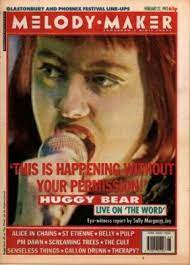
I have a piece about 90s Riot Grrrl band Huggy Bear in the latest Uncut to mark the 30th anniversary of their single, “Her Jazz”. Here’s Huggy Bear performing the song on The Word. Apparently you can see three members of their labelmates Cornershop in the crowd. It’s a thrilling performance and I remember watching it at the time, impressed and slightly scared.
Although I was not a huge Huggy Bear fan – frankly, they intimidated me – I couldn’t miss the fact that in the music press, Huggy Bear got a tough time in a manner that seemed completely out-of-proportion to their actual size. NME and Melody Maker were known for their snark, but the usual targets were the self-important big stars – Bono, Sting, Morrissey – or the current flavour-of-the-month, such as Suede or Manic Street Preachers (a band that have some interesting similarities with Huggy Bear). But for the latter, the nastiness was usually balanced by regular cover features, positive reviews, news pieces and a general boosting of the latest indie hero.
With Huggy Bear – a small band on an indie label whose fan base barely filled a couple of pubs in north London – it seemed like it was all snark. The vitriol was relentless; Huggy Bear were the eternal punchline.
Talking to the band – mostly via email as even after 30 years they were still reluctant to trust a journalist so wanted to retain control of their words – it was clear they’d had experience this as, in one member’s word, “spiteful bullying”. And it wasn’t just the press. Other bands refused to sign to the same label as them, or created such hostility they couldn’t drink in the usual indie haunts in Camden. Some of their peers even went to gigs just to heckle. It was vicious.
What was everybody’s problem? It wasn’t Huggy Bear’s music, it was their politics – and more to the point – the sheer conviction with which they held their views. Huggy Bear believed in the underground community of fanzine culture and DIY gigs, and they believed in – and passionately espoused – gender and sexual equality. They were fierce feminists and that scared the boys. It still does. To care so much was unforgivable in the early 90s, as the affected ennui of Generation X was about to give way to the destructive irony of Britpop and Loaded – an irony, of course, that heavily favoured the views of white men.
After that performance on The Word, there was an interview with a pair of identical twins who modelled for Playboy and proudly declared they were “bimbos”. Huggy Bear and their friends in the crowd heckled, while guest Henry Rollins and presenter Terry Christian smirked awkwardly. Terry Christian is a good guy with sound views but he couldn’t handle being upstaged – on The Word for chrisake, which was explicitly created to manufacture controversy – and had them all thrown out. That earned Huggy Bear an appearance on the cover of Melody Maker. It was not The Word‘s finest hour.
Back then, Huggy Bear were sneered at for being “right on” and “politically correct”, even in the ostensibly left-leaning NME, which regularly carried a column by comedian Simon Munnery based on his Alan Parker, Urban Warrior character, which targeted this tiny but easy-to-mock demographic. Ironically, this terrible column was far more humourless than Huggy Bear themselves, whose songs brim with wit as well as fire and compassion.
These days, that terrible lazy “W” word would be deployed to diminish their opinions.
It must be annoying for them to know that Huggy Bear were right. About pretty much everything.
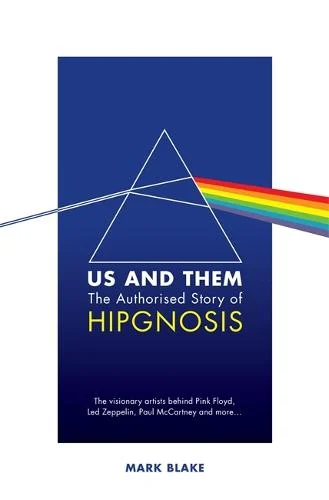
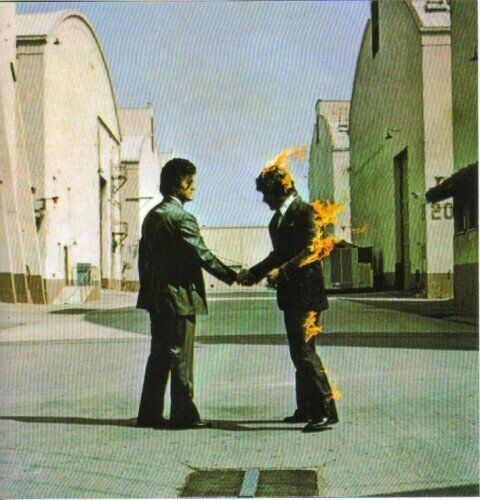
As with the Mona Lisa, I’ve no idea when I first saw the cover of Dark Side Of The Moon, so ubiquitous is its presence in popular culture. The Floyd prism is one of the most recognisable record sleeves in the world and was the work of designers Hipgnosis, who are now the subject of a new book, Us And Them by Mark Blake. I’ve written about Hipgnosis before – in a feature for Uncut, in my book on Battersea Power Station, and in my next book too, a forthcoming musical history of Denmark Street as Hipgnosis’s office was at No 6, a space they shared with the Sex Pistols.
One of the reasons the Hipgnosis story is so interesting is that the company – founded by Floyd associate Storm Thorgersen and Aubrey Powell – came from exactly the same 60s scene as the bands they worked with. They loved rock and roll and Beat poetry, went to the UFO and the Technicolour Dream, watched the Beatles change music and saw first-hand as their friends in Floyd developed from a blues band into a psychedelic all-conquering world-making powerhouse. They were flatmates with Syd Barrett, took drugs, dated models and had huge ambitions – so when Paul McCartney wanted to take a photo of an Egyptian statue on top of a mountain for a Wings compilation, that’s exactly what they did, flying to Switzerland and hiring a helicopter rather than simply mock it all up in the studio – even if the final cover did actually look like a studio mock-up.
You can’t get them all right.
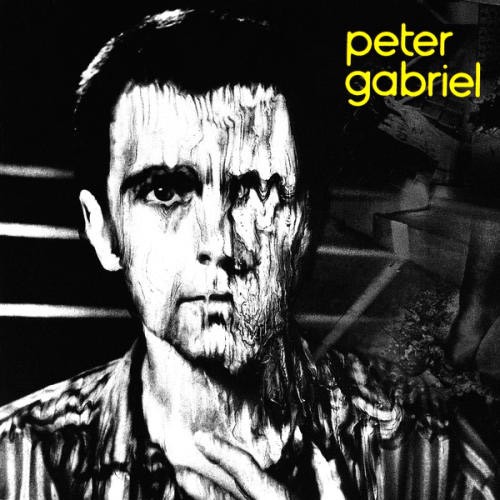
That thinking is what led to so many memorable covers from Presence to Ummagumma, including Led Zeppelin’s Houses Of The Holy – which I write about in more detail in my Led Zeppelin cover story for this month’s Uncut. It also meant rock stars enjoyed the process, particularly the likes of 10cc and Peter Gabriel, who really embraced the debate about art and commerce and meaning and surrealism. Not everybody was happy. Storm was a difficult customer and fell out with several of his clients, including heavy-hitters like the McCartneys, Zep manager Peter Grant and Roger Waters. But all of them kept coming back to Hipgnosis because they knew they had the best ideas and the chutzpah to carry them out.
Like all great bands – Floyd especially – the key figures in this story had an epic falling out. When I interviewed Suede in 2015, Mat Osman took a moment to reflect on his band’s journey: “I always thought we had such an interesting story – what we’d done was so different,” he said. “But then I looked at the shape of the story and it was every band ever: hard work, success, hubris, drugs, fights, coming back together a bit wiser. It’s been done a million times, it’s almost Shakespearean, but every generation has to go through it.”
The Hipgnosis story has exactly this shape, and it is one that naturally lends itself to biography. The 70s yarns are all well told but Blake’s book is particularly helpful in exploring Storm and Po’s origins in the Cambridge/London counterculture, as well as extending the gaze beyond the Hipgnosis era and looking at what happened when they stepped away from cover art and began to make pop videos and adverts in the 1980s. He also diligently explores their eventually falling out and reconciliation. Storm died in 2013 but Powell continues to work with Pink Floyd – he designed the new cover for the remixed Animals – and is surely one of the only human beings who has the confidence of both Roger Waters and Dave Gilmour.
Us And Them: The Authorised Story Of Hipgnosis by Mark Blake.
Performance is probably the greatest London film of all time. When this strange and unsettling fusion of counterculture and crime was finally released in 1970, it was accompanied by a novelisation – a cheap paperback by William Hughes published by Tandem – that I chanced upon last week behind the counter in the fabulous Bookmongers on Coldharbour Lane. I love novelisations, so this was a no brainer.
Although I’ve read a few books about Performance – the best is Paul Buck’s 2012 biography of the film published by Omnibus, which frustratingly lacks an index – I’m not sure I was aware there had been a novelisation. There’s a short review here, but there’s little about William Hughes on the internet, although his name does crop up on Abe Book alongside some other novelisations of the era – 1968’s Secret Ceremony, 1971’s Lust For A Vampire, 1974’s The Marseille Contract, 1976’s Aces High and 1978’s Death Sport among others. A follower on Twitter suggested his real name was Hugh Williams.
UPDATE Head to the comments for a great twist on the “who was William Hughes” question…
It didn’t cost 9p
What particularly appealed was the knowledge that novelisations are often written from early drafts of scripts, which means there are interesting differences between the plots as told in the books and what you get in the finished films. I was very keen to see how Performance the book differed from Cammell and Roeg’s final film, and also curious at how the author would tackle some of the stranger moments from the film, including the famous ending. Incidentally, apparently the film’s dialogue coach and underworld/counterculture figure David Litvinoff wanted to write it, but was declined.
The book is, as you’d probably expect, a lot more conventional than the film – but that isn’t saying a great deal, as most things are more conventional than Performance. William Hughes is a decent writer who has a great sense of pace and solid grasp of genre, so he is pretty assured when dealing with the first half of the story – about the gangster Chas who oversteps the mark and has to do a runner. This all unfolds at great speed, but we are also treated to some insights into Chas’s background, motivations and general sense of unease at his chosen career as a heavy. We learn that Chas lives in a “luxury flat in predominantly working class” Shepherds Bush, and his activities take him to various parts of London including Campden (sic) Town, where he terrorises a mini cab firm, Mayfair, Liecester Square (sic) and the Temple, where a lawyer’s chauffer is shaved while his Rolls-Royce is covered in acid.
In the film, things get much weirder when the action moves to the home of a reclusive rock star in West London – in the film this is located at Powis Square but here it’s named as 22 Melbury Terrace, “behind Notting Hill Tube”. Hughes handles that transition fairly well and there’s a sense of Chas’s discomfort as he encounters Turner and his two female friends, Pherber and Lucy. But while in the film this relationship becomes relationship increasingly complex and sinister, the book – presumably following the initial script – has the two worlds quickly come to an understanding. They develop a sense of mutual respect and it all feels far more comfortable than it does on film. There’s also much less sex. Or as one Twitter user put it..
Just like the film, apart from the psychedelics, identity swaps, Borges riffs, and Litvinoff gangster dialogue. pic.twitter.com/XYW4T555j5
What that suggests is how ordinary a film Performance could have been without Cammell’s influence and without the performances of Edward Fox and Mick Jagger, whose uneasy sparring is one of the signature flavours of the film. Plot-wise, the most notable difference is right at the end, but there are other more subtle plot differences that affect the mood – for instance, at one point in the book we go into the garden at Powis Square/Melbury Terrace, while there’s also a pivotal, and topical, drug bust that never made it into the final film. Both these scenes would have diluted the claustrophobic, hallucinogenic nature of the second section of the film, which has one of the most peculiar atmospheres of any film by a major studio thanks, it seems, to the way Cammell and Anita Pallenberg manipulated Fox and Jagger. Oh, and the book also omits one of the greatest lines in the film: “Comical little geezer. You’ll look funny when you’re fifty.”
These aren’t the only differences. Chas runs to Powis Square/Melbury Terrace because he murders a rival, Joey Maddocks, bringing down unwanted heat on the mob led by Harry Flowers. In the film, there are strong suggestions that Chas and Joey were former lovers and that Chas’s repressed homosexuality is part of the “performance” but in the book this relationship is made explicit. By contrast, Flower’s own homosexuality, alluded to on film, makes no appearance in the book.
Being trivial, I also enjoyed some of the moments of trivia. We learn the name of Turner’s band – Turner And The Spinals, or Turner And The Spinal Cords – and the fact they scored seven No 1s and three No 2s. In fact, “not one of his singles ever missed the charts. Up until the end, I mean”, says his still faithful housekeeper. It turns out that Turner was such a star he shook the Queen’s hand at a film premiere. At one point, Chas even hums one of his hits.
“Of all the crap I ever perpetuated, that was the vilest, man,” says Turner.
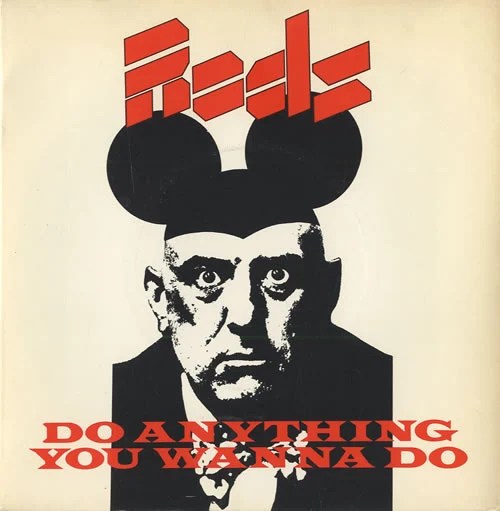
Several years ago, I commissioned a writer at Time Out to go and explore what we then described as one of occultist and writer Aleister Crowley’s few remaining London homes – an apartment at 73 Chancery Lane, that was about to be turned into offices. In these rooms, Crowley had set up a temple for his magical friends, the Order of the Golden Dawn, and our writer made a valiant attempt at conjuring up a spooky atmosphere from what was probably a rather forgettable set of empty rooms. He even quoted a builder working on the site who claimed to have discovered a human skull and pentangle formed from sticks.
Time Out article on Crowley’s temple, Jan 18 2006
This seemed an entertaining and fairly useful thing to do because even though London is replete with memorials and blue plaques to long-forgotten politicians and music hall artists, there are no blue plaques for Aleister Crowley. London has a plaque for the dog that inspired the HMV logo, but even today, the one-time “wickedest man alive” is beyond the pale for the heritage industry despite his decent literary output and outsized influence on popular culture. (I have written about one such story here.)
Phil Baker’s fabulous new book, City Of The Beast, corrects that oversight. This is a biography of Crowley told through London locations – 93 in all, a number with magical significance for Crowley’s Thelamic religion. Baker, whose biography of artist and occultist Austin Osman Spare is a minor classic, began the book as a lockdown project, listing London places associated with Crowley as something to do to pass the time and stop worrying about the end of the world. He’d soon listed dozens of Crowley homes thanks to Crowley’s inability to settle anywhere for long. That residence at Chancery Lane is mentioned, along with numerous apartments around Piccadilly plus others in Chelsea and Fitzrovia. At times, Crowley resided in such unlikely spots as Streatham, Surbiton, Richmond and Paddington, sometimes living for only weeks, fleeing in advance of creditors as his circumstances declined. It’s likely that most of us will have walked past one or two of Crowley’s front doors and certainly visited the same shops or drank in the same pubs. London overlaps – that’s one of the reason we like blue plaques. As Baker notes at one point, Caxton Hall in Westminster, the site of a public performance of a Crowley rite in 1910, was also the location of “Churchill’s election speech; the assassination of Sr Michael O’Dwyer in revenge for the Amritsar Massacre; the founding of the National Front; and the wedding of Ringo Starr”.
This is more social history than psychogeography, thank goodness. Drawing from Crowley’s unpublished personal diaries, Baker presents Crowley’s rather sad progression through homes and temples as well as the museum, shops, restaurants, printers and courtrooms of Edwardian London. We follow Crowley’s dramatic, even thrilling rise and then a rather pathetic long decline, a petering out, as he hops, heroin-addicted, from home to home, desperately trying to maintain his image and reputation. That must have been awful for a man who once supped with giants – Augustus John, Anthony Powell, WB Yeats, Nina Hamnett, W Somerset Maugham, Auguste Rodin – and in the diaries, some of the frustration comes through. We also get to meet many other remarkable figures who are now largely forgotten such as Labour MP and Crowleyite Tom Diberg, Allen Bennett, who lived with Crowley at Chancery Lane and later became a leading proponent of Buddhism in England, and composer and occultist Peter Warlock, father of the great art critic Brian Sewell. A typical entry will introduce a character like JFC Fuller, a successful soldier who loved yoga the occultism and fascism, becoming one of only two Englishmen invited to Hitler’s 50th birthday parade.
Crowley’s magical and philosophical beliefs are explored in outline, as are his literary achievements, his impressive sexual exploits (these were carefully recorded as Crowley practised sex-magic) and, rather wonderfully, his recipes. Crowley loved to cook and enjoyed strong flavours: a Crowley recipe book could surely be created for the niche occult-gastronomic market, although it would take a brave soul to sample some of these recreations.
Baker presents Crowley as a man whose outlook was formed in the decadent 1890s, one who never really adapted to the changing world, his own age or the reduced circumstances that meant a gentleman without money could no longer shop at Fortnums and live on Jermyn Street and would, instead, have to spend some time in a bedsit near Praed Street drinking at the Royal Oak. He quotes Cyril Connolly’s observation that Crowley bridged “the gap between Oscar Wilde and Hitler”, and that’s a neat way of looking at Crowley both in terms of the age he occupied and the principles and philosophy he espoused. That makes this a very rewarding social history – a look at London in the first decades of the 20th century, still clinging to the veneer of Victoria, like Jeeves And Wooster with magic.
It’s ultimately a very human study of the man, stripping him of much of his mystic allure without making him seem ridiculous, which could easily be the case when dealing with figure who did as many ridiculous things as Crowley. It’s hard not to see Crowley as analogous to those pop stars of the 1960s who worshipped Crowley’s libertarianism and whiff of stage-conscious evil who are still living a priapic life with full heads of hair, clinging to those glory days. And frankly, who can blame them?
When I started freelancing at Time Out in 1998, originally on sport and then with the TV section, I often sat on the “Channel 5/cabsat desk” – the desk for the journalist appointed to review the best Channel 5 and cable & satellite programmes of the forthcoming week (yes, we were so flush we had reporters for each channel,, even C5).
The desk was close to the office photocopier, which was frequently used by a young-looking old man – I mean, he was at least 50 – invariably attired in jeans and a paisley shirt. This chap would engage me in conversation – not unusual in the friendly Time Out office I was beginning to realise – and he usually had an opinion on something I had reviewed. This was more surprising given I was only writing about Channel 5, was an infrequent freelancer and reviewers were identified only by their initials.
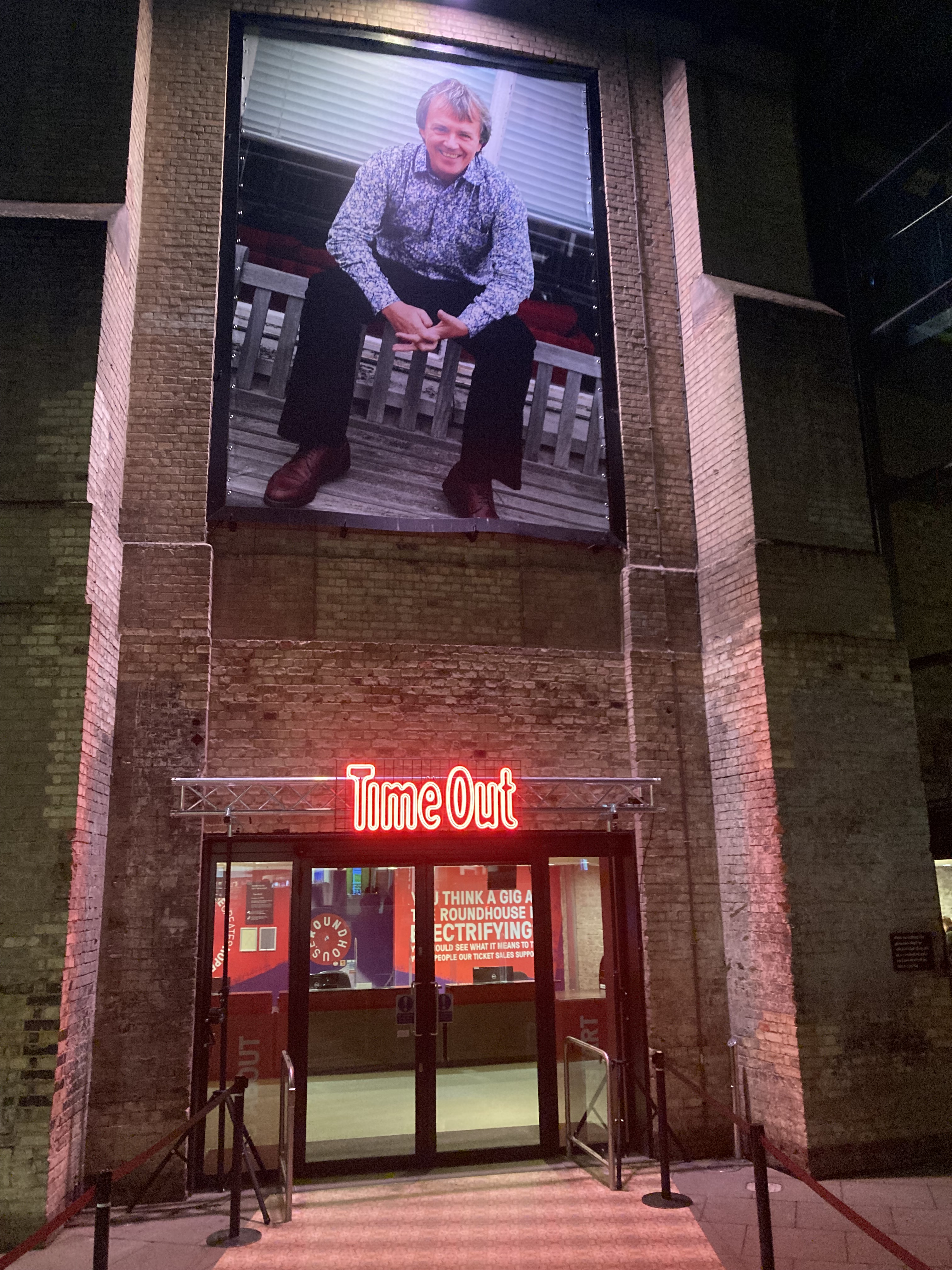
I’m not sure precisely when I worked out this was Tony Elliott, founder and owner of Time Out, but it’s safe to say that Tony knew who I was long before I recognised him. Tony seemed to read every single word – and remember each initialed byline – of every magazine and was then happy to discuss your review of Hitler’s Secret Pets, even when you had no idea who he was. Coming from The Sunday Times, where I’d never met the editor let alone the owner, it was a bit of a shock but I soon learnt to roll with it, and it helps explain why there was so much emotion and, yes, love in the room at the Roundhouse on Monday evening when 800 people attended Tony’s memorial service. We all had an experience like that, and it shaped who we were.
Tony died in July 2020 and the memorial event celebrated a wonderful life, kicking off with a speech from Alan Yentob and including reminiscences from significant figures in media and business as well as former colleagues and friends. Several talked about being part of the “Time Out family”, which seems a bit soppy when I write it down but which in that moment, surrounded by former colleagues – including those who had worked at Time Out longer before I started or long after I had left – it made a lot of sense. Others said that Time Out was the best place they had ever worked, the happiest time in their careers. That’s partly because we were young and excitable with unprecedented access to an entire city through our free travel cards and ability to get on any press list – but it’s also because of that welcoming spirit that came from the very top. Time Out wasn’t shangri-la but it had a culture that was intoxicating.
Right at the end of my Time Out career, when I was no longer such a happy member of the family, Tony sought me out to recommend I meet this guy, a bookseller, he knew. He kept on at me so much that eventually I acquiesced – something that ultimately led to one of the most fascinating projects of my career, writing a book about a billionaire who amassed the world’s largest private library devoted to altered states of consciousness. Tony wasn’t doing this with any particular outcome in mind, he just thought me and Carl would get along so went out of his way to make it happen. That was his gift and a microcosm of what he did with Time Out – opening up first London and then the world to as many people as wanted access to it. What you did after that was down to you.
After the Roundhouse, still reeling from all the old friends I had encountered, I was chatting to a lawyer who worked for Time Out during Tony’s long battle to democratise TV listings. This was discussed during the memorial service and the lawyer confirmed all the details in more colourful language. Basically, in the 1980s, the BBC published their listings in the Radio Times and ITV published theirs in TV Times. This was a cartel of information suppression that represented everything Time Out and Tony stood against. Time Out was all about opening things up, allowing Londoners to know about every nightclub or cafe or poetry reading or korfball match – the 24-hour city for everybody. TV listings was just another aspect of this philosophy.
Time Out won their battle but first they were given a unique opportunity – Time Out and Time Out alone could print complete TV listings, a privilege that would not be extended to other publications. For the lawyer, this was the best possible result. It would give Time Out a legal victory and a massive competitive advantage. He urged Tony to accept but Tony refused. He believed everybody deserved the same access. Within 18 months, the Guardian launched their own Time Out-style Guide based on their TV listings, and soon everybody was doing it. Time Out’s circulation began a slow decline.
Back in the early 2000s, some of us would, in idle moments, compare Tony to Richard Branson, another figure who emerged from the counterculture to create a business empire – and who delivered a nice video tribute at Tony’s memorial. But Tony Elliott’s empire was never anywhere near as powerful as Virgin something that we then saw as a flaw – Tony was basically a bit of a control freak who couldn’t move on. But now it’s pretty obvious that the flaw was simply one of principle. You could never imagine Branson making that same decision when it came to TV listings because he simply didn’t have the same desired outcome. He would have placed the profit imperative over principle every time. That’s fine, but there are already enough Richard Bransons in the world. There was only one Tony Elliott.
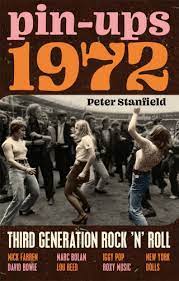
That headline is not a phrase you hear much of – or in fact at all – these days, but in 1972 it was a much-discussed concept that attempted to define the music and performance of the early 70s as demonstrated by the likes of David Bowie, Alice Cooper, Roxy Music, New York Dolls and T-Rex. As author Peter Stanfield explains in his fabulous new book Pin-Ups 1972 about the London music scene in 1972, this went by other names too – Fag Rock and Poof Rock being just two of them – which is a reminder of how insensitive even the progressive rock papers of the time could be.
That distance between then and now is the focus of Stanfield’s book. So much has been said and written about the 1970s that it’s easy to believe we all lived through them and already understand everything there is to know, but by going back to the journalism of the time, Stanfield demonstrates how writers were attempting to comprehend the music of the time without benefit of hindsight or obscured by four decades of received wisdom. Stanfield has devoured the journalism of 1972 – underground, national press, music weeklies, colour monthlies, even soft porn titles – to examine the music through a detailed reading of the writing of Nick Kent, Nik Cohn, Richard Williams, Michael Watts, Simon Frith, Mick Farren, Chrissie Hynde and many more – not just their greatest hits, but deep cuts that even they will have forgotten writing.
We see these writers in real time try to get to grips with the ambiguities and contradictions of third generation rock and Stanfield writes in an approximation of these pioneers, dropping theories, connections and cultural references with intoxicating verve, daring the reader to keep up and learn something. Look it up or go with the flow, your call.
What is third generation rock? By this reading, the first generation were the original ’56 rockers – Elvis, Chuck Berry, Little Richard – and the second generation were those that grew from R&B – the Beatles, Stones, Who, Kinks, Floyd, Zeppelin and you know the rest. Third generation were those that followed, essentially the ones who had more time to understand the grammar, scriptures, cliches and language of rock and roll and then tried to do something different with it – even if many of them, Bowie, Bolan, Lou Reed, Iggy Pop for starters, had been making music for almost as long as the second generation.
It’s a slippery concept (whither Hawkwind and the Pink Fairies?), as such genre-defining often is, but that isn’t really the point. What compels is the approach of exploring the acts through the media of the time. We see hippie journalists struggle to accept the sudden elevation of Marc Bolan from underground hero to teenage fantasy, haphazardly chronicle the New York Dolls’ ill-fated trip to London in 72, or write in awe of the arrival of the semi-mythical Iggy Pop and Lou Reed when the pair come and live in London (Lou Reed settling down in Wimbledon of all places). How do you make sense of Bowie and Roxy Music, when they are happening right in front of your eyes and you have no real frame of reference? The latter explains why for much of their first year, Roxy are likened to Sha Na Na: when something genuinely revolutionary happens, critics are left grasping for comparisons – only later are they able to go back and make it all fit together. But watching that struggle, and the sheer intellectual effort demonstrated by so many writers of the time, is fascinating and a little humbling. The through-line to punk and indie is clear to us but obviously was unknown at the time, and despite walk-on roles for Malcolm McLaren and Glen Matlock, Stanfield wisely leaves that largely unsaid, helping to seal 1972 into its own time capsule.
That makes this very much a book for those who enjoy historiography and media studies almost as much as they love rock and roll. What you don’t get is recycled anecdotes, biography or even too much in the way of music criticism – although the reappraisal of Bowie’s Pin-Ups is magnificent. Stanfield is more interested in the wider culture, with rock being as much about performance and publicity and fandom as it is about chords and melodies. Which for the writers and musicians of 1972, it almost certainly was.














 The Great Wen