Possibly the only interesting sentence that has ever been written about Harry Redknapp appeared 40 years ago, when Redknapp was playing West Ham. It goes:
‘It is said that when West Ham were fighting Coventry at Coventry station last year, Billy Bonds and the inevitable Harry Redknapp came along to lend a hand.’
This appears almost as an aside in Chris Lightbown’s seminal article Football Gangs in Time Out in April 1972, which looked at the mobs that followed the four big London clubs: Arsenal, Chelsea, Tottenham and West Ham.
Did Redknapp really join in a ruck in 1971? This should surely be the first question put to him if he ends up getting the England job.
I’ve just come across a treasure trove on You Tube of old Rank Look At Life newsreels, each ten-minutes long and looking at different aspects of London life. There are some real treats to be found, but here are a few I enjoyed when I should have been working, or at least making a cup of tea.
Members only, 1965 – inside London’s private clubs
Coffee bar, 1959 – the new world of Soho’s coffee shops
Goodbye, Piccadilly, 1967 – a portrait of Piccadilly Circus
In Gear, 1967 – an iconoclastic look at Swinging London
Top People, 1960 – the crazy world of highrise living
Shopping By The Ton, 1960 – Covent Garden, Smithfield and Billingsgate markets
Report on a River, 1963 – a love letter to the Thames
In 1974, this picture was taken of Muhammad Ali at Tulse Hill Comprehensive, sparring with a schoolboy.
But how did the world heavyweight champion – and one of the most famous men in the world – end up in a South London state school shortly after the Rumble In The Jungle with George Foreman in Zaire?
Well, he was invited by civil rights campaigner Paul Stephenson, who was on the school’s board of governors and thought it would be a good idea to ambush Ali in the lobby of the Hyde Park Hilton and suggest he come to the school assembly.
We continued to chat and he wanted to know how much I’d pay him. I looked him straight in the eye and said: ‘Muhammad, I haven’t got a dollar.’ He responded ‘Not even a dime? You have more nerve than Frazier.’
This review was published in the Independent last week but has not surfaced online.
It’s going to be hard to avoid Charles Dickens in the next few months. The writer will be everywhere, as publishers, programmers and producers commemorate the 200th anniversary of his birth on February 7, 2012. The best celebration of Dickens’s legacy could be this illuminating exhibition at the Museum of London. It’s an imaginative look at a familiar subject, and represents the best of what a museum can do.
This is no staid trawl through Dickens’s back catalogue but a vivid evocation of Victorian life based around themes from his books, from poverty to innovation. Sure, the big objects like Dickens’s writing desk or his manuscript for Great Expectations are there to grab the attention, but this drama is complemented by Victorian minutiae, the fascinating bric-a-brac of everyday life, everything from rent arrears books and mourning wands (wooden sticks carried by footmen ahead of funeral processions) to clay pipes, Punch and Judy puppets, model trains and Dickens’s soup ladle.
The exhibition is more than objects. There are mournful photographs of Victorian buildings that Dickens wrote about but have since disappeared, and a short film by William Raban that meanders around modern London while an actor recites Night Walks, Dickens’s essay about the sleeping city, drawing subtle parallels between his time and our own. The film is a rare chance to wallow in Dickens’s own voice, but neither this nor the manuscripts are quite as impressive as Dickens’s reading copy of Oliver Twist. This is the book he used on reading tours towards the end of his life; words and sentences are underlined for emphasis, and melodramatic stage directions (‘Action’, ‘mystery’, ‘terror to the end’) are scrawled in the margins.
The Strand, Looking Eastwards from Exeter Change, London
Most rewarding of all, though, is the art. There’s classically sentimental Victoriana, such as William MacDuff’s Shaftesbury, which shows two urchins looking in a shop window like something by Norman Rockwell. There’s the fascinating documentary sketches of George Scharf’s, who drew the people he saw on streets acting as human advertisements, in colourful costume and carrying eye-catching signs for shows and products. And there are many detailed depictions of Victorian street life, which owe a clear debt to Hogarth. Phoebus Levin’s ‘Covent Garden Market’, Caleb Robert Stanley’s ‘The Strand, Looking Eastwards From Exeter Change’ and especially Edmund John Niemann’s ‘Buckingham Street’ portray a city of energetic bustle, cobbled streets and vicious contrasts of wealth that are the visual embodiment of what we still call Dickensian London.
Museum of London, 150 London Wall, EC2Y 5HN (020 7001 9844). Until June 10, 2012. Admission £8 (£7 advance booking); concs £6 (£5 advance booking).
There are some songs I have listened to all my life, without really stopping to think what they are about.
So it is with Steve Harley and Cockney Rebel’s “Make Me Smile (Come And See Me”), which I’ve spent around 20 years assuming was some sort of love song.
When I wrote about the song in this month’s Uncut, Harley told me the song was actually a rebuke to his old bandmates who asked for more money and then left him – he felt – in the lurch – shortly before he entered the recording studio. Harley’s response was to immediately write the accusatory “Make Me Smile” (‘Blue eyes, blue eyes, why must you tell so many lies?’) and sing it with a Dylanesque sneer, but bury the sentiment beneath a layer of perfect pop production. So a song written in a despondent stew made his fame and fortune and still follows him all round the world.
The favourite thing Harley told me though, was that one of the backing singers for the song’s famous ‘ooooh la la’ chorus was the actor and singer Clarke Peters, now better known as Lester Freamon from The Wire. You won’t find that on Wikipedia. Yet.
Maggs Bros is a posh antiquarian bookseller on Berkeley Square that has a Royal Warrant and is supposed to occupy the site of the most haunted house in Britain, but it is also home to a small contemporary art gallery, located out the back and accessed via 50 Hays Mews.
The latest show is being curated by New Artists and features photographs by Richie Culver taken of London crackhouses. These are loosely based on Gustave Dore’s engravings of Victorian opium dens.
The exhibition also features Polaroids by Shorvon & Hunter that explore the demise of the Polaroid and newspapers as forms of media. It’s definitely worth a look if you are in the area before it closes on Monday, December 5.
If you do, you should also pop upstairs to see a selection of some items that Maggs’s counterculture expert Carl Williams is currently selling. These include photographs of William Burroughs taken by Brion Gysin in Paris and an extraordinary mural taken from an American street gang club house. You could also pick up a copy of Carl’s latest catalogue to see if he has anything you fancy, whether it be items to do with Crowley, punk or the Weathermen. Last time I visited, he showed me some pictures he’d just acquired of dead Victorian babies, but don’t let that put you off.
Hollingshead was the British man who introduced LSD to Tim Leary in December 1961 on the recommendation of Aldous Huxley. Hollingshead was working in New York when he came upon a quantity of LSD. Huxley suggested he send it to Leary, who was already experimenting with administering psilocybin to patients during his psychological research at Harvard. Leary loved it. The LSD revolution began.
After working in America with Leary – he even lived in his house – Hollingshead was sent to London in September 1965 with enough Czechoslovakian lysergic acid to produce 5,000 trips, thirteen boxes of psychedelic literature – The Psychedelic Experience, The Psychedelic Review and The Psychedelic Reader – and plans for ‘a psychedelic jamboree’ at the Royal Albert Hall featuring the Stones, the Beatles and Leary himself. Although this is sometimes presented as Hollingshead playing the role of John The Baptist to Leary’s Psychedelic Christ, Barry Miles’s ‘London Calling’ suggests that Leary was just trying to get rid of the increasingly drug-addled Hollingshead and is said to have remarked upon his departure, ‘Well, that writes off the psychedelic revolution in England for at least ten years.’
Hollingshead promptly set up his base at his flat in Belgravia’s Pont Street, which he renamed the World Psychedelic Centre, and redecorated with the key elements needed for a good trip: bowls of fruit, handwoven cloth, open fire, bread, cheese, wine, candles, incense and goldfish. A chill out space, basically.
This was one of only two reliable sources for LSD in London at the time, so visitors were plentiful and Hollingshead began welcoming key figures from the scene – including Roman Polanski, Alex Trocchi, William Burroughs, Paul McCartney, Eric Clapton, Donovan and the Rolling Stones.
Guests were invited to take part in LSD sessions designed to make the most of the experience, with ‘lots of cushions, some excellent tapes and hi-fi equipment, a slide projector, and several chillums’. The LSD was dispensed after midnight inside grapes impregnated with 300 micrograms of the drug. The atmosphere was key. Hollingshead writes:
Shortly after dropping the acid, I played a tape of Buddhist Cakra music, followed by Concert Percussion by the American composer, John Cage. Next I played some music by Ravi Shankar and some bossanova. Interval of fifteen minutes. Then some music by Scriabin and part of a Bach cello suite. Interval. Some Debussy, and Indian flute music by Ghosh. Interval. Bach organ music and some John Cage ‘space’ music. Interval. The Ali Brothers and Japanese flute music. We also looked at slides projected on to the ceiling Tantric yantras, Vedic Gods, the Buddha, Tibetan mandalas.
There were also regular readings from Leary’s work
While Hollingshead dispensed LSD to his visitors in these carefully controlled conditions, he was soon self-medicating with cannabis, speed and heroin to control the fierce highs he experienced from taking strong doses of acid at least three times a week. The tabloids soon got wind of these experiments with the ‘killer drug’ and after hosting a party of 80 hippies at which two undercover police officers were dosed with acid after sampling the spiked punch, Hollingshead was busted. Naturally, he attended his trial while tripping and was sentenced to 21 months at Wormwood Scrubs. There he met spy George Blake, who promptly took a trip on some of the acid Hollingshead smuggled in to the prison, before escaping and going into exile in the Soviet Union.
Hollingshead didn’t make it quite that far himself, ending up in Cumbrae, a Scottish island, where he settled with a group of believers who treated LSD as a holy sacrament in quasi-religious services. He then went on his world travels.
Hollingshead was undoubtedly a key player in the scene. However, it’s notable that when a copy of his book, The MAn Who Turned on the World was sent to Timothy Leary in prison in the 1970s, Leary underlined only a single sentence – ‘…my taking of methedrine…’ Leary’s acquaintances believe that not everything Hollingshead said about his role in the psychedelic revolution could be trusted because of his addiction to opiates.
In 1953, a momentous event occurred in Soho. London’s first proper coffee shop – one equipped with a Gaggia coffee machine – opened at 29 Frith Street. This was a place where teenagers too young for pubs could come and gather, and it is said by some that the introduction of this coffee bar prompted the youth culture explosion that soon changed social life in Britain forever.
Inside the Moka Bar
The Moka was an instant success, selling over a thousand cups of coffee a day. The author John Sutherland recalls, ‘the Gaggia machine, a great burbling, wheezing, spluttering monster, would grudgingly excrete some bitter caffeinated essence. It would be swamped with steamed-milk foam and dusted with chocolate to form its ‘cappuccino’ hood… Glass cups and brown sugar (lots of it) were de rigueur. Frankly, 50s espresso was no taste thrill. But it felt smart as hell.’
By 1972, coffee bars where everywhere and the teenage revolution was firmly established. At this time, the author of ‘Naked Lunch’, former junkie and all-round Beat legend William S Burroughs was living in London, quietly going about his business in St James’s. He lived in Dalmeny Court, Duke Street, and loved the plush gentlemen’s shops of the area, not to mention the ‘Dilly Boys‘, young make prostitutes who hustled for clients outside the Regent Palace Hotel.
Although Burroughs was fond of the finer things in life – he got his shoes from John Lobb, hat from Locke’s and bought most of his food in Fortnum and Mason’s – he did at some point stumble into the Moka Bar, and was not impressed by what he found.
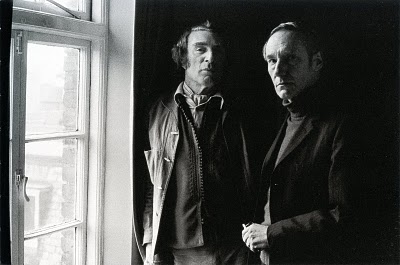
Burroughs and friend Brion Gysin in London
Burroughs at this time was getting sick of London – sick of the licensing laws, sick of the crap food and small drinks, sick of the weather, the terrible service and sexual hypocrisy. He was also sick of the Moka, which he believed responsible for an ‘outrageous and unprovoked discourtesy and poisonous cheesecake’.
The Church of Scientology, Fitzroy Street
Burroughs decided to mount a sound-and-image attack. He had previously launched one of these against the Church of Scientology, of which he had been a member, turning up at their headquarters at 37 Fitzroy Street every day, taking photographs and making sound recordings. He believed that ‘as soon as you start recording a situation and playing them back on the street, you are creating a new reality’ and that repeated exposure to such an attack would lead to ‘accidents, fires and removals’. After a few weeks, the Scientologists did indeed move, round the corner to 68 Tottenham Court Road.
Photo taken by Burroughs during the operation
On August 3, 1972, Burroughs turned his attention to the Moka. He would stand outside every day taking photos and making recordings by tape, and then return the next day to play the previous days recordings. Burroughs was convinced he was winning. ‘They are seething in there,’ he said. ‘I have them and they know it.’
I interviewed Tony Adams in May for BMI’s Voyager magazine, and we talked at length about Arsène Wenger, who is currently under all sorts of pressure at Arsenal.
To my surprise, Adams refuted the notion that Wenger completely transformed the football culture at Highbury. Received wisdom is that Wenger brought with him ‘European’ attitudes towards diet and fitness that revolutionised English football. Adams, though, insisted:
‘That’s a bit of an insult to the directors and dieticians that had been at Arsenal for years. We were reading books on diet in 1987, ten years before Arsène walked into the club. Arsène came with his own ideas and strategies, and brought in an osteopath and acupuncturist. But there’s no secrets. Diet won’t change anything if you don’t have great players and I still ate fish and chips every week for the last six years under Arsène Wenger. Every Friday on Putney Bridge I went and got battered cod and a chip sandwich and sat there looking at the river.’
Adams says that ‘the coaching system is the same as it was under George Graham’ and feels Wenger’s biggest triumph was that he ‘walked into a squad of great players. The 1991 squad was the best I’ve ever played with. I’d love to have walked into a squad of players that good as a manager. He brought in everything he learnt, that’s what managers do. He’s a fantastic physiologist and psychologist, that’s where he excelled.’
Adams clearly holds Wenger in great esteem and affection, but seems to feel the pre-history of Arsenal – the terrific team put together by George Graham – has been unfairly forgotten. His comments are an attempt to place Wenger’s achievements in perspective and to understand that his success was only a continuation of what was started by Graham. Wenger is often credited with ending the drinking culture at Arsenal, but Adams says he’d already given up booze at this point and that was something else Wenger benefited from. This terrific interview in The Sunday Times about Graham and Wenger with Adams, Steve Bould, Nigel Winterburn and Lee Dixon seems to back up what Adams told me.
Adams went on to say, ‘Don’t get me wrong, I’m not having a go at Arsène Wenger. One of the gifts he’s got is that he’s a lovely human being and I respect him a great deal. But I’ve got to get it real, he coaching isn’t his strong point [Adams’s original phrase was far more damning, but he later asked for it to be toned down]. I love him dearly, he’s a fantastic physiologist but he’s not a great motivator. I’d just laugh at his attempts to gee us up, but I come from a different place, time and culture. But he got me in the best condition I could possibly get in to do my job, and for that I love him and have so much respect for him.’
It’s an interesting argument. The counter-argument is this goal, although in light of Adams’s comments it no longer looks quite so remarkable – just a triumphant and fit centre-half with a three-goal cushion running through a knackered, battered defence at the end of the season and belting the ball unscientifically past a beleaguered keeper. Total football, or just taking the piss?
Like many adolescent boys who thought they were cleverer than they really were and were scared of girls, I was obsessed with The Smiths and Morrissey.
The Smiths are a Manchester band, but by the time I became a fan, Morrissey had – like so many Northerners – fled the provinces for London where he spent the next few years revelling in the size, confusion and culture of the Big Smoke. Instead of Whalley Range and the Moors Murders, he sang about Earl’s Court and the Krays and as he entered his ‘Glam Nazi’ era he became obsessed with distinctly London aspects of working-class life such as skinheads, West Ham and the Cockney Rejects.
This was Morrissey’s London period; you could argue it began with the Smiths songs London (1987) and Half A Person (1987), and lasted until he was hounded out of the capital for going a bit crap around a decade later. Sure, London still cropped up in later songs – 2004’s Come Back To Camden, for instance – but the love was gone. He would later sound like any other tedious expat whn complaining to the NME that ‘if you walk through Knightsbridge on any bland day of the week you won’t hear an English accent. You’ll hear every accent under the sun apart from the British accent.’ But it was fun while it lasted.
Interesting Drug (1989)
Although Morrissey’s previous solo singles were very London-influenced, this was the first – rather odd – video to be clearly filmed in London. But where? The red bus glimpsed at 1:21 may tell somebody with better eyesight than I. Is it a 34, placing this somewhere between Barnet and Walthamstow? Update: Comments suggest this is Battersea, so not the 34 after all. Maybe the 37?
Our Frank (1991)
A pretty poor song, but the video marks the start of Morrissey’s skinhead obsession – it was not long after this that he took to performing before a skinhead backdrop and brandishing the Union Jack at Finsbury Park. There are lots of buses here, and also a gorgeous ghost sign at 1:47. But where is it shot? Charing Cross Road? The City? Victoria? Anybody? Update: Comments place this definitively as King’s Cross.
We Hate It When Our Friends Become Successful (1992)
I hated this when it came out, but I was wrong because it is brilliant and the video is a treat as Morrissey wanders around a still not-quite-gentrified Wapping with the gang of bequiffed young boys who have put a smile back on his own thin and youthful face. Most Morrissey fans get a kick out of seeing the old boy looking happy, which is why his recent ‘love’ album, Ringleader Of The Tormentors, got such strangely good reviews. The abandoned pub in this video is now the Turk’s Head cafe and you can also catch a glimpse of Oliver’s Wharf, which was one of the first warehouses in the area to be redeveloped into housing.
You’re The One For Me Fatty (1992)
An awful song, but an unmistakable setting as a young skin takes ‘fatty’ on a date, while Moz whines about how ‘all over Battersea’ there’s ‘some hope, and some despair’, over a shot of the power station. Interestingly, a scene from one of Morrissey’s favourite Northern kitchen sink dramas, ‘Saturday Night and Sunday Morning’ was filmed by director Karel Reisz around here, in Culvert Road, Battersea. Of Reisz, we’ll hear more later.
Boxers (1995)
From the start of Morrissey’s decline – and height of his obsession-with-male-physicality – this ho-hum single was filmed at the legendary York Hall, Bethnal Green, as can be seen in the rather elegant closing shots.
Sunny (1996)
Such a terrible song I didn’t know anything about it until now, as I had long lost interest in Morrissey at this point, but it’s filmed in Victoria Park in East London. And the cover featured this iconic Morrissey shot, outside old Kray haunt the Grave Maurice (now, I think a fried chicken shop).
There were many other London influences in Morrissey’s songs at the time, with the Kray-referencing Last Of The Famous International Playboys, the song Spring-Heeled Jim (a reference to the Victorian London monster Spring-Heeled Jack), the song titles Piccadilly Palare and Dagenham Dave, and the album titles Your Arsenal and Vauxhall & I, as Morrissey explored the seamy side of London life. He was also rumoured to be making his first acting appearance at around this time as the South London gangster Charlie Richardson, although sadly that never came to pass.
I’ll leave you with one last example. This clip is of Kennington kids discussing the infamous case of Derek Bentley, who was sentenced to death for his part in the shooting of a policeman in Croydon, and it comes from Karel Reisz’s classic London documentary ‘We Are The Lambeth Boys’. It was sampled by Morrissey for the track Spring-Heeled Jim, which featured on the Vauxhall & I album. How much more London can you get?




 The Great Wen