Category Archives: Books

Five fictional Londons

For more on London Fiction, see the latest issue of the wonderful Curiocity map-magazine. 

Nú Lundun

The Book Of Dave (2006)

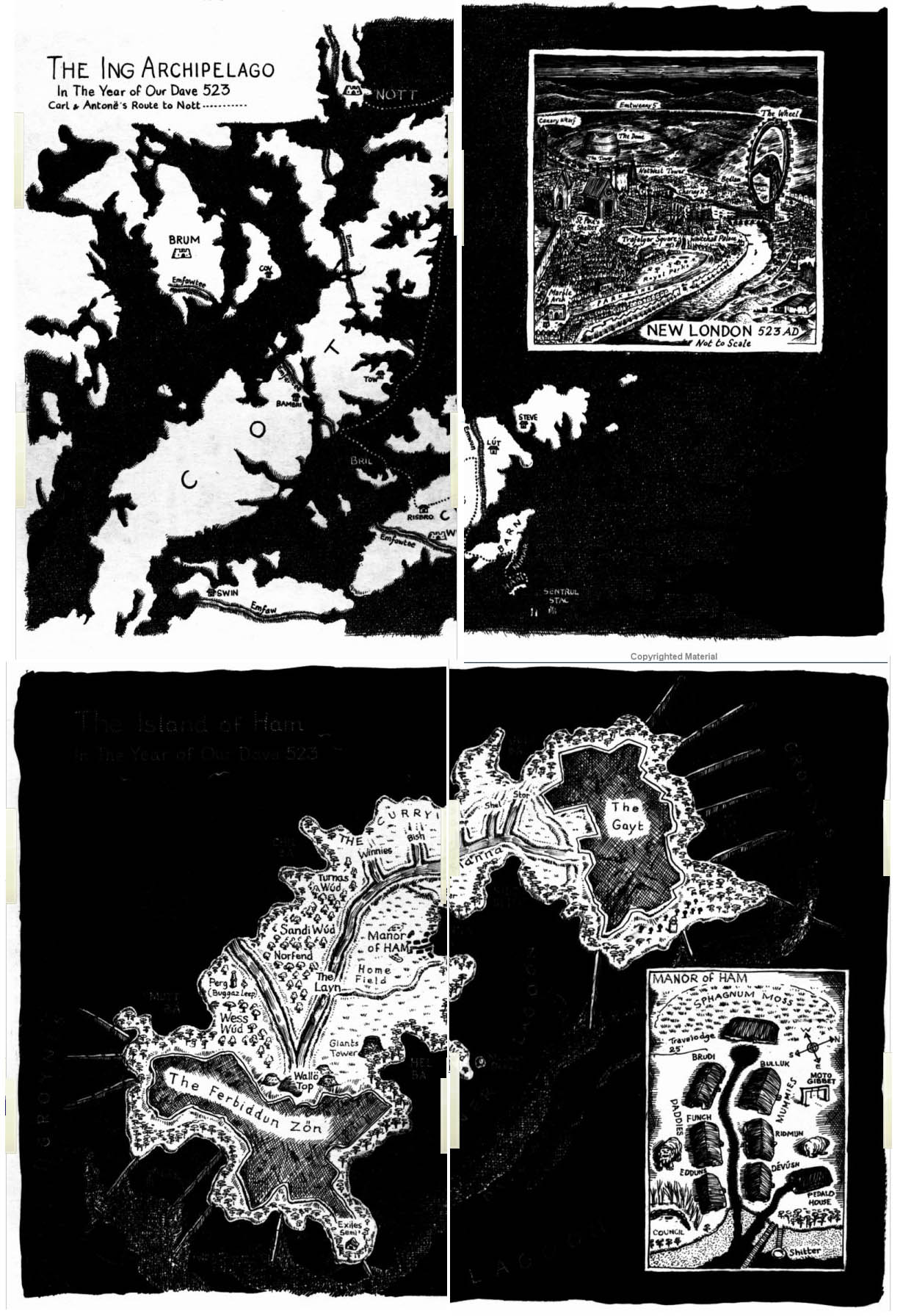
Will Self’s phonetic and splenetic Mockney masterpiece imagines a future London buried beneath flooded waters. It is set on the island of Ham, all that remains of Hampstead Heath, where the inhabitants worship a psychotic taxi driver, so take a cab up to Parliament Hill and imagine yourself looking down upon a lagoon. The book ends in Nú Lundun, rebuilt near Nottingham.

MAP

Un Lun Dun

Un Lun Dun (2007)

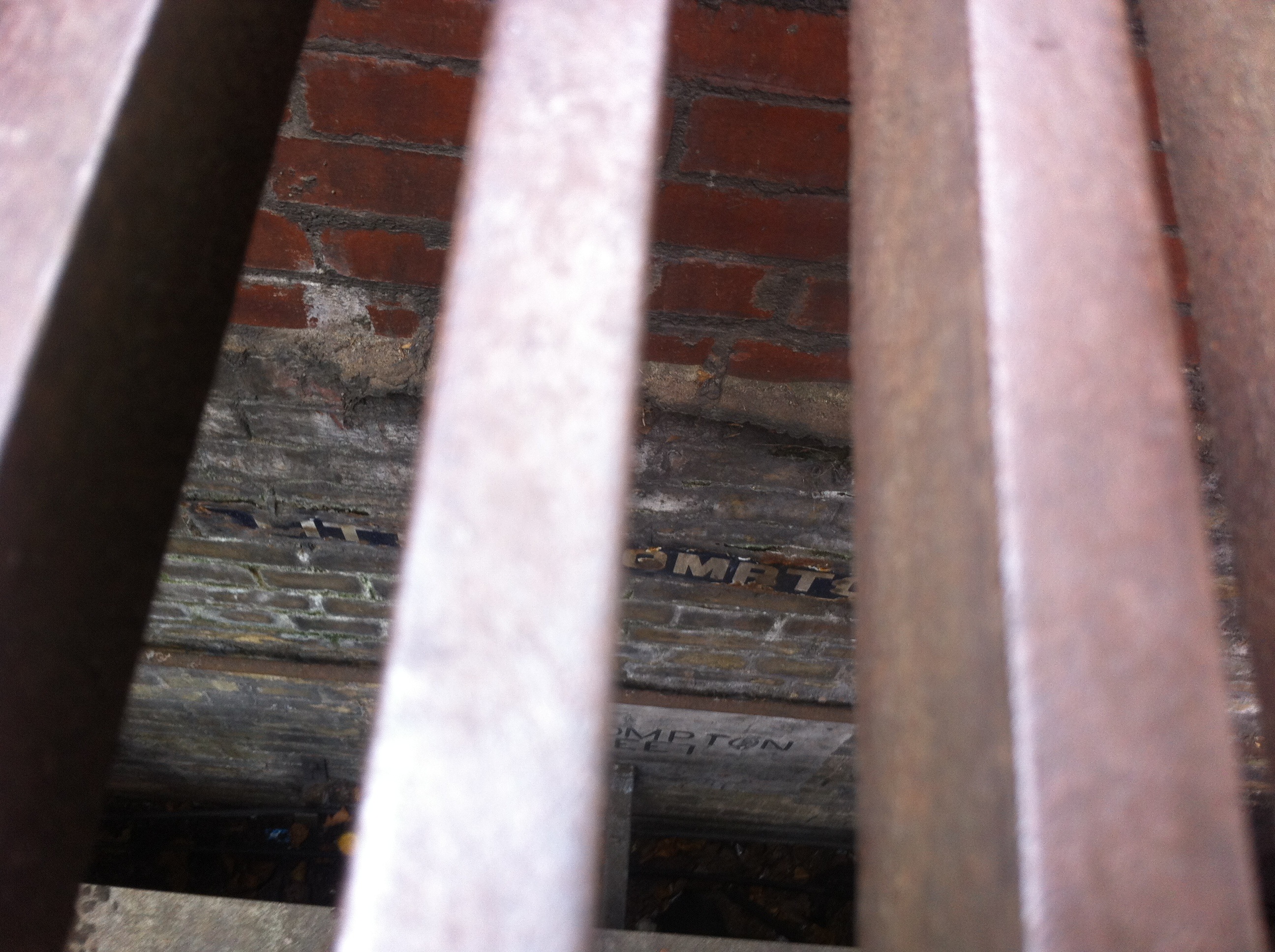
China Mieville’s underground fantasy city populated with things that people in real London throw away and accessed through a door in an estate in Kilburn. If you stand in the right part of Charing Cross Road and stare through a grille in the pavement, you can see a subterranean sign for a long-lost London street – perhaps this is how we can enter Un Lun Dun?


Brit-Cit

2000AD (1980s-present)

A post-apocalyptic city of giant towers and rage imagined by the creators of Judge Dredd, this megalopolis has distinctive landmarks like the New Old Bailey, Bigga Ben and the Battersea Mutants Home. The closest you can get to it today is by walking around Canary Wharf in a motorcycle helmet shouting ‘Drokk’ at passing bankers.


London Below

Neverwhere (1996)

Neil Gaiman’s TV series about a magical subterranean London where many of London’s evocative place names – Angel, Earl’s Court, Knightsbridge – have come to life: there’s a real angel, a real earl and the Night’s Bridge is an ominous stone bridge. Recreate the experience by going to Catford shopping centre with a tin of Whiskas and trying to entice the giant cat down for a cuddle.

Londongrad

Comrade Dad (1986)

Short-lived sitcom starring George Cole and set in London in 1999 after a Communist invasion – the opening credits feature the Red Army marching through Trafalgar Square while a revolving red star sits atop Nelson’s Column. Recreate the experience by living in a tiny London bedsit struggling to pay the heating bills while the government and their cronies bathe in diamonds and caviar and listen to your phone calls.

Phyllis Pearsall and searching for truth in the A-Z

I’ve written before about the urban legend surrounding Phyllis Pearsall, and her oft-repeated claims that she created the A-Z by walking every inch of London streets even though she could have just picked up the London street atlas created by her father, Alexander Gross, a few years before.

Pearsall related how she single-handedly created the A-Z in a pair of self-published unreliable memoirs and this became the definitive account after the publication of this biography. The story of Pearsall’s life has now been made into a musical, The A-Z Of Mrs P, at Southwark Playhouse.

The veracity of Pearsall’s claims is robustly challenged by her half-brother, Alex Gross, who has created a website dedicated to establishing the truth behind the creation of the A-Z and the key role played in it by his and Pearsall’s father, Alexander Gross. The image below comes from Gross’s map and show how much it looks like the A-Z. An excellent comparison of the two maps can be found in Peter Barber’s London: A History In Maps.

IMG_2230[1]

A summary of Gross’s argument can be found here. Gross is hugely critical of the story Pearsall created. He is adamant that Pearsall was operating at the direction of her father to update his already existing London street atlas and is dismissive of her claims that she walked the streets for 18 hours herself, or delivered early copies of the A-Z herself by wheelbarrow. I have no way of telling whether Gross is accurate in his own recollections, but I know that his skepticism towards Pearsall’s claims are shared by Peter Barber, who is head of the map collection at the British Library.

Gross is scathing about Sarah Hartley’s book on Pearsall, Mrs P’s Journey, claiming it has more in common with ‘chick lit’ than it does biography (never having read either ‘chick lit’ or Hartley’s book, I cannot pass opinion on this). Gross also casts a withering eye over Pearsall’s own books about her life in great detail. There is also considerable biographical material on Gross’s relationship with both his father and half-sister, later describing her as ‘urbane, witty, and utterly personifying the spirit of the English eccentric’, something that goes a long way towards explaining why her version of history has been so widely embraced by the British public.

Secret London: streets beneath streets of London

Paul, the librarian at Time Out, first told me about the street beneath Charing Cross Road in around 2005. He promised to show it to me, but never did.

Then, last month, I saw it. I was mooching around Cambridge Circus, noting the loss of London’s best-named book shop, Lovejoys, a landmark from the time I used to be a dedicated fanzine-browser across the road at Sportpages, also since departed. I had always assumed Lovejoys was a wittily named Soho porn shop, but it actually stocked cheap classics and DVDs. The shop taking over the site will be a sex shop it seems, albeit of the modern, seedless, air-brushed, air-conditioned variety rather than Soho’s traditional damp basement. With the erasure of any trace of character at the arse-end of Berwick Street, the old Soho sex shop is nearly gone. Indeed, much of this post is about things that have been removed, including Paul the librarian, who left Time Out shortly before I did.

As I crossed Charing Cross Road from Soho and stood on an island in the middle of the road waiting for a No 24 bus to pass, I happened to look into the grille beneath my feet. I have instinctive curiosity when it comes to London holes but this is the first time I’ve really seen anything of interest, as, to my surprise, I could make out what appeared to be a subterranean street sign set into the wall a few feet below the ground.

IMG_1992

I leaned in closer and there they were – not one, but two street signs for Little Compton Street, one blue enamel and the other painted on to brick. Here was London’s buried street.

IMG_1990

Although Little Compton Street has its own Wikipedia page, it is not entirely clear how the signs got here. The street itself was obliterated by the construction of Charing Cross Road – here you can see Little Compton Street on an old map of 1868, intersecting with Crown Street (which is marked by green as Soho’s border, though surely red would be more appropriate) just before Cambridge Circus. Little Compton Street ceased to exist in around 1896 and is now part of the Cambridge Circus utility tunnels, which some urban explorers write about here. (Apparently, Rimbaud and Verlaine used to drink in a pub on Little Compton Street during their dramatic London stay.)

map1868

Were the underground signs accidentally left behind when Charing Cross Road was run roughshod over the top of Crown Street or was it a careful act of preservation by an unnaturally thoughtful council? Or were they removed from a wall by unknown hand and deliberately placed down here, where Little Compton Street has existed ever since, entombed beneath London feet and offering a tantalising glimpse of those fantasy Londons from countless dreams and dramas. There’s an echo of China Mieville, Neil Gaiman and the Borribles, but also of Malcolm McLaren’s mysterious and misremembered subterranean Victorian road (neatly discussed here) that is said to exist intact beneath Selfridges on Oxford Street.

One wonders whether the brutal Crossrail redevelopment of this bedraggled part of the West End will allow any such traces to remain. I hope so. And I hope they also have this last-gasp, accidental feel, of something that London can’t quite let go, like dying fingernails clawing a wall, leaving behind a ghost, a whisper, of one of London’s many pasts.

For some great old images of Charing Cross Road, browse here with leisure and a little sadness.

Know London

City-lit London

This is an edited extract of an introduction I wrote for City-Lit London, a superb anthology of London writing, from 2009.

I don’t really know London. This despite having lived and worked within the collar of the M25 for my entire life, something that is simultaneously a source of great pride and creeping shame. I’ve explored it, sure. I’ve gazed down at dawn on drowsy Londoners from atop a thirteenth-century church tower in Hackney. I’ve listened to the hum of traffic passing overhead from deep within the buried Fleet River beneath Holborn Circus. I’ve walked the Thames one Sunday afternoon from St Paul’s to Hampton Court, been to the end of more than half the tube lines, sniffed Billingsgate Market’s early-morning buzz and fed the black-tongued giraffes at London Zoo. I’ve even travelled every bus from 1 to 50 in numerical order, a task that’s taken me to every point of the compass from Debden in the north-east to Fullwell in the south-west (no, I’d never heard of them before I started, either). But I still don’t know London. Not really. There are vast tracts of its urban geography that are a total mystery to me, a no-man’s land, vacant lots, blank space in my internal A-Z.

This is not an unusual condition. Indeed, it might even be a necessity for living a sane, balanced London life because most of the city’s residents seem to suffer from it, some quite contentedly, perfectly happy to stay within the few square miles where they live and the West End where they work. This could be because there is simply too much London to handle ― too many streets, too many people, too much history, too many inconsistencies. The London cabby, scientists say, has developed a larger-than-average hippocampus ― the part of the brain that processes navigation – simply to cope with all the information. One of them, Fred Housego, even won ‘Mastermind’ in 1980.

Most of us don’t even try to deal with all this geographical sludge. In Soft City, Jonathan Raban’s charismatic study of the modern city from 1974, he noted: ‘The Greater London Council is responsible for a sprawl shaped like a rugby ball about twenty-five miles long and twenty miles wide; my London is a concise kidney-shaped patch within that space, in which no point is more than seven miles from any other… I hardly ever trespass beyond those limits, and when I do, I feel I’m in foreign territory, a landscape of hazard and rumour. Like any tribesman hedging himself in behind a stockade of taboos, I mark my boundaries with graveyards, terminal transportation points and wildernesses. Beyond them, nothing is to be trusted and anything might happen.’

This is a common way of behaving, retreating within self-imposed borders and putting up the fences to the darkness on the other side. It’s captured by Tarquin Hall’s passage from Salaam Brick Lane and the stark single-line confession: ‘Most of London, the city of my birth, was as foreign to me as Prague’. The bard of Cricklewood, Alan Coren, explored a related theme in typically whimsical fashion in which he imagined his intended tour of all the London landmarks he has never actually visited – the Tower of London the Monument and the Serpentine — having decided to leave that sort of thing to the tourists.

No wonder and no shame. If you’re born in Harrow, what should you understand of Harlow? If you live near Crystal Palace park, why would you need to know Hampstead Heath? How many Londoners have ever toured the Houses of Parliament or been into the Whispering Gallery of St Paul’s? The greatest area of neglect is the City — if you don’t work within that glorious square mile that contains all history from the Romans to the Credit Crunch why would you ever have a reason to go there? Londoners leave it to tourists and bankers.

And then there are the contradictions. This is the city that features some of the wealthiest real estate within some of the most deprived boroughs in the United Kingdom; the city whose ships helped spread English around the world but is now home to more than 250 different languages and has schools where the native tongue is barely spoken; the city that when called upon to appoint a new mayor, replaced a left-wing, working-class, car-hating socialist with a right-wing, public-school educated, neo-Thatcherite motoring correspondent, two iconoclasts who seemed to have nothing in common bar a quick wit and mutual contempt for orthodoxy. Who can get their head round that?

So, how can you learn to master this metropolis, the first great city of the modern age and still the world leader in art and commerce? Well, you could follow in the footsteps of Phyllis Pearsall, the creator of the single greatest London book – and one that is understandably omitted from this anthology – the A-Z. In the 1930s, Pearsall claimed to have walked every one of London’s 23,000 streets – that’s around 3,000 miles of serious perambulation – in her determination to produce the most comprehensive map of London that is humanly possible. It’s almost certainly an urban myth, but the conceit is admirable.

Alternatively, you could save on leatherwear and consult some of the other classics of London literature, those writers who have made it their business to understand the city, or at least their particular patch of it. After all, will anybody ever show off Soho like Colin McInnes, or capture Camden like David Thomson? Virginia Woolf’s West End is so beautifully developed, so perfectly drawn, so hyper-real, it almost dwarfs the genuine article. And Monica Ali’s Brick Lane places it as firmly on the tourist map as Big Ben and the Wheel, so you can tell yourself that there really isn’t any need to check it out for yourself.

London books allow you to travel in time as well as space. McInnes’s Soho is the good one, the one we’ve all heard about from the 1950s, when it was still raw, neon-lit, jazz-fuelled and edgy rather than a shallow cluster of over-priced restaurants and drunken daytrippers wondering where all the loucheness has gone (it’s still there, just, in secret drinking clubs and members’ bars hidden behind nameless Georgian façades). And Thomson’s Camden is one on the verge of massive change, a working-class district of pubs and markets that is about to experience the first invasion by the middle-classes that will recondition the area beyond all recognition, setting off a chain reaction of gentrification around London’s inner suburbs from Notting Hill to Islington. For those of us who only know these places in their current incarnation, this stuff has an extraordinary archaeological value that their authors could never have intended, like the background of family photographs that show furniture and fittings everybody forgot about long ago because they never bothered to record them.

But that’s not to say things were so much better in the old says. Indeed, one of the most important things about this volume is that it emphasises the current prodigious strength of London writing. Yes, there’s Dickens and Woolf and Conrad and Wilde and Conan Doyle – as there should be – but there’s also Ackroyd and Sinclair and Self, the titanic trinity of contemporary London writing. Since the 1980s they have done more to resurrect the concept of London writing as a standalone genre than anybody since the Victorians, when London, the New Jerusalem, was seen to embody the contradictory values of Empire and became a rich source of fiction and journalism. They have encouraged the rediscovery of some of the lost classics of London literature and fostered the climate in which anthologies like this one can flourish. In their wake, modern classics have followed, from Justin Cartwright’s snappy satirical novel Look At It This Way to Sukhdev Sandhu’s invaluable nocturnal jaunts into the belly of sleeping London in Night Haunts. This regained respect for London writing also allows the voice of the new Londoner to be heard — the 27.1 per cent of the population that the 2001 census considered to be non-native-born ― through authors such as Xiaolu Guo, with her faux-naïve extracts from A Concise Chinese-English Dictionary for Lovers. In Rebecca Taylor’s ‘London Lives’ we even meet one of these recent arrivals in the form of a young brother and sister who travel to London from Poland to begin their new lives, part of the huge wave of Eastern European immigration that has transformed the city in recent years.

It is authors from this final category who could provide some of the finest and boldest London writing of the twenty-first century, because they will come to the city with a fresh mind and open eye, prepared to live and work in those parts of London that are closed by personal choice to most natives. None of them, of course, will ever really get on top of London, even if they choose to stay here for the rest of their lives — but every little bit helps. And if you put all the fragments together, you may one day get something close to the full picture, the London that we all love, even if it’s not the one we know.

Jonathan Gili, on collecting and connecting

Paul McCartney-designed wrapping paper for Indica bookshop and gallery.

Paul McCartney-designed wrapping paper for Indica bookshop and gallery.

The wonderful new catalogue by Maggs counterculture is dedicated to (a fragment) of the vast collection amassed over four decades by the film-maker Jonathan Gili. An insight into Gili’s collecting instinct comes from this article by Anthony Gardner:

Lift the lids of the boxes, and you can scarcely believe your eyes. There are bottles of Star Wars bubble bath and packets of Beatles bubblegum; fridge magnets shaped like kettles and Danish pastries; hair clips
commemorating the Queen’s coronation; Camembert boxes and plastic lizards and packets of tortilla chips. It is as if all the flotsam and jetsam of post-war consumer society had been washed up on a concrete shore and painstakingly catalogued by an tireless, obsessive beachcomber.

Although the catalogue focuses on the recognised brilliance of London’s 1960s psychedelic poster artists like Martin Sharp and Haphash And The Coloured Coat, Gili would collect anything – indeed, Gardner notes he was particularly drawn to sardine tins and even self-published a book about them. The items Maggs has for sale includes such magpie oddities as shopping bags, wrapping paper (albeit designed by Paul McCartney) and old newspaper posters, such as this one regarding Joe Orton’s murder, taken from a newstand in London in 1967.

1465_28

In 1986, Gili wrote an article about his collection asking rhetorically: ‘Who could resist records shaped like Elton John’s hat or Barry Manilow’s nose? They have poor sound and often can’t be made to play at all… but as art objects they are sublime.’

Sadly, there are no records shaped like Barry Manilow’s nose in this catalogue as much of Gili’s collection went to a private collector sympathetic to the intentions and ambitions of Gili. But what makes somebody collect stuff like this? In his short, thoughtful, introduction to the catalogue, Carl Williams – who knows much about collectors – ponders that question. Collectors are often said to be creating a bulwark against their own death, but perhaps, speculates Williams, they also wish to act as a guardian for those things that would otherwise be ‘forgotten, scorned or destroyed’ as tastes and times change?  Today’s trash is tomorrow’s museum piece; yesterday’s lunatic is the future’s visionary. Gardner touches on this, with an anecdote in which Gili ‘rescues’ a particularly revolting object from a garage forecourt. It’s a revealing story. By the very nature of his collecting this worthless item, Gili has given it value. But he’s also, clearly and very simply, enjoyed the moment, relishing both the acquisition and the reaction it will get from his co-conspirator. Why collect? Why not!

Lucinda Lambton tells a story which epitomises Gili’s passion for acquisition. ‘We were driving through the outskirts of Guildford,’ she says, ‘and he suddenly shouted “Stop!” Then he jumped out of the car while it was still moving and ran across this huge, horrible garage forecourt. When he came back, he was triumphantly waving a gold-lamé-clad Michael
Jackson doll.

Collections also gain their own momentum, and I sometimes wonder how many collections have been made almost by accident – one minute you are idly picking up old books about London from secondhand shops and markets, the next thing you know you have 250 of the things and, inadvertently, the beginnings of a minor collection. And if you’ve started, you might as well finish. What else is there to do with your time?

More obviously, collectors hoard items that carry the echo of a cherished memory, certain pieces that remind them of a special moment in their past, or of a past they wished they had. Many of the items being sold by Maggs are focused around the London underground scene of the 1960s. I’m not sure quite what relationship Gili had with the counterculture, but he was clearly an interested observer at the very least – and he edited cult London film Bronco Bullfrog, with soundtrack by 1960s Gilbert & George support act, Audience.

Gili’s 1960s collection includes a number of items from that era that have always been regarded as important and beautiful, such as these stunning posters by Martin Sharp, one of my favourite psychedelic artists and, in my view, a rival to anything that came out of the more lauded Bay Area poster scene.

Cream by Martin Sharp

Cream by Martin Sharp

Purple Dylan by Martin Sharp

Purple Dylan by Martin Sharp

Oz magazine

Oz magazine

UFO Club poster

UFO Club poster

Many of the objects are related specifically to the London scene – the shops, clubs, galleries and ‘fun palaces’ of 1960s London. Gili, then, had a close relationship with this city. One of his best-known films is the charming To The World’s End, about the No 31 bus journey from Islington to Chelsea. Interestingly, 1960s historian Jonathon Green recalls a map of this very bus route once published as a cover of IT newspaper, showing how it connected some of the key points of swinging London – ‘The hippie highway: all the way from Granny Takes a Trip to the Roundhouse’, as Green puts it.

A semi-thorough scouring of the ever-so-distracting IT archive has not turned up this delightful sounding map, so perhaps it was produced by one of the many other underground papers of the era. But it is not a massive leap to speculate that Gili, the great collector of underground London, noted this off-kilter way of observing and uniting the London villages, and later chose to make a film taking precisely that approach. Collections, like buses, are a way to make connections.

fotoflexer_photo

Mick Farren: dead good Deviant

‘Sure the underground was elitist: we were an elite. We were the cutting edge of ongoing bohemianism at that point.’ Mick Farren in Days In The Life by Jonathon Green

The last time I spoke to Mick Farren (May, 2013) he was waiting for the doctor to come round. He was, he told me, in pretty poor shape but welcomed our interview as it gave him something else to think about. Farren’s ill health had been known for some years, but it didn’t stop him going on stage with his old band the Deviants every now and then. It was while performing at the Borderline last night (Saturday, July 27) that he collapsed and died.

It seems crude to say that is how Mick Farren would want to go, but it’s certainly no great surprise that this vivacious ball of hair and action, the closest thing London ever came to producing an Abbie Hoffman,  should die while giving it all to his great love rock and roll. (The following, and all subsequent quotes, are from my interviews with Farren.)

‘Essentially, from when I was in art school through to Joe Strummer the major communication medium of the counterculture certainly in the second half of the 1960s was rock and roll music. You start with that and everything else was peripheral to it.’

Farren’s Deviants were pre-punk noise terrorists whose self-distributed debut album, Ptooff! was one of the first records to come directly out of the London counterculture. When I spoke to Farren for Uncut about the Rolling Stones free gig at Hyde Park in 1969, I asked him whether the Deviants had wanted to play the show. He said,

‘We asked if we could play. We were vetoed, it was probably Jagger. Everybody said I wouldn’t behave myself and start rabble rousing, which was fair enough.’

I put this to Pete Jenner, who co-organised the gig, who responded.

‘Well, there was that and also the fact they were a rotten band. I really like Mick [Farren] but they were a rotten band who smashed instruments on stage. It wasn’t kick out the jams motherfucker, it was let’s have a joint and a buttercup sandwich.’

The Deviants weren’t really a rotten band, but Farren certainly saw them as London’s answer to the MC5. He was heavily active in the political end of the counterculture, forming the London branch of John Sinclair’s White Panther Party and leading the occasional putsch at the International Times when he felt it was getting too bourgeois and boring. Farren was a key figure in so much of what happened in the counterculture, running the door at UFO, writing for and editing alternative newspapers, organising free festivals while playing shows and really meaning it, man. He was fixer and a doer, a wit and sometimes a sage.

‘IT came out of the Beats – poetry, jazz and art with a bit of lefty politics. I told them this was fucked up, they weren’t talking about the weird changes going on with The Who, or where The Beatles were coming from. I’d say that with all respect to John Coltrane there’s this black geezer in the Bag O’ Nails who has long hair and plays guitar with his teeth, what are we going to do about THAT?’

His politics though, always came with a sense of fun – at one anti-war demo the Deviants played he annoyed the po-faced organisers by being more concerned with getting on stage without splitting his trousers than with espousing the cause. He was once described to me by a fellow traveler as being one of the three coolest men in London in 1967, and that made him one of the three coolest men in the entire world.

”We were always condemned as frivolous and philosophically disorganised, and the counter-accusation was they were just boring totalitarians who wanted to sing the Red Flag when we’d rather listen to Voodoo Child and smoke pot.’

When the alternative press disintegrated, Farren – like many from the underground – went on to write great pieces like this for the NME:

The immediate legacy of the underground papers was the NME because we all went there. They had a very profound effect on the visual effect of magazine publishing, but much more important is that the spirit of the thing is now preserved on the internet.  It’s all still there, it’s just become more specialised and you have to go looking for it.’

Farren is one of the dominant figures in Jonathon Green’s essential history of the British underground, Days In The Life, and also wrote brilliantly, if unreliably, about his own activities in Give The Anarchist a Cigarette. What resonates from those books is what an unlikely fit Farren seems in the upper-middle-class world of the counterculture, which was largely run by public schoolboys and Oxbridge graduates imbued with that remarkable confidence that comes with a good education. Farren was different, his confidence was self-generated and less polite, while his art school experiences meant he ‘learned to manage chaos’. Indeed, he relished it. Take a look at the clips below if you don’t believe me.

In his own writings and when interviewed, Farren always came across as funny and incredibly sharp but there was more to it at than that. He was fundamentally, intrinsically, decent. A man without edges. As Jonathon Green told me when hearing the news of his death: ‘Of the underground ‘stars’ he seems, and always did, to have been one of the good guys.’

RIP Mick Farren. He will be missed by many.

Farren invading The Frost Show.

Farren recollecting the Grosvenor Square anti-Vietnam riot of 1968.

Banking on Sherlock

When Abbey National opened their grand Art Deco headquarters at Nos 219-229 Baker Street in 1932, they didn’t quite know what they were getting into. Because it sat in the spot where 221b should be, the new building almost immediately began receiving letters addressed to Sherlock Holmes. When Arthur Conan Doyle chose an address for Holmes, he deliberately picked 221b because the Baker Street numbering did not go that high. But after renumbering, and with the arrival of Abbey House, Holmes’s address suddenly came into solid existence.

While many banks might have ignored this accident of geography, Abbey embraced it. Over the years, they really threw themselves into the business of celebrating the fictive biography of the world’s greatest detective. They installed a plaque (now lost), they published books and, after a while, they employed a letter writer, somebody whose job was to respond to all the letters addressed to Sherlock, acting more or less as his personal secretary.

In 1989, the New York Times interviewed Nikki Caparn, who then had that responsibility, and she described how she had received letters asking Sherlock to solve Watergate, or locate some missing homework. ‘Many people don’t ask for anything in particular,’ she said. ‘They just want to know what Mr Holmes is doing now or where he is and they hope he is well. And many people know he’s not real and write tongue in cheek. But some people haven’t worked it out. Mr Holmes would be 136 years old now, so it’s unlikely that he’d still be living here.’

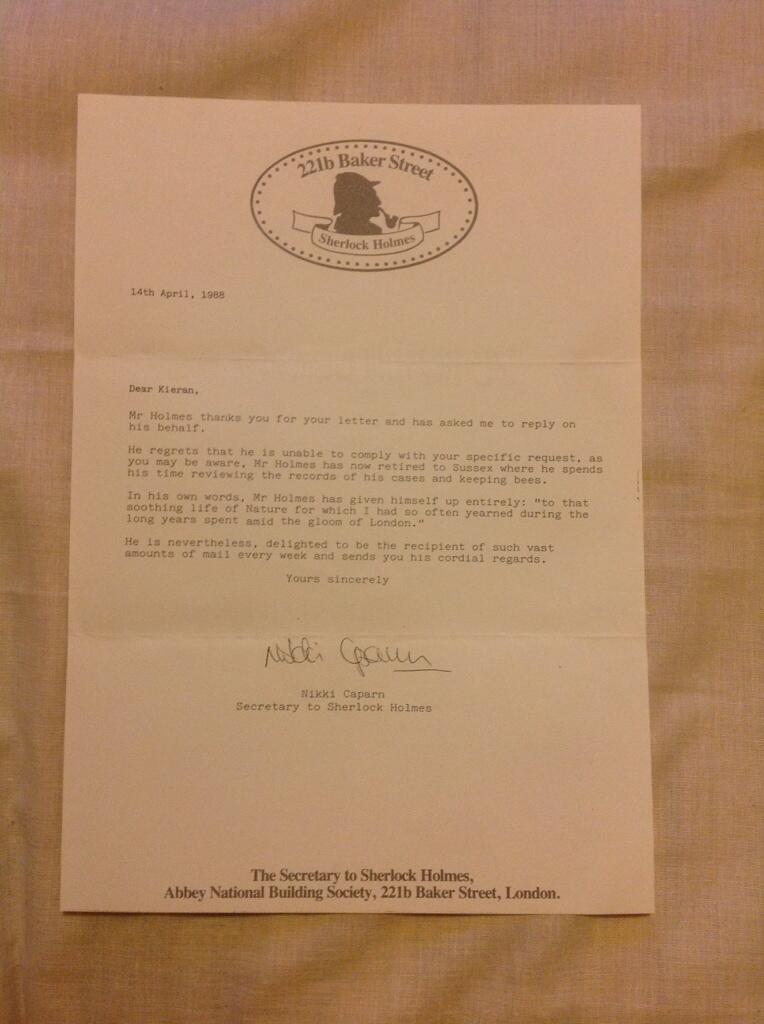
Here is one such response from around exactly that time, sent to Kieran (@hail_tothechimp on Twitter), who had written to Sherlock to ask him about his most difficult case. Ms Caparn clearly does not feel equipped to respond to such a difficult and controversial query, so plays a straight bat with her standard response.

BOb2ZThCcAAIQBZ

Abbey have since moved from Baker Street and are owned by Spanish giants Santander, and I don’t know what has happened to their vast archive of letters. However, Abbey also created something for Sherlock Holmes fans that is definitely still standing. In 1951, the bank put together a Sherlock Holmes exhibition for the Festival of Britain at Abbey House. The Spectator said the Festival ‘was unlikely to show anything nearer perfection in its way than the reconstruction by the Marylebone Public Libraries Committee of Sherlock Holmes’s room in Baker Street.’

The review continues that ‘everything is here for the student of Holmes—violin, hypodermic syringe, revolvers, handcuffs’ and provides not just ‘a shrine for the connoisseurs of Holmes but a deep pleasure for the student of the late Victorian period’. The Spectator concluded that ‘when the Festival has subsided, this charming reconstruction is preserved for the enjoyment of posterity.’

Which it was. In 1957, the brewer Whitbread purchased the entire exhibition and put it on display in a pub, the Northumberland Arms, which it renamed the Sherlock Holmes and opened as what was surely one of London’s first theme pubs. The pub is located in Charing Cross, a key location in many Holmes stories, and the exhibition is still standing exactly as it was installed, preserving to this day behind glass in an upstairs room a slice of 1950s Britain in the shape of a fictional Victorian living room.

Jimmy Page, Aleister Crowley and the curse of Eddie And The Hot Rods


For the full story of the curse of “Do Anything You Wanna Do”, see my interview with the band in this month’s issue of Uncut magazine. 

It’s easy to turn your nose up at any mention of Aleister Crowley, especially if you have little interest in the occult and esoteric world in which he thrived. But to do so means ignoring the man’s often brilliant writing – his Diary of A Drug Fiend is a superior pulp classic, for instance – and also missing out on some of the greatest anecdotes of the 20th century.

For the uninitiated, Crowley (1875–1947) was a British writer who used sex, drugs and magic –often simultaneously – to try to attain altered states of mind and who achieved such a level of notoriety for his activities that he was brandished the ‘wickedest man in the world’. If not wicked, he was certainly a character. As well as signing his letters ‘666’ and conducting numerous affairs with lovers of both sexes, he climbed mountains, wrote pornographic poetry, fraternised with novelists, artists and spies and attempted to write a new American national anthem.

To give a flavour of Crowley’s often bizarre intersections with normal society, in the early days of the Second World War he was tapped up by British intelligence officer Ian Fleming, who asked him to take part in an ‘occult disinformation plot’ against Adolf Hitler’s deputy Rudolf Hess, a fervent believer in astrology and the occult. Crowley was keen, but the plot was ultimately shelved; Fleming, however, later used Crowley as the model for villain Le Chiffre in his first James Bond novel, Casino Royale, in 1953. Another fan of Crowley was Scientology founder L Ron Hubbard. It is claimed Hubbard took part in ‘sexual magick’ (magick was a term favoured by Crowley) with a couple called Jack and Betty Parsons in an attempting to create a magical child, thus fulfilling a prophecy from Crowley’s The Book Of The Law. Crowley was not impressed, writing in one of his typically entertaining letters: ‘Apparently Parsons or Hubbard or somebody is producing a Moonchild. I get fairly frantic when I contemplate the idiocy of these louts.’

Crowley was bisexual and a heavy drug user, eventually becoming addicted to heroin. He also enjoyed peyote, handing it out at parties. On one occasion in New York he gave some to the novelist Theodore Dreiser, who became uncomfortable and asked if there was a doctor in the area. ‘I don’t know about a doctor,’ said Crowley, ‘But there’s a first-class undertaker on the corner of 33rd and 6th.’

This freeness with sex and drugs saw Crowley embraced by the rock and roll generation, particularly after he appeared on the cover of Sgt Pepper. But the story behind another of Crowley’s cover appearances is not so well known. In 1977, Essex rockers Eddie And The Hot Rod wrote a song that was partly inspired by Crowley’s famous motto: ‘Do what thou wilt is the whole of the law’. The band rewrote this as “Do Anything You Wanna Do”, a spirited ode to self-empowerment, and attached the lyrics to a perky pop tune that quickly reached the Top Ten. It was engineered by a young Steve Lillwhite, who recorded it at Island’s studio in Notting Hill.

In recognition of his contribution to the song’s genesis, the band decided to put Crowley on the cover of the single. But they also felt his glowering visage was not really in the spirit of the band, so manager Ed Hollis (brother of Talk Talk’s Mark) attached a slightly comical pair of Mickey Mouse ears to Crowley’s head.

EDDIE_AND_THE_HOT_RODS_DO+ANYTHING+YOU+WANNA+DO+-+PS-447606

Great cover, big mistake. According to rumour, this image soon came to the attention of Jimmy Page, a Crowley apostle who lived in the Crowley’s old house, had a vast collection of Crowley paraphernalia and was fascinated by the occult. Page had orchestrated the Crowley-influenced occult symbolism that adored Led Zeppelin’s fourth album, which incidentally was also record at Island Studios.

The band were told that Page placed a curse upon Eddie And The Hot Rods for their disrespectful treatment of the Great Beast. From that moment, the band were plagued by problems. They were dropped by their label, their manager became hooked on heroin and they never bothered the higher reaches of the chart again. From behind his Mickey Mouse ears and with the help of satanic rock royalty, Crowley had got his revenge. As bassist Paul Gray told me, ‘Weird shit happened after that. A lot of people said we shouldn’t have fucked about with Crowley.’

The last bus to London Bridge

In the previous post, I linked to The Special London Bridge Special from 1972, which features Tom Jones travelling on a No 13 bus to Lake Havasu City, Arizona, where London Bridge had just been sold. Incredibly, that bus is still in Arizona but it isn’t in quite the same condition as the bridge.

BUS-CABINDISTANCE-COLOUR

Thanks to Travis Elborough for the picture. Travis – who has just published London Bridge In America: The Tall Story of A Translantic Crossing – also pointed me in the direction of this marvellous song by Cilla Black, lamenting love and the loss of London Bridge.