Honesty, reliability, quickness

I love these flyers you get in London promoting the work of African spiritualists. I’m not sure how much cause there is for them in Herne Hill, but who doesn’t want to ‘regain fidelity’ or receive the ‘immediate return of affection and of forever love’?

England and Egypt, Nasser and Rooney

Yesterday I attended my first England game for more than a decade. I first gave up England in 1990, shortly after Chris Waddle belted the bar over the crossbar against Germany and I realised that I already had one useless team in my life and didn’t need another.

Nevertheless in 1996 I found myself at Wembley for England v Holland, one of the iconic England games of my generation simply for the fact it epitomised the ambition England will never satisfactorily deliver on. Pathetically, the one thing I can remember is that I refused to celebrate any goal scored by Tottenham’s Teddy Sheringham, so in my mind England won 2-1 rather than 4-1, meaning Scotland should have qualified for the next round instead of Holland, something that UEFA to their eternal discredit chose to ignore despite my send them repeated letters pointing out the error.

Interest sort of reignited, I decided to go to Paris to watch England v Brazil in Le Tournoi, a friendly tournament involving England, France and Brazil. Big mistake. I have never spent 90 minutes in the company of a more unpleasant group of men, and I’ve been to Millwall-Chelsea. It was if you took the worst one per cent of supporters from every club in the country and decanted them all in the Parc Des Princes stand, with ten cans of Special Brew, subsidised lobotomies and shirt-drenching humidity. The casual racism and sexism, the witlessness, the stupidity, the ugliness – my god, it was hideous. So that was it: by the time England played Scotland in the play-off for the 2000 European Championships, I was cheering for the other side.

But there I was last night at Wembley watching England v Egypt. Why? Well, partly because I am slightly Egyptian. My mother was born in Alexandria but because her family could trace their ancestry back to Malta they held British passports even though they’d lived in Egypt for at least three generations and none of them could speak English. In 1956, when Britain attempted to reclaim the Suez Canal, her family were told they had to get out or nationalise, so they came to England, living in a former German POW camp in Yorkshire before settling in Tooting. Thanks to silly old Eden and Nasser, the strong man of Egypt, I came to exist. It doesn’t make me Egyptian at all really, but it’s a nice story.

So, notwithstanding my deep personal connection to the two teams, I was not looking forward to the game. And for the first twenty minutes, it was much as I expected. There were crap jokes about suicide bombers, the customary booing of one sacrificial lamb (currently John Terry) and the terrible band playing terrible songs. England fans will perhaps always represent the very worst aspects of football support from any era, and, in the modern fashion, this lot had all the passion and originality of people watching a pantomime.

Then Egypt took the lead. I tried not to snicker.

But, slowly, things improved. The crowd stopped booing Terry and he put in his best performance for a month; SWP made the correct decision with the ball, twice; and there was Wayne Rooney.

One of the reasons I go to football is for that one moment each game when a footballer does something that makes me gasp and think ‘did he really just do that?’. Rooney provided that moment last night, bring down a high ball on the near touchline with a soft touch that stopped the ball with a smidgen of back spin and gave him, what, half-a-second, perhaps less, than he should have had. It was a more important moment than any of the goals, because it emphasised just what a marvellous player Wayne Rooney is, and how important he is to an England team that is otherwise horribly workmanlike. Think back to that 1990 World Cup squad and England had players like Beardsley, Waddle, Barnes, Steven and Gascoigne (plus Hoddle left at home); this team only has Rooney. Capello can mould them into a strong unit, but only Rooney will make anybody coo.

So not all bad then, and unlike some people, I really am looking forward to the World Cup, perhaps because I still don’t care how England perform. As for last night, Tottenham’s Crouch scored twice, SWP got another so England drew 1-1, an entirely appropriate sharing of honours for us Anglo-Egyptian mongrels, who went home happy.

For two very different takes on the game, see the Wing Commander and James Hamilton.

Top blogging: an essay in futility

A quick post to point you in the direction of the latest from Lucky Jim.

I am hugely envious of Lucky Jim’s writing skill – the ability to write well is something that is easily overlooked when people talk about great blogging – and his latest piece is a minor masterpiece, a perfectly formed short story that also happens to be true.

He probably won’t thank me for saying this, but it also ends in the only possible way it could.

Books and charity in Herne Hill

When I moved to Herne Hill three years ago the one thing I thought it lacked was a bookshop. In Waterloo, we’d had the excellent Crockatt And Powell (now sadly closed) as well as numerous shops selling second-hand and remaindered book. In Herne Hill, all we had was the brilliant but not-for-adults Tales On Moon Lane, a children’s bookshop.

Fast forward a few years and we have not one but two grown-up bookshops. Rejoice! But this bliss for booklovers, has not come without controversy.

The Bookseller has the background, but for those who can’t be bothered to click through, here’s the story. Shortly before Christmas, Herne Hill Books opened near the station. It’s a lovely shop albeit in the smallest space I have ever seen, but with good stock and helpful, friendly stuff – exactly what an independent should be like. It did well before Christmas and was seen as a welcome and overdue addition to the area.

Then, last month, a competitor arrived around the corner on Half Moon Lane. But this was no ordinary competitor, this was a branch of Oxfam Books. I was delighted, the more bookshops the better say I!, but Alastair Kenward at Herne Hill Books was less pleased. I bumped into him last week while he was out walking his dog, and we discussed the problem, which boils down to this.

Oxfam Books are not like any other business. They are a huge company with all the economies of scale that go with that, but they do not pay staff and do not pay for stock, which gives them an even greater advantage over their rivals. And to cap it all, they are a lovely fluffy charity, so you can’t criticise them without being called an evil sod who steals shirts from the backs of starving orphans, as happened to Kenward when he spoke out in The Bookseller.

I have a lot of sympathy with his position, especially given the threats indie booksellers already face from the internet and supermarkets.

So here’s the issue: should Oxfam go about their business like any other company even though we have established they are not actually like any other company?

Should they, as a charity, be beholden to a higher moral principle, one that is perhaps ludicrously idealistic and impractical but which is that they endeavour to only open in areas where there no existing local independent businesses to threaten?

Or does being a charity mean they should exploit every loophole and advantage they can, because at the end of the day all the money they make will theoretically make the world a better place?

I take the middle view, with many caveats, but that won’t stop me using both shops, which in the end do serve slightly different markets- new and second-hand – and together with Tales On Moon Lane make Herne Hill south London’s answer to Hay-on-Wye.

Perhaps all three shops should get together and organise SE24’s first literary festival?

Great Foods of London No 1: Beard Papa’s Cream Puffs

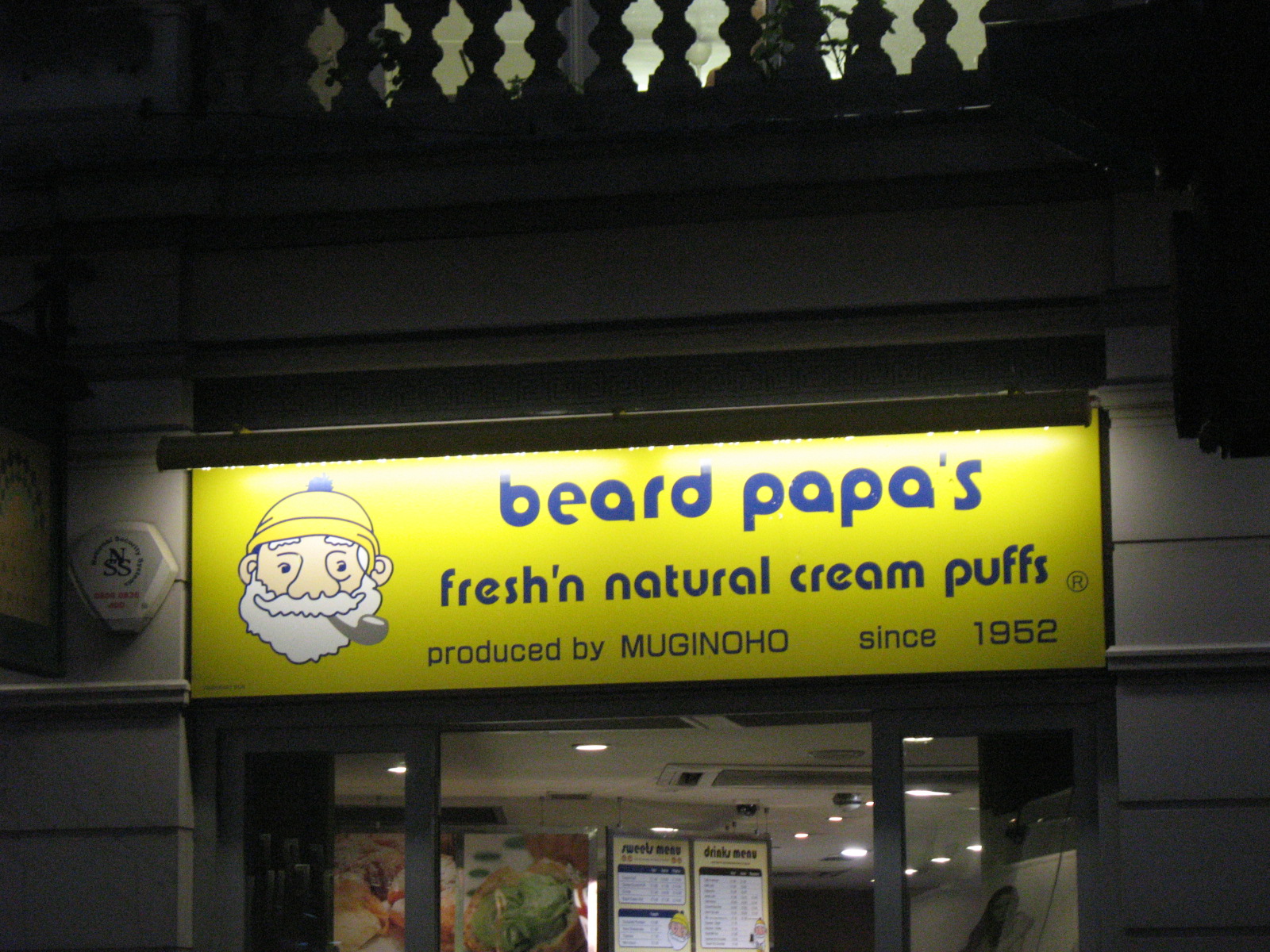
I must have walked past this shop on Oxford Street hundreds if not thousands of times. Yet it’s only now that I ask: who is Beard Papa? What is a cream puff? Why would anybody eat one? Are they really fresh? ‘N natural? Why are they advertised by Ken Bates? How did this shop get here from its original location in a suburban Belgian railway station? Who is Muginoho? And 1952, really?

Passages in books that make reviews unnecessary: No 1

‘Gustav Metzger and John Sharkey were prosecuted under the Obscene Publications Act for organizing Hermann Nitsch’s Abreaktionsspiel No 5 at the St Bride’s Institute in 1966. This consisted of a film showing male genitals controlled by wires and dipped in various liquids projected on an eviscerated lamb carcass used as a screen.’

P154, ‘London Calling: A Countercultural History of London since 1945’ by Barry Miles (Atlantic, £25).

Buy it.

Hare Marsh and Rabbit Marsh: fact and fiction in Bethnal Green, part two

In ‘King Dido’, his 1969 novel about Dido Peach, a docker turned criminal, Alexander Baron set the action in a shabby Bethnal Green alleyway called Rabbit Marsh. This was directly inspired by Baron’s memories of Hare Marsh, a tiny cul-de-sac that still exists near Brick Lane. Here, Baron gives us a careful description of the squalid street.

‘In 1911, although the crowding was less abominable and the old Hogarthian bedlam had vanished, the street was still a slum, the roadway narrow and cobbled, the houses black and decayed, many of the ground floors turned into miserable shops and workshops… the railway lines ran behind high brick walls on an embankment behind Rabbit Marsh.’

It hasn’t changed much, has it?

Although a new block of luxury flats sits on the right-hand side, the left wall is an old workshop, the street is still cobbled and it ends abruptly and noisily at the railway. Dido Peach lived above his mother’s rag shop, so it is perhaps apposite that the building to the left is now a second-hand clothes shop.

Here it is again in 1973, in a brilliant, bleak image by Jonathan Barker on Flickr. Scroll down and Barker also has a great picture of it later that year with Cheshire Street’s atmospheric market in full swing.

Baron writes.

‘Imagine a narrow ravine whose floor consists of worn cobbles running between pavements of uneven flags. Such was Rabbit Marsh. That was all the street was; two narrowly facing rows of such buildings, leaning forward with age, cleft by an alley here or there or pierced at the base by a porch leading into a yard.’

Alexander chose his location carefully – the contrast between the rural idealism of the name and the reality of the space is crucial; the words ‘rabbit’ and ‘marsh’ also have insinuations, of over-breeding and of getting stuck  – but he also cheated a bit. Although we know that Rabbit/Hare Marsh is a short dead-end street in the book it is still large enough to contain several dozen shops and houses (Dido lives at No.34) as well as a pub (the Railway), and we are told it hosts a street market on Sundays. The real Hare Marsh simply isn’t large enough for all of that.

Nowhere in the book does Baron mention Hare Street (as Cheshire Street was then named), the now trendy road that links Hare Marsh to Brick Lane, and my assumption is that the author conflated Hare Marsh and Hare Street to give Rabbit Marsh a little extra space for him to play with than really existed. So Rabbit Marsh is stretched, the residents allowed more room in which to breath.

He did not have to imagine much. Opposite Hare Marsh is a pub that looks a lot like the one described in the book.

This is the Carpenter’s Arms. In another nod to reality, there is real villainy here. Dido Peach ends up becoming a kind of local enforcer, taking protection money from local shopkeepers, and the Carpenter’s was once owned by the Krays. All three Krays – Ron, Reg and Charlie – had their funerals at the nearby St Matthew’s church.

Baron’s descriptions of Hare Marsh are captivating, but they are necessarily evocative. Dido Peach’s universe is tiny, and we have to believe in it. This was true to life. In this era, the average Londoner was born, lived, worked and died within a three-mile circle and Peach’s world is similarly shrivelled. The furthest north he gets is Dalston; south is the impenetrable barrier of the river. His one trip west takes him as far as Liverpool Street station, where he heads for the Tube platform and sits watching the trains coming and going, but never considers getting on board.

In ‘The People Of The Abyss’, Jack London’s 1902 account of the East London poor, he writes of one young soak: ‘From the moment of his birth, all the forces of his environment had tended to harden him, and he viewed his wretched, inevitable future with a callousness and unconcern I could not shake.’

This is also the tragedy of Dido Peach’s life, the limitations of possibility and how poverty destroys self-belief and any means the protagonist has of escape, but it is what makes the book so acute and so realistic. Seek it out, then take the pilgrimage to this tiny and otherwise forgotten dead-end alleyway in E2, where fact and fiction collide in gritty, grotty greatness.

Part one is here.

Hare Marsh and Rabbit Marsh: fact and fiction in Bethnal Green

Last month, a friend bought me ‘King Dido’ by Alexander Baron, a lost London novel written in 1969 that has recently been reprinted. It is set in the East End in 1911 and is about Dido Peach, a taciturn docker who almost against his will and certainly against his intentions becomes a vicious criminal, the boss of his manor. It’s a great book – lively, cynical, witty, violent yet thoughtful; it reminded me of Camus’ ‘The Stranger’, but filtered through a very exacting East End eye.

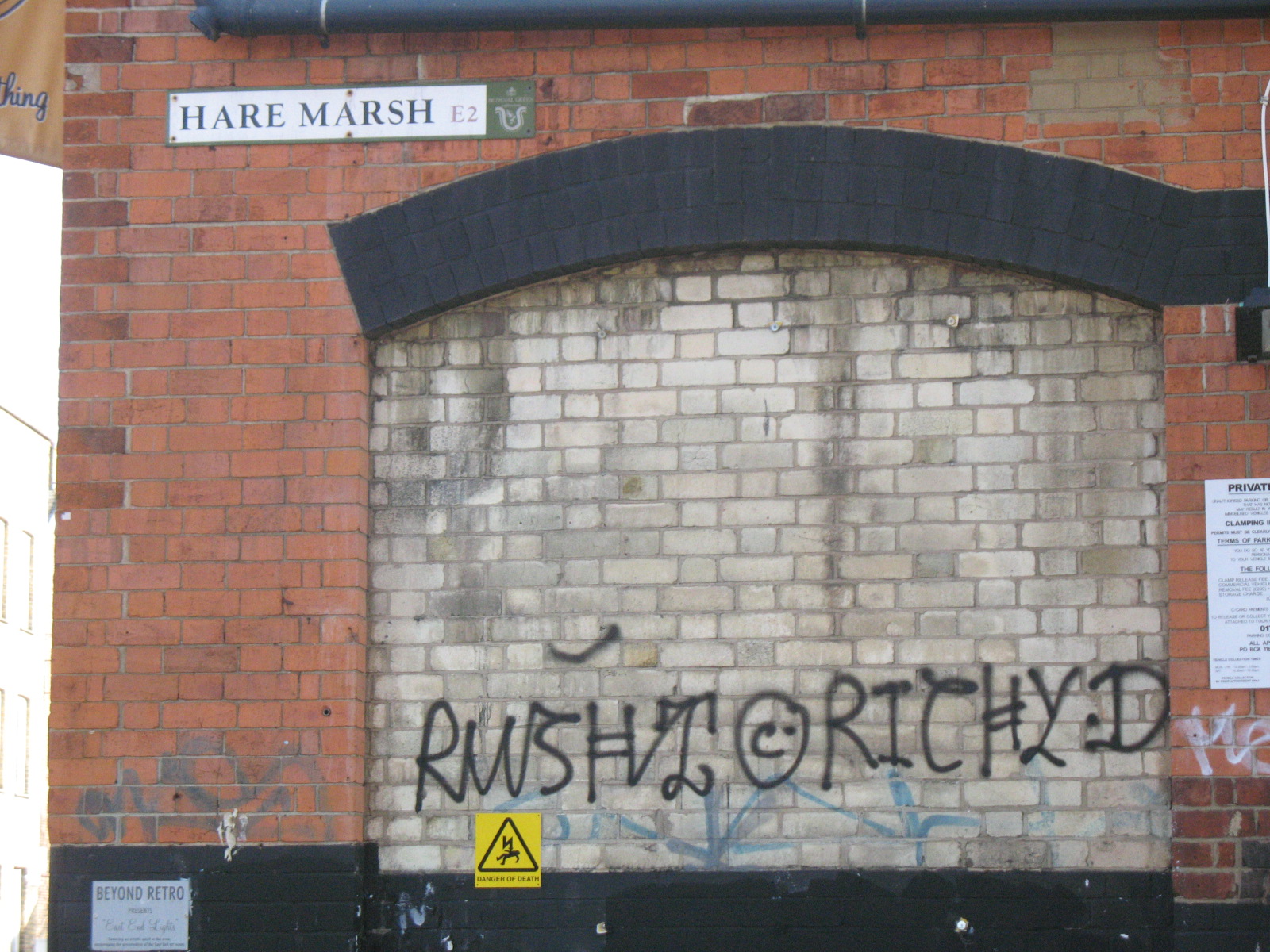
Off  Cheshire Street, south of where it meets St Matthew’s Road, you will find an easily overlooked dead-end street called Hare Marsh. This is where Baron’s mother grew up and it’s where Baron places Dido’s small and rather pathetic manor, renamed Rabbit Marsh in the book.

Originally, Hare Marsh was the name given to the entire area. It had been built on since before the 1670s, but had long been a slum by the time Baron’s book was set. He writes:

‘Rabbit Marsh acquired its name at the end of the seventeenth century, when it was a green and pleasant country place on the outskirts of London. Artisans came here to picnic, practise their sports and trap the rabbits, which abounded… The industrial revolution had turn the whole eastern quarter into an immense slum which had overrun Bethnal Green. Rabbit Marsh was swallowed up with the rest… ‘

This is why William Cobbett called London ‘the Great Wen’, a monstrous cyst that was consuming the country around it, and you can trace the development and decline of Hare Marsh in maps.

Here you can see it on this enlarged square of John Rocque’s London map of 1746. It’s towards the top of the map in the shape of a little lane coming south off Hare Street, the last turning on the right, and heading into fields. Bucolic, no?

To get some perspective, here’s a link to the whole map; Hare Marsh is in square 1F.

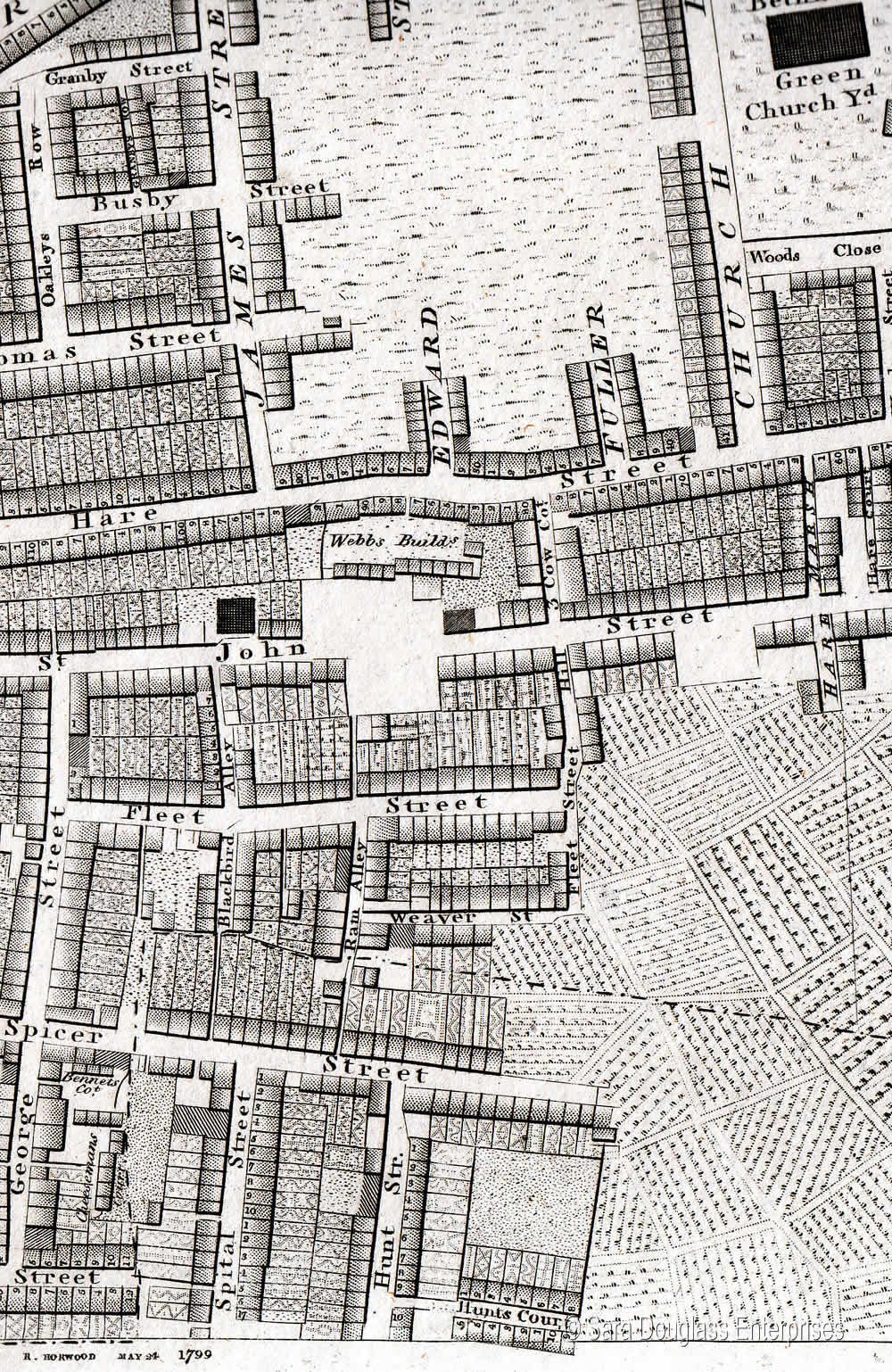
Now, here’s the incredible Horwood map of 1792 – Hare Marsh is on the far right, still an open and pleasant looking space but buildings are starting to encroach.

It hasn’t changed much by the time of the Greenwood map of 1827.

It’s the short street off Hare Street (as Cheshire Street was known until sometime between 1929 and 1945) directly below St Matthew’s Church right next to the big black square.

The square is the workhouse and Hare Marsh also contains almshouses, buildings that show there has been a change in the area’s status. But there’s still no sign of the railway, so even now Hare Marsh opens directly on to fields.

That was soon to change.

Here it is on Booth’s poverty map of 1898, coloured dark and light blue – not quite black (semi-criminal) on Booth’s colour coded scale, but not far off it. Bethnal Green is now entirely built over.

Again it’s the little turning off Hare Street – you can just see it between the ‘r’ and ‘e’ of street. By now, the railway is very much in place, closing in the inhabitants and offering them no escape. This feeling of dead-endness, of a lack of options, of claustrophobia, is central to the atmosphere of Baron’s book and partly explains why he chose this as the location. The railways brought London its greatest devastation since the Great Fire, and this is a great example of the adverse impact it had on individual streets.

Finally, here it is (square aD) in 1922 shortly after the period in which Baron’s book was set (and again in 1952, by which time Hare Street had become Cheshire Street). What had been a quiet lane, open to fields and on the very edge of London, was now a cul-de-sac, hemmed in by a noisy and polluting railway, in the heaving centre of London’s chaotic and overpopulated East End. The perfect location for a novel about poverty and powerlessness.

More on Hare Marsh later.

Many of these maps are available for purchase from the linked websites.

Free London writing talk with Iain Sinclair

Iain Sinclair is one of three writers who will be giving free talks on the subject of ’21st-century London writing’ at the University of Westminster’s Regent Street campus (309 Regent Street, W1B 2UW) starting next month.

Sinclair will be talking on March 4 at 6pm. He will be followed by Toby Litt on March 11 and Rachel Lichtenstein on April 22, both at 6pm. The writers will discuss their work in relation to the city and the opportunities and challenges it offers/poses to contemporary writers.

All talks are free and take place in the Boardroom, but booking is essential. Reserve your seat by emailing Sharon Sinclair at sinclas@wmin.ac.uk to book a place.

Love is…

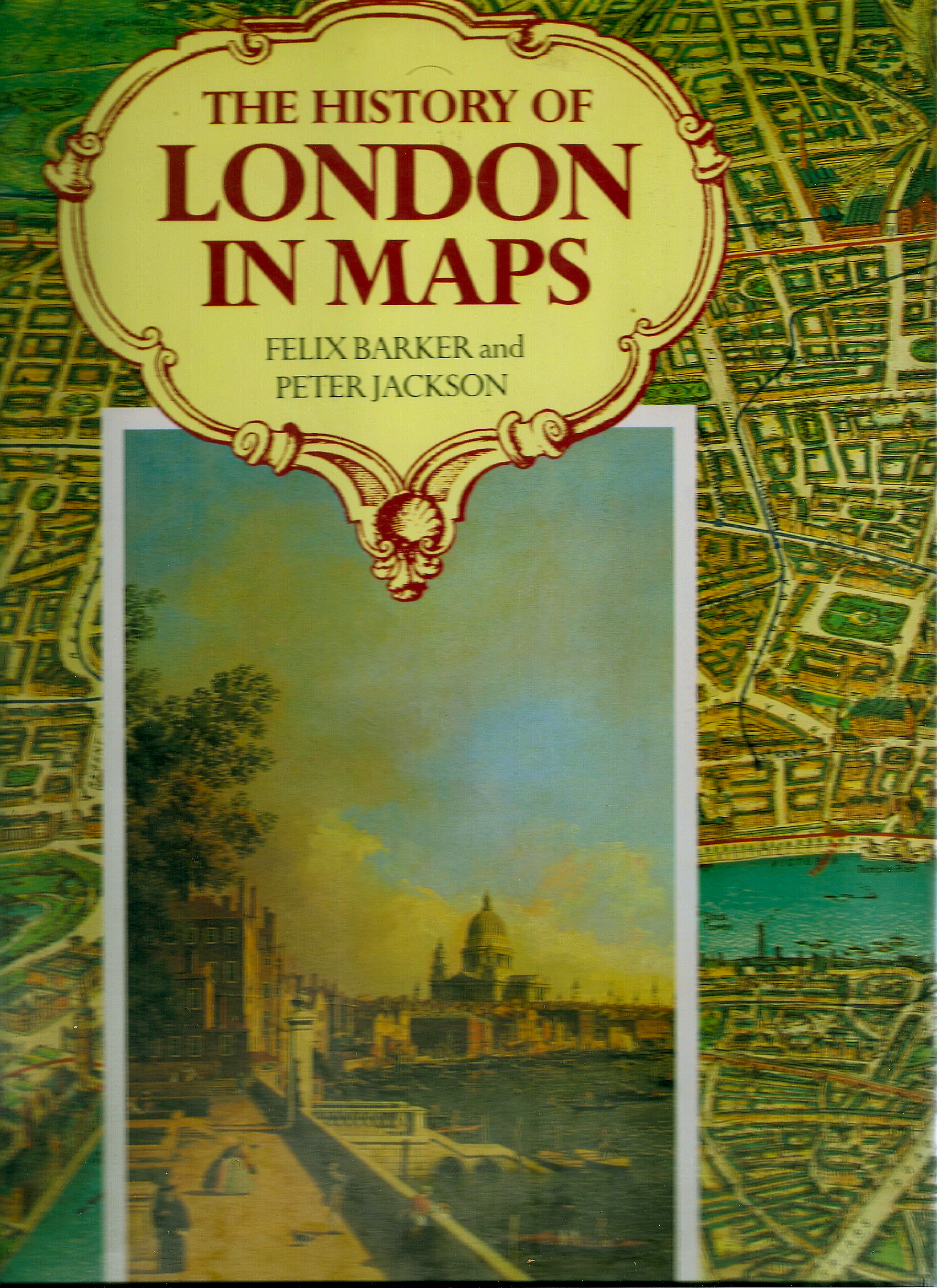
Another book on London maps, for a tenner, from Charing X Road. Yes, I had to get it for myself, but there’s no shame in that. Happy Valentine’s for those so inclined, I’m off to recline with John Rocque…