Richard Fortey’s secret tour of the Natural History Museum

Some years ago, the writer and scientist Richard Fortey took me on a tour of his favourite items in the Natural History Museum. His book, Dry Store Room No 1, is one of the best books I’ve read about London museums.

1 ‘This is the collection of all known species of humming birds which I used as the cover for my book. It goes back nearly 200 years to the earliest days of natural history as spectacle. One of the amazing things is that the colours, the iridescent feathers, have survived so long. You can even see the tiny eggs, with the appropriate egg in it. This whole bird gallery is a survivor to the old days of the museum, preserved almost apologetically as an example of the classic gallery, but a lot of people still stop and look at it even though it’s just stuffed birds.’

Pregnant ichthyosaur fossil showing three skeletons of young inside her bodys 2. ‘This one of the great sea dragons, an ichthyosaur, a marine reptile. This one is particularly beautiful and informative because within the body cavity you can see here outlined in red, the remains of other smaller individuals. The question originally was ‘were they cannibals or did they give birth to live young’ and the answer is almost certainly the latter. These animals are very like porpoises and almost certainly lived the same way, gregariously and pursuing a very fast life that gave them no time to sit on eggs. But this is very easy to miss.’

45 NHMX 4597.jpg

3 ‘The building itself. You can choose anything from the various animals and birds that adorn the interior. Even the pillars are based on the bark of trees. On the whole, the building moves from living to fossil as you go from one end to another and that is true also of the animals portrayed. In the mineral gallery, right at the end above a door on the left is a dodo. I also think that one of the monkeys has been made to look a little like Darwin.’

4. ‘The mineral gallery has probably changed the least since my early days and it’s also the least visited. It’s a classic systematic approach where all the minerals are laid out in cases arranged by chemical composition, so you could come here and learn some serious mineralogy if you started at one end and worked your way through. At the end, in the Vault, where particularly precious minerals are displayed, is something  called bournonite with black wheels shaped like cogwheels. This came from a Cornish mine that has since closed so this is really the only good specimen that will ever be found with this particular chemical composition. It’s now extremely valuable because the rarer something gets, the more valuable it becomes.’

5. ‘The blue whale, it might be obvious but it is remarkable. For a while, during the war, some people working here kept an illicit still in the belly of the whale. So even with the best-known exhibit, there are secrets to be had.’

The Natural History Museum's table tops

6. ‘Finally, head for the geology section in the mezzanine level. This used to be an old-fashioned museum in its own right but now it has been changed and in making space they only put back about ten per cent of the specimens. Each one is individually highlighted so it doesn’t give you the systematic overview or leave room for the quirkier items. But this table is still here. It’s a collection of North European ornamental stones all made into one table. You can even make out fossilised nautiloids of around 450 millions year in some of them, and also fossilised coral. There’s no label for it, nothing to say what it is and where it came from. You and I are probably the first people to have stopped and look at this for several weeks.’

London: ale and hearty

I like beer, but I do not fully understand it. By which I mean, I vaguely understand how it is made and I know how much of it I can drink (less with each year), but while I know fairly quickly whether I do or do not like a particular beer, I am never entirely clear exactly what it is I like about it. Is it the hoppiness, the finish, the strength, the, I dunno, malt? Search me guv.

I took this ignorance with me when I interviewed Evin O’Riordain, owner of the Kernel Brewery, at his microbrewery in Bermondsey. Evin is an intense fellow. In lots of ways he reminds me of people  who run independent music labels, absolutely committed to a certain ethic, a particular way of doing things, not because it is easiest or will bring the most rewards, but because it is right. Indeed, Kernel’s stark labels even remind me of Peter Saville’s Factory Records sleeves.

Electronic Beats - Kaufen: FACT 14

Evin talked me through his brewing philosophy, lubricating his lecture with samples from his stocks. We tried a session ale, an IPA, a porter, a stout and a saison. Evin told me about each style’s particular history – how it came to be brewed, who it was originally for – and then explained Kernel’s sophisticated fundamentalist take on it.

It was a very pleasant afternoon.

Photo by Josh Shinner.

The result of that chat with Evin, and four other London brewers (none of whom actually come from London), can be seen in my piece on London’s brewing renaissance in this month’s London Magazine.

New London writing, or What the fuck is psychogeography anyway?

I don’t think anybody, with the possible exception of Will Self, really knows what psychogeography means but that doesn’t mean there’s not a lot of it about. For years, the London writing landscape has been dominated by three masters of the genre, the Ackroyd-Sinclair-Self trinity (in this interview, Self distinguishes between their different approaches) – it’s hard to find a book in the Museum Of London bookshop that doesn’t have an intro penned by one of them – but that is starting to change. In the past year or so, three books have been written by debutant writers that take a broadly psychogeographical approach – you can tell this by the use of words like ‘palimpsest’ and liminal’ –  to the city or patches thereof but are happy to present it in a more approachable, less LRB-approved style.

The man above is Nick Papadimitriou, and his Scarp is the most Sinclairian of the three, written by a man obsessed with a small parcel of land on the city’s northern border. ‘I’m trying to get below the surface into something that’s moving in my mind as much as in the landscape,’ he says, which doesn’t say a great deal and is therefore as neat a summary of his obscure methodology as you are likely to find. Scarp is a wonderful book, a brilliantly obsessive and beautifully observed celebration of the meditative quality of what Papadimitriou calls deep topography and the rest of us know as walking. It’s also classic psychogeography in that you read it in the knowledge that a significant proportion of the theorising is total codswallop, but at least it is entertaining codswallop, an intriguing combination of the occult and broad generalisations about place drawn from a tiny physical space.

Next up in This Other London by John Rogers, a lighter but similarly intentioned account of ten walks – ‘a plunge into the unknown’ – around fairly random parts of London that were previously just strange names on old maps to the author, a film-maker and good egg. Rogers has none of the astonishing familiarity with his territory as Papadimitriou and he makes a virtue of this, imbuing the book with the joy of new discovery. It is, as a friend noted, a salute to the rewards of simple rambling, of going somewhere unusual and just strolling, or flaneuring to use the specific vernacular of psychogeography. As an alternative guide to London walks – or an inspiration to do the same yourself – it is a marvel.

Finally, came Gareth Rees‘s Marshland, hallucinatory, speculative non-fiction about the marshes of Hackney and Walthamstow that combines Scarp‘s deep knowledge about a specific locality with the dry wit and accessibility of This Other Land. Again, Rees is fond of that psychogeographical turn of phrase – ‘There is no final draft of London’, being a particularly fine example – but laces it with humour as he explores this odd landscape of rave holes, filter beds, football pitches and reservoirs (and a fascinating landscape it is too), mixing in a bit of fiction and even offering an audio soundtrack. Rees has a tremendous, natural, written voice and the book fairly skips along. I loved it.

All three books are a lot of fun and that is the great, dirty, secret of psychogeographical writing – it is hilariously fun to do as you train your brain to make grandiose statements about people, place and history that you are fairly sure won’t stand up to any great inquisition but look fucking brilliant on paper. Bill Drummond’s neat summary of psychogeography is perfect – ‘An intellectual justification for what I have been doing most of my life’.

I do not consider myself to be a psychogeographical writer (and here I express some of my dislike of it), but that’s not to say I’ve never indulged in it myself of occasion (as here, when writing about Wappingness), particularly when asked to do so by property developers, who seem to love this style of writing as a way to signify their deeper engagement with the city they are hoping to exploit.

By my experience then, psychogeography is used as much to shift property as it is to expand and combine the frontiers of space and mind, which is perhaps inevitable in London, where any amount of folklore and fauna only really has any value if it can be seen to have a positive effect on land prices. I’m not entirely sure that this is what Guy Debord was hoping for when he first conceived his theory, but given that he’s long gone there’s not a great deal he can do about it.

Situationists at the Sailors' Society in London during the 4th Conference of the Situationist International. Those assembled included (from l. to r.): Attila Kotányi, Hans-Peter Zimmer, Heimrad Prem, Asger Jorn (covered), Jørgen Nash (front), Maurice Wyckaert, Guy Debord, Helmut Sturm, and Jacqueline de Jong. To ensure that the proceedings were kept away from any contact with artistic circles or London newspapers, the conference took place in Limehouse, "a district renowned for its criminals."

Guy Debord’s Situationists in Limehouse, in search of Wappingness and investment opportunities.

Five fictional Londons

For more on London Fiction, see the latest issue of the wonderful Curiocity map-magazine. 

Nú Lundun

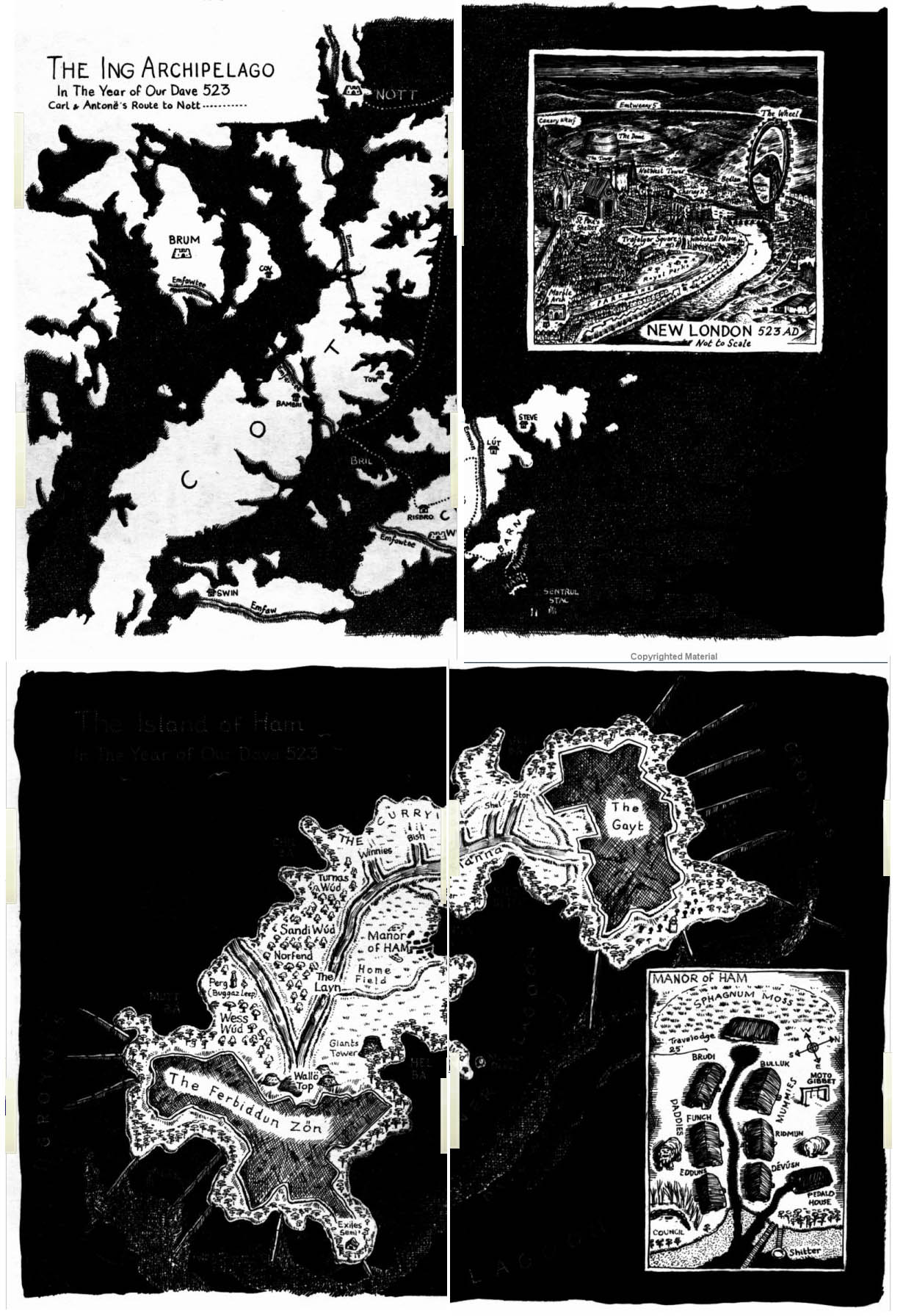
The Book Of Dave (2006)

Will Self’s phonetic and splenetic Mockney masterpiece imagines a future London buried beneath flooded waters. It is set on the island of Ham, all that remains of Hampstead Heath, where the inhabitants worship a psychotic taxi driver, so take a cab up to Parliament Hill and imagine yourself looking down upon a lagoon. The book ends in Nú Lundun, rebuilt near Nottingham.

MAP

Un Lun Dun

Un Lun Dun (2007)

China Mieville’s underground fantasy city populated with things that people in real London throw away and accessed through a door in an estate in Kilburn. If you stand in the right part of Charing Cross Road and stare through a grille in the pavement, you can see a subterranean sign for a long-lost London street – perhaps this is how we can enter Un Lun Dun?


Brit-Cit

2000AD (1980s-present)

A post-apocalyptic city of giant towers and rage imagined by the creators of Judge Dredd, this megalopolis has distinctive landmarks like the New Old Bailey, Bigga Ben and the Battersea Mutants Home. The closest you can get to it today is by walking around Canary Wharf in a motorcycle helmet shouting ‘Drokk’ at passing bankers.


London Below

Neverwhere (1996)

Neil Gaiman’s TV series about a magical subterranean London where many of London’s evocative place names – Angel, Earl’s Court, Knightsbridge – have come to life: there’s a real angel, a real earl and the Night’s Bridge is an ominous stone bridge. Recreate the experience by going to Catford shopping centre with a tin of Whiskas and trying to entice the giant cat down for a cuddle.

Londongrad

Comrade Dad (1986)

Short-lived sitcom starring George Cole and set in London in 1999 after a Communist invasion – the opening credits feature the Red Army marching through Trafalgar Square while a revolving red star sits atop Nelson’s Column. Recreate the experience by living in a tiny London bedsit struggling to pay the heating bills while the government and their cronies bathe in diamonds and caviar and listen to your phone calls.

The Ramones in London: What if nobody speaks English?

I have written a cover story about the Ramones in the current issue of Uncut. One element of the Ramones story is their two gigs in London in July 1976, when the band played the Roundhouse and Dingwalls before audiences of around 5,000 at a time they were drawing around 150 back in New York.

These are considered key dates for the punk revolution in the UK, giving a kickstart to the three pioneering London punk bands, the Sex Pistols, Damned and Clash. The truth is a little more complex. One of the reasons the Ramones even got a record deal was because of interest in the New York scene in the UK. As Craig Leon, who produced Ramones for Sire, told me: ‘There had been inklings in the British press that something was happening and Malcolm McLaren had been over for a while managing the New York Dolls and took a lot of the scene – mainly Richard Hell’s dress sense – over to London, where it began developing in its own way. Sire felt that if we could make a cheap album and then get our money back in Europe it wasn’t a risky proposition.’

So even before the Ramones went to London, they knew the city was familiar with the CBGBs scene. For a band that loved English pop, this was quite a thrill. As Tommy Ramone explained, ‘They said the UK was interested and we’d grown up with all our favourite bands coming from the UK [Tommy told me that “Judy Is A Punk” was basically based on “I’m Henry VIII, I Am” by Herman’s Hermits] so we were very excited and we thought it might give us our break. We went over for a few days and played the Roundhouse and Dingwalls. We met a lot of the English bands, who came to the soundcheck at Dingwalls. We knew that we had sold out these place so we had an idea something was going on.” The success of the Camden shows did nothing for the band’s reputation back home, however. When they returned they continued playing in front of small crowds. In fact, as the Pistols gained in notoriety, being associated with English punk acts was more of a hindrance.

Nonetheless, Danny Fields, the band’s manager, felt the Ramones appearance gave London a crucial fillip. ‘To be the toast of London was incredible. There were people line up to meet them, to sleep with them, to sleep with me. All the would-be bands were there to see them. The  dressing room was full of people from the Clash, Damned and Sex Pistols. They were amazed that a band could put out a record like this, that they would even be allowed to play. We sat with Paul Simonon before the show and he said to Johnny he was in band but they weren’t good enough. Johnny said, “You’re going to see us for the first time. We suck, we can’t play. But don’t worry about it, just do it.” Johnny Rotten had to climb up knotted sheets. They took inspiration and thought the Ramones were exotic. The inspiration was, “We stink, stop rehearsing, start playing.’”

The only problem with Fields’ narrative is that the Pistols and Clash already were playing. Indeed, both bands actually missed the Ramones show at the Roundhouse because they were playing that same night, at the Black Swan in Sheffield, while the Stranglers were supporting the Ramones. The Damned made their debut a day after the Ramones show at the Dingwalls on July 6. So Rat Scabies, Damned drummer, thinks the influence of those London shows was more subtle. ‘Their influence on British punk rock is negotiable, because the London bands had already started,’ he says. ‘We were rehearsing, the Sex Pistols and Clash were doing the odd gig. But I remember listening to the Ramones debut album with Paul Simonon and we thought it was great as it was exactly what we were all about, three minute pop songs about life. We felt an immediate connection and it was confirmation: we realised we weren’t the only ones doing it. What was important isn’t ‘who came first?’ but the fact the same thing was happening in different parts of the world. It wasn’t just London frustration, it was the next generation getting angry. It made us realise we weren’t alone.’

In that sense, the Ramones shows were more like the International Poetry Incarnation at the Royal Albert Hall in 1965, when the hippies, ex-Beats, freaks and flower kids all turned up at the same place for the first time and realised they had a constituency, that the happenings they were organising in silos could be fed into a collective scene. It’s a glorious movement for any youth movement, the realisation you are part of something bigger than yourself. Even the underground wants to be popular.

The Ramones shows then have passed into punk legend, to be reinterpreted by new generations. ‘There’s a comic book called Gabba Gabba Hey that talks about the Ramones trip to London and how we were so concerned about the economic conditions, the UK depression, unemployment, children out of work,’ says Fields. ‘In truth, we were there for three days and the last thing anybody was thinking about was whether the British state was unfair to unwed mothers. They only thing they were worried about on the flight over is whether we had enough t-shirts to sell and what if nobody speaks English.’

Here’s an excerpt from the Ramones documentary End Of The Century talking about the Ramones in London.

Homeless in London

This is a rewritten version of a piece I wrote on London’s homeless tours in 2011. 

No amount of playful London nerdery can prepare you for the emotional thump that is an Unseen Tour. These walks are organised by Sock Mob, an informal group of volunteers who work with London’s homeless – and it’s the homeless, or former homeless, who take you on the tour. In their company, you’ll learn things about London you probably didn’t know, like where to find the Second World War shrapnel on the side of St Clement’s Dane church on the Strand, and you’ll learn things you definitely didn’t know, like which Covent Garden cafe gives food on credit to the homeless when they are short of cash.

We meet at Temple, that aged hive of streets dominated by the vast grey Victorian Gothic splendour of the Royal Courts of Justice. Mark and Viv, the tour guides, have spent long periods sleeping rough and few people can have as strong a relationship with the streets of London as those who used to sleep on them. The next hour-and-a-half is a powerful mix of autobiography and ancient history. One minute Viv is talking about the Knights Templers, who lent their name to the area after building a circular stone church here in 1185, the next she’s telling you about the night she got chased from her ‘bash’ (a makeshift shelter constructed every night) under Waterloo Bridge by a gang of ‘rough elements’, a group of homeless women pursuing a petty feud. This truly is another London, and one that most of us will never have to discover. It is a bitterly cold night and as snowflakes fall , the bleak doorways that Mark once called home look especially uninviting. London can look like something from a fairy tale in the snow, but not this night.

As we move into Theatreland, the tour develops the ebb and flow of performance art as comic vignettes – a singalong of ‘The Muffin Man’ on Drury Lane – are mixed with upsetting accounts of the vicious treatment the public can hand out to the homeless. Mark and Viv have harrowing stories of their time on the streets. They talk of rough sleepers who have been spat on, robbed, punched and even set on fire by passers-by. ‘Somebody called me a tramp last week,’ says Mark, more indignant at this verbal slight than with the physical abuse he has received. Despite these dangers, this area between West End and City has always been popular with the homeless: the narrow streets are largely free of cars but receive plenty of pedestrians, often tourists on their way to the theatre, pockets jangling with change. Mark and Viv point out safe alleyways, often frequented by rough sleepers, that have been their former homes; or they take you to areas that the owners have rendered unusable for sleepers through the erection of barriers or removal of anything that may have acted as a shelter.

The walk concludes at Lincoln’s Inn Field, a large green square in Holborn surrounded by imposing terraces. With a fresh fall of snow on the lawn, it’s a majestic sight but this was once a vast homeless campsite called Tent City. In the early 90s, the homeless were noisily evicted, part of an ongoing campaign against rough sleeping that Mark and Viv say is escalating, with long-running soup kitchens being banned by councils and rough sleepers forced to move from favoured spots in the West End out into the suburbs where they can be ignored. There is danger here – previously rough sleepers found safety in numbers, but now the forces of the state, as well as private security firms hired by companies to protect the public appearance of their premises, crack down on large groups of homeless people. The number of homeless on London’s streets is rising, but that is harder to discern than it was in the 1980s, when there were huge homeless camps like Waterloo’s Bull Ring and Holborn’s Tent City. The state has sanitised the streets and tried to tidy the homeless away. They do not fit into the narrative of London as a great city of opportunity, reward and cash. But they still exist. 

The tour finishes on this disconcerting note, and Viv and Mark depart for their hostels in a flurry of kisses, handshakes and farewells and I wander off into the snow, back to my warm home and family. London will never seem quite the same again.

There are Unseen Tours in Camden, London Bridge, Covent Garden, Shoreditch and Brick Lane. For more information and to book tickets, see here

Phyllis Pearsall and searching for truth in the A-Z

I’ve written before about the urban legend surrounding Phyllis Pearsall, and her oft-repeated claims that she created the A-Z by walking every inch of London streets even though she could have just picked up the London street atlas created by her father, Alexander Gross, a few years before.

Pearsall related how she single-handedly created the A-Z in a pair of self-published unreliable memoirs and this became the definitive account after the publication of this biography. The story of Pearsall’s life has now been made into a musical, The A-Z Of Mrs P, at Southwark Playhouse.

The veracity of Pearsall’s claims is robustly challenged by her half-brother, Alex Gross, who has created a website dedicated to establishing the truth behind the creation of the A-Z and the key role played in it by his and Pearsall’s father, Alexander Gross. The image below comes from Gross’s map and show how much it looks like the A-Z. An excellent comparison of the two maps can be found in Peter Barber’s London: A History In Maps.

IMG_2230[1]

A summary of Gross’s argument can be found here. Gross is hugely critical of the story Pearsall created. He is adamant that Pearsall was operating at the direction of her father to update his already existing London street atlas and is dismissive of her claims that she walked the streets for 18 hours herself, or delivered early copies of the A-Z herself by wheelbarrow. I have no way of telling whether Gross is accurate in his own recollections, but I know that his skepticism towards Pearsall’s claims are shared by Peter Barber, who is head of the map collection at the British Library.

Gross is scathing about Sarah Hartley’s book on Pearsall, Mrs P’s Journey, claiming it has more in common with ‘chick lit’ than it does biography (never having read either ‘chick lit’ or Hartley’s book, I cannot pass opinion on this). Gross also casts a withering eye over Pearsall’s own books about her life in great detail. There is also considerable biographical material on Gross’s relationship with both his father and half-sister, later describing her as ‘urbane, witty, and utterly personifying the spirit of the English eccentric’, something that goes a long way towards explaining why her version of history has been so widely embraced by the British public.

Wappingness

This is an edited version of a piece about Wapping  written in 2011.

‘Explore Wapping,’ exhorted Samuel Johnson to Boswell, ‘to see the wonderful extent and variety of London.’ It is fine advice still. Johnson was speaking in the 1790s, when Wapping was London’s principle settlement for sailors, a hive of cobbled streets and damp, narrow alleys that led to the numerous wharves and jetties of riverside London, but his instruction rings true today. Explore Wapping and see how London can demonstrate a seemingly infinite capacity to reinvent itself, how it will welcome newcomers and how it celebrates its past while never neglecting to engage with the future. Few cities have such a knack at looking simultaneously backwards as well as forwards, and few places in London do this better then Wapping. Here, Morrissey explores Wapping landmarks in his 1992 video, “We Hate It When Our Friends Become Successful”, just as the area was undergoing heavy gentrification.

To understand Wapping try approaching it from St Katherine’s Dock, the pretty riverside development that lies adjacent to the Tower of London. Leave St Katharine Dock at the point where it almost touches the Thames and you will arrive in Wapping at the very western end of Wapping High Street, the charismatic street that runs parallel to the river for the length of the district. Here, on the corner with Kennet Street, is a large stone wall, decorated with icicle-like drips of cement. Inside the wall is a large red brick building, which still proudly wears the emblem of the Port Of London Authority, although this has over time turned the sort of misty green colour you associate with cannons dredged from the ocean floor.

This is the old dock house, a remnant of when Wapping was home to London Docks, and it stands next to Hermitage Basin, one of the few parts of the dock complex not to have been filled with concrete and covered with roads and houses in the 1970s. Hermitage Basin once offered a way for ships from around the world to get from the mammoth London Dock to the Thames, but now it is a sweet little ornamental lake surrounded by houses, and a home itself to a sedate family of regal swans and the odd mallard.

Hermitage Basin is a fine example of what you could call Wappingness: the way Wapping has come to terms with its past, making sensible accommodation with what has been before. This has not been an easy task. Wapping has been battered by change over the centuries, first when the docks were built in 1805, carving great watery holes throughout the neighbourhood and reducing the population of 6,000 by two thirds, and then when they were filled in again in the 1970s, eradicating what had been Wapping’s identity for more than 150 years. The warehouses and docks of Wapping were also heavily targeted by German bombers during the Second World War. But still it prospers.

Signs of Wapping’s maritime heritage are everywhere. Before the docks arrived, it was a place of wharves, jetties, warehouses, boatbuilders, sailmakers, brothels and pubs, having been originally settled by the Saxons and used by London’s sailors for centuries. The building of the docks over reclaimed marshland helped cement these long links with the sea, even if they replaced the bustling village atmosphere with vast warehouses and a more transient population. The London Docks were the closest docks to the City of London, which gave them a significant advantage over those docks that had recently been built on the Isle of Dogs.

In these Wapping warehouses, dockers would unload treasures from right across the British Empire, including tobacco, rum, whalebone, spices, cocoa, coffee, rubber, coconuts, marble and wool. Settlers from overseas lived in Wapping – nearby Limehouse was home to London’s first Chinatown and is now home to a thriving Bangladeshi community – and artists, writers and poets would come to Wapping to glimpse exotica in the form of both the goods brought from overseas and in the working-class men and women who lived and worked in the area. They would then disperse around London and the East End, taking some of the essence of Wapping with them across the Highway into Whitechapel, Spitalfields and beyond. Later still, artists set up studios in the derelict warehouses of Wapping in the 1970s, heralding a trend that soon spread throughout east London.

The chief attraction, of course, was the river, although the Thames itself can only intermittently be glimpsed between the tall warehouses that act almost like a river wall. But stroll round Wapping and you’ll see signs of its maritime history everywhere in the shape of weathered dock walls, converted warehouses and industrial walkways that allow passageway high above the cobbled streets. Here are restaurants and pubs that pay homage to the past, plus a pretty canal that stretches in a narrow strip from Hermitage Basin in the west to Shadwell Basin in the east, offering a slender shadow of the bustling docks that once stood here. Between buildings on Wapping High Street you can see numerous ancient stone stairs, green with age, that lead directly down to the river.

Such is the all-pervasive water-soaked atmosphere that Wapping itself can even feel like something of an island, bordered on three side by the liquid barriers of the Thames, St Katherine’s Dock and Shadwell Basin and with a busy main road, the Highway, to the north, cutting it off from the rest of London. And within this island, there is just as much to explore as there was in Johnson’s time. You can find London’s oldest riverside inn, the grisly site of pirate executions, an abandoned shopping centre, a gorgeous listed church, a power station turned art gallery, a historic foot tunnel, London’s only memorial to the Blitz, a beach that the Beatles posed on, mudlarks searching for Tudor bric-a-brac, Wapping Wood and an escaped tiger. So follow Johnson, explore Wapping, embrace Wappingness.

Secret London: more streets beneath London streets

A fascinating, I think anyway, footnote to my previous post about the secret streets beneath London comes courtesy of reader Steve Lloyd.  Although it may raise more questions that it answers.

Steve worked at shoe shop Lilley & Skinner in the early 1980s and thinks the abandoned Victorian shops beneath Selfridges as seen at around 31 minutes in Malcolm McLaren’s The Ghosts of Oxford Street, may have been located in their basement. I’ll let Steve take up the story.

SAVE0010

‘In the early 80s I was manager of Lilley & Skinner at 356-360 Oxford Street (the largest shoe store in the world according to the Guinness Book of Records). The staff entrance to the store was at the rear along Barrett Street. Here was a short driveway downhill into the building where I used to park.Also situated here was the maintenance department and adjacent was a concrete staircase which led down to several lower levels that were really no more than cellars. The lads in maintenance had told me about the ‘old street’ that was down there and took me down one day to have  to have a look.

Though of course very interesting there was not a lot to see, just a bit of old shop front under some arches and some cobbled street. The lads said that the council had put a preservation order on it and that we weren’t allowed to use the space in any way.

I found some stills from The Ghosts of Oxford Street a couple of years ago after I saw it discussed on this forum and I have to say that they are exactly how I remember the site at Lilley & Skinner.

523-33904523-33905
The first is one of the arches and the second is the piece of shop front and window frame. Entering the right of the store from Oxford Street you’d go downstairs to the Mens department on the lower ground floor and then there was another department (Tall and Small) at lower lower ground floor, which was on the left hand side of the building. Our secret street was a couple of levels down from that.’
imgres
So there we go. Is this the true location of the secret street beneath Oxford Street? Does it really have a preservation order from the council? And if so, does it still exist? The site at 360 Oxford Street, incidentally, is now a branch of Forever 21.