Category Archives: Mumbo jumbo

Hawksmoor at the Royal Academy: bunkum and brilliance

As the adverts all over the tube let us know, there’s currently a big David Hockney exhibition at the Royal Academy. Less well advertised, but far more compelling from a London point of view, is the same gallery’s fine show on the fascinating architecture of Nicholas Hawskmoor.

This takes place in the Architecture Space – a nice name for a small corridor near the restaurant – and features a short introduction to the architect, alongside photographs and paintings (photographed, not originals) of key works that feature or reference Hawksmoor’s work.

Leon Kossoff's Christchurch, Spitalfields

Hawksmoor, who specialised in hefty Baroque churches, is not an architect to everybody’s taste. In 1734, James Ralph argued that Christchurch was ‘beyond question, one of the most absurd piles in Europe’.  His reputation was resuscitated by Kerry Downes in 1959, who insisted of his churches that ‘they will repel us or fascinate us, but we cannot escape from their strange, haunting power’. This has been a mantra repeated by writers in the following years.

I actually find it quite easy to escape their powers, strange, haunting or otherwise, but this supposed mysterious attraction of Hawksmoor churches is now almost impossible to ignore or deny. It has been repeated so many times, it’s become fact, as Hawksmoor became the anointed architect for a certain type of London writer, the Peter Cook to Sir Christopher Wren’s Dudley Moore. I admire Hawksmoor’s churches, but don’t see them as particularly profound or unsettling.

Charles Hardaker's Hawksmoor Baroque, St Mary Woolnoth, London

Among the first to take up this theme was Iain Sinclair who wrote about Hawksmoor in King Lud (1975). A quote from the book is reproduced on the wall, and it offers a perfect illustration of what I dislike about the psychogeographic way of seeing London: ‘From what is known of Hawksmoor it is possible to imagine he did work a code into the buildings, knowingly or unknowingly, templates of meaning, bands of continuous ritual.’

‘From what is known’; ‘possible to imagine’; ‘knowing or unknowing’. Make it up as you go along, in other words. There’s nothing wrong with this, of course, but I do resent the way it is elevated above all other forms of London writing.

Sinclair has made a career out it, and he does it so well you could almost believe he takes it seriously. A fascinating map drawn by him features in the exhibition, showing his hand-drawn connections between London buildings, and there’s also a great film in which he talks eloquently about his relationship with Hawksmoor, which began when he was a gardener employed by Tower Hamlets to mow the churchyard grass at St Anne, Limehouse. Sinclair is a wonderful speaker, and spins a fine yarn here.
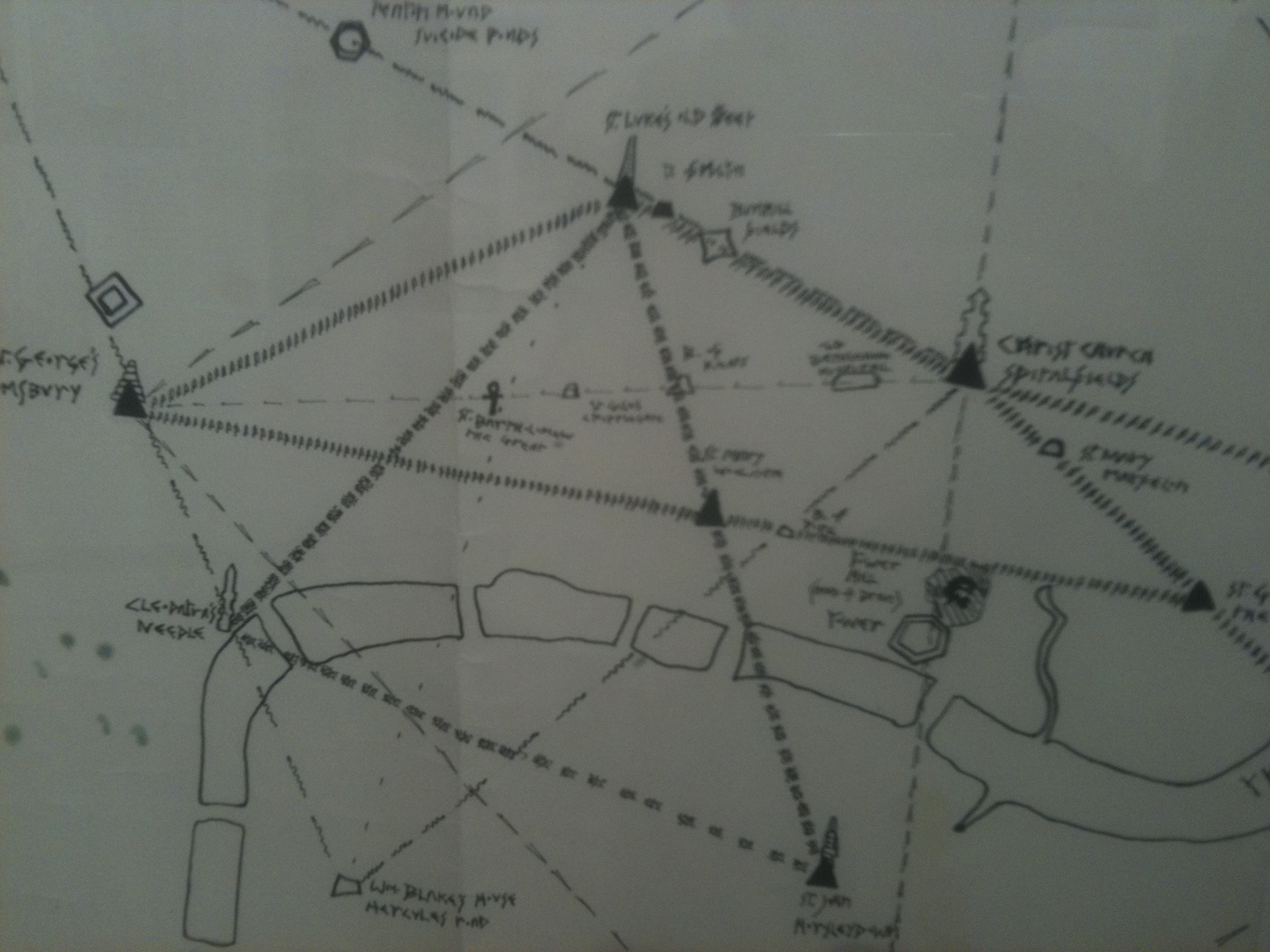
Sinclair's map for King Lud

After Sinclair came Ackroyd and Alan Moore, both of whom woves tales of occultish imagination around this indefinable mystery of Hawksmoor churches. Nonsense clearly, but at least it gave us the majestic From Hell, which features prominently in the exhibition.

From Hell featuring Christchurch, Spitalfields

All this bunkum gets space in the exhibition, but I found much else to entertain besides. There are wonderful photographs and prints of Hawksmoor buildings in many different styles and from varied eras, and also a passionate film by Ptolmy Dean, explaining – quite successfully – the attractions of the easily overlooked St Mary Woolnoth near the Bank of England.

The most interesting element, however, were the photos that drew attention to the parallels between Hawksmoor’s work and more recent buildings. We see a comparison of St Mary Woolnoth and Poultry in the City, and another between St Anne, Limehouse and the National Theatre. It might not be as sexy as psychogeography, but there’s nothing wrong with a bit of straightforward architectural history every now and then.

paul_0133fw.jpg

Celia Paul's St George, Bloomsbury

William Burroughs and the strange demise of London’s first espresso bar

In 1953, a momentous event occurred in Soho. London’s first proper coffee shop – one equipped with a Gaggia coffee machine – opened at 29 Frith Street. This was a place where teenagers too young for pubs could come and gather, and it is said by some that the introduction of this coffee bar prompted the youth culture explosion that soon changed social life in Britain forever.

Inside the Moka Bar

The Moka was an instant success, selling over a thousand cups of coffee a day. The author John Sutherland recalls, ‘the Gaggia machine, a great burbling, wheezing, spluttering monster, would grudgingly excrete some bitter caffeinated essence.  It would be swamped with steamed-milk foam and dusted with chocolate to form its ‘cappuccino’ hood… Glass cups and brown sugar (lots of it) were de rigueur.  Frankly, 50s espresso was no taste thrill.  But it felt smart as hell.’

By 1972, coffee bars where everywhere and the teenage revolution was firmly established. At this time, the author of ‘Naked Lunch’, former junkie and all-round Beat legend William S Burroughs was living in London, quietly going about his business in St James’s. He lived in Dalmeny Court, Duke Street, and loved the plush gentlemen’s shops of the area, not to mention the ‘Dilly Boys‘, young make prostitutes who hustled for clients outside the Regent Palace Hotel.

Although Burroughs was fond of the finer things in life – he got his shoes from John Lobb, hat from Locke’s and bought most of his food in Fortnum and Mason’s – he did at some point stumble into the Moka Bar, and was not impressed by what he found.

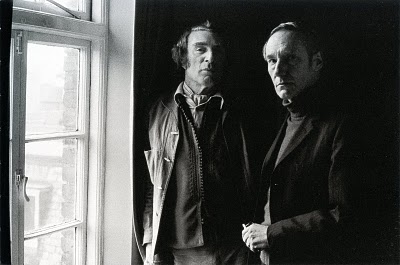
Burroughs and friend Brion Gysin in London

Burroughs at this time was getting sick of London – sick of the licensing laws, sick of the crap food and small drinks, sick of the weather, the terrible service and sexual hypocrisy. He was also sick of the Moka, which he believed responsible for an ‘outrageous and unprovoked discourtesy and poisonous cheesecake’.

The Church of Scientology, Fitzroy Street

Burroughs decided to mount a sound-and-image attack. He had previously launched one of these against the Church of Scientology, of which he had been a member, turning up at their headquarters at 37 Fitzroy Street every day, taking photographs and making sound recordings. He believed that ‘as soon as you start recording a situation and playing them back on the street, you are creating a new reality’ and that repeated exposure to such an attack would lead to ‘accidents, fires and removals’. After a few weeks, the Scientologists did indeed move, round the corner to 68 Tottenham Court Road.

Photo taken by Burroughs during the operation

On August 3, 1972, Burroughs turned his attention to the Moka. He would stand outside every day taking photos and making recordings by tape, and then return the next day to play the previous days recordings. Burroughs was convinced he was winning. ‘They are seething in there,’ he said. ‘I have them and they know it.’

On October 30, 1972, the Moka Bar closed.

This Charming Man: Edward Lovett at the Wellcome Collection

I have a small piece in the Independent about the fascinating  Edward Lovett, whose collection of lucky charms, collated around 100 years ago, has just gone on display at the Wellcome Collection.

Lovett, who lived in Croydon, was a banker and self-taught folklorist who was interested in those items that everyday Londoners kept about their person in aid of good fortune or to ward off bad luck. He would travel to the East End and docks to purchase samples of these lucky charms, which could be anything from a dead mole in a bag to a copy of the Lord’s Prayer written in careful handwriting in a spiral on a tiny scrap of paper dated 1872.

Many of the owners would claim not be superstitious, but then explain in hushed tones how a certain coin or nut or shoe had saved them from disaster; numerous items were from soldiers who had taken them to the Western Front in the First World War.

It is an extraordinary and humble collection, but one that grew so vast that Lovett’s wife eventually left him in despair in 1925. At around this time he wrote a marvellous book – Magic In Modern Love – in which he chronicled some of the items from his collection, but in a delightfully haphazard way, rarely bothering to say exactly where he bought them or when or from whom.

Felicity Powell, the artist who is curating the exhibition for the Wellcome, says, ‘He was not the most diligent of reporters. The labelling is often non-existent, which gives the items real mystery. Sometimes you can’t even be sure what they were for so you have this open space in which to speculate.’

Because Lovett was mainly collecting from the docks around east London, the collection gives a real perspective on London as a trading city that used the river to connect with the wider world. ‘There are objects from all over the world,’ says Powell, ‘There’s even an Inuit paddle.  It all came through London and into the hands of dockers and hawkers. We don’t know if these originally belonged to immigrants or natives. We don’t even know if he was collecting authentic objects. Did the people selling them see him coming?’

Lovett died in 1933 and much of his curious collection was absorbed by the Wellcome and the Pitt-Rivers Museum. It is rarely seen by the public. The exhibition at the Wellcome Collection runs until February 26, 2012.

London’s crappest ghost: a Halloween post

London has many ghost stories and some are actually rather scary, like the Black Dog of Newgate. This spirit is said to haunt Amen Court near St Paul’s, where a wall from Newgate Prison remains. It manifests itself as a shapeless, black form slithering along the wall before it disappears into the shadows.

Considerably less spooky is the ghost said to haunt Pond Square in Highgate.

The story goes like this.

In January 1626, the writer and philosopher Sir Francis Bacon wanted to test his theory that ice could be used to preserve food, so he bought a chicken on Highgate Hill, killed and plucked it, and stuffed the carcass with snow. The frozen chicken had been invented, but the effort caused Bacon to contract pneumonia from which he died.

A sad tale, but one which doesn’t end there. For, ever since, on icy cold nights in the depths of winter, a shape resembling a partially plucked chicken has been seen flapping around Pond Square and squawking before vanishing spookily into the ether.

Yes, that’s right, London is haunted by the spirit of a featherless fowl.

Has there ever been a crapper ghost than this?

Honesty, reliability, quickness

I love these flyers you get in London promoting the work of African spiritualists. I’m not sure how much cause there is for them in Herne Hill, but who doesn’t want to ‘regain fidelity’ or receive the ‘immediate return of affection and of forever love’?