Category Archives: London

The Ramones in London: What if nobody speaks English?

I have written a cover story about the Ramones in the current issue of Uncut. One element of the Ramones story is their two gigs in London in July 1976, when the band played the Roundhouse and Dingwalls before audiences of around 5,000 at a time they were drawing around 150 back in New York.

These are considered key dates for the punk revolution in the UK, giving a kickstart to the three pioneering London punk bands, the Sex Pistols, Damned and Clash. The truth is a little more complex. One of the reasons the Ramones even got a record deal was because of interest in the New York scene in the UK. As Craig Leon, who produced Ramones for Sire, told me: ‘There had been inklings in the British press that something was happening and Malcolm McLaren had been over for a while managing the New York Dolls and took a lot of the scene – mainly Richard Hell’s dress sense – over to London, where it began developing in its own way. Sire felt that if we could make a cheap album and then get our money back in Europe it wasn’t a risky proposition.’

So even before the Ramones went to London, they knew the city was familiar with the CBGBs scene. For a band that loved English pop, this was quite a thrill. As Tommy Ramone explained, ‘They said the UK was interested and we’d grown up with all our favourite bands coming from the UK [Tommy told me that “Judy Is A Punk” was basically based on “I’m Henry VIII, I Am” by Herman’s Hermits] so we were very excited and we thought it might give us our break. We went over for a few days and played the Roundhouse and Dingwalls. We met a lot of the English bands, who came to the soundcheck at Dingwalls. We knew that we had sold out these place so we had an idea something was going on.” The success of the Camden shows did nothing for the band’s reputation back home, however. When they returned they continued playing in front of small crowds. In fact, as the Pistols gained in notoriety, being associated with English punk acts was more of a hindrance.

Nonetheless, Danny Fields, the band’s manager, felt the Ramones appearance gave London a crucial fillip. ‘To be the toast of London was incredible. There were people line up to meet them, to sleep with them, to sleep with me. All the would-be bands were there to see them. The  dressing room was full of people from the Clash, Damned and Sex Pistols. They were amazed that a band could put out a record like this, that they would even be allowed to play. We sat with Paul Simonon before the show and he said to Johnny he was in band but they weren’t good enough. Johnny said, “You’re going to see us for the first time. We suck, we can’t play. But don’t worry about it, just do it.” Johnny Rotten had to climb up knotted sheets. They took inspiration and thought the Ramones were exotic. The inspiration was, “We stink, stop rehearsing, start playing.’”

The only problem with Fields’ narrative is that the Pistols and Clash already were playing. Indeed, both bands actually missed the Ramones show at the Roundhouse because they were playing that same night, at the Black Swan in Sheffield, while the Stranglers were supporting the Ramones. The Damned made their debut a day after the Ramones show at the Dingwalls on July 6. So Rat Scabies, Damned drummer, thinks the influence of those London shows was more subtle. ‘Their influence on British punk rock is negotiable, because the London bands had already started,’ he says. ‘We were rehearsing, the Sex Pistols and Clash were doing the odd gig. But I remember listening to the Ramones debut album with Paul Simonon and we thought it was great as it was exactly what we were all about, three minute pop songs about life. We felt an immediate connection and it was confirmation: we realised we weren’t the only ones doing it. What was important isn’t ‘who came first?’ but the fact the same thing was happening in different parts of the world. It wasn’t just London frustration, it was the next generation getting angry. It made us realise we weren’t alone.’

In that sense, the Ramones shows were more like the International Poetry Incarnation at the Royal Albert Hall in 1965, when the hippies, ex-Beats, freaks and flower kids all turned up at the same place for the first time and realised they had a constituency, that the happenings they were organising in silos could be fed into a collective scene. It’s a glorious movement for any youth movement, the realisation you are part of something bigger than yourself. Even the underground wants to be popular.

The Ramones shows then have passed into punk legend, to be reinterpreted by new generations. ‘There’s a comic book called Gabba Gabba Hey that talks about the Ramones trip to London and how we were so concerned about the economic conditions, the UK depression, unemployment, children out of work,’ says Fields. ‘In truth, we were there for three days and the last thing anybody was thinking about was whether the British state was unfair to unwed mothers. They only thing they were worried about on the flight over is whether we had enough t-shirts to sell and what if nobody speaks English.’

Here’s an excerpt from the Ramones documentary End Of The Century talking about the Ramones in London.

Homeless in London

This is a rewritten version of a piece I wrote on London’s homeless tours in 2011. 

No amount of playful London nerdery can prepare you for the emotional thump that is an Unseen Tour. These walks are organised by Sock Mob, an informal group of volunteers who work with London’s homeless – and it’s the homeless, or former homeless, who take you on the tour. In their company, you’ll learn things about London you probably didn’t know, like where to find the Second World War shrapnel on the side of St Clement’s Dane church on the Strand, and you’ll learn things you definitely didn’t know, like which Covent Garden cafe gives food on credit to the homeless when they are short of cash.

We meet at Temple, that aged hive of streets dominated by the vast grey Victorian Gothic splendour of the Royal Courts of Justice. Mark and Viv, the tour guides, have spent long periods sleeping rough and few people can have as strong a relationship with the streets of London as those who used to sleep on them. The next hour-and-a-half is a powerful mix of autobiography and ancient history. One minute Viv is talking about the Knights Templers, who lent their name to the area after building a circular stone church here in 1185, the next she’s telling you about the night she got chased from her ‘bash’ (a makeshift shelter constructed every night) under Waterloo Bridge by a gang of ‘rough elements’, a group of homeless women pursuing a petty feud. This truly is another London, and one that most of us will never have to discover. It is a bitterly cold night and as snowflakes fall , the bleak doorways that Mark once called home look especially uninviting. London can look like something from a fairy tale in the snow, but not this night.

As we move into Theatreland, the tour develops the ebb and flow of performance art as comic vignettes – a singalong of ‘The Muffin Man’ on Drury Lane – are mixed with upsetting accounts of the vicious treatment the public can hand out to the homeless. Mark and Viv have harrowing stories of their time on the streets. They talk of rough sleepers who have been spat on, robbed, punched and even set on fire by passers-by. ‘Somebody called me a tramp last week,’ says Mark, more indignant at this verbal slight than with the physical abuse he has received. Despite these dangers, this area between West End and City has always been popular with the homeless: the narrow streets are largely free of cars but receive plenty of pedestrians, often tourists on their way to the theatre, pockets jangling with change. Mark and Viv point out safe alleyways, often frequented by rough sleepers, that have been their former homes; or they take you to areas that the owners have rendered unusable for sleepers through the erection of barriers or removal of anything that may have acted as a shelter.

The walk concludes at Lincoln’s Inn Field, a large green square in Holborn surrounded by imposing terraces. With a fresh fall of snow on the lawn, it’s a majestic sight but this was once a vast homeless campsite called Tent City. In the early 90s, the homeless were noisily evicted, part of an ongoing campaign against rough sleeping that Mark and Viv say is escalating, with long-running soup kitchens being banned by councils and rough sleepers forced to move from favoured spots in the West End out into the suburbs where they can be ignored. There is danger here – previously rough sleepers found safety in numbers, but now the forces of the state, as well as private security firms hired by companies to protect the public appearance of their premises, crack down on large groups of homeless people. The number of homeless on London’s streets is rising, but that is harder to discern than it was in the 1980s, when there were huge homeless camps like Waterloo’s Bull Ring and Holborn’s Tent City. The state has sanitised the streets and tried to tidy the homeless away. They do not fit into the narrative of London as a great city of opportunity, reward and cash. But they still exist. 

The tour finishes on this disconcerting note, and Viv and Mark depart for their hostels in a flurry of kisses, handshakes and farewells and I wander off into the snow, back to my warm home and family. London will never seem quite the same again.

There are Unseen Tours in Camden, London Bridge, Covent Garden, Shoreditch and Brick Lane. For more information and to book tickets, see here. 

Phyllis Pearsall and searching for truth in the A-Z

I’ve written before about the urban legend surrounding Phyllis Pearsall, and her oft-repeated claims that she created the A-Z by walking every inch of London streets even though she could have just picked up the London street atlas created by her father, Alexander Gross, a few years before.

Pearsall related how she single-handedly created the A-Z in a pair of self-published unreliable memoirs and this became the definitive account after the publication of this biography. The story of Pearsall’s life has now been made into a musical, The A-Z Of Mrs P, at Southwark Playhouse.

The veracity of Pearsall’s claims is robustly challenged by her half-brother, Alex Gross, who has created a website dedicated to establishing the truth behind the creation of the A-Z and the key role played in it by his and Pearsall’s father, Alexander Gross. The image below comes from Gross’s map and show how much it looks like the A-Z. An excellent comparison of the two maps can be found in Peter Barber’s London: A History In Maps.

A summary of Gross’s argument can be found here. Gross is hugely critical of the story Pearsall created. He is adamant that Pearsall was operating at the direction of her father to update his already existing London street atlas and is dismissive of her claims that she walked the streets for 18 hours herself, or delivered early copies of the A-Z herself by wheelbarrow. I have no way of telling whether Gross is accurate in his own recollections, but I know that his skepticism towards Pearsall’s claims are shared by Peter Barber, who is head of the map collection at the British Library.

Gross is scathing about Sarah Hartley’s book on Pearsall, Mrs P’s Journey, claiming it has more in common with ‘chick lit’ than it does biography (never having read either ‘chick lit’ or Hartley’s book, I cannot pass opinion on this). Gross also casts a withering eye over Pearsall’s own books about her life in great detail. There is also considerable biographical material on Gross’s relationship with both his father and half-sister, later describing her as ‘urbane, witty, and utterly personifying the spirit of the English eccentric’, something that goes a long way towards explaining why her version of history has been so widely embraced by the British public.

Wappingness

This is an edited version of a piece about Wapping  written in 2011.

‘Explore Wapping,’ exhorted Samuel Johnson to Boswell, ‘to see the wonderful extent and variety of London.’ It is fine advice still. Johnson was speaking in the 1790s, when Wapping was London’s principle settlement for sailors, a hive of cobbled streets and damp, narrow alleys that led to the numerous wharves and jetties of riverside London, but his instruction rings true today. Explore Wapping and see how London can demonstrate a seemingly infinite capacity to reinvent itself, how it will welcome newcomers and how it celebrates its past while never neglecting to engage with the future. Few cities have such a knack at looking simultaneously backwards as well as forwards, and few places in London do this better then Wapping. Here, Morrissey explores Wapping landmarks in his 1992 video, “We Hate It When Our Friends Become Successful”, just as the area was undergoing heavy gentrification.

To understand Wapping try approaching it from St Katherine’s Dock, the pretty riverside development that lies adjacent to the Tower of London. Leave St Katharine Dock at the point where it almost touches the Thames and you will arrive in Wapping at the very western end of Wapping High Street, the charismatic street that runs parallel to the river for the length of the district. Here, on the corner with Kennet Street, is a large stone wall, decorated with icicle-like drips of cement. Inside the wall is a large red brick building, which still proudly wears the emblem of the Port Of London Authority, although this has over time turned the sort of misty green colour you associate with cannons dredged from the ocean floor.


This is the old dock house, a remnant of when Wapping was home to London Docks, and it stands next to Hermitage Basin, one of the few parts of the dock complex not to have been filled with concrete and covered with roads and houses in the 1970s. Hermitage Basin once offered a way for ships from around the world to get from the mammoth London Dock to the Thames, but now it is a sweet little ornamental lake surrounded by houses, and a home itself to a sedate family of regal swans and the odd mallard.

Hermitage Basin is a fine example of what you could call Wappingness: the way Wapping has come to terms with its past, making sensible accommodation with what has been before. This has not been an easy task. Wapping has been battered by change over the centuries, first when the docks were built in 1805, carving great watery holes throughout the neighbourhood and reducing the population of 6,000 by two thirds, and then when they were filled in again in the 1970s, eradicating what had been Wapping’s identity for more than 150 years. The warehouses and docks of Wapping were also heavily targeted by German bombers during the Second World War. But still it prospers.

Signs of Wapping’s maritime heritage are everywhere. Before the docks arrived, it was a place of wharves, jetties, warehouses, boatbuilders, sailmakers, brothels and pubs, having been originally settled by the Saxons and used by London’s sailors for centuries. The building of the docks over reclaimed marshland helped cement these long links with the sea, even if they replaced the bustling village atmosphere with vast warehouses and a more transient population. The London Docks were the closest docks to the City of London, which gave them a significant advantage over those docks that had recently been built on the Isle of Dogs.

In these Wapping warehouses, dockers would unload treasures from right across the British Empire, including tobacco, rum, whalebone, spices, cocoa, coffee, rubber, coconuts, marble and wool. Settlers from overseas lived in Wapping – nearby Limehouse was home to London’s first Chinatown and is now home to a thriving Bangladeshi community – and artists, writers and poets would come to Wapping to glimpse exotica in the form of both the goods brought from overseas and in the working-class men and women who lived and worked in the area. They would then disperse around London and the East End, taking some of the essence of Wapping with them across the Highway into Whitechapel, Spitalfields and beyond. Later still, artists set up studios in the derelict warehouses of Wapping in the 1970s, heralding a trend that soon spread throughout east London.

The chief attraction, of course, was the river, although the Thames itself can only intermittently be glimpsed between the tall warehouses that act almost like a river wall. But stroll round Wapping and you’ll see signs of its maritime history everywhere in the shape of weathered dock walls, converted warehouses and industrial walkways that allow passageway high above the cobbled streets. Here are restaurants and pubs that pay homage to the past, plus a pretty canal that stretches in a narrow strip from Hermitage Basin in the west to Shadwell Basin in the east, offering a slender shadow of the bustling docks that once stood here. Between buildings on Wapping High Street you can see numerous ancient stone stairs, green with age, that lead directly down to the river.

Such is the all-pervasive water-soaked atmosphere that Wapping itself can even feel like something of an island, bordered on three side by the liquid barriers of the Thames, St Katherine’s Dock and Shadwell Basin and with a busy main road, the Highway, to the north, cutting it off from the rest of London. And within this island, there is just as much to explore as there was in Johnson’s time. You can find London’s oldest riverside inn, the grisly site of pirate executions, an abandoned shopping centre, a gorgeous listed church, a power station turned art gallery, a historic foot tunnel, London’s only memorial to the Blitz, a beach that the Beatles posed on, mudlarks searching for Tudor bric-a-brac, Wapping Wood and an escaped tiger. So follow Johnson, explore Wapping, embrace Wappingness.

Secret London: more streets beneath London streets

A fascinating, I think anyway, footnote to my previous post about the secret streets beneath London comes courtesy of reader Steve Lloyd.  Although it may raise more questions that it answers.

Steve worked at shoe shop Lilley & Skinner in the early 1980s and thinks the abandoned Victorian shops beneath Selfridges as seen at around 31 minutes in Malcolm McLaren’s The Ghosts of Oxford Street, may have been located in their basement. I’ll let Steve take up the story.

SAVE0010

‘In the early 80s I was manager of Lilley & Skinner at 356-360 Oxford Street (the largest shoe store in the world according to the Guinness Book of Records). The staff entrance to the store was at the rear along Barrett Street. Here was a short driveway downhill into the building where I used to park.Also situated here was the maintenance department and adjacent was a concrete staircase which led down to several lower levels that were really no more than cellars. The lads in maintenance had told me about the ‘old street’ that was down there and took me down one day to have  to have a look.

Though of course very interesting there was not a lot to see, just a bit of old shop front under some arches and some cobbled street. The lads said that the council had put a preservation order on it and that we weren’t allowed to use the space in any way.

I found some stills from The Ghosts of Oxford Street a couple of years ago after I saw it discussed on this forum and I have to say that they are exactly how I remember the site at Lilley & Skinner.

523-33904523-33905
The first is one of the arches and the second is the piece of shop front and window frame. Entering the right of the store from Oxford Street you’d go downstairs to the Mens department on the lower ground floor and then there was another department (Tall and Small) at lower lower ground floor, which was on the left hand side of the building. Our secret street was a couple of levels down from that.’
imgres
So there we go. Is this the true location of the secret street beneath Oxford Street? Does it really have a preservation order from the council? And if so, does it still exist? The site at 360 Oxford Street, incidentally, is now a branch of Forever 21.

Secret London: streets beneath streets of London

Paul, the librarian at Time Out, first told me about the street beneath Charing Cross Road in around 2005. He promised to show it to me, but never did.

Then, last month, I saw it. I was mooching around Cambridge Circus, noting the loss of London’s best-named book shop, Lovejoys, a landmark from the time I used to be a dedicated fanzine-browser across the road at Sportpages, also since departed. I had always assumed Lovejoys was a wittily named Soho porn shop, but it actually stocked cheap classics and DVDs. The shop taking over the site will be a sex shop it seems, albeit of the modern, seedless, air-brushed, air-conditioned variety rather than Soho’s traditional damp basement. With the erasure of any trace of character at the arse-end of Berwick Street, the old Soho sex shop is nearly gone. Indeed, much of this post is about things that have been removed, including Paul the librarian, who left Time Out shortly before I did.

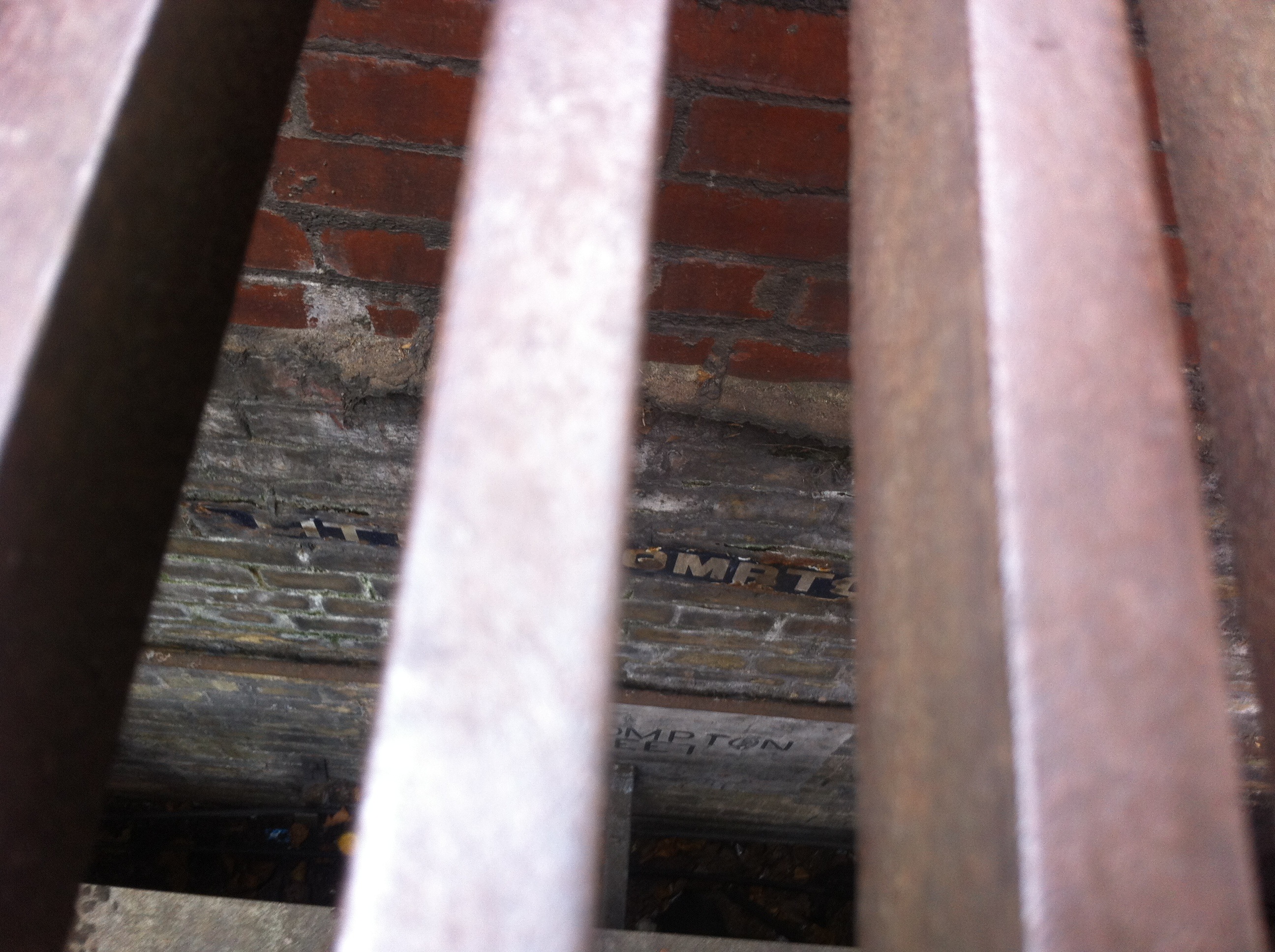
As I crossed Charing Cross Road from Soho and stood on an island in the middle of the road waiting for a No 24 bus to pass, I happened to look into the grille beneath my feet. I have instinctive curiosity when it comes to London holes but this is the first time I’ve really seen anything of interest, as, to my surprise, I could make out what appeared to be a subterranean street sign set into the wall a few feet below the ground.

IMG_1992

I leaned in closer and there they were – not one, but two street signs for Little Compton Street, one blue enamel and the other painted on to brick. Here was London’s buried street.

IMG_1990

Although Little Compton Street has its own Wikipedia page, it is not entirely clear how the signs got here. The street itself was obliterated by the construction of Charing Cross Road – here you can see Little Compton Street on an old map of 1868, intersecting with Crown Street (which is marked by green as Soho’s border, though surely red would be more appropriate) just before Cambridge Circus. Little Compton Street ceased to exist in around 1896 and is now part of the Cambridge Circus utility tunnels, which some urban explorers write about here. (Apparently, Rimbaud and Verlaine used to drink in a pub on Little Compton Street during their dramatic London stay.)

map1868

Were the underground signs accidentally left behind when Charing Cross Road was run roughshod over the top of Crown Street or was it a careful act of preservation by an unnaturally thoughtful council? Or were they removed from a wall by unknown hand and deliberately placed down here, where Little Compton Street has existed ever since, entombed beneath London feet and offering a tantalising glimpse of those fantasy Londons from countless dreams and dramas. There’s an echo of China Mieville, Neil Gaiman and the Borribles, but also of Malcolm McLaren’s mysterious and misremembered subterranean Victorian road (neatly discussed here) that is said to exist intact beneath Selfridges on Oxford Street.

One wonders whether the brutal Crossrail redevelopment of this bedraggled part of the West End will allow any such traces to remain. I hope so. And I hope they also have this last-gasp, accidental feel, of something that London can’t quite let go, like dying fingernails clawing a wall, leaving behind a ghost, a whisper, of one of London’s many pasts.

For some great old images of Charing Cross Road, browse here with leisure and a little sadness.

The many voices of Bon Scott

While there’s no such thing as a romantic rock death, there are few as bleakly pathetic as that of Bon Scott, the AC/DC frontman who died drunk in the passenger seat of a Renault 5 outside a friend’s flat in East Dulwich, just a short distance from where I live.

I wrote about Bon Scott’s life in the current issue of Uncut, which allowed me to revisit some of the fabulous archive footage of Scott and AC/DC you can find on You Tube. The band spend much of the late 1970s based in London, where they were able to build up a large fanbase thanks to regular gigs at the Marquee. Here Scott is interviewed by Australian TV while walking through Covent Garden in a pair of the smallest shorts I’ve ever seen. I’m still not entirely sure where he produces that banana from.

A considerable amount of Scott’s charm as well as his brilliance as a vocalist is captured in this coruscating video for “Let There Be Rock”. Just watch it all the way through, and you can see how Scott worked the camera almost as well as he did the stage.

This is the Bon Scott I knew and loved, but researching the article I discovered more about Scott’s Australian life pre-AC/DC when he performed a pair of bands that were radically different from both each other and from AC/DC. Try this out for size, it’s Scott’s Perth-based teenybop 1960s act, The Valentines, singing, er, “Nick Nack Paddy Whack”. The main singer is Vince Lovegrove. Scott stands at the back next to the drummer, you can see his embarrassed grin at around 90 seconds. (The Valentines also recorded a jingle for Coca-Cola, which lifts you up when you are feeling down apparently.)

After The Valentines broke up, Scott did a complete turnabout and joined Fraternity, a bunch of Aussie hippies who lived in a commune in Adelaide and wanted to be The Band. Here he is, bearded and playing recorder, on a profoundly serious cover of “Seasons Of Change”.

No wonder, then, that he leaped at the chance to join AC/DC, and release some of his natural impish spirit. Here he is doing “I’m A Rocker” in London in 1977, the very image of the 1970s hard rock frontman and one of the best of his generation.

Scott’s “It’s A Long Way To The Top” is one of the great songs about being in a band. Scott wrote it from the heart. He knew. And that is why he could sing it like this, from the Marquee in 76.

And this is where it all ended: 67 Overhill Road, East Dulwich. How about a plaque, Southwark? It’s the least the man deserves.


London by the bollards

I have a piece in the Autumn 2013 issue of Completely London about London experts, those Londoners who specialise in esoteric subjects like lion statues, ghost signs and stinkpipes. You can read part of it here. My interview with John Kennedy, London’s bollard supremo, didn’t make the cut so I have reproduced it below.

John Kennedy, 47, taxi driver & writer of Bollards Of London
Most people in London get excited about the Tower of London and Buckingham Palace but when you drive a taxi you get bored of the norm and start to look around and notice other things. With me, it’s bollards. It actually began as a bet with ‘Big’ George Webley, a radio presenter. He challenged me to write a blog about something weird and it got picked up by the Guardian. Now I’m really interested in bollards, the way they look, where they are located, what they are used for and how we interact with them.


Bollards have so many uses but most people don’t notice them no matter how colourful, ornate or dandy they are. I really like the Anthony Gormley bollards in Peckham. I love that one of our great contemporary artists is making street furniture. I picked up Charles Saatchi recently and we ended up talking bollards, he found it quite amusing that I had a blog with pictures of 330 bollards. You do get some odd looks when you photograph a bollard – the other day I was spotted taking a picture by somebody. He said, ‘You must be the bollard man.’

Know London

City-lit London

This is an edited extract of an introduction I wrote for City-Lit London, a superb anthology of London writing, from 2009.

I don’t really know London. This despite having lived and worked within the collar of the M25 for my entire life, something that is simultaneously a source of great pride and creeping shame. I’ve explored it, sure. I’ve gazed down at dawn on drowsy Londoners from atop a thirteenth-century church tower in Hackney. I’ve listened to the hum of traffic passing overhead from deep within the buried Fleet River beneath Holborn Circus. I’ve walked the Thames one Sunday afternoon from St Paul’s to Hampton Court, been to the end of more than half the tube lines, sniffed Billingsgate Market’s early-morning buzz and fed the black-tongued giraffes at London Zoo. I’ve even travelled every bus from 1 to 50 in numerical order, a task that’s taken me to every point of the compass from Debden in the north-east to Fullwell in the south-west (no, I’d never heard of them before I started, either). But I still don’t know London. Not really. There are vast tracts of its urban geography that are a total mystery to me, a no-man’s land, vacant lots, blank space in my internal A-Z.

This is not an unusual condition. Indeed, it might even be a necessity for living a sane, balanced London life because most of the city’s residents seem to suffer from it, some quite contentedly, perfectly happy to stay within the few square miles where they live and the West End where they work. This could be because there is simply too much London to handle ― too many streets, too many people, too much history, too many inconsistencies. The London cabby, scientists say, has developed a larger-than-average hippocampus ― the part of the brain that processes navigation – simply to cope with all the information. One of them, Fred Housego, even won ‘Mastermind’ in 1980.

Most of us don’t even try to deal with all this geographical sludge. In Soft City, Jonathan Raban’s charismatic study of the modern city from 1974, he noted: ‘The Greater London Council is responsible for a sprawl shaped like a rugby ball about twenty-five miles long and twenty miles wide; my London is a concise kidney-shaped patch within that space, in which no point is more than seven miles from any other… I hardly ever trespass beyond those limits, and when I do, I feel I’m in foreign territory, a landscape of hazard and rumour. Like any tribesman hedging himself in behind a stockade of taboos, I mark my boundaries with graveyards, terminal transportation points and wildernesses. Beyond them, nothing is to be trusted and anything might happen.’

This is a common way of behaving, retreating within self-imposed borders and putting up the fences to the darkness on the other side. It’s captured by Tarquin Hall’s passage from Salaam Brick Lane and the stark single-line confession: ‘Most of London, the city of my birth, was as foreign to me as Prague’. The bard of Cricklewood, Alan Coren, explored a related theme in typically whimsical fashion in which he imagined his intended tour of all the London landmarks he has never actually visited – the Tower of London the Monument and the Serpentine — having decided to leave that sort of thing to the tourists.

No wonder and no shame. If you’re born in Harrow, what should you understand of Harlow? If you live near Crystal Palace park, why would you need to know Hampstead Heath? How many Londoners have ever toured the Houses of Parliament or been into the Whispering Gallery of St Paul’s? The greatest area of neglect is the City — if you don’t work within that glorious square mile that contains all history from the Romans to the Credit Crunch why would you ever have a reason to go there? Londoners leave it to tourists and bankers.

And then there are the contradictions. This is the city that features some of the wealthiest real estate within some of the most deprived boroughs in the United Kingdom; the city whose ships helped spread English around the world but is now home to more than 250 different languages and has schools where the native tongue is barely spoken; the city that when called upon to appoint a new mayor, replaced a left-wing, working-class, car-hating socialist with a right-wing, public-school educated, neo-Thatcherite motoring correspondent, two iconoclasts who seemed to have nothing in common bar a quick wit and mutual contempt for orthodoxy. Who can get their head round that?

So, how can you learn to master this metropolis, the first great city of the modern age and still the world leader in art and commerce? Well, you could follow in the footsteps of Phyllis Pearsall, the creator of the single greatest London book – and one that is understandably omitted from this anthology – the A-Z. In the 1930s, Pearsall claimed to have walked every one of London’s 23,000 streets – that’s around 3,000 miles of serious perambulation – in her determination to produce the most comprehensive map of London that is humanly possible. It’s almost certainly an urban myth, but the conceit is admirable.

Alternatively, you could save on leatherwear and consult some of the other classics of London literature, those writers who have made it their business to understand the city, or at least their particular patch of it. After all, will anybody ever show off Soho like Colin McInnes, or capture Camden like David Thomson? Virginia Woolf’s West End is so beautifully developed, so perfectly drawn, so hyper-real, it almost dwarfs the genuine article. And Monica Ali’s Brick Lane places it as firmly on the tourist map as Big Ben and the Wheel, so you can tell yourself that there really isn’t any need to check it out for yourself.

London books allow you to travel in time as well as space. McInnes’s Soho is the good one, the one we’ve all heard about from the 1950s, when it was still raw, neon-lit, jazz-fuelled and edgy rather than a shallow cluster of over-priced restaurants and drunken daytrippers wondering where all the loucheness has gone (it’s still there, just, in secret drinking clubs and members’ bars hidden behind nameless Georgian façades). And Thomson’s Camden is one on the verge of massive change, a working-class district of pubs and markets that is about to experience the first invasion by the middle-classes that will recondition the area beyond all recognition, setting off a chain reaction of gentrification around London’s inner suburbs from Notting Hill to Islington. For those of us who only know these places in their current incarnation, this stuff has an extraordinary archaeological value that their authors could never have intended, like the background of family photographs that show furniture and fittings everybody forgot about long ago because they never bothered to record them.

But that’s not to say things were so much better in the old says. Indeed, one of the most important things about this volume is that it emphasises the current prodigious strength of London writing. Yes, there’s Dickens and Woolf and Conrad and Wilde and Conan Doyle – as there should be – but there’s also Ackroyd and Sinclair and Self, the titanic trinity of contemporary London writing. Since the 1980s they have done more to resurrect the concept of London writing as a standalone genre than anybody since the Victorians, when London, the New Jerusalem, was seen to embody the contradictory values of Empire and became a rich source of fiction and journalism. They have encouraged the rediscovery of some of the lost classics of London literature and fostered the climate in which anthologies like this one can flourish. In their wake, modern classics have followed, from Justin Cartwright’s snappy satirical novel Look At It This Way to Sukhdev Sandhu’s invaluable nocturnal jaunts into the belly of sleeping London in Night Haunts. This regained respect for London writing also allows the voice of the new Londoner to be heard — the 27.1 per cent of the population that the 2001 census considered to be non-native-born ― through authors such as Xiaolu Guo, with her faux-naïve extracts from A Concise Chinese-English Dictionary for Lovers. In Rebecca Taylor’s ‘London Lives’ we even meet one of these recent arrivals in the form of a young brother and sister who travel to London from Poland to begin their new lives, part of the huge wave of Eastern European immigration that has transformed the city in recent years.

It is authors from this final category who could provide some of the finest and boldest London writing of the twenty-first century, because they will come to the city with a fresh mind and open eye, prepared to live and work in those parts of London that are closed by personal choice to most natives. None of them, of course, will ever really get on top of London, even if they choose to stay here for the rest of their lives — but every little bit helps. And if you put all the fragments together, you may one day get something close to the full picture, the London that we all love, even if it’s not the one we know.