Category Archives: Journalism

Inside London’s super-rich bubble

Peter Mandleson once famously said that ‘we are intensely relaxed about the filthy rich’, a sentence that has always made me intensely uncomfortable until very recently, when I spent some time exploring the various ways the filthy rich spend their filthy money. What really surprised me, though, isn’t what they spend, but the way they spend it. It isn’t greed so much as purchasing for sheer pleasure on a scale that most of us can barely imagine and that they themselves will hardly even notice.

It began at Christie’s auction house for a piece I wrote for the Independent on Sunday that went behind the scenes before this week’s big impressionist/modern evening sale. The collectors who will be bidding on paintings by Monet, Picasso and Degas are taken from the ranks of the world’s super rich, and will between them spend around £100m on new paintings for the walls of their second and third homes.

Then I went to see some of those second and third homes when I wrote a piece for Gulf Life magazine about London’s super-prime property market – that’s anything from £15 million up to about £150 million. I visited four apartments and houses in Knightsbridge, Bayswater and Regent’s Park – including the Candy Brothers extraordinary One Hyde Park development – that between them had a combined value around £121 million and contained more marble and flat-screen TVs then is good for anybody.

Finally, last week the owner of my favourite football club – who many believed to be losing interest in the sport – dropped in to spend a trifling £70m in one day on two players, just like that.

Now, while it is undeniable that the outlay of such vast sums of money on luxuries is morally indefensible and all the rest, it’s also increasingly apparent that as there is absolutely nothing you can do about it, there’s no point in being anything other than intensely relaxed about it. The alternative would drive you mad.

These people are worth billions, and for them £150m is an irrelevance. To understand exactly why, try this thought experiment, taken from John Lanchester’s outstanding ‘Whoops!’, about the global financial crisis, which shows in a fairly clear way the vast difference between millions of pounds and billions.  

Lanchester writes, ‘Without doing the calculation, guess how long a millions seconds is. Now try the same for a billion seconds. Ready? A million seconds is less than 12 days; a billion seconds is almost 32 years.’

Or as one estate agent told me, ‘When they spend £30 million on a property, it’s not a financial decision, it’s a personal one.’

Cabbage, cheese and Liverpool

Uncut dragged me kicking and screaming out of my London comfort zone by asking me to write about Liverpool’s Cavern club. The feature was to commemorate the 50th anniversary of the first Beatles show at the Cavern in February and is published in the current issue. It begins like this:

Something is happening in the streets of Liverpool. It manifests itself in a number of unusual ways: in the explicable aroma of cabbage and cheese that clings to local youths, in the long queues of teenagers that stretch down Mathew Street before disappearing into a hole in the ground and, most worryingly for the workers in nearby offices, in a constant and puzzling low rumbling sound that breaks out underground every weekday afternoon from midday.What on earth is going on?

The answer, of course, was that The Beatles were going on.

This is probably the only feature I’ve ever written that will namecheck Cilla Black, Edwina Currie and Freddie Starr but don’t let that put you off. I’ve also interviewed the Bonzo Dog Doo Dah Band’s about their hit ‘Urban Spaceman’, which was about as insanely entertaining as the song itself. 

Inside the Fleet: exploring London’s lost rivers

I wrote this piece for Time Out in 2005 and for some reason it’s never been available online. Until now.

It’s only as the filthy brown water rises above my thigh-high waders and my feet struggle to grip the tunnel’s slimy floor that I realise that drowning in a river of shit after breaking into a London sewer would be a really, really crap way to die.

It all began so well. I found Jondoe and Stoop, two urban explorers who get their kicks investigating drains, lost rivers and derelict buildings, on the internet and asked them if I could come on their next journey beneath the city streets.

We met near Farringdon. The plan is to explore one of London’s lost rivers, the Fleet, which once flowed from Hampstead to Blackfriars. Although long bricked over, the Fleet, like many of London’s old rivers, still flows underground through a series of pipes and culverts. Joseph Bazalgette integrated these rivers into his sewer system, using them as storm-relief drains to carry overspill into the Thames when the main east-west sewers were swelled beyond capacity. These days, heavy rain can still cause sewage to flow into the river via the Fleet.
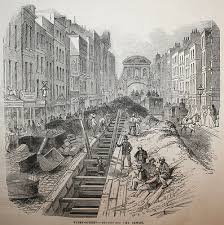
Jondoe and Stoop have been in the Fleet before, but turned back when the stench became overwhelming for even these experienced drainers. This time, they are determined to reach the end. They believe no other UK urban explorer has made the trip, largely because it takes considerable planning to find a way into London drains. Urban explorers are driven by a combination of adrenalin and curiosity, and take their hobby seriously. This trip has been months in the planning. They’ve popped many manholes looking for the right entry point, and the weather has to be right – no rain for at least three days before we enter.

In a nearby car park, we change into waders, boiler suits, flourescent vests and hard hats – the latter more for disguise than protection. Carrying a couple of traffic cones, we’re suddenly transformed into construction workers, practically invisible to passers-by. Nobody bats an eyelid as we walk through busy streets to the selected manhole, stick some cones round it, lift the cover and climb down the ladder into the gloom.

We enter a feeder tunnel with a five-foot ceiling, which means we have to abandon our hats and walk with cricked necks. It’s cramped, damp, dank and dirty but doesn’t smell too bad. Stoop and Jondoe glide like skaters along the slippery floor while I splash clumsily behind, using slimy walls to keep my balance. We head downwards along a series of mini-waterfalls. The light and noise that intermittently emerges from the grates overhead suggest we aren’t getting deeper, but simply following the gradient of the road. It’s a curious feeling, being isolated in the dark but with occasional glimpses of London reminding us that normal life continues up above.

Eventually we reach the end of the feeder tunnel and swing into the Fleet itself using broadband cables that make useful subterranean handrails. It stinks in here and the air is heavy with a strange mist. Jondoe points north, to where the Fleet is blocked by the main east-west sewer. Ominous clumps of matter fester in pools all around. ‘Don’t disturb them,’ he says. ‘It’ll be full of gas that just sits there and collects.’
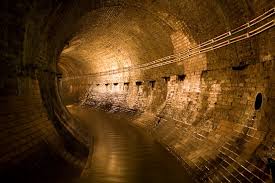
As he speaks, one of the hard hats we’d left by the entry point shoots out of the feeder tunnel on a wave and floats towards the Thames, bobbing along the shallow water that moves sluggishly down the centre of the tunnel.

We follow, heading south. The tunnel is around ten feet tall and wide, so we can walk two abreast. It’s about the same size as a tube tunnel. The smell slowly subsides, although lumps of faeces and toilet paper gather in places where they’ve washed against the brickwork. Otherwise, there’s just a trickle of brown water ferrying the odd cotton-bud downriver.

It’s no hellhole, but still a far cry from the Fleet’s sixteenth-century heyday as one of London’s key tributaries, when, flanked by wharves and warehouses, it was a centre of London commerce. It separated Westminster from the City and carried cargo to the Thames, was compared unfavourably with the four rivers of Hades by Ben Jonson, was briefly turned into a canal and then covered in portions from 1732, by which time it was little more than an open sewer.

But this was not the end of it. In 1846, the Fleet exploded, its sewage gasses bursting the street above, rendering King’s Cross Road impassable, destroying Clerkenwell poorhouses and smashing a Thames steamboat against Blackfriars Bridge. This river, it seems, has a habit of coming back to ambush those who thought it dead and buried.

Almost two centuries later, traffic and police sirens are audible overhead, competing with the constant crash of water that flows from numerous side tunnels, feeding the central trickle. Rats stop and stare as we walk past. I nervously keep my torch shining on them until we have moved on.

Before Ludgate Circus, the Fleet splits into two parallel tunnels, directly replicating the pattern of Farringdon Street overhead. Otherwise, it’s impossible to work out exactly where we are. The tunnel heads south, but is full of turns. At one point we notice large iron rings cemented into the wall. They are support for scaffolding, but look like mooring rings. Throughout, the Victorian brickwork is surprisingly beautiful for something that is so rarely seen.


After about two miles of trudging, we emerge into an enormous end chamber, more than 20-feet high and elaborate in design and construction. Two short tunnels lead from here, ending in huge metal flaps, which we assume open directly into the Thames.

After taking pictures, we head back. Immediately, we realise there’s a problem. It’s much harder to walk uphill against the flow of water. On the way down, the water was a stream, heading back, it’s more like a river. We labour onwards and upwards in the dark, but it’s tough work.

Stoop eventually says what we’ve all been thinking. ‘Is it just me,’ he asks, ‘Or is the water getting deeper?’

Water which before barely covered our feet is now above our knees, flooding downhill towards us at pace and rising slowly all the time. Wading into the tide, our clothes are heavy with water and our feet struggle to grip the slimy stone floor. Panicking rats scurry up the walls to get out the way of the bubbling water.

 It’s frightening. Nobody knows we are down here and as our pace slows I begin to ponder our options. Should we press on, or brave a side tunnel, where a ladder may at least take us above water level, so we can sit it out. But how long would that take? And what if the water keeps rising and the side tunnel we’re in doesn’t have access to the street? 

We reach a turn where the water has become a torrent and Stoop tries to brace himself against the tide but instead starts sliding backwards towards me, threatening to skittle us all into the dirty water. For a split second I consider what an undignified death this would make, and with one final effort we press on, forcing ourselves to a point where we can stand without getting knocked off our feet. But we’re exhausted.

Then Jondoe shouts, ‘That’s where we came in!’ It is indeed. We pull ourselves up into the feeder drain via the broadband cable and watch the river below us boil to a frenzy. The Fleet is back with a vengeance. Later Jondoe explains, ‘Somewhere further up the sewer they must have been doing some maintenance and so diverted the flow down the Fleet.’ It is, he says, something he’s never experienced before.

Twenty minutes later, after an exhausting walk through the smaller drain in the course of which I bang my head several times on overhanging pipes and bricks, I haul my battered, sodden body up the ladder and into the sunshine. It’s bright outside. The air smells clean. Half-a-dozen people across the road pay us no heed as we emerge from the manhole and sit slumped in the road, moving only to remove our waders and empty them back down the drain.

We trek back to the car in soaking socks, leaving a trail of footprints behind us.

The Siege Of Sidney Street

My review of the Museum of London Dockland’s exhibition on the Siege of Sidney Street can be read in the New Statesman.

For once, I have little more to add. It’s an excellent exhibition and I recommend heading to Docklands before it ends in April. For more on the siege, you can see Pathe newsreel footage here or read Caroline’s article here.

Or you can watch a clip from the 1960 movie loosely based on the events.

Andy Coulson: getting it

In 1999, I happened to share a dinner table with the recently disgraced Tory director of communications Andy Coulson.

Coulson was then editor of the Sun‘s Bizarre column and he spent a large part of the evening holding court and talking loudly about those celebrities who ‘got it’ and those that didn’t ‘get it’. Chris Evans ‘got it’ he said, but Hugh Grant didn’t ‘get it’.

‘It’ was that the celeb in question understood and accepted that having their names, families, relationships and reputations trashed each day in the tabloids was all just a bit of fun, fair game, cheeky banter, part and parcel of what comes with being famous. Evans went along with it and didn’t complain; Grant, on the other hand, was less compliant.

After what’s happened in recent weeks, I can’t help but wonder whether Andy Coulson ‘gets it’.

Why I love Pat Nevin

I remember when I fell in love with Pat Nevin. It was in the playground and somebody was passing round a 1985 Panini sticker album. I turned straight to the Chelsea page to see my heroes.

There was Kerry Dixon, bluffly handsome with golden hair, azure eyes and self-confident grin. There was Colin Pates, a brick-wall centre-back with disco dancer hair. There was Doug Rougvie with a nose that looked like it had lost an argument with a spade.

And there was Pat Nevin. Pasty-faced, greasy-haired, nervous, thin and sullen. He looked like a smackhead. Who wouldn’t fall in love?

I only saw Nevin play once for Chelsea, a 3-0 victory at Watford in 1988 about which I remember little, but his legend loomed large over the following years. By the time I started watching Chelsea regularly the next season, the club were in the Second Division and Nevin was at Everton, but my bible, the Chelsea Independent fanzine, spoke of little else.

They drooled over Nevin’s dribble against Newcastle, when he beat eight players in a slalom run that took him from one end of the pitch to the other. They marvelled at his free kick against Sheffield Wednesday, when he chipped the ball over the defensive wall, ran round the other side and lofted a perfect cross on to David Speedie’s goalscoring noggin. They giggled at his famous penalty miss against Manchester City.

The love seemed mutual. When Nevin was injured playing for Tranmere, he attended a Chelsea-Everton game at Goodison Park and paid to go in the Chelsea end. This was important. Chelsea fans, then as now, were despised, but if somebody like Nevin loved us, maybe there was hope, maybe there was redemption,

And Nevin was the sort of player that fans love – an exciting, creative, unpredictable dribbler, but there was more to it than this. Nevin was smart. Nevin was cool. Nevin was different.

He angrily attacked his own supporters for their racist, violent and anti-semitic predilections – to the delight of the left-wing students at the Chelsea Independent. He read French and Russian literature. His favourite bands were Joy Division, Jesus And Mary Chain and the Cocteau Twins. He once insisted on being substituted at half-time in a friendly so he could attend a gig. He brought Brechtian principles to the club programme when he interviewed himself – yes, himself – for a player profile. He was friends with John Peel. For the teenager who read Camus and listened to Sonic Youth it was a no-brainer: if you could be a footballer, you’d be Pat Nevin.

NME described Nevin as the first post-punk footballer, although it may have been more accurate to say he was the first art school footballer. He was also the last. 

When at Everton, Nevin gave a lengthy to the Chelsea Independent, and talked at length about football, music and literature, and what it was like drinking in Soho with George Melly. I’d never heard of Melly, but here I was, learning about jazz and the counterculture from a footballer, in a fanzine. Would that happen now? 

When I interviewed Colin Pates – who is not a stupid man, by any means -he still seemed bemused by the fact Nevin would read books on the way to away games rather than play cards. Nevin, though, never seemed to get bullied about his interests. He was clever, but he was also proudly working-class and therefore more acceptable to other footballers and more capable of sticking up for himself than the middle-class Guardian-reading Graeme Le Saux who followed him as Chelsea’s token intellectual.

In the early 1990s, I finally got to see Nevin play at Stamford Bridge. He was wearing an Everton kit, but when he scored the Shed gave him a standing ovation – the only time I have ever seen Chelsea fans applaud an opposition goal. Pat Nevin was a very intelligent footballer and when he was around, fans seemed to use their brains a little bit more as well.

Pussyfoot Johnson and the London mob

My review of Ink And The Bottle, an exhibition about cartoons and alcohol, appears in the Independent.

One of the cartoons at the gallery is based on the story of William ‘Pussyfoot’ Johnson, an American who was active in the temperance movement and came to London on Nov 13, 1919 to give a talk.

Johnson was leader of the Anti-Saloon League and after success in America, he headed to the Old World to spread the anti-drinking word. He argued, ‘There is more bootlegging and more moonshining in Europe than in the whole United States.’

He may have been right. This temperance movement map from 1886 attempted to show the scale of the problem by depicting all of London’s pubs in its ‘Modern Plague of London’ map.

Modern Plague, London

Pussyfoot earned his nickname for his habit of amending laws by stealth, and this did not go down well with the London mob. As one anti-temperance advocate told the New York Times, ‘You know how the majority of Englishmen look upon prohibition and Mr Johnson’s activities? The thought of not being able to have the well-known pint of bitter fills them with horror. The war was terrible enough but it was something that happened before. There have always been wars. Taking away the drinks is attacking the divine rights of the Britisher. I can tell you they don’t like it!’

They certainly didn’t, and decided to do something about it. While Johnson was speaking at Essex Hall, he was captured by medical students from nearby King’s College who dragged him out the buildin, poured a bottle of beer over his head and marched him around the West End chanting ribald songs. It was noted that the police ‘seemed lacking in sympathy with the missionary’.

Johnson was hauled hatless on a stretcher around Regent’s Street, Leicester Square and Oxford Street while the students chanted ‘What won the war? Rum!’ and ‘We’ve got Pussyfoot meow, send him back to America’.

Such larks, what fun and games! 

And so what if Johnson lost his right eye in the incident? The lesson was learnt. Not many people have tried to take the Britisher’s beer away from him since.

Magic mushrooms in Georgian London

I have always considered Green Park to be the dullest of all central London parks. Look. There’s really nothing there. It’s just a very big lawn.

But twas not always this way. High Society, the Wellcome Collection’s superb new exhibition on drugs in culture – which I recently reviewed in New Statesman – includes a great story from 1799 concerning a doctor, Everard Brande, who was called to the London house of a family suffering from some form of poisoning.

Concerned for his sick family, the father had gone out to seek help but was soon found in a confused state, unable to remember where he was going or why. He was rescued by neighbours and eventually the doctor pieced the story together.

The family had been out gathering mushrooms in Green Park, which they had cooked into a broth, and this had upon the parents and four children an extraordinary effect. All were giddy – with high pulse rates and intense breathing – and all were seeing things. While the adults seemed struck by a morbid fear of death, eight-year-old Edward ‘was attacked by fits of immoderate laughter’ and his staring pupils were massively dilated.

After treatment from Dr Brande, the family recovered (aka came down). I’ll never see Green Park in quite the same way again. I’m sure they didn’t. 

For more, see Michael Jay‘s excellent accompanying book.

Apologies…

For lack of blogging this week, my life is currently taken up with:

and

and

and

and

and

But more to come shortly.

Eel Pie Island

ImageShack, share photos of eel pie island, eel pie island fire, trevor bayliss house eel pie island, share pictures of eel pie island, eel pie island fire, trevor bayliss house eel pie island, share video of eel pie island, eel pie island fire, trevor bayliss house eel pie island, free image hosting, free video hosting, image hosting, video hosting.

My feature on the birth of British R&B at Eel Pie Island is in this month’s issue of Uncut.

It includes interviews with Pete Townshend, Ron Wood, Kenny Ball, Top Topham and the inventor Trevor Baylis, who still lives on the island and told me.

 ‘I moved to the island in the 1970s when I’d made enough money as an underwater escape artist in Berlin to buy a plot of land, but I went there regularly from 1957. They were wild times. If you wanted to get your leg over, that’s where you went. It was notorious. There was no bridge, the only way to get there was on a chain ferry. On the island, a little old lady sat in a tollbooth and stamped the back of your hand. The hotel was very Dickensian, a bit of a tramshed just about hanging together, but it had a dance floor that was like a trampoline so if you couldn’t dance when you went in you certainly could when you came out.’

South-west London was a fertile territory for music in the early 1960s, and the likes of Keith Richards, Eric Clapton, Jeff Beck, Rod Stewart and Jimmy Page all learnt their craft in the venues of Richmond and on Eel Pie Island.

As Ian McLagan of the Small Faces explained: ‘The audience was full of musicians. Loads of them. You’d see them all in the front row – “Do you see that?”, “Yeah”, “Well I can do that too”. We were all kids, but when you saw the Stones it was “Fuck me, it’s possible…” ’

Diamond Geezer visited Eel Pie Island recently and writes about it here.