Category Archives: Animals

‘My heart’s in the highlands, wherever I go’

I’ll be taking a break from the blog while I go to Scotland. Speaking of which, I’ve never really got my head round Rabbie Burns, but this statue in Victoria Embankment Gardens is rather lovely.

Sadly, it’s no match for the nearby attractions of the remarkable York Watergate…

London’s finest camel…

Or the weeping bare-breasted maiden who thrashes impotently (and rather fetchingly) at the memorial for Victorian composer Arthur Sullivan.

I’m sure many of you will feel this way about my absence, but don’t worry, I’ll be right back… after a few of these.


The City of London’s secret zoo

My piece on the extraordinary Animal Reception Centre (ARC) at Heathrow – where all animals entering the UK have their passports stamped – appeared in last week’s Independent on Sunday.

One of the great things about the ARC is that by a quirk of administration it is run from Guildhall by the City of London Corporation. As Rob Quest, the facility’s manager, told me, ‘The City is responsible for the import of all animals in Greater London. That’s because in 1965 when the LCC broke up, the City still had a veterinary department because of Smithfield Market so they were deemed the best people to run the border control. They built this place after there was a rabies outbreak in Camberley in 1969 (Fritz, a black-and-white terrier, was released from quarantine early and bit two people) and it was decided we needed somewhere secure for animals to be checked.’

The City still runs the centre today, one of a number of non-Square Mile outposts that includes Epping Forest and Hampstead Heath. For more on the City’s more traditional oddities, check out David Long’s new book Hidden City.

The Muppets in London

The Muppets have a long relationship with London. That’s partly because Jim Henson lived in Camden from 1977 and opened his workshop, the Jim Henson Creature Shop, in the area, filming many of the Henson films in London. A rather fantastic Muppets walk with all locations – including a Muppets bench on Hampstead Heath – can be found on the Camden website here.

Henson’s first workshop was at 1b Downshire Hill, NW3. It was initially used for the production of The Dark Crystal but remained in use from the late 1970s to 1990. It is said it had to be closed after neighbours complained about the strange smells coming from the factory, which reminds me of Charlie and the Chocolate Factory.

You can watch a (rather scratchy) tour of (I think) the second Creature Shop here.

I visited this second Creature  Shop in 2000 on the invitation of a model-maker who I met in a Camden pub. There was a definite magical/spooky Roald Dahl quality to the experience. This Creature Shop was located on Oval Road overlooking the canal, and was a huge mysterious building filled with puppets of all sizes. This is where the puppets for Animal Farm, 101 Dalmatians and The Muppet Christmas Carol were made.


The Creature Shop closed in 2005 and the building has since been demolished, but you can see London’s influence on the Muppets in a number of films. Here are five of my favourites.

1 ‘Maybe It’s Because I’m A Londoner’
This is from the time when Chris Langham was writing the Muppets. It’s an early, possibly rather clumsy, stab at celebrating London’s multiculturalism, and thus the sort of thing that would make Rod Liddle cry.

2 Burlington Bertie From Bow
A great version of one of the great London Music Hall songs, a repeated inspiration for Muppets songs.

3 The London Fog
Kermit reports from ‘London, England’ and interviews a cockney frog and a Beefeater.

4 The Muppets Christmas Carol
The superior Dickens adaptation is all London, obviously, but this first meeting with Michael Caine’s Scrooge sets the scene nicely. Plus: singing pigeons.

5 Wotcher (Knocked ‘Em In The Old Kent Road)
Another Music Hall classic, with Fozzie Bear dressed as a Pearly King (or possibly as an Old Compton Street stroller).

Among the moles at the Grant Museum

My short piece about the recently reopened Grant Museum of Zoology appears in today’s Independent.

If you haven’t been to the Grant Museum in either its old or new guises, do go and check it out one lunch break. This is the only museum in the country where you can see 18 baby moles stuffed in a sweet jar.

It also has one of only seven quagga skeletons that are known to exist in the world. The discovery of the quagga says much about the delightful way the Grant goes about its business.

The museum had two zebra skeletons, but curators were convinced that one was actually a quagga, so in the 1970s they got an expert to make the requisite calculations.  To their delight it turned out that one of the zebras was indeed a quagga, and this was unveiled to great publicity. However, less happily, it seemed that the other zebra was actually a donkey. Both are now displayed in the new museum, the quagga in pride of place near the entrance, the donkey out of sight on the first-floor balcony. But zebras, there are none.

Grant Museum of Zoology, UCL, Rockefeller Building, 21 University Street, WC1E 6DE. Open Mon-Fri, 1-5pm.

Celebrating the noble tradition of defacing London statues

It seems to happen every time a march or protest takes place in London. A much-loved statue or monument is defaced, horrifying the sort of people who are horrified by this sort of thing while the rest of us wonder why nobody’s got round to throwing a bucket of paint at that godawful Animals At War monstrosity on Park Lane.

On Saturday, after the TUC and some kids dressed in black marched through the London to complain about stuff, it was the turn for the Landseer lions at Trafalgar Square to take a pasting.

lion

While the statue of Charles I received a more artful reimagining.

statue

Interestingly, this Charles I statue had already been manhandled by the mob – albeit inadvertently – way back in 1867 when a reporter climbed the statue to get a better view of a passing protest and used the sword to steady himself. The sword promptly fell off and disappeared into the crowd, never to be seen again.

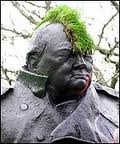
Most people think that this habit of deliberately defacing certain statues is a recent thing, dating back to the inarguably splendid Winston Churchill turf mohican on May Day 2000.

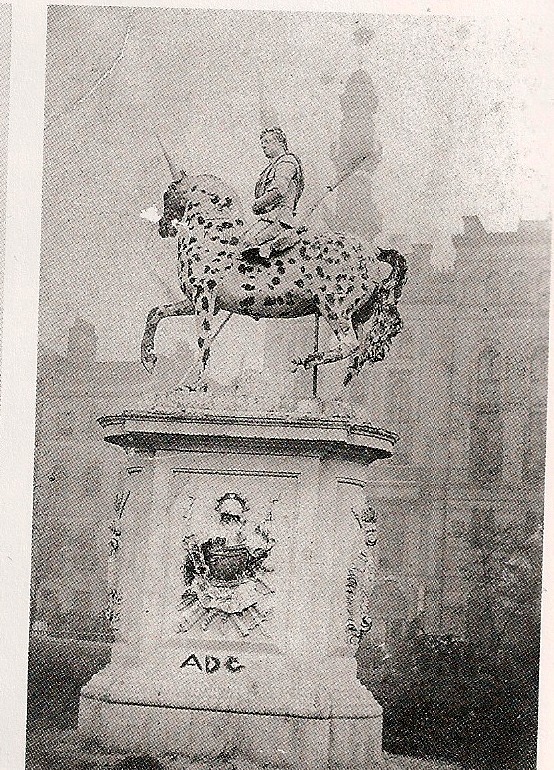
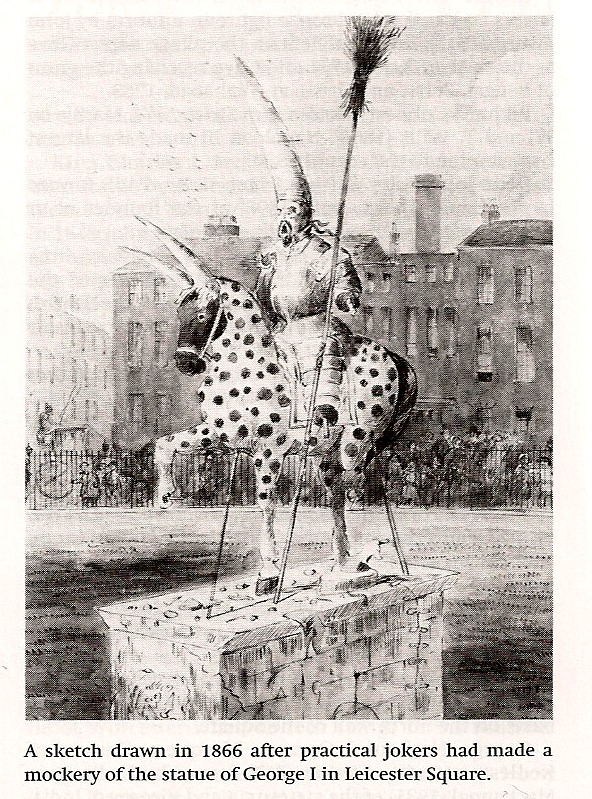
But the London mob has a rich tradition of dressing up (or down, depending on your viewpoint) London statues. My favourite example is the treatment dished out to the statue of a mounted George I, which was cast in 1716 and placed in Leicester Fields in 1784. This received serious punishment over the years as children clambered all over it, so both horse and rider lost bits, and at one point the poor king was without head, legs and arms. But worse was to come.

In October 1866, after the state of the statue had been discussed in the Times, guerilla jokers attacked the statue at night, painting black spots all over the horse, replacing the lance with a broomstick and putting a dunce’s hat from the nearby Alhambra Theatre on George’s bonce. Crowds flocked to see the spectacle. It was cleaned up, but eventually sold for £16 and pulled down in 1872.

As British History online website comments: ‘It would be almost impossible to tell all the pranks that were played upon this ill-starred monument, and how Punch and his comic contemporaries made fun of it, whilst the more serious organs waxed indignant as they dilated on the unmerited insults to which it was subjected.’

Nothing changes, once again.

Five unknown London pleasures

1 London’s first artificial ice rink
The Glaciarium opened in 1842 at the Baker Street Bazaar near Portman Square. The backdrop was ski chalets and snow-capped mountains, the ‘ice’ was churned-up hogs’ lard and sulphur. On hot days it smelt of cheese. It closed in 1844.

2 The clown and the geese
In 1884, a clown called Barry was watched by a huge crowd as he sailed down the Thames from Vauxhall to Westminster in a washtub pulled by four geese.

3 One-legged cricket
In 1796, Montpelier Gardens in Walworth hosted a cricket match between eleven one-armed Greenwich pensioners and eleven one-legged Greenwich pensioners. Interest was so great that a fence was broken and spectators fell through a stable roof. The match was drawn, but the one-legged team won a replay, earning themselves 1,000 guineas.

4 London’s first public museum
This was opened in a coffee house near Chelsea Old Church in 1695 by James Salter, a former servant of Hans Sloane, the man whose collection later formed the British Museum. Sloane reputedly handed Salter – renamed Don Saltero – some of the less important of his 80,000 objects, including a giant’s tooth,  a necklace made of Job’s tears and a bonnet that belonged to Pontius Pilate’s wife’s chambermaid’s sister (it actually came from Bedford).

5 The Peace of 1814
On Monday August 1, 1814, London celebrated the abdication of Napoleon Bonaparte with a series of festivities. It began with a balloon ascent at Green Park; the balloon was captured by the winds and sent towards the Estuary until the ballooneer cut a hole and landed on Mucking Marshes near Tilbury. Next came a miniature Battle of the Nile on the Serpentine, followed by a firework display in Green Park, for which John Nash had designed a new pagoda. Sadly this caught fire, killing two people. The crowd applauded, assuming it was all part of the fun.
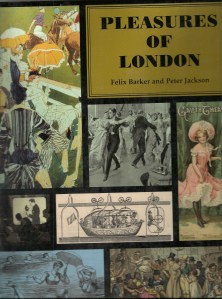
All these came from Pleasures of London, a book available at the Museum of London bookshop for £30. It is my new favourite London book. It should have been published in 1992, but was delayed repeatedly and by the time it was published by the London Topographical Society in 2009 the authors, Felix Barker and Peter Jackson, had both died.

What the pair had created was an endlessly browsable book on all the fads and fancies that have occupied Londoners leisure since the Dark Ages, from Frost Fairs to black-faced minstrels, lidos to the Great Exhibition. There are brilliant throwaways  – such as those mentioned above – as well as short but thorough looks at things like music halls, pleasure gardens (which I still don’t get the point of), museums and the origins of sports like cricket, football and boxing.

Buy it.

Natural selection

My review of the Natural History Museum’s very good exhibition on Sexual Nature, about the mating habits of animals, can be read at the New Statesman. It features slug sex, Guy the Gorilla and Isabella Rossellini.  

For more on this sort of thing, you should read Melissa Harrison’s Tales Of The City blog, who writes about blossom, snowdrops, daffodils and foxes from the urban wilderness of sunny Streatham.