Category Archives: Maps

Urban legends: Phyllis Pearsall and the A-Z

The story of Phyllis Pearsall and the A-Z is one of London’s most enduring and endearing myths. To take but one example, here’s the Design Museum‘s version of how, in 1935, Pearsall couldn’t find her way to a party in Belgravia so decided to make a completely new map of London, which she did by getting up at 5am each morning and walking every one of London’s 23,000 streets – a distance of 3,000 miles. The result was the A-Z, the first street atlas of London.


You’ll find this story everywhere, often repeated word for word, which is usually a sign something is up. Here it is on the BBC. Here it is in Time Out. Here it is on Wikipedia.  And here’s some sap repeating it in an excerpt from a book on Amazon.

Peter Barber reckons it’s nonsense. And as the head of maps at the British Library, he should know.

‘The Phyllis Pearsall story is complete rubbish,’ Barber told me. ‘There is no evidence she did it and if she did do it, she didn’t need to.’

Barber maintains first of all that the first street-indexed map of London was made in 1623 by John Norden, but his reservations are not just academic. Pearsall’s father, Alexander Gross, had been a map-maker and produced map books of London that were almost identical to the A-Z in everything but name. They looked the same and used the same cartographical tricks. It’s Barber’s belief that Pearsall simply updated these maps to include the newly built areas of outer London and called the result the ‘A-Z’.

‘She was a great myth-maker,’ says Barber. ‘But English Heritage investigated the story and decided not to award her a blue plaque because it was not felt she’d done anything to deserve one [Pearsall does have a plaque, but it was awarded by Southwark]. It was marketing and it’s a very pervasive myth, she was a lovable character and people want to believe it.’

So did she really walk those streets or not? Here, Barber is hard to pin down. In writing he is equivocal, as the final comment here shows, but in conversation he makes his position pretty clear.

‘Pearsall was building on a body of information that had been around for years,’ he says. ‘What she may have done is be more thorough in mapping the new areas that cropped up between the wars, and there were two ways of doing this. You could either tramp the streets of outer suburbia for hours on end, or you could visit the local council office and ask for their plans. Which do you think she did?’

Maps and apps


Some months ago, I heard about the Time Travel London Explorer app, a nifty iPhone application that allows you to layer different historical maps of London on top of each other, so you can use GPS to see how the street you are standing in has changed (or not) since 1746.

I was so excited I went out and bought an iPhone in anticipation and wasn’t disappointed when the app was finally completed. It features four different maps – Rocque 1746, Horwood 1799, Greenwood 1830 and Stanford 1862 – as well as lots of easily searchable historical information and photographs of London, along with audio guides. You can read a review here.

It’s a bit like the Museum of London’s Street Museum app only better as fading in from one historic map to another is fun and informative.

The Time Travel Explorer website features a blog about mapping and London history written by myself and M@ from Londonist. If this is the kind of thing that gets you going – and really, how could it not? – go check us out.

Magnificent Maps at the British Library

The British Library currently has an excellent new exhibition about maps called Magnificent Maps. I reviewed it for New Statesman (get me), and tried to focus on the sort of political aspects of the maps on display that would appeal to the generally Labour-supporting readers of the New Statesman, seeking any sort of diversion from the electoral massacre they had recently witnessed.

Diamond Geezer also took inspiration from contemporary politics with his review. He wins, I think.

The highlight of the exhibition for many Londoners will undoubtedly be Stephen Walter’s incredible idiosyncratic The Island, which you can study in detail here. This is a very personal and witty look at London by an artist. I particularly like the rather condescending but still satisfying comment he puts next to Herne Hill – ‘If I lived south of the river it would be here’. What finer praise could a North Londoner offer?

If you like maps a lot, you should also check out the hand-drawn gallery at Londonist. A little bird tells me that these may soon get a museum exhibition of their very own.

Hare Marsh and Rabbit Marsh: fact and fiction in Bethnal Green

Last month, a friend bought me ‘King Dido’ by Alexander Baron, a lost London novel written in 1969 that has recently been reprinted. It is set in the East End in 1911 and is about Dido Peach, a taciturn docker who almost against his will and certainly against his intentions becomes a vicious criminal, the boss of his manor. It’s a great book – lively, cynical, witty, violent yet thoughtful; it reminded me of Camus’ ‘The Stranger’, but filtered through a very exacting East End eye.

Off  Cheshire Street, south of where it meets St Matthew’s Road, you will find an easily overlooked dead-end street called Hare Marsh. This is where Baron’s mother grew up and it’s where Baron places Dido’s small and rather pathetic manor, renamed Rabbit Marsh in the book.

Originally, Hare Marsh was the name given to the entire area. It had been built on since before the 1670s, but had long been a slum by the time Baron’s book was set. He writes:

‘Rabbit Marsh acquired its name at the end of the seventeenth century, when it was a green and pleasant country place on the outskirts of London. Artisans came here to picnic, practise their sports and trap the rabbits, which abounded… The industrial revolution had turn the whole eastern quarter into an immense slum which had overrun Bethnal Green. Rabbit Marsh was swallowed up with the rest… ‘

This is why William Cobbett called London ‘the Great Wen’, a monstrous cyst that was consuming the country around it, and you can trace the development and decline of Hare Marsh in maps.

Here you can see it on this enlarged square of John Rocque’s London map of 1746. It’s towards the top of the map in the shape of a little lane coming south off Hare Street, the last turning on the right, and heading into fields. Bucolic, no?

To get some perspective, here’s a link to the whole map; Hare Marsh is in square 1F.

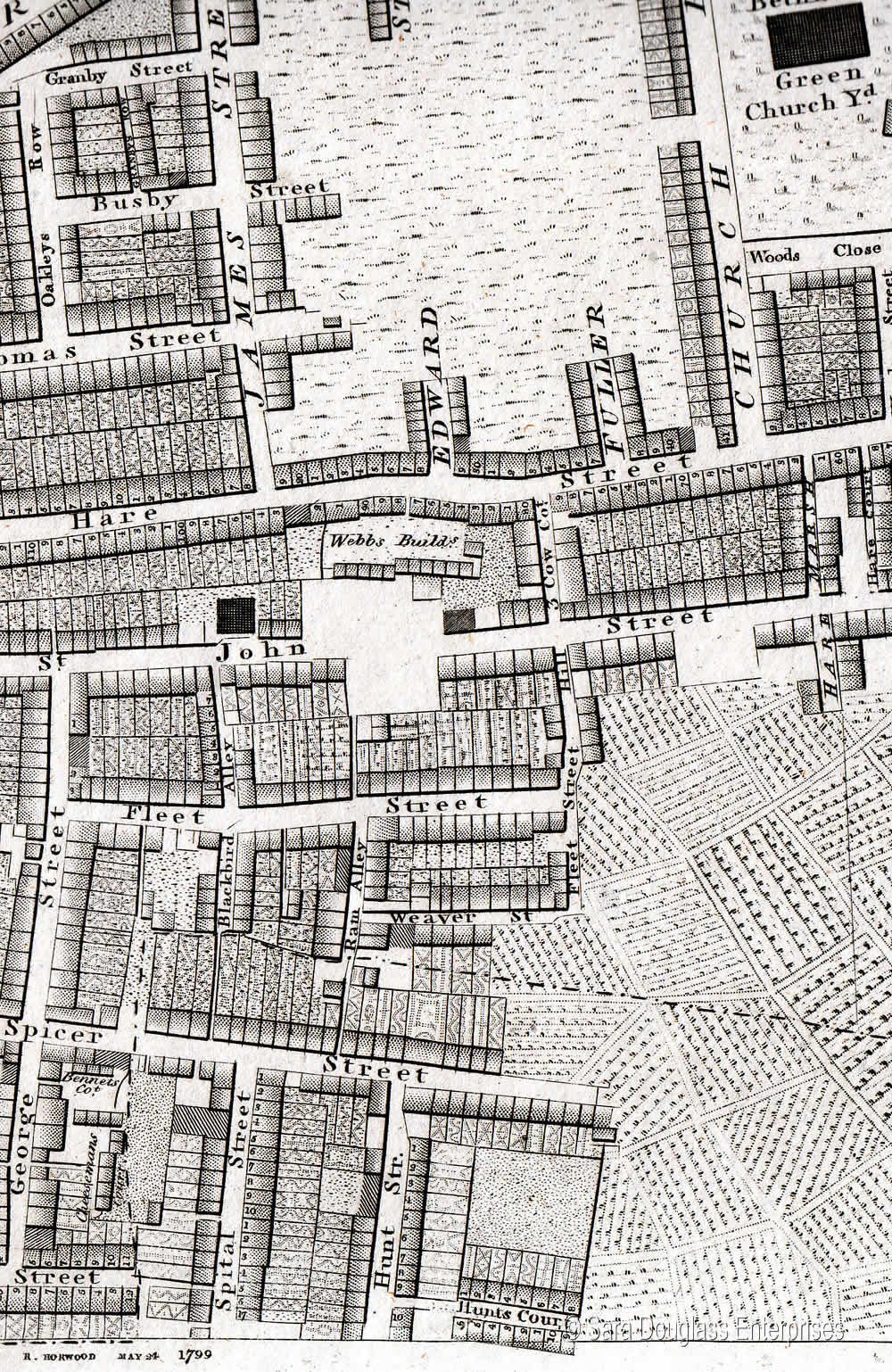
Now, here’s the incredible Horwood map of 1792 – Hare Marsh is on the far right, still an open and pleasant looking space but buildings are starting to encroach.

It hasn’t changed much by the time of the Greenwood map of 1827.

It’s the short street off Hare Street (as Cheshire Street was known until sometime between 1929 and 1945) directly below St Matthew’s Church right next to the big black square.

The square is the workhouse and Hare Marsh also contains almshouses, buildings that show there has been a change in the area’s status. But there’s still no sign of the railway, so even now Hare Marsh opens directly on to fields.

That was soon to change.

Here it is on Booth’s poverty map of 1898, coloured dark and light blue – not quite black (semi-criminal) on Booth’s colour coded scale, but not far off it. Bethnal Green is now entirely built over.

Again it’s the little turning off Hare Street – you can just see it between the ‘r’ and ‘e’ of street. By now, the railway is very much in place, closing in the inhabitants and offering them no escape. This feeling of dead-endness, of a lack of options, of claustrophobia, is central to the atmosphere of Baron’s book and partly explains why he chose this as the location. The railways brought London its greatest devastation since the Great Fire, and this is a great example of the adverse impact it had on individual streets.

Finally, here it is (square aD) in 1922 shortly after the period in which Baron’s book was set (and again in 1952, by which time Hare Street had become Cheshire Street). What had been a quiet lane, open to fields and on the very edge of London, was now a cul-de-sac, hemmed in by a noisy and polluting railway, in the heaving centre of London’s chaotic and overpopulated East End. The perfect location for a novel about poverty and powerlessness.

More on Hare Marsh later.

Many of these maps are available for purchase from the linked websites.

Love is…

Another book on London maps, for a tenner, from Charing X Road. Yes, I had to get it for myself, but there’s no shame in that. Happy Valentine’s for those so inclined, I’m off to recline with John Rocque